Theses and Dissertations
2014
The Development of a Performance Progression for
Science Teachers' Implementation of Model-Based
Teaching
Christopher Bogiages
University of South Carolina - Columbia
Follow this and additional works at:https://scholarcommons.sc.edu/etd Part of theEducation Commons
This Open Access Dissertation is brought to you by Scholar Commons. It has been accepted for inclusion in Theses and Dissertations by an authorized
Recommended Citation
Bogiages, C.(2014).The Development of a Performance Progression for Science Teachers' Implementation of Model-Based Teaching.
by
Christopher Bogiages
Bachelor of Science Coastal Carolina University, 2001
Master of Education Coastal Carolina University, 2007
Submitted in Partial Fulfillment of the Requirements
For the Degree of Doctor of Philosophy in
Secondary Education
College of Education
University of South Carolina
2014
Accepted by:
Christine Lotter, Major Professor
Stephen Thompson, Committee Member
Nate Carnes, Committee Member
Bert Ely, Committee Member
Cynthia Passmore, Committee Member
This dissertation is dedicated to my family Tina, Alyssa and Nicholas. Without their
Over the past seven years, there have been many people from whom I have
received support and encouragement. Dr. Christine Lotter, my advisor and mentor, was
immensely supportive throughout my journey. My former high school administrator,
Joyce Jackson, provided me with the flexibility I needed to grow as a teacher as well as
develop my skills as an education researcher. I am immensely grateful for their patience
and professional support.
As a teacher, I was fortunate to have some of the best, brightest, and most
considerate students in my classroom. They always had faith in me that the instructional
strategies I was “experimenting” with would be fruitful and productive. When it came
time to for me to run a professional development institute, my students provided the leg
work, manual labor, and organizational skills to keep the institute running smoothly. I
specifically thank Emily Rhorick for her dedication throughout that long week in the
summer of 2012.
That same summer, I was honored to attend the Sandra K. Abell Institute for
Doctoral Students sponsored by Pennsylvania State University, Biological Science
Curriculum Study, and the National Association of Research in Science Teaching. The
invaluable advice I was given by the numerous scholars and the sense of community from
leading teacher professional development. My colleagues at the Knowles Science
Teaching Foundation kept me motivated and provided insights and advice through one of
the most challenging years of my life, both personally and professionally. For their help
and advice, I am eternally grateful.
Through the years, many family members supported my journey with babysitting,
tuition bills, and emotional support. My grandmother in-law Lillian, mother in-law
Barbara, and Father in-law Doug spent countless hours looking after my son while I
worked in the office or at the local coffee shops. My mother Adele, my father Nick, and
my second father Jim helped me keep “the faith” in myself and my work. From these
family members, I drew strength. Thank you, all of you, for your support and guidance
through this journey.
And last and most importantly, I thank my wife, Tina. Without your patience and
perseverance in holding our family together and reminding me of why I am doing this
work in the first place, well, no words can really do justice to the incredible spirit and
The Next Generation Science Standards (NGSS) call for science teachers to
implement pedagogical strategies that can approximate authentic scientific practices. One
such strategy, Model-Based Teaching, engages students in learning the disciplinary core
ideas of science through the process of developing and using Scientific Models.
Model-Based Teaching is a difficult pedagogical strategy for teachers to learn and implement.
Factors such as Knowledge of Scientific Models and Modeling (KSM), understanding of
the Nature of Science (NOS), and use of questioning to facilitate whole class discussions
play important roles in the development of teachers’ ability to implement Model-Based
Teaching. This study employed a mixed methods, multiple case study approach to
investigate the impact these factors had on in-service science teachers’ ability to
implement Model-Based Teaching. Data from before, during and after a one-week
summer professional development institute that focused on Model-Based Teaching were
collected and analyzed for 15 middle and high school science teachers. Three of these
teachers were selected for a multiple case study. Through the use of the Interconnected
Model of Teacher Professional Growth (IMPG) (Clarke & Hollingsworth, 2002) as an
analysis framework, a performance progression for Model-Based Teaching was
identified. This performance progression identified four distinct levels of Model-Based
teachers towards effective implementation of Model-Based Teaching. Facilitating whole
class discussions focused on models was found to be a central factor in the progression of
teachers’ implementation of Model Based Teaching. Implications for professional
development of science teachers include a need to provide sustained experiences that
build knowledge of scientific models and modeling as well as support student-centered
discourse strategies that focus on the use of questioning to facilitate whole class
DEDICATION ... iii
ACKNOWLEDGEMENTS ... iv
ABSTRACT ... vi
LIST OF TABLES ... ix
LIST OF FIGURES ... xi
CHAPTER 1 INTRODUCTION ... 1
CHAPTER 2 LITERATURE REVIEW ... 15
CHAPTER 3 METHODS ... 46
CHAPTER 4 FINDINGS ... 90
CHAPTER 5 CASE STUDIES ... 112
CHAPTER 6 CROSS CASE ANALYSIS, DISCUSSION, AND IMPLICATIONS ... 184
REFERENCES ... 214
APPENDIX A – KNOWLEDGE OF SCIENTIFIC MODELS QUESTIONNAIRE ... 223
APPENDIX B – KNOWLEDGE OF SCIENTIFIC MODELS SCORING RUBRIC ... 224
APPENDIX C – EQUIP DISCOURSE RUBRIC ... 227
APPENDIX D – PERFORMANCE PROGRESSION FOR MODEL-BASED INQUIRY ... 228
Table 2.1 Possible Alignment of the Nature of Science, Scientific Models, and Scientific
Literacy ... 31
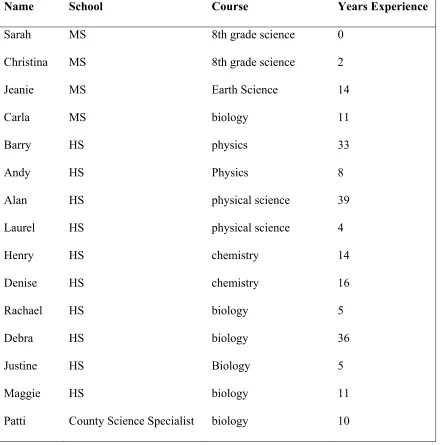
Table 3.1 Summary of Participating Teachers’ Context ... 51
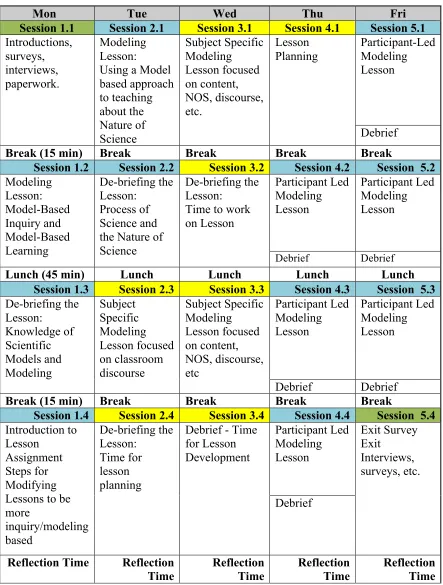
Table 3.2 Summer Professional Development Schedule ... 56
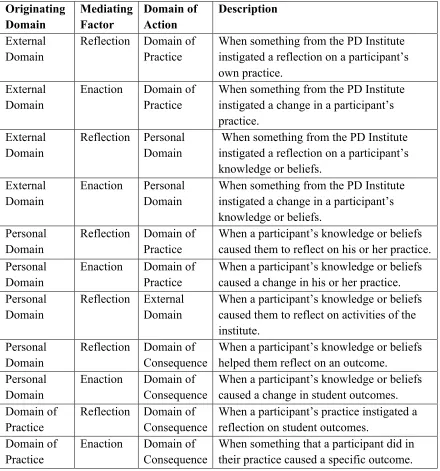
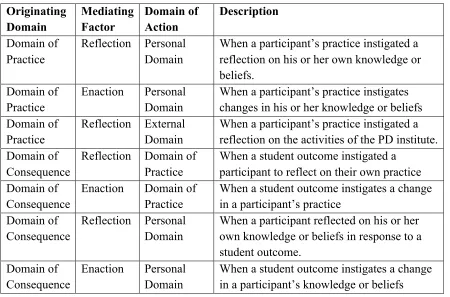
Table 3.3 Description of Mediating Processes between Domains of the IMPG ... 80
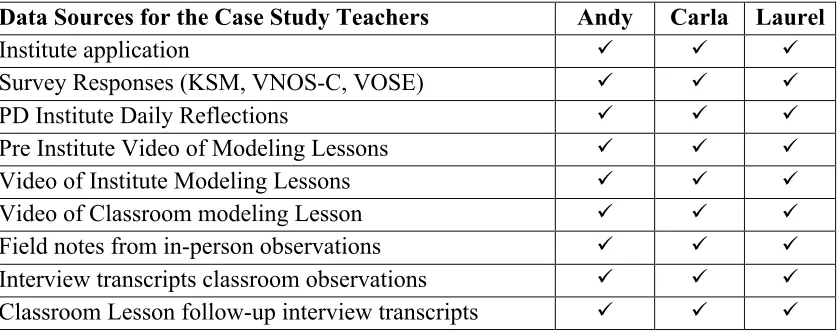
Table 3.4 Data Sources for the Case Study Teachers ... 82
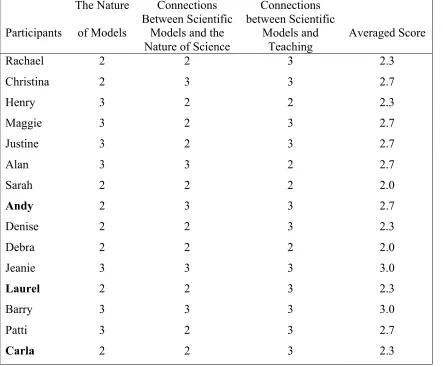
Table 4.1 Participating Teachers’ Knowledge of Scientific Models and Modeling ... 93
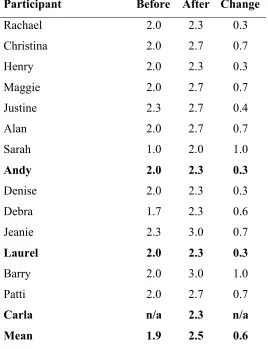
Table 4.2 Knowledge of Scientific Models and Modeling Diagnostic Assessment ... 94
Table 4.3 Participating Teachers’ Average VOSE Scores ... 100
Table 4.4 Participating Teachers’ Use of Questioning During Instruction ... 105
Table 4.5 Participating Teachers’ Implementation of Model-Based Teaching ... 107
Table 5.1 Andy’s KSM Questionnaire Scores ... 114
Table 5.2 Andy’s VOSE Scores ... 119
Table 5.3 Carla’s KSM Questionnaire Scores ... 136
Table 5.4 Carla’s VOSE Scores ... 140
Table 5.5 Laurel’s KSM Questionnaire Scores ... 150
Table 5.6 Laurel’s VOSE Scores ... 159
Table A.1 Knowledge of Scientific Models Questionnaire ... 223
Table B.1 Knowledge of Scientific Models Scoring Rubric ... 224
Table D.1 Performance Progression for Model Based Inquiry ... 228
Table E.1 Comparisons of Nature of Science Instrument Scores (Laurel) ... 229
Table E.2 Comparisons of Nature of Science Instrument Scores (Carla) ... 230
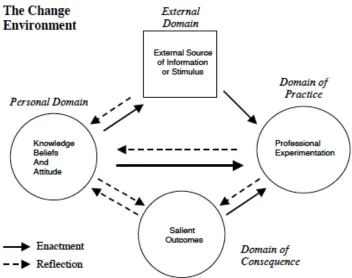
Figure 3.1 The Interconnected Model of Teacher Professional Growth ... 76
Figure 5.1 Andy’s Growth Network ... 130
Figure 5.2 Carla’s Growth Network ... 150
Figure 5.3 Laurel’s Growth Network ... 171
Figure 6.1 Pattern of Factors that Influence Model-Based Teaching ... 190
Figure 6.2 KSM as the mediating factor in the progress from a pre-modeling level to an emergent modeling level. ... 193
Figure 6.3 Use of Questioning as the mediating factor in the progress from an emergent modeling level to a transitional modeling level. ... 200
Figure 6.4 Knowledge of the NOS as the mediating factor in the progress from a transitional modeling level to an adept modeling level. ... 205
CHAPTER 1
INTRODUCTION
In 1910, John Dewey published How We Think, which contained in it an outline
of what we know today as The Scientific Method (TSM). This ultimately redefined how
most people thought of science and its application as an everyday problem-solving
activity (Rudolph, 2005). Since then, TSM has come to be the predominant, almost
exclusive, view of science that has been taught to American students. Yet as far back as
the 1950’s, scientists have criticized its use as the only method of science being described
to school children (Windschitl, Thomson, & Braaten, 2008). They argue that TSM
resembles a very small portion of the work scientists do and many instances of science
can be identified that use little or none of TSM described in schools.
Cold war era anxiety and the “Space Race” in the late 1950s inspired the nation to
develop and enact science education reforms aimed at improving American students’
ability to do science and think scientifically. A subsequent reform movement in the
1980’s culminated with the release of the Benchmarks of Science Literacy (AAAS, 1993)
and the National Science Education Standards (NSES) (NRC, 1996). Both documents
were unanimous in their call for science educators to teach in ways that reflect the
generally accepted view of the Nature of Science (NOS) as well as engage students in the
provided all of these standards in order to realize the systemic change being called for
through the movement from didactic teaching to an inquiry based approach. “Inquiry”
teaching not only engages students in the processes of science but also allows for the
development of the understanding of science content through engagement in these
processes (AAAS, 1993, p. 9; NRC, 1996, p. 105). Inquiry is highly regarded as a
successful way to teach students about the nature and process of science while also
teaching them the content of science.
The NSES standards are organized into 8 categories which are further subdivided
into concepts which students need to develop understanding in three different grade
bands; k-4, 5-8, and 9-12. Within each category there range from two to six indicators of
what students should know at each grade band. These indicators are further subdivided
into descriptions of “fundamental concepts and principles” that underlie the standard.
As a follow up publication to the National Science Standards, the NRC published
Inquiry and the National Science Education Standards: A Guide for Teaching and
Learning, (2000). In it, the National Research Council expanded on the continuum that
was discussed in the original standards and identified five essential features of classroom
inquiry that could be identified in any quality inquiry activity regardless of the specific
implementation strategy. They included:
• “Learner engages in scientifically oriented questions”.
• “Learner gives priority to evidence in responding to questions”.
• “Learner formulates scientific knowledge”.
• “Learner connects explanations to scientific knowledge”.
The essential features of inquiry are those features of scientific work that are worthwhile
for students to understand and use if they are to become scientifically literate citizens.
Despite these reform efforts, American students continue to be outperformed on
international measures of science education. The results of the 2007 Trends in
International Mathematics and Science Study (TIMMS) indicate that U.S. eighth-graders'
scored lower than 9 of the 47 educational systems that participated in the study.
Furthermore, the results of the 2009 Program for International Student Assessment
(PISA) show that the average score 15-year-olds in the United States were lower than 18
of the 65 participating countries and other education systems (Fleischman, 2010). Several
contributing factors have been identified including the continued use of a traditional
didactic approach in science classrooms, the persistent use of TSM as the only
representation of science offered to students, and the focus on preparation for
standardized tests rather than deeper knowledge of the practices of scientists and the
NOS.
The didactic approach, still common in American science classrooms, typically
begins with a lecture or presentation of some chunk of science content that includes sets
of more or less related facts and theories that are presented as pieces of knowledge that
scientists’ have established as truths. The teacher follows the sequence of the textbook
closely, presenting the content listed as what “students are required to know” by the state
standards on which, in many cases, their students will be assessed. The content, often
presented as facts rather than tentative ideas, are further illustrated and discussed through
lecture. In other words, if the students follow the cookbook style directions provided by
the laboratory handout, then the data should align with what was presented during lecture
thus affirming the truth of the teacher’s presentation. A lab report is typically assigned
and requires students to identify each step of the scientific method and relate it to the
laboratory activity that was performed. Summative assessment of student learning is
accomplished by grading the lab report and administering a paper and pencil test that uses
a variety of multiple-choice, short answer, and essay questions that require students to
reiterate the content presented to them. Despite the large body of evidence from science
education research that clearly identifies the shortcomings of the often didactic,
“scientific method” approach, strategies closely aligned with TSM, such as those
described above, continue to be used extensively in high school science classrooms
(Windschitl, 2004).
Inquiry, the pedagogical alternative to didactic forms of instruction proposed by
the NSES, has met many challenges to becoming the dominant instructional method in
science classrooms. Challenges faced by teachers when attempting to implement an
inquiry strategy include the teacher’s beliefs about the NOS, the considerable time
needed for planning successful inquiry lessons, and changing the power dynamics of the
classroom from one in which the teacher controls the learning to one in which the
students have increased control over the learning process (Lotter, Harwood, & Bonner,
2007; Roehrig & Luft, 2004; Wallace & Kang, 2004). Further exacerbating the problem,
there are, within the inquiry movement, many different ways of implementing inquiry
(discovery learning, project based learning, the case study approach, and model based
highly applicable nature of inquiry by those familiar with inquiry, can be interpreted by
novice teachers as a confusing set of strategies that may or may not be doable in the
classroom (Anderson, 2007).
In response to the current state of science education in the United States, the
National Research Council (NRC) and American association for the Advancement of
Science (AAAS) developed a new framework for science education, A Framework for
K-12 Science Standards: Practices, Crosscutting Concepts, and Core Ideas (NRC, 20K-12).
The Framework was developed using research-based evidence on how students learn,
input from scientists and science educators, and the insights gained from past reform
movements. The new framework did not propose to be the new standards but a basis on
which new standards would be developed that reflects new understandings in the fields of
student learning and science teaching.
There are several important differences between the NSES and the new
Framework that will have an impact on the secondary science classroom as well as the
field of science education research. The new framework focuses on depth of
understanding rather than breadth of content knowledge, learning progressions across
years of education and disciplines of science, and the integration of scientific practices
with science content in meaningful and authentic ways.
Depth not Breadth
The new framework and the resulting Next Generation Science Standards (NGSS)
(NGSS Lead States, 2013) are intended to move teachers and students away from these
science down to a series of unrelated facts, the new framework and standards attempt to
lay the ground work for this effort by providing three key dimensions made up of 8
scientific practices, 7 cross cutting concepts, and 4 domains of science. The approach of
the framework and standards is one that emphasizes the integration of the 8 practices into
the students endeavor to learn the content. The 7 cross cutting concepts provide links
between the 4 domains of science so that teachers and students can connect the ideas
from the 4 domains into a coherent and scientific view of the world (NRC, 2011b).
Research has identified the importance of depth of teacher content knowledge
when implementing reform strategies (Carlsen, 1992). In response to the changes in the
expectations of classroom instruction called for by the NGSS, teachers will not only need
to have deeper, more connected understanding of their own content knowledge but also
need to recognize how the practices that embody the work of scientists should now be
considered part of the content being taught to students. As a result, teacher educators will
need to be able to provide professional development that deepens teacher content
knowledge in one of the areas that will be outlined by the new standards while also
providing new strategies for the delivery of this content that embodies the new
framework’s call for the integration of the core practices of science. This represents a
unique and nascent challenge in light of most science teacher educators’ background in
discrete sciences, separated for the most part form other disciplines and integrated only
when directly needed (Lederman & Lederman, 2013).
Learning Progressions
The new framework is built on the premise that learning is a developmental
students need sustained opportunities to develop an appreciation of the
interconnectedness of science over periods of years rather than weeks or months. This
understanding has given rise to the development of learning progressions. Learning
progressions provide a map of how students learn a particular concept. These maps
identify the sequence of experiences and activities that lead to understanding of a targeted
concept and the progressions are based on evidence based studies of how students learn
rather than anecdotal or “best practice” ideas (Corcoran, Mosher, & Rogat, 2009). One
unique character of learning progressions is their ability to be falsified. The development
of a learning progression begins with a review of the relevant literature on how students
learn a particular topic thus they are empirically grounded. As such, the next step for a
learning progression is for it to be tested in real classrooms to ensure its accuracy. In this
regard, learning progressions differ from traditional approaches to curriculum alignment.
Quite often the authority of the developer and government agencies legitimate the scope
and sequence documents used for establishing curricular decisions. Learning progressions
are empirically based and if found to be ineffective can be modified or discarded. This
quality provides for an iterative process through which research can inform, change, and
improve the learning progression over time(Corcoran, et al., 2009). Teachers will need to
become familiar with the view of student learning as a progression and be provided with
opportunities to develop and use learning progressions in their classrooms.
Integration of Scientific Practices: Scientific Modeling in Particular
The new framework seeks to acknowledge the connection between scientific
understand the interconnectedness of the knowledge of science then they need to
understand the processes by which that knowledge is generated. Scientists use a variety
of practices in order to generate new knowledge. The new framework, on which the
NGSS are based, has chosen 7 practices that are evident in most areas of science.
One of the most prominent practices in the new Framework and resulting NGSS
is the practice of Scientific Modeling. Scientific Modeling is listed as a core disciplinary
practice as well as a cross cutting concept, a distinction which no other topic has within
the new standards. This unique position sheds light on the paramount importance of
models and modeling in science education, a realization that until only recently has gone
unaddressed in science classrooms (Justi & Gilbert, 2002c; Khan, 2011; Van Driel &
Verloop, 1999a). Scientific modeling has also been described as a “keystone practice”
and as such, participation in scientific modeling can serve as a link to other scientific
practices (Mayer, Damelin, & Krajcik, 2013).
Scientific modeling provides an authentic scientific experience, an opportunity to
engage in the learning of science content in a similar way to its initial discovery, and a
method of inquiry that can be applied to other areas of life and the decision-making
processes therein. Its prominence in the new framework supports this assertion and
positions it as a key strategy for both student and teacher learning.
Inquiry Learning and the Connection to Scientific Modeling
The new framework and standards have attempted to address the challenges met
by Inquiry teaching by framing science as a set of intellectual and disciplinary practices
in which students can engage, just as scientists engage in them when doing science. As
scientific, and connected view of the discipline as a way of knowing rather than an
isolated list of facts to be memorized. Understanding science as a way of knowing
requires students to possess a basic understanding of the Nature of Science.
Although the debate over definitions and the meaning of the NOS continues
among philosophers, educators, and historians, the characteristics of scientific knowledge
that are agreed on provide a sufficient framework for K-12 educators on which classroom
instruction can be based (Bell & Lederman, 2007). These characteristics are that
scientific knowledge is tentative, empirically based, subjective, creative, and socially and
culturally embedded. In order for teachers to engage students in understanding NOS, it
becomes especially important for teachers to move from implicitly teaching the processes
of science (observing, hypothesizing, predicting, experimenting, measuring, analyzing,
inferring, communicating, etc.) as a linear process to explicitly teaching the non-linear,
iterative, process of science.
One possible way to unite both the Nature of Science and the processes of science
is by defining science as a process of constructing predictive conceptual models (Gilbert,
1991). This definition unifies the majority of scientific fields in a manner that is not
possible by TSM (Windschitl, et al., 2008). The process of scientific modeling is an
iterative one in that when an initial model is generated and its predictions tested, new
information can result in a changed model. This new model’s predictions are then tested
and new information may result in a further change to the model. Thus, the tentative
nature of scientific models and the iterative process of scientific modeling serve as a
perspective is supported by the prominent role of models and modeling in both the
practices and the cross cutting concepts, two of the three dimensions of the new
Framework and subsequent NGSS (NGSS Lead States, 2013).
Model-Based Teaching (MBT) is an approach to teaching science that closely
resembles the process by which many scientists learn about their specific field of study
and as such, when implemented successfully, incorporates all of the essential features of
inquiry as listed above. MBT is the set of learning activities, resources, and instructional
approaches that facilitate mental model building in individuals or groups of learners
(Gobert & Buckley, 2000). MBT is based on an understanding that science is a process of
building, testing, and modifying scientific models (Gilbert, 2011). As such, it stands to
reason that if students are expected to achieve the three primary goals of science
education (learning the content of science, the history of science, and how to do science
((Hodson, 1992)) they should come to know the major historical models in science,
appreciate the role of models and modeling in the process of science, and be engaged in
the process of creating, testing, and communicating their own models (Henze, Van Driel,
& Verloop, 2007; Justi & Gilbert, 2002a). Several strategies that facilitate the use of a
model- based approach to inquiry learning have been described in the literature (Clement
& rea-Ramirez, 2008; Hestenes, 1996; Passmore, Stewart, & Cartier, 2009; Schwarz &
White, 2005; Windschitl, Thomson, et al., 2008). All of these strategies explicitly identify
the importance of teachers being knowledgeable about scientific models and the process
of modeling. Many other studies imply several other skills (e.g., leading
student-to-student classroom discourse, explicitly illustrating the Nature of Science (NOS)) that are
(Danusso, Testa, & Vicentini, 2010; Henze, et al., 2007; Hestenes, 1996; Van Der Valk,
Van Driel, & De Vos, 2007; Xiang, Hvidsten, Dowd, & Beauchamp, 2010). Although
challenges have been identified that range from personal to systemic in nature (Passmore,
Xiang, Hvidsten, Dowd, & Beauchamp, 2010), the majority of the literature on using a
model-based approach to teaching science alludes to these characteristics that good
“modeling” teachers possess but does not explicate the magnitude of the effects these
characteristics have on the implementation of MBT in the classroom. More specifically,
few sources have been found that directly articulate the impact of skills such as
facilitating modeling discourse through questioning, understanding of the Nature of
Science, and knowledge of scientific models and scientific modeling on teachers
implementation of MBT.
This study sought to understand the extent to which teachers’ understanding of the
Nature of Science, ability to use questioning to facilitate modeling discourse, and
knowledge of models and modeling impact their implementation of MBT in their
classrooms. If the factors described above are truly important factors in the progression of
teachers becoming effective modeling teachers, professional development opportunities
should provide specific training that improves these three facets of model based inquiry
implementation. By identifying new insights through the study of 15 middle and
secondary science teachers before, during, and after a summer professional development
institute focused on Model Based Teaching, I have generated a performance progression
for teachers implementing MBT. The performance progress lends new insights into the
classrooms. The findings of this study will inform teacher educators’ future design of
effective professional development.
Personal Interest
This topic became of great interest to me as I spent eight years teaching biology
and chemistry in a program for highly gifted students. The traditional didactic approach
to teaching was simply ineffective at engaging gifted students to think deeper and explore
the content to a degree that was commensurate with their ability. I began searching for
alternative methods of instruction and this led me to complete a Master’s degree in
secondary science education.
Through that process I learned about inquiry learning, conceptual change theory,
and utilizing a constructivist approach to teaching. While I was learning about these
various approaches I began to look for a pedagogical strategy that incorporated all of
these theories and yet was coherently engaging. In other words, rather than implementing
one style after another, which led to a discontinuous framework of teaching, I wanted to
find one framework in which all of the “best practices” could be implemented.
My mentor at the time was a professor who had published several articles about
using models to engage students in thinking more deeply about the content they were
learning. I decided to create my own modeling lesson, which we later published in a
peer-reviewed journal. The process of generating an idea, testing it in my own classroom, and
subsequently publishing what I learned in a peer reviewed journal instilled in me the
drive to further engage in the science education research process. The decision to
continue my studies required choosing an area of science education that I was curious
Model-Based Learning, collectively fit that description. These processes engage students
in an authentic scientific process of which multiple real world examples can be provided.
Yet as I learned more about these methods, I found it increasingly difficult to implement
the strategies in my own classroom. I wondered if there was research about the
challenges of implementing model-based teaching in the secondary science classroom.
The literature does contain information about the challenges of inquiry in general as well
as the challenges for elementary and middle schoolteachers implementing model-based
teaching. However I found relatively little mention of the specific challenges of
implementing model-based teaching in the secondary classroom.
Research Questions
Few studies have focused on exactly how and to what magnitude a science
teacher’s knowledge of the Nature of Science, the use of questioning to facilitate
modeling discourse, and knowledge of scientific models and modeling affect their
implementation of Model-Based Teaching. Thus, articulating the relationship these
variables have with the implementation of MBT and gaining a deeper understanding of
how these factors impact the implementation of MBT was the focus of this research. This
study focused on the following three research questions:
1. In what ways does teachers’ understanding of the Nature of Science (NOS)
impact their ability to implement Model-Based Teaching?
2. In what ways does teachers’ use of questioning to facilitate modeling discourse
impact their ability to implement Model-Based Teaching?
The first part of this study focuses on the 15 participating teachers’ understanding of the
Nature of Science, their skills in using questioning to facilitate modeling discourse, and
their knowledge of scientific models and modeling. Quantitative measures of these three
factors for 15 teachers were compared to their level of implementation of MBT strategies
in their classrooms. The second part of this study involved a multiple case study of three
of the participating teachers, purposefully selected as unique cases of teacher progress
towards effective implementation of MBT. The second part of the study focused on
identifying how the factors in part one of this study impacted the teachers’
implementation of MBT in their classrooms. Through a combination of quantitative and
qualitative data analysis, this study will shed new light on how teachers learn to
implement MBT and provide key insights into the design of effective professional
development focused on MBT strategies through the articulation of a performance
CHAPTER 2
LITERATURE REVIEW
This chapter will provide a discussion of the literature regarding the use of
Scientific Models and the process of Modeling in both science and in science education.
Also included is a review of the relevant literature on the Nature of Science (NOS) and
on classroom questioning as they pertain to the implementation of Model Based Teaching
(MBT). This chapter will then conclude with a review of the literature on effective
professional development for secondary science teachers and how it may be used to
develop teachers’ content knowledge, pedagogical content knowledge, and metamodeling
knowledge.
Scientific Models and Teaching Models
The process of developing, applying, and revising scientific models has been
described as a fundamental part of every scientific discipline (Passmore, et al., 2009;
Windschitl, Thomson, et al., 2008). Models are an integral part of both the processes and
the purpose of science. Gilbert (1991) describes science as a process of constructing
predictive conceptual models and Harrison and Treagust (2000, p. 1011.) state that
“Modeling is the essence of thinking and working scientifically”. Model building, when
viewed in this manner, serves to unify the various fields of science that utilize a multitude
relationships. Thus Scientific Models are generated, applied, tested, and revised
extensively by scientists (Van Driel & Verloop, 2002b) and as such, models and the
process of modeling should play a central role in science education (Justi & Gilbert,
2002b).
Although models have been defined in a variety of ways, the word typically refers
to the internal Mental Model or the external Expressed Model (Gobert & Buckley, 2000).
Clement and Rea-Ramirez (2008) describe the Mental Model as being a personal
representation built on personal experiences or knowledge of the phenomena being
modeled. The Mental Model is an abstraction of a particular system or phenomenon and
as such are not one-to-one representations of a physical reality (Halloun, 2007). Due to
the personal nature of Mental Models, they are often extremely dynamic and difficult to
assess and as such, tend to possess misconceptions and errors and thus are the focus of
instruction (Harrison & Treagust, 2000). Since others cannot directly evaluate another
person’s Mental Models, the construction of Expressed Models is necessary for the
evaluation and communication of the Mental Model. Gilbert and Boulter (1998) describe
the Expressed Model as a version of the Mental Model that the possessor of the Mental
Model creates either through drawings, verbal discourse, or other forms of model
building.
The Expressed Model of a scientist, once it has gained wide peer acceptance
through peer review and testing, may become a Consensus Model. Consensus Models
that are in current use as predictive and explanatory tools by scientists are referred to as
Scientific Models and are defined by many science education researchers in a variety of
an object, or process in which a target is matched with an analog. Hestenes (1996)
defines a Scientific Model as a unit of structured knowledge used to represent observable
patterns in physical phenomena. Cartier, Rudolph, and Stewart (2001) define a Scientific
Model as a set of ideas that describe a natural process. Scientific models, once discarded
for better models, can be considered Historical Models. Well known historical models
include Rutherford’s solar system model of atomic structure.
The process of generating an Expressed Model from a Mental Model is a way of
making thinking visible. When students are engaged in a drawing task to make their
Mental Models explicit, the drawing can be used for collaborative discourse as well as an
artifact that can be revised based on new ideas and learning activities (Gobert & Pallant,
2004). Gobert and Pallant (2004) showed how students with more sophisticated
understandings of models were better able to understand content than students with more
naïve understandings of models.
Although the definitions of a model vary, descriptions of the process of
generating models share much in common. A model is generated based on an observation
of a real world phenomenon, tested for its explanatory and predictive ability, modified by
new empirical evidence so that it can better represent observations of the real world
(Windschitl, Thomson, et al., 2008), and then presented as part of an evidence based
argument to other scientists for peer review.
Scientists generate Scientific Models and use them for a variety of reasons
including organizing their ideas, testing predictions, generating new ideas or predictions,
according to the specific field of science in which they are generated. Nevertheless,
scientists generally agree that common characteristics of all Scientific Models include a
relationship to a target while being different from the target and an ability to predict or
explain a natural phenomenon (Van Der Valk, et al., 2007).
Scientific models can be significantly different from Teaching Models used in
science classrooms. Teaching Models can be generally categorized as analogical models
(Harrison & Treagust, 2000). These models are often constructed for teachers or by
teachers to be used for conveying knowledge of a curricular concept. Scale modes, like
model airplanes or models of plants or animals, are used as visual tools for describing
some object. They are analogical in that they are often smaller or larger than the real
thing and made of different materials. Chemical formulas or other symbolic models can
be used to simplify the process of explaining complex chemical processes. Mathematical
models such as equations and graphs can represent physical phenomena that are not
objects but processes, for example Boyle’s Law or Newton’s Laws of Motion. Maps,
diagrams, or tables can represent patterns or relationships and can help students visualize
complex processes. Concept process models such as food webs or energy pyramids can
be effective explanations for otherwise unobservable phenomena such as island formation
or erosion. Simulations, either physical or computer based, can help students to
understand dangerous or otherwise unobservable processes. All of these models are
analogical models because there are simplified or exaggerated representations of physical
or theoretical processes and as a result, their ability to explain or depict a phenomenon
eventually breaks down (Harrison & Treagust, 2000). In other words, the target of the
models can be employed for the same phenomenon but focus on different constituent
parts of the phenomenon (Crawford & Cullin, 2004). For example, a globe is a scale
model of the Earth but a simulation of tectonic movement might lead to the use of a
concept process model describing the movement of the Earth’s mantle.
All of these types of analogical models are used to teach students about the
Scientific Model. The Scientific Model, also referred to as an Expert model or Target
model (Clement & rea-Ramirez, 2008), is one that has been tested and has come to be
generally accepted by experts. The Teaching Model is a less complex version of the
Scientific Model in that it is constructed with the purpose of teaching parts of the
Scientific Model. Since its purpose is to explain the Scientific Model it is often simplified
to a level that is associated with the intended audience.
Van der Valk, Van Driel, and De Vos (2007) identify seven salient features of
scientific models as they pertain to science education. They include (a) the distinction
that a model is always related to a target and is designed for a specific purpose and as
such, it is always possible to distinguish between the model and the target; (b) a model
serves as a research tool in that models are used to obtain information that cannot be
easily observed or obtained supporting the purpose of a model as mostly to predict or to
explain phenomena; (c) a model bears some analogy to the target and these analogies
enable the researcher to derive hypotheses or make predictions that can be tested while
studying the target; (d) models differ in certain respects from the target and these
differences make the model more accessible than the target; (e) models are always
there is an element of creativity in their design; (g) several consensus models may
co-exist in order to represent a target; (h) models evolve through an iterative process.
The prominence of model building and use in science is justification for the
inclusion of models and modeling in science education. When students are engaged in
learning about the process of model construction in an authentic way, they are taking
large steps towards understanding the “business” of science and well on their way to
science literacy. The multiple levels of accessibility for engaging in modeling can
provide avenues for the realization of “science literacy for all” called for by modern
reform documents such as the Next Generation Science Standards (NGSS)(NGSS Lead
States, 2013).
Teacher and Student Knowledge of Scientific and Teaching Models
Most students recognize models as copies of phenomena and have a simplistic
conception of models in general (Grosslight, Unger, Jay, & Smith, 1991; Schwarz &
White, 2005). Treagust, Chittleborough, and Mamiala (2004) affirm in their study of
secondary students’ that although students have a sound understanding of the descriptive
nature of teaching models, their understanding of the predictive nature of those models is
limited. In a study of 19 high school students where the focus of instruction was on
model assessment, Cartier (2000) noted that all students were able to assess models based
on empirical fit but not on conceptual congruence with other models or within the model
itself. Cartier proposed that this was due to the students’ lack of understanding the
conceptual nature of models beyond their physical properties.
These findings, that indicate students’ naïve understanding of scientific models
both experienced and prospective science teachers’ knowledge of models and modeling is
often limited, inadequate, and may include inconsistencies (Crawford & Cullin, 2004;
Van Driel & Verloop, 1999b) that result in students seeing science as overly simplified
and static. Furthermore, despite the importance of models and modeling in science and in
stark contrast to the importance of models and modeling that scientists attribute to them
in the course of scientific practices, researchers are now demonstrating that pre-service
and in-service teachers do not fully address nor understand the importance of developing
student understanding of the model-based definition of science (Justi & Gilbert, 2002b;
Van Driel & Verloop, 1999a, 2002a).
In a study conducted by Van Driel & Verloop (1999), in-service science teachers
shared the general definition of models as simplified or schematic representations of
reality (Van Driel & Verloop, 1999b) and emphasize the explanatory function of models
while other important functions of models, such as using a model to make predictions,
were rarely mentioned. However, they also found that teachers’ content knowledge of
models and modeling was both limited and diverse. Among the teachers who held more
informed views of models, there was evidence that these teachers held an integrated
positivist and social constructivist epistemological orientation in their practical
knowledge. In other words, teachers with more informed views of models tended to
temper a positivist epistemological stance with social constructivist ideas.
In a study focused on supporting prospective teachers’ knowledge of models,
Crawford and Cullin (2004) found that in spite of professional development focused on
common assumptions of pre-service teachers about what it means to “do science” amount
to a “folk theory” of science largely attributable to the prominence of an atheoretical
scientific method. Further research by Khan (2011), identified common practices of
modeling that were missing from most teachers’ implementation of modeling in the
classroom. These included the modification of models and the systematic cycling
between evaluation and modification of models. It is, as a result, no surprise that students
lack adequate knowledge of Scientific Models as well.
Grosslight, Unger, Jay, and Smith (1991) used a semi-structured interview to
collect data about students’ general understanding of the term “model”. When used with
students, the questions in that interview were supported by the use of physical examples
of models (toy airplane, a diagram of the water cycle, etc.). The questions were then
asked of experts in the field of science to establish comparison group for analysis. Their
analysis led to the development of three general levels of understanding of scientific
models. However, only the third level, the expert level, was given a robust descriptive
account of understanding. In order to assign number scores to each individual student, the
Grosslight et al., (1991) study developed six dimensions of one’s understanding of
models. The development of these dimensions allowed the researchers to assign students
a score of 1, 2, or 3 for each dimension. These scores were averaged and used to assign a
general level of knowledge of scientific models to each student.
Attempting to illuminate experienced teachers’ knowledge of models and
modeling, Van Driel and Verloop (1999) designed an open response questionnaire based
on the Grosslight et al., (1991) interview which focused on four themes within the
science, characteristics of scientific models, and role of modeling in science. They
followed the open response questionnaire with a Likert type questionnaire. They found
that experienced teachers’ knowledge of models and modeling was limited. Teachers
with a more developed understanding of models and modeling tended to have a more
social constructivist view of teaching and learning than those with a less developed
understanding of models who held a more positivist view of science. This study asserted
that while teachers’ held similar definitions of a scientific model, they held very different
views of models and modeling.
Justi and Gilbert (2002) developed a survey for experienced science teachers in
Brazil aimed at illuminating teachers’ views of the nature of models, the nature of
modeling and implications for its use in science education, and about the use of models
and modeling in teaching and learning science. Their analysis resulted in general themes,
ideas and understandings of the participants. Their analysis did not develop rich
descriptions of each participant; rather they developed general categories of the things
teachers understood as relevant or important in relation to models and modeling. For
example, they found that teachers, in general, thought that either the integrity of scientific
models was too important to be modified enough for use in the classroom or that
scientific models could be simplified enough to be considered useful teaching models.
While this finding provides some insight into teachers generally, it does not provide
insight into how one of these beliefs might impact a teacher’s ability to implement model
based teaching.
prospective teachers and aimed at identifying the developing understanding of
prospective teachers understanding of modeling in science. The survey consisted of 8
open ended questions, 6 aimed at knowledge of models and 2 additional questions
designed to elicit their views about teaching about scientific models. The authors
followed up the survey with a semi-structured interview to further explore the responses.
Where the Grosslight et al. (1991) survey led to general descriptions of levels of model
knowledge, Crawford and Cullen’s survey with the follow up interview, provided a richer
data set about teachers’ conceptions of models and ideas about teaching about and with
scientific models. They found that prospective teachers became more familiar with the
language of modeling and were able to think critically about models and modeling, but
did not achieve full understand of scientific modeling. These findings implied that simply
experiencing scientific modeling and improving facility with the language of modeling
may lead to teachers using models in their classroom more often but will not likely lead
to teaching about models and modeling.
Multiple Strategies for Teaching through Modeling
Similarly to the various ways Scientific Models are employed by scientists,
science educators have developed a variety of frameworks for implementing instruction
focused on the use of Scientific Models. In the following section, I will outline three of
the most popular frameworks for implementing model-based instruction.
Model Based Inquiry (MBI) is an iterative and cyclic methodological approach to
inquiry learning in the science classroom that involves the development, use, assessment,
and revision of models (Passmore, et al., 2009) to explain patterns in collected data or
topic either through presenting a discrepant event or demonstration of a particular
phenomenon. Students generating an initial model of what is happening and why it is
happening follow this activity. This can be a diagrammatic representation, a physical
model, or even a verbal model. The initial model is then used to formulate some testable
questions and experiments or observations are completed to either support or refute the
initial model. Based on what is learned, the model can then be refined, modified, or
discarded depending on the findings. This revision process results in a new model that
should better represent the phenomena. This refined and modified model can then be used
to predict or explain other similar phenomena. Once this cycle is complete students then
generate an evidence-based argument describing the phenomena being studied and use
their evidence-based model in support of their argument. Different methods of enacting
each of these steps in the process can be used but the overall guiding steps are cyclic and
iterative in nature.
Modeling Instruction (MI) is a similar but slightly different approach to teaching
through modeling. MI is organized around two general classes of modeling activities:
model development and model deployment. The model development stage includes a
descriptive phase in which students are guided by the teacher in a process of describing
the fundamental measurable parameters of a phenomena that might exhibit a cause and
effect relationship. The students then turn to the formulation phase in which they develop
a functional relationship between some or all of the identified fundamental parameters
through the design and carrying out of experiments. The data collected is then used to
of students carry out experiments then analyze and present their data to the rest of the
class.
During the model deployment stage, students apply their models to new situations
or related problems to solve. The solutions are then presented to the rest of the class
through an activity called white boarding. White boarding is an activity that requires
students to generate a poster on a white board that includes a diagram of their model, the
mathematical relationship, and the solution to the problem.
Model Based Teaching (MBT) begins with aligning with student prior
knowledge, supports students authentic inquiry skills, develops understanding of the
process and nature of science, and as a result, leads to significant improvements in
scientific literacy (Gobert & Pallant, 2004). Gobert and Buckley (2000) succinctly define
MBT as any instructional strategy that brings together information resources, learning
activities, and instructional activities that intend to facilitate mental model building both
in individuals and among groups of learners.
Clement and Rea-Ramirez (2008) describe the process of Model Evolution as a
student-teacher interaction process that begins with the identification of students’ initial
models and proceeds through an iterative process of developing intermediate models until
reaching the target model of the lesson.
Implementing any of these strategies effectively often requires a great deal of
practice and can take a considerable amount of effort and time on the part of the teacher.
Teachers who demonstrate skilled use of model-based strategies in the classroom possess
several common characteristics associated with skillful implementation. These include
engages students in productive discussions leading to students being able to generate
evidence based arguments (Hestenes, 1996; Passmore, et al., 2010). Teachers who are
successful at implementing model based strategies also need adequate understanding of
the nature of models and the process of modeling with respect to an overarching
understanding of the Nature of Science and how the processes of science, model building
in particular, generate the body of scientific knowledge (Danusso, et al., 2010; Henze, et
al., 2007). While the focus of this study is on how the factors above impact teachers’
implementation of MBT, other factors may impact a teacher’s implementation of MBT
including contextual or cultural factors such as school resources, importance of high
stakes testing, or student socioeconomic status (SES).
Scientific Models and the Nature of Science
Abd-El-Khalick and Lederman (2000) found that in addition to teachers’ lack of
knowledge of models and modeling, they also lack an adequate understanding of the
Nature of Science (NOS) and its processes of knowledge building in science. Although
the debate over definitions and the meaning of the NOS continues among philosophers,
educators, and historians, the characteristics of scientific knowledge that are agreed on
provide a sufficient framework for k-12 educators on which classroom instruction can be
based (Bell & Lederman, 2007). These characteristics are that scientific knowledge is
• tentative
• empirically based
• subjective
The tentative nature of science arises from the understanding that our current state
of knowledge is at best flawed and new information can resolve inconsistencies. In other
words, as new information arises, the new information is weighed against the current
understanding and may in fact change the accepted understanding thus rendering the
current state of knowledge as temporary. Despite this tentative aspect of the NOS, most
scientific knowledge is durable and it should be understood that certain theories in
science have changed little for long periods of time. However, upon closer inspection,
even theories as robust as that of biological evolution, have undergone slight
modifications as new examples and new information becomes available (Abd-El-Khalick
& Lederman, 2000).
All science is empirically based. In other words, any scientific argument must be
supported by evidence. This evidence could be collected through experiments, direct
observation, or even inference. Furthermore, the arguments put forth as scientific must be
able to withstand a process of peer review, which will evaluate the empirical nature of the
position being presented (Lederman, Abd-El-Khalick, Bell, & Schwartz, 2002).
The subjective nature of science arises from the understanding that science rarely
begins with a random or isolated question and that most questions are rarely neutral.
Scientists are motivated to make observations of the world around them and that world is
viewed with a degree of bias that emanates from previous experiences, beliefs, and
training. These experiences serve to guide a scientist’s theoretical perspective and so any
scientific idea that arises within such a perspective is inherently subjective (Bell &
In order to generate a testable hypothesis or model, a scientist must actually think
up or create a possible explanation for the phenomena in question. They may have to
imagine a possible solution to a problem and then take steps to realize what was
imagined. These are creative processes and as a result impart a certain level of required
creativity in the process of science (Abd-El-Khalick & Lederman, 2000).
Science is a human endeavor and as such occurs within the larger context of
human culture. Not only is science affected by the culture in which it is conducted but it
also, in turn, affects the culture. It is with this understanding that science must be seen as
a culturally embedded and social enterprise (Abd-El-Khalick & Lederman, 2000).
NOS and Inquiry
The process of science includes those activities that relate to the collection and
analysis of data through scientific inquiry. Scientific inquiry is not the Nature of Science;
it is a process of science. NOS is best taught within the process of inquiry as a context
for learning (Lederman, 1999). These inquiry experiences provide the necessary context
on which thoughts about NOS can be applied. However, in order for teachers to develop
their own deeper understanding of the NOS during professional development, direct and
clear connections need to be made between the inquiry activities being used and the NOS
(Akerson, Hanson, & Cullen, 2007).
Research has shown that teachers who have reasonably acceptable views of the
NOS may not intentionally plan their instruction to teach that view of the NOS to
students (Lederman, 1999). Years of teaching experience impact their efforts as well.
tentative nature of science but less experienced teachers (<5 years) described challenges
to using these activities.
The Argument for Models in the Classroom
It is interesting to note that the qualities of scientific models described by Van der
Valk, Van Driel, and De Vos (2007) more than loosely align with the generally accepted
features of the Nature of Science that should be taught to students (Lederman, 1999) in
order for students to be considered scientifically literate (NRC, 1996). Crawford and
Cullen (2004) noted the direct relationship between the tentative nature of science and
continual revision and evaluation of the modeling process. Taking this idea one step
further, there are many relationships between multiple aspects of the NOS and the
process of Scientific Modeling. The modeling process could serve as an especially
effective method of achieving scientific literacy that emerges from a refined and
well-developed understanding of the Nature of Science. Table 2.1 below identifies this
alignment and how it correlates to the goal of science education as the production of
Table 2.1
NOS-Modeling-Scientific Literacy
Nature of Science (Bell &
Lederman, 2007)
Nature of Models Scientific Literacy (NRC,
1996)
Tentative Scientific knowledge changes with new evidence. (e.g., The Atomic Model)
Modeling is an iterative process that continues with new information.
A literate citizen should be able to evaluate the quality of scientific information on the basis of its source and the methods used to generate it.
Empirical Arguments must
be supported by evidence in order to be considered scientific
arguments.
In order for a model to be changed new empirically based evidence must be brought forward.
Scientific literacy also implies the capacity to pose and evaluate arguments based on evidence and to apply conclusions from such arguments appropriately. Subjective The theoretical
perspectives of scientists guide research and analysis of data.
Multiple models for one phenomenon can coexist
simultaneously.
Scientific literacy means that a person can ask, find, or determine answers to questions derived from curiosity about everyday experiences.
Creative Scientists often generate creative explanations for phenomenon.
Model generation is a creative process. (formation of an analogy for natural phenomenon)
It means that a person has the ability to describe, explain, and predict natural
phenomena.
Socially and Culturally Embedded
Science is a human endeavor and as such scientists approach their work from cultural perspectives.
Particular models are generated and used to explain phenomena to specific audiences.
Scientific literacy entails being able to read with understanding articles about science in the popular press and to engage in social conversation about the validity of the conclusions.
that embodies the sociocultural and social constructivist perspectives. The iterative,
socially dependent nature of the MBT process emulates very closely the community of
practice of real scientists. Just as scientists generate knowledge through social
interactions, students can generate their own “new” knowledge in similar ways. From a
sociocultural perspective, learning involves the change from one sociocultural context to
another by participating in shared activities (Lave & Wenger, 1991). If students
participate in cooperative learning activities that are framed as activities in which real
scientists engage, then they are more apt to see themselves as scientists and as such,
becoming acculturated into the community of science (Coll, France, & Taylor, 2005).
The Importance of Questioning in Classroom Discourse and Model Based Teaching
David Hestenes (1996) asserts that, “The most critical element in the successful
implementation of the modeling method is the skill of the teacher in managing classroom
discourse” (p. 19). When viewing teacher education and student learning through a
sociocultural/ social constructivist lens it is important to recognize Lev Vygotsky’s
(1978) perspective on development and learning. He asserts that higher mental
functioning in the individual derives from social life. If we consider the construction of
knowledge in the educational setting as a higher mental function then we may assert that
learning is a social and constructive process developed within the social context of the
classroom (Driver, Asoko, Leach, Mortimer, & Scott, 1994; Duit & Treagust, 1998).
Within the science classroom students and teachers may differ in the types of social
language they use. When teachers and students engage in science talk in the classroom, it
is a social interaction through which roles and positions relating to each other are
effectively use the social language of science (Vygotsky, 1987) then it is of paramount
importance for teachers to effectively bridge the gap between scientific social language
and the students’ culturally influenced spontaneous and everyday language.
Thus learning is a social enterprise that is often developed through discourse.
Discourse has been defined as language in use and is typically longer than a sentence.
Discourse is also language that is related to social knowledge and identity as well as
power (Kelly, 2007). An important point is that when students are asked to use science
discourse in the classroom this can be very foreign to the types of social discourse they
may be accustomed to outside of the classroom. In other words, scientific discourse can
serve to empower students whose social status uses a similar form of discourse while
alienating those students whose cultural discourse is very different from that of scientific
discourse (Kelly, 2007). One skill a teacher needs to possess is the ability to generate an
atmosphere that leads to productive discourse for all students rather than only those few
who are already familiar with its subtleties.
Since language is the primary tool for social interaction then discourse plays a
central role in the learning of science (Mortimer & Scott, 2000). Kelly (2007) points out
three observations that support this understanding. First, that teaching and learning occurs
through processes that are primarily facilitated by discourse. Second, that student access
to science is gained through engaging in the social and symbolic practices of specialized
communities within science. Third, the content of science is developed and
communicated through the use of language. Thus, scientific discourse is central to
Although the importance of discourse in the secondary science classroom is well
documented, much of this classroom discourse remains teacher-driven and didactic.
Lemke (1990) described how classroom discourse was often controlled by the teacher,
presented in a final refined way that hid the generative, iterative nature of science
knowledge generation, and in turn, served to disengage students from the discourse rather
than engaging them in an opportunity to “talk science”. Facilitating productive classroom
discourse is difficult and requires a great deal of effort on the part of the teacher (Alozie,
Moje, & Krajcik, 2010). The ineffective practices of teachers results in an unjustified
authority of scientific knowledge and the authority of the teacher. Furthermore,
ineffective classroom discourse practices serve to alienate students from science
discourse while also providing a false understanding of the Nature of Science as
authoritative.
A key teacher skill in managing effective classroom discourse is the use of
questions (Harris, Phillips, & Penuel, 2011). Teachers use questions to ascertain what
students know. A typical classroom-questioning episode involves a sequence in which a
teacher initiates the discussion with a question. This is followed by a response from a
student and then the teacher evaluates the response by commenting on its correctness.
This sequence has been identified as the Initiate, Respond, Evaluate (IRE) strategy
(Cazden, 1988) or Triadic Dialogue (Lemke, 1990). This form of teacher questioning
does little to engage students in interactions that foster participation in scientifically
productive discourse. Often teachers may take this one step further towards productive
questioning but still remain inattentive to student ideas is through a process of funneling.
one correct answer(Herbal-Eisenmann & Breyfogle, 2005). When teachers are able to
enact productive classroom discourse that is open to ideas that arise, is attentive to
student ideas and prior knowledge, and pursues productive ideas and questions, students
are likely to deepen their understanding of both the content and process of science, and as
such, the Nature of Science (Osborne, 2010). Minstrell and van Zee (2003) identified an
alternative approach called the reflective toss. In this form of questioning, the teacher
encourages student-student discussion through a careful framing and selection of
questions in an effort to foster true dialogue, which leads to greater shifts in student
understanding. This method of questioning shifts the authority from the teacher and that
of science to the students as they generate their new understanding. The teacher serves as
a guide, thoughtfully guiding that understanding towards the scientifically accepted
viewpoint rather than authoritatively giving the ideas to the students. The difference lies
in how the students arrive at the understanding with the perceived self-construction being
the more effective strategy for long-term understanding. Additional questioning strategies
such as “focusing” improve upon strategies such as IRE and funneling
(Herbal-Eisenmann & Breyfogle, 2005).
A more robust preparatory practice for developing questions and preparing for
student responses is situated within a framework for planning whole class discussions
known as the Five Practices (Stein, Engle, Smith, & Hughes, 2008). One of these five
practices for lesson planning is described as “Anticipating”. This practice involves the
anticipation of likely student responses to cognitively demanding tasks, or in this case,