629
A Structural Approach to Enhancing WordNet with Conceptual Frame
Semantics
Ivelina Stoyanova Institute for Bulgarian Language
Bulgarian Academy of Sciences
Svetlozara Leseva Institute for Bulgarian Language
Bulgarian Academy of Sciences
Abstract
This paper outlines procedures for enhanc-ing WordNet with conceptual information from FrameNet. The mapping of the two resources is non-trivial. We define a num-ber of techniques for the validation of the consistency of the mapping and the exten-sion of its coverage which make use of the structure of both resources and the system-atic relations between synsets in WordNet and between frames in FrameNet, as well as between synsets and frames).
We present a case study on causativity, a relation which provides enhancement complementary to the one using hierarchi-cal relations, by means of linking in a sys-tematic way large parts of the lexicon. We show how consistency checks and denser relations may be implemented on the basis of this relation.
We, then, propose new frames based on causative–inchoative correspondences and in conclusion touch on the possibilities for defining new frames based on the types of specialisation that takes place from parent to child synset.
1 Introduction
The research presented in this paper aims at en-hancing WordNet with information about the con-ceptual structure of verbs based on the mappings between WordNet (WN) and FrameNet (FN). This information includes description of the conceptual elements that receive expression as verbs’ argu-ments and adjuncts as well as the selectional re-strictions imposed on these elements.
Our approach relies on the structural features of each of the resources as well as on various kinds
of linguistic analysis. The proposed enhancement is directed to: (a) improving the quality of exist-ing mappexist-ings; (b) expandexist-ing the mappexist-ings’ cov-erage; (c) enhancing the description of frames with additional information obtained from WN; (d) proposing structural improvements on the re-sources based on systemic features (e.g., causativ-ity), including the definition of new conceptual frames; and (e) suggesting further procedures for verification and improvements of precision.
The described methodology is semi-automatic (automatic assignment complemented by manual verification at several stages), but its contribution consists in the devising of a set of procedures to a structured and consistent enrichment of the two resources, which presents an important step to-wards its automatisation. The enhanced resources will be made available to the research community. As the description of verbs’ conceptual structure is largely language independent, the enriched de-scription is applicable cross-linguistically.
2 Prerequisites and Motivation
2.1 Linguistic Resources
WN (Miller, 1995; Fellbaum, 1998) is a large lexical database that represents comprehensively the conceptual and lexical knowledge in the form of a network whose nodes denote cognitive syn-onyms (synsets) interconnected through a number of conceptual-semantic and lexical relations. The main relation that determines WN’s structure (as reflected in the hierarchical treelike organisation of nouns and verbs) is a relation of inheritance of conceptual and lexical features between synsets. The respective pairs of synsets are linked through the relation of hypernymy/hyponymy.
concep-tual structures describing particular types of ob-jects, situations, or events along with their com-ponents, called frame elements, or FEs (Baker et al.,1998;Baker and Ruppenhofer,2002; Rup-penhofer et al., 2016). Depending on their sta-tus, FEs may be core, peripheral or extra-thematic, cf. Ruppenhofer et al.(2016). For our purposes, we deal particularly with core FEs, which instanti-ate conceptually necessary components of a frame, and which in their particular configuration make a frame unique and different from other frames. To a lesser degree we touch upon peripheral FEs, which mark notions such as Time, Place, Man-ner, Means, among others and may be instantiated in any semantically appropriate frame. A Lexi-cal Unit (LU) in FN is a pairing of a word with a meaning; each LU is associated with a frame de-scribing its conceptual semantics.
2.2 Structural Properties of WN and FN
FN frames are related into a netlike structure through a number of frame-to-frame relations part of which also provide a hierarchical organisation. These relations are presented in detail in Leseva and Stoyanova (2019); below, we just sum up those used in the procedures we propose.
Inheritance (Is Inherited by ↔ Inherits from)
is the strongest and most prominent relation in FN, which posits a relationship between a more general (parent) frame and a more specific (child) frame so that the child frame elaborates on the par-ent frame in such a way that each semantic fact about the parent must correspond to an equally or more specific fact about the child ( Ruppen-hofer et al., 2016, p. 81–82). By definition, In-heritance corresponds to the relation of hyper-nymy/hyponymy in WordNet. In an ideal set-ting, the hyponyms should be instantiations of the hypernym’s frame or of a more specific frame that inherits from the hypernym’s frame. For in-stance, the frame ExecutionInherits fromKilling and is assigned to the WN synset{execute:1, put to death:1}– a hyponym of{kill:1}, which is as-signed the frame Killing.
As the two resources have been developed in-dependently, their relational structure is distinct, one of the major differences being that there are other frame-to-frame relations that to various de-grees embody the notion and features of inheri-tance; we use (some of) them in the definition of the procedures proposed in Section4.1.
The first one is Using (Is Used by↔ Uses), a frame-to-frame relation defined as a relationship between two frames where the first one makes ref-erence in a very general kind of way to the struc-ture of a more abstract, schematic frame ( Rup-penhofer et al., 2016, p. 83); it may be viewed as a kind of weak inheritance (Petruck, 2015) where only some of the FEs in the parent frame have a corresponding entity in the child frame, and if such exist, they are more specific (Petruck and de Melo, 2012). Thus, the frame Arrang-ing Uses the frame Placing and the two frames share the FEs Agent and Theme, while the more specific FE Configuration in the frame Arranging corresponds to the more general FE Goal in the frame Placing; the first frame is exemplified by the synset{arrange:1, set up:5}which is a hyponym of{put:1, set:1, place:1, pose:5}whose assigned frame is the more general frame Placing.
We consider two more relations although they align with the notion of inheritance only marginally. Perspective (Is Perspectivized in ↔
Perspective on)is defined as a relation which indi-cates that a given situation viewed as neutral may be further specified by means of perspectivised frames representing different possible points-of-view on this neutral situation (Ruppenhofer et al.,
2016, p. 82).Subframe (Has Subframe(s)↔ Sub-frame of)is a relation between a complex frame re-ferring to sequences of states and transitions (each of which can itself be separately described as a frame) and the frames denoting these states or transitions (Ruppenhofer et al.,2016, p. 83–84).
These hierarchical relations are the basis for part of the procedures outlined in Section4.
2.3 Causativity in WN and FN
Causativity (Is Caused by ↔ Causative of) is a systematic non-inheritance relation where one of the frames represents the causative counterpart of the other, stative or inchoative, frame ( Ruppen-hofer et al.,2016, p. 85).Causativitycorresponds straightforwardly to the WN relation causes, al-though this correspondence is exhibited in only a small number of cases (30 pairs) – the rela-tion has not been implemented consistently neither in FN, nor in WN even in clear-cut parts of the lexicon such as those described by the hypernym trees with the roots{change:1, alter:1, modify:3}
become different in essence; losing one’s or its original nature’).
3 Existing Mappings of WN and FN
Previous efforts at linking WN and FN includeShi and Mihalcea(2005),Baker and Fellbaum(2009), WordFrameNet1(Laparra and Rigau,2009,2010), MapNet2(Tonelli and Pighin,2009), and more en-hanced proposals, such as the system Semlink3 (Palmer,2009) which brings together WN, FN and VerbNet with PropBank, and its follow-up Sem-link+ that brings in mapping to Ontonotes (Palmer et al., 2014). Some procedures for automatically extending the mapping, are presented by Leseva et al. (2018) and a more thorough overview may be found inLeseva and Stoyanova(2019).
Whereas these efforts have resulted in the cre-ation of databases of integrated semantic knowl-edge, most of them deal with mapping of the units of the original resources to each other – FN LUs and WN synset members (literals), LU definitions and synset glosses, etc. Such a methodology is able to perform mapping in those cases where there is a correspondence between LUs and liter-als with equivalent or close meaning, but would fail where such correspondence is missing. With 155,287 synonyms in 117,659 synsets and more than 246,577 relations, of which 91,631 are in-stances of the hypernymy relation4 as compared with 13,640 LUs and 1,875 frame-to-frame rela-tions5in FN, the discrepancy in the size of the data is reflected in the limited coverage of the map-pings between synsets and frames. To the best of our knowledge, no further checks and verification have been performed on the mappings, as well.
The approach that we propose in addition to the lexical mapping of units deals with explor-ing and takexplor-ing into account the relational structure of the resources (especially the structure of WN), particularly the relation of inheritance which en-sures the propagation of conceptual and linguistic features down the trees. We employ features of the relational structure in the definition of proce-dures for the augmentation of the mapping
cov-1http://adimen.si.ehu.es/web/
WordFrameNet
2https://hlt-nlp.fbk.eu/technologies/
mapnet 3
https://verbs.colorado.edu/semlink/ 4
https://wordnet.princeton.edu/ documentation/wnstats7wn
5https://framenet.icsi.berkeley.edu/
fndrupal/current_status
erage which are aimed at: (i) discovering exist-ing but unmapped relations between synset mem-bers and FN frames; and (ii) transferring frames between synsets through relations of inheritance derived from WN and FN.
4 Enhancing WN Mappings to FN
As noted above, the proposed approach combines the features used in the direct mapping with the structural properties of WN and FN – particu-larly, the inheritance relations existing between hypernyms and hyponyms in WN and the inher-itance (and other similar relations) that determine the hierarchical structure of FN. As shown in Le-seva and Stoyanova(2019), although the relations in the two resources have different number and scope, part of them are grounded in similar uni-versal assumptions which leads to partial overlap, depending on their definition and the specificities of the information in the resources.
Apart from the correspondences between FN’s
Inheritanceand other relations and the WN hyper-nymy relation, there are other systematic structural relations which can be applied for the purpose of enhancing the resources. Notable examples are the
Causativityrelation between frames in FN and the
causesrelation defined between causative and sta-tive or inchoasta-tive verbs in WN (cf. Section5).
4.1 Expanding Mappings based on Hierarchical Relations in WordNet
Our work relies on the assumption that in a tax-onomic structure such as WN subordinate nodes inherit the properties of their superordinates, i.e. a hyponym elaborates on the meaning of its hyper-nym and shares its conceptual and linguistic prop-erties. We propose that if a WN synset instantiates a particular FN frame, its hyponyms should (ide-ally) instantiate the same or a more specific frame which may or may not hold a(n) (inheritance) re-lation with the more general frame.
This assumption allows us to suggest that in the cases where we are not able to assign a FN frame due to the fact that the coverage of the two re-sources is non-overlapping and/or other mapping procedures fail, we may resort to assigning the frame of a hypernym to its hyponyms; at worst, the semantic representation will be too general.
have been assigned to a total of 4,306 synsets out of which 264 are root synsets. In order to improve the quality of the existing mappings and to expand the coverage we performed the following steps: (i) manual verification of the frames assigned to root synsets (resulting in 75 corrected mappings); (ii) semi-automatic assignment of valid frames to selected root synsets with a large number of hy-ponyms (27 roots); (iii) assignment of a hyper-nym’s frame to its hyponyms in the cases where a hyponym is not directly mapped to FN frames, thus obtaining an extended coverage of 13,226 verb synsets with an assigned FN frame; (iv) defi-nition of further procedures to the end of improv-ing the quality of this assignment (section4.2).
4.2 Selection of Frames based on the FN and the WN Structure
We devised two types of procedures aimed at ob-taining a more specific mapping: (i) procedures that make use of the conceptual and lexical infor-mation and the relational structure in FN; (ii) pro-cedures employing the conceptual and lexical in-formation and the relational structure in WN.
As noted above, the first step of assigning a FN frame to a WN synset is transferring the frame assigned to the synset’s direct or inherited hyper-nym. The frame so assigned may either appropri-ately describe the conceptual structure of the liter-als in the synset, or it may provide a more general description than an optimally informative one. We therefore view this as a default assignment on the basis of which we try to elaborate to the end of discovering a more suitable or specific frame to which to map the synset. When such a frame is found, we validate it manually and assign it to the hyponyms of the synset under discussion, overrid-ing the more general frame as in Example 1.
Example 1. Synset: eng-30-00047945-v
{dress:6; clothe:1; enclothe:1; garment:1}
’provide with clothes or put clothes on’
Assigned FR from hypernym: Undergo change Suggested FR: Dressing (transferred automati-cally to 13 out of 15 hyponyms such as{corset:1}
’dress with a corset’,{vest:1}’dress with a vest’,
{overdress:2}’dress too warmly’)
Below, we describe the procedures proposed and how they make use of the relational structure of FN and WN and the following components of the description in the two resources, in particular: (i) WN literals (and synsets) and synset-to-synset
relations – especially the hypernymy relation, as well as the relations between synsets with a com-mon hypernym (i.e., sister synsets); and (ii) LUs from a particular FN frame (the verbs listed as instantiations of a given frame), the hierarchical frame-to-frame relations: Inheritance,Uses, Sub-frame, andPerspective, as well as the relation be-tween two frames inheriting from the same frame (i.e., sister frames).
For a synset assigned a frame inherited from its hypernym, we apply the following procedures:
(1)Literal–LU correspondence using FN re-lations: We check whether any of the synset liter-als appears as a LU in: (a) the assigned frame (to confirm its validity); (b) more specific frames the frame under discussion is linked to by means of any of the considered frame-to-frame relations (to make it more precise); (c) the sister frames of the assigned frame.
Example 2. Synset: eng-30-00540946-v
{extend:8; expand:4}’expand the influence of’ Assigned FR from hypernym: Cause change Suggested FR from (1b): Change event duration (LU: extend)
Suggested FR from (1c): Cause expansion (LU: expand)
(2)Literal–LU correspondence using WN re-lations: We check whether any of the synset lit-erals appears as a LU in: (a) any of the frames assigned to its hyponyms; (b) any of the frames re-lated to the frames in (a) through frame-to-frame relations; and (c) any of the frames assigned to its sister synsets.
Example 3. Synset: eng-30-00223374-v
{bolster:1; bolster up:1}’support and strengthen’ Assigned FR from hypernym: Cause change Suggested FR from (2c): Supporting (LU: bolster)
(3) General literal–LU correspondence: We check whether any of the synset literals appears as a LU in any other frame in FN.
Example 4. Synset: eng-30-00544936-v
{exalt:1}’raise in rank, character, or status’ Assigned FR from hypernym: Cause change Suggested FR from (3): Judgment (LU: exalt)
as-signed the frame in question.
Example 5. Synset: eng-30-00448864-v
{clean out:1; clear out:1}’empty completely’ Assigned FR from hypernym: Cause change Suggested FR from (4): Emptying (keyword
emptyfound in gloss)
(5) Direct similarity: We check the similarity between the gloss of a verb synset and FN LU definitions (even when there is no correspondence between literals and LUs) to identify candidate frames for a given verb synset. We separate: (i) suggested frames related to the one assigned from the hypernym, which are given higher priority; (ii) unrelated suggestions.
Example 6. Synset: eng-30-02514187-v
{gloss over:1; skate over:1; smooth over:1; slur over:1; skimp over:1} ’treat hurriedly or avoid dealing with properly’
Assigned FR from hypernym: Intentionally act Suggested FR from (5): Avoiding (which In-herits from Intentionally act); similarity with the definition of LUskirt.v’avoid dealing with’
(6) Indirect similarity: We check the similar-ity between the glosses of synsets derivationally related to the verb under discussion (as well as the glosses of their hypernyms, which are consid-ered their closest semantic generalisation) and FN LU definitions to identify candidate frames for the verb synset. We separate: (i) suggested frames related to the one assigned from the hypernym, which are given higher priority; (ii) unrelated sug-gestions.
Example 7. Synset: eng-30-00831651-v
{warn:1}’notify of danger, potential harm, risk’ Assigned frame from hypernym: Telling Derivationally related synset: eng-30-07224151-n {warning:1} ’a message informing of danger’
Suggested FR from (6): Warning (Inherits from Telling); similarity with the gloss of LUalert.n’a message to inform someone of danger; a warning’
Similarity in procedures (5) and (6) is calcu-lated as a cumulative measure based on coinciding terms in the two definitions. Scores of similarity between two words are highest for full match and lower when stemming is applied. Short words (up to length 3) are disregarded and longer words are given more weight. The final score is normalised by the length (in words) of the definitions.
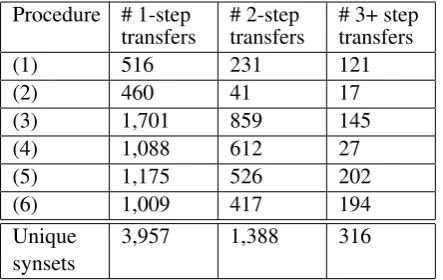
Through these steps 9,341 new suggestions of
Procedure # 1-step transfers
# 2-step transfers
# 3+ step transfers
(1) 516 231 121
(2) 460 41 17
(3) 1,701 859 145
(4) 1,088 612 27
(5) 1,175 526 202
(6) 1,009 417 194
Unique synsets
3,957 1,388 316
Table 1: Distribution of frames suggested for synsets with automatic frame assignments from the hypernym (rows (1)-(6) include multiple sug-gestions for the same synset)
more specific or other possible frames have been made for 5,661 synsets with automatically trans-ferred hypernym frames – Table1shows the dis-tribution of the new suggestions in terms of the types of procedures that have been applied and the distance of the synset from the hypernym whose frame has been inherited.
4.3 Discussion on Evaluation
These suggestions need to be manually verified as so far no reliable fully automated verification pro-cedure has been established. Since the main ob-jective is to discover, or suggest, a more precise frame than the one assigned from the hypernym, which is not necessarily wrong but rather may be too general, such evaluation needs to measure the degree of relevance as opposed to precision. Fur-thermore, it will be highly dependent on the gran-ularity of the frames and their hierarchical organi-sation. Designing such a measure and its automa-tisation, if at all achievable, is beyond the scope of this work.
Suggestions, although non-definitive, provide useful pointers to candidate frames and thus are valuable in assisting the manual selection of frames. Only in 203 cases are there multiple sug-gestions as a result of the procedures, out of which in 177 cases 5 or more different frames are gested. There are 1,056 synsets for which a sug-gestion is confirmed at least 2 times from the re-peated application of the same or different proce-dures, out of which 265 cases are confirmed 5 or more times.
higher in the tree as errors propagate down and may result in multiple wrong assignments.
5 Causativity and Inchoativity as a Systemic Structural Feature
Another direction of expanding the mappings and verifying the information in both FN and WN is by employing systematic semantic relations such as causativity. It is a non-hierarchical relation that links stative (e.g. {lie:2} ’be lying, be pros-trate; be in a horizontal position’) or inchoative ({lie down:1, lie:7}’assume a reclining position’) verbs with their causative ({lay:2, put down:2, re-pose:5} ’put in a horizontal position’) counter-parts. The relation provides enhancement comple-mentary to the one using hierarchical relations de-scribed above and links in a systematic way large parts of the lexicon.
A considerable part of causative and non-causative pairs are formed with the same root and are thus morphologically similar or identical, e.g. ENchange – change; ROschimba – schimba; BG
promenyam – promenyam se, which makes them easier to identify. Nevertheless, as noted above, causativity is not consistently encoded in WN, and neither is it fully implemented in FN where we have spotted a number of instances of inchoat-ive/stative or causative frames lacking a counter-part in the opposite domain. This means that the verbs instantiating them cannot be appropriately described in FN. Respectively, the mapping of lit-erals instantiating non-defined frames will result in failure of assignment or wrong assignment.
Causativity also has an important application in WN and FN data validation and expansion: exploring the assignment of frames from FN to synsets enables us to check the consistency of as-signments, by adopting the following logic: (i) in a tree whose root is a causative synset, all the descendants must be assigned a causative frame; (ii) in a tree with an inchoative/stative root all the descendants must be inchoative/stative; (iii) the pairs of causative–non-causative synsets from corresponding trees should be connected to each other through the WNcausesrelation in a consis-tent way; (iv) the respective pair of causative–non-causative frames assigned to such a pair of synsets should also be related via theIs Causative of rela-tion in FN. The opposite signals either wrong as-signment of a frame or inconsistency either in the WN data, that is – the encoding of a stative or
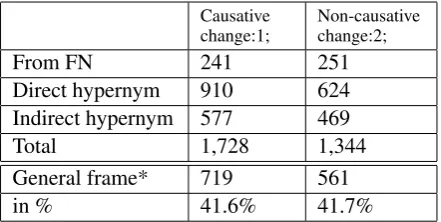
in-Causative change:1;
Non-causative change:2;
From FN 241 251
Direct hypernym 910 624 Indirect hypernym 577 469
Total 1,728 1,344
General frame* 719 561
in % 41.6% 41.7%
Table 2: Analysed data with respect to causativ-ity (* assignments of the most general frame Cause change for the causative and Undergo change for the non-causative)
choative verb in a causative tree or vice versa, or in the FN data – missing or wrong relation between frames, undefined frames, etc.
Sections5.1and5.2describe the procedures for exploring pairs of causative–non-causative trees and extracting information enabling the valida-tion of assigned frames, as well as the increase of the density of causativity relations within FN and WN. Section5.3deals with the formulation of new causative or stative and/or inchoative frames.
5.1 Analysis and Consistency Checks
We have extracted two separate WN trees from two root synsets connected by the causes re-lation (see Table 2): (1) eng-30-00126264-v {change:1; alter:1; modify:3}, assigned the frame Cause change; and its corresponding non-causative counterpart (2) eng-30-00109660-v
{change:2}, assigned the frame Undergo change. The checks for consistency with regards to (i)-(iv) above, included the following procedures:
(1) Identifying non-causative synsets in the causative tree and causative synsets in the non-causative tree. These mismatches are identified by pattern matching of the gloss or by analysis aimed at establishing whether the manually as-signed frame contradicts the position in the tree. 9 such cases have been found in the causative tree (e.g., eng-30-00416880-v {even:6; even out:2}
’become even or more even’). Pattern-matching in the non-causative tree proved to be unreli-able. It identified 120 cases of ’make’ or ’cause’ in the gloss, but only a small number of them were causative synsets (e.g., eng-30-00330565-v
rel-evant tree and attaching it to its real hypernym. Furthermore, there are synsets which com-bine the causative and the non-causative meaning and thus, create inconsistency in the WN struc-ture. We identify such synsets by pattern match-ing of the gloss since they usually have glosses such as ’make or become’, ’cause or become’, ’cause or undergo’. There are 7 cases in the causative (e.g., eng-30-01253468-v {coarsen:2}
’make or become coarse or coarser’) and 5 in the non-causative tree (e.g., eng-30-00280532-v {blacken:1; melanize:1} ’make or become black’). We propose that such synsets are split into two and placed at the respective positions in the relevant trees. This is an optimal solution as these concepts are not necessarily expressed by the same lexeme cross-linguistically, and such a split improves the consistency of WN.
(2) Identifying non-causative frames assigned to synsets in the causative tree and causative frames assigned to synsets in the non-causative tree. A causative frame is identified based on: keywords such as ’cause’ or ’make’ in its name or its definition; Agent or Cause/Causer FEs in its conceptual structure; its position as the first member in aIs Causative of relation, etc. A non-causative frame is identified based on: keywords such as ’become’ or ’undergo’; lack of Agent or Cause/Causer FEs in its structure; its position as the second member of anIs Causative of relation. We found 7 non-causative frames in the causative tree (e.g., eng-30-02190188-v
{quieten:3; hush:5; quiet:9; quiesce:1; quiet down:1; pipe down:1}’become quiet or quieter’, Frame: Becoming silent) and 61 causative frames in the non-causative tree (e.g., eng-30-00339085-v {crush:1} ’break into small pieces’, Frame: Cause to fragment). These are clearly either er-rors in the frame assignment or wrongly encoded synsets as discussed in (1).
(3) Identifying synset pairs connected by the
causesrelation in WN where the causative synset is assigned a non-causative frame or vice versa. Section 5.2deals with the enrichment of the two resources with instances of the causative relation.
5.2 Densifying Causative Relations in WN and FN
The causative tree stemming from{change:1}and the non-causative one stemming from{change:2}
were aligned using the WNcausesrelation,
result-ing in 47 pairs of correspondresult-ing synsets – one in each tree. A set of consistency checks showed that there are no crossing relations (i.e., no instances where for a causative hypernym C1 and its hy-ponymC2, and a non-causative hypernymN1and its hyponymN2,C1causesN2andC2causesN1). Further procedures were proposed to dis-cover pairs of corresponding causative and non-causative synsets unrelated through the non-causative relation. These are based on pattern matching of the definition and/or on measuring similarity, as well as on an analysis of the synsets position in the WN tree structure, the causative relations in which their sisters, hypernym and hyponyms enter, and the frames assigned to them. On the basis of these linguistic features we have identified 673 possible causative relations between pairs of synsets in the two corresponding trees. After manual validation they may be used to create a more dense structure of causative relations in WN, as well as to extend them to frame-to-frame relations in FN.
5.3 Suggesting New Frames
New frames are suggested where a suitable causative or non-causative frame is not defined in FN to match its existing counterpart. The miss-ing one is defined usmiss-ing the conceptual descrip-tion of the available frame. Consider the synset
{age:3} ’make older’: we assign it the frame
Cause change and then try to acquire additional classificatory information and, possibly, to find a more specific frame by applying the remaining procedures. We confirm that the synset’s mean-ing is causative through the keyword procedure (cf. Section 4.2). Another mapping procedure suggests Aging as the corresponding frame. Ag-ing is a non-causative frame denotAg-ing the mean-ing of an entity undergomean-ing a particular kind of change (see Example 8). Since Aging does not have a causative counterpart in FN, we posit such a frame, Cause to age. The conceptual structure of stative/inchoative and causative counterparts is distinguished by the presence of a causative subevent in the latter (Van Valin Jr. and LaPolla,
frames inherit from the abstract frame Transi-tive action so we define anInheritancerelation be-tween Transitive action and Cause to age. In such a way the newly-defined relation is integrated into the FN relational structure.
Example 8. Frame: Cause to age Core frame elements: Agent/Cause; Entity FN definition: An Agent or Cause causes an En-tity to undergo a change in age typically associated with some deterioration or change in state. Example synsets:{age:3}’make older’ FN relation: Inherits from
Frame: Transitive action
Core frame elements: Agent/Cause; Patient Frame definition: An Agent or Cause affects a Patient.
FN relation: Is Causative of Frame: Aging
Core frame elements: Entity
Frame definition: An Entity is undergoing a change in age typically associated with some deterioration or change in state.
Example synset: {senesce:1, age:2, get on:7, mature:5, maturate:2}’grow old or older’
The domain of causativity provides an approach at symmetricising large parts of the lexicon both at a horizontal level (same level lexemes in a tax-onomical hierarchy) and in depth as the improve-ments in the higher levels of the lexicon influence the deeper levels as reflected in the procedure of assigning relations by inheritance described in4.1.
6 Frame Specialisation and Relations
The observations on hierarchical relations, es-pecially on the more populated ones, such as
Inheritance, Using and See also, shed light on the specialisation that takes place from parent to child in the taxonomic (inheritance) hierar-chy. The changes in the causativity domain deal with including/excluding FEs that correspond to causative subevents in the event structure. The modifications that occur in the conceptual and se-mantic structure include, but are not limited to the following:
– Reducing the number of core frame ele-ments by incorporatingone of them in the verb’s meaning, e.g. {whip:4} incorporates the periph-eral FE Instrument (’whip’) of {strike:1} in the frame Cause harm assigned to both;
–Reducing the scope of the framethrough im-posing more strict selectional restrictions on the
FEs, e.g. {drive:1} (Operate vehicle) as a hy-ponym of {operate:3} (Operating a system) ap-plies only to land vehicles while other verbs in the frame impose different restrictions on the FE Ve-hicle;
–Profiling a different FEfrom the one profiled by the hypernym, e.g. {rob:1}(Robbery) profiles the Victim, while its hypernym{steal:1; rip off:2, rip:4}(Theft) profiles the stolen Goods;
– Inclusion/exclusion of a causative/agentive FEs corresponding to a causative subevent in the respective pairs of frames, e.g. {break:5}
(Cause to fragment) and {break:2, separate:10, fall apart:4, come apart:1}(Breaking apart).
Some of the types of specialisation are currently being studied as a point of departure for defining more narrow-scope frames that would allow for more precise predictions about the selectional re-strictions and the syntactic realisation of FEs.
7 Future Work
A further goal is to enrich FN by extending its lex-ical coverage on the basis of the expanded map-ping to synsets. Verbs which do not have corre-spondence among LUs (or no correcorre-spondence in a given frame) but belong to synsets that have been successfully mapped to FN frames, will be sug-gested as possible LUs to be included in the re-spective frame(s).
A venue of ongoing research is to define precise selectional restrictions on FEs and to implement them as semantic relations between a verb synset and a set of noun synonyms that satisfy these re-strictions. In such a way we will enrich WN with relations between verbs and nouns corresponding to participants in their conceptual structure, partic-ularly ones realised as arguments and adjuncts.
The developed resource may have a consider-able impact on the development of methods for identification of predicate-argument structure in text, which in turn will facilitate the development of new methods for frame verification and consis-tency checks on FN and WN.
Acknowledgments
References
Collin F. Baker. 2008. FrameNet, present and future. In Jonathan Webster, Nancy Ide, and Alex Chengyu Fang, editors, The First International Conference on Global Interoperability for Language Resources. City University, City University, Hong Kong.
Collin F. Baker and Christiane Fellbaum. 2009. Word-Net and FrameWord-Net as Complementary Resources for Annotation. InProceedings of the Third Linguistic Annotation Workshop (ACL-IJCNLP ’09), Associa-tion for ComputaAssocia-tional Linguistics, Stroudsburg, PA, USA. pages 125–129.
Collin F. Baker, Charles J. Fillmore, and John B. Lowe. 1998. The Berkeley FrameNet Project. In COLING-ACL ’98: Proceedings of the Conference. Montreal, Canada. pages 86–90.
Collin F. Baker and Josef Ruppenhofer. 2002. FrameNet’s frames vs. levin’s verb classes. In J. Larson and M. Paster, editors,Proceedings of 28th Annual Meeting of the Berkeley Linguistics Society. pages 27–38.
Christiane Fellbaum. 1998. A Semantic Network of English Verbs . In Christiane Fellbaum, editor, WordNet: An Electronic Lexical Database, MIT Press, Cambridge, MA, pages 69–104.
E. Laparra and G. Rigau. 2009. Integrating Word-Net and FrameWord-Net using a knowledge-based Word Sense Disambiguation algorithm. InProceedings of Recent Advances in Natural Language Processing (RANLP09), Borovets, Bulgaria. pages 208–213.
Egoitz Laparra and German Rigau. 2010. eXtended WordFrameNet. In Proceedings of LREC 2010. pages 1214–1219.
Svetlozara Leseva and Ivelina Stoyanova. 2019. En-hancing Conceptual Description through Resource Linking and Exploration of Semantic Relation. In Proceedings of 10th Global WordNet Conference, 23 – 27 July 2019, Wroclaw, Poland. pages 229–238.
Svetlozara Leseva, Ivelina Stoyanova, and Maria Todorova. 2018. Classifying Verbs in WordNet by Harnessing Semantic Resources. InProceedings of CLIB 2018, Sofia, Bulgaria. pages 115–125.
George A. Miller. 1995. WordNet: A Lexical Database for English.Commun. ACM38(11):39–41.
Martha Palmer. 2009. Semlink: Linking PropBank, VerbNet and FrameNet. InProceedings of the Gen-erative Lexicon Conference. 9–15.
Martha Palmer, Claire Bonial, and Diana McCarthy. 2014. SemLink+: FrameNet, VerbNet and Event Ontologies. In Proceedings of Frame Semantics in NLP: A Workshop in Honor of Chuck Fillmore (1929–2014), Baltimore, Maryland USA, June 27, 2014. Association for Computational Linguistics, pages 13–17.
Miriam R. Petruck. 2015. The
Com-ponents of FrameNet. http://
naacl.org/naacl-hlt-2015/ tutorial-framenet-data/
FNComponentsMRLP.pdf.
Miriam R. Petruck and Gerard de Melo. 2012. Pre-cedes: A semantic relation in FrameNet. In Pro-ceedings of the Workshop on Language Resources for Public Security Applications. pages 45–49.
Josef Ruppenhofer, Michael Ellsworth, Miriam R. Petruck, Christopher R. Johnson, C. F. Baker, and Jan Scheffczyk. 2016. FrameNet II: Extended The-ory and Practice. International Computer Science Institute, Berkeley, California.
Lei Shi and Rada Mihalcea. 2005. Putting Pieces To-gether: Combining FrameNet, VerbNet and Word-Net for Robust Semantic Parsing. In A. Gel-bukh, editor,Computational Linguistics and Intelli-gent Text Processing. CICLing 2005. Lecture Notes in Computer Science, Springe, Berlin, Heidelbergr, volume 3406.
Sara Tonelli and Daniele Pighin. 2009. New Features for Framenet – Wordnet Mapping. InProceedings of the Thirteenth Conference on Computational Natu-ral Language Learning (CoNLL’09), Boulder, USA.