Proceedings of the Student Research Workshop associated with RANLP-2019, pages 83–89, Varna, Bulgaria, Sep 2–4, 2019.
83
Multilingual Complex Word Identification: Convolutional Neural
Networks with Morphological and Linguistic Features
Kim Cheng Sheang LaSTUS / TALN / DTIC Universitat Pompeu Fabra
Barcelona, Spain
Abstract
Complex Word Identification (CWI) is an essential task in helping Lexical Simpli-fication (LS) identify the difficult words that should be simplified. In this paper, we present an approach to CWI based on Convolutional Neural Networks (CNN) trained on pre-trained word embeddings with morphological and linguistic fea-tures. Generally, the majority of works on CWI are either feature-engineered or neu-ral network with word embeddings. Both approaches have advantages and limita-tions, so here we combine both approaches in order to achieve higher performance and still support multilingualism. Our evalu-ation has shown that our system achieves quite similar performance as the state-of-the-art system for English, and it outper-forms the state-of-the-art systems for both Spanish and German.
1 Introduction
Text Simplification (TS) (Saggion,2017) is a re-search field which aims at developing solutions to transform texts into simpler paraphrases. Gener-ally, there are two types of TS: Lexical Simplifi-cation (lexical-level simplifiSimplifi-cation) and Syntactic Simplification (sentence-level simplification).
The research on TS has become more attrac-tive in recent years because of its benefits as a tool for reading aids or help improve the per-formance of other Natural Language Processing (NLP) tasks. TS has been shown useful for de-veloping reading aids for children (Siddharthan, 2002;Watanabe et al.,2009), non-native speakers (Siddharthan,2002), people with intellectual dis-abilities (Bott et al., 2012;Saggion et al., 2015). Moreover, TS can also be used as a
preprocess-ing step to improve results of many NLP tasks, e.g., Parsing (Chandrasekar et al.,1996), Informa-tion ExtracInforma-tion (Evans, 2011; Jonnalagadda and Gonzalez,2010), Question Generation (Bernhard et al., 2012), Text Summarization (Siddharthan et al.,2004), and Machine Translation (ˇStajner and Popovic,2016).
Lexical Simplification (LS) simplifies text mainly by substituting difficult and less frequently-used words with simpler equiva-lents. Typically, the pipeline of LS comprises the following steps: complex word identification, substitution generation, substitution selection, and substitution ranking (Paetzold and Specia,2015).
In this work we concentrate on Complex Word Identification (CWI), a core component of LS, which is used to identify difficult words or phrases that are needed to be simplified. Language diffi-culty often comes at the lexical level, so simply applying the LS alone could help improve reader understanding and information retention (Leroy et al.,2013).
In this paper, we describe our work on CWI based on deep learning approach called Convo-lutional Neural Networks (CNN) in combination with word embeddings and engineered-features. The task is to create a model that learns from ex-amples and then uses it to classify any target text in a given sentence as complex or non-complex. As it will be shown, our approach achieves state of the art performance in Spanish and German data, and almost state of the art performance in English data.
We carry out our experiments on data from the Complex Word Identification Shared Task 2018 (Yimam et al., 2017b). Here are two examples from the English and Spanish datasets:
En: Both China and the Philippines
Es: Allston es un vecindario (munici-pio) de Boston, en los Estados Unidos, ubicado en la parte occidental de la ciu-dad.
The target text flexed their musclesin the En-glish sentence andvecindarioin the Spanish sen-tence are annotated as complex by at least one an-notator.
In Section2, we give an overview of recent re-search on CWI. Section3, we describe all the de-tails about the implementation of our system. Sec-tion 4 is about the details of the datasets we use in the experiments. Section5, we present the per-formance of our system with some discussion. Fi-nally, Section6is our conclusion and future work.
2 Related Work
There are many different techniques have been in-troduced so far to identify complex words ( Paet-zold and Specia,2016b;Yimam et al.,2018). It is obvious that feature-based approaches remain the best, but deep learning approaches have become more popular and achieved impressive results.
Gooding and Kochmar (2018) proposed a feature-based approach for monolingual English datasets. The system used lexical features such as number of characters, number of syllables, num-ber of synonyms, word n-gram, POS tags, depen-dency parse relations, number of words grammat-ically related to the target word, and Google n-gram word frequencies. It also used psycholin-guistic features such as word familiarity rating, number of phonemes, imageability rating, con-creteness rating, number of categories, samples, written frequencies, and age of acquisition. The model achieved the state-of-the-art results for En-glish datasets during the CWI Shared Task 2018 (Yimam et al.,2018), but the limitation of this ap-proach is that it is hard to port from one language to another.
Kajiwara and Komachi(2018) developed a sys-tem for multilingual and cross-lingual CWI. The system was implemented using word frequencies features extracted from the learner corpus (Lang-8 corpus)Mizumoto et al.(2011), Wikipedia and WikiNews. The features contained the number of characters, the number of words, and the fre-quency of the target word. The system achieved state-of-the-art results for both Spanish and Ger-man datasets.
Aroyehun et al. (2018) developed systems for both English and Spanish using binary classifica-tion and deep learning (CNN) approaches. The feature-based approach used features such as word frequency of the target word from Wikipedia and Simple Wikipedia corpus, syntactic and lexical features, psycholinguistic features and entity fea-tures, and word embedding distance as a feature which is computed between the target word and the sentence. The deep learning approach used GloVe word embeddings (Pennington et al.,2014) to represent target words and its context. The deep learning approach is very simple and achieves bet-ter results than other deep learning approaches.
Our methodology follows that of Aroyehun et al.(2018) deep learning model in combination with word embeddings and linguistic features.
3 Model
In this section, we explain our approach based on Convolutional Neural Networks (CNN) trained on word embeddings and engineered features. Sec-tion 3.2 describes the details on how to prepro-cess data, transforming from a raw sentence into a matrix of numbers containing all the features de-scribed in Section 3.1. Section 3.3 describes the overall architecture of our network, Hyperparam-eters tuning and training details.
3.1 Features
In this section, we describe all features incorpo-rated in our system.
Word Embeddings Feature: We use pre-trained word embeddings GloVe (Pennington et al.,2014) with 300 dimensions to extract word vector representation of each word for all the three languages. For English, we use the model trained on Wikipedia 2014 and Gigaword 5 model (6B tokens, 400K vocab).1 For Spanish, we use the model (Cardellino, 2016) trained on 1.5 billion words data from different sources: dumps from the Spanish Wikipedia, Wikisource, and Wikibooks on date 2015-09-01, Spanish portion of SenSem, Spanish portion of Ancora Corpus, Tibidabo Tree-bank and IULA Spanish LSP TreeTree-bank, Spanish portion of the OPUS project corpora, and Span-ish portion of the Europarl.2 For German, we use
1
https://nlp.stanford.edu/projects/ glove
2https://github.com/dccuchile/
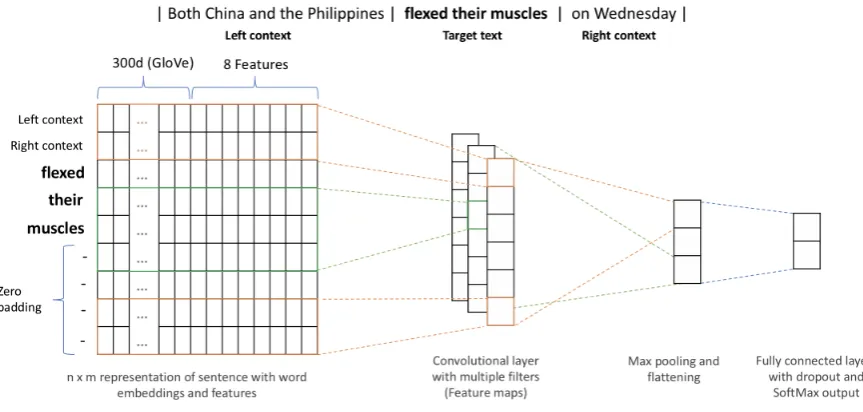
Figure 1: The model architecture
the model trained on the latest dumps of German Wikipedia.3
Morphological Features: Our morphologi-cal feature set consists of word frequency, word length, number of syllables, number of vowels, and tf-idf.
• Word frequency: the frequency of each word is extracted from the latest Wikipedia dumps as the raw count and then normalize to be-tween 0 and 1.
• Word length: the number of character in the word.
• Number of syllables: the number of syllables of the word, calculated using Pyphen.4
• Number of vowels: the number of vowels in the word.
• tf-idf: Term frequency - inverse document frequency, calculated using scikit-learn li-brary.5
Linguistic Features: The linguistic features consists of part-of-speech, dependency, and stop word.
• Part-of-speech (POS): a category to which a word is assigned in accordance with its syn-tactic functions, e.g. noun, pronoun, adjec-tive, verb, etc.
3https://deepset.ai/
german-word-embeddings
4
https://pyphen.org
5https://scikit-learn.org
• Dependency: a syntactic structure consists of relations between words, e.g. subject, prepo-sition, verb, noun, adjective, etc.
• Stop word: a commonly used word such as ”the”, ”a”, ”an”, ”in”, ”how”, ”what”, ”is”, ”you”, etc.
All these features are extracted using SpaCy ( Hon-nibal and Montani,2017).
3.2 Preprocessing
We separate each sentence into three parts: target text, left context and right context. The target text is a word or a phrase which is selected and marked as complex or non-complex by the annotators. The left context and the right context are words that appear to the left and the right of the target text.
row corresponds to the right context vector, and the lastrrows are given by the embedding vectors of the words contained in the target text, wherer is the number of words in the target text. In order to have a fixed size matrix, we pad the remaining rowspwith zero vectors, wherep =h−r andh is the maximum value ofrin the corpus.
To convert each feature into a vector represen-tation, first we need to transform its values. For example:
• Part-of-speech and Dependency have values such as N, V, ADJ, ADV, and PREP, so we index as 1, 2, 3, 4, 5 and normalize it to be-tween 0 and 1.
• Stop word: 1-stop word, 0-otherwise.
• All the values of word frequency, word length, number of syllables, number of vow-els, and tf-idf are numbers, so we just nor-malize it to between 0 and 1.
For each feature, we initialize a matrix of one column and n rows where the first row corre-sponds to the average value of the left context, the second row corresponds to the average value of the right context, and the lastrrows are the values of the feature for each word in the target text, and the remaining rows are padded with zero. Then, we append this matrix to the previous matrixX.
3.3 Hyperparameters and Training
Figure1shows the general architecture of our net-work. The model has been constructed using pure Tensorflow deep learning library version 1.14.6
We train our model using CNN with the num-ber of filters 128, stride of 1, and kernel size of 3, 4, and 5. We then apply the ReLu activation func-tion with Max Pooling to the out of this layer; the output of this layer is often called feature maps. The feature maps are flattened and pass through three Fully-Connected layers (FC) with dropout between each layer. The first two FC layers use ReLu activation function with 256 and 64 of out-puts. The last FC layer uses Softmax activation function which provides the output as complex (1) or non-complex (0).
For all datasets, the training is done through Stochastic Gradient Descent over shuffle mini-batches using Adam optimizer (Kingma and Ba, 2014) with the learning rate of 0.001, dropout rate
6https://www.tensorflow.org
of 0.25, mini-batch size of 128. Also, we use weighted cross-entropy as a loss function with the weight of 1.5 for the positive since our datasets are imbalanced; it contains roughly 60% negative ex-amples and 40% positive exex-amples as you can see in the Table1. We train the system for 200 epochs, and for every 20 iterations, we validate the sys-tem with the shuffle development set. Then, if the model achieves the highest f1-score, we save the model and use it for our final evaluation with the test set. In our case, all the hyperparameters are selected via a grid search over the English devel-opment set.
We train and evaluate each language separately. For English, the dataset has three different genres, so we combine and train all at once. For Spanish and German, it has only one genre, so we use it directly for training.
4 Datasets
Table 1 shows all the details about each dataset used in the experiments.
Dataset Train Dev Test Positive
News 14,002 1,764 2,095 40%
WikiNews 7,746 870 1,287 42%
Wikipedia 5,551 694 870 45%
Spanish 13,750 1,622 2,233 40%
German 6,151 795 959 42%
Table 1: English, Spanish and German datasets
System English Spanish German News WikiNews Wikipedia
Camb (Gooding and Kochmar,2018) 87.36 84 81.15 - -TMU (Kajiwara and Komachi,2018) 86.32 78.73 76.19 76.99 74.51 NLP-CIC (Aroyehun et al.,2018) 85.51 83.08 77.2 76.72 -ITEC (De Hertog and Tack,2018) 86.43 81.10 78.15 76.37 -NILC (Hartmann and Santos,2018) 86.36 82.77 79.65 - -CFILT IITB (Wani et al.,2018) 84.78 81.61 77.57 - -SB@GU (Alfter,2018) 83.25 80.31 78.32 72.81 69.92
Gillin Inc. 82.43 70.83 66.04 68.04 55.48
hu-berlin (Popovi´c,2018) 82.63 76.56 74.45 70.80 69.29 UnibucKernel (Butnaru and Ionescu,2018) 81.78 81.27 79.19 - -LaSTUS/TALN (AbuRa’ed and Saggion,2018) 81.03 74.91 74.02 -
-Our CWI 86.79 83.86 80.11 79.70 75.89
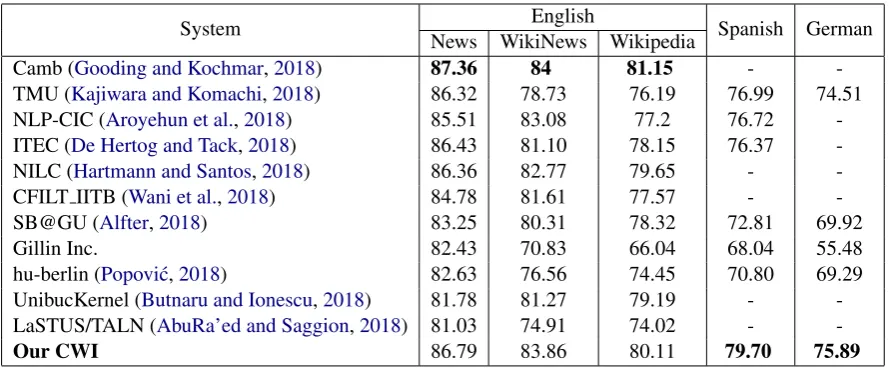
Table 2: The evaluation results
5 Results
Table2shows the results of our model against oth-ers (all the results are based on macro-averaged F1-score).
Our evaluation has shown that when training with the dataset which has more training exam-ples, the model achieves the better result. For example, the model achieves the score of 86.79 on the English News dataset with 14,002 exam-ples compared to the score of 83.86 on the English WikiNews dataset with 7,746 examples and the score of 80.11 on the English Wikipedia dataset with 5,551 examples.
We have found an interesting problem. A word can be both complex and non-complex in the same sentence, depending on the selection of the target text. Consider the following sentence, for exam-ple,
The distance, chemical composition, and age of Teide 1 could be established because of its membership in the young Pleiades star cluster.
• The target text ”Pleiades” is annotated by 3 native and 2 non-native speakers as complex, and our system also predicts it as complex.
• The same sentence with different target text ”Pleiades star cluster”. None of native and non-native speakers annotate it as complex, but our system predicts it as complex.
Here is another example,
Definitions have been determined such that the ’super casino’ will have a
mini-mum customer area of 5000 square me-tres and at most 1250 unlimited-jackpot slot machines.
• For the target text ”casino”, none of native and non-native speakers annotate it as com-plex, and our system also predicts it as non-complex.
• The same sentence with different target text ”super casino”. Only one non-native speaker annotates it as complex, so it is marked as complex, but our system predicts it as non-complex.
6 Conclusion and Future Work
In this paper, we have presented a new CWI ap-proach that utilizes deep learning model (CNN) with word embeddings and engineered features. The evaluation has shown that our model performs quite well compared to the state-of-the-art system for English, which realizes on feature-engineered, and better than the state-of-the-art systems for both Spanish and German.
In future work, we plan to use deep contextual-ized word representations such as BERT (Devlin et al.,2018) or XLNet (Yang et al.,2019) instead of GloVe. Also, we plan to add more features which will be extracted from MRC psycholinguis-tics database (Paetzold and Specia,2016a) such as age of acquisition, familarity, concretness, and im-agery.
Acknowledgments
Linguistics: Human Language Technologies. pages 435–440.
Gustavo Paetzold and Lucia Specia. 2016b. Semeval 2016 task 11: Complex word identification. In Pro-ceedings of the 10th International Workshop on Se-mantic Evaluation (SemEval-2016). pages 560–569.
Jeffrey Pennington, Richard Socher, and Christo-pher D. Manning. 2014. Glove: Global vectors for
word representation. InEmpirical Methods in
Nat-ural Language Processing (EMNLP). pages 1532– 1543.http://www.aclweb.org/anthology/D14-1162.
Maja Popovi´c. 2018. Complex word identification using character n-grams. In Proceedings of the Thirteenth Workshop on Innovative Use of NLP for Building Educational Applications. pages 341–348.
Horacio Saggion. 2017. Automatic Text Simplifica-tion. Synthesis Lectures on Human Language Tech-nologies10(1):1–137.
Horacio Saggion, Sanja ˇStajner, Stefan Bott, Si-mon Mille, Luz Rello, and Biljana Drndare-vic. 2015. Making It Simplext. ACM Transactions on Accessible Computing 6(4):1–36.
https://doi.org/10.1145/2738046.
Advaith Siddharthan. 2002. An architecture for a text simplification system. In Language Engineering Conference, 2002. Proceedings. IEEE, pages 64–71.
Advaith Siddharthan, Ani Nenkova, and Kathleen McKeown. 2004. Syntactic simplification for im-proving content selection in multi-document sum-marization. InProceedings of the 20th international conference on Computational Linguistics. Associa-tion for ComputaAssocia-tional Linguistics, page 896.
Sanja ˇStajner and Maja Popovic. 2016. Can Text Sim-plification Help Machine Translation? In Proceed-ings of the 19th Annual Conference of the European Association for Machine Translation4(2):230–242.
Nikhil Wani, Sandeep Mathias, Jayashree Aanand Gaj-jam, and Pushpak Bhattacharyya. 2018. The Whole is Greater than the Sum of its Parts : Towards the Effectiveness of Voting Ensemble Classifiers for Complex Word Identification. Proceedings of the Thirteenth Workshop on Innovative Use of NLP for Building Educational Applicationspages 200–205.
Willian Massami Watanabe, Arnaldo Candido Junior, Vin´ıcius Rodrigues de Uzˆeda, Renata Pontin de Mat-tos Fortes, Thiago Alexandre Salgueiro Pardo, and Sandra Maria Alu´ısio. 2009. Facilita: Reading As-sistance for Low-literacy Readers Willian. Proceed-ings of the 2010 International Cross Disciplinary Conference on Web Accessibility (W4A) - W4A ’10
page 1. https://doi.org/10.1145/1805986.1805997.
Zhilin Yang, Zihang Dai, Yiming Yang, Jaime Car-bonell, Ruslan Salakhutdinov, and Quoc V Le. 2019. Xlnet: Generalized autoregressive pretrain-ing for language understandpretrain-ing. arXiv preprint arXiv:1906.08237.
Seid Muhie Yimam, Chris Biemann, Shervin Malmasi, Gustavo H Paetzold, Lucia Specia, Sanja ˇStajner, Ana¨ıs Tack, and Marcos Zampieri. 2018. A report on the complex word identification shared task 2018.
arXiv preprint arXiv:1804.09132.
Seid Muhie Yimam, Sanja ˇStajner, Martin Riedl, and Chris Biemann. 2017a. Cwig3g2-complex word identification task across three text genres and two user groups. InProceedings of the Eighth Interna-tional Joint Conference on Natural Language Pro-cessing (Volume 2: Short Papers). pages 401–407.
Seid Muhie Yimam, Sanja ˇStajner, Martin Riedl, and Chris Biemann. 2017b. Multilingual and
Cross-Lingual ComplexWord Identification. In
RANLP 2017 - Recent Advances in Natural Language Processing Meet Deep Learning. In-coma Ltd. Shoumen, Bulgaria, pages 813–822.
http://www.acl-bg.org/proceedings/2017/RANLP