Evaluation of Classification Algorithms and Features for
Collocation Extraction in Croatian
Mladen Karan, Jan ˇSnajder, Bojana Dalbelo Baˇsi´c
University of Zagreb
Faculty of Electrical Engineering and Computing
[email protected], [email protected], [email protected]
Abstract
Collocations can be defined as words that occur together significantly more often than it would be expected by chance. Many natural language processing applications such as natural language generation, word sense disambiguation and machine translation can benefit from having access to information about collocated words. We approach collocation extraction as a classification problem where the task is to classify a given n-gram as either a collocation (positive) or a non-collocation (negative). Among the features used are word frequencies, classical association measures (Dice, PMI, chi2), and POS tags. In addition, semantic word relatedness modeled by latent semantic analysis is also included. We apply wrapper feature subset selection to determine the best set of features. Performance of various classification algorithms is tested. Experiments are conducted on a manually annotated set of bigrams and trigrams sampled from a Croatian newspaper corpus. Best results obtained are 79.8 F1 measure for bigrams and 67.5 F1 measure for trigrams. The best classifier for bigrams was SVM, while for trigrams the decision tree gave the best performance. Features which contributed the most to overall performance were PMI, semantic relatedness, and POS information.
Keywords:collocation extraction, feature subset selection, Croatian language
1.
Introduction
Automatic collocation extraction (CE) is the task of auto-matically identifying collocated words in a given natural language text. The termcollocationhas a significant over-lap with the termmulti word entity(MWE). MWEs include phrases, idioms, named entities, etc. Collocations can be viewed as empirical epiphenomena of MWEs: each time a MWE is mentioned in a text, the words forming it occur to-gether. Most collocations have a certain degree of added meaning, making them more than a sum of their parts. While there exist more elaborate definitions, in the scope of this paper we will define collocations as sequences of terms or words that appear together more often than it would be expected by chance (Manning and Sch¨utze, 1999). The reason why CE is important is that many Natural Lan-guage processing (NLP) tasks can benefit by having ac-cess to information about collocated words. One exam-ple of a task that greatly benefits from such information is natural language generation (NLG) in the form of text or speech. A common example is the phrase“strong tea”
used far more often than“powerful tea”, which sounds un-natural, although it is grammatically correct and conveys the same meaning. This information is very useful to an NLG algorithm. Some other areas of NLP that benefit from collocation information include word sense disambiguation (Jimeno-Yepes et al., 2011; Jin et al., 2010) as well as ma-chine translation (Liu et al., 2010).
CE can be framed as a classification problem, where can-didates are classified as collocations or non-collocations based on input features. Traditionally used lexical asso-ciation measures (AMs) used for CE (Church and Hanks, 1990) have a limited modelling power. It has been shown in (Pecina and Schlesinger, 2006) and (Ramisch et al., 2010) that combining several AMs together with other features
and using machine learning methods to train a classifier can improve CE. The goal of this paper is to further explore this classification approach for CE in Croatian. Several learning methods are evaluated in an effort to find both the optimal classification model and optimal features using feature sub-set selection (FSS). In addition to several commonly used traditional features, we also explore the possible benefits of using semantic relatedness between words. Motivated by the future application of our work in terminology and keyword extraction for Croatian, we focus on noun phrases (NP) exclusively. The evaluation is done intrinsically on a set of examples derived from a corpus in Croatian language. The rest of the paper is structured as follows. In the next section we briefly discuss related work. In Section III we describe the classification methods and features. Section IV presents the experimental setup and evaluation results. Section V concludes the paper and outlines future work.
2.
Related Work
Among the first to use lexical AMs based on statistics and information theory were Church and Hanks (1990). A lex-ical AM measures the lexlex-ical association between words in a collocation candidate. The higher the AM value, the more likely it is for the candidate to be a collocation. Some traditional AMs are as follows.
The Dice coefficient is a simple yet remarkably effective measure, which gives larger values for words that often oc-cur together:
DICE = 2f(w1w2)
f(w1) +f(w2) (1)
Table 5: Results for bigram classification
All features Feature subset selection
Precision Recall F1 Precision Recall F1
Baseline 70.7±12.6 64.3±15.6 67.3 71.1±7.3 64.2±7.1 67.5 Decision tree 69.2±13.0 67.7±6.8 68.4 75.0±9.1 65.2±5.6 69.8 RIPPER 70.6±7.5 68.8±13.2 69.6 72.3±14.8 61.9±5.2 66.7 Naive Bayes 39.3±8.0 95.2±2.4 55.7 72.5±8.4 77.6±9.3 75.0 Logistic regression 77.6±9.2 78.7±6.9 78.2 85.3±13.6 75.0±6.6 79.8 Neural network 84.2±10.5 72.7±5.7 78.0 83.4±8.6 72.6±5.9 77.6 SVM (linear) 65.7±9.5 82.2±5.1 73.0 85.5±11.6 70±4.9 76.7 SVM (polynomial) 85.9±6.7 71.3±6.3 78.1 91.5±6.7 67.3±5.1 77.6
Table 6: Results for trigram classification
All features Feature subset selection
Precision Recall F1 Precision Recall F1
Baseline 59.2±1.5 62.85±12.4 61.0 49.9±9.4 67.3±14.9 57.3 Decision Tree 61.1±4.2 75.4±6.8 67.5 64.9±5.5 68.7±13.4 66.8 RIPPER 58.1±3.9 48.3±5.4 52.8 64.9±4.6 56.0±13.4 60.1 Naive Bayes 50.6±1.4 94.4±2.2 65.9 67.9±4.3 61.7±6.5 64.6 Logistic regression 74.8±5.3 52.2±4.7 61.5 68.9±7.3 57.0±11.7 62.4 SVM (linear) 70.7±7.9 58.7±10.9 64.1 70.4±7.2 53.9±8.8 61.1
forward selectionalgorithm described by Kohavi and John (1997). The algorithm starts with an empty set of features and then it iteratively adds new features. In each iteration the feature that improves performance the most is added to the feature set. The process stops when no remaining fea-ture would provide significant improvement when added to the feature set. This algorithm was chosen because we ex-pect the relevant subset of features to be small with resex-pect to the total number of features.
An important advantage of the wrapper approach to FSS is that it implicitly takes into account redundancy and corre-lation between features, unlike univariate filter FSS meth-ods. The disadvantage of the wrapper approach is that it is prone to overfitting. In order to prevent overtraining, the entire parameter optimization and FSS procedure is encap-sulated in an outer cross validation loop, making it a nested cross validation. The outer validation loop is done in five folds and the inner one in ten folds. E.g., for bigrams the inner loop uses a train set consisting of ∼60 collocations and∼384 non-collocations and a validation set containing
∼6 collocations and ∼42 non-collocations. The optimal feature subset as well as parameters can vary in different folds of the outer validation, however we can still measure the overall importance of a given feature by counting how many times it was chosen during the entire feature selection procedure.
The calculation of SVD required for LSA was performed using the SVDLIBC library.1 Once all the features were
1
http://tedlab.mit.edu/˜dr/SVDLIBC/
calculated, the evaluation process was implemented as a RapidMiner2model.
To measure how well our classifiers work we use the stan-dard F1 measure, which is the harmonic mean of precision and recall first introduced by van Rijsbergen (1979). As a baseline we use a perceptron with a single traditional AM value as input (this ammounts to computing the optimal threshold for the AM). Among the three tested traditional AMs, PMI was chosen as the best performing one.
4.3. Results
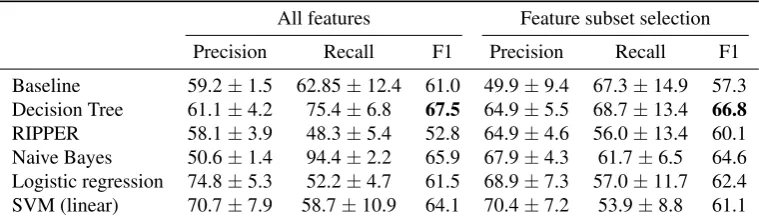
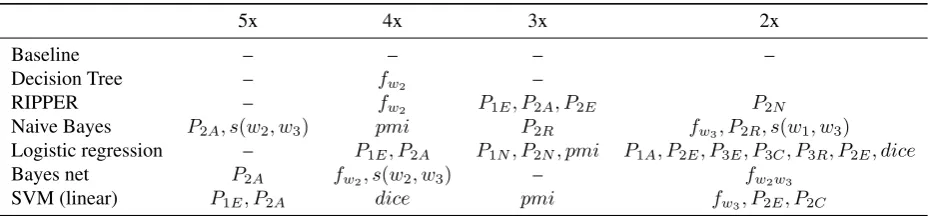
After each iteration of the outer validation loop, the optimal set of features for that iteration was recorded. The number of times a feature was chosen during the entire procedure is given in Tables 7 and 8 for bigrams and trigrams, respec-tively. Only features occurring two or more times are listed. The results for bigram and trigram classification with and without using FSS are given in Tables 5 and 6, respectively. In case of bigrams, the LSA-based semantic feature is cho-sen often, which implies it is useful. Decision trees seem to be able to take advantage of theχ2measure better than the other classifiers. Other methods predominantly use a combination of semantic, PMI, and Dice features. SVMs give better precision, while better recall is achieved by the Bayes classifier. This may indicate that further improve-ment is possible by using a classifier ensemble. POS tag features are also selected often, especiallyP1,E, which de-termines if the first word is a pronoun or a number. This is
Table 7: Features used most often for bigram classification
5x 4x 3x 2x
Baseline – – – –
Decision Tree – χ2 s(w
1, w2) fw1, fw1w2, P1A, P1E
RIPPER – fw2, χ
2 s(w
1, w2) pmi
Naive Bayes pmi P1A P2R –
Logistic regression P1N, s(w1, w2) P1A fw1w2 P1E
Neural network P1A, pmi, s(w1, w2) fw1w2 fw2, P2E –
SVM (linear) P1E, s(w1, w2), pmi – fw2, fw1w2 dice
SVM (polynomial) P1E, s(w1, w2), pmi – dice, fw2, fw1w2, P2R –
Table 8: Features used most often for trigram classification
5x 4x 3x 2x
Baseline – – – –
Decision Tree – fw2 –
RIPPER – fw2 P1E, P2A, P2E P2N
Naive Bayes P2A, s(w2, w3) pmi P2R fw3, P2R, s(w1, w3)
Logistic regression – P1E, P2A P1N, P2N, pmi P1A, P2E, P3E, P3C, P3R, P2E, dice
Bayes net P2A fw2, s(w2, w3) – fw2w3
SVM (linear) P1E, P2A dice pmi fw3, P2E, P2C
along the lines of results obtained by Petrovi´c et al. (2010). In general, in case of bigrams, classifiers using FSS outper-form classfiers trained on all features.
Trigram classification appears to be a harder problem and FSS does not seem to be as useful as in the case of bi-grams. However, there are some patterns that can be ob-served. POS features are used by all classifiers. TheP2A (second word is an adjective) in particular was selected very often for most of the classifiers. From the selection of other POS features it can be concluded that theadjectiveand pro-noun or number(which behave very similarly to adjectives) features were selected often. Of classical AMs, PMI is the one chosen most often. Classifiers that did not choose classical AMs as features compensated for this by choos-ing raw frequency features instead. An interestchoos-ing findchoos-ing was the performance of the Decision tree classifier, which had a very good result using only thefw2(frequency of the
second word) feature consistently. In addition tofw2, other
features were used in different folds of the outer validation, but each one no more than once. This is not completely unexpected as some of our features are highly correlated.
It is difficult to say which classifier is the best consider-ing the large variances caused mostly by the small size of the data set. Further statistical analysis of the results is re-quired. While there are similar approaches used for English (Pecina and Schlesinger, 2006; Ramisch et al., 2010), to our knowledge, the work reported here is the first attempt to treat collocation extraction in Croatian as a classifica-tion problem. Consequently, comparison to existing work in Croatian for collocations ( ˇSnajder et al., 2008; Petrovi´c et al., 2010) is difficult.
5.
Conclusion and Future Work
We have evaluated several common machine learning mod-els on the task of collocation extraction for Croatian. The logistic regression classifier gave the best F1 score for bi-grams while the decision tree was best for tribi-grams. Of all the features that were evaluated, it can be concluded that specific POS features, semantic features, and PMI seem to generally contribute the most to best performing classifiers. In our opinion the approach should be further evaluated on a bigger and more consistent data set.
For future work, we also intend to experiment with other types of features such as morphological, syntactic, and other semantic features. A different venue of research can include modifying the methods to perform ranking (regres-sion) instead of classification. Another idea is to perform evaluation on different types of collocations to determine what features work best for what type.
6.
Acknowledgments
We thank the anonymous reviewers for their useful com-ments. This work has been supported by the Ministry of Science, Education and Sports, Republic of Croatia under the Grant 036-1300646-1986.
7.
References
K.W. Church and P. Hanks. 1990. Word association norms, mutual information, and lexicography. Computational linguistics, 16(1):22–29.
A. Jimeno-Yepes, B. Mclnnes, and A. Aronson. 2011. Collocation analysis for UMLS knowledge-based word sense disambiguation.BMC bioinformatics, 12.
P. Jin, X. Sun, Y. Wu, and S. Yu. 2010. Word clustering for collocation-based word sense disambiguation. Com-putational Linguistics and Intelligent Text Processing. R. Kohavi and G.H. John. 1997. Wrappers for feature
sub-set selection. Artificial intelligence, 97(1-2):273–324. B. Krenn and S. Evert. 2001. Can we do better than
fre-quency? A case study on extracting pp-verb collocations. In Proceedings of the ACL Workshop on Collocations, pages 39–46.
T.K. Landauer. 2007. Handbook of latent semantic analy-sis. Lawrence Erlbaum.
Z. Liu, H. Wang, H. Wu, and S. Li. 2010. Improving statis-tical machine translation with monolingual collocation. InProceedings of the 48th Annual Meeting of the Asso-ciation for Computational Linguistics.
C. D. Manning and H. Sch¨utze. 1999. Foundations of sta-tistical natural language processing. MIT Press, Cam-bridge, MA, USA.
J. ˇSnajder, B. Dalbelo Baˇsi´c, and M. Tadi´c. 2008. Auto-matic acquisition of inflectional lexica for morphological normalisation. Information Processing & Management, 44(5).
P. Pecina and P. Schlesinger. 2006. Combining association measures for collocation extraction. InProceedings of the COLING/ACL on Main conference poster sessions, COLING-ACL ’06. Association for Computational Lin-guistics.
P. Pecina. 2005. An extensive empirical study of colloca-tion extraccolloca-tion methods. InProceedings of the ACL Stu-dent Research Workshop.
S. Petrovi´c, J. ˇSnajder, and B. Dalbelo Baˇsi´c. 2010. Ex-tending lexical association measures for collocation ex-traction. Computer Speech & Language, 24(2).
C. Ramisch, A. Villavicencio, and C. Boitet. 2010. mwe-toolkit: a framework for multiword expression iden-tification. In Proceedings of the Seventh conference on International Language Resources and Evaluation (LREC’10), Valletta, Malta.
C. J. van Rijsbergen. 1979. Information Retrieval. Butter-worths, London, 2 edition.