DOI : https://doi.org/10.32628/CSEIT183820
Wavelet and its Applications
Ashu PrakashBusiness Analyst, Tredence Analytics, Whitefiled Industrial Area, Kundalhalli, Bengaluru, Karnataka, India ABSTRACT
Wavelets are mathematical functions which are used as a basis for writing down other complex functions in an easy way. These cut up data into its frequency components and so that we can study each and every part with more preciseness as it is scaled for our convenience. We may also term wavelets as a tool to decompose signals and trend as a function of time. Wavelets are certainly used in place of the applications of Fourier Analysis as wavelets give more freedom to work on. In this paper, a basic idea of wavelet is provided to a person who is unknown with the idea of function approximation. Apart from pure mathematics areas, wavelets are highly useful tool in analyzing a time series. Wavelets are used for removing noise from a statistical data which is one of the most important job in data analysis. The applications of wavelets not only bars here, but they are also used in quantum physics, artificial intelligence and visual recognition. An important aspect of wavelets, image processing is covered in brief in this paper which will give a thin-air idea of how digital images are stored. Keywords : Wavelets, Haar wavelet, Wavelet Transform, Image Processing
I. INTRODUCTION
Wavelet Analysis
Wavelets are a new form of basis to represent functions. It is a versatile tool which has a very large potential for real life applications. Wavelet is named from the requirement that they should integrate to zero, waving above and below the axis of choice. We may also say that a wavelet is a function of zero average centred in the neighbourhood of say t = 0 and is normalised as
∫ ( )
( )
and
|| || ( )
Where || || represents norm of
This idea of approximating functions is not a new thing. The approximation of functions started in 1800s by using superposition technique. Fourier discovered that sines and cosines can approximate almost all the functions. However, there was a big problem in approximating functions having discontinuities and sharp peaks i.e.; the problem of scaling.
A. Why Wavelets?
Wavelet analysis has recently attracted attention of people from mathematics and physics. The world is seeing this area of mathematics being used in multiple fields, a few to name such as Signal Analysis, Image Analysis, Communication Systems, etc. We must know that it is not a new theory but a trickier one as many of the ideas used in wavelets were worked individually by mathematicians and physicists. What makes wavelets interesting is its wide range of applications and because of this, wavelets are a very active area of research in mathematics these days. Even quantum field theorists are crazy about this mathematical tool.
B. Fourier Analysis
Before we start understanding wavelets mathematically, we will look into the Fourier Analysis.
Fourier Analysis is a method of defining periodic waveform(s) in terms of trigonometric function(s). It was studied and developed by the French mathematician and physicist Jean-Baptiste Joseph Fourier in the 18th century AD.
Fourier Analysis states that any function ( ) having periodicity can be represented as
The Fourier transform has a very specific and limited view of frequency. Say in terms of signal, Fourier what happens a signal, not when it happens.
C. Fourier Transforms
The very useful application of Fourier transform is to analyse a signal in the given time domain for its frequency. The transforms first translate the function in the time domain into a function in the frequency domain.
1. Discrete Fourier Transforms
The Discrete Fourier Transform (DFT) converts a finite sequence of equally spaced samples of functions into a same length sequence of equally spaced samples of discrete time Fourier Transform which a complex-valued function of frequency. It has the symmetry properties just like the continuous Fourier Transform.
2. Windowed Fourier Transforms
complete, stable and redundant way of representing a signal. To explain it more clearly, let's think of a non-periodic signal, because in real life a signal may not always be periodic. Right!? Thus, using general Fourier Transform by sines and cosines may not be able to approximate the signal well. In such cases, we sometimes extrapolate the wave to make it periodic. The WFT can hence be used to represent a non-periodic signal. It can be used to give information about signal in the time and frequency, both domains simultaneously.
The mathematical properties of the transformation matrix in both wavelet and Fourier are similar. The inverse transform matrix for both the FFT and the DWT (Discrete Wavelet Transform) is the transpose of the original. Thus, both are just the rotations in function space. For the Fourier, the basis functions are sines and cosines. For the wavelet transform, the basis functions chosen are called wavelets, mother wavelets, or analysing wavelets. An important observation between two transforms is that the basis functions in wavelets i.e.; the individual wavelet only frequency analysis, but after the advancement of wavelets, we started considering the notion of scale analysis.
Like sines and cosines in Fourier analysis, we use wavelets as basis functions for representing other functions. Say, the wavelet be ( ), also called the
mother wavelet is fixed, one may form translations and dilations of the mother wavelet ( ).
{ ( ) ( ) } ( )
We take and where k and j are integers. Choosing a and b requires critical sampling which gives a sparse matrix (a matrix with most of its elements as zero).
1. Daubechies Wavelets
Ingrid Daubechies worked in this area in her career. She published her paper Ten Lectures on Wavelets in 1992 which included the introduction of wavelets, discrete and continuous wavelet transforms, time - frequency density and orthonormal bases. This publication of hers gave wavelets a good limelight in the world of mathematics and physics.
Daubechies wavelets are the most natural functions for using basis functions to represent solution of integral equations. They are functions of compact support that can locally point wise represent lower degree polynomials. These are very similar to splines except the fact that Daubechies wavelets are orthonormal.
maximum number of moments going to zero for some defined support. Although we won't look into all Daubechies. We will rather discuss about The Haar Wavelet in detail.
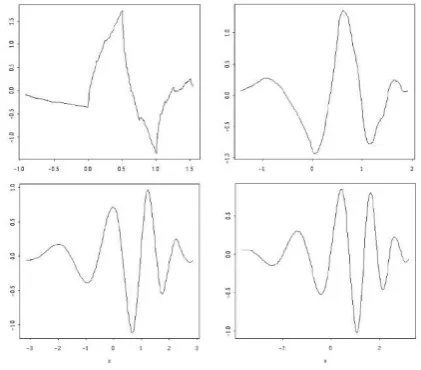
Figure 1. Wavelets from Daubechie's family Source: Wavelets for Kids (B. Vidakovic & P. Mueller)
F. The Haar Wavelet
The Haar wavelet (also known as the mother of all wavelets) is the simplest and the oldest wavelet. It is a step function taking values of positive and negative unity for some defined interval and vanishes outside that interval. The Haar wavelet is defined as,
( )
{
( )
We can uniformly approximate any continuous function with the help of Haar wavelets. Even the random motion like Brownian motion can be defined by this wavelet.
The scaling function of the Haar wavelet is defined as,
( ) { ( )
Dilations and translations of the function ( ) is defined as,
( ) ( ) ( )
This define an orthogonal basis in ( ) i.e.; the space of all square integrable functions. It means that any element in ( ) can be represented as a linear combination of these basis functions.
More precisely, for every pair of integers in ℤ, the Haar function is defined as,
( ) ( ) ( )
The function is supported on the right open interval
[ ( ) )
We may also say that the function vanishes outside the interval. It has integral 0 and norm 1 in the Hilbert Space ( ) .
∫ ( ) ( )
|| ||
( ) ∫ ( ) ( )
Also, the Haar functions are pairwise orthogonal
∫ wherever and is not satisfied simultaneously. This is because,
∫ ( ) ( ) where represents
Kronecker delta function.
Figure 2. Graphical representation of the Haar Wavelet
Source: Wikipedia (The Haar Wavelet)
We will try to look more into the Haar Wavelet. Let's start with the function
1.
( ) √ ( ) ( )
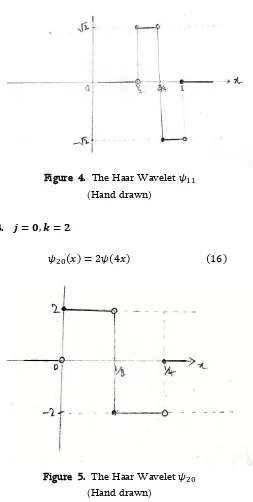
Figure 3. The Haar Wavelet (Hand drawn)
2.
( ) √ ( ) ( )
Figure 4. The Haar Wavelet (Hand drawn)
3.
( ) ( ) ( )
Figure 5. The Haar Wavelet (Hand drawn)
Similarly, we can go on sketching the Haar wavelets for other and values. Earlier in this paper, we discussed a little about the scaling function. Let's see what it is in more detail:
basis . For the Haar wavelet basis, the scaling function is unity on the interval , ).
( ) ̃ ( ) ( )
Before we go any further, we will look into the Haar transformation matrix. Note that we are not looking into the derivation of the Haar Matrix which uses approximation using Haar wavelet transformation. The example is taken directly from the paper
Wavelets for Kids, (Vidakovic & Mueller). The example is directly taken as the input data vector is well defined.
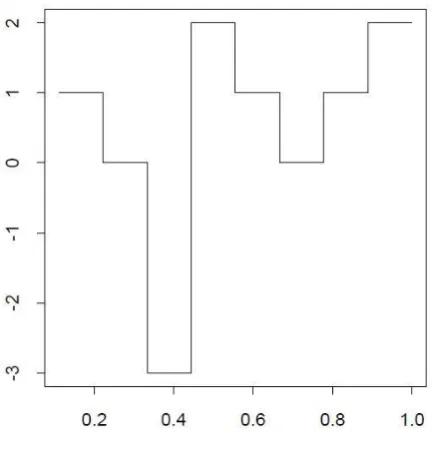
Consider a data vector ̃ ( )
represented as the data function shown in the figure below. The data function is defined in the interval
, ) . We will show how this data can be transformed using the Haar matrix of size .
Figure 6. Data Vector ̃
The matrix equation below shows the relation between the data vector and the wavelet coefficients.
Thus, the function can be written as the linear combination of the Haar wavelets and the transformed vector elements. The function
√ √
(23)
II. APPLICATIONS OF WAVELET
Since last few years, wavelets have emerged extensively in the areas of pure mathematics, electrical engineering, quantum physics, computer science, image processing, data analysis, cryptology,
etc. Looking at history, wavelets were first applied in geophysics to analyse data from seismic surveys, which are used in oil and mineral exploration to get pictures of layering in subsurface rock.
We will see few case studies, the real-life application of wavelets used.
A. Wavelets for Image Compression
Image compression is a method through which we can decrease the file size of an image. Reduction of image file size is needed for easy transmission of any computer process in which that image file is used. Note that there must be a trade-off between the size of the file and the quality of the image. With wavelets we are trying to reduce this trade-off so that we can get better quality images in less file sizes. Haar wavelets are commonly used in still image compression system. Mean square error and the energy retained are few common scales at which we judge the quality of image compression.
Image compression is used widely in the field of digital image processing. Think about the number of digital images created every day in the world! Every photograph that we take in our android phone gets
uploaded to the servers of Google. Every picture media transfer on WhatsApp or every photo upload on Facebook takes billions of megabytes every day. It is impossible to increase the size of server room every day for these mega companies. This is one important reason they keep on researching on image compression techniques. Reducing the storage requirement is equivalent to increasing the capacity of the storage medium increase the speed of transmission and hence communication bandwidth. The efficient ways of storing large amount of data and due to the bandwidth and storage limitations, images must be compressed before transmission and storage. At some later time, the compressed image is decompressed to reconstruct the original image or approximation of it.
1. Multi Resolution Analysis
In Multiresolution Analysis, source signal is processed at multiple resolutions. Say we have an image IMAGE. We go through the following pyramid,
(24)
Then we apply and combine filtering at all these resolutions. A better way to understand MRA is think of an image. Say the image below,
It is our common observation that the level of details within an image varies from location to location. For example, the image above has some locations that contain significant details (the lower half of the image), where we require finer resolution for analysis and there are other locations (the upper half showing sky), where a coarser resolution representation suffices. A multi-resolution representation of an image gives us a complete idea about the extent of the details existing at different locations from which we can choose our requirements of desired details. Multiresolution representation facilitates efficient compression by exploiting the redundancies across the resolutions. Wavelet transforms is the popular approach for multi-resolution image analysis.
There are two types of image compression, Lossless
and Lossy. In Loseless compression, the image is recovered completely after the decompression. Such compressions are not very common as with natural images, there is always some loss due to significant detailing. We can obtain higher compression ratios, if we allow some errors between the decompressed image and the original image. This is Lossy compression. Sometimes these compressions are very helpful in de-noising the data. Consider a photograph clicked with flash in the evening outdoors. Thus, compressing and decompressing this photograph, the image will lose its preciseness and sharpness at the critical significant part of the image.
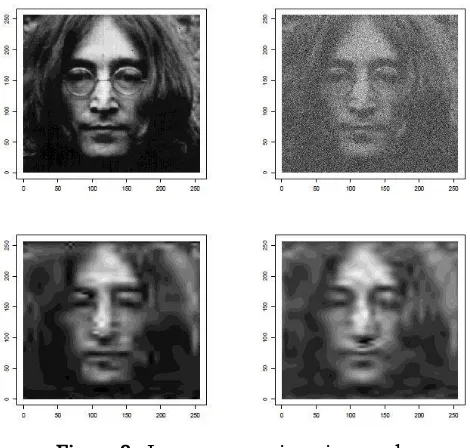
Figure 8. Image restoration via wavelets (Source: Wavelets for Kids (Vidakovic & Mueller))
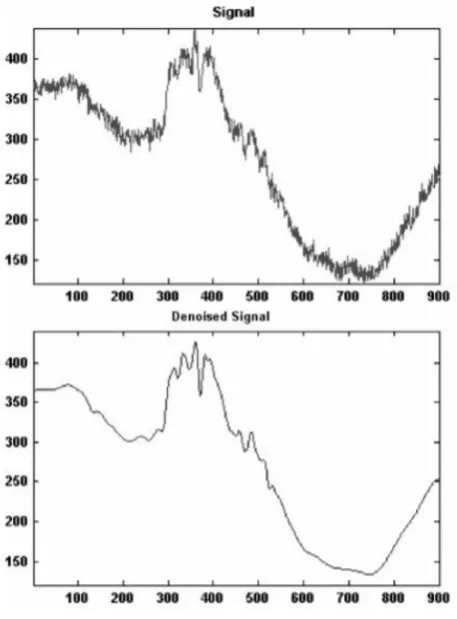
B. De-noising of Noisy Data
Figure 9. Denoising by wavelets: before & after (Source: Wavelets and their applications [15])
C. Wavelets in Google Maps
Google Maps provides one of the best satellite images to the world. This web-service provides a high-resolution imagery of not just popular and important zones of USA but also of the huts and woods of Africa. Wavelet filters are used for processing these high definitions and high-resolution imageries.
III.CONCLUSION
From this paper, one may get a basic idea of what wavelets are, how the most basic wavelet transformation works and the applications of wavelets in image processing. From the exponential increase in the use of wavelet analysis in science and engineering, it is one of the burning topics of mathematics for research.
From this paper, a person may also get the idea of transformation of data vector using the Haar matrix. The important topics summed up in this paper are the basic introduction to wavelets, the Haar wavelets and the matrix, and a short and basic image compression example. I also read MRA (Multiresolution Analysis) and Thresholding to understand the application of image processing.
Overall, this self-project gave me a very good idea to carry on advanced research in pure and applied mathematics altogether. Reading papers and trying to understand and carry out problems were the most interesting part in the creation of this material.
IV. REFERENCES
[1] Ingrid Daubechies. Ten Lectures of Wavelets.
Springer – Verlag, Reading, June 1992.
[2] Brani Vidakovic, Peter Mueller. Wavelets for Kids. Duke University, Reading, 1991.
[3] Fahima Tabassum, Md Imdadul Islam, Mohamed Ruhul Amin. A Simplified Image Compression Technique Based on Haar Wavelet Transform. Jahangirnagar University, ICEEICT, May 2015.
[4] Amara Graps. An Introduction to Wavelets.
IEEE Computer Society, Reading, 1995.
[5] B. M. Kessler, G. L. Payne, W. N. Polyzou.
Wavelet Notes. The University of Iowa, Notes, Feb 2008.
[6] Daniel T.L. Lee, Akio Yamamoto. Wavelet Analysis: Theory and Applications. Hewlett-Packard Journal, Reading, Dec 1994.
[7] Sangeeta Arora, Yadwinder Singh Brar, Sheo Kumar. Haar Wavelet Matrices for the Numerical Solutions of Differential Equations.
International Journal of Computer Applications (0975 8887), Jul 2014.
University of Silesia, Machine GRAPHICS & VISION, 2004.
[9] Rajesh Patil. Noise Reduction using Wavelet Transform and Singular Vector Decomposition.
IIT Bombay, IMCIP-2015, Reading, 2015. [10] James S. Walker. Wavelet-based Image
Compression. University of Wisconsin – Eau, Claire, Transforms and Data Compression, Book.
[11] Kamrul Hasan Talukder, Koichi Harada. Haar Wavelet Based Approach for Image Compression and Quality Assessment of Compressed Image. IAENG, IJAM, Reading. [12] Gilbert Strang. Wavelets and Dilations
Equations: A Brief Introduction. Society for Industrial & Applied Mathematics, Reading, Dec 1989.
[13] Dipalee Gupta, Siddhartha Choubey. Discrete Wavelet Transform for Image Processing.
International Journal of Emerging Technology and Advanced Engineering, Reading, Mar 2015. [14] Tzu–Heng Henry Lee. Wavelet Analysis for Image Processing. National Taiwan University, Reading.
[15] Michel Misiti, Yves Misiti, Georges Oppenheim, Jean-Michel Poggi. Wavelet and their applications. ISTE Ltd, Book, 2007.
[16] Amelia Carolina Sparavigna. Enhancing the Google imagery using a wavelet filter.