© 2018 IJSRCSEIT | Volume 3 | Issue 5 | ISSN : 2456-3307
A Survey on Intrusion Detection Technique in Cloud
Computing System
Preeti Chourasiya
Department of Information Technology, PCETs Pimpri Chinchwad College of Engineering, Pune, Maharashtra, India
ABSTRACT
The existing IDS used in traditional Internet or Intranet environments deficiency the features of autonomic scalability. In accumulation, they are not proper work which produce them unsuitable for cloud based environments. This needs the essential of an innovative cloud based IDS which can carry out its security necessities. In this research work to study and analysis number of intrusions affecting approach, secrecy and reliability of Cloud resources and services. To proposed novel Intrusion Detection algorithm in Cloud are examined. Our proposed algorithm work as with multi-threaded IDS approach. The multithreaded IDS would be intelligent to increase enormous quantity of data and could diminution the packet loss. The cloud user can access its data on servers at service provider’s site over the cloud network. Customer requests and actions are monitor and logged during a multi-threaded NIDS. The attentive logs are voluntarily communicate to cloud user with a specialist advice for cloud service provider.
Keywords: Cloud computing, IDS, Network Based IDS, Host Based IDS.
I.
INTRODUCTION
Cloud computing is an internet created computing where virtual cooperative servers give Infrastructure, stand, Application, Elastic resources, devices and hosting to customer as a service on “pay-for-use” basis. Cloud computing is the distribution of on necessitate network access to a collective pool of configurable computing resources the entire thing from application to Data Centers over the Internet.[1][3] Figure.1 clarify the perception.
Figure 1. [Created by Sam Johnston-2009] basic Cloud Computing Infrastructure
Cloud computing has number of services provisioning infrastructure, less preservation cost, data & services convenience declaration, rapid convenience and scalability. Cloud computing deliver three services clearly Software as a Service (Saas), Platform as a Service (Paas), and Infrastructure as a Service (Iaas).
II.
INTRUSION DETECTION SYSTEM
IDS can be dissimilar as defense machinery, which detects aggressive actions in a network. The key is to detect and possibly avoid activities that might collaboration system security, or particular hacking determination in progress counting investigation data compilation phases that engage port scans. One key feature of intrusion detection systems is their ability to give a view of infrequent activity and to question alerts notifies administrators and or blocking a supposed connection. IDS tools are knowledgeable of characteristic amongst insider attacks originate from private the organization and separate ones. Once an intrusion and threat has been detected, IDS issue alerts alert cloud administrators. The afterward step is assumed by the administrators or the IDS itself. Two define foremost category of intrusion detection technique. Misuse detection - Misuse Detection model mentions to detection of intrusions that go late distinct intrusion patterns. It is enormously cooperative in detecting recognized attack pattern. Anomaly detection - Anomaly detection refers to detection perform by detecting deviations in the patterns or performance of the system. It can be used to detect predefined recognized and anonymous attack. Anomaly Detection classify irregular behavior (anomalies). The IDS can be additional classified affording to data collection. Host Based IDS Host-based IDSs (HIDS) function on in sequence collected from inside an individual computer system. A Host-based IDS fundamentally monitors the received and departing packets from the computer system simply and would prepared the customer or administrator if mistrustful activity is detected. Host Based IDSs inspect the distrustful behavior comparable system call, developments and configuration access by scrutinize the circumstances of host. It is used to protect valuable and private information on server system. HIDSs are intelligent to allocate as NIDS if they are installed on a single host and prepared to detect network activities. HIDS is collected of sensors located on servers or workplaces which are complete to avert the attacks to a host. Network Based IDS - Network-based IDSs (NIDS) can scrutinize, monitor
and investigation the specific and pre-identified network traffic. This type of IDS internment network traffic packets such as) and examine the content following to a set of RULES or SIGNATURES to select if a POSSIBLE occurrence assumed place. It can detect different conditions based on specific points and located amongst the end point approach layers delivers the data pending after a layer to a new layer. The rest of this paper is structured as follows: In section II, we define concisely numerous possible intrusions in Cloud. Section III presents detection techniques used by IDS. In Section IV, we define dissimilar types of IDS in Cloud. Section presents detailed analysis of numerous existing IDS techniques for cloud Section V. concludes our work with the references at the end.
III.
LITERATURE REVIEW
Tara Salman et al[1] In this paper, investigate both detecting and classifying anomalies relatively than just detecting, which is a collective trend in the contemporary research works. They have used a current publicly accessible dataset to build and test learning models for together detection and categorization of dissimilar attacks. To be exact, they have used two supervised machine learning methods, namely linear regression (LR) and random forest (RF). Hamza Hammami et [2] in this work explained by the significance of expending services offered by cloud computing in disseminated applications and by the interest to completely take benefit of their strengths. Proposed a novel intrusion detection system dedicated to the security of cloud computing resources and services.
Zhiyuan Tan et al[3] resilient to collusion attacks, in which frequent nodes are cooperation and consistent for attack. Lastly, a backup central coordinator runs subsequent to the foremost coordinator to put off a single point of failure. The coordinators’ roles can be trade conditional on actual requirements and network conditions.
Manthira Moorthy et al[4]Cloud intrusion detection datasets are intelligent to perceive cloud attacks. Cloud based IDS were intelligent to detect 80% of Random sets of cloud attacks. By adding situation traffic retrieved from darpa, IDS was intelligent to detect the like percentage of attacks and no false positive alarm is elevated while filtering environment traffic.
U. Oktay et al[5]expected to provide definitions and properties of different attack types in cloud computing and to inductee intrusion detection and prevention model to resist these types of attacks.
Turki Alharkan et al[6]present IDSaaS, which is a framework that permit consumers to protect their virtual and Virtualization machines in public clouds. IDSaaS is compatible with a percentage of cloud
features, such as movability, elasticity, on insist requirements and pay-per-use service. The technique presented in this examine is implemented as a gathering of virtual machines in instruction to perceive with the cloud model.
The work by Mazzariello et al. [7] discusses a selection of deployments of existing IDS to an open preliminary place cloud condition. The recommended model is to establish multiple IDSs subsequent to both cloud physical controller, which monitors a less important portion of network traffic for a set of virtual machines. The collective setup for this method necessitate deep alteration of the physical achievement of the cloud assets, which significances in a strong need among the IDS components and the cloud provider's infrastructure. As a consequence, the IDS administration process reachable to the cloud consumers is limited and deficiencies customization. architecture contains of a quantity of sensors and a central management unit. This distributed-IDS architecture is appreciate in all of the three cloud computing layers (Application layer, Platform layer and System layer), which include a combination of host-based IDS (HIDS) and network base IDS (NIDS) sensors.
IV.
PROPOSED METHODOLOGY
ability in detecting novel attacks. The Anomaly Based IDS describes a baseline model for normal behavior of the system complete training, and deliberate several activity which lies separate of this usual model as anomaly. Though, furthermost of the IDSs are signature-based[3], meaning that they are unable to detect novel threats. Problematic to detect network intrusion in virtual network and detect intrusion since encrypted traffic. IDS Detector are establish at a allocation of places that decrease the presentation of complete system. It cannot detect insider attack as well as recognized attack since just snuffle is used. Virtualized Intrusion Detection System is assist to handle the enormous scale network access traffic and protect the data and application in cloud from malicious attack and vulnerabilities. A cloud IDS Model have the individuality of virtualization to contemporary improved security in cloud environment. This architecture will be proficient of detecting insider and unidentified attacks and host and port scanning achieve by each host in a network. The cloud IDS Model use a Virtualized IDS system and composed NIDS and HIDS professionally to block malicious traffic. It produce a report with the support of both IDS Supervisor and Third Party observing and optional service to Cloud Service provider and as well produces an attentive report for Cloud users.
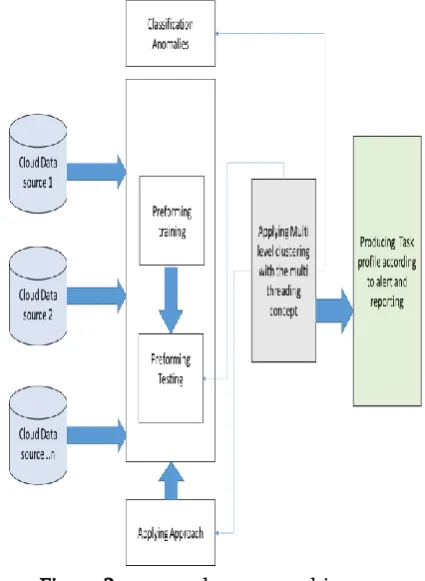
Figure 2. proposed system architecture
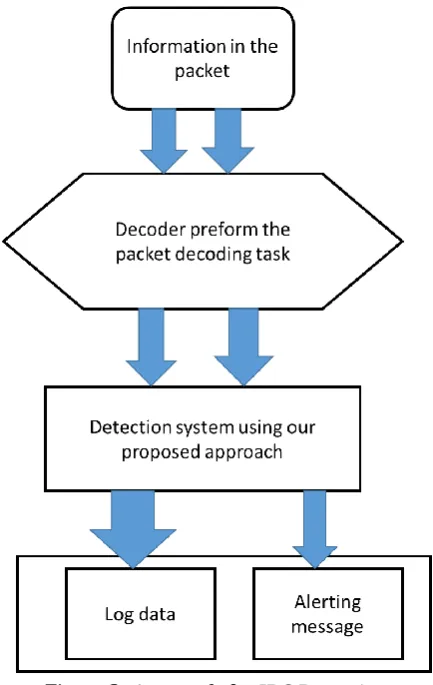
Figure 3. Approach for IDS Detection
To propose architecture of cloud IDS Model, there are foremost four constituents. Figure.1 illustrations the architecture of cloud IDS Model.
Stage 1. IDS Controller - An IDS controller will produce different illustrations of IDS for each user and these occurrences are deployed between each user and Cloud Service Provider (CSP). These instances are name as Mini IDS and it will occupation on every precise user.
Stage 2. Multi-threaded Cloud IDS based on fuzzy logic and artificial intelligent neural network concept organized on the bottleneck of network points such as router, gateway external the virtual machine and monitor the system traffic.
Stage 3. Third party Analysis the alerts sent by cloud IDS and produce optional reports to IDS controller. The IDS Controller decrease the workload of single IDS aimed at cloud surroundings. It similarly produces a concluding recommended report to CSP and an alert report to cloud user.
Stage 4. HIDS Based Hypervisor - It used for server and analysis the encrypted and fragmented data by signature and concert study on them.
Our proposed fuzzy cluster based technique is to partition a quantified set of data into clusters, and it be thought to have the consequent properties. Similarity classified the clusters, affecting to data in comparable cluster, and heterogeneity amongst clusters, where data fit to different clusters should be as dissimilar as possible. Complete fuzzy clustering module, the training set is clustered into a quantity of subsets. Outstanding to the information that the size and difficulty of every training subset is focused, the efficiency and efficiency of subsequent ANN module can be developed and improve. There to used multi-level clustering technique. Subsequent to Partition of training set correspondingly necessitate to collective the significances for fuzzy aggregation. Consequently, to select one of the applying clustering technique, fuzzy c-means clustering, aimed at fuzzy clustering module.
V.
CONCLUSION
IDS would be intelligent to increase enormous quantity of data and could diminution the packet loss.
VI.
REFERENCES
[1]. T. Salman, D. Bhamare, A. Erbad, R. Jain and M. Samaka, "Machine Learning for Anomaly Detection and Categorization in Multi-Cloud Environments," 2017 IEEE 4th International Conference on Cyber Security and Cloud Computing (CSCloud), New York, NY, 2017, pp. 97-103. doi: 10.1109/CSCloud.2017.15 [2]. H. Hammami, H. Brahmi and S. Ben Yahia,
"Security insurance of cloud computing services through cross roads of human-immune and intrusion-detection systems," 2018 International Conference on Information Networking (ICOIN), Chiang Mai, 2018, pp. 174-181. doi: 10.1109/ICOIN.2018.8343106 [3]. Zhiyuan Tan , Upasana T. Nagar, Xiangjian He,
and Priyadarsi Nanda, Ren Ping Liu , Song Wang , Jiankun Hu," Enhancing Big Data Security with Collaborative Intrusion Detection" IEEE CLOUD COMPUTING SEPTEMBER 2014.
[4]. Manthira Moorthy S, Virtual Host based IDS for Cloud, International Journal of Engineering and Technology (IJET),Vol 5 No 6 Dec 2013-Jan 2014.
[5]. U. Oktay and O.K. Sahingoz," Attack Types and Intrusion Detection Systems in Cloud Computing" 20-21 September /Eylül 2013 | Ankara / TURKEY.
[6]. Ms Deepavali p Patil, Prof.Archana C.Lomte Implementation of Intrusion Detection System for Cloud Computing International Journal of Advanced Research in Computer Science and Software Engineering,Volume 3, Issue 11, November 2013.
[7]. A.Y. Sarhan and S. Carr, "A Highly-Secure Self-Protection Data Scheme in Clouds Using Active Data Bundles and Agent-Based Secure Multi-party Computation," Proceedings of the IEEE 4th International Conference on Cyber
Security and Cloud Computing (CSCloud 17), 2017, pp. 228–236.
[8]. M.B. Mollah, M.A. Azad, and A. Vasilakos, "Security and privacy challenges in mobile cloud computing: Survey and way ahead," Journal of Network and Computer Applications, vol. 84, 2017, pp. 38–54.
[9]. S.S. Gill et al., "CHOPPER: an intelligent QoS-aware autonomic resource management approach for cloud computing," Cluster Computing, 2017, pp. 1–39.
[10]. Turki Alharkan , Patrick Martin," IDSaaS: Intrusion Detection System as a Service in Public Clouds" CLOUD COMPUTING 2012 : The Third International Conference on Cloud Computing, GRIDs, and Virtualization.
[11]. S. Roschke, F. Cheng, and C. Meinel, "Intrusion Detection in the Cloud", In Proceedings of Workshop Security in Cloud Computing (SCC'09), IEEE Press, Chengdu, China, pp. 729- 734 (December 2009).
[12]. F. Sibai and D. Menasce, "Defeating the Insider Threat via Autonomic Network Capabilities," Communication Systems and Networks (COMSNETS), 2011 Third International Conference pp. 1-10, 4-8 Jan. 2011
[13]. Sengaphay K, Saiyod S, Benjamas N. "Creating Snort-IDS Rules for Detection Behavior Using Multi-sensors in Private Cloud" Information Science and Applications (ICISA) 2016. Lecture Notes in Electrical Engineering, vol 376. Springer, Singapore