IJEDR1502109
International Journal of Engineering Development and Research (www.ijedr.org)596
Image Inpainting Through Quality Based Patch
Selection Matrix
1
Varsha Soni,
2Yogesh Rathore
1Scholar, 2Assistant Professor1,2Department of Computer Science & Engineering, Raipur Institute of Technology, Raipur, India
______________________________________________________________________________________________________
Abstract - Image inpainting refers to the set of techniques which include filling-in of missing area (known as holes) in a picture such that modifications made to the picture are unnoticeable. The algorithms for image inpainting that are proposed in the literature are rooted on the concept to fill-in the holes by means of available information in the surroundings. This information can be automatically detected or hinted by the user. This paper propose a modified Criminisi’s exempler based image-inpainting method in which quality based patch selection is performed in the process of inpainting of digital images to recover the lost part of the image in a visually plausible way such that the changes made to the image are not detected by the normal user. Here, a measure of SSIM (Structural Similarity Index Metrics) is integrated in the process of inpainting, where, confidence term, data term and priorities for the patches are based on SSIM index that compares local patterns of pixel intensities that have been normalized for luminance and contrast. After the image-inpainting is completed using this proposed modified criminisi’s inpainting algorithm, a single-image super-resolution (SR) approach is employed to enhance the super-resolution of the inpainted image consequently improving the quality of the resulting image.
IndexTerms - Image-inpainting, Image-processing, texture-synthesis, super-resolution, ssim
________________________________________________________________________________________________________
I.INTRODUCTION
Image inpainting is a technique to recover missing or damaged parts of an imageso that the reconstructed image looks natural and modifications made to the image are unnoticeable. Image-inpainting is significant research matter in image restoration. Here, a modified exempler based inpainting technique is proposed in this paper. In the proposed method, quality based patch selection is performed by integrating a measure of SSIM (Structural Similarity Index Metrics) in the process. Here, Confidence term, data term and priorities for the patches are based on SSIM index that compares local patterns of pixel intensities that have been normalized for luminance and contrast.
Natural image signals are tend to be highly structured. Their pixels hold strong dependencies, mainly while they are spatially proximate, and these dependencies bear essential information regarding the structure of the objects in a digital image. It is assumed that the human visual system (HVS) is very well adaptable in extracting structural information from the viewing field. Consequently a measurement of change in structural information might supply a good approximation to perceived distortion in image. The SSIM measurement is based on this assumption, as a result of which higher accuracy and reliability is achieved as compared to other similarity measures.
The resulting SSIM index is a decimal value between -1 and 1, where value 1 is reachable only in the situation when the two sets of data are identical. The closeness of the result of SSIM to the value 1 indicates the good similarity percentage between the images.
In Exemplar-based scheme, the target region is filled iteratively employing the best matching image patch from the rest of the known image. An essential part of this paradigm include confidence term, data term along with priority of patches which is the base to decides order of filling process. Here, in the proposed work priority computation is based on confidence term, data term as well as SSIM index. SSIM further enrich priority assignment for patches on the boundary as a consequence helps in assessing correct order of filling procedure.
Once priorities are obtained, patch holding highest priority is selected. For that selected patch, best matching patch is explored from source region (I − Ω). Information from the best-match-patch is then copied to the highest priority patch. This is demonstrated by Figure 1 below.
Importance of priority
The order in which filling procedure is carried on is extremely important for all the approaches for inpainting. Linear structure information is preserved by adjusting the order of inpainting. Priority term is computed for all the image patches of the removal area of the damaged image.
IJEDR1502109
International Journal of Engineering Development and Research (www.ijedr.org)597
Figure 1 Patch propagation in exemplar-based inpainting Data term is additional feature of priority term. It is a function of the strength of isophotes hitting the front at each iteration. This term further improves the priority of a patch that an isophote “flows” into. This encourages linear structures to be inpainted first and also helps in preventing „connectivity principle‟ of psychology [2].
SSIM compares similarity among the current patch and the rest of the known image patches based on the structure component of the patch. The patch with similarity index closest to 1 will be given highest priority.
SR Approach
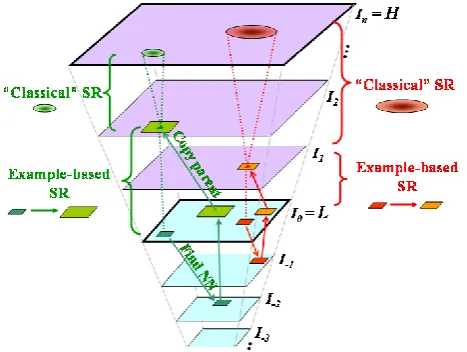
After the inpainting of the picture is completed, we use a single-image super-resolution approach [3] to enhance the resolution of the inpainted image which results in improved image quality. In this paper Glasner et al. introduces a unified framework that combines the two families of SR methods viz the classical multi-image super-resolution and the example-based super-resolution. This combined approach is employed to achieve super-resolution using a single image (without any database or prior examples). Recurrence of patches in an image is the foundation for this single image super-resolution approach. Figure 2 illustrates this approach.
Here, Let B be the blur kernel (camera PSF) linking the low-resolution input image L with the unknown high-resolution image H: L = (H * B) . Let I0, I1,…., In represent a cascade of unknown images of increasing resolutions (scales) ranging from the low-res L to the target high-low-res H (I0 = L and In = H), including a corresponding cascade of blur functions B0, B1,….Bn (where Bn = B is the PSF relating H to L, and B0 is the δ function), such that every Il satisfies: L = (Il *B1) (sl denotes the relative scaling factor). The resulting cascade of images is shown in Figure 2 (the purple images).
In addition, Let L = I0, I -1 , … , I -m represent a cascade of images of decreasing resolutions (scales) obtained from L using the same blur functions {Bl}; (l = 0,…,m). Furthermore, note that these low-resolution images are known (computed from L), unlike the high-res image cascade. The resulting cascade of images is illustrated in Figure 2 (the blue images).
Considering the input low-res image L, its patches (dark red and dark green patches) are searched for in the down-scaled versions of L (the blue images). As soon as a matching patch is found, its higher-resolution parent patch (light red and light green),is extracted from L, and is copied to the appropriate location in the unknown high-resolution image (purple images) including the appropriate gap in scale. Such a „learned‟ (copied) high-res patch produces classical SR linear constraints on the unknown high-resolution intensities in the target high-resolution H. The support of the corresponding blur kernels (red and green ellipses) are governed by the residual gaps in scale amongst the resolution levels of the „learned‟ high-res patches and the target resolution level of H. Note that for different patches found in different scale gaps, the corresponding blur kernels (red and green ellipses) will consequently comprise different supports.
IJEDR1502109
International Journal of Engineering Development and Research (www.ijedr.org)598
II.RELATED WORKJian Sun et al. published a paper [7].This paper presents a novel scheme for image completion that is labeled as structure propagation. In this approach, user needs to specify by means of a curve-based interface, the significant structures that are supposed to be completed prior to the filling-in of the left over missing regions. Structure propagation is devised as a universal optimization problem, solution of which lies in belief propagation if only a single curve is specified or else dynamic programming, if multiple interconnected curves be specified. As soon as structure propagation is completed, the remaining lost regions are filled in utilizing patch-based texture synthesis. Their work is exposed on a number of challenging examples .As a result of employing proficient optimizing algorithms along with an intuitive interface, the system efficiently incorporate human intelligence within the completion procedure that produces high-quality results for a number of challenging images.
Shai Gepshtein and Yosi Keller published a paper [8].In this paper a Diffusion based framework is introduced for image inpainting. In this approach, Diffusion embedding is utilized to produce application based smoothness on the inpainted picture. The smoothness of the embedded eigenvectors is responsible for the induced smoothness in the inpainted picture, when suitable affinity measures are used to compute, for instance the LBP texture features. In addition, to facilitate computation of an inverse-diffusion mapping a novel efficient scheme is introduced that is based upon discrete optimization, including an analogous spectral relaxation. The presented inpainting technique compares auspiciously with earlier defined schemes. The proposed scheme is capable of inpainting texture as well as smooth images, as canonical smooth representation is achieved by the embedding space .The usefulness of the proposed method is illustrated by the results of the inpainting of real images, along with comparing to earlier inpainting schemes.
Seunghyup Shin published a paper [9].This paper proposed a method for texture synthesis that is a pixel-based method having non-parametric sampling. The proposed scheme uses global framework of the pixel-based paradigm, including three distinctive features: window size estimation, seed point planting, & iterative refinement. Using the scale of a dominant texture component the window size is anticipated automatically. A grid of seed points are at the beginning planted onto the output texture to capture large-scale structures of a texture sample and, eventually, the output texture is improved as a result of iterating diffusion of non-stationary artifacts on the whole output texture region. On the basis of experimental results, it is concluded that texture blurring and garbage growing problems are not actually inherent in pixel-based methods.
David Tschumperle. et al. published a paper [11].This paper presents a novel formalism that expresses a huge set of previous vector-valued regularization schemes within a common local expression. In order to understand the local smoothing behavior of diffusion PDEs, the proposed formulation is become accustomed. In fact, it enlighten the link among the diffusion tensor shapes in divergence d trace-based equations, and the actual smoothing achieve by these processes, concerned with local filtering. Moreover, a broad range of applications is illustrated that is handled by the proposed selected anisotropic diffusion equations with application results on color images which demonstrate the effectiveness of the scheme in dealing with concrete cases of vector-valued regularization processes.
William T. et al. published a paper [12].This paper introduces a simpler and faster algorithm for one-pass super-resolution which is develop on the basis of training-based super-resolution algorithm presented in [28].The scheme necessitate simply a nearest-neighbor search in the training set in favor of a vector derived from each patch of local image data. This goal of the algorithm is to achieve resolution independence in image based representations. Here image interpolation schemes are utilized that make use of a database of training images to generate probable high-frequency details in zoomed images.
III.PROPOSED MODELING
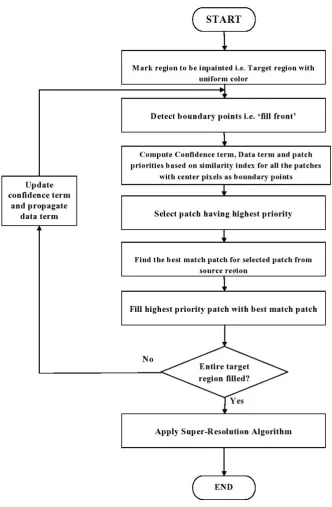
The proposed work is the modified exempler-based inpainting proposed by criminisi [1].The conventions used are similar to earlier papers that deal with this problem of image inpainting. Here, I correspond to the original image. Ω represents the target region, i.e. the region to be inpainted. Φ represents the source region, i.e. the region from which information is available to reconstruct the image. In general, Φ = I – Ω. In addition, δΩ is used to represent the boundary of the target region, i.e. the „fill front‟. The patch to fill-in is selected from here. Using this algorithm, inpainting of large missing regions in an image as well as reconstruction of small defects is performed. Flowchart for the algorithm is given by Figure 3. It involves the following steps: (i) Initialize the target region.
This is usually performed separately from the inpainting process and entails the use of an additional image processing tool. This is achieved by marking the target region in some special color. Without any loss of generality, let us consider that the color that the target region will be marked in is red (i.e. R = 255, G = 0, B = 0).
(ii) Find the boundary of the target region.
After the target region is initialized, its boundary also known as „fill front‟ is discovered. A kind of spatial filtering is used to detect pixels on the boundary of target region. Next, for all border patches, priority is computed having distinct patches for each pixel lying on the boundary of the target region.
This approach undertakes isophotes into consideration, and thus assigns higher priority to those „interesting points‟ on the boundary of the gap, that are a part of linear structures, and therefore should be extended into gap so as to attain a natural look. Criminisi assigns a priority value to all pixels on the boundary of the gap, in order to recognize those interesting points. The interesting points will gain higher priority; as a consequence the linear structures are likely to be extended first.
(iii) Iterate the steps (iv) to (viii)
IJEDR1502109
International Journal of Engineering Development and Research (www.ijedr.org)599
(iv) Compute Confidence term, Data term and patch prioritiesFor each pixel present on the boundary a patch is considered with that pixel as the centre. Then for all the boundary pixels, confidence term and data term are computed using eqn. (1) and (2) respectively and SSIM index for the current patch and the rest of the known patches is computed using eqn. (3). Priority for the patches is calculated using eqn. (4).
C(p) = ∑
| | (1)
D(p) = | | (2)
Where,
|ψp| -is the area of the patch ψp with center pixel p; I -is the entire image;
Ω- is the target region;
C(q) -represents confidence value for pixel q which belongs to patch centered at pixel p which is already known; -is the normalization factor (equal to 255 for a normal grey level image);
np-is a unit vector orthogonal to the front δΩ at the point p and represents the perpendicular isophote at point p.
The value of np is obtained by finding the gradient for the source region. The source region represents a matrix with all ones for the points that are not in the target region and zeros otherwise (i.e. for the points in Ω).
SSIM(x, y) = ( )( )
( ) ( ) (3)
Where,
µx = ∑ ,
σx = ( ∑ ) ,
and {μx, σx} and {μy, σy} represent the mean intensity and standard deviation set of image block x and image
block y, respectively, whereas σxydenote their cross correlation. C1 and C2 are small constants value to prevent instability problem
when the denominator is too close to zero.
P(p) = C(p) × D(p) + SSIM(x, y) (4)
(v) Select patch having highest priority
After the priorities for each boundary pixels are obtained, patch that possesses maximum priority is selected. The size of the patch should be slightly larger than the largest distinguishable texture element of the picture. Here a default patch size of 9 x 9 is taken which can be changed depending on size of the largest texture element in the image. The selected patch is denoted by ̂.
(vi)Find a patch from the image which best matches the selected patch ̂ .
The patch having the highest priority would be the target to fill. In order to find a patch that has most similarities with target patch, a global search is performed on the entire image. For the selected patch, ̂, best match patch is searched from source region
i.e. (I − Ω) using Sum of Squared Distance (SSD).
Formally,
̂ = arg ̂ , (5)
Where the distance d (Ψa , Ψb) between two generic patches Ψa and Ψb is simply defined as the sum of squared differences (SSD) of the already filled pixels in the two patches.
(vii)Fill highest priority patch with best match patch
Subsequently, the highest priority patch is then filled by the best matching patch, more specifically, information from the best-match-patch is then copied to the highest priority patch i.e. Copy image data from ̂ to ̂.
(viii) Update the image information
Afterwards, update the data term and confidence term according to the patch found in the previous step. After the patch ̂has
IJEDR1502109
International Journal of Engineering Development and Research (www.ijedr.org)600
C (q) = C (̂) ̂ . (6)This simple update rule permit us to evaluate the relative confidence of patches on the fill front, with no image specific parameters. Confidence values tends to decay as filling proceeds, demonstrating that near the centre of the target region, the color values of pixels are less certain.
(ix) Apply SR Algorithm
As soon as the entire target region is inpainted, a single image super-resolution algorithm is applied to the image to enhance the resolution of the image.
Figure 3 Flowchart for the proposed work;
IV.
R
ESULTS AND DISCUSSIONSIJEDR1502109
International Journal of Engineering Development and Research (www.ijedr.org)601
processor with 4 GB of RAM. We have also taken into account color images having composite textures. A patch size of 9×9 is considered throughout the algorithm.We have shown results visually as well as on the basis of comparison between MSE(Mean Square Error) and PSNR (Peak Signal to Noise Ratio) of the images before inpainting and after inpainting. Time-taken by the method to inpaint an image is considerable and obviously depends upon the size of the image as well as on how much area is selected to be inpainted.
Now, we show the resulting images by applying the proposed approach. Figure 4 shows the input images to the inpainting process and their outcomes. It is visually demonstrated that the proposed approach gives promising results.
(a) (b)
(c) (d)
(e) (f)
(g) (h)
Figure 4 Results: (a),(c),(e) and (g) are input images; (b),(d),(f) and (h) are outcome of the proposed work;
Next, Table 1 gives brief comparison between MSE and PSNR values of 5 images before inpainting and values after inpainting using our proposed approach, in tabular format. Our proposed approach results in lowering the MSE values and increasing the PSNR values of the images.In addition, Figure 5 and Figure 6 below represents the above comparison graphically using charts, where images are taken in X-axis and their MSE and PSNR values in Y-axis, respectively.
Table 1 Comparison of MSE and PSNR of the images before and after inpainting
Image MSE PSNR
Before After Before After
1. 0.2104 0.0207 54.932 65.003
2. 0.1863 0.0281 55.461 63.674
3. 0.0576 0.0087 60.559 68.723
4. 0.1231 0.0091 57.2607 68.5668
IJEDR1502109
International Journal of Engineering Development and Research (www.ijedr.org)602
Figure 5 Graph representing MSE values of 5 images before inpainting and after inpaintingFigure 6 Graph representing PSNR values of 5 images before inpainting and after inpainting V.
C
ONCLUSIONImage Inpainting is a set of techniques for making undetectable modifications to images. It is as ancient as art itself. There are several methods for digital inpainting proposed in literature. In this paper, modified criminisi‟s exempler based image-inpainting method is proposed to remove small as well as large objects from digital photographs, in a way such that the changes made to the image are not detected by the normal user. Here, a measure of SSIM (Structural Similarity Index Metrics) is integrated in the process of inpainting, where, Confidence term, data term and priorities for the patches are based on SSIM index that compares local patterns of pixel intensities that have been normalized for luminance and contrast. SSIM further enrich priority assignment for patches on the boundary as a consequence helps in assessing correct order of filling procedure. Experimental results show that the proposed work is effectual in visual quality improvement along with user preference consideration. It can be seen that MSE and PSNR values of the outcome images are improved by a considerable percentage, demonstrating the significance of the proposed work.
Moreover, this framework can be improved. Future work may include implementing the proposed algorithm using other quality factors, investigating extensions to current algorithm to handle accurate propagation of curved structures in still photographs, investigating extensions to current algorithm to handle accurate propagation of curved structures in still photographs, investigate methods for inpainting videos. In addition, two or more inpainting algorithms can be combined and implemented to further improve the result.
REFERENCES
IJEDR1502109
International Journal of Engineering Development and Research (www.ijedr.org)603
[2] Tony F. Chan, Jianhong Shen, “Nontexture Inpainting by Curvature-Driven Diffusions”, Journal of Visual Communicationand Image Representation, Volume 12, Issue 4, Pages 436-449, December 2001.
[3] Glasner, D., Bagon, S., Irani, M.: “Super-resolution from a single image”. In: In 2009 IEEE 12th International Conference on Computer Vision (ICCV). Volume 10. (2009) 349356.
[4] M. Bertalmio, G. Sapiro, V. Caselles, and C. Ballester, “Image inpainting,” in Comput. Graph. (SIGGRAPH 2000), July 2000 . [5] Marcelo Bertalmio, Luminita Vese, Guillermo Sapiro, Member, IEEE, and Stanley Osher:” Simultaneous Structure and
Texture Image Inpainting”,ieee transactions on image processing, vol. 12, no. 8, august 2003. [6] Sean Borman, Robert L. Stevenson, “Super-Resolution from Image Sequences - A Review”.
[7] Jian Sun Lu Yuan Jiaya Jia Heung-Yeung Shum:” Image Completion with Structure Propagation”,Microsoft Research Asia , Tsinghua University ,Chinese University of Hong Kong.
[8] Shai Gepshtein ,Yosi Keller : “ Image completion by diffusion maps and spectral relaxation”, Image Processing, IEEE Transactions on (Volume:22 , Issue: 8 )
[9] Seunghyup Shin, “On Pixel-Based Texture Synthesis by Non-parametric Sampling” Advanced Institute of Science and Technology, Korea.
[10] William T. Freeman, Thouis R. Jones, and Egon C. Pasztor, “Example-based super-resolution”, Computer Graphics and Applications, IEEE (Volume:22 , Issue: 2 ),2002
[11]David Tschumperle´ and Rachid Deriche, “Vector-Valued Image Regularization with PDEs: A Common Framework for Different Applications”, IEEE transactions on pattern analysis and machine intelligence, vol. 27, no. 4, april 2005
[12]W. T. Freeman, E. C. Pasztor, and O. T. Carmichael., “ Learning lowlevel vision. Intl. J. Computer Vision”, 40(1):25–47, 2000.
[13]Sina Farsiu, Michael Elad, Peyman Milanfar, “Multi-Frame Demosaicing and Super-Resolution of Color Images” IEEE Transactions on Image Processing vol. 15, no. 1, pp. 141-159, Jan. 2006
[14] Olivier Le Meur and Christine Guillemot:” Super-Resolution-based Inpainting”, ieee transactions on image processing vol.pp no 99 year 2013.
[15]W. T. Freeman, E. C. Pasztor, and O. T. Carmichael., “ Learning lowlevel vision. Intl. J. Computer Vision”, 40(1):25–47, 2000.
[16]Anupam , Sapan Diwakar and Pulkit Goyal ,” Fast and Enhanced Algorithm for Exemplar Based Image Inpainting “, Image and Video Technology, PSIVT, 2010 - ieeexplore.ieee.org.
[17]Ismail Avcıbas¸, “Image quality statistcs and their use in steganalysis and compression,” Ph.D. dissertation, Boˇgazic¸i University, 2001.