LHCf experiment: forward physics at LHC for cosmic rays study
M. Del Prete1,2,a, O. Adriani1,2, E. Berti1,2, L. Bonechi1,2, M. Bongi1,2, G. Castellini3, R. D’Alessandro1,2, M. Haguenauer4, Y. Itow5,6, K. Kasahara7, K. Kawade5, Y. Makino5, K. Masuda5, E. Matsubayashi5, H. Menjo8, G. Mitsuka2,5, Y. Muraki5, Y. Okuno5,9, P. Papini1, A-L. Perrot10, S. Ricciarini1,2, T. Sako5, N. Sakurai6, Y. Sugiura5, T. Suzuki7, T. Tamura11, A. Tiberio1,2, S. Torii6, A. Tricomi12,13, W.C. Turner14, and Q.D. Zhou5
1INFN section of Florence, Italy 2University of Florence, Italy 3IFAC-CNR, Italy
4Ecole-Polytechnique, France
5Solar-Terrestrial Environment Laboratory, Nagoya University, Japan
6Kobayashi-Maskawa Institute for the Origin of Particles and the Universe, Nagoya University,Japan 7RISE, Waseda University, Japan
8Graduate school of Science, Nagoya University, Japan 9Nagasaki Institute Applied Science, Japan
10CERN, Switzerland
11Kanagawa University, Japan 12INFN Section of Catania, Italy 13University of Catania, Italy 14LBNL, Berkeley, USA
Abstract. The LHCf experiment, optimized for the study of forward physics at LHC, completes its main physics program in this year 2015, with the proton-proton collisions at the energy of 13 TeV. LHCf gives important results on the study of neutral particles at extreme pseudo-rapidity, both for proton-proton and for proton-ion interactions. These results are an important reference for tuning the models of the hadronic interaction cur-rently used for the simulation of the atmospheric showers induced by very high energy cosmic rays. The results of this analysis and the future perspective are presented in this paper.
1 Introduction
LHC-forward experiment (LHCf) measures neutral particles production in a very forward region in proton-proton and proton-ion collisions at the Large Hadron Collider. The main purpose of LHCf is to improve hadronic interaction models used by Monte Carlo (MC) simulations of cosmic ray experiments. Highest energy cosmic rays can only be detected from secondary particles which are produced by the interaction of the primary particles with nuclei of the atmosphere, the so-called air showers. It is possible to reconstruct the kinematic parameters and the type of primary particle
studying the development of air showers. The energy flow of secondary particles is concentrated in the forward direction. Measurement of particle production at lager pseudo-rapidity, small angles, are very important. Moreover in the forward region soft QCD interactions dominates this MC simulations of air showers are based on phenomenological model, therefore inputs from experimental data are crucial. LHC accelerator gives the possibility to study a wide range of collision energies, from 0.9 TeV to 13 TeV in the center of mass frame, which corresponds to an energy range in the laboratory frame from 1014eV to 1017eV, this energy range covers the ”knee” region of cosmic rays spectrum, which occurs at 1015eV.
For these reasons LHCf can give more information to improve hadronic interaction models used in MC simulations to reproduce the development of air showers.
2 The LHCf experiment
LHCf is composed of two independent detectors, called Arm1 and Arm2 located 140 meters away from ATLAS interaction point, IP1 [1]. Arm1 is placed in the side of IP8 direction, toward LHCb experiment, and Arm2 is in the opposite direction toward IP2 and ALICE experiment. Detectors are placed inside Target Neutral Absorber (TAN), where the beam pipe turns into two separates tubes. The LHCf detectors occupy the first 30cmof the TAN slots, facing the interaction point, thus minimizing the material between them and IP1. This is the best condition allowed at the LHC for measuring fluxes and energy spectra of high energy forward neutral particles produced by the interacting beams. Since charged particles are deviated by the D1 dipole magnet (which bends colliding beams into the two separate beam pipes), only neutral particles, mainly photons and neutrons, reach the detector.
Each detector is made of two sampling and imaging calorimeters called towers. This is required to minimize the overlap of signals due to the different simultaneous showers when detecting two gamma system decay. The longitudinal dimension of towers is of 44 radiation lengths, which correspond to 1.6 nuclear interaction lengths. The transverse cross sections are different for the two detectors. Arm1 has dimension 20x20mm2for the small tower and for the large tower 40x40mm2. The Arm2 transverse cross sections are 25x25mm2for the small tower and 32x32mm2for the large tower.
Each tower is composed of 16 tungsten layers and 16 plastic scintillator layers to measure energy and also contains 4 position sensitive layers that are different for the two detector [2]. Arm1 uses scintillating fiber (SciFi) to measure position of the neutral particles in the towers, in Arm2 the position is measured by silicon microstrip detectors.
The different geometries of the two detectors have been carefully studied to maximize the acces-sible kinematic region and exploit the different characteristics of the position sensitive detectors. The smaller tower of each detector is placed on the beam center and covers the pseudo-rapidity rangeη> 9.6, while the larger tower covers the pseudo-rapidity range 8.4<η<9.4. Energy resolution obtained with these detectors configuration is better than 5 % for photons and of about 40 % for neutrons.
3 Results from LHCf
Until now, data were taken in three different runs of LHC in 2010, 2013 and 2015. In 2010 LHC produced proton-proton collisions at √s=900GeVand at √s=7T eV; in 2013 proton-lead colli-sions at √sNN =5.02T eVand proton-proton collisions at
√
s=2.76T eVwere produced. In 2015 a special low luminosity proton-proton run at √s = 13T eV was dedicated to LHCf. Main results by the LHCf experiment are published in papers [3–6]. In this section we will present results for the inclusive neutron spectra measured in p-p collisions at √s=7T eV in section 3.1, for thepT vs
the pseudo rapidityπ0spectra in p-Pb collisions at √sNN =5.02T eVin section 3.2 and preliminary
3.1 Neutron spectra in p-p collisions at √s=7T eV
The data used in this analysis were taken in 2010 in low luminosity conditions, that are optimal for LHCf experiment due to the reduced event pile-up effect. Integrated luminosities were 0.68nb−1and 0.53nb−1 for Arm1 and Arm2 respectively, with a typical luminosity of 6.4·1028cm−2s−1, derived from LHCf front counters [7]. Performance of detectors for hadron measurements have been carefully studied by Monte Carlo simulations. The data analysis method for neutron energy spectra closely follows that used for the photon component, which is described in [8].
Figure 1. Preliminary neutron spectra measured by LHCf Arm1 in the √s = 7T eV p-p collisions in three different rapidity regions.ηis>10.75, 8.99< η <9.22 and 8.81< η <8.99, in the left, central and right plots respectively.
Particle identification has been carried out by looking at the longitudinal shower development, using two dimensional cuts in the L20% and L90% plane, whereL20% andL90% are the longitudinal depths containing 20% and 90% of the total deposited energy, respectively. A two dimensional cut on parameterL2D=L90%−1/4·L20% is then applied. Impact position of particle is reconstructed by the transverse distribution of energy deposit in position sensitive layer. Since the energy resolution
Figure 2. Preliminary neutron spectra measured by LHCf in the √s=7T eV p-p collisions in three different rapidity regions, compared with the models predictions.
to apply leakage corrections to the energy. Smeared energy spectra of neutrons measured by Arm1 and Arm2 are compared with MC simulation predictions of several models are shown in figure 1 in three pseudo-rapidity ranges. Unfolding technique is therefore needed to estimate true energy spectra, we use a multidimensional-spectra unfolding Bayesian method relying on energy andPT measured
variables [9]. Preliminary results after unfolding are shown in figure 2. A pronounced high energy neutron peak in the very forward region (η >10.76), that is predicted only by the QGSJET-II model, is evident from these results. The presence of this peak is a clear indication of small inelasticity in the very forward direction of the p-p collision. We therefore expect that the baryons produced in the first interaction of a primary cosmic ray with the atmosphere carry on a large fraction of the primary energy, leading to deeply penetrating VHECR induced atmospheric showers.
3.2 π0spectra in p-Pb collision at √sNN =5.02T eV
During 2013 p-Pb run at the nucleon-nucleon center-of-mass energy of √sNN=5.02T eV, Arm2 was
installed on p-remnant side for almost all the time, but it also operated for some hours on the Pb-remnant side. The spectra measured in the p-Pb-remnant side provide new information on the effect of
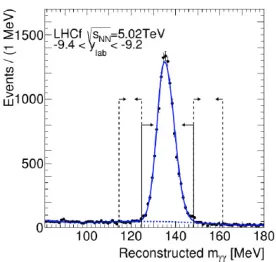
Figure 3.Two-photon invariant mass distributions in rapidity range−9.4< yLAB<−9.2. Peak is fitted with an
asymmetric Gaussian (blue solid curve), background is fitted with a polynomial (blue dashed curve). Signal and background windows are indicated by solid and dashed black lines respectively.
the dense nuclear matter in the forward particle production, which is particularly important for HECR Physics. Infact heavy nuclei and light nuclei can be involved in the the primary interactions of cosmic rays in the Earth atmosphere [10].
The invariant mass spectrum of the photons pairs for events where each calorimeter tower is hit by one photon, in figure 3, demonstrates the good performance of the detector in the reconstruction of a cleanπ0sample. A clean peak corresponding to the neutral pion events is prominent over a small back-ground due to pairs of uncorrelated photons. Once theπ0events are identified, transverse momentum and rapidity are evaluated, neutral pionPT spectra is measured in different rapidity ranges, and the
Figure 4.Transverse momentum distribution of neutral pions in several rapidity regions. Coloured histograms show results from Monte Carlo simulations with different hadronic interaction models, black points show exper-imental data in p-Pb collisions at 5.02T eV, gray shaded areas represent the extrapolation at 5.02T eVfrom data with p-p collisions (multiplied by a factor 5).
and finally the electromagnetic interactions between the virtual photons and the proton is simulated with the SOPHIA model [11].
Neutral pionPTspectra were measured in different rapidity ranges, and the results were compared
to the predictions of different hadronic interaction MC models. Moreover spectra are compared with the spectra in p-p collisions at 5.02T eV. Th p-p spectra were estimated by interpolating the LHCf results from the p-p runs at 2.76T eVand 7T eVtaken in the 2013 and 2010 respectively. In figure 4 are shown the results. The better data agreement is with the EPOS and DPMJET simulations and the
PT spectra in p-Pb collisions are harder than in p-p collisions.
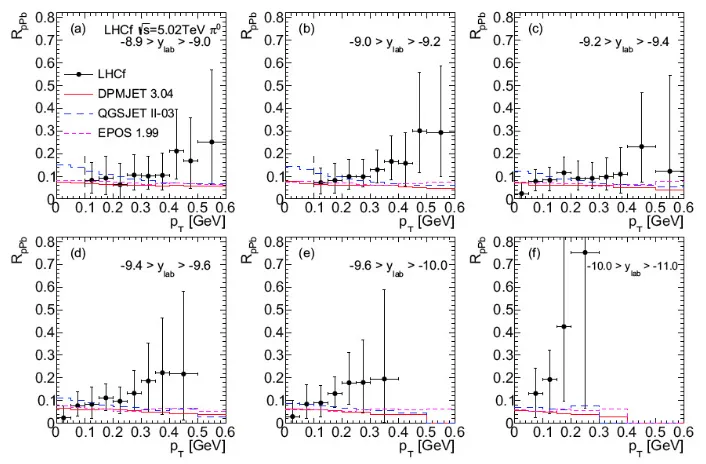
Figure 5 shows the measuredRpPbcompared with the predictions by different models. LHCf data
show a strong suppression for neutral pion production for rapidity valuesylab>8.9.RpPbvaries from
0.1 atPT ∼0.1GeVto 0.3 atPT ∼0.6GeV. Hadronic interaction models predict also small values
ofRpPb, showing an overall agreement with the LHCf data within the experimental uncertainty
3.3 Preliminary analysis at√s=13T eVp-p run
Figure 5.Nuclear modification factor for neutral pions in p-Pb collisions at 5.02T eV. Coloured histograms show results from Monte Carlo simulations with different hadronic interaction models, experimental data are shown as black points. Nuclear modification factor grows with energy as expected.
has been done to reduce the signal amplitude and avoid saturation of electronics with higher energy signals [12]. From 8th to12nd of June LHCf takes successfully more than 32 hours of physics data .
This operation was in collaboration with the ATLAS experiment, the trigger signals of LHCf were sent to ATLAS that recorded their data accordingly. The analyses of common events will permit to classify the events based on the nature of the processes, diffractive dissociation and non-diffractive. Selecting only diffractive events using ATLAS informations will improve the study of soft QCD interactions.
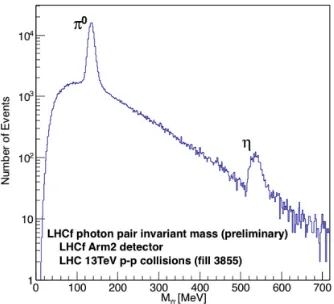
The high statistic and the good performance of detectors have permitted to detect clearly during the operation, with a preliminary analysis, the mesonsπ0 andη, in the invariant mass of the two gammas (figure 6).
4 Conclusion and future prospects
LHCf experiment has successfully completed the first proposed program. LHCf performed mea-surements on forward production of neutral particles in proton-proton and proton-lead collisions at LHC accelerator. These measurements are necessary to calibrate hadronic interaction models used in cosmic rays physics to understand the development of atmospheric showers. We measured pho-tons, neutral pions and neutrons for p-p interactions at √s=900GeVand 2.76,7,13T eVand p-Pb interactions at √s=5.02T eV.
Figure 6.Photon pair invariant mass obtained with the data of the fill 3855 in Arm2. The mass ofπ0andηare clearly reconstructed at∼140MeVand∼550MeVrespectively.
The future prospects of the experiment are to complete the data taking with a p-Pb run at the top LHC energy in the 2016 or 2017. Another opportunity will given moving Arm1 detector to RICH, and LHCf will be RICHf, and take data in p-p collisions at 510T eVin the 2017.
References
[1] O. Adriani et al., JINST 3, S08006 (2008) [2] O. Adriani et al., JINST5, P01012 (2010)
[3] O. Adriani et al., Physics Letters B715, 298-303 (2012) [4] O. Adriani et al., Physics Letters B703, 128-134 (2011) [5] O. Adriani et al., Physical Review D86, 092001 (2012) [6] O. Adriani et al., Physical Review C89, 065209 (2014) [7] K. Taki et al., JINST7, T01003 (2012)
[8] K. Kawade et al., JINST9, P03016 (2014)
[9] G. D’ Agostini, Nucl. Instrum. Meth. A362, 487 (1995)