MULTISENSOR FUSION AND INTEGRATION
Vipin Chandra
Research Scholar, Amity University, Noida (India)
ABSTRACT
Multisensor fusion and integration is a rapidly evolving research area and requires interdisciplinary knowledge in control theory, signal processing, artificial intelligence, probability and statistics, etc. The advantages gained through the use of redundant, complementary, or more timely information in a system can provide more reliable and accurate information. This paper provides an overview of current sensor technologies and describes the paradigm of multisensor fusion and integration as well as fusion techniques at different fusion levels. Applications of multisensor fusion in robotics, biomedical system, equipment monitoring, remote sensing, and transportation system are also discussed. Finally, future research directions of multisensor fusion technology including microsensors, smart sensors, and adaptive fusion techniques are presented.
Keywords: Pixel-Level Fusion, Signal-Level Fusion, Feature-Level Fusion
I INTRODUCTION
Sensor is a device that detects or senses the value or changes of value of the variable being measured. The term sensor sometimes is used instead of the term detector, primary element or transducer. The fusion of information from sensors with different physical characteristics, such as light, sound, etc enhances the understanding of our surroundings and provide the basis for planning, decision making, and control of autonomous and intelligent machines.
in the case of sensor error or failure. Complementary information from multiple sensors allows features in the environment to be perceived that are impossible to perceive using just the information from each individual sensor operating separately. More timely information may be provided by multiple sensors due to either the actual speed of operation of each sensor, or the processing parallelism that may be possible to achieve as part of the integration process.
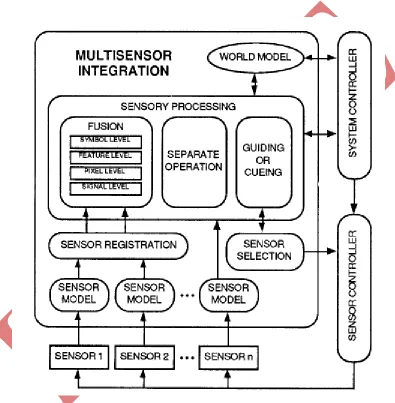
Fig 1: Functional diagram of multisensor integration and fusion in the operation of asystem
II MULTISENSOR INTEGRATION
modeled. A sensor model represents the uncertainty and error in the data from each sensor and provides a measure of its quality that can be 7used by the subsequent integration functions.After the data from each sensor has been modeled, it can be integrated into the operation of the system in accord with three different types of sensory processing: fusion, separate operation, and guiding or cueing.
Sensor registration refers to any of the means used to make data from each sensor commensurate in both its spatial and temporal dimensions. If the data provided by a sensor is significantly different from that provided by any other sensors in the system, its influence on the operation of the sensors might be indirect. The separate operation of such a sensor will influence the other sensors indirectly through the effects he sensor has on the system controller and the world model. A guiding or cueing type sensory processing refers to the situation where the data from one sensor is used to guide or cue the operation of other sensors.
The results of sensory processing functions serve as inputs to the world model .a world model is used to store information concerning any possible state of the environment that the system is expected to be operating in. A world model can include both a priori information and recently acquired sensory information. High level reasoning processes can use the world model to make inferences that can be used to detect subsequent processing of the sensory information and the operation of the system controller.
handling the error and uncertainty inherent in the integration of multiple sensors. The use of the artificial neural network formalism allows adaptability to be directly incorporated into the integration process.
III MULTISENSOR FUSION
The fusion of data or information from multiple sensors or a single sensor over time can takes place at different levels of representation. The different levels of multisensor fusion can be used to provide information to a system that can be used for a variety of purposes.eg signal level fusion can be used in real time application and can be considered as just an additional step in the overall processing of the signals, pixel level fusion can be used to improve the performance of many image processing tasks like segmentation ,and feature and symbol level fusion can be used to provide an object recognition system with additional features that can be used to increase its recognition capabilities.
The fusion of the data or information from multiple sensors or a single sensor over time can take place at different levels of representation (sensory information can be considered data from a sensor that has been given a semantic content through processing and/or the particular context in which it was acquired). A useful categorization is to consider multisensor fusion as taking place at the signal, pixel, feature, and symbol levels of representation. Most of the sensors typically used in practice provide data that can be fused at one or more of these levels. Although the multisensor integration „functions of sensor registration and sensor modeling as being separate from multisensor fusion, most of the methods and techniques used for fusion make very strong assumptions, either explicitly or implied, conceming how the data from the different sensors is modeled and to what degree the data is in registration. A fusion method that may be very sound in theory can be difficult to apply in practice if the assumed sensor model does not adequately describe the data from a real sensor, e.g., the presence of outliers due to sensor failure in an assumed normal distribution of the sensory data can render the fused data useless, or the degree of assumed sensor registration may be impossible to achieve, e.g, due to the limited resolution or accuracy of the motors used to control the sensors.
3.1 Signal-Level Fusion
values at common points of time. The signals can be registered spatially by having the sensors co aligned on the same platform. Signal-level fusion is usually not feasible if the sensors are distributed on different platforms due to registration difficulties and bandwidth limitations involved in communicating the signals between the platforms. The most common means of measuring the improvement in quality is the reduction in the expected variance of the fused signal. One means of implementing signal level fusion is by taking a weighted average of the composite signals, where the weights are based on the estimated variances of the signals. If the signals are multidimensional the Kalman filter, for example, can be used for fusion.
3.2 Pixel-Level Fusion
3.3 Feature-Level Fusion
Feature-level fusion can be used to both increase the likelihood that a feature extracted from the information provided by a sensor actually corresponds to an important aspect of the environment and as a means of creating additional composite features for use by the system. A feature provides for data abstraction and is created either through the attachment of some type of semantic meaning to the results of the processing of some spatial and/or temporal segment of the sensory data or, in the case of fusion, through a combination of existing features. Typical features extracted from an image and used for fusion include edges and regions of similar intensity or depth. When multiple sensors report similar features at the same location in the environment, the likelihood that the features are actually present can be increased and the accuracy with which they are measured can be improved; features that do not receive such support can be as spurious artifacts and eliminated. An additional feature, created as a result of the fusion process, may be either a composite of the component features (e.g., an edge that is composed of segments of edges detected by different sensors) or an entirely new type of feature that is composed of the attributes of its component features (e.g, a three-dimensional edge formed through the fusion of corresponding edges in the images provided by stereo cameras). The geometrical form, orientation, and position of a feature, together with its temporal extent, are the most important aspects of the feature that need to be represented so that it can be registered and fused with other features. In some cases, a feature can be made invariant to certain geometrical transformations (e.g., translation and rotation in an image plane) so that all of these aspects do not have to be explicitly represented. The sensor registration requirements for feature-level fusion are less stringent than those for signal- and pixel-level fusion, with the result that the sensors can distributed across different platforms. The geometric transformation of a feature can be used to bring it into registration with other features or with a world model. The improvement in quality associated with feature-level fusion can be measured through the reduction in processing requirements resulting from the elimination of spurious features, the increased accuracy in the measurement of a feature (used, e.g., to determine the pose of an object), and the increase in performance associated with the use additional features created through fusion (e.g., increased object recognition capabilities).
IV ADVANTAGES IN INTEGRATING MULTIPLE SENSORS
Redundant
information is provided from a group of sensors (or a single sensor over time) when each sensor is perceiving, possibly with a different fidelity, the same features in the environment. The integration or fusion of redundant information can reduce overall uncertainty and thus serve to increase the accuracy with which the features are perceived by the system. Multiple sensors providing redundant information can also serve to increase reliability in the case of sensor error or failure.
Complementary
information from multiple sensors allows features in the environment to be perceived that are impossible to perceive using just the information from each individual sensor operating separately. If the features to be perceived are considered dimensions in a space of features, then complementary information is provided when each sensor is only able to provide information conceming a subset of features that form a subspace in the feature space, i.e., each sensor can be said to perceive features that are independent of the features perceived by the other sensors; conversely, the dependent features perceived by sensors providing redundant information would form a basis in the feature space.
More timely
information, as compared to the speed at which it could be provided by a single sensor, may be provided by multiple sensors due to either the actual speed of operation of each sensor, or the processing parallelism that may be possible to achieve as part of the integration process.
Less costly
information, in the context of a system with multiple sensors, is information obtained at a lesser cost when compared to the equivalent information that could be obtained from a single sensor. Unless the information provided by the single sensor is being used for additional functions in the system, the total cost of the single sensor should be compared to the total cost of the integrated multisensor system.V POSSIBLE PROBLEM
Many of the possible problems associated with creating a general methodology for multisensor integration and fusion, as well as developing the actual systems that use multiple sensors, center around the methods used for modeling the error or uncertainty in the integration and fusion process, the sensory information, and the operation of the overall system including the sensors. For the potential advantages in integrating multiple sensors to be realized, solutions to these problems will have to be found that are both practical and theoretically sound.
detailed the different geometric transformations needed for registration. Lee and Van Vleet and Holm have studied the registration errors between radar and infrared sensors. Lee and Van Vleet have presented an approach that is able to both estimate and minimize the registration error, and Holm has developed a method that is able to autonomously compensate for registration errors in both the total scene as perceived by each sensor (“macroregistration”), and the individual objects in the scene (“microregistration”).
2)
Error in Sensory Information:
The error in sensory information is usually assumed to be caused by a random noise process that can be adequately modeled as a probability distribution. The noise is usually assumed not to be correlated in space or time (i.e., white), Gaussian, and independent. The major reasons that these assumptions are made is that they enable a variety of fusion techniques to be used that have tractable mathematics and yield useful results in many applications. If the noise is correlated in time (e.g., gyroscope error) it is still sometimes possible to retain the whiteness assumption through the use of a shaping filter. The Gaussian assumption can only be justified if the noise is caused by a number of small independent sources. In many fusion techniques the consistency of the sensor measurements is increased by first eliminating spurious sensor measurements so that they are not included in the fusion process. Many of the techniques of robust statistics (e.g., &-contamination) can be used to eliminated spurious measurements. The independence assumption is usually reasonable so long as the noise sources do not originate from within the system.3)
Error in System Operation:
When error occurs during operation due to possible coupling effects between components of a system, it may still be possible to make the assumption that the sensor measurements are independent if the error, after calibration, is incorporated into the system model through the addition of an extra state variable. In well-known environments the calibration of multiple sensors will usually not be a difficult problem, but when multisensor systems are used in unhown environments, it may not be possible to calibrate the sensors. Possible solutions to this problem may require the creation of detailed knowledge bases for each type of sensor so that a system can autonomously calibrate itself. One other important feature required of any intelligent multisensor system is the ability to recognize and recover from sensor failure.VI APPLICATIONS
In recent years, benefits of multisensor fusion have motivated research in a variety of application area as follows:
in an uncertain or unknown environment, integrating and tuning data from multiple sensors enable mobile robots to achieve quick perception for navigation and obstacle avoidance.
Marge mobile robot equipped with multiple sensors perception, position location, obstacle avoidance vehicle control, path planning, and learning are necessary functions for an autonomous mobile robot.Honda humanoid robot is equipped with an inclination sensor that consists of three accelerometer and three angular rate sensors. each foot and wrist is equipped with a six axis force sensor and the robot head contains four video cameras multisensor fusion and integration of vision ,tactile, thermal, range, laser radar, and forward looking infrared sensors play a very important role for robotic system.
2)
Military application:
It is used in the area of intelligent analysis, situation assessment, force command and control, avionics, and electronic warfare. It is employed for tracking targets such as missiles, aircrafts and submarines.3)
Remote sensing :
Application of remote sensing include monitoring climate, environment, water sources, soil and agriculture as well as discovering natural sources and fighting the important of illegal drugs. Fusing or integrating the data from passive multispectral sensors and active radar sensors is necessary for extracting useful information from satellite or airborne imaginary.4)
Biomedical application:
Multisensor fusion technique to enhance automatic cardiac rhythm monitoring by integrating electrocardiogram and hemodynamic signals. Redundant and complementary information from the fusion process can improve the performance and robustness for the detection of cardiac events including the ventricular activity and the atria activity.5)
Transportation system
: Transportation system such as automatic train control system, intelligent vehicle and high way system, GSP based vehicle system, and navigation air craft landing tracking system utilize multisensor fusion technique to increase the reliability, safety, and efficiency.VII CONCLUSION
Sensors play an n important role in our everyday life because we have a need to gather information and process it for some tasks. Successful application of sensor depends on sensor performance, cost and reliability.
REFERENCES
[1] Ren C. Luo, Chih-Chen Yih and Kuo Lan Su, “Multisensor Fusion and Integration: Approaches, Applications, and Future Research Directions”, IEEE SENSORS JOURNAL, VOL. 2, NO. 2, APRIL 2002.
[2] Ren C. Luo, Chih Chia Chang, and Chun Chi Lai, “Multisensor Fusion and Integration: Theories, Applications, and its Perspectives”, IEEE SENSORS JOURNAL, VOL. 11, NO. 12, DECEMBER 2011.
[3] NATIONAL MONTHLY REFEREED JOURNAL OF REASEARCH IN SCIENCE & TECHNOLOGY [PDF document]. Retrieved [28.03.'13] from the World Wide Web.
[4] Mutlisensor Fusion and Integration: Approaches, Applications and Future Research Directions [PDF document]. Retrieved [28.03.'13] from the World Wide Web.
[5] D. L. Hall and J. Llinas, "An introduction to multisensor data fusion", Proc. IEEE, vol. 85, pp.6 -23 1997.
[6] M. Kokar and K. Kim, "Review of multisensor data fusion architectures and techniques", Proc. 1993 Int. Symp. Intell. Control.
[7] P. K. Varshney, "Scanning the special issue on the data fusion", Proc. IEEE, vol. 85, pp.6 -23 1997.
[8] B. V. Dasarathy, "Sensor fusion potential exploitation-innovative architectures and illustrative applications", Proc. IEEE, vol. 85, pp.24 -38 1997.
[9] L. A. Klein, "Sensor and Data Fusion Concepts and Applications", SPIE Optical EngineeringPress, vol. 14, pp.131 1993.
[10] B. R. Bracio, W. Horn, and D. P. F. Moller, "Sensor fusion in biomedical systems", Proc. 19thAnnu. Int. Conf. IEEE Eng. Med. Biol. Soc., vol. 3, pp.1387 -1390 1997.