Cryptanalysis of Chen
et al.
’s RFID Access
Control Protocol
Masoumeh Safkhani1
, Nasour Bagheri2
, and Majid Naderi1
1 Electrical Engineering Department, Iran University of Science and Thechnology,
Tehran, Iran{M Safkhani,M Naderi}@iust.ac.ir
2 Electrical Engineering Department, Shahid Rajaee Teacher Training University ,
Tehran, [email protected]
Abstract. Recently Chenet al.have proposed a RFID access control protocol based on the strategy of indefinite-index and challenge-response. They have claimed that their protocol provides optimal location privacy and resists against man in the middle, spoofed tag and spoofed reader attacks. However, in this paper we show that Chen et al.protocol does not provide the claimed security. More precisely, we present the following attacks on the protocol:
1. Tag impersonation attack. 2. Reader impersonation attack. 3. Location traceability attack.
All attacks presented in this paper have the success probability of ’1’ on the cost of only one or two runs of protocol.
keyword RFID, Access Control, Spoofed Reader Attack, Authentication,
Desynchronization Attack.
1
Introduction
RFID mutual authentication protocols [1–16] and access control protocols [17, 18] have already been proposed in the literatures.
Most of the available access control protocols are based on hash-functions. Nevertheless, two main drawbacks dissuade for the practical use of hash based-protocols in an RFID system. Firstly, the resource requirement of hash functions (circuit size, memory and power consumption) may not be available on a tag which is supposed to be very chip [19]. Secondly, when we send all data hashed the search process in the readers would be required, to find a matching between the values received from the tag and the records stored in the reader, which often implies a heavy computation load for the back-end data base.
Chenet al. [12] recently proposed a hash based access control protocol. To
improve the search time for the reader, they proposed a novel approach. They proposed to represent the tag index as (xi, yi) an select two non-parallel random lines that crosses (xi, yi). Then, they select two random points on each line and include this information on a matrix. The generated matrix will be multiplied by a secret matrix and passed to the reader. Since the reader knows the secret matrix it can extract the tag index. However, we show that their protocol com-promises privacy location. In addition, we show that a fake tag can impersonate a legitimate one and an adversary can impersonate a legitimate reader. It will get worse if we know that the success probabilities of our attacks are almost ’1’ while the complexities are at most two runs of protocol.
Paper Organization :In§2 we review notations and preliminaries that are
used through the paper. A brief description of Chenet al.protocol is given in§3. Our reader impersonation and the tag impersonation attacks on the protocol are given in§4 and§5 respectively. We present our traceability attack on protocol in section§6. Finally concluding remarks are presented in§7.
2
Preliminaries
Throughout this paper, we will use the following notations:
• indexi: Tag’s serial number. • Keyi: Tag’s secret value. • h(.): A one way hash function.
• Q: A random number generated by the reader side. • R: A random number generated by the Tag. • ω: A square matrix which is stored in all tags. • ω−1
: The inverse matrix ofω which is stored in the reader. • π: A square matrix generated by tag which includes some
• fCRC: A cyclic redundancy check function.
• EKeyi(.): An encryption function with the key ofKeyi.
• DKeyi(.): The decryption function with the key ofKeyi.
• ǫ: The critical response time. • ⊕: Exclusive-or operation.
3
Chen
et al.
RFID Access Control Protocol
Recently, Chenet al.[12] proposed an access control protocol for RFID systems.
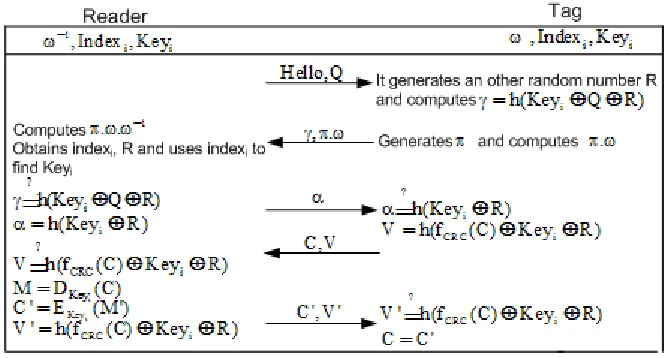
The proposed protocol includes an authentication mechanism and an access right authorization mechanism to be used in low-cost RFID systems. The protocol, see also Figure 1, works as follows:
1. The reader generates a random numberQand sends it to the tag.
2. As the tag receivesQ, it generates a random number R and computesγ=
h(Keyi⊕Q⊕R). To keep the tag’s location private the serial number is pre-processed to be different in each access. The tag index is included in a matrixπas follows:
(a) Use the tag index as a tuple denoted by (xi, yi).
(b) Generated two non parallel lines crossed on tag index denotes byL1and
L2 respectively.
(c) Select two random points onL1and denote them by (x1, y1) and (x2, y2). (d) Select two random points onL2and denote them by (x3, y3) and (x4, y4). (e) Generateπmatrix as follows:
π=
x1y1 x2
y2x3 y3
x4y4R⊕Q
3. The tag computes matrix product π.ω and passes it along with γ to the reader.
4. As the reader receives (π.ω,γ), it pass (π.ω,γ,Q) to the back-end data base. 5. The back-end data base obtains π matrix by multiplying ω−1
to π.ω and obtains tag index (xi, yi) andRfrom π.
6. Given tag index, the back-end data base retrieves the tag’s secret valueKeyi from data base and verifies whetherγ =? h(Keyi⊕Q⊕R). In the case of equality, it authenticates the tag, computes α = h(Keyi ⊕R) and sends
Keyi,Randαto the reader. 7. Reader passesαto the tag.
8. Once the tag receives α, at first it checks that the response time is shorter thanǫ. Then, it verifies whetherα=? h(Keyi⊕R) to authenticate the reader. If tag authenticated the reader the reader would be authorized to access the ciphertext C in the tag, where the tag sends C and related check value
V =h(fCRC(C)⊕Keyi⊕R) to the reader.
Fig. 1.Chenet al.’s RFID access control protocol.
10. Whenever the reader desires to modify dataM′ to the tag, it encrypts new
information M′ with the Keyi as C′ = EKey
i(M′) and sendsC′ with its
check valueV′ =h(fCRC(C′)⊕Keyi⊕R) to the tag.
11. Once the tag receives the message it verifies whether V′ =? h(fCRC(C′)⊕
Keyi⊕R) to update Cto C′.
The authors claimed that the above protocol satisfies the following goals for an RFID system:
– guarantees the mutual authentication.
– provides the location privacy.
– resists the man-in-the-middle attack.
– resists to the spoofed reader attack.
– resists to the spoofed tag attack.
4
Reader Impersonation attack
Chenet al.[12] claim that their protocol is resistant against the spoofed reader
attacks. More precisely, the authors state that to impersonate the reader, given
γ = h(Keyi⊕Q⊕R), the adversary at least requires to find a preimage for
h(.) to obtainKeyi⊕Q⊕Rand generate a valid α=h(Keyi⊕R). However, we present a rather simple attack which can impersonate a legitimate reader as follows:
2. As the tag receivesQ, it generates a random number R and computesγ=
h(Keyi⊕R⊕Q) and generate the matrixπfollowing the given approach on the protocol description. Then, it replies with the tuple (γ, π.ω).
3. Recall that the adversary had selectedQ= 0 so we have:
γ=h(Keyi⊕R⊕Q) =h(Keyi⊕R⊕0) =h(Keyi⊕R)
Hence, when the adversary is expected to send some value asα, it just replies with the receivedγas αand passes it to the tag.
4. As the tag receivesα, which is equal toh(Keyi⊕R), it will authenticate the adversary as a legitimate reader.
The success probability of the given attack is ’1’ while the complexity is only a single run of protocol. Hence, despite of the authors claim, the protocol is vulnerable to the reader impersonation attack.
5
Tag Impersonation attack
The authors [12] claim that their protocol is resistant against the spoofed tag attacks. More precisely, similar to their argument for the spoofed reader, the authors state that to impersonate the tag, a fake tag needs ¯X =Keyi⊕R to generate a validγ=h(Keyi⊕Q⊕R) =h( ¯X⊕Q). Therefore, they have claimed that the tag impersonation costs 2n/2 in average. However, we show that their assumption is not correct and, to impersonate a legitimate tag, an adversary does not necessarily require ¯X =Keyi⊕R. At the follows, we present an attack which can impersonate a legitimate tag in a rather easy way:
1. The adversary eavesdrops a run of protocol and stores the tag replay to the reader queryQwhich is the (γ, π.ω) tuple.
2. In the future, to impersonate the tag, on receivingQ′ the adversary replies
with the stored tuple (γ, π.ω) as the expected (γ′, π′.ω), whereγ=h(Keyi⊕
R⊕Q) and:
π=
x1y1 x2
y2x3 y3
x4y4R⊕Q
3. As the back-end data base receives the tuple (Q′, γ′, π′.ω), it retrieves the
matrixπ′ as follows:
π′ =π′.ω.ω−1
=π.ω.ω−1
=π=
x1y1 x2
y2x3 y3
x4y4R⊕Q
4. Given the matrix π′ andQ′, the back-end data base assignsR⊕Q⊕Q′ to
R′ which is used on the verification of receivedγ′. In addition, givenπ′ =π,
5. To authenticates the tag the back-end database verifies whetherγ′=? h(Keyi⊕
Q′⊕R′), where, given thatR′=R⊕Q⊕Q′, we have:
h(Keyi⊕Q′⊕R′) =h(Keyi⊕Q′⊕R⊕Q⊕Q′) =h(Keyi⊕Q⊕R) =γ=γ′
6. The reader will authenticate the adversary as a legitimate tag.
The success probability of the given attack is ’1’ while the complexity is only two runs of protocol. Hence, despite of the authors claim, the protocol is also vulnerable to tag impersonation attack.
6
Traceability Attack on the Mutual Authentication
Protocol
In this section we show how Chen et al. protocol puts at stake the location
privacy of tags’ holders because it is possible to track tags with the probability of ’1’. Our traceability attack follows the used approach to mount the reader impersonation attack on the protocol, presented in§4. However, in this attack, the adversary continues the protocol to receive the stored C value in the tag. More precisely, to trace a tagTi, an adversaryAcan follow the steps described below:
1. A supplants a legal reader in a mutual authentication session and sends
Q= 0 to the tag.
2. As the tag receivesQ, it generates a random number R and computesγ=
h(Keyi⊕R⊕Q) and generates the matrixπfollowing the given approach on the protocol description. Then, it replies with the tuple (γ, π.ω).
3. Recall that the adversary had selectedQ= 0, so we have:
γ=h(Keyi⊕R⊕Q) =h(Keyi⊕R⊕0) =h(Keyi⊕R)
Hence,Ajust replies with the receivedγas the expectedαto be sent toTi. 4. As the tag receives α, which is equal toh(Keyi⊕R), it will authenticateA
as a legitimate reader.
5. When tag authenticates A as a legitimate reader, it would be authorized to access the ciphertextC in the tag where the tag replies withC and the related check valueV =h(fCRC(C)⊕Keyi⊕R).
6. AstoresC.
7. In the future, givenTj,Arunes the above steps again to receive the stored
C′ of Tj.
8. IfC′ =C then the adversary conclude thatTj is the targetTi.
As long as a legitimate reader does not update the stored decrypted value in Tj an adversary which follows the above attack would be able to trace Ti. In addition, if the adversary presents during the protocol run that change the encrypted value to C′, it can store C and trace Ti based on this value. The
7
Conclusion
In this paper we analyzed the security of Chen et al.’s RFID access control
protocol and demonstrated several successful attacks against the protocol. We showed that this protocol does not resist against spoofed reader and spoofed tag. In addition, we demonstrated a traceability attack on protocol which can be applied to protocol between two data updating. The success probabilities of attacks are almost ’1’ and the complexities are at most two runs of protocol.
References
1. Pedro Peris-Lopez, Julio Cesar Hernandez-Castro, Juan M. Estevez-Tapiador, and Arturo Ribagorda. EMAP: An Efficient Mutual Authentication Protocol for Low-Cost RFID Tags. In OTM Federated Conferences and Workshop: IS Workshop – IS’06, volume 4277 ofLecture Notes in Computer Science, pages 352–361, Mont-pellier, France, November 2006. Springer-Verlag.
2. Chien Hung-Yu. SASI: A New Ultralightweight RFID Authentication Protocol Providing Strong Authentication and Strong Integrity. IEEE Transactions on Dependable and Secure Computing, 4(4):337–340, December 2007.
3. Pedro Peris-Lopez, Julio C´esar Hern´andez Castro, Juan M. Est´evez-Tapiador, and Arturo Ribagorda. LMAP:A Real Lightweight Mutual Authentication Protocol for Low cost RFID tags. InRFIDSec, 2006.
4. Pedro Peris-Lopez, Julio C´esar Hern´andez Castro, Juan M. Est´evez-Tapiador, and Arturo Ribagorda. Advances in Ultralightweight Cryptography for Low-Cost RFID Tags: Gossamer Protocol. In Kyo-Il Chung, Kiwook Sohn, and Moti Yung, editors, WISA, volume 5379 ofLecture Notes in Computer Science, pages 56–68. Springer, 2008.
5. Alireza Sadighian and Rasoul Jalili. AFMAP: Anonymous Forward-Secure Mu-tual Authentication Protocols for RFID systems. In Rainer Falk, Wilson Goudalo, Eric Y. Chen, Reijo Savola, and Manuela Popescu, editors, The Third IEEE In-ternational Conference on Emerging Security Information, Systems and Technolo-gies(SECURWARE 2009), pages 31–36, Athens, Greece, 2009. IEEE Computer Society.
6. Alireza Sadighian and Rasool Jalili. FLMAP: A fast lightweight mutual authenti-cation protocol for RFID systems. InICON, pages 1–6. IEEE, 2008.
7. Lars Kulseng, Zhen Yu, Yawen Wei, and Yong Guan. Lightweight Mutual Authen-tication and Ownership Transfer for RFID systems. In The proceedings of IEEE INFOCOM 2010, pages 1–5, March 2010.
8. S. Weis. Security and Privacy in Radio Frequency Identification Devices. Masters Thesis, Massachusetts Institute of Technology (MIT), 2003.
9. Stephen A. Weis, Sanjay E. Sarma, Ronald L. Rivest, and Daniel W. Engels. Secu-rity and Privacy Aspects of Low-Cost Radio Frequency Identification Systems. In International Conference on Security in Pervasive Computing-SPC 2003, volume 2802 ofLecture Notes in Computer Science, pages 201–212, 2004.
11. Yiyuan Luo, Qi Chai, Guang Gong, and Xuejia Lai. A lightweight stream cipher WG-7 for RFID encryption and authentication. InGLOBECOM, pages 1–6. IEEE, 2010.
12. Meng-Lin Tsai Yu-Yi Chen and Jinn-Ke Jan. The design of rfid access control protocol using the strategy of indefinite-index and challenge -response. computer communication, 34(3):250–256, 2011.
13. Jung-Sik Cho, Sang-Soo Yeo, and Sung Kwon Kim. Securing against brute-force attack: A hash-based rfid mutual authentication protocol using a secret value. Computer Communications, 34(3):391–397, 2011.
14. Tzu-Chang Yeh, Chien-Hung Wu, and Yuh-Min Tseng. Improvement of the rfid authentication scheme based on quadratic residues. Computer Communications, 34(3):337–341, 2011.
15. Dang Nguyen Duc and Kwangjo Kim. Defending rfid authentication protocols against dos attacks. Computer Communications, 34(3):384–390, 2011.
16. Chiu Chiang Tan, Bo Sheng, and Qun Li. Secure and serverless RFID authen-tication and search protocols. IEEE Transactions on Wireless Communications, 7(4):1400–1407, 2008.
17. R.Rivest D. Engels S.Weis, S.Sarma. Security and privacy aspects of low-cost radio frequency identification systems. In1st International Conference on Wierless Communications, Networking and mobile computing 2007(WiCom 2007), pages 2078–2080, 2007.
18. H.Y.Chien. Secure access control schemes for rfid systems with anonymity. 19. M. Feldhofer and C. Rechberger. A Case Against Currently Used Hash Functions