Authentication Protocol for RFID Systems
Masoumeh Safkhani1, Pedro Peris-Lopez2, Julio Cesar Hernandez-Castro3, Nasour Bagheri4and Majid Naderi1
1 Electrical Engineering Department, Iran University of Science and Technology, Tehran, Iran, {M Safkhani,M Nderi}@iust.ac.ir
2 Information Security and Privacy Lab, Delft University of Technology, Delft, The Netherlands,
3 School of Computing of Portsmouth University, UK, [email protected]
4 Electrical Engineering Department, Shahid Rajaee Teacher Training University, Tehran, Iran,[email protected]
Abstract. Radio frequency identification systems need protocols to provide confidentiality, user privacy, mutual authentication and etc. These protocols should resist active and passive attacks such as forgery, traceability, replay and desynchronization attacks.
In this paper we cryptanalysis a hash based RFID mutual authentication protocol which has been recently proposed by Cho et al. More precisely, we present the following attacks on this protocol:
1. Desynchronization attack: the success probability of attack is “1” while the attack complexity is one run of protocol.
2. Tag impersonation attack: the success probability of attack is “14” for two runs of protocol. 3. Reader impersonation attack: the success probability of attack is “1
4” for two runs of protocol.
Keywords: RFID, Authentication, Desynchronization Attack, Tag Impersonation Attack, Reader
Impersonation Attack.
1 Introduction
2 Preliminaries
The notations that used through of this paper are as follows:
•IDk: Identifier of the kthtag.
•h(.): One way hash function. • k: A concatenation operation. • ⊕: Exclusive-or operation.
•s: An 96-bit secret value which is shred between tag and back-end server. •sj: A secret value used in the jthsession.
•DAT A: Tag’s related information.
•RIDi: An 96-bit Group ID of random number. •Rr: Random number generated by reader.
•Rt: Random number generated by tag.
•α: Message generated by tag for authentication. •β: Blind factor.
•X(a:b): A fraction of value X includes the ath-bit to the bth-bit.
•Xi: Parameter X related to the ith tag.
3 Cho et al.’s RFID Hash-based Mutual Authentication Protocol
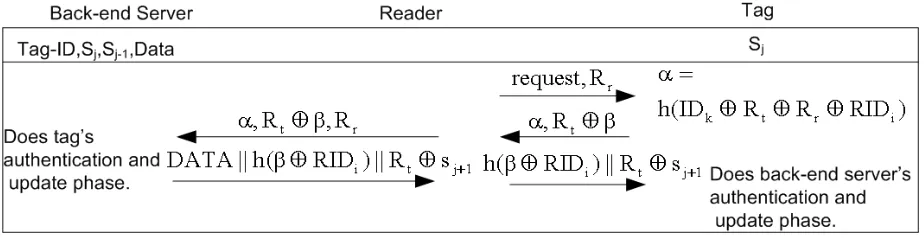
Recently, Cho et al. [15] proposed a mutual authentication protocol for RFID systems. The proposed protocol uses a one way hash function in its structure and expected to provide enough security against various attacks. In addition, they randomize each session of mutual authentication by employing two random values Rr and Rt, respectively generated by the reader and the tag and a value denoted by RIDiwhich is supposed to be dependent on Rt. Since the secret value of tag sj get updated at each
successful run of protocol, to avoid the desynchronization attack the back-end database keeps a record of two latest secret value of tag denoted by soldand snewrespectively. The protocol, see also
Fig. 1, works as follows:
1. The reader generates a random number Rrand sends request along with Rrto the tag.
Fig. 1. The Cho et al.’s hash-based RFID Mutual Authentication Protocol.
(a) It computes RIDi =(Rt−Rtmod sj+1)(0:47)||(Rt+sj−Rt mod sj)(48:95),α=h(IDk⊕Rt⊕ Rr⊕RIDi) andβ=(sj)(0:47)||(IDK)(48:95).
(b) It sendsαand Rt⊕βto the reader.
3. As the reader receivesαand Rt⊕β, passes them to the back-end data base.
4. To authenticate the tag and update the secret value s, the back-end data base does as follows: (a) for any record i on its data base (the ith record includes (IDi
k, siold, sinew, Datai) of a tag ) it
computesβfor each tuple (IDik, siold) and (IDki, sinew), extracts Rtfrom Rt⊕βfor any computed
β, calculates RID′i andα′=h(IDk⊕Rt⊕Rr⊕RID′i).
(b) If it finds a match between the receivedαand a retrievedα′, it will authenticate the tag and updates its record. Assuming that (IDik, sij) is a tuple for which tag i has been authenticated, the back-end data base will authenticate the record of the authenticated tag as follows:
– it assigns sijto siold,
– generates a new secret value sj+1and assigns it to sinew.
(c) The back-end data base generates DAT Akh(β⊕RIDi)kRt ⊕sj+1and sends it to the reader.
5. The reader passes h(β⊕RIDi)kRt⊕sj+1to the tag.
6. The tag extracts h(β⊕RIDi) from the received value and verifies it to whether authenticate the reader.
7. If the tag authenticated the reader it extracts sj+1from Rt⊕sj+1and updates its secret value sjto sj+1.
The authors have claimed several security properties for the protocol [15, Section 6.] including but not limited to the following properties:
– resistance against the desynchronization attack.
– resistance against the spoofed reader attack, in which the adversary sends intended or
meaning-less request and tries to h(β⊕RIDi) to be authenticated by the tag.
– resistance against the spoofed tag attack, in which the adversary tries to generate a validαto be authenticated by the reader.
2. Change the last message that sent by R to Tifrom h(β⊕RIDi)kRt⊕sj+1to h(β⊕RIDi)kRt⊕sj+1⊕∆,
for∆,0.
3. The tag authenticates the reader based on the received h(β⊕RIDi) and assigns sj+1⊕∆to sj+1.
Following the above attack the secret value contained in Ti is set to sj+1⊕∆while the stored
values on R are sjand sj+1and the reader has no record of sj+1⊕∆. Hence, R never authenticates Ti
in the next sessions of protocol. The success probability of our desynchronization attack is “1” and the complexity of attack is only one run of protocol.
5 Tag Impersonation Attack
Cho et al. [14] claim that it would not be possible for the adversary to generate a tupleαandβ⊕Rt
such that the reader authenticate the adversary as a valid Tag. More precisely, the authors state that to generate a validαand β⊕Rt and impersonate the tag, the adversary at least requires to find the secret values sjand IDk that are protected by h(.). However, we present a rather simple attack which
can impersonate a legitimate tag without any knowledge of the secret values sj and IDk. Our attack
is based on this fact that for a<b we can state that:
a mod b≡a
Given this fact and assuming that Rt< sjwe have:
RIDi =(Rt−Rtmod sj+1)(0:47)||(Rt+sj−Rt mod sj)(48:95)=(1)(0:47)||(sj)(48:95)
which independents on Rt. Now, we use this observation on the tag impersonation attack which its
steps are described below:
1. Adversary eavesdrops one session of protocol and obtains Rr,α, Rt ⊕β, where assuming that Rt < sjthen RIDi =(1)(0:47)||(sj)(48:95).
2. On the next session of protocol, when the reader sends request along with R′r, adversary imper-sonates the tag and replies with the tupleαand Rt⊕β⊕Rr⊕R′r.
3. The back-end server uses the tuple (IDk,sj) of the tag to generateβand extracts R′t =Rt⊕Rr⊕R′r
and RID′i.
5. If R′t < sj then RID′i =(1)(0:47)||(sj)(48:95)=RIDiand we have:
h(IDk⊕R′t ⊕R′r⊕RID′i)=h(IDk⊕Rt⊕Rr⊕R′r⊕R′r⊕RIDi)=h(IDk⊕Rt⊕Rr⊕RIDi)=α
6. Sinceα = h(IDk ⊕ R′t ⊕R′r ⊕RID′i) the back-end data base authenticates the adversary as a
legitimate tag.
The adversary will be succeed in its attack if the assumptions are correct. For random selection of Rt and Rr, the success probability of each assumption is “12”. Hence the total probability of the
above tag impersonation attack is “14” and the complexity of attack is two runs of protocol.
Remark 1. The above attack works as long as the tag has not updated its secret value s. However,
when the adversary does the eavesdropping phase at step 1. of the above attack, if it blocks the last message of protocol, on which the reader sends h(β⊕RIDi)kRt⊕sj+1to the tag, then the attack can
be applied even after one updating of secret value s. The reason comes from this property of protocol that the back-end data base keeps a record of sold.
6 Reader Impersonation Attack
The authors [14] claim that the proposed protocol is very secure against an intended request because the adversary has no control on the generated Rtand the related RIDithat are changed every session,
even if the secret value s has not been updated. However, we present an attack which can impersonate a legitimate reader without any knowledge of the secret values sj and IDk and any control over the
generated Rt. Our attack is based on the given observation that for Rt < sjone can state that:
RIDi=(1)(0:47)||(sj)(48:95)
which is independent on Rt. The proposed reader impersonation attack is as bellow:
1. Adversary eavesdrops one session of protocol and obtains Rr,α, Rt⊕βand h(β⊕RIDi)kRt⊕sj+1,
where for Rt < sjone can state that:
RIDi =(1)(0:47)||(sj)(48:95)
2. It blocks the last message from the reader to the tag, h(β⊕RIDi)kRt⊕ sj+1. Hence, the tag does
not update its secret value s.
3. Adversary supplants a legitimate reader and sends request with the stored Rr to the tag and
receives tag’s response,α′ and R′t ⊕β′, where β′ = β because the secret value s has not been updated.
4. For R′t < sjwe can state that:
RID′i =(1)(0:47)||(sj)(48:95) =RIDi
5. The adversary replies to the tag with h(β⊕RIDi)k∆, where∆can be any random value.
6. For the given assumptions, h(β⊕RIDi)=h(β′⊕RID′i) and the tag authenticates the adversary as
7 Conclusion
In this paper we analyzed the security of Cho et al. mutual authentication protocol which is a hash based protocol to be employed in RFID systems. We demonstrated desynchronization, tag imperson-ation and reader impersonimperson-ation attacks on this protocol. The success probability of these attacks are “1”, “14” and “14” respectively and the complexity of each attack is at most two runs of protocol.
References
1. S. Weis. Security and Privacy in Radio Frequency Identification Devices. Masters Thesis, Massachusetts Institute of Technology (MIT), 2003.
2. Stephen A. Weis, Sanjay E. Sarma, Ronald L. Rivest, and Daniel W. Engels. Security and Privacy Aspects of Low-Cost Radio Frequency Identification Systems. In International Conference on Security in Pervasive Computing-SPC 2003, volume 2802 of Lecture Notes in Computer Science, pages 201–212, 2004.
3. Kinoshita S. Ohkubo M., Suzuki K. Hash-chain based forward-secure privacy protection scheme for low-cost RFID. In Proc. of the 2004 Symposium on Cryptography and Information Security (SCI 2004), pages 719–724, 2004. 4. Yiyuan Luo, Qi Chai, Guang Gong, and Xuejia Lai. A lightweight stream cipher WG-7 for RFID encryption and
authentication. In GLOBECOM, pages 1–6. IEEE, 2010.
5. Pedro Peris-Lopez, Julio Cesar Hernandez-Castro, Juan M. Estevez-Tapiador, and Arturo Ribagorda. EMAP: An
Efficient Mutual Authentication Protocol for Low-Cost RFID Tags. In OTM Federated Conferences and Workshop:
IS Workshop – IS’06, volume 4277 of Lecture Notes in Computer Science, pages 352–361, Montpellier, France, November 2006. Springer-Verlag.
6. Chien Hung-Yu. SASI: A New Ultralightweight RFID Authentication Protocol Providing Strong Authentication and Strong Integrity. IEEE Transactions on Dependable and Secure Computing, 4(4):337–340, December 2007. 7. Pedro Peris-Lopez, Julio C´esar Hern´andez Castro, Juan M. Est´evez-Tapiador, and Arturo Ribagorda. LMAP:A Real
Lightweight Mutual Authentication Protocol for Low cost RFID tags. In RFIDSec, 2006.
8. Pedro Peris-Lopez, Julio C´esar Hern´andez Castro, Juan M. Est´evez-Tapiador, and Arturo Ribagorda. Advances in Ultralightweight Cryptography for Low-Cost RFID Tags: Gossamer Protocol. In Kyo-Il Chung, Kiwook Sohn, and Moti Yung, editors, WISA, volume 5379 of Lecture Notes in Computer Science, pages 56–68. Springer, 2008. 9. Alireza Sadighian and Rasoul Jalili. AFMAP: Anonymous Forward-Secure Mutual Authentication Protocols for
RFID systems. In Rainer Falk, Wilson Goudalo, Eric Y. Chen, Reijo Savola, and Manuela Popescu, editors, The Third IEEE International Conference on Emerging Security Information, Systems and Technologies(SECURWARE 2009), pages 31–36, Athens, Greece, 2009. IEEE Computer Society.
10. Alireza Sadighian and Rasool Jalili. FLMAP: A fast lightweight mutual authentication protocol for RFID systems. In ICON, pages 1–6. IEEE, 2008.
11. Lars Kulseng, Zhen Yu, Yawen Wei, and Yong Guan. Lightweight Mutual Authentication and Ownership Transfer for RFID systems. In The proceedings of IEEE INFOCOM 2010, pages 1–5, March 2010.
13. Hung-Yu Chien. Secure access control schemes for RFID systems with anonymity. In Mobile Data Management. IEEE Computer Society, 2006.
14. Meng-Lin Tsai Yu-Yi Chen and Jinn-Ke Jan. The design of RFID access control protocol using the strategy of indefinite-index and challenge -response. In Computer Communication, volume 34, pages 250–256, 2011.
15. Sang-Soo Yeo Jung-Sik Cho and Sung Kwon Kim. Securing against brute-force attack: A hash-based RFID mutual authentication protocol using a secret value. In Comput.Commun,doi:10.1016/j.comcom.2010.02.029, 2010. 16. Tzu-Chang Yeh, Chien-Hung Wu, and Yuh-Min Tseng. Improvement of the rfid authentication scheme based on
quadratic residues. Computer Communications, 34(3):337–341, 2011.
17. Dang Nguyen Duc and Kwangjo Kim. Defending rfid authentication protocols against dos attacks. Computer Com-munications, 34(3):384–390, 2011.
18. Chiu Chiang Tan, Bo Sheng, and Qun Li. Secure and serverless RFID authentication and search protocols. IEEE Transactions on Wireless Communications, 7(4):1400–1407, 2008.
19. Mih´aly B´ar´asz, Bal´azs Boros, P´eter Ligeti, Krisztina L´oja, and D´aniel Nagy. Passive Attack Against the M2AP Mutual Authentication Protocol for RFID Tags. In First International EURASIP Workshop on RFID Technology, Vienna, Austria, September 2007.
20. Tianjie Cao, Elisa Bertino, and Hong Lei. Security analysis of the sasi protocol. IEEE Trans. Dependable Sec. Comput., 6(1):73–77, 2009.
21. Julio C Hernandez-Castro, Juan M E Tapiador, Pedro Peris-Lopez, and Jean-Jacques Quisquater. Cryptanalysis of the SASI Ultralightweight RFID Authentication Protocol with Modular Rotations. Technical Report arXiv:0811.4257, Nov 2008.
22. Raphael C.-W. Phan. Cryptanalysis of a New Ultralightweight RFID Authentication Protocol - SASI. IEEE Transac-tions on Dependable and Secure Computing, 99(1), 2008.
23. Tieyan Li and Robert H. Deng. Vulnerability Analysis of EMAP - An Efficient RFID Mutual Authentication Protocol. In Second International Conference on Availability, Reliability and Security – AReS 2007, Vienna, Austria, April 2007. 24. Mih´aly B´ar´asz, Bal´azs Boros, P´eter Ligeti, Krisztina L´oja, and D´aniel Nagy. Passive Attack Against the M2AP Mutual Authentication Protocol for RFID Tags. In First International EURASIP Workshop on RFID Technology, Vienna, Austria, September 2007.
25. Masoumeh Safkhani, Majid Naderi, and Nasour Bagheri. Cryptanalysis of AFMAP. IEICE Electronics Express, 7(17):1240–1245, 2010.
26. Masoumeh Safkhani, Majid Naderi, and Habib Rashvand. Cryptanalysis of AFMAP. International Journal of Com-puter&Communication Technologys, 2(2):182–186, 2010.
27. Masoumeh Safkhani, Nasour Bagheri, Majid Naderi, Yiyuan Luo, and Qi Chai. Tag impersonation attack on two RFID mutual authentication protocols. In FARES, 2011.
28. Masoumeh Safkhani, Majid Naderi, Nasour Bagheri, and Somitra Kumar Sanadhya. Cryptanalysis of some protocols
for RFID systems. Cryptology ePrint Archive, Report 2011/061, 2011. http://eprint.iacr.org/.
29. Masoumeh Safkhani, Nasour Bagheri, and Majid Naderi. Cryptanalysis of Chen et al.’s RFID access control protocol.
Cryptology ePrint Archive, Report 2011/194, 2011. http://eprint.iacr.org/.
30. Nasour Bagheri, Masoumeh Safkhani, Majid Naderi, and Somitra Kumar Sanadhya. Security analysis of LMAP++,
an RFID authentication protocol. Cryptology ePrint Archive, Report 2011/193, 2011.http://eprint.iacr.org/. 31. A.Jules. RFID security and privacy: a reserch survey. In Selected Areas in Communications, volume 24, pages
381–394, 2006.
32. T.Dimitriou. A lightweight RFID protocol to protect against traceability and cloning attacks. In in Proceedings of SecureComm’05, pages 59–66, 2005.