Growth regulators’ effect on crested wheatgrass forage yield
and quality
LARRY M. WHITE
AbSdCt
If crested wheatgrass [Agropyron dcscrorum (Fisch.) Schult.] could be maintained in an immature growth stage, it would improve forage quality and thus extend the grazing season. In 1981 and 1982, plant growth regulators were applied to crested wheat- grass 0,2,4, and 6 weeks after first floral primordium initiation to determine which compound, date, and rate of application would maximize forage quality yet minimize reduction of forage yield when harvested at seed ripe stage. Mefluidide [N-(Z&dhnethyl-S- ([(trifluoromethyl~sulfonyl]rmino)phenyl)amide] at 4 rates [O.O, 0.28, 0.56, and 0.84 kg/ha active ingredient (a.i.)j, mrleic hydrazide (MI-I) (l&dihydro_3,6_pyridazinedione) at 4.5 kg/ha &~~(336kg/h=Qphs9 -(me@+--
xyfluorenc9-carboxylate) at 1.12 kg/ha r.i. were applied to crested wheatgrass growing on a Shambo loam (Typic Haplobo- rolls) in northeast Montana. Application of MH or MH plus chlorflurenol generally gave a similar response in heading, forage yield, CP, and in vitro organic matter digestibility on a dry matter basis (IVDOMD) as did melfluidide at 0.56 kg/ha. Mefluidide (0.56 kg/ha) applied 2 weeks after fiit floral prhnordhim initiation decreased heading 80 md 95%, decreased forage yield 20 and 30%, increased CP 1.7 and 2.3 percentage units, and increased IVDOMD 1.8 to 4.2 percentage units compared to untreated, depending upon year.
Key Words:
Agropyron desertorum,
heading, crude protein, in vitro digestibility, melfhddide, mrleic bydruide, chloflurenol, floral prhnordium, growth stage, application ratesCrested wheatgrass [Agropyron desertorum (Fisch.) Schult.] provides high quality forage during early spring, but forage quality (White and Wight 1981) and livestock weight gains decrease as the growing season progresses (Campbell 1961). If crested wheatgrass could be maintained in an immature growth stage, it would improve forage quality and thus extend the grazing season.
Haferkamp et al. (1987) found that application of melfluidide [N~2,4dimethy1-5-([(trifluoromethyl)-sulfonylJamino}pheny1) ace- tamide] to crested wheatgrass near flora1 differentiation increased crude protein (CP) 1.8 to 1.9 percentage units and in vitro digesti- ble organic matter by 3.0 to 4.0 percentage units. However, this decreased forage production by 20 to 60% depending upon rate. The effect of timing of melfluidide application was not determined. Field and Whitford (1982) found that date of melfluidide applica- tion affected reductions in dry matter production of perennial ryegrass (Lolium perenne L.) depending upon plant growth stage. Other growth regulators such as maleic hydrazide (MH) (1,2- dihydro-3,6_pyridazinedione) and MH plus chlorflurenol (methyl- 2_chloro-9-hydroxyfluorene-9carboxylate) have effectively reduced heading of grasses along roadsides (Wakefield and Dore 1973), and may, therefore, be effective in increasing forage quality.
The study objective was to determine the effects of growth regulators [melfluidide (4 rates), MH, and MH plus chlorflurenoll and application date on heading, forage yield, CP, and in vitro
Author is range scientist, USDA-ARS, Southern Plains Range Research Station, 2000-18th St., Woodward, Okla. 73801. At the time of research, author was a range scientist, USDA-ARS, Northern Plains Soil and Water Research Center, Sidney, Mont.
This article is a contribution from USDA, Agricultural Research Service Manuscript accepted 4 August 1988.
digestibility of crested wheatgrass when harvested at seed ripe stage during early August.
Materials and Methods
The study was conducted during 1981 and 1982 on a stand of standard crested wheatgrass seeded in the early 1960s. The study site was 25 km north of Sidney, Mont., at an elevation of 640 m (2,100 ft) on a silty range site. The soil is a Shambo loam (fine- loamy, mixed, Typic Haploborolls). A single application of ammonium nitrate was made in early December 1980 at 54 kg N/ha. Average annual precipitation is 350 mm, with 21% received from October through March, 44% from April through June, and 35% from July through September. Precipitation from October 1980 through May 1981 averaged 40% of normal each month, while June 1981 was twice normal. Precipitation from October through December 1981, January through March 1982, April through May, and June through September was 99,232,13, and 96% of normal, respectively. January and July long-term mean temperatures are -13 and 20’ C, respectively, and the average frost-free period is 122 days.
Mefluidide (0.0,0.28,0.56, and 0.84 kg/ ha of active ingredient [a.i.]), MH alone (4.5 kg/ha a.i.), and MH (3.36 kg/ha a.i.) plus chlorflurenol(1.12 kg/ ha a.i.) were applied to a new set of plots on 3 dates in 198 1 in a 3 X 6 factorial arrangement of treatments (plots 1.5 by 3 m) in 4 randomized complete blocks. Crested wheatgrass had not reached the early boot stage by the third application date so a fourth application was made on a set of plots adjacent to the first set. In 1982, the treatment area was expanded on the same site to include a 4 X 6 factorial arrangement of treatments. The first application of growth regulators each year was applied within the same week that the flora1 primordia were initiated as determined by weekly examination of nearby plants. Growth regulators were applied to a new set of plots every 2 weeks thereafter. The fourth application was made when crested wheatgrass was 1 and 20% headed in 1981 and 1982, respectively. Application dates were 7 April, 22 April, 4 May, and 18 May 1981; and 28 April, 12 May, 25 May, and 10 June 1982. Growth regulators were applied in water using 3 flat-fan nozzles (8004) mounted on a bicycle sprayer pres- surized with CO2 at 207 kPa (30 psi) moving at 3.2 km/hr (2 miles/ hr) and delivering 469 and 425 L/ha during 1981 and 1982. Bromoxyni1(3,5dibromo4hydroxybenzonitrile) was applied in water on 7 May 1982 at 0.5 kg/ ha a.i. with flat-fan nozzles (80015) delivering 210 L/ha to control yellow sweetclover (Melilotus offi- cinulis Lam.) in the plots.
Crested wheatgrass seed heads were counted each year in 2 quadrats (0.5 by 0.63 m) within each plot when seed was ripe during early August. Forage was then harvested from a 1.0 by 2.0-m sample area to a 5-cm stubble height. Forage from the remainder of the plot was removed a few days later. Plant material was dried at 600 C and ground to pass a I-mm screen before analysis. Nitrogen concentration was determined by the macro-Kjeldahl method and multiplied by 6.25 to estimate CP. In vitro organic matter digesti- bility on a dry matter basis (IVDOMD) was determined by a modification of the Tilley and Terry two-stage method (White et al.
1981).
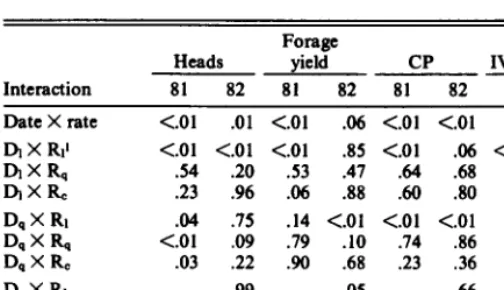
Table 1. Probability of F teet for Ijlleer, quadratic, end cubic interaction lor 3 and 4 application dates in 1981814 1982 with 4 rater of mefluididc (0,0.28,0.56, end 0.84 kg/he) application on number of be8ds, forage yield, CP, and IVDOMD of crested wbeatgraee grown near Sidney, Montana.
Forage
Heads yield CP IVDOMD Interaction 81 82 81 82 81 82 81 82 Date x rate <.Ol .Ol <.Ol .06 <.Ol <.Ol .07 c.01 DI X RI’ c.01 <.Ol <.Ol .85 <.Ol .06 c.01 c.01 DI X R, .54 .20 .53 .47 .64 .68 .55 c.01 DIXR, .23 .96 .06 .88 60 .80 .74 .31 D,XRI .04 .75 .14 c.01 <.Ol c.01 .06 .64 DqX% <.Ol .09 .79 .lO .74 .86 .39 .60 Dp X R, .03 .22 .90 .68 .23 .36 .80 .08 D,Xk - .99 -- .05 - .66 -- .18 DCXR, -- .03 -- .11 - -21 -- <.Ol DCXR, -- .28 - .60 - .04 -- .05 II= linear, ., = quadratic, E = cubic response
Precipitation was measured daily at the site from April through October in a standard 2O-cm recording rain gauge. Precipitation data from November through March and daily air temperatures from February through June were obtained from an official weather station located at Sidney, Mont. Degree days (accumu- lated daily mean air temperature above 3’ C threshold) accumu- lated from the first of February through June were calculated to determine if there was a difference between years when growth regulators were applied.
The data were first analyzed with a 3 date by 6 treatment and 4 X 6 factorial analysis of variance the first and second years, respec- tively, using a randomized complete block design to determine if different kinds of growth regulators had a significant effect on heading, forage yield, CP, and IVDOMD. The analysis showed a significant or highly significant date by treatment interaction for all variables measured. Since F test was significant, the least signif- icant difference (LSD) test at 0.05% was used to determine: (1) if the response from application of 0.56 kg/ ha of mefluidide differed from that of MH, and (2) if MH differed from that of MH plus chlorflurenol. The data from the fourth application in 1981 were analyzed separately since they were not included in the same blocks as the first 3 dates. All treatment differences reported are signifi- cant at the EO.05 probability level unless otherwise stated.
The response surface showing date and rate changes for meflui- dide was determined using a 3 X 4 and 4 X 4 factorial analysis of variance the first and second years, respectively. The interaction treatment sum of squares was partitioned into linear, quadratic, and cubic components with orthogonal polynomials for all possi- ble combinations of interactions of dates and rates (Table 1). Multiple regression was used to determine the coefficients for the appropriate terms in the interaction, e.g., date quadratic by rate cubic. Data from all 4 applications dates for both years were used to draw the 3dimensional graphs to display the response surface. Adding data from the fourth application date in 1981 only slightly decreased the R2 values and the response surface for the first 3 dates remained nearly the same.
Polynomial equations did not adequately represent the data when there was a significant interaction between date and rate even though Rz values ranged from 0.77 to 0.97. The 3dimensional graphs showed a response across application dates for the zero mefluidide rates when there should have been no response. Log and log-log transformations were tested but did not adequately represent the data between the zero and 0.28 kg rates.
Results and Discussion Comparison of Chemicals
The licensed rates of MH (4.5 kg/ ha a.i.) and MH (3.36 kg/ha) plus chlorflurenol(l.12 kg/ ha) were used in this study to compare with various rates of mefluidide. The licensed rate of MH plus chlorflurenol was determined by extensive testing on various grass species in both the United States and Canada (Anderson 1970). With one exception, there was no significant difference between MH alone and MH plus chlorflurenol on heading, forage yield, CP, and IVDOMD of crested wheatgrass when applied on 4appli- cation dates in 1981 and 1982 (Table 2). This exception was when MH plus chlorflurenol decreased forage yield more than MH alone on the first application date in 198 1. Stich et al. (1978) also found that application of 5.6 kg/ha of MH decreased heading of red fescue (Fesruca rubra L.) similar to application of 3.36 kg/ha of MH plus 1.12 kg/ha of chlorflurenol. However, Jagschitz et al. (1978) found that addition of chlorflurenol with MH was better than MH alone in reducing heading in Kentucky bluegrass (Poe pratensb L.) and about equal for the other 4 cool-season grasses. There were some differences between application of mefluidide at 0.56 kg/ ha and MH in 198 1 and 1982 on heading, forage yield, CP, and IVDOMD of crested wheatgrass (Table 2). These differ- ences were not consistent across all application dates and may have resulted from sampling error. For example, mefluidide decreased
Table 2. Effect of mefluldlde (0.56 kg/be) (MF), maleic hydrazlde (4.5 kg/ha) (MI-I) end MH (3.36 kg/be) plus cblorfluerenol(l.12 kg/ha) (MH+C) on
number of he8ds, forage yield, CP, and IVDOMD of created wheetgraee grown near Sidney, Montana during 1981 end 1982.
Appl. date
7 Apr. 22 Apr. 4 May LSD& 18 May LSD.m 28 Apr. 12 May
Heads/m2 Forage, T/ha CP, % IVDOMD, % MF MH MH+C MF MH MH+C MF MH MH+C MF MH MH+C
1981
168 363 288 1.78 1.82 1.50 6.6 6.9 6.6 56.4 56.0 54.7 15 97 99 1.33 1.62 1.39 8.6 8.1 8.6 57.2 57.8 56.3 55 7 4 1.04 1.25 1.18 8.3 8.0 8.2 55.3 54.6 54.1
122 0.25 0.9 1.9
372 107 55 1.27 1.26 1.32 7.4 7.4 7.7 53.3 51.4 52.6
166 0.19 0.7 1.5
1982
52 87 54 1.55 1.15 0.95 5.2 6.5 6.7 59.7 59.2 58.1 16 23 12 1.13 0.94 0.83 6.2 6.9 7.3 59.7 54.9 56.3 25 May 170 102 104 1.07 1.10 1.08 6.3 6.1 6.4 56.8 57.2 59.0 10 June 313 228 240 1.64 1.61 1.59 4.7 4.8 4.7 54.3 57.1 56.1
LSD.& 95 0.22 nfl 1.9
*LSD of interaction
cw 1981
J’rt_Rq Rs - 8.77
300
400
“E h 300 E l&J 200 I
100
8
cw 1981 cw 1982
Dq-RI p - 8.90
Jh-Rl ,.R’ - 0.81
cw 1981
Dq-RI RL - 0.82 * 10
T
I
CW 1981 64
62 x 60
cw JSSE
500
400 i ;i 300 :: u 200 I
100 8
RR’IE, kg’h8
cw 1982
DC-Rc RL - 0.37 x 10
T
T
CW 1982
Dq-Rc R’- 0.33 64 T T
RATE, kg/ha
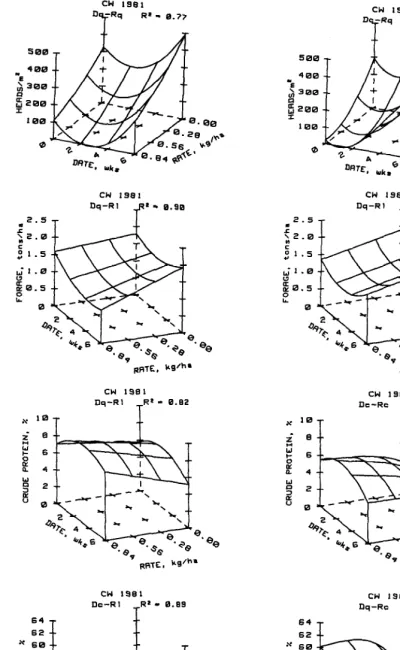
Fig. 1. Effects of date (weeks afterjloralprimordium initiation) and rate of mefuidide application on heads, forage yield, CP, and IVDOMD of crested wheatgrassgrown near Sidney, Mont., during 1981 and 1982. Zhe interaction terms used inplottingeuch response surfocare listed on thegraph, e.g., Dq-Rq. D=date. R=rate, Hinear, q=quadratic, and cxubic.
48
heading more than MI-I the first application date and less the last date in 1981 but no difference was noted the next year. Mefluidide reduced forage yield more than MH the second application date in 1981 but less than MH the fist date in 1982. Mefluidide increased CP less than MH the first and second application dates in 1982 but not in. 1981. Mefluidide also increased IVDOMD more than MH the last date in 1981 but less than MH the last date in 1982. Jagschitz et al. (1978) also found that mefluidide and MH were similar in reducing heading of 5 cool-season grasses. Stich et al. (1978) found that MH at 5.6 kg/ha was similar to 0.42 kg/ ha of mefl~dide in controlling heading of red fescue.
Date of Mefhidide Application
There was a significant date by rate interaction for mefluidide both years (Table 1). Application of mefluidide 2 to 4 weeks after floral primordium initiation in 1981 was most effective in reducing heading of crested wheatgrass but in 1982 it was most effective 2 weeks earlier (Fig. 1).
Why growth regulators were more effective reducing crested wheatgrass heading on the first application date in 1982 than in
1981 is unclear. Growth regulators were applied both years within the same week that the first floral primordium was initiated; at that time, leaf height was about 10 cm. Mefluidide was applied the first, second, third, and fourth application dates when 126,229,357, and 493 degree days had been accumulated the first year, and when 132, 237,373, and 551 degree days had been accumulated the second year, respectively. Accumulated degree days were more nearly the same both years for the first 2 dates than the last 2 dates. The fourth application of mefluidide was made when crested wheatgrass was
1% and 20% headed the fust and second years, respectively. It does not appear that precipitation following application of growth regulators affected their effectiveness. During the first year, precipitation was received 5 (2 mm), 5 (2 mm), 4 (2 mm), and 5 (5 mm) days after application of growth regulators when applied 0,2, 4, and 6 weeks after floral primordium initiation, respectively. During the second year, precipitation was received 10 (2 mm), 3 (13 mm), 2 (25 mm), and 17 (23 mm) days after application of growth regulators when applied 0, 2,4, and 6 weeks after floral primor- dium initiation, respectively. The mefluidide label states that opti- mum results may not be obtained if precipitation occurs within 8 hr following application and this did not happen.
Others have found that date of mefluidide application on peren- nial ryegrass (Field and Whitford 1982), annual bluegrass [Pou clllnua var. reptans (Hauskins) Tim.] (Danneberger et al. 1987, Jagschitz 1985), tall fescue (Fesrucu arundinaceu Schreb.) (Gerrish and Dougherty 1983), and foxtail barley (Hordeurn jubutum L.) (White 1984) had a significant effect on head control. However, most researchers have applied mefluidide a few days after mowing of turf grasses (Hield et al. 1979), Field and Whitford 1980, Jack- son et al. 1980) or on some calendar date with no measure of plant growth stage (Fales et al. 1976, Jagschitz et al. 1978, Robb et al. 1983, Glenn et al. 1987). However, White (1984) found that meflui- dide was most effective in controlling heading of foxtail barley when applied near initiation of floral primordia. It appears from thii study that mefluidide was most effective in reducing heading of crested wheatgrass when applied from 0 to 2 weeks after initiation of floral primordia. This would be 4 to 6 weeks before appearance of the seed heads. The optimum time for application of mefluidide to crested wheatgrass is less than that suggested on the mefluidide label. Label instructions state that maximum benefits can be attained by applying mefluidide at any time between uniform green up in the spring until 2 weeks before seed head appearance.
Mefluidide reduced August forage yield (Fig. 1) most when applied 2 to 6 weeks after floral primordium initiation in 198 1 and 2 to 4 weeks after initiation in 1982. This was 2 weeks later than the most effective date for reducing heading. Mefluidide was most
effective in increasing CP (Fig. 1) both years when applied 2 to 4 weeks after floral primordium initiation. In contrast mefluidide was most effective in increasing IVDOMD (Fig. 1) both years when applied 0 to 2 weeks after flora initiation.
Indices other than the initiation date of crested wheatgrass floral primordia could be used to determine when to apply mefluidide. For example, in both years Hood’s phlox (Phlox /ZOO& Richard- son) first flowered the same week that crested wheatgrass floral primordium was initiated. Common dandelion (Turuxucum offic- inuk Weber) first flowered a week later.
Rate of Mefluidide Application
Mefluidide rates from 0 to 0.84 kg/ ha decreased heads quadrati- cally and forage yield linearly both years (Fig. 1). Mefluidide increased CP and IVDOMD linearly the first year but cubicly the second year (Fig. 1).
In 1982, application of only 0.28 kg/ ha of mefluidide within 0 to 2 weeks after floral primordium initiation reduced crested wheat- grass seed heads by over 9% and increased forage quality. How- ever, in 198 1, a similar response required application of 0.56 kg/ ha of mefluidide. Application of 0.56 kg/ha of mefluidide 2 weeks after floral primordium initiation decreased heading 80 and 95%, decreased forage yield 22 and 31%, increased CP 1.7 and 2.3 percentage units, and increased IVDOMD 1.8 and 4.2 percentage units in 1981 and 1982, respectively.
Morre and Tautvydas (1986) also found that application of successively higher rates of mefluidide to tall fescue caused a curvilinear decrease in heads. The response surface and magnitude of various rates of mefluidide on heading, forage yield, CP, and IVDOMD of crested wheatgrass was very simiir to that reported by Haferkamp et al. (1987). They also found that heading, yield, and quality response varied from linear to curvilinear depending upon the year.
The effects of mefluidide might have been more consistent if a nonionic surfactant had been applied with it. Jackson et al. (1980) and Morre and Tautvydas (1986) found that application of a nonionic surfactant at 0.25 to 0.5% V/V with mefluidide enhanced its effectiveness, while Jagschitz et al. (1978) found no such effect. The mefluidide label originally prohibited additions of adjuvants such as surfactants, spreaders, stickers, etc. The label now states that nonionic surfactant be used at 0.25 to 0.5% volume/volume of tank mixture. If surfactant addition was as effective as reported by Morm and Tautvydas (1986), the 0.28 kg/ ha mefluidide rate could have provided over 9% control of heading in 1981. This would reduce chemical cost by half.
Conclusions
Future research on improving forage quality with growth regu- lators should be concentrated on mefltidide. Mefluidide will be licensed for use on tall fescue in 1989, and thii license may later be extended to crested wheatgrass. Maleic hydrazide or MH plus chlorllurenol will probably not be licensed for such use because of residue problems. The application of 4.5 kg/ ha of MH had no consistent benefit over application of 0.56 kg/ ha of mefluidide at 4 growth stages. Application of 3.36 kg/ha of MH plus 1.12 kg/ha of chlorflurenol at 4 growth stages had no beneficial effects on forage yield or quality in comparison with MH alone.
Mefluidide was more effective in decreasing heading and increasing CP and IVDOMD when applied 0 to 2 weeks after inititation of first floral primordium. The accumulation of degree days or initiation of first floral primordium can be used to deter- mine when to apply mefluidide most effectively to crested wheat- grass. Application of 0.56 kg/ ha of mefluidide 0 to 2 weeks after floral primordium initiation was the most effective treatment in reducing heading and increasing forage quality. Further research is needed to determine what date and rate mefluidide should be applied to crested wheatgrass to optimize beef gains per hectare. In
order to increase beef gains per hectare mefluidide needs to be applied
when it will maximize IVDOMD
increases and minimize forage yield decreases.Literature Cited
Anderson,
D.O. 1970. Growth retardant chemicals. Ohio State Univ. Short Course Roadside Develop. 2993-97.Cunpbtll, J.B. l%l. Continuous versus repeated-seasonal grazing of grass-alfalfa mixtures at Swift Current, Saskatchewan. J. Range Man- age. 14~72-77.
Daooebtrgtr, T.K., B.E. Bnohusl, rod J.M. Varpt, Jr. 1987. Mefluidide applications for annual bluegrass seedhead suppression based on degree- day accumulation. Agron. J. 7969-71.
F&s, S.L., A.P. Nitlttn, and RX. Waktfitld. 1976. Top growth and root growth response of red fescue to growth retardants. Proc. N.E. Weed Sci. sot. 303334-339.
Field, R.J., and A.R. Whitford. 1980. The effect of mefluidide on the growth of perennial ryegrass. Proc. 33rd New Zealand Weed and Pest Control Conf. 33:74-78.
Field, R.J., and A.R. Whitford. 1982. The retardation of grass growth by synthetic plant growth regulators. p. 485-504. In: J.S. McLann (cd.). Chemical Manimdation of COD Growth and Develoament. * . Butter- worths, London.
Gerrish, JR., and C.T. Dougherty. 1983. Tall fescue sward response to mefluididc and nitroaen. Aaron. J. 75:895-898.
Glenn, B.P., J. Bond, a&l S. &~II. 1987. Effects of mefluidide treatment, nitrogen fertilization, and tall fescue variety on nutrient metabolism by growing sheep fed fall-harvested silages. J. Anim. Sci. 65:797-807.
Haftrkunp, M.R., R.F. Miller, and F.A. Sotva. 1987. Mefluidide effects on forage quality of crested wheatgrass. Agron. J. 79:637-641.
Hitld, IL, S. Htmrtmt, V.A. GibtauIt, aad V.B. Youagntr. 1979. Warm season turf growth control with Embark. California Agr. 33:(10)15-16.
Jht00, I-F., B.P. O’COMO~, md D.J.I. Jm&too. 1980. Mcfluididc: A plant growth ngulator. Proc. 33rd New Zealand Weed and Pest Control Conf. 33:67-73.
Japehitz, J.A. 1985. Mefluidide timing for Pea annuo L. seedhead sup- pression. Proc. N.E. Weed Sci. Sot. 39268-269.
J8g=bitz,
J.A., J.D. St@ and R.C. Wtktfltld. 1978. Effect of growth retardants on cool season lawn grasses. Proc. N.E. Weed Sci. Sot. 32319327.Mom, DJ., md K.J. Tmtvydu. 1986. Mefluidide-chlorsulfuron-2,4-D surfactant combinations for roadside vegetation management. J. Plant Growth Regul. 4:189-201.
Robb, T.W., D.G. Ely, C.E. Ritck, S. Glenn, L. Kitchen, B.P. Glenn, and R J. Thomas. 1983. Beef production from tall fescue treated with meflui- dide, a chemical plant-growth regulator. p. 725-728. In: J.A. Smith and V.W. Hays (ed.). Proc. XIV Int. Grassland Congr.
Stich, J.D., R.C. Wtktfitld, sod J.A. Jtgtchitz. 1978. Combinations of growth retardants and broadleaf herbicides for roadside turf-grass. Proc. N.E. Weed Sci. Sot. 32328-331.
WtktIitld, R.C., and A.T. Don. 1973. Growth control for highway turf. Proc. 2nd Int. Turfgrass Res. Conf. p. 569-576.
white, L.M. 1984. Foxtail barley heading, yield, and quality as infhrenccd
by growth regulators and a desiccant. Agron. J. 7627-30.
White, LM., G.P. Htrtmtn, tad J.W. Btrgoun. 1981. In vitrodigestibility, crude protein, and phosphorus content of straw of winter wheat, spring wheat, barley, and oat cultivars in eastern Montana. Agron. J. 73: 117- 121.
wbitt, L.M., tad J.R. Wig& 1981. Seasonal dry matter yield and digestib-
lity of seven grass species, alfalfa, and cicer milkvetch in eastern Mon- tana. Agron. J. 73~457462.
Range Research:
Basic Problems and Techniques
editors: C. Wayne Cook and James Stubbendieck
RANGE RESEARCH:
BASIC PROBLEMS
AND TECHNIQUES,
a
majorrevision of an earlier publication of the National Academy of Science, presents steps in research planning, evaluation of results, and meth- ods and procedures in range research, including sampling techniques and experimental design. Chapter titles include: The Range Research Problem, Assessment of Habitat Factors, Methods of Studying Vegeta- tion, Studies of Root Habits and Development, Methods of Measuring Herbage and Browse Utilization, Livestock Selection and Manage- ment in Range Research, Methods for Studying Rangeland Hydrol- ogy, Economic Research in Range Management, Sampling Methods with Special Reference to Range Management, Experimental Design, and Problems Involved in the Application of Research Techniques in Range Management. The book is designed to serve as a reference guide for range research methodology and as a textbook for advanced students who anticipate careers in this increasingly important field. 1986.
336
pages ISBN 09603692-3-6. $28/bard.Society for Range Management
‘639 YGRK STREET 0 DENVER. COl_ORADO SC!206 l USA