PROJECT PLANNING PRACTICES AND PERFORMANCE OF CONSTRUCTION PROJECTS IN NAIROBI CITY COUNTY, KENYA
NDAVI CATHERINE MUUTE D53/CTY/PT/31973/2015
A Research Project Submitted to the School of Business in Partial Fulfillment of the Requirements for the Award of the Degree in Master of Business Administration
(Project Management Option) Kenyatta University.
ii
DECLARATION
This project is my original work and has not been presented for the award of degree in any other University.
Signature: _____________ Date: ____________
Catherine Muute Ndavi
D53/CTY/PT/31973/2015
I confirm that the work in this project has been carried out by the candidate under my supervision.
Signature: ____________ Date: ___________ Dr. Rosemary James
Department of Management Science, School of Business,
iii
DEDICATION
iv
ACKNOWLEDGMENT
The accomplishment of this work has been successful through the continuing technical help of my supervisor Dr. Rosemary James. I give thanks to my employer for providing time and creating great environment for the study. I also appreciate the encouragement and resilie nce of my family through the tasking period. I am grateful to my colleagues for their ethical support and encouragement. I also gratefully appreciate the respondents for sharing their time and experience for the purpose of this study.
TABLE OF CONTENT
DECLARATION...ii
DEDICATION...iii
ACKNOWLEDGMENT ...iv
TABLE OF CONTEN T...iv
LIST OF TABLES ...vii
ABBREVIATIONS AND ACRONYMS ...ix
OPERATION AL DEFINITION OF TERMS ...x
ABSTRACT ...xi
CHAPTER ONE: INTRODUCTION ...1
1.1 Background of the Study ...1
1.1.1 Project Performance...4
1.1.2 Project Planning Practices ...5
1.1.3 Construction Projects in Nairobi City County ...8
1.2 Statement of the Problem ...10
1.3 Objectives of the Study ...11
1.3.1 General Objective ...11
1.3.2 Specific Objectives ...12
v
1.5 Significance of the Study ...13
1.6 Scope of the Study ...13
1.7 Limitations of the Study...14
1.8. Organization of the study ...14
CHAPTER TWO: LITERATURE REVIEW ...15
2.1 Introduction ...15
2.2 Theoretical Review ...15
2.2.1 Agency Theory ...15
2.2.2 Theory of Change ...16
2.2.3 Stewardship Theory ...17
2.3 Empirical Literature ...19
2.3.1 Human Resource Planning and Project Performance ...19
2.3.2 Financial Resource Planning and Project Performance ...21
2.3.3 Material Usage Planning and Project Performance ...23
2.3.4 Time Management and Project Performance ...24
2.4 Summary of Empirical Literature and Research Gap ...26
2.5 Conceptual Framework ...27
CHAPTER THR EE: RESEARCH METHODOLOGY ...28
3.1 Introduction ...28
3.2 Research Design...28
3.3 Target population ...28
3.4 Sampling Design ...29
3.5 Data Collection Instruments ...29
3.6 Validity of Research Instruments...30
3.7 Reliability of Research Instrument ...30
3.8 Data Analysis and Presentation ...30
3.8.1 Operationalization and Measurement of Research Variables ...32
3.9 Ethical Considerations ...33
CHAPTER FOUR: RESEARCH FINDINGS AND DISCUSSIONS ...34
4.1 Introduction ...34
vi
4.3 Demographic Characterization of the Respondents...35
4.3.1 Respondents’ Level of Education ...36
4.3.2 Type of the Project...36
4.3.3 Project Owner ...37
4.4 Descriptive Analysis Results ...38
4.4.1 Human Resource Planning and Project Performance ...38
4.4.2 Financial Resource Planning and Project Performance ...40
4.4.3 Material Usage Planning and Project Performance ...41
4.4.4 Time management and Project Performance ...43
4.4.5 Projects Performance ...44
4.5 Inferential Analysis ...45
4.5.1 Correlation Analysis ...45
4.5.2 Testing Multicollinearity ...47
4.5.3 Regression Analysis...48
CHAPTER FIVE: SUMMARY, CONCLUSIONS AND RECOMMENDATIONS .53 5.1 Introduction ...53
5.2 Summary of the Study ...53
5.2.1 Human Resource Planning and Project Performance ...53
5.2.2 Financial Resource Planning and Project Performance ...54
5.2.3 Material Resource Planning and Project Performance ...54
5.2.4 Time Management and Project Performance ...54
5.3 Conclusion ...55
5.4 Recommendation ...56
5.5 Suggestions for Further Research ...57
REFERENCES...59
APPENDICIES ...65
APPENDIX I: IN TRODUCTOR Y LETTER ...65
APPENDIX II: QUESTIONNAIRE ...66
APPENDIX III: KEN YATTA UNIVERSITY RESEARCH AUTHORIZATION ...71
APPENDIX IV: NACOSTI RESEARCH AUTHORIZATION ...72
vii
LIST OF TABLES
Table 2.1: Summary of Empirical Literature and Research Gap ... 26
Table 3.1: Target Population... 29
Table 3.2: Operationalization and Measurement of Variables ... 32
Table 4.1: Level of Education... 35
Table 4.2: Type of the Project... 37
Table 4.3: Human Resource Planning and Project Performance ... 39
Table 4.4: Financial Resource Planning and Project Performance ... 40
Table 4.5: Material Usage Planning and Project Performance ... 42
Table 4.6: Time management and Project Performance ... 43
Table 4.7: Projects Performance ... 44
Table 4.8: Correlation Analysis ... 46
Table 4.9: Multicollinearity Coefficientsa... 47
Table 4.10: Model Summary ... 49
Table 4.11: Analysis of Variance... 49
viii LIST OF FIGURES
ix
ABBREVIATIONS AND ACRONYMS
GIS Geographical Information System
HR Human Resource
HRM Human Resource Management
HRMP Human Resource Management Practices ICT Information Communication Technology
JIT Just in Time
KNBS Kenya National Bureau of Statistics
LAPSSET Lamu Port-South Sudan-Ethiopia-Transport MRP Material Resource Planning
NACOSTI National Commission for Science, Technology and Innovations NAMSIP Nairobi Metropolitan Services Improvement Project
x
OPERATIONAL DEFINITION OF TERMS
Construction Projects Assembling of building infrastructures in an organized effort to construct a building/structure.
Financial Planning Describing each of the resources, activities, equipment as well as materials needed to achieve these objectives, and the involved timeframes.
Human Resource Planning This process identifies current as well as future needs of human resources within an organization to attain its goals. Material Usage Planning A process that identifies current as well as future material
resources needs in an organization to attain its goals.
Project Management This is the application of knowledge, skills, tools, and techniques to project activities to meet the project requirements.
Project Performance This is the capability of completing the project in line with the required specifications, within the promised time schedule, the specified budget, while keeping the stakeholders as well as customer happy.
Project Planning The process of estimating or specifying milestones, timetab les, equipment, budget and workforce are specified. It defines the estimation of the time, effort, cost as well as employee resources needed in the execution of the project.
Project Planning Practices These are the elements that are necessary for a successful project implementation.
Project A temporary endeavor, which is undertaken after specific cycle of initiation, planning, and execution as well as close to creation of a unique product or service.
xi ABSTRACT
1
CHAPTER ONE
INTRODUCTION
1.1 Background of the Study
Projects make up approximately 50% of all work conducted and consequently deemed as the vehicle for the organizational growth execution (Raz & Shenhar, 2003). Fretty (2005) noted that the project management is the project accomplishment through application and integration of initiation, planning, execution, controlling, monitoring and closing.
Andrew, Joana, Peter and Alan (2013) reported that a project could be regarded as a scheme, that is vigorous and keeps on changing from one stage to another within a life cycle. Regarding a generic project, its status changes from that of a concept or an idea through to studies of feasibility, execution and lastly completion. In addition, projects are recently far more complicated than ever before. Large capital investment is involved as well as several disciplines embraced, tighter schedules, project participants who are widely dispersed, and quality standard, which are stringent. This combined with fast improvement in ICT; these components have incredibly affected project performance in taking focal points of recently created management tools and the most recent innovation. The project management creative concept is all-inclusive and non-specific.
2
The planning of a project plan represents a managerial promise to seek after activit ies’ arrangement in the development of the business, pulling in and client satisfaction, contending efficiently, leading tasks and improving financial and market performance of the company. Therefore, some of the construction company’s project plan entails growing the business, building a loyal clientele and outcompeting the rivals. In choosing a project plan, management should effect all the business approaches and ways of competing hence the management should make use of this competitive and operating approaches combination in moving the organization the expected way, reinforcing its market position and aggressiveness and boosting execution. The project planning choices a company makes are not often easy decisions and some of them might turn out to be wrong but that is not an excuse for not deciding on a concrete course of action (Al Khattab, 2012).
3
desired result/outcome with minimum defects. Schedule: The project generates the desired result/outcome within the estimated period.
Kress (2014), noted that all projects should endeavor to satisfy the three aspects of a project. However, external forces at play force the project to go off course. It is therefore necessary to perform proper planning since projects are capital intensive and carry along many risks and uncertainties with them (Telsang, 2014).
A properly planned project typically has control mechanism that are inbuilt to make sure that all necessary procedures are followed to enhance the success of the project based on the set plan. Shenhar, (2008) noted that the control mechanisms guarantee that actions anticipated to execute established plan to action are well matched with objectives set, and able of realizing the plan. It is not always easy for a project manager to identify deviations in budget or that there are time and cost overruns. It is through the project control mechanism that these are noted.
4
Kenya has made heavy investments in infrastructure with a view to get better people’s socio-economic conditions (Telsang, 2005). The government aims at efficient management and deriving good returns on the investment for future development. However, performance of projects in most developing economies is relatively low notwithstanding their contribut io n to these countries. It has been argued that many projects within developing nations fail to meet the three core aspects of successful project hence they do not meet the intended purpose (Idoko, 2008).
1.1.1 Project Performance
The performance of a project is largely determined by personal capabilities as well as skills of the available potential leaders than a mere understanding of the projects’ constraints. (Jiang, 2009). Berg and Karlsen, (2007) noted that managers of the project have traditiona l ly stressed technical skills and knowledge as the key ingredients in the management of projects. The need for effective project management has called for a better project manageme nt approaches that consider human capital and leadership skill as necessary tools in project management (Sumner, 2006).
5
objectives as well as core business) and supported by a well-organized commissio ning programmes are the expected outcomes of the project. The indicators of proper project performance include; aligning project outcomes with customer needs expectations and specifications (Lauri & Gregory, 2002).
According to Lisa (2013) other measures of project performance includes; project completed according to desired specifications, completion of project using the specified budget and completion of project within the promised schedule of time. Hamilton and Gibson (1996) have also argued that the cost and schedule saving is a good measure of project performance while meeting the expectations of stakeholders. The project performance relies heavily upon on key indicators such as time taken to complete, meeting the standards set by varies authorities such as the government and county authorities (Kagalwala & Ram, 2003). The current study used quality management, cost management and completion time as the measures of project performance.
1.1.2 Project Planning Practices
6
It also refers to the process of defining suitable approaches for the accomplishment of predefined project objectives (Faniran, Oluwoye and Lenard, 2008). It can as well be described as the process in which project objectives are defined, project framework determined, while methods, tactics, targets strategies, and deadlines are set to attain the set objectives while communicating the same to the relevant stakeholders.
Projects normally have a diversity of objectives, involve many external and internal players, and cut across different activity sectors. Since 1980, lots of practitioners as well as academics have approved that human resource management (HRM) planning practices, time management practices, material usage planning practices and financial planning practices are the most vital elements of the success of an organization (Dvir, Raz & Shenhar, 2003). Nowadays, Human Resource Management Practices (HRMP) is being renewed within organizations and steadily affirming its strategic role. HRMP are one area, which influe nces intention of employees to leave, job satisfaction levels and organizational commitment hence affecting the performance of a project (Huang, 2009). A project’s human resource management practices contribute to increased performance and therefore help it to grow as well as gain sustainable competitive advantage.
7
development of time schedules. According to Antvik & Sjöholm (2007) activities must be sequenced accurately to develop realistic as well as achievable schedules.
The process of activity resource estimation encompasses determination of what resources are needed as well as the quantity of each resource that will be used in the project. Needed resources may be material, equipment and personnel hence material planning practices. The process as well includes determination of when each resource will be available to the project especially the material used in the project (PMBOK, 2004). Generally, there are two resource estimation methods; bottom-up and top-down. In instances of constrained information, the top-down strategy is frequently utilized. The projects’ higher management conducts it and it is founded on experience from projects, which are similar. The bottom-up method, which involves each definite work classification in the process, is also called qualitative based estimations.
8
stop of the entire project. The estimation of cost ought to be centered on the scope of the project, the WBS and be linked to the plan of the project. Adisa Olawale & Sun (2010) reported that due to the presence of several factors of uncertainty in a project, a reserve cost could be assigned to activities with a low work packages level or detailed information with possible high financial risks.
Project developments must include consideration of goal measurement methods and financ ia l planning practices. Some processes of planning include this step; other planning processes leave this question to be attended to by a separate process. According to Olsen S.& Pulawska G. (2013) addressing goal measurement involves articulation of indicators, benchmarks as well as objectives. Most of the JIT cost advantages took place when large inflation increases brought about large increases in the carrying inventory cost (Plenert, 1993; Plenert & Best, 2006). Nevertheless, looking at MRP's basic philosophy, we ought to be capable of focusing our scheduling only on the needed materials, and when they are needed (Ritzman, 2004).
1.1.3 Construction Projects in Nairobi City County
9
information from Kenya National Bureau of Statistics (KNBS) (2016), the constructio n industry grew by 9.2 percent in 2016 from growth of 13.9 percent registered in 2015. The same statistics demonstrated an expansion in action in the development of housing and construction of roads meaning an increase in employment within the sector to 163.0 thousand jobs in 2016 from 148.6 thousand jobs in 2015.
Constructions activities in Nairobi City County are carried out mainly by organizations that are usually organized into firms which are outfits that deal with day to day running in the construction projects. The projects to be considered in this study are infrastructure projects and service delivery projects. Nairobi county embarked on the implementation of several infrastructure and service delivery projects in the year 2013 and some the projects that never took off , that is, the Eastland’s Urban Renewal project which was a proposal to construct new housing units built within the open spaces in the estates of old and new Pangani, Jevanjee Bachelors, Ngara, Woodley and Uhuru (Mong’are, 2016).
10
Nairobi City County are still incomplete and 10 percent of these projects have stalled completely.
Other important projects in the county are the drilling of boreholes, construction of storm-water drainage systems, construction of elevated storm-water tanks, road projects, security projects and street lighting. Some of the projects funded by the World Bank under the NAMSIP have not been started/completed in time for example physical address system projects, a GIS mass valuation system, and the redevelopment of a different city estates.
1.2 Statement of the Problem
While most of the project managers utilize most of their time figuring out how to meet the objectives of the projects they are carrying out, most of these projects within Nairobi City County are not completed within the stipulated time. The main challenges experienced in this delay being human capital and financial resources (Kennedy, 2016). Majority of the project managers concentrate their financial and time resources in handling the immed iate problems thus unable to anticipate and prepare for the next challenges.
11
Cooke‐ Davies (2014), Lianying Zhang, Weijie Fan (2013), found that scanty planning and analysis leads to a failed project while good planning increases the chances of success of the project.
However, there is scanty of empirical studies on the effects of project planning practices on project performance in Kenya. For the last five years, several plans on how the city’s infrastructure projects and most important how the road can be decongested have been mooted and laws created, but less than 10 projects have been actualized. Competing interests, duplication of roles, endless planning and grandstanding by stakeholders are standing in the way of an efficient traffic flow, working public transport system in Nairobi and poorly constructed infrastructures. This study sought to bridge this gap by determining effects of project planning practices on construction projects performance in Nairobi City County, Kenya.
1.3Objectives of the Study 1.3.1 General Objective
12 1.3.2 Specific Objectives
The specific objectives of the study were:
i. To determine the effects of human resource planning on performance of constructio n projects in Nairobi City County, Kenya.
ii. To analyze the effects of financial resource planning on performance of constructio n projects in Nairobi City County, Kenya.
iii. To identify the effects of material usage planning on performance of constructio n projects in Nairobi City County, Kenya.
iv. To establish the effects of time management on performance of construction projects in Nairobi City County, Kenya.
1.4 Research Questions
The study was guided by the following research questions:
i. What are the effects of human resource planning on performance of construction projects in Nairobi City County, Kenya?
ii. How does financial resource planning affect performance of construction projects in Nairobi City County, Kenya?
iii. What are the effects of material usage planning on performance of construction projects in Nairobi City County, Kenya?
13 1.5 Significance of the Study
The study was of benefit to construction firms. The construction firms were able to establish the effects of project planning practices on performance of project and learn to utilize some of the benefiting planning practices such as financial planning practices, human resource planning practices and time planning practices. This study was of great assistance to the project managers in various counties in developing the right direction on improved projects performance in all the counties. Other researchers can utilize the study’s findings for reference. It helped them as a source of secondary data when doing research on interrela ted fields in different areas of interest. The research study assisted other scholars get insight in the project management field. There were only few studies in the area and therefore the findings of this study gave a good starting point to the scholars to conduct more research in project management. The findings and recommendations was useful in both policy and practice in public and governmental organization undertaking projects. Application of concepts outlined in this study ensured project success.
1.6 Scope of the Study
14
projects, housing projects and water and drainage projects since these were the major mega projects done in the county from 2013 to 2017.
1.7 Limitations of the Study
The study faced the following limitations; some participants viewed the information sought as confidential and were hesitant in providing information fearing that competitors might use the information for their own gains. However, the researcher used introductory and authorization letter from the university to assure the participants that the informa t io n provided would be used for education purposes only. There were delays in data collectio n where the respondents were too busy to fill in the research questionnaire. The researcher however, persuaded the respondents by explaining the importance of the research study.
1.8. Organization of the study
15
CHAPTER TWO
LITERATURE REVIEW
2.1 Introduction
This section discussed literature on project performance and empirical findings on the effect of project planning on the project performance. It presented literature on relevant project theories and their application to construction firms. The discussions sought to identify, evaluate and present relevant information from textbooks, journals and findings from other scholars as well as experts. These logical summaries tried to capture the minds of others in relation to the variables to be investigated.
2.2Theoretical Review 2.2.1 Agency Theory
16
In agency theory terms, the project beneficiaries are principals and project managers are the agents. Therefore, the agents, since they hold power on behalf of the principal, are expected to exercise control for the benefit of the principal by ensuring sufficient returns. According to (Bonazzi, 2007). Agency theory specifies mechanisms that reduce loss and increasing benefits (wealth creation) to the principal thus, managers should always act to the best interest of the beneficiaries. This theory is significant in managing projects and it indeed emphasizes on the need of taking the interest of the stakeholder in all management decision of the projects. Agency theory is applicable to the study in that it supports the works of project managers in ensuring that resources such as time, finance, human and materials are utilized to the best interest of the citizens/beneficiaries.
2.2.2 Theory of Change
Theory of Change rose during the 1990s at the Aspen Institute Roundtable on Communit y Change to model and assess exhaustive network activities. Notable methodologists, for example, Michael Quinn Patton, Huey Chen, Heléne Clark, Carol Weiss and Peter Rossi, had been considering the application of program theories to assessment since 1980. The Roundtable's initial work centered around working through the difficulties of assessing complex network activities.
17
Theory of Change is a comprehensive illustration as well as description of how and why a change that is desired is anticipated to take place in a context (Andersen, 1996). It’s focused on bridging the gap in the so commonly referred to as the “missing middle” between what a change or program initiative does (its interventions or activities) and how these bring about preferred goals being attained (Chizea, 2002). This theory is applicable to the study in that it supports construction firms to first identify the preferred long-term project/goals performance and then work back from these to make out all the conditions (outcomes) that ought to be in place (and how these casually related to one another) for the goals to take place (Mintzberg & Waters 1996). This may involve ensuring material, time, financial and human resources are used effectively and efficiently.
2.2.3 Stewardship Theory
Stewardship Theory created by Donaldson and Davis (1991 and 1993) is another way of understanding to current relationships between ownership and management of the company. Managers are corporations’ good stewards and work diligently to attain high corporate profit levels and returns of their shareholders (Donaldson and Davis, 1994).
18
superior decisions as they run it on an everyday basis as compared to the directors who are more of outsiders (Donaldson and Davis, 1994).
It has been noted that where the wealth of a shareholder is maximized, the utilities of stewards are maximized as well, since organizational success will serve the majority requirements and the stewards will have a mission that is clear (Smallman, 2004). Therefore, stewardship theory refers to an argument proposed in performance of firms that satisfies the interested parties’ requirements resulting in dynamic performance equilibrium for governance that is balanced. According to Donaldson & Davis, (1994) stewardship theorists have argued that senior executives within an organization will not disadvantage shareholders for fear of endangering their reputation. This theories implication is that the managers and employees of construction firms ought to have an important proportion of guidance to guarantee more efficient as well as effective decision making.
19 2.3Empirical Literature
2.2.1 Human Resource Planning and Project Performance
The relationships between practices of human resource have been studied; quit rates of employee, and project performance within the service sector (Batt, 2002). The study was a descriptive study. The findings confirmed that firms’ puts emphasize on high skills, participation of employee in decision making and in teams and incentives of human resource for instance employment security and high relative pay, have higher performance and lower quit rates, sales growth. The study targeted only the service sector where the main assets are human being and may not be applicable to other sectors.
Belout and Gauvreau (2004) studied the determinants of labor productivity in project performance. Descriptive analysis was used and the study targeted employees of various projects. The study found a positive association between planning of HR and project performance. The study recommended that organizations should put in place worker involvement program, which will enable workers with opportunities to reflect their own work experiences and attitudes, and their own hopes for the future. The study concentrated only on the human inputs but non-human inputs in a project such as finance and material planning were not factored in this study.
20
styles with motivation of employees. Nevertheless, the researchers reported that only under highly participative systems, practices of HR (selection, training, leadership and management styles are positively interrelated to project performance of a firm.
Huang (2009) studied the influence of human resource management practices on employees’ performance (job satisfaction levels, intention to leave, and organizational commitment). The study targeted employees in construction industry. The study found that a company’s human resource management practices contribute to increased performance and therefore help it to grow as well as gain sustainable competitive advantage. These researches bade to explain the relationship between human resource management practices and financial performance and sustenance of a competitive advantage in a dynamic environment but did consider the project performance aspects.
21
Werner and De Simone, (2016) studied the influence of human resource planning on organizational performance. The study targeted the human resource managers and inferent ia l research design was used. The study found that planning of human resource helps companies in the prediction of how changes in their strategy will affect the needs of their HR. The study recommended that planning the labor force needs of any organization is very important as well as critical particularly in the rapid changes in demands of external market. The study concentrated on the human resource needs and how they affect organization performance, but it failed to address the issue on human resource planning.
2.3.2 Financial Resource Planning and Project Performance
Guoli (2010) studied budget-planning effects on project performance. The descriptive research design was used, and the study targeted the stalled projects. The study deduced that a professional developed budget controls the project costs and creates favorable cash-flow conditions in the project. The study also found that insufficient cash flow consequence in a project is frequently associated with delays and large extra costs, since there is big threat for a temporary discontinuation of the entire project. The study did not investigate fully the contribution of budget planning on project performance.
22
responsibility of a certain area within which they can make decisions over and this is a problem since it was not considered in this study. Many of the construction companies are more flat and power is extensively given to middle management. This is as well connected to the higher level of authority in the organization and may affect how finances are utilized.
Antvik and Sjöholm (2013) studied the impact of cost in project performance. The study was a census. The study found that estimation of cost ought to be grounded on the scope of the project, the WBS and be linked to the plan of the project. The study also found that for the project to reach a correct estimation, the cost of individual activities must be estimated based on the specific activity conditions. Due to the various factors of uncertainty in a project, it is wise to reserve some cost dedicated to activities with high risk and a low level of detailed information.
23
project. However, the study failed to show the relationship strength between project performance and cost planning.
2.3.3 Material Usage Planning and Project Performance
Plenert and Best (2012) studied the influence of material level on project performance. The study was a survey of construction companies. Descriptive analysis was utilized, and the study found that most of the JIT cost benefits took place when inflation increases bringing about great increases in the cost of carrying inventory. The study recommended that firms must be capable of only focusing our planning on materials needed, and when they are needed. The study failed to indicate clearly the relationship between material usage and project performance.
Kress (2014) studied the effects of material planning on project performance through a survey design of selected constructions firms. The study targeted construction projects not completed in time in London. The study found that the project management primary objective is to meet otherwise surpass the material usage sponsors anticipation of the project. According to the study these anticipations are usually expressed within 3 groupings; a given project generates preferred result with minimum defects. Cost: A given project generates preferred result for the expected cost Schedule: A given project generates the preferred result within the expected period. However, the study did not consider many forces interve ning and attempting to push projects off target.
24
that planning gives a definition of the actions as well as activities, targets of cost and time, and milestones of performance, which will bring about successful project implementation as well as project objectives achievement. The study also found that the plan must make an indication of the human resources, equipment, materials, facilities, as well as other resources that are essential to ensure project completion. Devoting resources and making timely planning does not always guarantee that a desired goal will be achieved. It hardly works that way since the unanticipated more often take place regardless of how scrupulous the process of planning may have been.
2.3.4 Time Management and Project Performance
Akpan and Chizea (2012) studied the determinants of time planning systems in the construction firms. A case study of failed projects in Nigeria were selected. The study found that time planning system necessitates the sensible evaluation of actual implementation with standards that are pre-established and if implementation is different from the conventio na l objectives/goals then the corrective action is enforced immediately. Conversely, execution of a project refers to the actualizing a project plan and at the same time, tracking the plans effectiveness in the achievement of the set goals and this can be defined as project control in action. The study did not establish the effects of time planning on project performance.
25
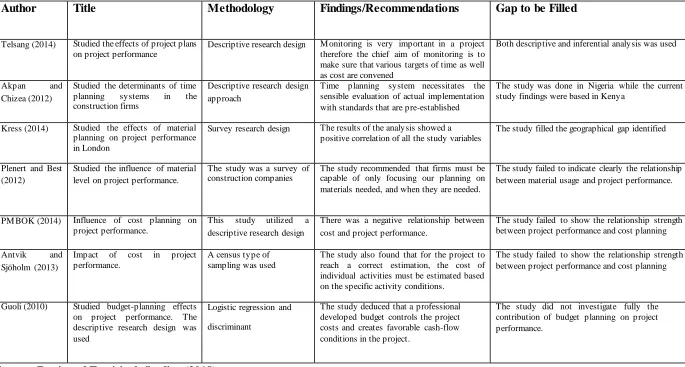
26 2.4 Summary of Empirical Literature and Research Gap
Table 2.1 Summary of Empirical Literature and Research Gap
Author Title Methodology Findings/Recommendations Gap to be Filled
Telsang (2014) Studied the effects of project plans on project performance
Descriptive research design M onitoring is very important in a project therefore the chief aim of monitoring is to make sure that various targets of time as well as cost are convened
Both descriptive and inferential analysis was used
Akpan and
Chizea (2012)
Studied the determinants of time planning systems in the construction firms
Descriptive research design approach
Time planning system necessitates the sensible evaluation of actual implementation with standards that are pre-established
The study was done in Nigeria while the current study findings were based in Kenya
Kress (2014) Studied the effects of material planning on project performance in London
Survey research design The results of the analysis showed a positive correlation of all the study variables
The study filled the geographical gap identified
Plenert and Best (2012)
Studied the influence of material level on project performance.
The study was a survey of construction companies
The study recommended that firms must be capable of only focusing our planning on materials needed, and when they are needed.
The study failed to indicate clearly the relationship between material usage and project performance.
PM BOK (2014) Influence of cost planning on project performance.
This study utilized a descriptive research design
There was a negative relationship between cost and project performance.
The study failed to show the relationship strength between project performance and cost planning
Antvik and Sjöholm (2013)
Impact of cost in project performance.
A census type of sampling was used
The study also found that for the project to reach a correct estimation, the cost of individual activities must be estimated based on the specific activity conditions.
The study failed to show the relationship strength between project performance and cost planning
Guoli (2010) Studied budget-planning effects on project performance. The descriptive research design was used
Logistic regression and discriminant
The study deduced that a professional developed budget controls the project costs and creates favorable cash-flow conditions in the project.
The study did not investigate fully the contribution of budget planning on project performance.
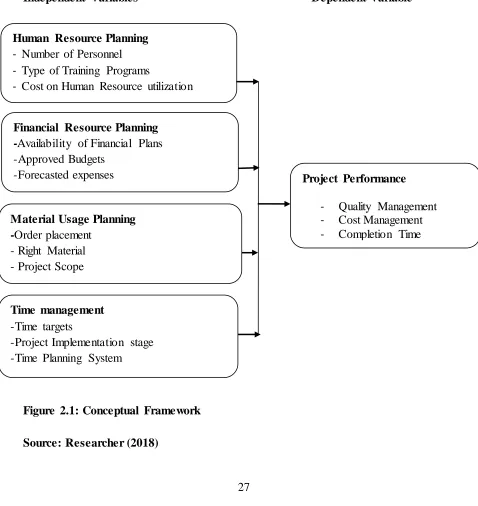
27 2.5 Conceptual Framework
The conceptual framework shows how the different variables are related to each other. Human resource planning, financial planning, time planning, and material planning are the independent while dependent variable is the project performance.
Independent Variables Dependent Variable
Figure 2.1: Conceptual Framework
Source: Researcher (2018) Material Usage Planning -Order placement
- Right Material - Project Scope
Human Resource Planning - Number of Personnel
- Type of Training Programs
- Cost on Human Resource utilization -
Financial Resource Planning -Availability of Financial Plans -Approved Budgets
-Forecasted expenses Project Performance
- Quality Management - Cost Management - Completion Time
Time management -Time targets
28
CHAPTER THREE
RESEARCH METHODOLOGY
3.1 Introduction
This chapter gives a description of the research methodology that was assumed in undertaking this study. It highlights the procedures as well as techniques that were utilized in the collection, processing and analysis of data. It therefore outlines the research design, population of study, sample size and procedure of sampling, data collection instrume nts, procedures and analysis techniques that the study was used.
3.2 Research Design
Descriptive research design and explanatory research design were adopted in this study. According to Mugenda and Mugenda (2014) descriptive survey demonstrates relations hips by assessing samples at one point without trying to make causal statements or inferences. The descriptive survey shows an in-depth investigation on the significance of project planning practices on performance of the project.
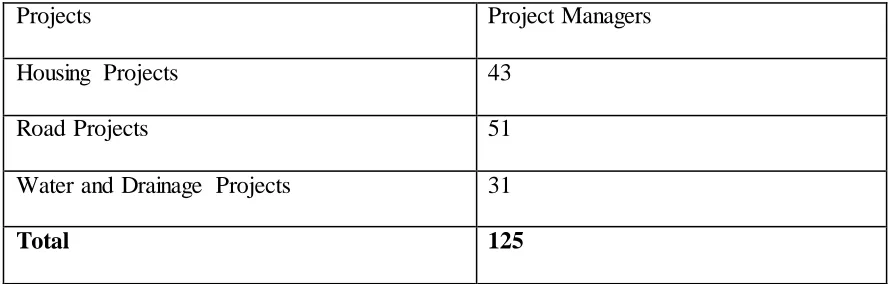
3.3 Target population
29 Table 3.1: Target Population
Projects Project Managers
Housing Projects 43
Road Projects 51
Water and Drainage Projects 31
Total 125
Source: Nairobi City County Secretary’s Office (2018)
3.4 Sampling Design
Sampling is described as the process of selecting the target population units that are to be included in a given study in such a way that the selected elements sample represents the whole population (Geteria, 2012). Since the population is of manageable size, a census of all the one-hundred and twenty five projects was conducted.
3.5 Data Collection Instruments
30 3.6 Validity of Research Instruments
Validity is described as the degree to which obtained findings from the analysis of data essentially represent the phenomenon under study (Mugenda & Mugenda, 2005). To assess the content validity, the researcher consulted experts who included the supervisor to offer suggestions on content. The researcher also involved some of the colleagues in the master class for their comments. Their recommendations were used in the improvement of the final questionnaires. Pretesting was done in five projects, which did not participate in the study to avoid bias for having interacted with the questionnaire.
3.7 Reliability of Research Instrument
Research instrument reliability is its level of internal consistency over time (Mwituria, 2012). A reliable instrument is therefore the one that produces constantly the anticipated results/outcome when used more than on one occasion in the collection of data from two samples drawn from the same population. The suitability of the instrument was checked using Cronbach’s alpha. A Score above 0.7 in the study’s threshold, which according to Hair (1998) an overall scale of above 0.7 is acceptable.
3.8 Data Analysis and Presentation
31
regression analysis, the study embraced key diagnostic tests. The regression model was a key analytical tool useful in testing the current hypothesis.
Analysis of data was done by use of descriptive statistics, which included mean, frequencies and percentages. These showed the correlation between the independent variable and dependent variable and the significant P- values, and inferential analysis was used to make judgments of the probability that an observed difference between groups and studies was dependable one. The Correlation coefficients provided the degree and direction of relationships. It does the measurement of the relationship, or co-variation of two or more dependent variables. The statistical calculation of such correlation was done and expressed in terms of correlation coefficients. A multiple regression model was utilized to show the connection between the dependent and independent variables. The multiple regression model of the form; Y = β0 + β 1X1 + β2X2 + β 3X3 + β4X4 + ε
Where: Y= Project Performance β0= Constant β1 to β4 =Coefficients X1 = HRM planning X2=
Financial Resource Planning X3 = Material Usage Planning X4 = Time Planning ε =Error
term. Inferential statistics was conducted to determine the relationship nature that exists between variables. Data was interpreted with the help of significance P-values; if the P-value is less than 0.05, the variables deemed significant to give an explanation on the changes in the dependent variable. The coefficient of determination (R2 or r2) was used to analyze the
32
3.8.1 Operationalization and Measurement of Research Variables
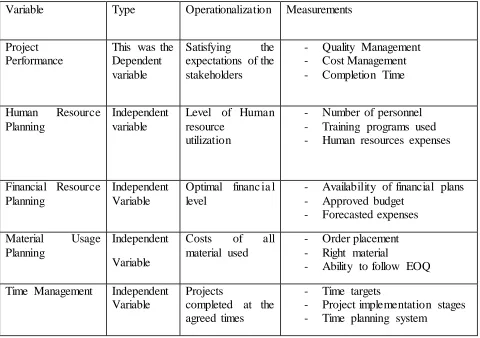
The independent variable of the study was project planning practices. The indicators of project planning practices were human resource planning, financial resource planning, material usage planning and time management. The dependent variable was project performance. The table 3.2 presents how the study variables was operationalized and measured.
Table 3.2: Operationalization of Variable
Variable Type Operationalization Measurements
Project Performance
This was the Dependent variable
Satisfying the expectations of the stakeholders
- Quality Management - Cost Management - Completion Time
Human Resource Planning
Independent variable
Level of Human resource
utilization
- Number of personnel - Training programs used - Human resources expenses
Financial Resource Planning
Independent Variable
Optimal financ ia l level
- Availability of financial plans - Approved budget
- Forecasted expenses Material Usage
Planning
Independent Variable
Costs of all material used
- Order placement - Right material
- Ability to follow EOQ Time Management Independent
Variable
Projects
completed at the agreed times
- Time targets
- Project implementation stages - Time planning system
33 3.9 Ethical Considerations
34 CHAPTER FOUR
RESEARCH FINDINGS AND DISCUSSIONS
4.1 Introduction
This chapter discusses the interpretation and presentation of the findings. The purpose of the study was to analyze effects of project planning practices on performance of constructio n projects in Nairobi City County, Kenya. The researcher used frequency tables and figures to present data. The finding intention was to answer the study’s research questions. Data composed was collated and reports were produced in form of tables and figures and qualitative analysis carried out in prose.
4.2 Response Rate
35 Figure 4.1: Response Rate
Source: Survey Data, (2018)
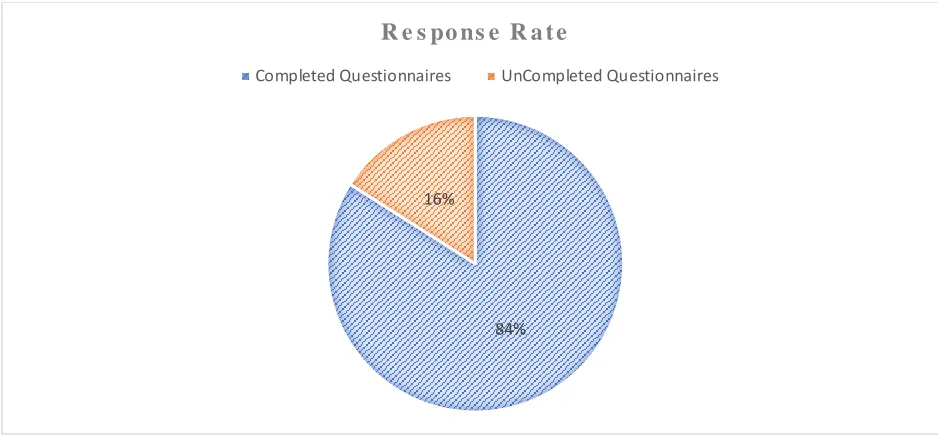
The findings in figure 4.1 indicated that 84% of the targeted respondents filled the questionnaire appropriately, as requested.16% of the respondent were reluctant to fill the questionnaire. They gave reasons which included that they did not get time fill them at the required time. The response rate establishes enthusiasm of the respondents to partake in the survey that the study sought.
4.3 Demographic Characterization of the Respondents
As part of the general statistics, the research required the respondents to indicate the type of the project the company was carrying out, project ownership and the highest level of education. The analysis depended on this information of the respondents to classify the various outcomes of the study.
84% 16%
R e s po ns e R a t e
36 4.3.1 Respondents’ Level of Education
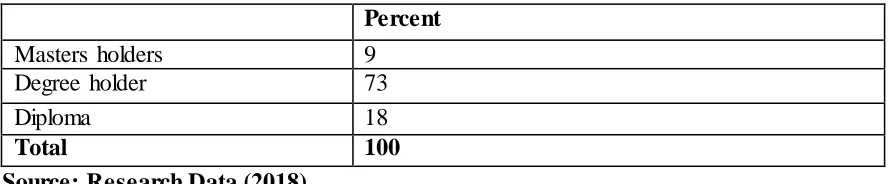
The study sought to establish the level of education that each respondent held. Table 4.1 illustrates the results.
Table 4.1: Level of Education
Percent
Masters holders 9
Degree holder 73
Diploma 18
Total 100
Source: Research Data (2018)
The findings in table 4.1 indicates that majority (73%) of the respondents had attained degree as their highest academic qualification, 18% held undergraduate as their highest level of education, 19% of the participant were diploma holders while 9% were master’s holders. Perrett (2003) pointed that academic qualification of the employees in an organiza t io n enhances their ability to handle their tasks and to understand any working formula developed in work place. This depicts that most of the employees working at projects process had relevant knowledge that is required in projects implementation process.
4.3.2 Type of the Project
37 Table 4.2: Type of the Project
Project Frequency Percent
Road project 27 26
Water and drainage 19 18
Housing project 59 56
Total 105 100
Source: Researcher, (2018)
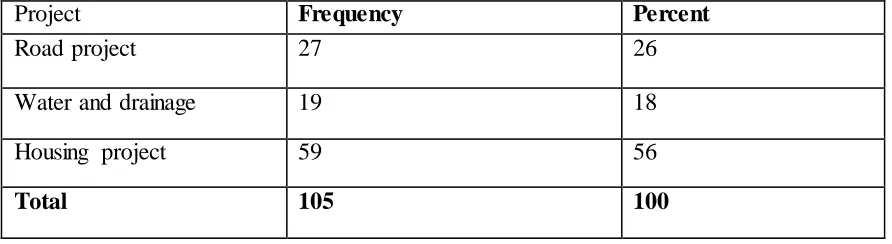
The figures in table 4.2 indicated that most (56%) of the firms were doing housing projects, 26% were doing road projects while 18% were doing water and sewerage projects. This shows that there were more ongoing development housing projects as compared to road projects, water and sewerage projects in Nairobi City County. This may be attributed to the increasing number of residents within Nairobi City County as they seek employment and urbanization hence increasing demand of the housing.
4.3.3 Project Owner
38 Figure 4.2: Project Owner
Source: Survey Data, (2018)
4.4 Descriptive Analysis Results
This section presents descriptive analysis on the data gotten from the respondents in connection with independent variables and dependent variable. The section describes the data using mean and standard deviation. High mean indicated that majority of the responded strongly approved the statements presented to them while standard deviation indicated the degree of dispersion from the mean.
4.4.1 Human Resource Planning and Project Performance
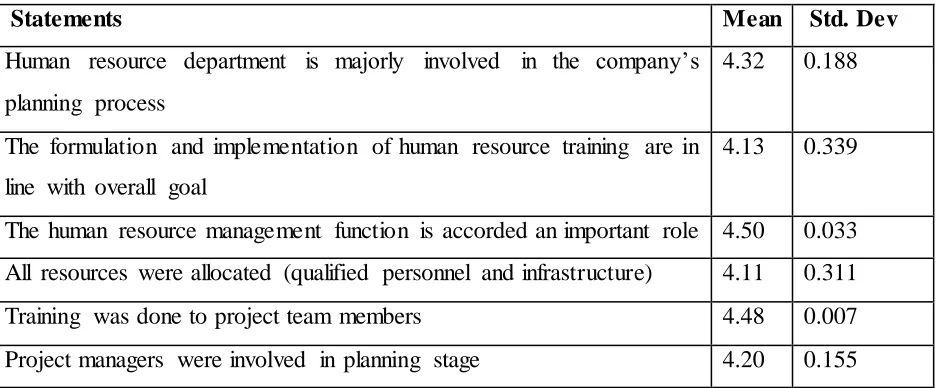
The study sought to establish the effect of human resource planning on project performance in Nairobi City County. Various statements were included in the questionnaire to indicate the level of human resource planning on the projects selected. Table 4.4 summar izes
0 10 20 30 40 50 60 70
Local Foreign Local private or jont-stock companies 62%
28%
39
respondents’ level of agreement on aspects relating to human resource planning on performance of construction projects in Nairobi City County.
Table 4.4: Human Resource Planning and Project Performance
Statements Mean Std. Dev
Human resource department is majorly involved in the company’s planning process
4.32 0.188
The formulation and implementation of human resource training are in line with overall goal
4.13 0.339
The human resource management function is accorded an important role 4.50 0.033 All resources were allocated (qualified personnel and infrastructure) 4.11 0.311 Training was done to project team members 4.48 0.007 Project managers were involved in planning stage 4.20 0.155
Source: Research Data, (2018)
40
0.311. It is therefore clear that human resource planning practices was being done effective ly by the projects in Nairobi City County through the consideration of the important role of human resource managers, allocating enough human resources and training them well. The study concurs with Batt (2002) findings that firms’ puts emphasize more on high training on skills, participation of employee in decision making and incentives of human resource for instance employment security.
4.4.2 Financial Resource Planning and Project Performance
The researcher required the respondents to state their level of conformity on the statements in relation to how financial resource planning affects performance of construction projects in Nairobi City County. Several indicators of financial resource planning were applied, and the results were presented in table 4.4.
Table 4.3: Financial Resource Planning and Project Performance
Statements Mean Std. Dev
Project cost was well estimated 3.16 1.965
The budgeted funds were enough to complete the project 4.34 0.515 Budget for the project was properly determined (combining the
estimated costs of individual activities or work packages to establish an authorized cost baseline)
4.37 0.998
41
The findings in the table 4.4 showed that majority of the respondents strongly agreed that project completion was done without struggle and that project manager was able to forecast expenses as depicted by mean score of 4.58 and 4.50 respectively. Further respondents agreed that budget for the project was properly regulated (combining the projected costs of specific activities or work packages to ascertain an approved expenditure baseline) and that the budgeted funds were enough to complete the project as indicated by mean score of 4.37 and 4.34 respectively. Finally, respondents were neutral that project cost was well estimated as depicted by a mean of 3.16 and a standard deviatio n of 1.965.
Generally, it is clear from the presented study that proper financial planning was done as indicated by proper projections of the costs and completions of project phases in time without hustle. The study agrees with Guoli (2010) which found that a professional developed budget controls and the project costs creates favorable cash-flow conditions in the project. The study also found that insufficient cash flow consequence in a project is frequently associated with delays and large extra costs, since there is a great possibility for a temporary halt of the entire project.
4.4.3 Material Usage Planning and Project Performance
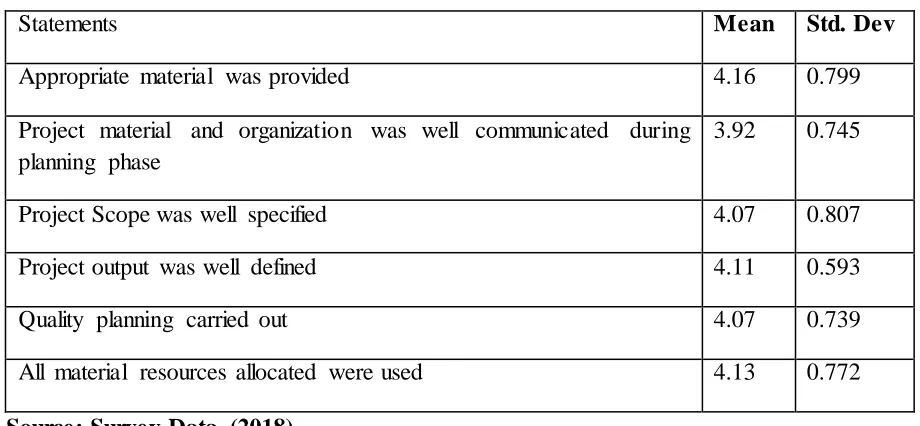
42
Table 4.4: Material Usage Planning and Project Performance
Statements Mean Std. Dev
Appropriate material was provided 4.16 0.799
Project material and organization was well communicated during planning phase
3.92 0.745
Project Scope was well specified 4.07 0.807
Project output was well defined 4.11 0.593
Quality planning carried out 4.07 0.739
All material resources allocated were used 4.13 0.772 Source: Survey Data, (2018)
The study findings as presented in table 4.5 indicated majority of the respondents agreed that appropriate material was provided as depicted by mean score 4.16 and a standard deviation of 0.799, respondent also agreed that all material resources allocated were used and that project output was well defined as shown by mean score of 4.13 and 4.11 respectively. Quality planning were carried out as illustrated by mean score of 4.07, further respondent agreed that project material and organization was well communicated during planning phase as depicted by mean score of 3.92.
43
the cost of carrying inventory. The study recommended that firms must be capable of only focusing our planning on material resources needed, and when they are required.
4.4.4 Time management and Project Performance
The study aimed to determine the effect of time planning on project performance in Nairobi City County. The results were presented in table 4.6.
Table 4.5: Time management and Project Performance
Statements Mean Std. Dev
The project scope was well specified during planning phase 4.55 0.195 Schedules were well developed (prepared) 4.58 0.126 Activity duration was well estimated 4.61 0.454 The project was completed on the original(planned) schedule 3.18 0.455 All projects were to be completed on the agreed time 3.01 0.29 Source: Research Data, (2018)
44
score of 3.18 and 3.01 respectively. This is an indication that on average projects are completed at the agreed time and that the project scope and activity duration were well done.
The study agrees with Lloyd (2013) findings that time planning functions effects on performance of the project. The study indicated that planning ought to be adequately comprehensive to make management possible, since it loses promptly its convenience if deviation from it cannot be sensed as well as amended promptly. The study disagrees with Telsang (2014) findings that the devoting resources and making timely planning does not always guarantee that a desired goal will be achieved. The study found that time manageme nt hardly works that way since the unanticipated more often take place regardless of how scrupulous the process of planning may have been.
4.4.5 Projects Performance
The study sought to establish the level of projects performance in Nairobi City County. Table 4.7 summarizes respondents’ level of agreement on various statement presented to them.
Table 4.6: Projects Performance
Statements Mean Std. Dev
The output/delivered product met the specifications in the planning stage
4.66 0.167
Quality work was performed 4.56 0.240
Project cost was well estimated 4.33 0.053
45
Findings in table 4.7 illustrates that greater part of the respondents agreed that the output/delivered product met the specifications in the planning stage as depicted by mean score 4.66 and a standard deviation of 0.167. Further respondent also approved that ensuring the project delivery quality is within the expectation of the clients is key for success of a project implementation as shown by mean score of 4.56 and a standard deviation of 0.240. Further respondents approved that quality work was performed as illustrated by mean score of 4.33 and standard deviation of 0.053.
It is clear that the selected projects had indicated high degree of project planning practices and these translated to high project performance that met the client’s specifications. The findings agree with Kress (2014) findings that the project management primary objective is to meet otherwise exceed the sponsors expectations of the project. According to the study these anticipations are usually stated within 3 groupings; a given project generates preferred result with minimum defects, a given project generates preferred result for the expected cost Schedule and that a given project generates the preferred result within the expected period.
4.5 Inferential Analysis
This section investigates the correlation between variables, tests the possibility of multicollinearity, presents the model summary, analysis of variance and the coefficients of the independent variables.
4.5.1 Correlation Analysis
46
management) and the dependent variable (project performance). To calculate the correlation (strength) between the study variables and their findings the Survey Data used the Karl Pearson’s coefficient of correlation (r). The findings were presented in table 4.8.
Table 4.7: Correlation Analysis
P er for m an ce of con st ru ct ion p roj ec ts H u m an R es ou rc e P lan n in g F in an ci al R es ou rc e P lan n in g M at er ial U sage P lan n in g T im e m an age m en t
Performance of
construction projects
Pearson Correlation Sig. (2-tailed)
1
Human Resource
Planning
Pearson Correlation .523 1 Sig. (2-tailed) .0032 Financial Resource
Planning
Pearson Correlation Sig. (2-tailed)
.6140 .0021
.3421 .0014
1
Material Usage
Planning
Pearson Correlation .7460 .1240 .0621 1 Sig. (2-tailed) .0043 .0120 .0043
Time management Pearson Correlation .5210 .3420 .0000 .1660 1 Sig. (2-tailed) .0172 .0031 1.000 .0031 Source: Survey Data, (2018)
47
construction projects and material usage planning had a positive correlation with a correlation value of 0.746 while a positive correlation was also found between performance of construction projects and time management with a correlation value of 0.521.
The results proved a positive correlation between performance of construction projects and human resource planning, financial resource planning, material usage planning and time management. The study findings agree with Belout and Gauvreau (2004) findings there is a positive correlation between planning of HR, time planning, material resource planning, financial planning and project performance. Wright (2009) findings confirm and agree with the current study that there is a direct connection between selection of human resources, material planning, financial planning and time management with project performance.
4.5.2 Testing Multicollinearity
The study sought to investigate whether two or more independent variables have a high correlation with each other. The findings were presented in Table 4.9
Table 4.9: Multicollinearity Coefficientsa
Model
Collinearity Statistics Tolerance VIF
Human Resource Planning .878 1.012
Financial Resource Planning .689 1.112
Material Usage Planning .869 1.158
Time management .655 1.321
a. Dependent variable: Project Performance
48
A VIF value of 5 or more and a tolerance value of less than 0.2 presents a possibility of multicollinearity. The findings in table 4.9 indicate that the tolerance values were above 0.2 and that the VIF values were below 5 indicating that there was no possibility of multicollinearity between variables thus regression analysis could be done to show the relationships between the dependent and independent variables.
4.5.3 Regression Analysis
The researcher conducted a multiple regression analysis to determine the change in the (dependent variable) performance of construction projects because of change in the four independent variables.
4.5.3.1 Model Summary
49 Table 4.10: Model Summary
Model Summary
Model R R Square Adjusted R Square Std. Error of the Estimate
1 .780a .632 .556 .50119
a. Predictors: (Constant), Time management, Material Usage Planning , Human Resource Planning , Financial
Resource Planning
Source: Survey Data, (2018)
The four independent variables (human resource planning, financial resource planning, material usage planning and time management) contributes to 55.6% on performance of construction projects as represented by the adjusted R2. Consequently, the other factors not
considered in this research contribute to 44.4% on performance of projects. The coeffic ie nt of correlation value of 0.780 indicates that there was a positive strong correlation between independent and dependent variables.
4.5.3.2 Analysis of Variance
The study sought to establish the overall significance. The results were presented in the table 4.11.
Table 4.11: Analysis of Variance
Indicator Sum of Squares Df Mean Square F Sig.
Regression 142.771 4 35.69 49.872 0.000
Residual 14.645 101 0.145
Total 157.416 105
Source: Research Data (2018)
50
calculated F statistics was large than the critical F statistic. The findings indicated that the variables: human resource planning, financial resource planning, material usage planning and time management are good predictors of performance of construction projects.
4.5.3.3 Regression Coefficients
The study coefficients of independent variables are presented in table 4.12. The coefficie nts indicate the direction and change of dependent variable because of change in the independent variables.
Table 4.12: Regression Coefficients
Model
Unstandardized Coefficients
Standardized Coefficients
T Sig.
B Std. Error Beta
(Constant) 1.308 1.342 1.623 0.357
Human Resource Planning 0.558 0.310 0.172 4.342 .0276
Financial Resource Planning 0.731 0.156 0.210 3.532 .0285
Material Usage Planning 0.785 0.322 0.067 3.542 .0202
Time management 0.620 0.245 0.148 3.458 .0249
Source: Survey Data, (2018)
As per the SPSS generated table 4.12, the equation
Y = β0 + β1X1 + β2X2 + β3X3 + β4X4+ε becomes:
Y= 1.308+ 0.558X1+ 0.785X2+ 0.620X3+0.731X4