Energy Efficient Routing Algorithms for Wireless Sensor Networks and
Performance Evaluation of Quality of Service
Rahul Jaiswal
*, Pavan Kumar
21 Department of ECE, Maharishi University of Information & Technology, Lucknow, India 2
Assistant Professor ECE Departments, Maharishi University of Information & Technology, Lucknow, India
([email protected],[email protected])
Abstract:
The popularity of Wireless Sensor
Networks
(WSN)
have
increased
tremendously in recent time due to growth
in
Micro-Electro-Mechanical
Systems
(MEMS)
technology.
WSN
has
the
potentiality to connect the physical world
with the virtual world by forming a network
of sensor nodes. Here, sensor nodes are
usually battery-operated devices, and hence
energy saving of sensor nodes is a major
design issue. To prolong the network‘s
lifetime,
minimization
of
energy
consumption should be implemented at all
layers of the network protocol stack starting
from the physical to the application layer
including cross-layer optimization. In this
paper, clustering based routing protocols
for WSNs have been discussed. In
cluster-based routing, special nodes called cluster
heads form a wireless backbone to the sink.
Each cluster heads collects data from the
sensors belonging to its cluster and
forwards it to the sink. In heterogeneous
networks, cluster heads have powerful
energy devices in contrast to homogeneous
networks where all nodes have uniform and
limited resource energy. So, it is essential to
avoid quick depletion of cluster heads.
Hence, the cluster head role rotates, i.e.,
each node works as a cluster head for a
limited period of time. Energy saving in
these approaches can be obtained by cluster
formation,
cluster-head
election,
data
aggregation at the cluster-head nodes to
reduce data redundancy and thus save
energy. The first part of this thesis discusses
methods for clustering to improve energy
efficiency of
homogeneous WSN. It also
proposes Bacterial Foraging Optimization
(BFO) as an algorithm for cluster head
selection for WSN. The simulation results
show improved performance of BFO based
optimization in terms of total energy
dissipation and no of alive nodes of the
network system over LEACH, K-Means and
direct methods.
1.
Introduction
complex algorithms and as gateways to other networks. New network architectures with heterogeneous devices and expected advances in technology are eliminating current limitations and expanding the spectrum of possible applications for WSNs considerably.
2.
Literature Review
In 1981, Baker and Ephremides proposed a clustering algorithms called ―Linked cluster algorithm (LCA)‖ [17] for wireless networks. To enhance network manageability, channel efficiency and energy economy of MANETS, Clustering algorithms have been investigated in the past. Lin and Gerla investigated effective techniques to support multimedia applications in the general multi-hop mobile ad-hoc networks using CDMA based medium arbitration in [18]. Random competition based clustering (RCC) [19] is applicable both to mobile ad hoc networks and WSN. RCC mainly focuses at cluster stability in order to support mobile nodes. The RCC algorithm applies the First Declaration Wins rule, in which any node can govern‘‘ the rest of the nodes in its radio coverage if it is the first to claim being a CH. Some of well known clustering algorithms for mobile ad hoc networks presented in the literature are Cluster Gateway Switch Routing Protocol (CGSR) [20], Cluster-Based Routing Protocol (CBRP) [21], Weighted Clustering Algorithm (WCA) [22]. A survey of clustering algorithms for mobile ad hoc networks has been discussed in [23]. QoS is the ability of a network element (e.g. an application, host or router) to have some level of assurance that its traffic and service requirements can be satisfied. QoS manages bandwidth according to application demands and network management settings. QoS has been extensively studied in wireless LANs and wired computer networks. IP and Asynchronous Transfer Mode (ATM) provide extensive QoS support ranging from best effort service to guaranteed service.
3.
Classification of Routing Protocols in
WSNs
In general, routing in WSNs can be divided into flat-based routing, hierarchical-based routing, and location-based routing depending on the network structure. In flat-based routing, all nodes are typically assigned equal roles or functionality. In hierarchical-based routing, however, nodes will play different roles in the network. In location-based routing, sensor nodes' positions are exploited to route data in the network. A routing protocol is considered adaptive if certain system parameters can be controlled in order to adapt to the current network conditions and available energy levels.
Furthermore, these protocols can be classified into multipath-based, query-based, negotiation-based, QoSbased, or routing techniques depending on the protocol operation. In addition to the above, routing protocols can be classified into three categories, namely, proactive, reactive, and hybrid protocols depending on how the source sends a route to the destination. In proactive protocols, all routes are computed before they are really needed, while in reactive protocols, routes are computed on demand. Hybrid protocols use a combination of these two ideas. When sensor nodes are static, it is preferable to have table driven routing protocols rather than using reactive protocols. A significant amount of energy is used in route discovery and setup of reactive protocols. Another class of routing protocols is called the cooperative routing protocols. In cooperative routing, nodes send data to a central node where data can be aggregated and may be subject to further processing, hence reducing route cost in terms of energy usage. Applications of Wireless Sensor Networks According to a new report from research firm ON World ―The home market for Wireless Sensor Networks (WSN) will reach US$6 billion a year by 2012‖. The prediction includes both products and services centered on in-home energy management and health monitoring. Meanwhile, ON World predicts the market for "Home Area Network" (HAN) energy management solutions to reach 20 million homes worldwide by 2013. Wireless Sensor Networks may consist of many different types of sensors such as seismic, low sampling rate magnetic, thermal, visual, infrared, acoustic and radar. They are able to monitor a wide variety of ambient conditions that include temperature, humidity, vehicular movement, lightning condition, pressure, soil makeup, noise levels, the presence or absence of certain kinds of objects, mechanical stress levels on attached objects, and the current characteristics such as speed, direction and size of an object. WSN applications can be classified into two categories [3] as shown in Figure 1:
Monitoring Tracking
Monitoring applications include indoor/outdoor environmental monitoring, health and wellness monitoring, power monitoring, inventory location monitoring, factory and process automation, and seismic and structural monitoring. Tracking applications include tracking objects, animals, humans, and vehicles and categorize the
4. Classification of Routing Protocols in WSNs In general, routing in WSNs can be divided into flat-based routing, hierarchical-based routing, and location-based routing depending on the network structure. In flat-based routing, all nodes are typically assigned equal roles or functionality. In hierarchical-based routing, however, nodes will play different roles in the network. In location-based routing, sensor nodes' positions are exploited to route data in the network.
4.
Modulations schemes and Operational
Frequencies
The standard specifies the multiple PHYs for 868, 915 and 2400 MHz three frequency bands, they use different modulation schemes and different spread spectrum methods to transmit data in different data rates with different chip rates. There are total 37 channels with different bandwidth specified in the standard, which includes one channel in 868 MHz frequency band and 10 channels in 915 MHz frequency band and 16 channels in 2.4 GHz frequency band.
The 868/915 MHz PHY uses a simple DSSS approach in which each transmitted bit is represented by a 15-chip maximum length sequence. Binary data is encoded by multiplying each m-sequence by +1 or -1 and the resulting chip sequence is modulated onto the carrier using binary phase shift keying (BPSK). Differential data encoding is used prior to modulation to allow low-complexity differential coherent reception.
Activation and deactivation of the radio transceiver
Turn the radio transceiver into one of the three states, i.e. transmitting, receiving or off (sleeping) according to the request from MAC sublayer. The turnaround time from transmitting to receiving, or vice versa, is less than 12 symbol periods.
The slotted CSMA/CA can be summarized in five steps as follows.
Step 1 -Initialization of NB, CW and BE: The number of back offs and the contention window are initialised (NB = 0 and CW = 2). The back off exponent is also initialized to BE = 2 or BE = min (2, macMinBE) depending on the value of the Battery Life Extension MAC attribute. macMinBE is a constant defined in the standard. After the initialization, the algorithm locates the boundary of the next back off period.
Figure 1: Slotted/Un-slotted CSMA-CA Algorithm Step 2 - random waiting delay for collision avoidance: The algorithm starts counting down a random number of BPs uniformly generated within [0, 2BE-1].The countdown must start at the boundary of a BP. To disable the collision avoidance procedure at the first iteration, BE must be set to 0, and thus the waiting delay is null and the algorithm goes directly to Step 3
Step 3 - Clear Channel Assessment (CCA): When the timer expires, the algorithm then performs one CCA operation at the BP boundary to assess channel activity. If the channel is busy, the algorithm goes to Step 4, otherwise, i.e. the channel is idle, and the algorithm goes to Step 5.
Step 5- idle channel: If the channel is assessed to be idle, CW is decremented. The CCA is repeated if CW ≠ 0 (Step 3). This ensures performing two CCA operations to prevent potential collisions of acknowledgement frames. If the channel is again sensed as idle (CW = 0), the node attempts to transmit. Nevertheless, collisions may still occur if two or more nodes are transmitting at the same time.
The non-slotted algorithm is similar to slotted CSMA with a few exceptions as follows.
Step 1. The CW variable is not used, since the non-slotted has no need to iterate the CCA procedure after detecting an idle channel. Hence, in Step 3, if the channel is assessed to be idle, the MAC protocol immediately starts the transmission of the current frame. Second, the non-slotted CSMA/CA does not support macBattLife-Ext mode and, hence, BE is always initialized to the macMinBE value. Steps 2,3and4. It is similar to the slotted CSMA/CA version. The only difference is that the CCA starts immediately after the expiration of the random back off delay generated in Step 2.
Step 5. The MAC sub-layer starts immediately transmitting its current frame just after a channel is assessed to be idle by the CCA procedure.
Data Transfer Models
There are three types of data transfer
●
Data transfer to a coordinator from a device●
Data transfer from a coordinator to a device●
Data transfer between two peer devices All three methods can be used in a peer-to-peer topology. In a star topology, only the first two are used, because no direct peer-to-peer communication is allowed.5. Data Transfer to a Coordinator
In a beacon-enabled network, when a device decides to transmit data to the coordinator, the device synchronizes its clock on a regular basis and transmits the data to the coordinator using the CSMA-CA method. It has been assumed that the transmission does not occur during a GTS. The coordinator may acknowledge the reception of the date only if it is requested by the data transmitter. This basic sequence chart is shown in Figure 3.8(a). Data Transfer from a Coordinator
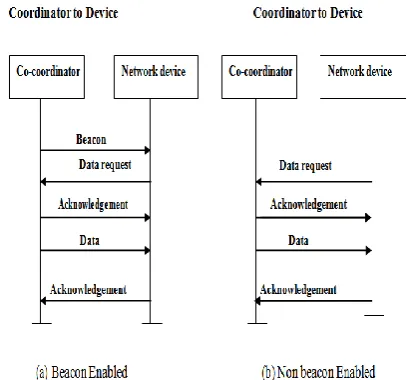
Figure 3.9(a) illustrates the data transmission steps to transfer data from a coordinator to a device in a beacon-enabled network. If the coordinator needs to transmit data to a particular device, it indicates in
its beacon message that a data message is pending for that device. The device then sends a data request message to the coordinator indicating that it is active and ready to receive the data. The coordinator acknowledges the receipt of the data request and sends the data to the device. Sending the acknowledgment by the device is optional.
Fig.2 Data transfer from a coordinator to a device (a) beacon enabled (b) non beacon
enabled
5. Principle of Evolutionary Algorithms
Evolutionary algorithms model natural processes, such as selection, recombination, mutation, migration, locality and neighborhood. Figure 4.1 shows the structure of a simple evolutionary algorithm. Evolutionary algorithms work on populations of individuals instead of single solutions. In this way the search is performed in a parallel manner.
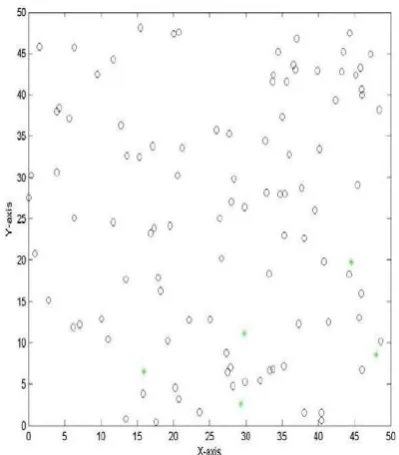
At the beginning of the computation a number of individuals (the population) are randomly initialized. The objective function is then evaluated for these individuals. The first/initial generation is produced.Figure 3: Initial positions of sensor nodes during simulation
Figure 4: Initial positions of sensor nodes during K-Means Clustering
6. Results and discussion
Figure 4. Compares the number of alive nodes of the network system for four methods viz: BFO, direct method, LEACH and K-Means algorithm. Here number of nodes that are alive has been plotted against time.
From the simulation results, it is seen that K-means provides better performance than the direct method. However it performs poorly compared to LEACH. It is seen that LEACH provides a considerably higher lifetime compared to K-Means clustering. In addition to reducing energy dissipation, LEACH successfully distributes energy-usage among the nodes in the network such that the nodes die randomly and at essentially the same rate. While these simulations do not account for the setup time to configure the dynamic clusters (nor do they account for any necessary routing start-up costs or updates as nodes die), they give a good first order approximation of the lifetime extension we can achieve using LEACH. Another important advantage of LEACH is the fact that nodes die in essentially a ―random‖ fashion. It is also seen that BFO provide better lifetime for nodes compared to other three methods. BFO is able to provide 100% live nodes for maximum duration.
Since all nodes are alive for long duration, there is sharp drop in live nodes at the end. However at any point of time BFO provides equal or more live nodes compared to LEACH algorithm.
7. Conclusion
It is seen that BFO provides better performance than other popular techniques. However, the computational complexity of BFO for applicability to WSNs still remains a challenge.
References
1. I. F. Akyildiz, W. Su, Y. Sankarasubramaniam, and E. Cayirci, "A survey on sensornetworks," Communications Magazine,IEEE, vol. 40, pp. 102-114, 2002.
2. I.F.Akyildiz, W.Su, Y. Sankarasubramaniam and E. Cayirci, "Wireless sensor networks: a survey," Computer Networks,Elsevier, vol. 38, pp. 393-422, 2002.
3. Jennifer Yick, Biswanath Mukherjee, Dipak Ghosal, "Wireless sensor network survey,"Computer Networks,Elsevier, vol. 52, pp. 2292-2330, 2008.
4. K. Martinez,J.K. Hart, and R. Ong, "Environmental Sensor Networks," Computer Magazine,IEEE, vol. 37, no. 8, pp. 50-56, 2004.
5. D. Culler, D. Estrin, M.Srivastava, "Overview of Sensor Networks," Computer Magazine,IEEE, vol. 37, no. 8, pp. 41-49, August 2004.
6. J. L.Hill, "System architecture for wireless sensor networks," University of California, Berkeley, Ph.D. dissertation 2003.
7. IEEE Standard 802.15.4, "Wireless Medium Access Control (MAC) and Physical Layer (PHY) Specifications for Low-Rate Wireless Personal Area Networks (LR- WPANs)," 2006.
8. Brian Otis, Jan Rabaey, Ultra-Low Power Wireless Technologies for Sensor Networks.: Springer, 2007.
9. G. Simon, M. Maroti, "Sensor network-based counter sniper system," in Proceedings of the 2nd international conference on Embedded networked sensor systems, Baltimore, MD, 2004, pp. 1-12. 10. G. Tolle, D. Culler, W. Hong, et al., "A
macroscope in the redwoods," in Proceedings of the 3rd international conference on Embedded networked sensor systems, San Diego, CA, 2005, pp. 51-63. 11. I. Vasilescu, K. Kotay, D. Rus, M.
Dunbabin, P. Corke, "Data collection, storage, retrieval with an underwater sensor network," in Proceedings of the Third International Conference on Embedded Networked Sensor Systems (Sensys), San Diego, CA, 2005.
12. P. Zhang, C.M. Sadler, S.A. Lyon, M. Martonosi, "Hardware design experiences in
ZebraNet," in Proceedings of the SenSys‘04, Baltimore, MD, 2004.
13. Welsh, K. Lorincz and M., "Motetrack: A robust, decentralized approach to RF-based location tracking," Personal and Ubiquitous Computing,Springer, vol. 11, pp. 489-503, 2007.
14. D.J. Baker, A. Ephremides, "The architectural organization of a mobile radio network via a distributed algorithm," Transactions on Communications,IEEE, vol. 29, no. 11, pp. 1694-1701, 1981. 15. C.R. Lin, M. Gerla, "Adaptive clustering for
mobile wireless networks," Journal on Selected Areas Communications,IEEE, vol. 15, no. 7, pp. 1265-1275, 1997.
16. K. Xu, M. Gerla, "A heterogeneous routing protocol based on a new stable clustering scheme," in Proceeding of IEEE Military Communications Conference, vol. 2, Anaheim,CA, 2002, pp. 838-843.
17. C. C. Chiang and M.Gerla, "Routing and Multicast in Multihop Mobile Wireless Networks," in Proceedings of 6th International Conference on Universal Personal Communications, vol. 2, 1997, pp. 546-551.
18. L. Jiang, J. Y. Li, and Y. C. Tay, Cluster Based Routing Protocol, 2004, draft-ietf- manet-dsr-10.txt,work-in-progress.
19. M. Chatterjee, S. K. Das and D. Turgut, "WCA: A Weighted Clustering Algorithm for Mobile Ad Hoc Networks," Cluster computing,Springer Netherlands, vol. 5, pp. 193- 204, April 2002.
20. J. Y. Yu and P. H. J. Chong, "A survey of clustering schemes for mobile ad hoc networks," Communication Surveys and Tutorials,IEEE, vol. 7, no. 1, pp. 32-48, 2005.
21. B. Atakan, O.B. Akan, and Tuna Tugcu, "Bio-inspired Communications in Wireless," in Guide to Wireless Sensor Networks.: Springer-Verlag London Limited, 2009, ch. 26, pp. 659-687.
![Figure 1: Slotted/Un-slotted CSMA-CA Algorithm Step 2 - random waiting delay for collision avoidance: The algorithm starts counting down a random number of BPs uniformly generated within [0, 2BE-1].The countdown must start at the boundary of a BP](https://thumb-us.123doks.com/thumbv2/123dok_us/1885543.1246022/3.595.308.533.87.468/algorithm-collision-avoidance-algorithm-uniformly-generated-countdown-boundary.webp)