using Hardware Tokens
(Full Version)
?Kimmo J¨arvinen1, Vladimir Kolesnikov2, Ahmad-Reza Sadeghi3, and Thomas Schneider3
1 Dep. of Information and Comp. Science, Aalto University, Finland
2 Alcatel-Lucent Bell Laboratories, Murray Hill, NJ 07974, USA
3 Horst G¨ortz Institute for IT-Security, Ruhr-University Bochum, Germany
{ahmad.sadeghi,thomas.schneider}@trust.rub.de? ? ?
Abstract. We consider Secure Function Evaluation (SFE) in the client-server setting where the client-server issues a secure token to the client. The token is not trusted by the client and isnota trusted third party. We show how to take advantage of the token to drastically reduce the communication complexity of SFE and computation load of the server. Our main contribution is the detailed consideration of design decisions, optimizations, and trade-offs, associated with the setting and its strict hardware requirements for practical deployment. In particular, we model the token as a computationally weak device with small constant-size memory and limit communication between client and server.
We consider semi-honest, covert, and malicious adversaries. We show the feasibility of our protocols based on a FPGA implementation.
1
Introduction
Secure and efficient evaluation of arbitrary functions on private inputs has been subject of cryptographic research for decades. In particular, the following sce-nario appears in a variety of practical applications: a service provider (serverS) and user (clientC) wish to compute a functionf on their respective private data, without incurring the expense of a trusted third party. This can be solved inter-actively using Secure Function Evaluation (SFE) protocols, for example using the very efficient garbled circuit (GC) approach [Yao86,LP09]. However, GC pro-tocols potentially require a large amount of data to be transferred betweenSand C. This is becausef needs to be encrypted (garbled) asfeand transferred fromS
?
This is the full version of the FC 2010 paper [JKSS10].
?? Supported by EU FP7 project CACE.
? ? ? Supported by EU FP6 project SPEED, EU FP7 projects CACE and UNIQUE, and
toC. In fact, the communication complexity of GC-based SFE protocols is dom-inated by the size of the GC, which can reach Megabytes or Gigabytes even for relatively small and simple functions (e.g., the GC for AES has size 0.5 MBytes [PSSW09]). Further, if security against more powerful adversaries is required, the use of the standard cut-and-choose technique implies transfer of multiple GCs. (For covert adversaries, only one GC must be transferred [GMS08].)
While transmission of this large amount of data is possible for exceptional occurrences, in most cases, the network will not be able to sustain the resulting traffic. This holds especially for larger-scale deployment of secure computations, e.g., by banks or service providers, with a large number of customers. Additional obstacles include energy consumption required to transmit/receive the data, and the resulting reduced battery life in mobile clients, such as smartphones.4
Further, computational load onS(computingfe) is also a significant problem, especially in the case of large-scale deployment of SFE.
Our setting, goals and approach. Motivated by the possibility of large-scale and decentralized SFE deployment we aim to remove the expensive communica-tion requirement, and to shift some ofS’s computation toC. To this end, we note that in SFE protocols, and, in particular, in GC, the role of the server can be split between two entities, with the introduction of a new entity – secure token T, which is placed in clientC’s possession, but executes S’s code thus offload-ingS. Further, it is possible to eliminate most of the communication betweenC and S and replace this with local communication between C andT. A number of technical issues arises in this setting, which we address in this work.
More specifically, we discuss and analyze hardware-supported SFE, where the service provider S issues a secure (see below) hardware token T to C. C communicates locally withT, and remotely with S. There is no direct channel between T and S, but of course C can pass (and potentially interfere with) messages betweenT andS.T is created byS, soStrustsT; however, asCdoes not trustS, she also does not trust the tokenT to behave honestly.5
Attack model. We consider all three standard types of adversaries: semi-honest (follows protocol but analyzes the transcript), malicious (arbitrary be-havior, cheating is always caught), and covert (cheating is caught with a certain deterrence probability, e.g., 1/2).
Hardware assumption.We assumeT is tamper-proof or tamper-resistant. We argue that this assumption is reasonable. Indeed, while every token can likely be broken into, given sufficient resources, we are motivated by the scenarios where the payoff of the break is far below the cost of the break. This holds for relatively low-value transactions such as cell phone or TV service, where
4 In some cases, the impact can be mitigated by creating and transferring GCs in the
precomputation phase. However, this is not fully satisfactory. Firstly, even more data needs to be transferred since demand cannot be perfectly predicted. Further, this creates other problems, such as requiring large long-term storage on client devices. 5 Note, if C in fact trusts T to behave honestly, then there exists a trivial solution,
the potential benefit of the attack (e.g., free TV for one user) is not worth the investment of thousands or tens of thousands of dollars to break into the card. For higher-value applications one could raise the cost of the attack by using a high-end tokenT, e.g., a smart card certified at FIPS 140-2, level 3 or 4.
Hardware restrictions.As we assume the token to be produced in large quan-tities, we try to minimize its costs (e.g., chip surface) and make the assumptions on it as weak as possible. In particular our token requires only restricted compu-tational capabilities (no public-key operations) and small constant secure RAM. We considerT with and without small constant secure non-volatile storage.
Further, we envision smart phones playing the role of the client (and a SIM card the role of the token). Therefore we aim to limit client’s computational power and storage ability.
Envisioned Applications. As mentioned above, we aim to bring SFE closer to a large-scale deployment. The need to minimize communication forces us to rely on tokens, the issuance of which requires certain logistical capabilities. Therefore, we believe client-server applications are most likely to be the early adopters of SFE. Further, the natural trust model (semi-honest or covert server and malicious client) allow for efficient GC protocols. Finally, many client-server application scenarios naturally include financial and other transactions which involve sensitive, in particular privacy-sensitive, information.
Today, many service providers already distribute trusted tokens to their users. Examples include SIM cards in users’ cell phones, and smart cards in users’ TV set-top boxes. Bank- and credit cards often contain embedded secure chips. Special purpose (e.g., diagnostic) medical devices, which need to be monitored and controlled, are often issued to users at home. In these settings, it is natural to use the existing infrastructure to enhance the security and privacy guarantees of the offered products, and to offer new products previously impossible due to privacy violation concerns. We consider the following examples in more detail.
Privacy protection in targeted advertisement and content delivery.Cable TV (phone, Internet) providers gain a large part of their revenue from advertise-ments, so it is desired to increase their effectiveness by considering individual user preferences, purchase history, and other collected personal information. On the other hand, privacy guidelines and laws severely limit the kinds of infor-mation that can be collected and how it can be used. Further, even legal use of personal information by the service provider may be viewed as privacy violation, and cause negative perception of the company. At the same time, using SFE to select advertisements guarantees customers’ privacy, and, moreover, ensures that the company cannot breach their privacy policies even by accident.
Privacy preserving remote medical diagnostics.Healthcare is moving faster than ever toward technologies that offer personalized online self-service, medical error reduction, consumer data mining and more (e.g., [Goo09]). Such tech-nologies have the potential of revolutionizing the way medical data is stored, processed, delivered, and made available in an ubiquitous and seamless way to millions of users all over the world. Here service provider S usually owns the diagnostic software and/or hardware that operates onC’s data and outputs classification/diagnostic results. A concrete example in this context is the classifi-cation of Electrocardiogram (ECG) data. A privacy-enhanced version for remote ECG diagnostics requires to transfer GCs of size≈63 MBytes [BFK+09]. With our token-based protocol this can be reduced substantially to approximately 100 kBytes as no garbled circuits need to be transferred.
Other applications concernfinancial transactionssuch as monetary transfers, bidding, or betting, as well as biometric authentication.
1.1 Our Contributions and Outline
Our main contribution is architecture design, implementation, a number of op-timizations, and detailed analysis of two-party SFE aided by a server-issued low-cost tamper-proof token. The communication complexity of our protocols is linear in the size of the input, and is independent of the size of the evaluated functionality. Further, most of the work ofS can be offloaded toT.
We use GC techniques of [KS08] and offer no-cost XOR gates. We rely on cheap hardware – the token T only executes symmetric-key operations (e.g., SHA and AES). T has small constant-size RAM (much smaller than the size of the circuit), but we do not resort to implementing expensive secure external RAM. In appendix §A we show how to optimize for low-power, low-memoryC.
We provide two solutions; in one,T keeps state in secure non-volatile storage (a monotonic counter), while in the other,T maintains no long-term state.
We consider semi-honest, covert [GMS08], and malicious [LP07] adversaries; our corresponding communication improvements are shown in Table 1.
Table 1.Communication between serverS and clientC for secure evaluation of func-tionfwithninputs, statistical security parameters, and deterrence probability 1−1/r.
Security Previous Work This Work semi-honest [Yao86] O(|f|+n) O(n)
covert [GMS08]O(|f|+sn+r)O(sn+r) malicious [LP07] O(s|f|+s2n) O(s2n)
in§4. In§5, we discuss technical details of our FPGA prototype implementation, present timings and measurements, and show practicality of our solution.
1.2 Related Work
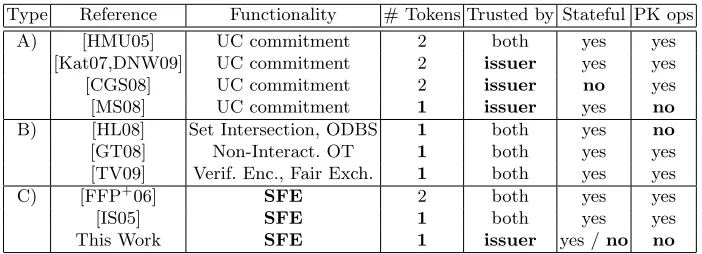
Related work on using tokens for secure computations falls in the following three categories, summarized in Table 2.
Table 2. Secure Protocols using Hardware Tokens. Columns denote the number of tokens, who trusts the token(s), if token(s) are stateful or stateless, and perform public-key operations. Properties more desired for practical applications in bold font.
Type Reference Functionality # Tokens Trusted by Stateful PK ops
A) [HMU05] UC commitment 2 both yes yes
[Kat07,DNW09] UC commitment 2 issuer yes yes
[CGS08] UC commitment 2 issuer no yes
[MS08] UC commitment 1 issuer yes no
B) [HL08] Set Intersection, ODBS 1 both yes no
[GT08] Non-Interact. OT 1 both yes yes
[TV09] Verif. Enc., Fair Exch. 1 both yes yes
C) [FFP+06] SFE 2 both yes yes
[IS05] SFE 1 both yes yes
This Work SFE 1 issuer yes /no no
A) Setup assumptions for the universal composability (UC) framework. As shown in [CLOS02], UC SFE protocols can be constructed from UC commit-ments. In turn, UC commitments can be constructed from signature cards trusted by both parties [HMU05], or from tamper-proof tokens created and trusted only by the issuing party [Kat07,MS08,CGS08,DNW09]. Here, [CGS08] consider stateless tokens, and [MS08] require only one party to issue a token. This line of research mainly addresses the feasibility of UC computation based on tamper-proof hardware and relies on expensive primitives such as generic zero-knowledge proofs. Our protocols are far more practical.
B) Efficiency Improvements for Specific Functionalities. Efficient protocols with a tamper-proof token trusted by both players have been proposed for specific functionalities such as set intersection and oblivious database search (ODBS) [HL08], non-interactive oblivious transfer (OT) [GT08], and verifiable encryption and fair exchange [TV09]. In contrast, we solve the general SFE problem.
2
Preliminaries
Notation.Throughout the paper we denote symmetric security parameter byt
(e.g.,t= 128), and pseudo-random function (PRF) keyed withkand evaluated on xby PRFk(x). PRF can be instantiated with a block cipher, e.g., AES, or a cryptographic hash function H, e.g., SHA-256, which we model as a Random Oracle (RO). AES is preferable if PRF is run repeatedly with samek as AES’s key schedule amortizes. Message authentication code (MAC) keyed withk and evaluated on messagemis denoted byMACk(m). We use a MAC that does not need to store the entire message, but can operate “online” on small blocks, e.g., AES-CMAC [SPLI06] or HMAC [KBC97].
2.1 Garbled Circuits (GC)
Yao’s Garbled Circuit approach [Yao86], excellently presented in [LP09], is the most efficient method for secure evaluation of a boolean circuitC. We summarize its ideas in the following. The circuit constructor (server S) creates a garbled circuit Ce: for each wire wi of the circuit, he randomly chooses two garblings
e
w0
i,wei1, wherewe j
i is thegarbled valueofwi’s valuej. (Note:weji does not revealj.) Further, for each gateGi,Screates agarbled tableTeiwith the following property: given a set of garbled values ofGi’s inputs,Teiallows to recover the garbled value of the correspondingGi’s output, but nothing else.Ssends these garbled tables, called garbled circuit Ce to the evaluator (client C). Additionally, C obliviously obtains thegarbled inputsweicorresponding to inputs of both parties: the garbled inputseycorresponding to the inputsy ofSare sent directly andexare obtained with a parallel 1-out-of-2 oblivious transfer (OT) protocol [NP01,AIR01]. Now, C can evaluate the garbled circuitCe on the garbled inputs to obtain thegarbled outputs by evaluating Ce gate by gate, using the garbled tables Tei. Finally, C determines the plain values corresponding to the obtained garbled output values using an output translation table received byS. Correctness of GC follows from the way garbled tables Tei are constructed.
Improved Garbled Circuit with free XOR [KS08]. An efficient method for creating garbled circuits which allows “free” evaluation of XOR gates was presented in [KS08]. More specifically, a garbled XOR gate has no garbled table (no communication) and its evaluation consists of XORing its garbled input values (negligible computation) – details below. The other gates, called non-XOR gates, are evaluated as in Yao’s GC construction [Yao86] with a point-and-permute technique (as used in [MNPS04]): The garbled values wei =hki, πii ∈
{0,1}t0 consist of a symmetric keyk
i ∈ {0,1}t and a random permutation bit
dis the number of inputs of the gate andsis a unique identifier used once. Enc
can be instantiated withm⊕H(k1||. . .||kd||s), whereHis a RO. This requires 2d invocations ofHfor creating and 1 invocation for evaluating a garbled non-XOR gate. In practice,H can be chosen from the SHA-2 family. For alternative instantiations of Enc see [BHKR13]. The main observation of [KS08] is, that the constructor S chooses a global key difference ∆ ∈R {0,1}t which remains unknown to evaluatorCand relates the garbled values ask0
i =k1i⊕∆. Clearly, the usage of such garbled values allows forfree evaluation of XOR gateswith input wiresw1, w2and output wirew3by computingwe3=we1⊕we2(no communication and negligible computation).
3
Architecture, System and Trust Model
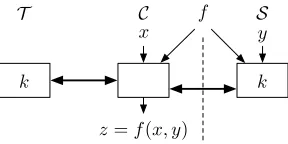
We present in detail our setting, players, and hardware and trust assumptions. As shown in Fig. 1, there are three parties – clientC, serverS and tamper-resistant token T, issued and trusted byS. Our goal is to letC andS securely evaluate a public functionf on their respective private inputsxandy.
T C S
k f
k
x y
z=f(x, y)
Fig. 1.Model Overview
Communication. C ↔ S: We view this as an expensive channel. Communica-tionC ↔ S flows over the Internet, and may include a wireless or cellular link. This implies small link bandwidth and power consumption concerns of mobile devices. We wish to minimize the utilization of this channel.
T ↔ C: AsT is held locally byC, this is a cheap channel (both in terms of bandwidth and power consumption), suitable for transmission of data linear in the size off, or even greater.
T ↔ S: There is no direct channel betweenT and S, but, of course,C can pass (and potentially interfere with) messages between T andS.
Trust.C ↔ S: As in the standard SFE scenario,CandS don’t trust each other. We address semi-honest, covert, and maliciousC andS.
Storage, computation and execution.C andS are computationally strong devices which can perform both symmetric- and asymmetric-key operations.6 Both have sufficient memory, linear in the size off. We also address the setting whereCis a weak mobile device with restricted memory in appendix§A.1.Chas control overT, and can reset it, e.g., by interrupting its power supply. As justified in§1,T is a cheap special purpose hardware with minimum chip surface:T has circuitry only for evaluating symmetric-key primitives in hardware (no public-key or true random number generator) and has a small secure RAM. It may (§4.3) or may not (§4.4) have small non-volatile secure storage7, unaffected by the resets byC.
4
Token-Assisted Garbled Circuit Protocols
In our presentation, we assume reader’s familiarity with the GC technique, in-cluding free XORs of [KS08] (cf.§2.1), and concentrate on the aspects specific to the token setting. We start with a high-level description of our protocol. Then, in §4.2 -§4.4, we present the technical details of our construction – efficient circuit representation, and GC generation by stateful and stateless tokens.
4.1 Protocols Overview, Security Intuition and Claim
Our constructions are a natural (but technically involved) modification of stan-dard GC protocols, so as to split the actions of the server into two parts – now executed byS andT – while maintaining provable security. We offload most of the work (notably, GC generation and output) toT, thus achieving important communication savings, and partially offloadingS’s computation toT.
We start our discussion with the solution in the semi-honest model. However, our modification of the basic GC is secure against malicious actions, and our protocols are easily and efficiently extendible to covert and malicious settings.
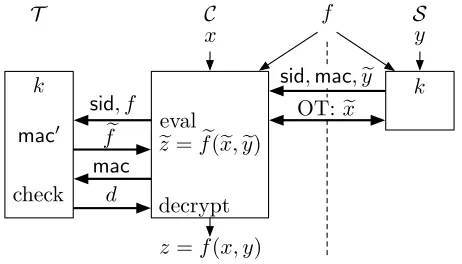
At the high level, our protocols work as shown in Fig. 2:Cobtains the garbled inputs x,e yefrom S, and the garbled circuit fecorresponding to the function f
fromT. Then, Cevaluates feonx,e ey and obtains the resultz=f(x, y).
It is easy to see that the introduction ofT and offloading to it some of the computation does not strengthen S, and thus does not bring security concerns forC (as compared to standard two-party GC). On the other hand, separating the states of S and T, placing C in control of their communication, and C’s ability to resetT introduces attack opportunities forC. We show how to address these issues with the proper synchronization and checks performed byS andT. Our main tool is the use of a unique session idsid for each GC evaluation. From sid and the shared secret key k, S and T securely derive a session key
K, which is then used to derive the randomness used in GC generation. We emphasize that each token shares a different random key k with S to obtain
sid,
mac,
y
!
x
z
=
f
(
x, y
)
C
decrypt
eval
!
z
=
f
!
(
x,
!
!
y
)
k
sid, f
!
f
mac
d
T
mac
!check
S
k
f
y
OT:
x
!
Fig. 2.Protocols Overview.
unique session keys K and to avoid break-one-break all behavior of the multi-token system. Jumping ahead (details in §4.3), we note that sid uniqueness is easily achieved if T is stateful simply by setting sid equal to the value of the strictly monotonic session counterctrmaintained byT. However, ifT is stateless, C can always replay S’s messages. In§4.4 we show how to ensure that replays do not helpC.
Since S and T derive the same randomness for each session, the (same) garbled circuitfecan be generated byT. Unfortunately, the weakT cannot store the entire f. Instead, C provides the circuit corresponding to function f gate-by-gate toT, and obtains the corresponding garbled gate offe. The garbled gate can immediately be evaluated byC and needs not to be stored.C is prevented from providing a wrong f to T, as follows. First, S issues a MAC of f, e.g.,
mac=MACk(sid, f), wheref is the agreed circuit representation of the evaluated function (cf.§4.2). Further,T computes its version of the above MAC,mac0, as it answersC’s queries in computingfe. Finally,T reveals the decryption information
dthat allowsCto decrypt the output wires only ifCprovides the matchingmac.
Garbled Inputs. The garbled input ey of S can be computed by S and sent to C, requiring |y| ·t bits communication, where t is the security parameter. Alternatively, if T is stateful, S can establish a secure channel with T, e.g., based on session keyK, sendyover the channel, and haveT outputyetoC. This achieves the optimal communication betweenS andCof|y|bits.
The garblingxeof C’s input can be transferred from S to C with a parallel OT protocol which requires O(|x|t) bits of communication. Alternatively, the efficient OT extension of [IKNP03] which reduces many OTs to a small number of OTs (depending on security parametert) can be adopted to our token-based scenario as described in appendix§C. This reduces the communication between S andC toO(t2) which is independent of the size of the inputx.
cut-and-choose technique. S creates multiple GCs Cei, deterministically derived from random seeds si, and commits to each, e.g., by sending Cei or H(Cei) to C. In covert case, C asks S to open all but one garbled circuit I by revealing the correspondingsi6=I. For all opened circuits,CcomputesCeiand checks that they match the commitments. The malicious case is similar, butCasksSto open half of the circuits, evaluates the remaining ones and chooses the majority of their results.
These protocols similarly benefit from our token-based separation of the server into S and T. As in the semi-honest protocol, the GC generation can be naturally offloaded toT, achieving corresponding computation and commu-nication relief on the server and network resources. GC correctness verification is achieved by requestingS to reveal the generator seedssi6=I. (Of course, these ”opened” circuits are not evaluated.) Note that requirements onT are the same as in the semi-honest setting. Further, in both covert and malicious cases, the communication between C and S is independent of the size of f. The resulting communication complexity of these protocols is summarized in Table 1.
Security Claim. For the lack of space, in this work we present our protocols implicitly, by describing the modifications to the base protocols of [KS08]. We informally argue the security of the modifications as they are described. Formal proofs can be naturally built from proofs of [KS08] and our security arguments. At the very high level, security against S/T follows from the underlying GC protocols, since S is not stronger here than in the two-party SFE setting. The additional power ofCto control the channel betweenSand statefulT is negated by establishing a secure channel (§4.3).C’s power to reset statelessT is addressed by ensuring that by replaying old messagesCgets either what he already knows, or completely unrelated data (§4.4).
Theorem 1. Assuming T is tamper-proof, protocols described throughout this section are secure in the semi-honest, covert, and malicious models respectively.
4.2 Circuit Representation
We now describe our circuit representation format. Our criteria are compactness, the ability to accommodate free XOR gates of [KS08], and ability ofT to process the encoding “online”, i.e., with small constant memory. Recall, ourT operates in request-response fashion. C incrementally, gate-by-gate, “feeds” the circuit description toT which responds with the corresponding garbled tables.
We consider circuits with two-input boolean gates. We note that our tech-niques can be naturally generalized to general circuits. A circuit can efficiently be transformed into our format as described in appendix§B.
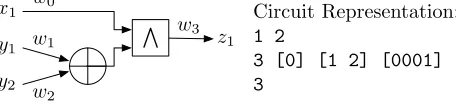
y1, y2 are two input bits ofS. The corresponding circuit representation shown on the right is composed from the description of the inputs, gates, and outputs as follows.
Circuit Representation: 1 2
3 [0] [1 2] [0001] 3
w0
w1
w2
x1
y1
y2
�
z1
w3
Fig. 3.Example for Circuit Representation
Inputs and wires: The wires wi of the circuit are labeled with their index
i={0,1, ...}(wires with a larger fan-out are viewed as a single wire). The firstX
wires are associated with the input ofC, the followingY wires are associated with the input of S, and the internal wires are labeled in topological order starting from index X +Y (output wires of XOR gates are not labeled, as XOR gates are incorporated into their successor gates as described in the next paragraph). The first line of the circuit description specifiesX andY (Fig. 3:X = 1, Y = 2). Gatesare labeled with the index of their outgoing wire; each gate description specifies its input wires. XOR gates do not have gate tables and are omitted from the description. Rather, non-XOR gates, instead of pointing to two input wires, include two input wirelists. If the input list contains more than one wire, these wire values are to be XORed to obtain the corresponding gate input. Gate’s description concludes with its truth table. In Fig. 3, the second line describes the AND gate, which has index 3, and inputsw0 andw1⊕w2.
Outputs: The circuit description concludes with Z lines which contain the indices of theZ output wires (Fig. 3: the only (Z= 1) output wire is w3).
Large XOR sub-circuits.In this representation, XOR gates with fan-out>1 occur multiple times in the description of their successor gates. In the worst case, this results in a quadratic increase of the circuit description. To avoid this cost, we insert an identity gate after each XOR gate with a large fan-out.
4.3 GC Creation with Stateful Token Using Secure Counter
The main idea of our small-RAM-footprint GC generation is havingT generate garbled tables “on the fly”. This is possible, since each garbled table can be generated only given the garblings of input and output wires. In our implemen-tation, we pseudorandomly derive the wire garbling from the session key and wire index. The rest of this section contains relevant details.
Session Initialization.SFE proceeds in sessions, where one session is used to securely evaluate a function once.T has a secure monotonic session counterctr
other errors.) Then, the session key is computed byS andT asK=PRFk(sid) and subsequently used to provide fresh randomness to create the GC.
As required by the construction of [KS08] (cf.§2.1), the two garbled values of the same wire differ by a global difference offset∆. This offset is derived from
K at session initialization and kept in RAM throughout the session. Subsequently, garbled wire valueswi are derived on-the-fly fromK as
e
w0
i =PRFK(i), we1i =we0i ⊕∆. (1) Garbled Gates.T receives the description of the circuit, line by line, in the format described in§4.2, and generates and outputs toCcorresponding garbled gates, using only small constant memory.T first verifies that the gate with the same label had not been processed before. (Otherwise, by submitting multiple gate tables for the same gate,Cmay learn the real wire values). This is achieved by keeping the monotonically increasing processed gate counter gctr, verifying that gate’s label glabel > gctr, and setting gctr = glabel. T then derives and stores garblings of the gate’s input and output wires according to (1). (For input lists, the wire’s garbling we0 is computed as the XOR of garblings of the listed wires, andwe1 is set to
e
w0⊕∆. Note that this requires constant RAM.) Finally, based on these garblings, gate’s garbled table is computed and output toC.
Garbled Outputs.Recall,T must verify circuit correctness by checkingmac
generated byS. Thus,T does not release the output decryption tables toCuntil after the successful check. At the same time, the check is not complete until the entire circuit had been fed toT. To avoid havingT store the output decryption tables or involvingS at this stage,T simply encrypts the output tables using a fresh keyK0, and outputs the key only upon a successful MAC verification.
4.4 GC Creation with Stateless Token (no Counter)
As discussed above, while non-volatile secure storage (the counterctr) is essential in our protocol of §4.3, in some cases, it may be desired to avoid its cost. We now discuss the protocol amendments required to maintain security of SFE with the support of a token whose state can be reset by, e.g., a power interruption.
First, we observe that S is still able to maintain state, and choose unique counters. However, T can no longer be assured that sid claimed byC is indeed fresh. Further, T does not have a source of independent randomness, and thus cannot establish a secure channel with S, e.g., by running a key exchange.
We begin with briefly describing a replay vulnerability of our protocol of§4.3, whenT is executed with samesid. First,Cproperly executes SFE. Second time he runs T with the samesid, but feeds T an incorrect circuit, receiving valid garbled tables for each of the gates, generated for thesamewire garblings. Now, even thoughT will not acceptmacand will not decrypt the output wires,Chad already received them in the first execution. It is easy to see thatC “wins”.
as described below. If C replays and gives a different gate description, she will not be able to relate the produced garbled table with a previous output ofT.
We associate with each wire wi a (revealed to C) hash value hi. For input wires,hiis the empty string. For each other wirei,hiis derived (e.g., via Random Oracle) from the description of the gatei(which includes index, truth table, and list of inputs; cf. §4.2) that emits that wire: hi =H(hgate descriptioni). The garbled value of wire wi now depends on its hash value hi: wei0 = PRFK(hi) and we1
i =we0i ⊕∆. Finally, to enable the computation of the garbled tables, C must feed back to T the hashes hi of the input wires, and receive fromT and keep for future use the hash of the output wire. As noted above,C’s attempts to feed incorrect values result in the output of garbled tables that are unrelated to previous outputs of T, and thus do not helpC.
5
Proof-of-concept Implementation
We have designed a proof-of-concept implementation to show the practicabil-ity of our token-assisted GC protocols of §4. In the following we describe our architecture for the stateful token case of §4.3. Extension to the stateless case is straightforward. We instantiatePRFwith AES-128, H and Hwith SHA-256, andMACwith AES-CMAC.
5.1 Architecture
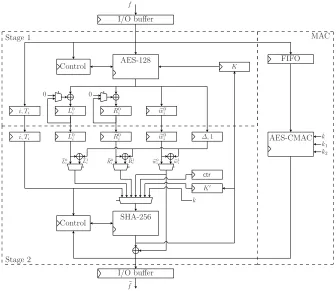
Fig. 4 depicts the high level architecture of our design consisting of a two-stage pipeline and a MAC core. Stage 1 of the pipeline creates the garbled input and output values of a gate using an AES core and stage 2 computes the garbled table with a SHA core. The two-stage pipeline increases performance as two gates can be processed concurrently. The MAC core computes the authentication message
mac0 of the circuit provided byC(cf.§4.1).
Design Principle. To achieve maximum speed with minimum hardware re-sources, we followed a general guideline exploiting parallelism as long as it can be done without using several instances of the same algorithm. For example, we opted to compute the four entries of a garbled table with a single SHA core in-stead of using four parallel SHA cores which would have increased performance, but only with a significant increase in area. As the only exception, we included a separate MAC core rather than reusing the AES core of stage 1, because it would have severely complicated the control of the pipeline.
Description of Operation.In the session initialization (cf.§4.4), the SHA core in stage 2 derives session keyK and output encryption keyK0 from keyk and current counter value ctr = sid which is used as key for the AES core. Then, the key difference∆ is derived with the AES core and stored in a register. The circuit is provided gate-by-gate into the input buffer in the format described in §4.2 (gate table denoted by Ti in Fig. 4). Stage 1 starts to process a gate by deriving the garbled output valuewe0
i. Then, the two garbled inputs of the gate (Le0
I/O buffer I/O buffer
FIFO AES-128
SHA-256
AES-CMAC
Control Control Stage 1
Stage 2
MAC
i, Ti
i, Ti
e
L0 i
e
L0 i
e
R0 i
e
R0 i
e
w0 i
e
w0 i
e L0
i Le1i Re0i Re1i we0i we1i
∆,1 k
k K′
k1
k2
ctr K
0 0
f
e
f
Fig. 4.Simplified architectural diagram of our proof-of-concept implementation. Selec-tors of multiplexers and write enables of registers are set by additional control logics.
lists one-by-one (see§4.3). When all garblings are derived they are forwarded to stage 2 and stage 1 processes the next gate. Stage 2 computes the garbled table and the encrypted output decryption tables and writes them into the output buffer. The MAC core operates independently from the two-stage pipeline.
5.2 Prototype Implementation
We implemented our architecture in VHDL.
k1 andk2, depend only on the keyk they were precomputed and hardwired in the design.
FPGAs.We compiled the VHDL code for a low-end FPGA, the Altera Cy-clone II EP2C20F484C7 FPGA, with Quartus II, version 8.1 (2008). We em-phasize that this FPGA is for prototyping only, as it lacks secure embedded non-volatile memory for storing ctr (e.g., the Xilinx Spartan-3AN FPGAs has integrated Flash memory for this). The resulting area and memory requirements are listed in Table 3. The design occupies 60 % of logic cells and 21 % of memory blocks available on the device and runs at 66 MHz (the critical path for clock frequency is in the AES core). These results show that the design is, indeed, fea-sible for a low-cost implementation, for example, with low-cost FPGAs which, in turn, is mandatory for the practicability of the token-based scheme.
Table 3.Results on an Altera Cyclone II FPGA (the hierarchy is as shown in Fig. 4).
Entity Stage 1 Stage 2 MAC IO Total
Area(Logic cells) 3317 (30 %) 4539 (40 %) 3059 (27 %) 263 (3 %) 11231 (60 %) Memory(M4K) 0 (0 %) 8 (73 %) 1 (9 %) 2 (18 %) 11 (21 %)
Smart Cards.In particular, we note that the requirements are sufficiently low also for contemporary smart card technologies, because AES-128 and SHA-256 require only about 3,400 and 11,000 gates, respectively [FW07]. As our protocol requires no public-key operations on the token, small smart cards are sufficient.
Performance. We determined the latency of our implementation with Mod-elSim, version 6.3g (2008). Overall, the latency is given as #clock cycles = 158G1 + 312G2 + 154O+ 150, where G1, G2 is the number of 1-input gates respectively 2-input gates andO is the number of outputs, assuming that each gate has at most 21 inputs in its input lists (if more, stage 2 needs to wait for stage 1) and that data I/O does not introduce additional delays. If we use a cor-relation robust hash function instead of RO, the coefficient forG2would roughly double for up to 42 inputs (cf.§2.1).
Example 1. Our implementation generates a GC for 16-bit comparison (G1 = 0, G2= 16, O= 1) in 5,296 clock cycles (≈80µs with 66 MHz clock). In Software, this takes roughly 0.5 s on an Intel Core 2 6420 at 2.13 GHz [LPS08].
Example 2. Generating a GC for AES-128 encryption (G1= 12614,G2= 11334,
O= 128) takes 5,549,082 clock cycles (≈84 ms with 66 MHz clock). In Software, this takes approximately 1 s on an Intel Core 2 Duo at 3.0 GHz [PSSW09].
the circuit has no more 1-input gates (G1= 0) which results in a faster creation (3,556,070 clock cycles), evaluation, and smaller size of the garbled circuit (|Ce| ≈
0.7 MB); however, as the lists of inputs to be XORed must be repeated for each use, the size of the circuit would be drastically larger (|f| = 94.5 MB) which might be a bottleneck if the communication betweenCandT is slow.
Acknowledgements. We would like to thank Wilko Henecka for preparing test circuits, and Ivan Damg˚ard and reviewers of FC’10 for their helpful comments.
References
[AIR01] W. Aiello, Y. Ishai, and O. Reingold. Priced oblivious transfer: How to sell digital goods. InAdvances in Cryptology – EUROCRYPT’01, volume 2045 ofLNCS, pages 119–135. Springer, 2001.
[Ber91] C. L. Berman. Circuit width, register allocation, and ordered binary deci-sion diagrams. IEEE Trans. on CAD of Integrated Circuits and Systems, 10(8):1059–1066, 1991.
[BFK+09] M. Barni, P. Failla, V. Kolesnikov, R. Lazzeretti, A.-R. Sadeghi, and T. Schneider. Secure evaluation of private linear branching programs with medical applications. In European Symposium on Research in Computer Security (ESORICS’09), volume 5789 of LNCS, pages 424–439. Springer, 2009.
[BHKR13] M. Bellare, V. T. Hoang, S. Keelveedhi, and P. Rogaway. Efficient garbling from a fixed-key blockcipher. InSymposium on Security and Privacy. IEEE, 2013.
[CAC+81] G. J. Chaitin, M. A. Auslander, A. K. Chandra, J. Cocke, M. E. Hopkins, and P. W. Markstein. Register allocation via coloring.Computer Languages, 6(1):47–57, 1981.
[Can05] D. Canright. A very compact S-box for AES. InCryptographic Hardware and Embedded Systems (CHES’05), volume 3659 of LNCS, pages 441–456. Springer, 2005.
[CGS08] N. Chandran, V. Goyal, and A. Sahai. New constructions for UC secure computation using tamper-proof hardware. In Advances in Cryptology – EUROCRYPT’08, volume 4965 ofLNCS, pages 545–562. Springer, 2008. [CLOS02] R. Canetti, Y. Lindell, R. Ostrovsky, and A. Sahai. Universally composable
two-party and multi-party secure computation. In ACM Symposium on Theory of Computing (STOC’02), pages 494–503, 2002.
[DNW09] I. Damg˚ard, J. B. Nielsen, and D. Wichs. Universally composable multi-party computation with partially isolated parties. InTheory of Cryptography (TCC’09), volume 5444 ofLNCS, pages 315–331. Springer, 2009.
[FFP+06] M. Fort, F. C. Freiling, L. D. Penso, Z. Benenson, and D. Kesdogan. Trust-edpals: Secure multiparty computation implemented with smart cards. In
European Symposium on Research in Computer Security (ESORICS’06), volume 4189 ofLNCS, pages 34–48. Springer, 2006.
[GMS08] V. Goyal, P. Mohassel, and A. Smith. Efficient two party and multi party computation against covert adversaries. In Advances in Cryptology – EU-ROCRYPT’08, volume 4965 ofLNCS, pages 289–306. Springer, 2008. [Goo09] Google Health, 2009. https://www.google.com/health.
[GT08] V. Gunupudi and S. Tate. Generalized non-interactive oblivious transfer using count-limited objects with applications to secure mobile agents. In
Financial Cryptography and Data Security (FC’08), volume 5143 ofLNCS, pages 98–112. Springer, 2008.
[HL08] C. Hazay and Y. Lindell. Constructions of truly practical secure protocols using standard smartcards. InACM Conference on Computer and Commu-nications Security (CCS’08), pages 491–500. ACM, 2008.
[HMU05] D. Hofheinz, J. M¨uller-Quade, and D. Unruh. Universally composable zero-knowledge arguments and commitments from signature cards. In Central European Conference on Cryptology (MoraviaCrypt’05), 2005.
[IKNP03] Y. Ishai, J. Kilian, K. Nissim, and E. Petrank. Extending oblivious transfers efficiently. InAdvances in Cryptology – CRYPTO’03, volume 2729 ofLNCS. Springer, 2003.
[IS05] A. Iliev and S. Smith. More efficient secure function evaluation using tiny trusted third parties. Technical Report TR2005-551, Dartmouth College, Computer Science, Hanover, NH, July 2005.
[JKSS10] K. J¨arvinen, V. Kolesnikov, A.-R. Sadeghi, and T. Schneider. Embedded SFE: Offloading server and network using hardware tokens. In Financial Cryptography and Data Security (FC’10), volume 6052 ofLNCS, pages 207– 221. Springer, 2010.
[Kat07] J. Katz. Universally composable multi-party computation using tamper-proof hardware. In Advances in Cryptology – EUROCRYPT’07, volume 4515 ofLNCS, pages 115–128. Springer, 2007.
[KBC97] H. Krawczyk, M. Bellare, and R. Canetti. HMAC: Keyed-hashing for mes-sage authentication. RFC 2104 (Informational), February 1997. http: //tools.ietf.org/html/rfc2104.
[KS08] V. Kolesnikov and T. Schneider. Improved garbled circuit: Free XOR gates and applications. InInternational Colloquium on Automata, Languages and Programming (ICALP’08), volume 5126 ofLNCS, pages 486–498. Springer, 2008.
[LP07] Y. Lindell and B. Pinkas. An efficient protocol for secure two-party compu-tation in the presence of malicious adversaries. InAdvances in Cryptology – EUROCRYPT’07, volume 4515 ofLNCS, pages 52–78. Springer, 2007. [LP09] Y. Lindell and B. Pinkas. A proof of Yao’s protocol for secure two-party
computation.Journal of Cryptology, 22(2):161–188, 2009. Cryptology ePrint Archive, Report 2004/175,http://eprint.iacr.org.
[LPS08] Y. Lindell, B. Pinkas, and N. Smart. Implementing two-party computa-tion efficiently with security against malicious adversaries. InSecurity and Cryptography for Networks (SCN’08), volume 5229 of LNCS, pages 2–20. Springer, 2008.
[MNPS04] D. Malkhi, N. Nisan, B. Pinkas, and Y. Sella. Fairplay — a secure two-party computation system. InUSENIX Security Symposium (Security’04). USENIX Association, 2004.
[NIS01] NIST, U.S. National Institute of Standards and Technology. Federal in-formation processing standards (FIPS 197). Advanced Encryption Stan-dard (AES), November 2001. http://csrc.nist.gov/publications/fips/ fips197/fips-197.pdf.
[NIS02] NIST, U.S. National Institute of Standards and Technology. Federal information processing standards (FIPS 180-2). Announcing the Secure Hash Standard, August 2002.http://csrc.nist.gov/publications/fips/ fips180-2/fips-180-2.pdf.
[NP01] M. Naor and B. Pinkas. Efficient oblivious transfer protocols. InACM-SIAM Symposium On Discrete Algorithms (SODA’01), pages 448–457. Society for Industrial and Applied Mathematics, 2001.
[PSSW09] B. Pinkas, T. Schneider, N. P. Smart, and S. C. Williams. Secure two-party computation is practical. InAdvances in Cryptology – ASIACRYPT 2009, volume 5912 ofLNCS, pages 250–267. Springer, 2009.
[Sha49] C. E. Shannon. The synthesis of two-terminal switching circuits. Bell Sys-tems Technical Journal, 28(1):59–98, 1949.
[SPLI06] JH. Song, R. Poovendran, J. Lee, and T. Iwata. The AES-CMAC Algo-rithm. RFC 4493 (Informational), June 2006. http://tools.ietf.org/ html/rfc4493.
[SS02] Y. N. Srikant and P. Shankar, editors. The Compiler Design Handbook: Optimizations and Machine Code Generation. CRC Press, 2002.
[Tur96] B. C. H. Turton. Extending Quine-McCluskey for exclusive-or logic synthe-sis. IEEE Transactions on Education, 39:81–85, 1996.
[TV09] S. Tate and R. Vishwanathan. Improving cut-and-choose in verifiable en-cryption and fair exchange protocols using trusted computing technology. In
Data and Applications Security (DBSec’09), volume 5645 of LNCS, pages 252–267. Springer, 2009.
[Yao86] A. C. Yao. How to generate and exchange secrets. InIEEE Symposium on Foundations of Computer Science (FOCS’86), pages 162–167. IEEE, 1986.
A
Further Optimizations
In order to allow C to evaluate the garbled circuit on-the-fly without caching the garbled gates, the gates of the circuit must be given in topologic order, i.e., all gates on which a gate depends have to occur before. As for most circuits many topologic orders exist, one can choose a specific topologic order according to further optimizations. We give two examples in the following – optimize C’s memory requirements for GC evaluation (appendix§A.1) or reduceT’s runtime by caching intermediate values (appendix§A.2).
A.1 Optimizing Memory of Client
For evaluating the garbled circuit,Cstarts with the garbled values of the inputs. Then,Cobtains the garbled gates one-by-one from the token and evaluates them. The obtained garbled output for the gate needs to be stored inC’s memory until it is used the last time as input into a garbled gate.
As pointed out in [Ber91], the problem of finding a topologic order of a circuit that minimizes the needed amount of memory to store intermediate values is equivalent to the register allocation problem which is well-studied in the context of compilers. In fact, algorithms for register allocation [CAC+81,SS02] can be used to find an optimal respectively good topologic order of the circuit which reduces the amount of memory needed for its evaluation.
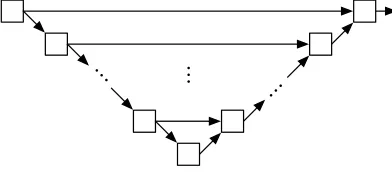
In the worst case, the memory needed to evaluate a circuitCis linear in the circuit size as one might need to keep garbled values of many wires. Fig. 5 shows an (artificially constructed) example circuit with k gates which requires Θ(k) memory for evaluation.
...
...
...
Fig. 5.Circuit withk gates which requiresΘ(k) memory for evaluation.
A.2 Optimizing Runtime of Token by Caching
During creation of the garbled circuit, the token T derives the garbled values corresponding to the gates’ inputs and outputs with a PRF. If the garbled value has already been derived before and stored in a cache, the garbled value does not need to be derived again. When the garbled values are stored into or loaded from the cache can be encoded in the description of the circuit provided byC.
Cache Sizes. If each garbled value should be derived only once and taken from the cache every time it is used afterwards, the cache needs to have size O(|f|). In practice, the size of the cache is however bounded to a constant number of cache entries.
Cache with constant size. To determine a good ordering of the gates which max-imizes the number of cache hits one can use standard algorithms for instruction scheduling and register allocation (instructions correspond to gates and registers to cache entries) [SS02].
Cache with size1. In many cases, a cache with only one cache entry is sufficient already. This is due to the fact that many commonly used functionalities (e.g., addition or comparison) are composed from a line of gates in which the output of a gate directly serves as the input into the next gate.
The following efficient algorithm (time and space complexity in O(|f|)) de-termines a topological order with many hits for the one entry cache: Insert – starting from the output gates – an edge to each of the gates whose outputs are input into the current gate. Afterwards run a depth-first search on the outputs which marks a gate as visited and visits all successor gates which have not been visited yet. After having visited all successor gates, the gate is output as next in the topologic order. This algorithm eliminates “dead” gates and results in many cache hits for the one entry cache.
B
Transformation of Circuit into Token Format
In order to convert a given circuit with n-input gates into the token format described in§4.2 the gates are first decomposed into 2-input gates and afterwards the XOR gates are grouped together:
Decomposition into 2-input gates. Decomposing then-input gates of a circuit into multiple 2-input gates can be done in a straight-forward way using Shan-non’s expansion theorem [Sha49] or the QuineMcCluskey algorithm which re-sults in smaller circuits [Tur96]. For small n(e.g., for the very common case of
n= 3), the optimal replacement can be found via brute-force enumeration of all possibilities [PSSW09].
Grouping of XOR gates. The XOR gates can be grouped together as follows: To each input wire and each output wire of a non-XOR gateiwe assign the set{i}. Afterwards we transfer the gates of the circuit in topological order and annotate to the output wire of each XOR gate the following set which is computed from the sets of its input wires S1, S2 as S = S1⊕S2 := (S1∪S2)\(S1∩S2). Finally, the remaining non-XOR gates are output in the token format using the sets associated to the input wires which contain those wires which need to be XORed together for the specific input. As merging two sets of size at most |C|
C
Extending OT Efficiently with Token
As described in §4.1, C needs to obtain the garbled values xe corresponding to her input with a parallel OT protocol.
The efficient OT extension of [IKNP03] for semi-honest receiver C can be used to replace the possibly huge number of|x|parallel OTs with a substantially smaller number oftOTs only, wheret is a security parameter. As the tokenT is computationally weak and can not perform public-key operations, the t real OTs in the protocol of [IKNP03] are performed between the computationally strong devices C and S. Afterwards,S sends its state, i.e., the values obtained in the parallel OT protocol to T over a secure channel. This requires O(t2) communication fromStoT (forwarded byC). Finally,T completes the protocol with C which requires several invocations of a correlation robust hash function (e.g., SHA-256) only, but no more public-key operations.