Constructing and Understanding Chosen Ciphertext Security via
Puncturable Key Encapsulation Mechanisms
⋆Takahiro Matsuda and Goichiro Hanaoka
National Institute of Advanced Industrial Science and Technology (AIST), Japan {t-matsuda,hanaoka-goichiro}@aist.go.jp
Abstract. In this paper, we introduce and study a new cryptographic primitive that we call puncturable key
encap-sulation mechanism (PKEM), which is a special class of KEMs that satisfy some functional and security
require-ments that, combined together, imply chosen ciphertext security (CCA security). The purpose of introducing this primitive is to capture certain common patterns in the security proofs of the several existing CCA secure public key encryption (PKE) schemes and KEMs based on general cryptographic primitives which (explicitly or implic-itly) use the ideas and techniques of the Dolev-Dwork-Naor (DDN) construction (STOC’91), and “break down” the proofs into smaller steps, so that each small step is easier to work with/verify/understand than directly tackling CCA security.
To see the usefulness of PKEM, we show (1) how several existing constructions of CCA secure PKE/KEM con-structed based on general cryptographic primitives can be captured as a PKEM, which enables us to understand these constructions via a unified framework, (2) its connection to detectable CCA security (Hohenberger et al. EURO-CRYPT’12), and (3) a new security proof for a KEM-analogue of the DDN construction from a set of assumptions:
sender non-committing encryption (SNCE) and non-interactive witness indistinguishable proofs.
Then, as our main technical result, we show how to construct a PKEM satisfying our requirements (and thus a CCA secure KEM) from a new set of general cryptographic primitives: SNCE and symmetric key encryption secure for
key-dependent messages (KDM secure SKE). Our construction realizes the “decrypt-then-re-encrypt”-style validity
check of a ciphertext which is powerful but in general has a problem of the circularity between a plaintext and a randomness. We show how SNCE and KDM secure SKE can be used together to overcome the circularity. We believe that the connection among three seemingly unrelated notions of encryption primitives, i.e. CCA security, the sender non-committing property, and KDM security, to be of theoretical interest.
Keywords: public key encryption, puncturable key encapsulation mechanism, chosen ciphertext security, sender non-committing encryption, key-dependent message secure symmetric-key encryption.
Table of Contents
1 Introduction . . . 3
2 Preliminaries . . . 5
2.1 Sender Non-committing Public Key Encryption . . . 6
2.2 Symmetric Key Encryption . . . 8
3 Chosen Ciphertext Security from Puncturable KEMs . . . 9
3.1 Syntax . . . 9
3.2 Security Requirements . . . 10
3.3 CCASecure KEM from a Puncturable KEM . . . 11
3.4 Understanding the Existing Constructions ofCCASecure KEMs via Puncturable KEM . . . 12
3.5 DCCASecure Detectable KEM from a Puncturable KEM . . . 14
4 Puncturable KEM from Sender Non-committing Encryption and KDM Secure SKE . . . 15
5 Dolev-Dwork-Naor KEM Revisited . . . 18
A Basic Cryptographic Primitives . . . 21
A.1 Public Key Encryption . . . 21
A.2 (Detectable) Key Encapsulation Mechanisms . . . 21
A.3 Signature . . . 22
A.4 Non-interactive Argument Systems . . . 23
A.5 Universal One-Way Hash Functions . . . 24
B Some Useful Facts . . . 25
B.1 Useful Facts on (Sender Non-committing) Public Key Encryption . . . 25
B.2 Statistical Properties of Basic Primitives . . . 26
C On Capturing ABO-XHPS-Based KEMs via Puncturable KEM . . . 28
D Postponed Proofs . . . 29
D.1 Proof of Theorem 1:CCASecurity of a PKEM . . . 29
D.2 Proof of Lemma 1: Strong Decapsulation Soundness ofΓDDN . . . 31
D.3 Proof of Lemma 2: Strong Punctured Decapsulation Soundness ofΓDDN. . . 32
D.4 Proof of Lemma 3:eCPASecurity ofΓDDN. . . 32
D.5 Proof of Lemma 4: Strong Decapsulation Soundness ofΓb . . . 35
D.6 Proof of Lemma 5: Strong Punctured Decapsulation Soundness ofΓb . . . 35
D.7 Proof of Lemma 6:eCPASecurity ofΓb . . . 36
D.8 Proof of Lemma 7:eCPASecurity ofΓDDNfrom Different Assumptions . . . 39
E Unpredictability of the Proposed PKEMs . . . 41
E.1 Strong Unpredictability ofΓDDN . . . 41
1 Introduction
In this paper, we continue a long line of work studying the constructions of public key encryption (PKE) schemes and its closely related primitive called key encapsulation mechanism (KEM) that are secure against chosen ciphertext attacks (CCA) [58, 63, 29] from general cryptographic primitives. CCA secure PKE/KEM is one of the most important cryptographic primitives that has been intensively studied in the literature, due to not only its implication to strong and useful security notions such as non-malleability [6, 12, 61] and universal composability [20, 24], but also its resilience and robustness against practical attacks such as Bleichenbacher’s attack [16, 5].
There have been a number of works that show CCA secure PKE/KEMs from general cryptographic primitives: These include trapdoor permutations [29, 35, 36] (with some enhanced property [37]), identity-based encryption [23] and a weaker primitive called tag-identity-based encryption [48, 45], lossy trapdoor function [62] and trapdoor functions with weaker functionality/security properties [65, 54, 46, 67], PKE with weaker than but close to CCA security [43, 47, 26], a combination of chosen plaintext secure (CPA secure) PKE and a hash function with some strong security [53], and techniques from program obfuscation [66, 52].
One of the ultimate goals of this line of researches is to clarify whether one can construct CCA secure PKE only from CPA secure one (and in fact, a partial negative result is known [34]). This problem is important from both theoretical and practical points of view. To obtain insights into this problem, clarifying new classes of primitives that serve as building blocks is considered to be important, because those new class of primitives can be a new target that we can try constructing from CPA secure PKE schemes (or similarly standard primitives such as one-way injective trapdoor functions and permutations).
Our Motivation. Although differing in details, the existing constructions of CCA secure PKE schemes and KEMs from general cryptographic primitives [29, 62, 65, 67, 52, 53, 26] often employ the ideas and tech-niques of the Dolev-Dwork-Naor (DDN) construction [29], which is the first construction of CCA secure PKE from general primitives. The security proofs of these constructions are thus similar in a large sense, and it is highly likely that not a few future attempts to constructing CCA secure PKE/KEMs from general crypto-graphic primitives will also follow the DDN-style construction and security proof. Therefore, it will be useful and helpful for future research and also for understanding the existing works of this research direction if we can extract and abstract the common ideas and techniques behind the security proofs of the original DDN and the existing DDN-like constructions, and formalize them as a cryptographic primitive with a few formal functionality and security requirements (rather than heuristic ideas and techniques), so that most of the ex-isting DDN-style constructions as well as potential future constructions are captured/explained/understood in a unified way, and in particular these are more accessible and easier-to-understand.
tag-based encryption [53] (which is in turn inspired by the notion of puncturable pseudorandom function [66]), and we explain the difference from [53] in the paragraph “Related Work” below.
To see the usefulness of our framework of PKEM, we show (1) how the KEM-analogue of the original DDN [29] and several existing DDN-like constructions (e.g. [62, 65, 67, 52, 53]) can be understood as a PKEM in Section 3.4, (2) its connection to detectable CCA security which is a weaker security notion than CCA security introduced by Hohenberger et al. [43] in Section 3.5, and (3) a new security proof for a KEM-analogue of the DDN construction from a set of assumptions that are different from the one used in its known security proof: sender non-committing encryption (SNCE, see below) and non-interactive witness indistinguishable proofs. (For the purpose of exposition, this last result is shown in Section 5.)
Then, as our main technical result, in Section 4 we show how to construct a PKEM satisfying our requirements (and thus a CCA secure KEM) from a new set of general cryptographic primitives: SNCE and symmetric key encryption secure for key-dependent messages (KDM secure SKE) [15]. Roughly speaking, a SNCE scheme is a special case of non-committing encryption [22] and is a PKE scheme which is secure even if the sender’s randomness used to generate the challenge ciphertext is corrupted by an adversary. See Section 2.1 where we define SNCE formally, explain the difference among related primitives, and how it can be realized from the standard cryptographic assumptions such as the decisional Diffie-Hellman (DDH), quadratic residuosity (QR), and decisional composite residuosity (DCR). The function class with respect to which we require the building block SKE scheme to be KDM secure, is a class of efficiently computable functions whose running time is a-priori fixed. Due to Applebaum’s result [1] (and its efficient variant [9,
§7.2]) we can realize a KDM secure SKE scheme satisfying our requirement from standard assumptions such as DDH, QR, DCR. For more details on KDM secure SKE, see Section 2.2.
Our proposed PKEM has a similarity with the “double-layered” construction of Myers and Shelat [56] and its variants [43, 50, 26], in which a plaintext is encrypted twice: firstly by the “inner” scheme, and sec-ondly by “outer” scheme. Strictly speaking, however, our construction is not purely double-layered, but in some sense is closer to “hybrid encryption” of a PKE (seen as a KEM) and a SKE schemes, much similarly to the recent constructions by Matsuda and Hanaoka [52, 53]. Furthermore, our construction realizes the “decrypt-then-re-encrypt”-style validity check of a ciphertext, which is a powerful approach that has been adopted in several existing constructions that construct CCA secure PKE/KEM from general cryptographic primitives [32, 62, 65, 56, 46, 43, 52, 53, 26]. In general, however, this approach has a problem of the circu-larity between a plaintext and a randomness, and previous works avoid such a circucircu-larity using a random oracle [32], a trapdoor function [62, 65, 46], a PKE scheme which achieves some security which is (weaker than but) close to CCA security [56, 43, 26], or a power of additional building blocks with (seemingly very strong) security properties [52, 53]. We show how SNCE and KDM secure SKE can be used together to overcome the circularity. Compared with the structurally similar constructions [43, 52, 53, 26], the assump-tions on which our construction is based could be seen weak, in the sense that the building blocks are known to be realizable from fairly standard computational assumptions such as the DDH, QR, and DCR assump-tions. We believe that the connection among three seemingly unrelated notions of encryption primitives, i.e. CCA security, the sender non-committing property, and KDM security, to be of theoretical interest.
constructions [52, 53]. (Technically, to capture it in the language of PKEM, slight relaxations of some of the security requirements will be necessary, due to its double-layered use of PKE schemes similarly to [56].)
Secondly and perhaps more importantly, it will be worth clarifying whether it is possible to construct a PKEM satisfying our requirements only from CPA secure PKE or (an enhanced variant of) trapdoor per-mutations in a black-box manner. Note that a negative answer to this question will also give us interesting insights, as it shows that to construct a CCA secure PKE/KEM from these standard primitives, we have to essentially avoid the DDN-like construction.
Finally, it would also be interesting to find applications of a PKEM other than CCA secure PKE/KEMs.
Related Work. The notion of CCA security for PKE was formalized by Naor and Yung [58] and Rackoff and Simon [63]. We have already listed several existing constructions of CCA secure PKE/KEMs from general primitives in the second paragraph of Introduction. In our understanding, the works [29, 62, 65, 67, 52, 53, 26] are based on the ideas and techniques from the DDN construction [29].
As mentioned above, our notion of PKEM is inspired by the notion of puncturable tag-based encryption (PTBE) that was recently introduced by Matsuda and Hanaoka [53]. Similarly to PKEM, PTBE is a special kind of tag-based encryption [48, 45] with two modes of decryption. (Roughly, in PKEM, a secret key can be punctured by a ciphertext, but in PTBE, a secret key is punctured by a tag.) Matsuda and Hanaoka [53] introduced PTBE as an abstraction of the “core” structure that appears in the original DDN construction (informally, it is the original DDN construction without a one-time signature scheme and a non-interactive zero-knowledge proof), and they use it to mainly reduce the “description complexity” of their proposed construction [53] and make it easier to understand the construction. However, they did not study it as a framework for capturing and understanding the existing DDN-style constructions (as well as potential future constructions) in a unified manner as we do in this paper. We note that Matsuda and Hanaoka [53] also formalized the security requirement calledeCPAsecurity whose formalization is a PTBE-analogue ofeCPA
security for a PKEM (and thus we borrow the name). However, they did not formalize the security notions for PTBE that correspond to decapsulation soundness and punctured decapsulation soundness for a PKEM.
Paper Organization. The rest of the paper is organized as follows: In Section 2 (and in Appendix A), we review the notation and definitions of cryptographic primitives. In Section 3, we introduce and study PKEM, where in particular we show its implication to CCA security and how some of the existing constructions of KEMs can be interpreted and explained as a PKEM. In Section 4, we show our main technical result: a PKEM from SNCE and KDM secure SKE, which by the result in Section 3 yields a new CCA secure KEM from general assumptions. In Section 5, we show the CCA security of the DDN-KEM based on SNCE and non-interactive witness indistinguishable arguments.
2 Preliminaries
Basic Notation. Ndenotes the set of all natural numbers, and form, n ∈ N, we define[n] := {1, . . . , n}. “x ← y” denotes thatxis chosen uniformly at random from yif yis a finite set,xis output fromy ify
is a function or an algorithm, oryis assigned toxotherwise. Ifxandyare strings, then “|x|” denotes the bit-length ofx, “x∥y” denotes the concatenationxandy, and “(x =? y)” is the operation which returns1
ifx =yand0otherwise. “(P)PTA” stands for a (probabilistic) polynomial time algorithm. For a finite set
S, “|S|” denotes its size. IfAis a probabilistic algorithm then “y ← A(x;r)” denotes thatAcomputesy
as output by takingxas input and usingr as randomness. Furthermore, for an algorithm or a functionO, “AO” denotes an algorithmAwith oracle access toO. A functionϵ(k) :N→[0,1]is said to be negligible if for all positive polynomialsp(k)and all sufficiently largek ∈ N, we have ϵ(k) < 1/p(k). Throughout this paper, we use the character “k” to denote a security parameter.
2.1 Sender Non-committing Public Key Encryption
Roughly, a SNCE scheme is a PKE scheme that remains secure even against an adversary who may obtain sender’s randomness used to generate the challenge ciphertext. This security is ensured by requiring that there be an algorithm that generates a “fake transcript”pkandcthat denote a public key and a ciphertext, respectively, so that the pair(pk, c) can be later explained as a transcript of an arbitrary messagem. Our syntax of SNCE loosely follows that of sender-equivocable encryption [31, 44], but departs from it because we need perfect correctness (or at least almost-all-keys-perfect correctness [30]) so that error-less decryption is guaranteed, which cannot be achieved by sender-equivocable encryption. We also note that recently, Hazay and Patra [40] introduced (among other notions) the notion that they call NCE for the Sender (NCES), which is a notion very close to SNCE we consider here. We will discuss the correctness and the difference between our definition and that of [40] later in this subsection.
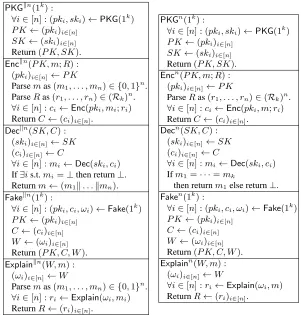
Formally, a sender non-committing (public key) encryption (SNCE) schemeΠ consists of the five PP-TAs(PKG,Enc,Dec,Fake,Explain)where(PKG,Enc,Dec)constitutes a PKE scheme (where definitions for ordinary PKE can be found in Appendix A.1), andFakeandExplainare the simulation algorithms with the following syntax:
Fake: This is the “fake transcript” generation algorithm that takes1k as input, and outputs a “fake” pub-lic key/ciphertext pair (pk, c) and a corresponding state information ω (that will be used in the next algorithm).
Explain: This is the (deterministic) “explanation” algorithm that takes a state information ω (where ω is computed by (pk, c, ω) ← Fake(1k)) and a plaintext m as input, and outputs a randomness r that “explains” the transcript(pk, c)corresponding toω. Namely, it is required thatEnc(pk, m;r) =chold.
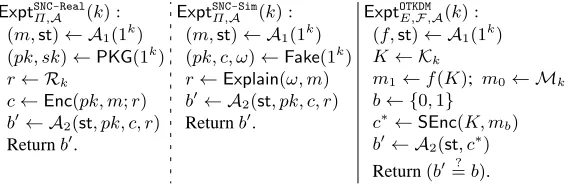
SNCSecurity. For a SNCE schemeΠ = (PKG,Enc,Dec,Fake,Explain)(where the randomness space of EncisR= (Rk)k∈N) and an adversaryA= (A1,A2), we define theSNC-RealexperimentExptSNCΠ,A-Real(k)
and theSNC-SimexperimentExptSNCΠ,A-Sim(k)as in Fig. 1 (left and center, respectively).
Definition 1. We say that a SNCE schemeΠisSNCsecure if for all PPTAsA, the advantageAdvSNC
Π,A(k) :=
|Pr[ExptSNC-RealΠ,A (k) = 1]−Pr[ExptSNC-SimΠ,A (k) = 1]|is negligible.
ExptSNC-Real
Π,A (k) :
(m,st)← A1(1k) (pk, sk)←PKG(1k)
r← Rk
c←Enc(pk, m;r)
b′← A2(st, pk, c, r)
Returnb′.
ExptSNC-Sim
Π,A (k) :
(m,st)← A1(1k) (pk, c, ω)←Fake(1k)
r←Explain(ω, m)
b′← A2(st, pk, c, r)
Returnb′.
ExptOTKDM
E,F,A(k) :
(f,st)← A1(1k)
K← Kk
m1←f(K); m0← Mk
b← {0,1}
c∗←SEnc(K, mb)
b′← A2(st, c∗)
Return(b′=? b).
Fig. 1. Security experiments for defining theSNCsecurity of a SNCE scheme (left and center) and that for theF-OTKDMsecurity of a SKE scheme (right).
several works [28, 33]) allows round interaction between a sender and a receiver (and even the multi-party case), but in this paper we only consider the public-key case (equivalently, the one-round two-multi-party protocol case). A SNCE scheme is a non-committing encryption scheme that only takes care of the sender’s side corruption.
Sender-equivocable encryption [31, 44] is a special case of a SNCE scheme in which a sender can, under an honestly generated public key, generate a fake ciphertext that can be later explained as an encryption of an arbitrary message (while a SNCE scheme allows that even a public key is a fake one).
Deniable encryption [21, 59, 14, 66] has an even stronger property in which an honestly generated ci-phertext under an honestly generated public key can be later explained as an encryption of an arbitrary message. For details on deniable encryption, we refer the reader to the papers [59, 14].
The difference among these primitives is very important in our paper, as we explain below.
On Correctness of SNCE Schemes. In this paper, unlike most of the papers that treat (sender) non-committing encryption schemes and related primitives such as sender-equivocable encryption and deniable encryption, we require a SNCE scheme satisfy perfect correctness or at least almost-all-keys perfect correctness [30]. This is because our proposed constructions follow the Dolev-Dwork-Naor-style construction [29] which re-quires error-less decryption (under all but negligible fraction of key pairs) for a building block PKE scheme. Here, the non-committing property and (perfect or almost-all-keys perfect) correctness might sound con-tradicting. This is indeed the case for ordinary (i.e. bi-) and “receiver” non-committing encryption, sender-equivocable encryption, and deniable encryption, and thus we cannot use these primitives in our proposed constructions. However, “sender” non-committing encryption can avoid such an incompatibility, because the fake transcript generation algorithm Fakecan generate(pk, c) such thatpk is not in the range of the normal key generation algorithm PKG. Moreover, as we will see below, SNCsecure SNCE schemes with perfect correctness (and even practical efficiency) can be realized from standard assumptions.
Concrete Instantiations of SNCE Schemes. Bellare et al. [11] formalized the notion of lossy encryption [11], which is a PKE scheme that has the “lossy key generation” algorithm. It outputs a “lossy public key” which is indistinguishable from a public key generated by the ordinary key generation algorithm, and an encryption under a lossy public key statistically hides the information of a plaintext. Bellare et al. [11] also introduced an additional property for lossy encryption called efficient openability, in which the lossy key generation algorithm outputs a trapdoor in addition to a lossy public key, and by using the trapdoor, an encryption under the lossy public key can be efficiently “explained” as a ciphertext of any plaintext.
randomnessrthat explains thatc= Enc(pk, m;r)holds. Hence, we can use the existing lossy encryption schemes with efficient openability that are based on standard assumptions. These include the scheme based on the quadratic residuosity (QR) assumption [11,§4.4] (which is essentially the multi-bit version of the Goldwasser-Micali scheme [38]), the scheme based on the decisional Diffie-Hellman (DDH) assumption [13, § 5.4] (which is the “bit-wise” encryption version of the DDH-based lossy encryption scheme [11,
§4.1]), and the scheme based on the decisional composite residuosity (DCR) assumption [41] (which shows that the original Paillier scheme [60] and the Damg˚ard-Jurik scheme [27] can be extended to lossy encryption with efficient openability). In particular, the DCR-based schemes [60, 27, 41] have a compact ciphertext whose size does not grow linearly in the length of plaintexts.
On the Difference from the Formalization of “NCE for the Sender” in [40]. The definition of NCE for the Sender in [40] explicitly requires that the scheme have the “fake” key generation algorithm that out-puts a “fake” public key together with a trapdoor, with which one can “equivocate” (or in our terminology, “explain”) any ciphertext as an encryption of arbitrary plaintextm. Therefore, it seems to us that their for-malization is close to lossy encryption with efficient openability [11]. On the other hand, our forfor-malization requires that only a pair (pk, c) of public key and a ciphertext (or a “transcript” in a one-round message transmission protocol between two parties) be explained. We can construct a SNCE scheme in our formal-ization from NCE for the Sender of [40] (in essentially the same manner as we do so from lossy encryption with efficient openability), while we currently do not know if the converse implication can be established. Therefore, in the sense that currently an implication of only one direction is known, our formalization is weaker.
2.2 Symmetric Key Encryption
A symmetric key encryption (SKE) schemeE with key spaceK = {Kk}k∈N and plaintext spaceM =
{Mk}k∈N1consists of the following two PPTAs(SEnc,SDec):
SEnc: The encryption algorithm that takes a keyK ∈ Kkand a plaintextm ∈ Mkas input, and outputs a
ciphertextc.
SDec: The (deterministic) decryption algorithm that takesK ∈ Kk andcas input, and outputs a plaintext
mwhich could be the special symbol⊥(which indicates thatcis an invalid ciphertext underK). Correctness. We require for all k ∈ N, all keys K ∈ Kk, and all plaintexts m ∈ Mk, it holds that
SDec(K,SEnc(K, m)) =m.
One-Time Key-Dependent Message Security. Let E = (SEnc,SDec) be a SKE scheme with key space
K = {Kk}k∈N and plaintext spaceM = {Mk}k∈N. LetF = {Fk}k∈N be an ensemble (which we call
function ensemble) where for eachk,Fkis a set of efficiently computable functions with their domainKk
and rangeMk.
For the SKE scheme E, the function ensemble F, and an adversary A = (A1,A2), we define the F-OTKDMexperimentExptOTKDME,F,A(k)as in Fig. 1 (right). In the experiment, it is required thatf ∈ Fk. Definition 2. We say that a SKE schemeEisOTKDMsecure with respect toF (F-OTKDMsecure, for short) if for all PPTAsA, the advantageAdvOTKDM
E,F,A(k) := 2· |Pr[ExptOTKDME,F,A(k) = 1]−1/2|is negligible.
1
We would like to remark that our definition ofOTKDMsecurity is considerably weak: it is a single instance definition that need not take into account the existence of other keys, and an adversary is allowed to make a KDM encryption query (which is captured byf) only once.
Concrete Instantiations of OTKDM Secure SKE Schemes. In our proposed construction in Section 4, the class of functions with respect to which a SKE scheme is OTKDM secure needs to be rich enough to be able to compute the algorithmExplainin a SNCE scheme multiple (an a-priori bounded number of) times. Fortunately, Applebaum [1] showed how to generically convert any SKE scheme which is many-time KDM secure (i.e. secure for many KDM encryption queries) with respect to “projections” (i.e. functions each of whose output bit depends on at most one bit of inputs) into a SKE scheme which is many-time KDM secure (and thusOTKDMsecure), with respect to a family of functions computable in a-priori fixed polynomial time. (We can also use a more efficient construction shown by Bellare et al. [9,§7.2].) This notion is sufficient for our proposed construction. Since most SKE and PKE schemes KDM secure with respect to the class of affine functions can be interpreted as (or easily converted to) “projection”-KDM secure SKE schemes [3,§A], we can use the existing (many-time) “affine”-KDM secure SKE schemes as a building block, and apply Applebaum’s conversion (or that of [9,§7.2]). Therefore, for example, one can realize aOTKDMsecure SKE scheme with respect to fixed poly-time computable functions, based on the DDH assumption [17], the QR assumption [19], the DCR assumption [19, 49], the learning with errors (LWE) assumption [4], and the learning parity with noise (LPN) assumption [4, 2]. Very recently, Bellare et al. [7, 8] introduced a notion of a family of hash function called universal computational extractor (UCE) which is seemingly quite strong (almost random oracle-like) but a standard model assumption. Using a version of UCE assumption, they [8] showed (among many other things) how to construct a SKE scheme which is non-adaptively KDM secure (in which encryption queries have to be made in parallel) with respect to any efficiently computable functions.
OTKDMsecurity is the special case of non-adaptive KDM security, and hence we can also use the result of [8] in our proposed construction.
3 Chosen Ciphertext Security from Puncturable KEMs
In this section, we introduce the notion of a puncturable KEM (PKEM) and show several results on it. This section is organized as follows: In Sections 3.1 and 3.2, we define the syntax and the security requirements of a PKEM, respectively. Then in Sections 3.3 and 3.5, we show the implication of a PKEM to aCCAsecure KEM and aDCCAsecure detectable KEM, respectively. We also explain how a wide class of the existing constructions ofCCAsecure KEMs can be understood via a PKEM in Section 3.4.
3.1 Syntax
Informally, a PKEM is a KEM that has additional procedures for “puncturing secret keys according to a ciphertext” and “punctured decapsulation.” In a PKEM, one can generate a “punctured” secret keyskcc∗from
an ordinarysk and a ciphertext c∗ via the “puncturing” algorithmPunc. Intuitively, although an ordinary secret keyskdefines a map (viaDecap) whose domain is the whole of the ciphertext space,cskc∗only defines
a map whose domain is the ciphertext space that has a “hole” produced by the puncture of the ciphertext
c∗. This “punctured” secret key cskc∗ can be used in the “punctured” decapsulation algorithm PDecapto
decapsulate all ciphertexts that are “far” fromc∗ (or, those that are not in the “hole” produced byc∗), while
c
skc∗ is useless for decapsulating ciphertexts that are “close” toc∗ (or, those that are in the “hole” including
ExptDSND
Γ,A(k) :
(pk, sk)←KKG(1k)
(c∗, K∗)←Encap(pk)
c′← ADecap(sk,·)(pk, c∗, K∗)
Return1iff(a)∧(b)∧(c):
(a)F(pk, c∗, c′) = 1 (b)c′̸=c∗
(c)Decap(sk, c′)̸=⊥
ExptPDSND
Γ,A(k) :
(pk, sk)←KKG(1k)
(c∗, K∗)←Encap(pk) c
skc∗ ←Punc(sk, c∗)
c′← APDecap(cskc∗,·)(pk, c∗, K∗)
Return1iff(a)∧(b):
(a)F(pk, c∗, c′) = 0 (b)Decap(sk, c′)̸=
PDecap(cskc∗, c′)
ExpteCPA
Γ,A(k) :
(pk, sk)←KKG(1k)
(c∗, K1∗)←Encap(pk) c
skc∗ ←Punc(sk, c∗)
K0∗← {0,1}
k
b← {0,1}
b′← A(pk,cskc∗, c∗, Kb∗) Return(b′=? b).
ExptsDSND
Γ,A (k) : (pk, sk)←KKG(1k) (c∗, K∗)←Encap(pk)
c′← A(pk, sk, c∗, K∗)
Return1iff(a)∧(b)∧(c):
(a)F(pk, c∗, c′) = 1 (b)c′̸=c∗
(c)Decap(sk, c′)̸=⊥
ExptsPDSND
Γ,A (k) : (pk, sk)←KKG(1k) (c∗, K∗)←Encap(pk)
c′← A(pk, sk, c∗, K∗)
Return1iff(a)∧(b):
(a)F(pk, c∗, c′) = 0 (b)Decap(sk, c′)̸=
PDecap(Punc(sk, c∗), c′)
Definitions of Advantages:
ForXXX∈ {DSND,sDSND,PDSND,sPDSND}: AdvXXX
Γ,A(k) := Pr[ExptXXXΓ,A(k) = 1]
eCPAsecurity: AdveCPA
Γ,A(k) := 2· |Pr[ExpteCPA
Γ,A(k) = 1]−12|
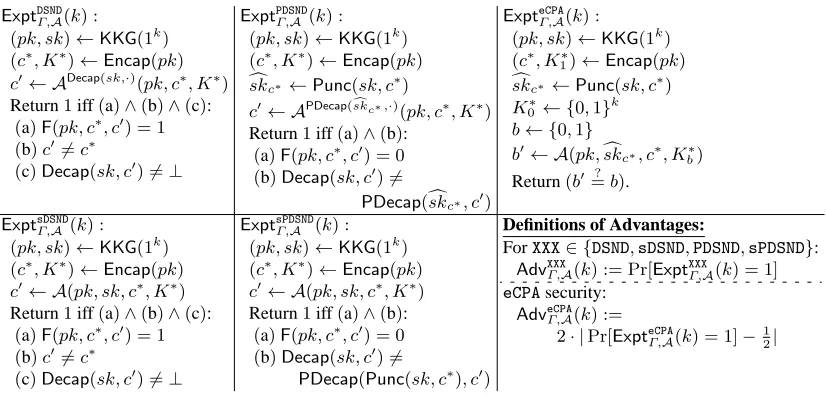
Fig. 2. Security experiments for a PKEM and the definitions of an adversary’s advantage in each experiment.
Formally, a puncturable KEM consists of the six PPTAs(KKG,Encap,Decap,F,Punc,PDecap), where
(KKG,Encap,Decap)constitute a KEM, and the latter three algorithms are deterministic algorithms with the following interface:
F: The predicate that takes a public key pk (output by KKG(1k)) and two ciphertexts c andc′ as input, wherechas to be in the range ofEncap(pk)(butc′need not), and outputs0or1.
Punc: The “puncturing” algorithm that takes a secret key sk (output by KKG(1k)) and a ciphertext c∗
(output byEncap(pk)) as input, and outputs a punctured secret keycskc∗.
PDecap: The “punctured” decapsulation algorithm that takescskc∗(output byPunc(sk, c∗)) and a ciphertext
cas input, and outputs a session-keyK which could be the special symbol⊥(meaning that “ccannot be decapsulated bycskc∗”).
The predicateFis used to define decapsulation soundness and punctured decapsulation soundness, which we explain in the next subsection. Its role is very similar to the predicate used to defineDCCAsecurity and unpredictability of detectable PKE in [43]. As mentioned above, intuitively, the predicateF(pk, c∗,·)divides the ciphertext space into two classes: ciphertexts that are “close” toc∗and those that are “far” fromc∗, and for each of the classes, we expect the decapsulation algorithmsDecapandPDecapto work “appropriately,” as we will see below.
3.2 Security Requirements
(c∗, K∗), it is hard to come up with another ciphertextc′̸=c∗that is (1) “close” toc∗(i.e.F(pk, c∗, c′) = 1), and (2) valid (i.e.Decap(sk, c′)̸=⊥).
Formally, for a PKEMΓ and an adversaryA, consider the decapsulation soundness (DSND) experiment ExptDSNDΓ,A(k)and the strong decapsulation soundness (sDSND) experimentExptsDSNDΓ,A (k)defined as in Fig. 2 (left-top/bottom). The adversaryA’s advantage in each experiment is defined as in Fig. 2 (right-bottom). Note that in the “strong” version (sDSND), an adversary is even given a secret key (which makes achieving the notion harder, but makes the interface of the adversary simpler).
Definition 3. We say that a PKEMΓ satisfies decapsulation soundness (resp. strong decapsulation sound-ness) if for all PPTAsA, the advantageAdvDSND
Γ,A(k)(resp.AdvsDSNDΓ,A (k)) is negligible.
Punctured Decapsulation Soundness. This security notion is intended to capture the intuition that the “punc-tured” decapsulation byPDecap(cskc∗,·)works as good as the normal decapsulation byDecap(sk,·)for all
“far” ciphertextsc′: It requires that given the challenge ciphertext/session-key pair (c∗, K∗), it is hard to come up with another ciphertextc′ that is (1) “far” fromc∗ (i.e.F(pk, c∗, c′) = 0), and (2) the decapsula-tions under two algorithmsDecap(sk, c′)andPDecap(cskc∗, c′)disagree.
Formally, for a PKEMΓ and an adversaryA, consider the punctured decapsulation soundness (PDSND) experiment ExptPDSNDΓ,A (k) and the strong punctured strong decapsulation soundness (sPDSND) experiment ExptsPDSNDΓ,A (k)defined as in Fig. 2 (center-top/bottom). The adversaryA’s advantage in each experiment is defined as in Fig. 2 (right-bottom). Note that as in thesDSNDexperiment, in the “strong” version (sPDSND), an adversary is even given a secret key (which makes achieving the notion harder, but makes the interface of the adversary simpler).
Definition 4. We say that a PKEMΓ satisfies punctured decapsulation soundness (resp. strong punctured decapsulation soundness) if for all PPTAsA, the advantageAdvPDSND
Γ,A (k)(resp.AdvsPDSNDΓ,A (k)) is negligible.
Extended CPA Security: CPA security in the presence of a punctured secret key. Extended CPA security (eCPA security, for short) requires that the CPA security hold even in the presence of the punctured secret keycskc∗corresponding to the challenge ciphertextc∗.
Formally, for a PKEMΓ and an adversaryA, consider theeCPAexperimentExpteCPA
Γ,A(k)defined as in
Fig. 2 (right-top). We define the advantage of an adversary as in Fig. 2 (right-bottom).
Definition 5. We say that a PKEM Γ is eCPA secure if for all PPTAs A, the advantage AdveCPA
Γ,A(k) is
negligible.
3.3 CCASecure KEM from a Puncturable KEM
Here, we show that a PKEM satisfying all security notions introduced in Section 3.2 yields aCCAsecure KEM. (The formal proof is given in Appendix D.1.)
Theorem 1. LetΓ = (KKG,Encap,Decap,F,Punc,PDecap)be a PKEM satisfying decapsulation sound-ness, punctured decapsulation soundsound-ness, andeCPAsecurity. Then,Γ∗ = (KKG,Encap,Decap)is aCCA
secure KEM. Specifically, for any PPTA A that attacks the CCAsecurity of Γ∗ and makes in totalQ = Q(k)>0decapsulation queries, there exist PPTAsBd,Ba, andBesuch that
Furthermore, ifΓ additionally satisfies strong punctured decapsulation soundness, we have tight secu-rity reduction. Specifically, for any PPTAAthat attacks theCCAsecurity ofΓ∗, there exist PPTAsBd,Ba, andBesuch that
AdvCCA
Γ∗,A(k)≤2·AdvDSNDΓ,Bd(k) + 2·AdvsPDSNDΓ,Ba (k) +AdveCPAΓ,Be(k). (2)
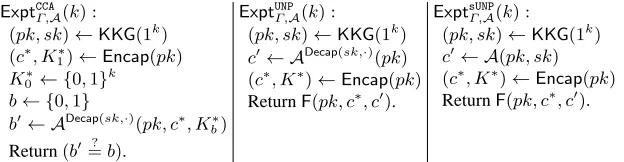
Proof Sketch of Theorem 1. The proofs for the both reductions proceed almost identically. LetAbe any PPTA adversary that attacks the KEMΓ∗ in the sense ofCCAsecurity. Consider the following sequence of games:
Game 1: This is theCCAexperimentExptCCA
Γ∗,A(k)itself.
Game 2: Same as Game 1, except that all decapsulation queriescsatisfyingF(pk, c∗, c) = 1are answered with⊥.
Game 3: Same as Game 2, except that all decapsulation queriescsatisfyingF(pk, c∗, c) = 0are answered withPDecap(cskc∗, c), whereskcc∗=Punc(sk, c∗).
Fori∈[3], letSuccidenote the event that in Gamei,Asucceeds in guessing the challenge bit (i.e.b′ =b
occurs). We will show that|Pr[Succi]−Pr[Succi+1]|is negligible for eachi∈[2]and that|Pr[Succ3]−1/2|
is negligible, which proves the theorem.
Firstly, note that Game 1 and Game 2 proceed identically unless A makes a decapsulation query c
satisfyingF(pk, c∗, c′) = 1andDecap(sk, c) ̸= ⊥, and hence|Pr[Succ1]−Pr[Succ2]|is upperbounded by the probability of A making such a query in Game 1 or Game 2. Recall that by the rule of theCCA
experiment, A’s queriescmust satisfyc ̸= c∗. ButF(pk, c∗, c′) = 1, c ̸= c∗, andDecap(sk, c) ̸= ⊥are exactly the conditions of violating the decapsulation soundness, and the probability ofAmaking a query satisfying these conditions is negligible.
Secondly, note that Game 2 and Game 3 proceed identically unless A makes a decapsulation query
c satisfyingF(pk, c∗, c) = 0 andDecap(sk, c) ̸= PDecap(cskc∗, c), where cskc∗ = Punc(sk, c∗). Hence
|Pr[Succ2]−Pr[Succ3]|is upperbounded by the probability ofAmaking such a query in Game 2 or Game 3.
However, since these conditions are exactly those of violating the punctured decapsulation soundness, the probability ofAmaking a query satisfying the above conditions is negligible. (The tightness of the reduction differs depending on whether we can assume “strong” puncutred decapsulation soundness. For the details, see the explanation in Appendix D.1.)
Finally, we can upperbound |Pr[Succ3]−1/2|to be negligible directly by the eCPA security of the PKEMΓ. More specifically, anyeCPAadversaryBe, which receives(pk,skcc∗, c∗, Kb∗)as input, can simulate
Game 3 forA, whereA’s decapsulation oracle in Game 3 is simulated perfectly by usingcskc∗, so thatBe’s
eCPAadvantage is exactly2· |Pr[Succ3]−1/2|. This shows that|Pr[Succ3]−1/2|is negligible. ⊓⊔
3.4 Understanding the Existing Constructions ofCCASecure KEMs via Puncturable KEM
To see the usefulness of a PKEM and the result in Section 3.3, here we demonstrate how the existing constructions ofCCAsecure KEMs can be understood via a PKEM.
KKGDDN(1k) :
∀(i, j)∈[k]× {0,1}:
(pk(ij), ski(j))←PKG(1k)
crs←CRSG(1k)
κ←HKG(1k)
P K←((pk(ij))i,j, crs, κ)
SK←((sk(ij))i,j, P K) Return(P K, SK). EncapDDN(P K) :
((pk(ij))i,j, crs, κ)←P K
K← {0,1}k
r1, . . . , rk← Rk
(vk, sigk)←SKG(1k)
h←Hκ(vk)
Viewhas(h1∥. . .∥hk)∈ {0,1}k. ∀i∈[k] :ci←Enc(pk
(hi)
i , K;ri)
x←((pk(hi)
i )i,(ci)i)
w←((ri)i, K)
π←Prove(crs, x, w)
σ←Sign(sigk,((ci)i, π))
C←(vk,(ci)i, π, σ). Return(C, K).
DecapDDN(SK, C) : ((ski(j))i,j, P K)←SK
((pk(ij))i,j, crs, κ)←P K
(vk,(ci)i, π, σ)←C IfSVer(vk,((ci)i, π), σ) =⊥
then return⊥.
h←Hκ(vk)
Viewhas(h1∥. . .∥hk)∈ {0,1}k.
x←((pk(hi)
i )i,(ci)i)
IfPVer(crs, x, π) =⊥then return⊥ ReturnK←Dec(sk(h1)
1 , c1).
FDDN(P K, C, C′) :
((pk(ij))i,j, crs, κ)←P K
(vk,(ci)i, π, σ)←C
(vk′,(c′i)i, π′, σ′)←C′ Return(Hκ(vk)=? Hκ(vk′)).
PuncDDN(SK, C∗) : ((ski(j))i,j, P K)←SK
((pk(ij))i,j, crs, κ)←P K
(vk∗,(c∗i)i, π∗, σ∗)←C
h∗←Hκ(vk∗)
Viewh∗as(h∗1∥. . .∥h∗k)∈ {0,1} k
.
d
SKC∗ ←(h∗,(sk(1−h∗i)
i )i, P K) ReturnSKdC∗.
PDecapDDN(SKdC∗, C) :
(h∗,(sk(1−h∗i)
i )i, P K)←SKdC∗
((pk(ij))i,j, crs, κ)←P K
(vk,(ci)i, π, σ)←C
IfSVer(vk,((ci)i, π), σ) =⊥then return⊥.
h←Hκ(vk)
Ifh∗=hthen return⊥.
Viewh∗as(h∗1∥. . .∥h∗k)∈ {0,1}k. Viewhas(h1∥. . .∥hk)∈ {0,1}k.
ℓ←min{i∈[k] :h∗i ̸=hi}
x←((pk(hi)
i )i,(ci)i)
IfPVer(crs, x, π) =⊥then return⊥. ReturnK←Dec(sk(1−h∗ℓ)
ℓ , cℓ).
Fig. 3. The PKEMΓDDNbased on a PKE schemeΠand a non-interactive argument systemP. In the figure, “(ri)i” and “(pk(ij))i,j” are the abbreviations of “(ri)i∈[k]” and “(pk
(j)
i )i∈[k],j∈{0,1}”, respectively, and we use a similar notation for other values.
LetΠ = (PKG,Enc,Dec)be a PKE scheme whose plaintext space is{0,1}k and whose randomness space (for security parameterk) isRk. Consider the NP languageL ={Lk}k∈Nwhere eachLkis defined
as follows:
Lk:=
{
((pki)i∈[k],(ci)i∈[k])∃((ri)i∈[k], K)∈(Rk)k× {0,1}ks.t.∀i∈[k] :Enc(pki, K; ri) =ci
} .
Let P = (CRSG,Prove,PVer) be a non-interactive argument system for the language L. Moreover, let
Σ = (SKG,Sign,SVer)andH= (HKG,H)be a signature scheme and a UOWHF, respectively. (The defi-nitions of an ordinary PKE scheme, a signature scheme, a non-interactive argument system, and a UOWHF, can be found in Appendices A.1, A.3, A.4, and A.5 respectively.) Then we construct the PKEMΓDDN = (KKGDDN,EncapDDN,DecapDDN,FDDN,PuncDDN,PDecapDDN), which is based on the DDN-KEM, as in Fig. 3.
The original DDN-KEMΓDDN∗ is(KKGDDN,EncapDDN,DecapDDN).
For the PKEMΓDDN, the three security requirements are shown as follows: (The formal proofs of
Lem-mas 1, 2, and 3 are given in Appendices D.2, D.3, and D.4, respectively.)
Lemma 1. IfHis a UOWHF andΣis aSOTsecure signature scheme, then the PKEMΓDDNsatisfies strong decapsulation soundness.
Lemma 2. If the non-interactive argument system P satisfies adaptive soundness, then the PKEM ΓDDN
satisfies strong punctured decapsulation soundness.
The first two lemmas are almost trivial. Specifically, letC∗ = (vk∗,(c∗i)i, π∗, σ∗)be the challenge
cipher-text, and let C′ = (vk′,(ci′)i, π′, σ′) be a ciphertext output by an adversary in the sDSNDexperiment or
thesPDSNDexperiment (recall that the interface of an adversary in these experiments is the same). Then, a simple observation shows that ifC′is a successful ciphertext that violates strong decapsulation soundness, thenC′ must satisfy one of the following two conditions: (1) Hκ(vk∗) = Hκ(vk′)andvk∗ ̸= vk′, or (2)
SVer(vk′,((c′i)i, π′), σ′) = ⊤,((c∗i)i, π∗, σ∗) ̸= ((c′i)i, π′, σ′), andvk∗ = vk′. However, a ciphertext with
the first condition is hard to find due to the security of the UOWHFH, and a ciphertext with the second condition is hard to find due to theSOTsecurity of the signature schemeΣ. Similarly, again a simple obser-vation shows that in order forC′ to be a successful ciphertext that violates strong punctured decapsulation soundness,C′ has to satisfy PVer(crs, x′, π′) = ⊤andx′ ∈/ Lk wherex′ = ((pk
(h′i)
i )i,(c′i)i), and hence
the adaptive soundness of the non-interactive argument systemPguarantees that the probability that an ad-versary coming up with such a ciphertext in thesPDSNDexperiment is negligible. TheeCPAsecurity is also easy to see. Specifically, we can first consider a modified experiment in whichcrsandπ are respectively generated by using the simulation algorithmsSimCRSandSimPrvwhich exist by theZKsecurity ofP. By theZKsecurity, aneCPAadversary cannot notice this change. Then, theCPAsecurity of the underlying PKE scheme directly shows that the information of a session-key does not leak, leading to theeCPAsecurity. Capturing Other Existing Constructions. Our framework with a PKEM can explain other existing construc-tions that, explicitly or implicitly, follow a similar security proof to the DDN construction. For example, the Rosen-Segev construction based on an injective trapdoor function (TDF) secure under correlated inputs [65], the Peikert-Waters construction [62] based on a lossy TDF and an all-but-one lossy TDF (ABO-TDF) in which the ABO-TDF is instantiated from a lossy TDF (see this construction in [62,§2.3]). Moreover, the construction based on CPA secure PKE and an obfuscator for point functions (with multi-bit output) by Matsuda and Hanaoka [52] and one based on CPA secure PKE and a hash function family satisfying the strong notion (called UCE security [7]) from the same authors [53] can also be captured as a PKEM.
Furthermore, our framework with a PKEM can also capture KEMs based on all-but-one extractable hash proof systems (ABO-XHPS) by Wee [67] (and its extension by Matsuda and Hanaoka [51]), by introducing some additional property for underlying ABO-XHPS. Although the additional property that we need is quite subtle, it is satisfied by most existing ABO-XHPS explained in [67, 51]. Since a number of recent practicalCCAsecure KEMs (e.g. [18, 25, 39, 42]) are captured by the framework of ABO-XHPS, our result is also useful for understanding practical KEMs. We expand the explanation for capturing ABO-XHPS-based KEMs in Appendix C.
3.5 DCCASecure Detectable KEM from a Puncturable KEM
Here, we show that even if a PKEM does not have decapsulation soundness, it still yields aDCCA secure detectable KEM [43, 50]. Therefore, if a PKEM satisfying punctured decapsulation soundness and eCPA
security additionally satisfies the unpredictability2(which we recall in Appendix A.2), it can still be used as a building block in the constructions [43, 50] to obtain fullyCCAsecure PKE/KEM.3
2Note that we treat unpredictability andDCCAsecurity of a detectable KEM as separate security notions (as opposed to treat the former as a requirement of the latter [43]), which we believe is more convenient to understand the connection between a PKEM and a detectable KEM.
3
Theorem 2. LetΓ = (KKG,Encap,Decap,F,Punc,PDecap)be a PKEM satisfying punctured decapsula-tion soundness andeCPAsecurity. Then,Γ†= (KKG,Encap,Decap,F)is aDCCAsecure detectable KEM.
Proof Sketch of Theorem 2. The proof of this theorem is straightforward given the proof of Theorem 1 (it is only simpler), and thus we omit a formal proof. The reason why we do not need decapsulation soundness is that an adversary in theDCCAexperiment is not allowed to ask a decapsulation querycwithF(pk, c∗, c) = 1, and we need not care the behavior ofDecapfor “close” ciphertexts. Thus, as in the proof of Theorem 1, the punctured decapsulation soundness guarantees thatPDecap(cskc∗,·) works as good asDecap(sk,·) for all
“far” ciphertextscwithF(pk, c∗, c) = 0, and then theeCPAsecurity guarantees the indistinguishability of a
real session-keyK1∗and a randomK0∗. ⊓⊔
On Unpredictability of PKEMs. We note that the DDN-KEM reviewed in Section 3.4 and our proposed KEM in Section 4 achieve strong unpredictabiilty (based on the security of the building blocks), which we show in Appendices E.1 and E.2, respectively.
4 Puncturable KEM from Sender Non-committing Encryption and KDM Secure SKE
In this section, we show our main technical result: a PKEM that uses a SNCE scheme and aOTKDMsecure SKE scheme (with respect to efficiently computable functions). By Theorem 1, this yields a CCAsecure KEM. Therefore, this result clarifies a new set of general cryptographic primitives that impliesCCAsecure PKE/KEM.
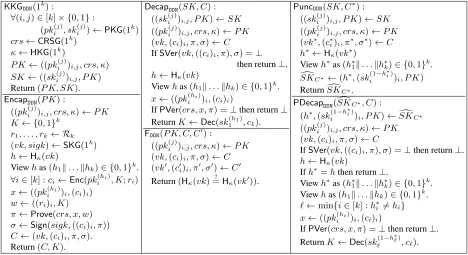
The construction of the proposed PKEM is as follows: Let Π = (PKG,Enc,Dec,Fake,Explain) be a SNCE scheme such that the plaintext space is {0,1}n (for some polynomial n = n(k) > 0) and the randomness space ofEncisRk. LetE = (SEnc,SDec)be a SKE scheme whose key space and plaintext
space (for security parameter k) areKk andMk, respectively. We requireKk ⊆ {0,1}n and(Rk)k+1×
{0,1}k ⊆ Mk. Furthermore, letH = (HKG,H)be a hash function family (which is going to be assumed
to be a UOWHF). Then we construct a PKEMΓb= (KKG[,Encap\,Decap\,bF,Punc[,PDecap\ )as in Fig. 4. Function Ensemble forOTKDMSecurity. For showing theeCPAsecurity ofΓb, we need to specify a function ensembleF = {Fk}k∈N with respect to whichE is OTKDMsecure. For each k ∈ N, define a set Fk of
efficiently computable functions as follows:
Fk:=
{
fz :Kk → Mkgiven by
fz(α) := ((Explain(ωi, α))i∈[k+1], K)
z= ((ωi)i∈[k+1], K)whereK ∈ {0,1}k
and eachωiis output fromFake(1k)
}
(3) Note that each function inFkis parameterized byz, and is efficiently computable.
Security ofΓb. The three security requirements of the PKEMΓbcan be shown as follows: (The formal proofs of Lemmas 4, 5, and 6 are given in Appendices D.5, D.6, and D.7, respectively.)
Lemma 4. IfHis a UOWHF, then the PKEMΓbsatisfies strong decapsulation soundness.
Lemma 5. The PKEMΓbsatisfies strong punctured decapsulation soundness (even against computationally unbounded adversaries) unconditionally.
Lemma 6. If the SNCE schemeΠisSNCsecure and the SKE schemeEisF-OTKDMsecure, then the PKEM
b
[
KKG(1k) :
∀(i, j)∈[k]× {0,1}:
(pki(j), ski(j))←PKG(1k)
(pkk+1, skk+1)←PKG(1k)
κ←HKG(1k)
P K←((pk(ij))i,j, pkk+1, κ)
SK←((sk(ij))i,j, P K) Return(P K, SK).
\
Encap(P K) :
((pk(ij))i,j, pkk+1, κ)←P K
α← Kk
((ri)i∈[k+1], K)←(Rk)k+1× {0,1}k
β←((ri)i∈[k+1], K) e
c←SEnc(α, β)
ck+1←Enc(pkk+1, α;rk+1)
h←Hκ(ck+1∥ec)
Viewhas(h1∥. . .∥hk)∈ {0,1}k. ∀i∈[k] :ci←Enc(pki(hi), α;ri)
C←(h,(ci)i,ec). Return(C, K).
\
Decap(SK, C) :
((sk(ij))i,j, P K)←SK
((pk(ij))i,j, pkk+1, κ)←P K (h,(ci)i,ec)←C
Viewhas(h1∥. . .∥hk)∈ {0,1}k.
α←Dec(sk(h1) 1 , c1)
Ifα=⊥then return⊥.
β←SDec(α,ec)
Ifβ=⊥then return⊥.
((ri)i∈[k+1], K)←β
ck+1←Enc(pkk+1, α;rk+1)
If(a)∧(b)then returnKelse return⊥:
(a)∀i∈[k] :Enc(pk(hi)
i , α;ri) =ci
(b)Hκ(ck+1∥ec) =h b
F(P K, C, C′) : (h,(ci)i,ec)←C
(h′,(c′i)i,ec′)←C′ Return(h=? h′).
[
Punc(SK, C∗) :
((sk(ij))i,j, P K)←SK
(h∗,(c∗i)i,ec∗)←C∗
Viewh∗as(h∗1∥. . .∥h∗k)∈ {0,1}k.
d
SKC∗←(h∗,(sk
(1−h∗i)
i )i, P K) ReturnSKdC∗.
\
PDecap(SKdC∗, C) :
(h∗,(sk(1−h∗i)
i )i, P K)←SKdC∗
(h,(ci)i,ec)←C Ifh∗=hthen return⊥.
Viewh∗as(h∗1∥. . .∥h∗k)∈ {0,1} k
. Viewhas(h1∥. . .∥hk)∈ {0,1}k.
ℓ←min{i∈[k] :h∗i ̸=hi}
α←Dec(sk(1−h∗ℓ)
ℓ , cℓ) Run exactly asDecap\ from
the sixth step and return the result.
Fig. 4. The PKEMΓbbased on a SNCE schemeΠand a SKE schemeE. In the figure, “(ri)i” and “(pk(ij))i,j” are the abbreviations of “(ri)i∈[k]” and “(pk
(j)
i )i∈[k],j∈{0,1}”, respectively, and we use similar notation for other values.
Here, we explain high-level proof sketches for each lemma.
Regarding strong decapsulation soundness (Lemma 4), recall that in thesDSNDexperiment, in order for a ciphertextC′ = (h′,(c′i)i,ec′)to violate (strong) decapsulation soundness, it must satisfyFb(P K, C∗, C′) = 1
(which implies h∗ = h′),C′ ̸= C∗, and Decap\(SK, C′) ̸= ⊥, which (among other conditions) implies
h∗ = Hκ(c∗k+1∥ec∗) = Hκ(c′k+1∥ec′) =h′, where the values with asterisk are those related to the challenge
ciphertext C∗ = (h∗,(c∗i)i,ec∗) andc′k+1 is the intermediate value calculated during the computation of \
Decap(SK, C′). On the other hand, a simple observation shows that the above conditions also imply another condition(c∗k+1,ec∗)̸= (c′k+1,ec′). This means that a successful ciphertext that violates (strong) decapsulation soundness leads to a collision for the UOWHFH, which is hard to find by the security of the UOWHFH.
Regarding punctured decapsulation soundness (Lemma 5), we show that for any (possibly invalid) ci-phertextC′ = (h′,(ci′)i,ec′), ifh′ ̸=h∗, then it always holds thatDecap\(SK, C′) = PDecap\ (SKdC∗, C′).
This can be shown due to the correctness of the building block SNCE schemeΠ and the validity check by re-encryption performed at the last step ofDecap\ andPDecap\ . In particular, the validity check by re-encryption works like a non-interactive proof with perfect soundness in the DDN construction, and hence for any adversary, itssPDSNDadvantage is zero.
Finally, we explain how theeCPAsecurity (Lemma 6) is proved. LetAbe anyeCPAadversary. Consider the following sequence of games:
Game 1:
α∗← Kk;
Fori∈[k+ 1] : (pki′, sk′i)←PKG(1
k
);
ri∗← Rk;
c∗i ←Enc(pki′, α∗;r∗i); End For
K1∗← {0,1}k;
(Continue to the center column↗)
β∗←((r∗i)i∈[k+1], K1∗); e
c∗←SEnc(α∗, β∗);
κ←HKG(1k);
h∗= (h∗1∥. . .∥h∗k)←Hκ(c∗k+1∥ec∗);
Fori∈[k] :
pk(h∗i)
i ←pk′i;
(pk(1−h∗i)
i , sk
(1−h∗i)
i )←PKG(1 k
); End For
(Continue to the right column↗)
P K ←((pki(j))i,j, pk′k+1, κ);
C∗←(h∗,(c∗i)i,ec∗);
d
SKC∗ ←(h∗,(sk(1−h∗i)
i )i, P K);
K0∗← {0,1}k;
b← {0,1};
b′← A(P K,SKdC∗, C∗, Kb∗)
Game 2: Same as Game 1, except that we generate each tuple (pk(h∗i)
i , c∗i, ri∗) and (pkk+1, c∗k+1, r∗k+1)
by using the simulation algorithmsFakeandExplainof the SNCE schemeΠ. More precisely, in this game, the step with the underline in Game 1 is replaced with: “(pk′i, c∗i, ω∗i) ← Fake(1k); r∗
i ←
Explain(ω∗i, α∗).”
Game 3: Same as Game 2, except that the information ofβ∗ = ((r∗i)i∈k+1, K1∗)is erased fromec∗. More
precisely, in this game, the step “ec∗ ← SEnc(α∗, β∗)” in Game 2 is replaced with the steps “β′ ← Mk;ec∗ ←SEnc(α∗, β′).”
Fori∈[3], letSucci be the event thatAsucceeds in guessing the challenge bit (i.e.b′ =boccurs). We will
show that|Pr[Succi]−Pr[Succi+1]|is negligible for eachi∈[2], and thatPr[Succ3] = 1/2, which proves
theeCPAsecurity of the PKEMΓb.
Firstly, we can show that|Pr[Succ1]−Pr[Succ2]|is negligible due to theSNCsecurity of the(k+ 1) -repetition constructionΠk+1, which in turn follows from theSNCsecurity of the underlying SNCE scheme
Πby a standard hybrid argument (see Lemma 10 in Appendix B.1).
Secondly, we can show that|Pr[Succ2]−Pr[Succ3]|is negligible due to theF-OTKDMsecurity of the
SKE scheme E. Here, the key idea in this proof is that we view the plaintextβ∗ = ((r∗i)i∈[k+1], K1∗) = ((Explain(ωi∗, α∗)i∈[k+1], K∗)which will be encrypted under the keyα∗ as a “key-dependent message” of
the keyα∗. More specifically, in the full proof we show how to construct aOTKDMadversaryBethat uses the KDM functionf ∈ Fkdefined byf(α∗) = ((Explain(ω∗i, α∗)i∈[k+1], K∗)(where(ω∗i)i∈[k+1]andK1∗ are
viewed as fixed parameters hard-coded inf) for the challenge KDM query, and depending onBe’s challenge bit,Besimulates Game 2 or Game 3 perfectly forAso thatAdvOTKDME,F,Be(k) =|Pr[Succ2]−Pr[Succ3]|.
Finally, observe that in Game 3, the challenge ciphertextC∗ is independent ofK1∗, and the input(P K, d
SKC∗, C∗, Kb∗)toAis distributed identically for bothb∈ {0,1}. This impliesPr[Succ3] = 1/2.
Our construction of the PKEM Γb, and the combination of Lemmas 4 to 6 and Theorem 1 lead to our main result in this paper:
Theorem 3. If there exist aSNCsecure SNCE scheme and a SKE scheme that isOTKDMsecure with respect to efficiently computable functions, then there exist aCCAsecure PKE scheme/KEM.
5 Dolev-Dwork-Naor KEM Revisited
In this section, we show that theeCPAsecurity of the DDN-PKEMΓDDN (Fig. 5) that we reviewed in
Sec-tion 3.4 can be shown from different assumpSec-tions on the PKE schemeΠ and the non-interactive argument systemP. More specifically, we show that ifΠis aSNCsecure SNCE scheme andP isWIsecure, then we can still show that the PKEMΓDDNiseCPAsecure. We emphasize that this change of assumptions does not
affect the other assumptions used for decapsulation soundness and punctured decapsulation soundness, and thus we see that this result is a concrete evidence of the usefulness of “breaking down” the steps in a secu-rity proof into small separate steps. By Theorem 1, we obtain a newCCAsecurity proof for the DDN-KEM based on a SNCE scheme and a non-interactive witness indistinguishable argument system (in the common reference string model).
We believe this new proof for the classical construction with different set of assumptions to be theoreti-cally interesting, and another qualitative evidence of the usefulness of SNCE in the context of constructing
CCAsecure PKE/KEM. In particular, compared with the original DDN-KEM, our result here shows a trade-off among assumptions on building blocks: a stronger assumption on a PKE scheme and instead a weaker assumption on a non-interactive argument system. Our result shows that the difference between aCPAsecure PKE scheme and aSNCsecure SNCE scheme is as large/small as the difference between theZKsecurity and
WIsecurity of a non-interactive argument system.
Lemma 7. If Π is aSNCsecure SNCE scheme and the non-interactive argument system P isWI secure, then the PKEMΓDDNiseCPAsecure.
The formal proof is given in Appendix D.8. Here, we explain some intuition on the proof of Lemma 7. Recall that in the proof based on the CPAsecurity ofΠ and theZKsecurity ofP, we first use the ZK
security ofP to “cut” the relation between the components(c∗i)i and the proofπ∗, and then use theCPA
security of thek-repetition constructionΠk (which in turn follows from theCPAsecurity ofΠ) to “hide” the information of the challenge bit. The proof of Lemma 7 in Appendix D.8 uses the properties of the building blocks in the reversed order: we first use theSNCsecurity of thek-repetition construction Πk to generate each tuple(pk(h∗i)
i , c∗i, ri∗)using the simulation algorithmsFakeandExplainof the SNCE scheme
Π. Because now each c∗i can be explained as an encryption of not just K1∗ but any plaintext due to the simulation algorithmsFakeandExplain, this change “cut” the relation between the components(c∗i)i and
the proofπ∗. Furthermore, due to theSNCsecurity, aneCPAadversary cannot notice this difference from the originaleCPAexperiment. Then, we use theWIsecurity of the non-interactive argument systemPto “erase” the information of the challenge bitb. That eachc∗i can be explained as an encryption of any plaintext means that there are many witnesses for the statementx∗ = ((pk(h∗i)
i )i,(c∗i)i) ∈ Lk, and hence the WIsecurity
suffices to “hide” the information onb. For more formal details, see Appendix D.8.
Acknowledgement
The authors would like to thank the members of the study group “Shin-Akarui-Angou-Benkyou-Kai” and the anonymous reviewers for their invaluable comments and suggestions.
References
![Fig. 4. �of “ The PKEM Γ� based on a SNCE scheme Π and a SKE scheme E. In the figure, “(ri)i” and “(pk(j)i)i,j” are the abbreviations(ri)i∈[k]” and “(pk(j)i)i∈[k],j∈{0,1}”, respectively, and we use similar notation for other values.](https://thumb-us.123doks.com/thumbv2/123dok_us/7946133.1318898/16.612.74.541.88.324/scheme-scheme-gure-abbreviations-respectively-similar-notation-values.webp)