From FE Combiners to Secure MPC and Back
Prabhanjan Ananth
∗Saikrishna Badrinarayanan
†Aayush Jain
†Nathan Manohar
†Amit Sahai
†Abstract
Cryptographic combiners allow one to combine many candidates for a cryptographic prim-itive, possibly based on different computational assumptions, into another candidate with the guarantee that the resulting candidate is secure as long as at least one of the original candi-dates is secure. While the original motivation of cryptographic combiners was to reduce trust on existing candidates, in this work, we study a rather surprising implication of combiners to constructing secure multiparty computation protocols. Specifically, we initiate the study of functional encryption combiners and show its connection to secure multiparty computation.
Functional encryption (FE) has incredible applications towards computing on encrypted data. However, constructing the most general form of this primitive has remained elusive. Although some candidate constructions exist, they rely on nonstandard assumptions, and thus, their security has been questioned. An FE combiner attempts to make use of these candidates while minimizing the trust placed on any individual FE candidate. Informally, an FE combiner takes in a set of FE candidates and outputs a secure FE scheme if at least one of the candidates is secure.
Another fundamental area in cryptography is secure multi-party computation (MPC), which has been extensively studied for several decades. In this work, we initiate a formal study of the relationship between functional encryption (FE) combiners and secure multi-party computation (MPC). In particular, we show implications in both directions between these primitives. As a consequence of these implications, we obtain the following main results.
• A two-round semi-honest MPC protocol in the plain model secure against up to n−1 corruptions with communication complexity proportional only to the depth of the circuit being computed assuming learning with errors (LWE). Prior two round protocols based on standard assumptions that achieved this communication complexity required trust as-sumptions, namely, a common reference string.
• A functional encryption combiner based on pseudorandom generators (PRGs) inNC1. This is a weak assumption as such PRGs are implied by many concrete intractability problems commonly used in cryptography, such as ones related to factoring, discrete logarithm, and lattice problems [AIK05]. Previous constructions of FE combiners, implicit in [AJS17],
∗
†
were known only from LWE. Using this result, we build a universal construction of func-tional encryption: an explicit construction of funcfunc-tional encryption based only on the assumptions that functional encryption exists and PRGs inNC1.
1
Introduction
The foundations of several cryptographic primitives rely upon computational assumptions. The last few decades have seen the birth of many assumptions, such as factoring, quadratic residuos-ity, decisional Diffie-Hellman, learning with errors, and many more. Understanding the security of these assumptions is still very much an active research area. Despite years of research, very little is known in terms of how different cryptographic assumptions compare with each other. For instance, its not known whether decisional Diffie-Hellman is a weaker or a stronger assump-tion than learning with errors. This leads us to the following unsatisfactory scenario: suppose a cryptographic primitive (say, public key encryption) has many candidate constructions based on different assumptions, and we want to pick the most secure candidate. In this scenario, it is unclear which one we should pick.
Cryptographic Combiners.
The notion of cryptographic combiners was introduced to resolve this dilemma. Given many candidates of a cryptographic primitive, possibly based on different assumptions, a cryptographic combiner churns these candidates into another candidate construction for the same primitive with the guarantee that the resulting construction is secure as long as at leastoneof the original candidates are secure. For instance, a combiner for public key encryption can be used to transform two candidates based on decisional Diffie-Hellman and learning with errors into a different public-key encryption candidate that is secure as long aseitherdecisional Diffie-Hellmanorlearning with errors is secure.
While combiners were originally introduced to reduce trust on existing cryptographic con-structions, in this work, we study a rather surprising implication from combiners to secure multi-party computation. Secure multi-party computation [Yao86,GMW87,BOGW88], one of the fundamental notions in cryptography, allows many parties, who don’t necessarily trust each other, to come together and compute a function on their private inputs. We consider the prim-itive of functional encryption and study the implications of functional encryption combiners to secure multi-party computation. But first, we recall the notion of functional encryption.
Functional Encryption.
Functional encryption (FE), introduced by [SW05,BSW11,O’N10], is one of the core primitives in the area of computing on encrypted data. This notion allows an authority to generate and distribute constrained keys associated with functions f1, . . . , fq,called functional keys, which can be used to learn the values f1(x), . . . , fq(x) given an
en-cryption of x. Intuitively, the security notion states that the functional keys associated with f1, . . . , fq and an encryption ofxreveal nothing beyond the valuesf1(x), . . . , fq(x). While this
notion is interesting on its own, several works have studied its connections to other areas in cryptography and beyond, including reusable garbled circuits [GKP+13], indistinguishability obfuscation [AJ15, BV15,AJS15,LPST16b,LPST16a], adaptive garbling [HJO+16], verifiable random functions [GHKW17,Bit17,BGJS17], deniable encryption [GKW17], hardness o1f Nash equilibrium [GPS16,GPSZ17], and many more.
Currently, we know how to construct only restricted versions1 of functional encryption from well studied cryptographic assumptions. However, constructing the most general form of functional encryption has been an active research area and has intensified over the past few
1
years given its implication to indistinguishability obfuscation [AJ15, BV15]. All the candi-dates [GGHZ14,Lin16,LV16, AS17,Lin17,LT17] we know so far are either based on assump-tions pertaining to the tool of graded encodings [BS03,GGH13], or on other new and relatively unstudied assumptions [AJKS18,LM18,Agr18]. Recent cryptanalytic attacks [CHL+15,HJ15, CLLT15,CJL16,CGH+15] on assumptions related to graded encodings have prompted scrutiny of the security of schemes that use this tool as the building block. Given this, we should hope to minimize the trust we place on any individual FE candidate. The notion of a functional en-cryption combiner achieves this purpose. Roughly speaking, a functional enen-cryption combiner allows for combining many functional encryption candidates in such a way that the resulting FE candidate is secure as long as any one of the initial FE candidates is secure. In other words, a functional encryption combiner says that it suffices to place trust collectively on multiple FE candidates, instead of placing trust on any specific FE candidate.
Our Work.
We initiate a systematic study of functional encryption combiners. In particular, we study implications from FE combiners to secure multi-party computation (and vice versa), and by doing so, we achieve interesting consequences that were previously unknown. We detail our contributions next.1.1
Our Contributions
Our results can be classified into two parts. The first part shows how to translate constructions of functional encryption combiners into secure MPC protocols. The second part studies the other direction.
From combiners for single-key FE to secure MPC:
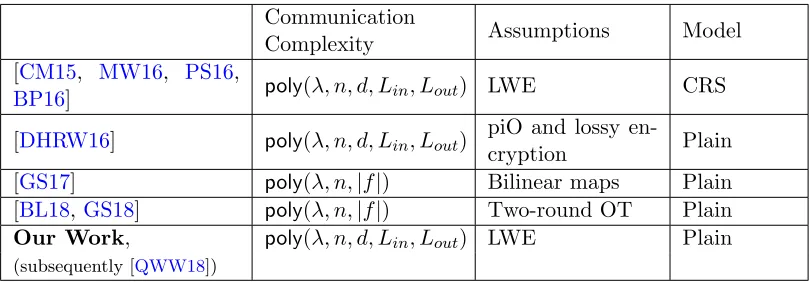
Our first result shows how to construct a passively secure multi-party computation protocol that is both round-optimal (two rounds) and communication efficient (depends only on circuit depth). Recall that in a passively secure MPC protocol, corrupted parties follow the instructions of the protocol, but try to learn about honest party inputs from their combined view of the protocol execution. Moreover, our resulting protocol is in the plain model and can tolerate all but one corruption2. Prior round-optimal passively-secure MPC protocols were either communication inefficient, that is communication complexity was proportional to circuit size [GS17,BGI+18,BL18,GS18], based on strong assumptions such as indistinguishability obfuscation [DHRW16] or were based on trust assumptions [CM15, MW16, PS16, BP16, BHP17] (for instance, a common reference string). Subsequent to our work3, [QWW18] (FOCS’18) matched our result under the same assumption; they use the new primitive of laconic function evaluation to achieve their result instead of FE combiners. We prove the following theorem.Theorem 1 (Informal). Consider an n-party functionality f computable by a poly-sized cir-cuit of depth d, for any n ≥2. Assuming LWE, there is a construction of a passively secure (semi-honest) n-party computation protocol for f in the plain model secure againstn−1 cor-ruptions. The number of rounds in this protocol is 2, and the communication complexity is poly(λ, n, d, Lin, Lout), where Lin is the input length of this circuit computing f, Lout is its output length andλ is the security parameter.
We summarize the state of art in the Table 1.1.
Central to proving the above theorem is a transformation from a functional encryption combiner to passively secure MPC. We only require a combiner for functional encryption schemes where the adversary only receives one functional key. We require the functional encryption
2
Unless otherwise specified, we only consider MPC protocols tolerating all but one corruption.
3We note that [QWW18] explicitly write that our work “previouslygot such result using functional-encryption
Communication
Complexity
Assumptions
Model
[
CM15
,
MW16
,
PS16
,
BP16
]
poly
(
λ, n, d, L
in, L
out)
LWE
CRS
[
DHRW16
]
poly
(
λ, n, d, L
in, L
out)
piO and lossy
en-cryption
Plain
[
GS17
]
poly
(
λ, n,
|
f
|
)
Bilinear maps
Plain
[
BL18
,
GS18
]
poly
(
λ, n,
|
f
|
)
Two-round OT
Plain
Our Work
,
poly
(
λ, n, d, L
in, L
out)
LWE
Plain
(subsequently [QWW18])
Figure 1: State of the art in terms of communication complexity of two-round passively secure
n
-party protocols in the all-but-one corruption model. We denote by
|
f
|
and
d
the size and depth of
the circuit representing the MPC functionality
f
, respectively. Moreover,
L
inand
L
out, respectively,
denote the input and output lengths of the circuit. CRS stands for common reference string and
piO stands for probabilistic indistinguishability obfuscation [
CLTV15
].
combiner to have some structural properties. Namely, the functional key forf associated with the combined candidate needs to be of the form (f, sk1
f, . . . , sk n
f), where (i) decomposability: sk i f
is produced by theith FE candidate and, (ii) succinctness: the length ofskfi ispoly(λ, d, Lout),
where dis the depth of the circuit computing f and Lout is its output length. As part of the
succinctness property, we also require that the encryption complexity is poly(λ, d, Lin), where Linis the length of the message to be encrypted. We show how to construct such an FE combiner
assuming LWE.
An intermediate tool we use in this implication is a communicationinefficient passively secure MPC protocol. By communication inefficient, we mean that the communication complexity is proportional to the size of the circuit representingf. We note that such protocols [GS17,BL18,
GS18] exist in the literature4 based on just the assumption of round-optimal passively secure oblivious transfer.
Lemma 1 (Informal). Consider a n-party functionality f, for any n ≥ 2. There is a pas-sively securen-party computation protocol for f in two rounds with communication complexity poly(λ, n, d, Lin, Lout)secure against n−1 corruptions, wheredis the depth of circuit comput-ingf,Lin is the input length of the circuit andLout is its output length. Moreover, we assume (i) a decomposable and succinct functional encryption combiner and (ii) a communication in-efficient (as defined above) two-round securen-party computation protocol secure againstn−1
corruptions.
By plugging in the recent round-optimal secure MPC protocols [GS17, BL18, GS18] that can be based on two-round oblivious transfer, which in turn can be based on learning with er-rors [PVW08], and our new decomposable and succinct FE combiner from LWE, we get Theo-rem 1. We note that MPC with malicious security requires at least 4 rounds [GMPP16,ACJ17,
BHP17,BGJ+18,HHPV18], and thus, we do not consider MPC with malicious security in this work.
4
From secure MPC to combiners for unbounded-key FE:
In the other direction, we show how to transform existing secure multi-party computation protocols into constructions of functional encryption combiners. However, we note that the FE combiners we construct from MPC here do not satisfy decomposability or succinctness. In particular, we show how to transform specific constant round passively secure MPC protocols based on low degree ran-domized encodings [BMR90] into functional encryption combiners. By instantiating low degree randomized encodings from pseudorandom generators inNC1, we get the following result.Theorem 2(Informal). Assuming pseudorandom generators in NC1, there is a construction of a combiner for unbounded-key functional encryption.
By unbounded-key functional encryption, we mean that there is no a priori bound on the number of functional keys the adversary can request in the security experiment. We note that such pseudorandom generators inNC1are implied by most concrete intractability assumptions commonly used in cryptography, such as ones related to factoring, discrete logarithm, and lattice problems [AIK05]. Furthermore, such PRGs are also implied by the existence of one-way permutations inNC1or one-way functions inNC1 with efficiently computable entropy [AIK05]. Next, we present a generic reduction that can transform two-round passively secure MPC protocols into functional encryption combiners. For this transformation to hold, the MPC protocol must satisfy two properties: (i) delayed function-dependence: the first round of the MPC protocol should be independent of the functionality being securely computed and (ii) reusability: the first round can be reused by the parties to securely compute many functionalities (but on the same inputs fixed by the first round).
Theorem 3 (Informal). Assuming a delayed function-dependent and reusable round-optimal secure MPC protocol, there is a construction of an unbounded-key decomposable functional en-cryption combiner.
We then observe that existing two-round secure MPC protocols [MW16, PS16, BP16], based on learning with errors, already satisfy delayed function-dependence and reusability. We note that it is not necessary for the round-optimal protocols to be in the plain model (indeed, the protocols [MW16,PS16,BP16] are in the common reference string (CRS) model).
Prior to this work, the only polynomial hardness assumption known to imply an FE combiner was the learning with errors assumption [AJS17]5. WhileTheorem 2already gives a construction of a functional encryption combiner from learning with errors (pseudorandom generators inNC1 can be based on learning with errors [BPR12]), the functional encryption combiner constructed inTheorem 3arguably provides a more efficient transformation. In particular, the efficiency of the functional keys in the combined scheme from Theorem 3 is linear in the efficiency of the functional keys in the FE candidates. However, the efficiency in the combined scheme from
Theorem 2degrades polynomially in the efficiency of the original FE candidates. Furthermore, the FE combiner fromTheorem 3 isdecomposable, a property needed by an FE combiner as a building block in the proof ofTheorem 1. On the other hand, the FE combiner fromTheorem 2is inherently not decomposable, since it is based on an “onion-layered” approach – this means that the keys generated with respect to one FE candidate make oracle calls to other FE candidates (see [HKN+05] for a related discussion on black-box combiners). Furthermore, the FE combiner from Theorem 3 makes only black-box use of the underlying FE candidates, whereas the FE combiner fromTheorem 2is inherently non-black-box.
In terms of techniques, we introduce mechanisms to emulate a MPC protocol using functional encryption candidates. This is remiscient of “MPC-in-the-head” paradigm introduced by Ishai et al. [IKOS07] and more relevant to the context of FE is the work of Gorbunov et al. [GVW12] who 5Note that [AJS17] required sub-exponential hardness only for constructing iO combiners, not for constructing
used information-theoretic MPC protocols to construct single-key FE. However, we encounter new challenges to implement the “MPC-in-the-head” paradigm in our context.
Universal Functional Encryption:
We strengthen our constructions of FE combiners by showing how to transform them into combiners that also work when the insecure candidates don’t necessarily satisfy correctness (of course, we still require that the secure candidate is cor-rect). Such combiners are calledrobust combiners. To do this, we present correctness amplifica-tion theorems based on previous works on indistinguishability obfuscaamplifica-tion [BV16,AJS17] and, in particular, our correctness amplification assumes only one-way functions (unlike [BV16,BV17]). Robust combiners have been useful in universal constructions [AJN+16,AJS17]. Roughly speak-ing, a universal construction of FE is a concrete construction of FE that is secure as long as any secure and correct construction exists. We show how to build universal functional encryption from robust FE combiners.Theorem 4 (Universal Functional Encryption). Assuming pseudorandom generators in NC1, there is a universal unbounded-key functional encryption scheme.
Our construction will be parameterized byT, whereT is an upper bound on the running time of all the algorithms associated with the secure candidate. This was a feature even in the universal iO construction of [AJN+16].
Related Work:
The notion of combiners has been studied in the context of many cryp-tographic primitives. Asmuth and Blakely [AB81] studied combiners for encryption schemes. Levin proposed a universal construction of one-way functions [Lev87]. Later, a systematic study of combiners and their relation to universal constructions was proposed by Harnik et al. [HKN+05] (also relevant are the constructions in [Her05, Her09]). Recently, Ananth et al. [AJN+16] designed universal constructions of indistinguishability obfuscation (iO). Concur-rently, Fishclin et al. also proposed combiners in the context of program obfuscation [FHNS16]. Ananth et al. [AJS17] then proposed the concept of transforming combiners that transforms many candidates of a primitive X, with at least one of them being secure and, into a secure candidate of primitiveY. In particular, they construct iO-to-functional encryption transforming combiners.Subsequent to our work, [QWW18] (FOCS’18) matched our result by also achieving a two-round semi-honest MPC protocol in the plain model with depth-proportional communi-cation complexity assuming LWE, using laconic function evaluation instead of FE combiners. [QWW18]’s protocol consists of pre-processing, online, and post-processing phases. Addition-ally, they note that the computation complexity of the online phase is also independent of the size of the function being computed. After seeing their work, we observe that our protocol also satisfies this property. In particular, in the construction inSection 5, steps 1−3 in round 1 can be made the preprocessing phase. The resulting protocol will now have online computation complexity independent of the size of the function being computed.
1.2
Technical Overview
We begin by tackling the problem of constructing secure multi-party computation with depth-proportional communication complexity, i.e, depth-proportional only to the depth of the circuit being securely computed, starting from a functional encryption combiner.
Round-Optimal MPC with Depth-Proportional Communication:
Let’s startround, the ithparty broadcasts an encryption of its input x
i. These ciphertexts are computed
with respect to public keys that are derived from the CRS. All thenparties then homomorphi-cally compute on the encryptions of (x1, . . . , xn) to obtain a ciphertext off(x1, . . . , xn), where f is the function they wish to securely compute. The resulting ciphertext is then partially de-crypted, and every party broadcasts its partially decrypted value in the second round. These values can be combined to recover the output of the functionality.
One could imagine getting rid of the CRS in the above protocol using the recent round-optimal MPC protocols in the plain model [GS17,BL18]. If this were possible, then it would yield a round-optimal MPC in the plain model that has depth-proportional communication complexity. However, the issue is that the messages in the first round of [MW16, PS16,BP16] are computed as functions of the CRS and thus, such an approach would inherently require three rounds.
To overcome this, we introduce a mechanism to parallelize the evaluation and the encryption processes. The output of the evaluation in our approach is the output of the functionality and not a partially decrypted value, as was the case in [MW16,PS16,BP16], and thus, we save one round. To implement this high level idea, we use a functional encryption combiner. Before we describe the high level template, we require that the underlying functional encryption combiner satisfies thedecomposability property: Suppose we have FE candidatesFE1, . . . ,FEn. Then, a
functional key for a circuitC in the combined scheme is just a concatenation of the functional keys forC, (sk1C, . . . , sknC), whereskiC is computed with respect to theithFE candidate.
The template of our depth-proportional communication secure MPC construction from an FE combiner satisfying this decomposability property is in Figure1.2. As an intermediate tool, we use a size-proportional communication secure MPC protocol (henceforth, also referred to as a communication inefficient protocol). By this, we mean that the communication complexity of the secure MPC protocol grows polynomially with the size of the circuit being securely computed.
Our Approach
Goal: t-round depth-proportional communication secure MPC from t-round size-proportional communication secure MPC using decomposable FE combiners.
• Suppose the input of theithparty isxiandf is the function to be securely computed.
All the parties execute thet-round (communication-inefficient) MPC protocol to obtain an encryption of (x1, . . . , xn) with respect to the combined FE scheme.
• Simultaneously, the ithparty computes the functional key off with respect to theith candidate and sends it to everyone.
Figure 2:
Our approach to construct round-optimal depth-proportional communication secure MPC from decomposable functional encryption combiners.At the end of second round, every party has an encryption of (x1, . . . , xn) with respect to
the combined candidate and functional keys for f with respect to every candidate. From the decomposability property, this is equivalent to generating a functional key for f with respect to the combined candidate. Each party can separately execute the FE combiner decryption algorithm to obtainf(x1, . . . , xn), as desired. Here, we crucially rely on the fact that all the FE
candidates are correct. This completes the high level description of the template.
protocols in the plain model and by suitably instantiating the FE combiners (described later), our approach yields a two-round MPC protocol with depth-proportional communication.
To argue security of our MPC protocol, the idea is to start with the assumption of a secure FE scheme and instantiate all the candidates using the same FE scheme. If the adversary corrupts all but thejth party, this means that he can obtain all the master secret keys of the FE scheme except thejthone. This is effectively the same as all except thejthcandidate being broken. At this point, we can use the security of thejthFE scheme to argue the security of the MPC protocol. This shows that the above template yields a secure two-round MPC protocol assuming a secure FE scheme.
Note that we also assume a two-round (communication-inefficient) MPC protocol. Without showing that our protocol has depth-proportional communication, the above protocol doesn’t achieve anything new. Indeed, it is unclear why our protocol should have depth-proportional communication. There are two sources of concern: (i) we are still using a communication
inefficient MPC protocol and, (ii) the functional key of f could be proportional to the size of the circuit computingf. Suppose we had a secure (magical) FE scheme satisfying the following two properties: (1) the encryption complexity of this FE scheme is proportional only to the depth of f, and (2) the functional key of f is of the form (f,aux), where |aux| only depends on the depth of the circuit computing f. We claim that this would immediately show that our protocol has communication complexity proportional only to the depth. Concern (i) is addressed by the fact the communication-inefficient MPC protocol is used only to evaluate the encryption circuit of the underlying FE scheme. Since the underlying FE scheme is succinct, the size of the encryption circuit only depends on the depth of the functionalityf. Therefore, the communication complexity of the communication-inefficient MPC protocol does not affect our construction. Concern (ii) is handled by the fact that the parties only have to send the “aux” part of the function keys to the other parties, which is only proportional to the depth off.
We next observe that the functional encryption scheme of Goldwasser et al. [GKP+13] can be used to satisfy both properties (1) and (2). We recall the functional encryption construction of Goldwasser et al.: the building blocks in this construction are attribute based encryption (ABE) for circuits, fully homomorphic encryption (FHE), and garbling schemes.
• To encrypt a message x, first encrypt x using a (leveled) FHE scheme. Suppose the maximum output length of the functions for which we generate functional keys is Lout.
Generate poly(Lout) ABE encryptions of the FHE ciphertext, for some fixed polynomial poly, along with wire keys of a garbled circuit. The garbled circuit is associated with the FHE decryption circuit.
• A functional key of f consists of poly(Lout) ABE keys associated with the circuit that
computes the FHE evaluation off.
If we instantiate the ABE scheme with the scheme of Boneh et al. [BGG+14] and the leveled FHE scheme with any of the schemes proposed in [GSW13,BGV14], we achieve both properties (1) and (2) described above. The schemes of [BGG+14] and [GSW13,BGV14] have encryption complexity proportional only to the depth of the circuit. In terms of the structure of the functional key, we note that the ABE scheme of [BGG+14] satisfies this nice property: you can express the ABE key of a functionf as (f,aux), where|aux|is a polynomial in depth andLout.
This can be used to argue that the above FE scheme satisfies property (2).
Thus starting from an FE combiner, we have constructed a communication-efficient two-round MPC. We note that the FE combiner is required to satisfy simulation security in order to prove that the resulting MPC is simulation secure. The security proof of the resulting MPC directly follows from the simulation security of the FE combiner and the simulation security of the underlying communication inefficient MPC.
Constructing the FE combiner:
As in the works of [AJN+16,AJS17], we view the FE candidates as analogous to parties in a secure MPC protocol. Suppose we want to construct an FE combiner for ncandidates. We start with a two-round (semi-honest) secure n-party MPC protocol in the plain model. To encrypt a messagex, first additively secret sharexinto shares (x1, . . . , xn). Compute the first round messages of all the parties, where theithparty’s input is xi. Finally, for every i∈[n], encrypt the first round messages of all the parties along with thelocal state of theithparty usingithFE candidate. All thenencryptions will form the ciphertext corresponding to the FE combiner scheme.
To generate a functional key for f, we generatenfunctional keys with each key associated with an FE candidate. The ith functional key computes the next message function of the ith
party. In this context, we define the next message function to be a deterministic algorithm that takes as input the state of the party along with the messages received so far and produces the next message. Moreover, the MPC functionality associated with the next message function is as follows: it takes as input nshares ofx, reconstructsx, and computes f(x). The functional key off corresponding to the FE combiner is the collection of all thesenfunctional keys.
The decryption in the FE combiner scheme proceeds by recovering the first and second round messages of all the parties. The reconstruction algorithm of the secure MPC protocol is then executed to recover the output of the functionality. An issue here is that the reconstruction part need not be publicly computable. Meaning that it might not be possible to recover the output of the functionality from the transcript of the protocol alone. This can be resolved by revealing the local state of one of the parties to the FE evaluator who can then use this to recover the output. We implement this by considering an (n+1)-party MPC protocol with the FE evaluator corresponding to one of the parties in the MPC protocol.
Without restricting ourselves to a specific type of two-round secure MPC protocols, the above template could be ill defined for two reasons:
• Function-Dependence: The first round messages of the MPC protocol we start off with could depend on the functionality being securely computed. This means that the FE en-cryptor needs to be aware of the functionf when it is encrypting the messagex. Hence, we need to enforce a delayed function-dependence property on the underlying MPC pro-tocol. Roughly, this property states that the first round messages of the MPC protocol are independent of the functionality being securely computed.
• Reusability: Suppose we wish to construct acollusion-resistantFE combiner, meaning that the FE combiner is secure even if the adversary obtains multiple functional keys during the security experiment. Even if one of the candidates is secure in the collusion-resistant setting, the above template doesn’t necessarily yield a collusion-resistant FE combiner. This is because the first round MPC messages are “reused” across different FE evaluations. The security of MPC, as is, doesn’t necessarily guarantee any security if the first round messages are reused for secure computation of multiple functionalities. Hence, we need to enforce a corresponding reusability property on the underlying MPC protocol to make it work in the collusion resistant setting.
Once we start with a delayed function-dependent and reusable secure MPC protocol, we can implement an FE combiner using the above template. We observe that the schemes of [MW16,
PS16, BP16] are both delayed function-dependent and reusable. As a corollary, we obtain an FE combiner based on learning with errors.
FE Combiner from Weaker Assumptions:
The above constructions and previous constructions of FE combiners [AJS17] relied on the learning with errors assumption. However, it would be interesting to try to construct an FE combiner from weaker assumptions. Our first observation is that there is a simple construction of an FE combiner for two FE candidates. In this case, one can simply “nest” the two candidates. That is, if the candidates are denoted FE1 andFE2, we encrypt a message xby first encryptingxunder FE1 and then encrypting the resulting ciphertext underFE2. To construct a function key forf, we first construct the function keySK1 forf using FE1 and then construct the function keySK2 for the decryption circuit of FE1, with SK1 hardcoded as the function key, usingFE2. SK2is then the function key for f in the nested scheme. In fact, this nested approach works to combine any constant dnumber of candidates. However, this approach does not scale polynomially in the number of candidates, and therefore, does not give us an FE combiner for a polynomial number of candidates.Using the above observation, we note that we can evaluate circuits over a constant number of inputs. In particular, we can evaluate constant-sized products. If we could compute the sum of various constant-sized products, then we could compute constant-degree polynomials, which would allow us to apply known bootstrapping techniques to go from FE for constant degree polynomials to FE for arbitrary functions via randomized encodings. Such randomized encodings can be constructed assuming a PRG in NC1 [AIK05]. But how do we go about computing the sums of constant degree polynomials? To reason about this, we will view this as an MPC problem, where each FE candidate is associated with a party. Given an inputx, we bitwise secret share x amongst all the parties. This effectively gives us an MPC problem where each party/candidate has a secret input (their share ofx). For simplicity, let’s consider the case where each candidate is given a single bit (theith candidate is given the bitxi). As an
example, suppose we wished to evaluate the polynomial
x21+x1x2+x1x3+x2x3.
Using the simple nested combiner for two candidates, we could evaluate each monomial and then sum the resulting monomial evaluations to compute the polynomial. However, this approach is flawed, since it will leak the values of each of the monomials, whereas functional encryption requires only the value of the polynomial to be computable and nothing else. We resolve this issue by masking each of the monomial evaluations by secret shares of 0 such that summing all these values gives the correct polynomial evaluation, but the individual computed monomial evaluations hide the true values of the monomials. To illustrate this, for the above polynomial, candidate 1 has its secret input in 3 monomialsx21, x1x2, and x1x3. We secret share 0 across 3 shares. LetShare1,1,Share1,2,Share1,3 denote these values, where
Share1,1+Share1,2+Share1,3= 0.
Similarly, candidates 2 and 3 have their secret inputs in 2 monomials: x1x2, x2x3for candidate 2 andx1x3, x2x3for candidate 3. We secret share 0 across 2 shares for each of these candidates. These shares are denoted Share2,1,Share2,2 for candidate 2 and Share3,1,Share3,2 for candidate 3. We then place a total ordering on the monomials of the polynomial in order to assign the shares to the monomials. Suppose our ordering was
x21< x1x2< x1x3< x2x3. Then, we would see thatx2
1 was the first monomial containing x1 and assign Share1,1 to this monomial. Forx1x2, we see that it is the second monomial containingx1and the first monomial containingx2. Therefore, we assign the sharesShare1,2andShare2,1to the monomialx1x2. In a similar manner, we assign the sharesShare1,3,Share3,1 tox1x3 and the sharesShare2,2,Share3,2 tox2x3. When generating the function key to evaluate the monomialx2
1, we actually give out a function key that evaluatesx2
By proceeding in this manner, we have made it so that each monomial evaluation hides the actual monomial value, but the sum of the monomial evaluations gives the polynomial value. However, this approach still raises several concerns: (i) how can we ensure that our secret sharing procedure hides intermediate sums of monomials, and (ii) how can we coordinate the randomness needed to generate the secret shares amongst the various monomials. To illustrate the first issue, suppose that the polynomial to evaluate wasx1+x2. In this instance, we would not add any secret shares, which would revealx1 andx2. Fortunately, the first issue is not an issue at all, since such problematic polynomials will not occur. This is because we begin by secret sharing the bits of the input xamongst the candidates. Therefore, every monomial will be broken into the sum of new monomials, such that each candidate contains a private bit in one of these new monomials. Since one of the candidates is secure, the secret sharing amongst the monomials with bits corresponding to the secure candidate ensures that nothing except the actual polynomial evaluation can be learned. To solve issue (ii), we utilize a PRF and generate a random PRF key for each candidate. This PRF key is then used to generate the secret shares of 0 associated with that candidate.
Organization:
We begin by defining the notion of functional encryption and secure multi-party computation inSection 2. In Section 3, we define the notion of a functional encryption combiner. In Section 4, we show how to build a decomposable FE combiner that will be used as a building block in the construction of our round-optimal and communication efficient MPC protocol and how to instantiate it from [GKP+13]. InSection 5, we give the construction of our round-optimal and communication efficient MPC protocol. InSection 6, we show how to build an FE combiner assuming the existence of a PRG inNC1. InSection 7, we demonstrate how to convert a delayed function-dependent and reusable round-optimal secure MPC protocol into an FE combiner. Finally, inSection 8, we show how to convert an FE combiner into a robust FE combiner and build a universal functional encryption scheme.2
Preliminaries
We denote the security parameter by λ. For an integer n ∈ N, we use [n] to denote the set
{1,2, . . . , n}. We use D0 =∼c D1 to denote that two distributions D0,D1 are computationally indistinguishable. We usenegl(λ) to denote a function that is negligible inλ. We usex← Ato denote thatxis the output of a randomized algorithmA, where the randomness ofAis sampled from the uniform distribution.
2.1
Functional Encryption
We define the notion of a (secret key) functional encryption candidate and a (secret key) func-tional encryption scheme. A funcfunc-tional encryption candidate is associated with the correctness requirement, while a secure functional encryption scheme is associated with both correctness and security.
Syntax of a Functional Encryption Candidate/Scheme.
A functional encryption (FE) candidate/schemeFE for a class of circuits C={Cλ}λ∈Nconsists of four polynomial timealgorithms (Setup,Enc,KeyGen,Dec) defined as follows. LetXλbe the input space of the circuit
classCλ and letYλbe the output space of Cλ. We refer toXλ andYλ as the input and output
• Setup,MSK←FE.Setup(1λ): It takes as input the security parameterλand outputs the
master secret keyMSK.
• Encryption,CT←FE.Enc(MSK, m): It takes as input the master secret keyMSKand a messagem∈ Xλ and outputsCT, an encryption ofm.
• Key Generation, SKC ←FE.KeyGen(MSK, C): It takes as input the master secret key MSKand a circuitC∈ Cλand outputs a function keySKC.
• Decryption, y ← FE.Dec(SKC,CT): It takes as input a function secret key SKC, a
ciphertextCTand outputs a valuey∈ Yλ.
Throughout this work, we will only be concerned withuniformalgorithms. That is, (Setup,Enc, KeyGen,Dec) can be represented as Turing machines (or equivalently uniform circuits).
We describe the properties associated with the above candidate.
Approximate Correctness.
Definition 1 (Approximate Correctness). A functional encryption candidate FE = (Setup, KeyGen,Enc,Dec) is said to be α-correct if it satisfies the following property: for every C :
Xλ→ Yλ∈ Cλ, m∈ Xλ it holds that:
Pr
MSK←FE.Setup(1λ) CT←FE.Enc(MSK, m) SKC ←FE.KeyGen(MSK, C)
C(m)←FE.Dec(SKC,CT)
≥α,
where the probability is taken over the coins of the algorithms.
We refer to FE candidates that satisfy the above definition of correctness withα= 1−negl(λ)
for a negligible function negl(·)as (almost) correct candidates.
Except for Section 8, we will only deal with correct candidates. Unless explicitly stated otherwise, all FE candidates throughout this paper satisfy (almost) correctness.
We refer the reader toAppendix A.1for the indistinguishability and simulation based secu-rity definitions.
Collusions.
We can parameterize the FE candidate by the number of function secret key queries that the adversary can make in the security experiment. If the adversary can only submit an a priori upper boundedq secret key queries, we say that the scheme isq-key orq-collusion secure. We say that the functional encryption scheme unbounded-key or unbounded-collusion secure if the adversary can make an unbounded (polynomial) number of function secret key queries. In this work, unless otherwise stated, we will allow the adversary to make an arbitrary polynomial number of function secret key queries.Succinctness.
Definition 2(Succinctness). A functional encryption candidateFE= (Setup,Enc,KeyGen,Dec)
• Let MSK←FE.Setup(1λ). The size of the circuitFE.Enc(MSK,·)<poly(λ, d, `in, `out) for some polynomialpoly.
• The function key SKC ← FE.KeyGen(MSK, C) is of the form (C,aux) where |aux| ≤ poly(λ, d, `out)for some polynomial poly.
In general, an FE candidate/scheme need not satisfy succinctness. However, we will need to utilize succinct FE candidates when constructing depth-proportional communication MPC (Section 4 and Section 5). In such cases, we will explicitly state that the FE candidates are succinct.
FE Candidates vs. FE Schemes.
As defined above, an FE scheme must satisfy bothcorrectness and security, while an FE candidate is simply the set of algorithms. Unless otherwise specified, we will be dealing with FE candidates that satisfy correctness. We will only refer to FE constructions as FE schemes if it is known that the construction satisfies both correctness and security.
2.2
Secure Multi-Party Computation
The syntax and security definitions for secure multi-party computation can be found in
Appendix A. Since we are dealing throughout this paper with the efficiency of MPC protocols, we give the definition of a succinct MPC protocol below.
Definition 3(Succinct MPC protocol). Consider ann-party semi-honest secure MPC protocol
Πfor a functionalityf, represented by a polynomial-sized circuitC. We define the communica-tion complexity ofΠto be the total length of all the messages exchanged in the protocol.
We define Πto be succinct if the communication complexity ofΠispoly(λ, d, n), whereλis the security parameter and dis the depth of the circuitC.
2.3
Additional Preliminaries
In this work, we will also make occasional use of threshold leveled fully homomorphic encryp-tion [AJLA+12,MW16,BGG+17] and garbling schemes [Yao86,BHR12]. Formal definitions of these primitives can be found inAppendix A.
3
FE Combiners: Definition
In this section, we give a formal definition of an FE combiner. Intuitively, an FE combiner FECombtakesnFE candidates,FE1, . . . ,FEn and compiles them into a new FE candidate with
the property thatFECombis a secure FE scheme provided that at least one of thenFE candi-dates is a secure FE scheme.
Syntax of a Functional Encryption Combiner.
A functional encryption combiner FECombfor a class of circuitsC={Cλ}λ∈Nconsists of four polynomial time algorithms (Setup,Enc, KeyGen,Dec) defined as follows. LetXλbe the input space of the circuit classCλ and letYλ bethe output space ofCλ. We refer to Xλ andYλ as the input and output space of the combiner,
respectively. Furthermore, letFE1, . . . ,FEn denote the descriptions of nFE candidates.
• Setup,FEComb.Setup(1λ,{FE
• Encryption, FEComb.Enc(MSK,{FEi}i∈[n], m): It takes as input the master secret key MSK, the descriptions ofnFE candidates{FEi}i∈[n], and a messagem∈ Xλand outputs CT, an encryption ofm.
• Key Generation, FEComb.Keygen MSK,{FEi}i∈[n], C
: It takes as input the master secret keyMSK, the descriptions ofnFE candidates{FEi}i∈[n], and a circuitC∈ Cλ and
outputs a function keySKC.
• Decryption, FEComb.Dec {FEi}i∈[n],SKC,CT
: It is a deterministic algorithm that takes as input the descriptions ofnFE candidates{FEi}i∈[n], a function secret keySKC,
and a ciphertextCTand outputs a valuey∈ Yλ.
Remark 1. In the formal definition above, we have included {FEi}i∈[n], the descriptions of the FE candidates, as input to all the algorithms of FEComb. For notational simplicity, we will often forgo these inputs and assume that they are implicit.
We now define the properties associated with an FE combiner. The three properties are correctness, polynomial slowdown, and security. Correctness is analogous to that of an FE candidate, provided that the n input FE candidates are all valid FE candidates. Polynomial slowdown says that the running times of all the algorithms ofFECombare polynomial inλand n. Finally, security intuitively says that if at least one of the FE candidates is also secure, then FECombis a secure FE scheme. We provide the formal definitions below.
Correctness.
Definition 4 (Correctness). Suppose{FEi}i∈[n] are correct FE candidates. We say that an FE combiner is correct if for every circuitC:Xλ→ Yλ∈ Cλ, and messagem∈ Xλ it holds that:
Pr
MSK←FEComb.Setup(1λ,{FEi}i∈[n]) CT←FEComb.Enc(MSK,{FEi}i∈[n], m) SKC←FEComb.Keygen(MSK,{FEi}i∈[n], C)
C(m)←FEComb.Dec({FEi}i∈[n],SKC,CT)
≥1−negl(λ),
where the probability is taken over the coins of the algorithms andnegl(λ)is a negligible function inλ.
Polynomial Slowdown.
Definition 5 (Polynomial Slowdown). An FE combiner FEComb satisfies polynomial slow-down if on all inputs, the running times of FEComb.Setup,FEComb.Enc,FEComb.Keygen, and FEComb.Dec are at most poly(λ, n), where n is the number of FE candidates that are being combined.
IND-Security.
Definition 6 (IND-Secure FE Combiner). An FE combinerFECombis selectively secure if for any set{FEi}i∈[n] of correct FE candidates, it satisfiesDefinition 16, where the descriptions of
{FEi}i∈[n] are public and implicit in all invocations of the algorithms ofFEComb,if at least one of the FE candidatesFE1, . . . ,FEn also satisfiesDefinition 16.
Simulation Security.
Similarly to FE candidates, we can also consider a different notion of security called (single-key) simulation security.Definition 7. An FE combinerFECombis single-key simulation secure if for any set{FEi}i∈[n] of correct FE candidates, it satisfiesDefinition 17, where the descriptions of{FEi}i∈[n]are public and implicit in all invocations of the algorithms ofFEComb,if at least oneof the FE candidates FE1, . . . ,FEn also satisfies Definition 17.
Note thatDef inition17is the simulation security definition for FE.
Succinctness.
Similarly to FE candidates, we can also define the notion of a succinct FE combiner. An FE combiner is not required to satisfy succinctness, but we will utilize a succinct FE combiner when construction low communication MPC (Section 4andSection 5).Definition 8. An FE combiner FEComb= (Setup,Enc,KeyGen,Dec)for a circuit classC con-taining circuits that take inputs of length`in, outputs strings of length`out bits and are of depth at mostdis succinct if for every set of succinct FE candidatesFE1, . . . ,FEn, the following holds: For any circuitC∈ C,
• Let MSK←FEComb.Setup(1λ,{FEi}i∈[n]). The size of the circuitFEComb.Enc(MSK,·)≤ poly(λ, d, `in, `out, n)for some polynomialpoly.
• The function keySKC ←FEComb.KeyGen(MSK, C)is of the form (C,aux)where |aux| ≤ poly(λ, d, `out, n)for some polynomialpoly.
Robust FE Combiners and Universal FE.
Remark 2. We also define the notion of a robust FE combiner. An FE combiner FEComb is robust if it is an FE combiner that satisfies the three properties (correctness, polynomial slowdown, and security) associated with an FE combiner when given any set of FE candidates
{FEi}i∈[n], provided that one is a correct and secure FE candidate. No restriction is placed on the other FE candidates. In particular, they need not satisfy correctness at all.
Robust FE combiners can be used to build a universal functional encryption scheme defined below.
Definition 9 (T-Universal Functional Encryption). We say that an explicit Turing machine
Πuniv= (Πuniv.Setup,Πuniv.Enc,Πuniv.KeyGen,Πuniv.Dec)is a universal functional encryption scheme parametrized by T if Πuniv is a correct and secure FE scheme assuming the existence a correct and secure FE scheme with runtime< T.
4
Succinct Single-Key Simulation Secure Decomposable
FE Combiner
Decomposability.
Definition 10 (Decomposability). An FE combiner FEComb = (Setup,Enc,KeyGen,Dec) is said to be decomposable if Setup runs MSKi ← FEi.Setup(1λ) for each FE candidate FEi and outputs MSK={MSKi}i∈[n] and KeyGenoperates according to the following two steps.
1. It first runs a deterministic subroutinePartitionthat, on input a circuit Cand the number of candidates1n, outputs(C
1, . . . , Cn), where each Ci is a circuit of depth polynomial in the depth ofC.
2. It then runs SKi ← FEi.KeyGen(MSKi, Ci) and outputs SKC = {SKi}i∈[n] That is, it generates a functional key forCi using theith candidate and outputs the union of all these functional keys as the function key for C.
When dealing with decomposable FE combiners, we will often make reference to the algo-rithmPartitionused in the first step ofKeyGen. We will include this algorithm as an additional algorithm for such combiners.
Such a notion of decomposability is natural when we consider the connection between FE combiners and MPC. In particular, in MPC, each party generates messages and broadcasts them to the other parties. When relating FE combiners to MPC, it will be useful to associate each FE candidate to a party in the MPC protocol. Decomposability of the FE combiner intuitively allows each party to generate a functional key corresponding to their FE candidate and broadcast it to the other parties. Once each party has acquired all the functional keys from the other parties, the decomposability property ensures that each party possesses the functional key for the FE combiner.
Single-key Simulation Security for Decomposable FE combiners:
We require decomposable FE combiners to satisfy a stronger single-key simulation security definition thanDefinition 7. Essentially, this notion allows the adversary to choose a setIcontaining all but one of the FE candidates and then receive the master secret keys associated with these candidates. This is in contrast to the weaker single-key simulation security definition (Definition 7), where the adversary received no master secret key information. Formally, single-key simulation security for decomposable FE combiners is defined by the computational indistinguishability of the real and ideal experiments defined below.
RealExptA(1λ,1d,1n, C)
1. Compute DFEComb.Setup(1λ,1d,1n) → MSK={MSKi}i∈[n]
2. Compute DFEComb.Keygen(MSK, C) →
SKC= (SK1, ..,SKn)
3. A0(1λ,1d,1n, C) →(I, z0). Here, I ⊂ [n] of sizen−1.
4. A1({MSKi}i∈I,SKC, z0)→(m, z1) 5. DFEComb.Enc(MSK, m)→CT 6. A2(CT,SKC, z1)→α
7. Outputα
IdealExptA,Sim(1λ,1d,1n, C)
1. Compute DFEComb.Setup(1λ,1d,1n) → MSK={MSKi}i∈[n]
2. Compute DFEComb.Keygen(MSK, C) →
SKC= (SK1, ..,SKn)
3. A0(1λ,1d,1n, C) →(I, z0). Here, I ⊂ [n] of sizen−1.
4. A1({MSKi}i∈I,SKC, z0)→(m, z1) 5. Sim(MSK,SKC, C, C(m))→CT˜
6. A2(CT,SKC, z1)→α 7. Outputα
to be secure if there exists an algorithm DFEComb.Sim such that the following holds: for a sufficiently large security parameterλ, for every circuitC∈ C, correct FE candidates{FEi}i∈[n] with at least one guaranteed to be secure, PPT non-uniform adversaryA= (A0, A1, A2):
|Pr[1←RealExptA(1λ,1d,1n, C)]−Pr[1←IdealExptA,Sim(1λ,1d,1n, C)]| ≤negl(λ).
4.1
Construction of a DFE Combiner from LWE
In this section, we give our construction of a succinct single-key simulation secure decompos-able FE combiner DFEComb from LWE. For the construction let, TFHE = (Setup,Enc,Eval, PartDec,FinDec) denote a threshold homomorphic encryption scheme. Let FE1, . . . ,FEn be n
FE candidates. For simplicity of the exposition, all the algorithms ofDFEComb implicitly get the description of the candidates as input. We show the following result.
Theorem 5. Assuming TFHEis a secure threshold (leveled) homomorphic encryption scheme, there exists a succinct single-key simulation secure decomposable FE combiner.
Corollary 1. Assuming LWE, there exists a succinct single-key simulation secure decomposable FE combiner.
Construction.
Since we are constructing a succinct FE combiner, the combiner and FE candidates will be instantiated for circuit classes with bounded depth. To make this clear, we input the depth of the circuit class to the setup algorithm in the construction. Additionally, we includePartitionin the list of algorithms for DFECombas we will reference it later.• DFEComb.Setup(1λ,1d,1n) : It runsFE
i.Setup(1λ,1d
0
)→MSKifor all i∈[n] and outputs MSK={MSKi}i∈[n].
Here, d0 is the depth of the circuit TFHE.PartDec(·,TFHE.Eval(·,·)) that evaluates a TFHEciphertext using a circuit of depthd, and then computes a partial decryption. Note that,d0 =poly(λ, d) due to compactness ofTFHE.
• DFEComb.Enc(MSK, m) : It executes the setup ofTFHE; TFHE.Setup(1λ,1d,1n)→ (fpk, fsk1, . . . ,fskn).
Then, it proceeds as follows:
– ComputeTFHE.Enc(fpk, m)→CTfhe
– For all i ∈ [n], sample ri $
←− {0,1}`fhe. Here, `fhe is the length of the randomness
required by thePartDecalgorithm.
– ComputeCTi←FEi.Enc(MSKi,(fpk,CTfhe,fski, ri)). – OutputCT={CTi}i∈[n].
• DFEComb.Partition(C) : Consider the circuit FC that takes as input four strings from
implicit domains of the form (fpk0,CT0fhe,SK 0
, r0) and computes p←TFHE.PartDec SK0,TFHE.Eval fpk0,CT0fhe, C
;r0
. The partition function outputs (FC, . . . , FC).
• DFEComb.Keygen(MSK, C) : The key generation algorithm first computes (C1, . . . , Cn)← DFEComb.Partition(C). Then, it computes (Ci,SKi)←FEi.KeyGen(MSKi, Ci) for i∈[n].
• DFEComb.Dec(SK,CT) : The decryption algorithm first parsesSK as (C,{SKi}i∈[n]) and CTas{CTi}i∈[n]. Then, it computespi←FEi.Dec(SKi,CTi). Finally, it outputs
TFHE.FinDec(p1, . . . , pn).
Lemma 2. The FE combiner construction above satisfies correctness, polynomial slowdown, and decomposability.
The correctness and efficiency of the combiner follow immediately from the construction and the correctness and efficiency of the FE candidates and TFHE. Decomposability follows immediately from the construction.
Lemma 3. The FE combiner construction above satisfies succinctness.
Let’s denote|m|to be`in. Let’s first bound the size of the encryption circuit. The ciphertext contains encryptions of fpk,CTfhe,fski, ri using the candidate i. If each candidate FEi satisfies
the efficiency requirement, then the size of the circuit computing each FE candidate ciphertext is justpolyi(λ, d, `in, `out) for some polynomialpolyi as it only depends on the following.
• The depth and output length ofTFHE.PartDec(TFHE.Eval(·, C);·), which ispoly(λ, d, `in, `out) since the algorithms ofTFHEare efficient.
• The length of CTfhe,fpk,fski, ri, which is also poly(λ, d, `in, `out) due to the compactness and efficiency ofTFHE.
• The length of the output ofC, which is`out.
The size of the circuit that computesTFHE.Encis bounded by some polynomialpoly(λ, d, `in) due to the compactness property of the TFHE scheme. Thus, the total size of the FE com-biner encryption circuit is bounded by some polynomial poly(n, λ, d, `in, `out). Furthermore,
|{SKi}i∈[n]|<poly(n, λ, d, `out) since each of the underlying FE candidates are succinct.
Theorem 6. The FE combiner construction above satisfies the single-key simulation security definition for a decomposable FE combiner (Definition 11).
This is the last step towards proving Theorem 5. We give a description of the simulator in
Figure 3.
We now prove security via a sequence of hybrid experiments by arguing that every pair of consecutive hybrids is computationally indistinguishable. The first hybrid, Hyb0, corresponds to the real experiment, while the last hybrid, Hyb3, corresponds to the simulated experiment. We will use red, underlined text to denote the differences between consecutive hybrids.
Hyb0: This hybrid is the real experiment. Namely,
1. For everyi∈[n], runFEi.Setup(1λ,1d
0
)→MSKi.
2. ComputeDFEComb.Keygen(MSK, C)→SKC= (SK1, . . . ,SKn).
3. A0(1λ,1d,1n, C)→(I, z0).
4. A1({MSKi}i∈I,SKC, z0)→(m, z1).
5. RunTFHE.Setup(1λ,1d,1n)→(fpk,fsk
1, . . . ,fskn).
6. ComputeTFHE.Enc(fpk, m)→CTfhe.
7. For alli∈[n], sampleri $
←− {0,1}`fhe. Here,`fhe is the length of the randomness required
Input:
Master secret key
MSK
= (
MSK
1, ..,
MSK
n), functional key
SK
C=
{
SK
i}
i∈[n], circuit
C
,
value
C
(
m
), set of insecure candidates
I
= [
n
]
\
i
∗.
•
Run
TFHE.Setup
(1
λ,
1
d,
1
n)
→
(
fpk,
fsk
1, . . . ,
fsk
n)
•
Compute
TFHE.Enc
(
fpk,
0)
→
CT
fhe•
For all
i
∈
I
, sample
r
i←
− {
$0
,
1
}
`fhe. Here,
`
fheis the length of the randomness required by
PartDec
algorithm.
•
Let
TFHE.Sim
(
TFHE.Eval
(
C,
CT
fhe)
,
{
fsk
i}
i∈I, C
(
m
))
→
p
i∗•
Compute
CT
i←
FE
i.Enc
(
MSK
i,
(
fpk,
CTfhe,
fsk
i, r
i)) for all
i
∈
I
.
•
Compute
CT
i∗←
FE
i∗.Sim
(
MSK
i∗, C,
SK
i∗, p
i∗)
•
Output
CT
=
{
CT
i}
i∈[n].
Figure 3: Simulator of
DFEComb
8. ComputeCTi ←FEi.Enc(MSKi,(fpk,CTfhe,fski, ri)).
9. OutputCT={CTi}i∈[n].
10. A2(CT,SKC, z1)→α. 11. Outputα.
Hyb1 : This hybrid is exactly the same as the previous one except that now, the output ciphertext of the secure candidateFE1 (without loss of generality, assume that FE1 is a secure candidate andI= [2, n] for the rest of the hybrids) is simulated using the correctTFHEpartial decryptionp1(defined below).
1. For everyi∈[n], runFEi.Setup(1λ,1d
0
)→MSKi.
2. ComputeDFEComb.Keygen(MSK, C)→SKC= (SK1, . . . ,SKn).
3. A0(1λ,1d,1n, C)→(I, z0).
4. A1({MSKi}i∈I,SKC, z0)→(m, z1).
5. RunTFHE.Setup(1λ,1d,1n)→(fpk,fsk1, . . . ,fskn).
6. ComputeTFHE.Enc(fpk, m)→CTfhe.
7. For alli∈[n], sampleri $
←− {0,1}`fhe. Here,`fhe is the length of the randomness required
byPartDecalgorithm.
8. LetTFHE.PartDec(TFHE.Eval(CTfhe, C),fsk1;r1)→p1.
9. ComputeCTi ←FEi.Enc(MSKi,(fpk,CTfhe,fski, ri)) for all i∈[2, n].
10. ComputeCT1←FE1.Sim(MSK1, C,SK1, p1).
12. A2(CT,SKC, z1)→α.
13. Outputα.
Hyb2: This hybrid is exactly the same as the previous one except that now, theTFHEpartial decryption is simulated using secret keysfsk2, . . . ,fskn.
1. For everyi∈[n], runFEi.Setup(1λ,1d
0
)→MSKi.
2. ComputeDFEComb.Keygen(MSK, C)→SKC= (SK1, . . . ,SKn).
3. A0(1λ,1d,1n, C)→(I, z0).
4. A1({MSKi}i∈I,SKC, z0)→(m, z1).
5. RunTFHE.Setup(1λ,1d,1n)→(fpk,fsk1, . . . ,fskn).
6. ComputeTFHE.Enc(fpk, m)→CTfhe
7. For alli∈[n], sampleri $
←− {0,1}`fhe. Here,`fhe is the length of the randomness required
byPartDecalgorithm.
8. LetTFHE.Sim(TFHE.Eval(C,CTfhe),{fski}i∈[2,n], C(m))→p1.
9. ComputeCTi ←FEi.Enc(MSKi,(fpk,CTfhe,fski, ri)) for all i∈[2, n].
10. ComputeCT1←FE1.Sim(MSK1, C,SK1, p1) .
11. OutputCT={CTi}i∈[n].
12. A2(CT,SKC, z1)→α.
13. Outputα.
Hyb3: This hybrid is exactly the same as the previous one except that now,CTfhe is set as encryption of 0.
1. For everyi∈[n], runFEi.Setup(1λ,1d
0
)→MSKi.
2. ComputeDFEComb.Keygen(MSK, C)→SKC= (SK1, . . . ,SKn).
3. A0(1λ,1d,1n, C)→(I, z0).
4. A1({MSKi}i∈I,SKC, z0)→(m, z1).
5. RunTFHE.Setup(1λ,1d,1n)→(fpk,fsk1, . . . ,fskn).
6. ComputeTFHE.Enc(fpk,0)→CTfhe.
7. For alli∈[n], sampleri $
←− {0,1}`fhe. Here,`fhe is the length of the randomness required
byPartDecalgorithm.
8. LetTFHE.Sim(TFHE.Eval(C,CTfhe),{fski}i∈[2,n], C(m))→p1. 9. ComputeCTi ←FEi.Enc(MSKi,(fpk,CTfhe,fski, ri)) for all i∈[2, n].
10. ComputeCT1←FE1.Sim(MSK1, C,SK1, p1) . 11. OutputCT={CTi}i∈[n].
13. Outputα.
Lemma 4. AssumingFE1 is single-key simulation-secure,Hyb0 is indistinguishable toHyb1.
Proof. The only difference between the two hybrids is the way CT1 is generated. In Hyb0, it is generated honestly while in Hyb1, it is simulated using the correct output p1. We sketch the reduction here. The reduction generates TFHE parameters and the functional encryption keys for all candidates in [2, n]. Then, it generates the value p1 correctly and gives p1 to the challenger. The challenger either sends a simulated FE1 ciphertext or the actual ciphertext. This ciphertext is forwarded to the adversary. The reduction outputs whatever the adversary outputs.
Lemma 5. Assuming TFHE is a secure threshold (leveled) homomorphic encryption scheme, Hyb1 is indistinguishable toHyb2.
Proof. The only difference between the two hybrids is the way p1 is generated. InHyb1, it is generated honestly while in Hyb2, it is simulated using the secret keys fsk2, . . . ,fskn and the
outputC(m). We sketch the reduction here. The adversary sends [2, n] to the reduction. The reduction sends it to the challenger and gets (fpk,fsk2, . . . ,fskn) from the challenger. Then,
the reduction generates CTfhe using the messagem sent by the adversary. The reduction also generatesFEikeys and interacts with the adversary using this information. It sendsC(m) to the
challenger. It either receives the actualp1 or a simulatedp1from the challenger. This response is then used to interact with the adversary. It outputs whatever the adversary outputs.
Lemma 6. Assuming TFHE is a secure threshold (leveled) homomorphic encryption scheme, Hyb2 is indistinguishable toHyb3.
Proof. The only difference between the two hybrids is the wayCTfheis generated. InHyb2, it is generated honestly while inHyb3, it is generated as an encryption of 0. Note that both hybrids are independent offsk1. Indistinguishability follows from the semantic security ofTFHE.
Instantiation:
We have given a construction of a succinct single-key simulation secure de-composable FE combiner. We note that we can potentially instantiate all the candidates using the same scheme.In particular, the FE construction in [GKP+13] can be made to satisfy these requirements. The candidate in [GKP+13] is based on any leveled FHE scheme, garbling scheme, and attribute-based encryption (ABE) scheme for circuits. In order for the FE candidate to satisfy succinct-ness, the underlying ABE scheme must also be succinct. This can be done by instantiating the ABE scheme with [BGG+14,GVW15] and the leveled FHE scheme with [GSW13, BGV14] as described in the technical overview. All these results are based on LWE. Therefore, we arrive at the following lemma.
Lemma 7. The FE construction in [GKP+13] is succinct according toDefinition 2.
Combining the above lemma and Theorem 5, we get the following corollary:
Corollary 2. Assuming LWE, there exists a single-key simulation secure succinct FE scheme.
5
Round Optimal MPC with Depth-Proportional
Com-munication from an FE Combiner
In this section, using any succinct single-key simulation secure decomposable FE combiner (see
Section 4), we show how to compile any two round semi-honest secure MPC protocol into one where the communication complexity is proportional only to the depth of the circuit being evaluated.
LetComm.Compl(π) denote the communication complexity of any protocolπ. Letλdenote the security parameter,n denote the number of parties, and ` denote the size of the input to each party. Formally, we show the following theorem:
Theorem 7. Assuming the existence of
• A succinct single-key single-ciphertext simulation secure decomposable FE combiner (AND)
• Succinct FE candidates (AND)
• A two round semi-honest MPC in the plain model (that may not be communication effi-cient) that is secure against up to all but one corruption,
there exists a two round semi-honest MPC protocol πin the plain model that is secure against up to all but one corruption for any boolean circuit C, where the communication complex-ity of the protocol π is independent of the size of the circuit. That is, Comm.Compl(π) = poly(Depth(C), n, `, λ).
We know how to construct a succinct single-key simulation secure decomposable FE combiner based on the learning with errors (LWE) assumption (seeSection 4). Further, from Lemma 7, we know that the construction in [GKP+13] is a succinct FE candidate. Also, two round semi-honest MPC protocols secure against up to all but one corruption can be based on the LWE assumption [GS18,BL18,PVW08]6. Instantiating the primitives in the above theorem, we get the following corollary:
Corollary 3. Assuming LWE, there exists a two round semi-honest MPC protocol π in the plain model that is secure against up to all but one corruption for any boolean circuit C with Comm.Compl(π) =poly(Depth(C), n, `, λ).
Furthermore, if we allow our protocol to have a preprocessing phase, we can obtain a two round semi-honest MPC protocol with depth-proportional communication complexity and with the computational complexity of each party in the online phase independent of the size of the circuit, matching the result of [QWW18]. By simply making steps 1−3 in round 1 of our construction the preprocessing phase, we arrive at the following corollary:
Corollary 4. Assuming LWE, there exists a two round semi-honest MPC protocol π in the plain model that is secure against up to all but one corruption for any boolean circuit C with Comm.Compl(π) =poly(Depth(C), n, `, λ) and with the computational complexity of the online phasepoly(Depth(C), n, `, λ).
5.1
Construction
Notation:
• ConsidernpartiesP1, . . . ,Pn with inputsx1, . . . , xn, respectively, who wish to evaluate a
boolean circuitC on their joint inputs. Letλdenote the security parameter and without loss of generality, let’s assume|xi|=λfor alli∈[n]. Also, let’s denote the randomness of
each partyPi asri= (r Setup i , r
Enc i , r
SH i , r
KeyGen
i ).
6[GS18, BL18] showed how to construct two round semi-honest MPC in the plain model from any two round
• LetDFEComb= (DFEComb.Setup,DFEComb.Enc,DFEComb.Keygen,
DFEComb.Dec,DFEComb.Partition) be a succinct single-key simulation secure decompos-able FE combiner (seeSection 4) fornFE candidatesFE1, . . . ,FEn.
• LetπSHbe a two round semi-honest secure MPC protocol (not necessarily communication efficient). Let (πSH.Round1, πSH.Round2) denote the algorithms used by any party to com-pute the messages in each of the two rounds andπSH.Outdenote the algorithm to compute the final output. Further, let πSH.Sim = (πSH.Sim1, πSH.Sim2) denote the simulator for this protocol - that is, πSH.Simi is the simulator’s algorithm to compute the ith round’s
messages.
Protocol.
We now describe the construction of our protocolπwith depth-proportional com-munication complexity.• Round 1:Each partyPi does the following:
1. GenerateMSKi←FEi.Setup(1λ) using randomnessriSetup.
2. Compute (C1, . . . , Cn)←DFEComb.Partition(1λ, C).
3. ComputeSKi=FEi.KeyGen(MSKi, Ci) using randomness r KeyGen
i .
4. Participate in an execution of protocolπSH with the remaining (n−1) parties using input yi = (xi,MSKi, rEnci ) and randomness rSHi to compute the deterministic
cir-cuit CCT defined in Figure 4. That is, compute the first round message msg1,i ←
πSH.Round1(y i;rSHi ).
5. Output (msg1,i,SKi).
• Round 2:Each partyPi does the following:
1. Letτ1 denote the transcript of protocolπSH after round 1. 2. Compute the second round message msg2,i ← πSH.Round2(y
i, τ1;riSH) where yi =
(xi,MSKi, rEnci ).
3. Output (msg2,i).
• Output Computation:Each partyPi does the following:
1. Letτ2 denote the transcript of protocolπSH after round 2. 2. Compute the output ofπSH asCT←πSH.Out(yi, τ2;rSHi ).
3. LetSKC= (SK1, . . . ,SKn).
4. OutputDFEComb.Dec(SKC,CT).
Input: {(xi,MSKi, rEnci )}ni=1
– LetMSK= (MSK1, . . . ,MSKn),x= (x1, . . . , xn) andr= (rEnc1 , . . . , rnEnc). – OutputDFEComb.Enc(MSK, x) using randomness r.