ISSN(Online): 2320-9801
ISSN (Print) : 2320-9798
I
nternational
J
ournal of
I
nnovative
R
esearch in
C
omputer
and
C
ommunication
E
ngineering
(An ISO 3297: 2007 Certified Organization)
Vol. 3, Issue 5, May 2015
Copyright to IJIRCCE DOI: 10.15680/ijircce.2015.0305084 4053
Touch-less Fingerprint Recognition Using
SVM and GMM: A Comparative Study
Shweta Warade
1, Rajesh Patil
2M. Tech Student, Department of Electrical, VJTI Mumbai University, India1
Professor, Department of Electrical, VJTI Mumbai University, India2
ABSTRACT: Fingerprint biometrics provides identity verification with a strong degree of confidence over past few
decades. Present work focuses on special branch of fingerprint recognition namely, touch-less fingerprint recognition which has fundamental advantage in terms of better hygiene, safety and latent fingerprints over traditional touch-based systems. Such systems find applications in numerous fields such as secure access to laptops and computer systems, cellular phones, banking, ATMs etc. Although lot of work have been done on touch-less fingerprint recognition systems, still people are looking for more accuracy. The proposed touch-less fingerprint recognition system opt digital camera as the device to acquire the fingerprint image and it consists of three main steps: Pre-processing, Feature extraction and Verification. Current work presents a comparative performance evaluation of two widely used classifiers: Support Vector Machine (SVM) and Gaussian Mixture Model (GMM). Experimental results illustrates that GMM shows slightly better accuracy than SVM.
KEYWORDS: Touch-less fingerprints, Minutiae features, Support Vector Machine (SVM), Gaussian Mixture Model (GMM).
I. INTRODUCTION
At present there are number of various biometric systems are available in the market and more progressively getting
used for almost everything that require security or identification and authentication. The quality of biometrics depends on accuracy, user recognition, cost and execution time and level of safety required [1]. As compared to other identification techniques, Fingerprint verification is simple, faster, inexpensive and reliable to recognize the individuals. It is a most established technique and has largest market share for authentication purpose [2]. A fingerprint is the pattern of ridges and valleys on the shell of a fingertip, and the structure of which is determined in the first seven months of fetal growth [3]. Current fingerprint recognition system requires that the users touch the device that is sensor for biometric acquisitions [4]. Touch-less fingerprint recognition system is proposed to overcome problems which are occurred in touch-based systems like skin distortion, contamination and fingerprint residue. Both touch-based as well as touch-less fingerprint recognition system follows same steps: pre-processing, fingerprint feature extraction and verification [4].II. RELATED WORK
There are several techniques in the literature based on uninhibited acquisition and inhibited acquisition setups. Uninhibited acquisition setups include mobile devices, laptops etc which requires less accuracy. Inhibited acquisition setups are used in order to get more accuracy e.g. banking services [4]. In both these setups, one or more images are captured by digital camera in touch-less recognition system, and then touch equivalent fingerprint images can be computed by performing pre-processing. After the computation of finger images, enhancement can be done to get ridge pattern. For other stages like feature extraction and matching, same methods are employed same as in touch-based recognition systems [3][6]. Feature extraction can be done by using Gabor filter or by minutiae detection [5][11][12]. Matching can be done by using different classifiers like support vector machine (SVM), principal component analysis (PCA), Euclidean distance method [5][6][9][11].
III.TOUCH-LESS FINGERPRINT
ISSN(Online): 2320-9801
ISSN (Print) : 2320-9798
I
nternational
J
ournal of
I
nnovative
R
esearch in
C
omputer
and
C
ommunication
E
ngineering
(An ISO 3297: 2007 Certified Organization)
Vol. 3, Issue 5, May 2015
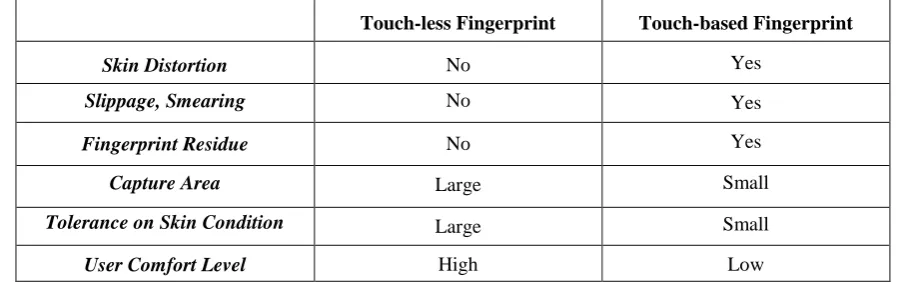
Table 1 shows the comparison of Touch-less and Touch-based fingerprint recognition system. Also, Touch-less fingerprint recognition system can capture fingerprint images consistently because it is not affected by different skin conditions or latent fingerprints. Touch-less sensing scheme can be implemented using a single camera. Touch-less fingerprint recognition system is free from the troubles in terms of maintenance, hygienic, latent fingerprints and so forth [5]. Some taxing problems may occur while developing the touch-less system. These problems are non-uniform lighting, low contrast between the ridge and the valley pattern on fingerprint image, motion blurriness and defocus. Hence Fingerprint image pre-processing step is important to overcome these problems.
Table 1: Touch-less versus Touch-based Fingerprint Recognition
Touch-less Fingerprint Touch-based Fingerprint
Skin Distortion No Yes
Slippage, Smearing No Yes
Fingerprint Residue No Yes
Capture Area Large Small
Tolerance on Skin Condition Large Small
User Comfort Level High Low
IV.SUPPORT VECTOR MACHINE (SVM)
SVM is a binary classifier that makes its decisions by constructing a linear decision margin or hyper-plane that optimally separates two classes [5][6][7]. A separating hyper-plane is a linear function that is capable of separating the training data without error. Assume that the training data consisting of n samples (a1, b1). . . (an, bn), a ∈ℜd, b ∈ +1,−1 can be separated by the hyper-plane decision function,
f(x)= w.a + x0 (1)
Where, w is the weight matrix, a is normal to the plane and x0 is bias term. SVM optimizes above equation (1) under the objective function,
(2) For a given training data set, all possible separating hyper-planes functions can be represented in the form of equation (3)
(w ・ a) + x0 ≥ +1 if bi = +1
(w ・ a) + x0 ≥ −1 if bi = −1, where i = 1…n (3)
To achieve better separatibility between the two classes, proper transformations is required and for this polynomial kernel function or radial basis function kernel is used.
V. GAUSSIAN MIXTURE MODEL (GMM)
The GMM is a soft decision classifier where each class has a Gaussian distribution [7][8]. GMM assumes the parametric form for probability distribution as [8],
( ) ( | , )
K
k k k
p x
N x 2
1
1
arg min
||
||
2
m i i
w
C
ISSN(Online): 2320-9801
ISSN (Print) : 2320-9798
I
nternational
J
ournal of
I
nnovative
R
esearch in
C
omputer
and
C
ommunication
E
ngineering
(An ISO 3297: 2007 Certified Organization)
Vol. 3, Issue 5, May 2015
Copyright to IJIRCCE DOI: 10.15680/ijircce.2015.0305084 4055 Where K is number of mixture models N(x, µ, Σ) represents the p dimension distribution with mean (µk), and
covariance (Σk) defined by
1 1
2
1 1
( | , ) exp{ ( ) ( )}
2
(2 | |)
T
N x x x
(5)
The weighting factor πk is a prior probability of class k with constraints
1
1
K k
k
, πk ≥1 (6)The input vector xi is supposed to be independent. The conditional probability of a given observation vector x belongs
to the components k of the GMM is given by Bayes rule,
1
( | , )
( | )
( | , )
k k k
K
j j j
j N x p k x
N x
(7) By using Expectation maximization (EM) algorithm, parameters π, µ and Σ can be estimated. This finds the parameters of GMM that gives maximum likelihood of observed data X. EM algorithm involves two steps [8]. In the expectation step, the probability that each data object is drawn from each of the k distributions is calculated according to the estimated parameters for k distributions previously (randomly chosen initially). In the maximization step, the probabilities from the expectation step are used to derive new estimates for the parameters of the k distributions such that the value of the log likelihood function is increased. The process continues until the log likelihood function has reached its maximum value.
VI.PROPOSED TOUCH-LESS FINGERPRINT RECOGNITION ALGORITHM
The touch-less fingerprint recognition system can be divided into three main steps. Each block performs a unique function over the input image. The three main steps of Touch less Fingerprint Recognition System are: Pre-processing, Feature Extraction and verification or Matching. We consider minutiae features as the correspondences for initial alignment. It is explained in the rest of the paper. Figure 1 shows the block diagram of proposed Touch-less Fingerprint Recognition System.
ISSN(Online): 2320-9801
ISSN (Print) : 2320-9798
I
nternational
J
ournal of
I
nnovative
R
esearch in
C
omputer
and
C
ommunication
E
ngineering
(An ISO 3297: 2007 Certified Organization)
Vol. 3, Issue 5, May 2015
A. Pre-processing:
In touch-less fingerprint recognition system, acquired fingerprint images may have problems like non uniform lightning, low contrast between ridges and valleys, noise etc. Such problems can be removed by pre-processing and it is an important step for detecting minutiae from the fingerprints. The purpose of fingerprint pre-processing step is to make fingerprint images standard and ready for feature extraction. Pre-processing is an important step prior to feature extraction and verification. Pre-processing is classified into Normalization, Image Segmentation, and Image Enhancement.
1. Normalization:
Normalization is done to reduce the non uniform lighting problem of fingerprint image. Also by altering the dynamic range of pixels intensity values, normalization can be completed [5]. It calculates the mean and variance of an image and thus reduces the difference of the illumination. Normalization is a pixel-wise process and it does not change the clarity of the ridge and valley structures. The normalization of f(x,y) is computed as follows [3] [5]:
( , )
( , )
( , )
( , )
ff
f x y
m x y
n x y
x y
(8)where f (x,y) : Original image
mf(x,y) : An estimation of a mean f (x,y) σf (x,y) : An estimation of the standard deviation
2. Image Segmentation:
Segmentation of fingerprint image is essential so as to reduce the size of the input data, to remove undesired background [9], and to focus on area which is in favor of the central part of the fingerprint. Here color based segmentation technique is used for segmentation. Various color spaces are available to detect the skin color but simplest is RGB. Hence we are using RGB color space for skin segmentation. Skin color based segmentation technique has some advantages over other techniques like color processing is much faster and robust in nature.
RGB is widely used in skin detection literature because of its simplicity [10]. The RGB color model is a preservative color model in which to reproduce a wide array of colors red, green, and blue light are added together in various ways. Here we extract all the three components R, G and B. If the extracted R, G, B values of a pixel satisfied the equation (9), consider it as a skin otherwise non-skin [10].
s = R + G + B;
(R >= G && (G >= (B+4)) && s>=16 && s<=750) (9)
3. Image Enhancement:
Fingerprint image quality is a key factor in the performance of minutiae extraction and matching algorithm. The purpose of an enhancement algorithm is to improve the contrast of the ridge structures in a fingerprint. Consider enhancement of fingerprint image using STFT analysis, as established Fourier analysis is not adequate to analyze the image entirely because of non-stationary nature of image [5] [9]. Here the image is first divided into overlapping windows to preserve the ridge stability and removes ‗block‘ effects common with other block processing image operations [4]. Then the image is assumed stationary inside this small window. The Fourier spectrum in polar form is represented as F( r,ϴ ). After the Fourier spectrum of this small region is analyzed, then Probabilistic estimatation of the ridge orientation, ridge frequency, and energy map are obtained. A probability density function p( r,ϴ )
(10)
Marginal density function p(ϴ) And p( r ) are defined as
| ( , ) |2 2 ,| ( , ) |
r
F r p r
F r
ISSN(Online): 2320-9801
ISSN (Print) : 2320-9798
I
nternational
J
ournal of
I
nnovative
R
esearch in
C
omputer
and
C
ommunication
E
ngineering
(An ISO 3297: 2007 Certified Organization)
Vol. 3, Issue 5, May 2015
Copyright to IJIRCCE DOI: 10.15680/ijircce.2015.0305084 4057 Let orientation ϴ is a random variable that has the probability density function p(ϴ).Then by performing a vector averaging the expected value of the orientation is obtained by using,
(12)
The smoothened image o‘(x,y) is obtained by using vectorial averaging form the resulted orientation image o(x,y).
The expected value of ridge frequency is calculated by using equation (13) where the ridge frequency r is assumed to be a random variable with the probability density function p(r).
(13)
To get finer fingerprint segmentation, energy map is used as a region mask. The region mask is obtained by using Otsu‘s optimal thresholding technique and the energy map is obtained by
(14)
B. Feature Extraction
Most fingerprint recognition methods make the use of minutiae as the fingerprint features [11][12]. Minutiae extraction involves the steps: binarization smoothing, local ridge orientation estimation, thinning and minutiae detection. Most minutiae extraction algorithms work on binary images: the black pixels that represent ridges, and the white pixels that represent valleys. It improves the contrast between the ridges and valleys in a fingerprint image, and therefore facilitates the extraction of minutiae. The orientation field of a fingerprint image defines the local orientation of the ridges enclosed in the fingerprint. For orientation field, we used block size of 7×7. The local orientation at pixel (i, j) can be estimated by computing the gradients ∂x(i, j) and ∂y(i, j) for each pixel in the block, which are the gradient magnitudes in the x and y directions, respectively and gradient operator is estimated as Sobel operator.
For smoothing, Gaussian smoothing is performed by using Gaussian filter of a size 5×5. Width of ridges of Black and white image consists of more than a pixel, this prevents from extracting the minutiae points and thus ridges are to be thinned. Along with thinning, it is necessary to remove H-breaks (unnecessary noise bridges that connect two or more ridges) and spikes (noisy projection out of some ridges) in the image. Minutiae points are exclusive recognition points, which are ridge endings (points where the ridge curve terminates) and bifurcations (a ridge splits from a single path to two paths). Minutiae extraction is done by using a 3×3 sliding window to observe the local region of each ridge pixel in the image. A pixel is considered as a ridge ending if it has single neighbouring ridge pixel in the window, and considered as a bifurcation if it has three neighbouring ridge pixels
VII. RESULTS AND DISCUSSION
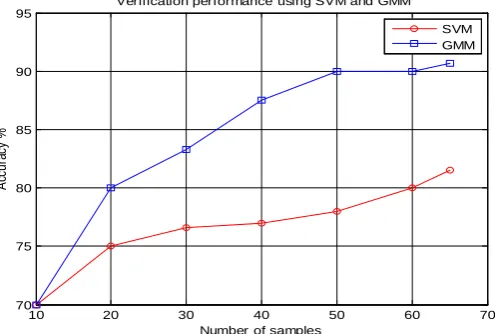
All the finger-print images are captured by using a low cost digital camera with 8 mega-pixels of effective resolutions and focus range is 4cm to 7cm. Experiments are conducted over 110 samples. Each sample is processed with all steps using MATLAB (R2012a) image processing toolbox. Verification accuracy is tested by using SVM and GMM classifier. For SVM, we found 86 samples correctly matched out of 110 while for GMM number of correctly matched finger-print images are 98. Therefore we can say that GMM shows 89.09% accuracy while SVM 78.19% accuracy over a database containing 110 fingerprint samples. The following Table 2 shows the accuracy of both the classifiers at different number of fingerprint sample images.
1 ( ) sin(2 ) 1
( ) tan
2 ( ) cos(2 )
p d
E
p d
( ) ( )
r
E r
p r rdr
2
( , )
log
|
( , |
r
E x y
F r
ISSN(Online): 2320-9801
ISSN (Print) : 2320-9798
I
nternational
J
ournal of
I
nnovative
R
esearch in
C
omputer
and
C
ommunication
E
ngineering
(An ISO 3297: 2007 Certified Organization)
Vol. 3, Issue 5, May 2015
Table 2: Classification performance of SVM and GMM over different number of samples
Number of samples Correctly
matched using SVM
Correctly matched using
GMM
10 8 8
20 17 18
30 25 27
40 32 38
50 40 45
60 48 54
65 53 59
The classification performance of SVM and GMM over different number of samples is represented in the following Figure 2. In this figure, the X-axis represents the number of samples used for each of the experiment and the Y-axis showcases the accuracy found for respective experiments. The accuracy is the number of correctly matched fingerprints samples from the each respective sample database. From the graph, it‘s quite evident that as the number of samples increase, the accuracy for the GMM classifier becomes slightly better as compared to the SVM classifier.
Figure 2: Classification performance using SVM and GMM
VIII. CONCLUSION AND FUTURE WORK
Touch-less fingerprint recognition have been a recent interest of many researchers. A secure digital camera based touch-less finger-print verification system is proposed. In this work, we concentrated on pre-processing; minutiae feature extraction and classification performance using SVM and GMM. Experiments shows that GMM contributes slightly better recognition performance than SVM. All the laptops, ATM centres, mobiles etc devices have a camera. So, one of the main applications which can be implemented in future will be installation of such recognition system in these devices. Accuracy needs to be checked on larger database which is a basic requirement for any fingerprint recognition system.
REFERENCES
1. Jain, A.K.; Ross, A.; Prabhakar, S., "An introduction to biometric recognition," Circuits and Systems for Video Technology, IEEE Transactions
10 20 30 40 50 60 70
70 75 80 85 90 95
Number of samples
A
ccu
ra
cy
%
Verification performance using SVM and GMM
ISSN(Online): 2320-9801
ISSN (Print) : 2320-9798
I
nternational
J
ournal of
I
nnovative
R
esearch in
C
omputer
and
C
ommunication
E
ngineering
(An ISO 3297: 2007 Certified Organization)
Vol. 3, Issue 5, May 2015
Copyright to IJIRCCE DOI: 10.15680/ijircce.2015.0305084 4059
2. Feng Liu; Zhang, D.; Changjiang Song; Guangming Lu, "Touchless Multiview Fingerprint Acquisition and Mosaicking,", Instrumentation and
Measurement, IEEE Transactions on , vol.62, no.9, pp.2492,2502, Sept. 2013
3. Hiew, B.Y.; Teoh, A.B.J.; Ngo, D.C.L., "Automatic Digital Camera Based Fingerprint Image Preprocessing," Computer Graphics, Imaging and
Visualisation, 2006 International Conference on , vol., no., pp.182,189, 26-28 July 2006
4. Shweta Warade, Rajesh Patil, ―Review of Touch-Less Fingerprint Recognition Technologies‖, International Journal of Science and Research
(IJSR), Volume 4 Issue 3,page no 2360-2363, March 2015.
5. Prabhjot Kaur,Ankit Jain,Sonia Mittal,"Touch-less Fingerprint Analysis — A Review and Comparison", IJISA, vol.4, no.6, pp.46-52, 2012.
6. B.Y. Hiew, Andrew B.J. Teoh and Y.H. Pang, ―Touch-less fingerprint recognition system‖, 2007.
7. Rafik Djemili, Hocine Bourouba, ―A Combination Approach of Gaussian Mixture Models and Support Vector Machines for Speaker
Identification‖, The International Arab Journal of Information Technology, Vol. 6, No. 5, page no.490-497 November 2009.
8. Christopher M. Bishop, ―Pattern Recognition and Machine Learning‖.
9. B.Y. Hiew, Andrew B.J. Teoh, and David C.L. Ngo, ―Preprocessing of Fingerprint Images Captured with a Digital Camera", 9th International
Conference on Control, Automation, Robotics and Vision (ICARCV 2006), Singapore, 2006.
10. Sneha Gautam, ― People counting in a group photograph using skin segmentation and morphological operation‖, International Journal of Image
Processing and Visual Communication, Volume 3 , Issue 2 , October 2014.
11. Ravi, H.; Sivanath, S.K., "A novel method for touch-less finger print authentication," Technologies for Homeland Security (HST), 2013 IEEE
International Conference on, vol., no., pp.147,153, 12-14 Nov. 2013.
12. Jainam Shah, Ujash Poshiya, ―TOUCHLESS FINGERPRINT RECOGNIZATION‖, Asian Journal Of Computer Science And Information
Technology 3 : 5 (2013) 73 – 76. 13.
BIOGRAPHY
Shweta Warade is a M.Tech. student of Electrical Department, VJTI, Mumbai, India. She received Bachelor of
Electronics and Telecommunication Engineering degree in 2012 from Nagpur University (RTMNU), India. Her research interests are Image processing, Biometrics etc.
Rajesh Patil is a Professor of Electrical Department, VJTI, Mumbai, India. His research interests are Signal