Modelling of attitude error in vector magnetic data: application to Ørsted data
R. Holme
GeoForschungsZentrum Potsdam, Telegrafenberg, D-14473 Potsdam, Germany
(Received March 3, 2000; Revised July 14, 2000; Accepted July 17, 2000)
Analysis of data from the Ørsted satellite indicates that the largest source of error arises from an anisotropic attitude uncertainty, related to poorly determined rotation about the axis of the star imager. For two data sets from May and December 1999, I quantify this error, and review and apply a formalism designed to allow for this problem. I argue that, when modelled correctly, this attitude uncertainty should not significantly damage the main field models obtained from Ørsted data.
1.
Introduction
In modelling of the geomagnetic field, it is customary to treat the errors on the data as uncorrelated, although this is generally far from the case. The full treatment of error correlations requires the inversion of a data by data matrix, which is impractical given the quantity of data required for high quality field modelling (although see Rygaard-Hjalsted
et al.(1997) for the application of sparse matrix techniques towards this goal). However, one form of error correlation can be treated easily: when different components of the field measured at the same place and time are correlated. Such local correlation can be allowed for easily at no additional numerical cost, and it has been shown that so doing can lead to significant improvements in field modelling. Two cases have been considered in detail thus far: anisotropy in the crustal field error for main field modelling (Holme and Jackson, 1997), and the effect of attitude uncertainty in spacecraft magnetometry (Holme and Bloxham, 1995, 1996).
The consideration of these methods has received new ur-gency from study of data from the Danish magnetic satellite Ørsted. This satellite was launched on February 23rd, 1999, and has returned much high quality data. More details of the mission and the field models which have been produced from the data can be found elsewhere in this issue. How-ever, one aspect of the data still requires detailed attention. Ørsted carries only one star camera, which provides highly accurate pointing information but lower resolution in its ro-tational direction. Preflight estimates of the uncertainties suggested that this effect would not be important (see, for example, Holme and Bloxham, 1996), but here, for two data sets from May and December 1999, I estimate the rotational error to be of order 60 , by far the largest contributor to the vector data error budget. It is clear that to avoid degrading the field models and subsequent science derived from Ørsted data, this effect must be accounted for properly.
As such, it is timely to reconsider the modelling of attitude error. I first summarise the basic field modelling framework,
Copy right cThe Society of Geomagnetism and Earth, Planetary and Space Sciences (SGEPSS); The Seismological Society of Japan; The Volcanological Society of Japan; The Geodetic Society of Japan; The Japanese Society for Planetary Sciences.
and the formalism for modelling the attitude error. This ma-terial has appeared previously; however, it is hoped that a more developed understanding of the problem will make this new presentation useful. I follow this with results from sim-ulations that quantify the degradation of field models from attitude error. The method is then applied to the two Ørsted datasets, and the magnitude of the attitude error estimated. To aid other workers in assessing the usefulness and impor-tance of the method, I use simulations to estimate the model contamination caused by ignoring the error correlations. I conclude that correct modelling of attitude error in Ørsted data is important, and provide a recommendation for future mission management to minimise its effects.
2.
Determining a Field Model
In a current-free region, the magnetic field can be ex-pressed as B = −∇, where the scalar potential satis-fies∇2=0. In spherical coordinates, the potential can be represented by a spherical harmonic expansion of the form
=a
∞
l=1 a
r
l+1l
m=0
Plm(cosθ)
·glmcos(mφ)+hml sin(mφ)
+a ∞
l=1 r
a
ll
m=0
Plm(cosθ)
·qlmcos(mφ)+slmsin(mφ) (1)
whereais the radius of the Earth, and(r, θ, φ)is a geocen-tric spherical coordinate system. Plm(cosθ) are Legendre polynomials, by convention Schmidt normalised, so that
2π
φ=0
π
θ=0
Plm(cosθ)cosmφ2sinθdθdφ= 4π
2l+1. (2)
Measurements of the magnetic field are used to estimate the so-called Gauss coefficients ({gm
l ,h m
l }for internal sources, and{qm
l ,s m
l }for external sources), which then uniquely de-fine the geomagnetic field outside the source regions. After truncating the series in Eq. (1), the Gauss coefficients are
tained by a least-squaresfit to the available data, minimising
eTCe−1e, (3)
whereCeis the data error covariance matrix, with elements
(Ce)i j=cov(ei,ej), (4)
and the error vectoreis given by
e=γγγγγγγγ−Am, (5)
whereAis an operator calculated from Eq. (1) relating the data vectorγγγγγγγγto the model vectorm. For the linear problem (see, e.g., Gubbins and Bloxham, 1985, for the extension to nonlinear modelling) the maximum likelihood solutionmˆ is obtained by solving the equation
(ATCe−1A)mˆ =ATCe−1γγγγγγγγ. (6)
Thefield modelling process is inherentlynon-unique; there are an infinite number of parameters {gm
l ,h m l ,q
m l ,s
m l } to fit an unavoidably finite number of data. This problem is best dealt with by regularisation or damping (Whaler and Gubbins, 1981; Shureet al., 1982; Gubbins and Bloxham, 1985), but here I adopt the simpler approach (reasonable when the data distribution is fairly even) of truncating the spherical harmonic series. I truncate at degreelmax =13 for internal sources, and degree 1 for external sources. Field models from Magsat data (for example, that of Cainet al., 1989) suggest that atØrsted altitude the rms magnitude of higher degree internalfield components (of crustal origin) will be of order only 2 nT, while previous models have sug-gested that for near-Earth data, higher-degree external terms are not significant (e.g., Langel and Estes, 1985).
3.
Theory
Modelling of attitude error requires construction of the cor-rect covariance matrixCe. Neglecting correlations between measurement points, consider the covariance of a particular orthogonal data triple. Uncertainty in the orientation of the measured reference frame (varianceψ2) introduces errors in
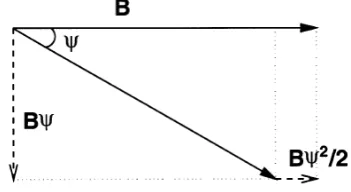
vector components of the magneticfieldB, but not its mag-nitude. Tofirst order, the error is purely perpendicular to the field, as sketched in Fig. 1. Ifσ2is the instrument variance
for each orthogonal component, andIthe 3×3 identity, the data error covariance matrix for a vector triple of magnetic field components is, as given by Holme and Bloxham (1995) (henceforth Paper 1)
C=σ2I+ψ2B2I−BBT (7)
(Valid for sinψ ≈ ψ, σ Bψ2 (Holme and Bloxham,
1996, henceforth, Paper 2)). This matrix is most easily applied by writing it in terms of vector outer products or dyadics:
C=σ2BB
T
B2 +(σ
2+B2ψ2)(nˆ∧B)(nˆ∧B)
T
(nˆ∧B)2
+(σ2+B2ψ2)(B∧(nˆ∧B))(B∧(nˆ∧B)) T
(B∧(nˆ∧B))2 (8)
Fig. 1. The directional dependence of orientation error.
wherenˆis an arbitrary unit vector not parallel toB. Although this representation may be unfamiliar, it is identical to the standard diagonalisation of a matrix by determination of its eigenvalues and eigenvectors, the latter being the unit vectors in the dyadics.
In Paper 2, this formalism was extended to cover the case ofØrsted, where the attitude uncertainty itself is anisotropic. It is assumed that this takes the form of a small angular uncertaintyψ in rotation perpendicular to the camera bore sight (the pointing angle), and a larger rotational uncertainty χabout the bore sight. The covariance matrix is now
C=σ2BB
T
B2
+(σ2+(nˆ∧B)2χ2+(nˆ.B)2ψ2)(nˆ∧B)(nˆ∧B) T
(nˆ∧B)2
+(σ2+B2ψ2)(B∧(nˆ∧B))(B∧(nˆ∧B))T
(B∧(nˆ∧B))2 (9)
wherenˆis no longer arbitrary, but is a unit vector in the di-rection of the star camera bore sight (assumed not parallel to
B). Note that to calculateC, only the star camera direction and the measured magneticfield are required—no additional details of the spacecraft trajectory or motion are necessary. If the star camera axis was aligned with the field, and the appropriate limits were taken to obtain the unit vectors, un-certainty about this axis would have nofirst order effect on thefield measurement. If thefield is perpendicular to the star camera (so that(nˆ∧B)2=B2andnˆ.B=0), then the error
is maximised, although note that it acts only inoneof the error eigendirections, so even in this case the expected error is less severe than if this large attitude error were isotropic. To emphasise this point, assume that only the rotational er-ror is significant, so thatψ=0. In this case, the covariance matrix can be written in a particularly simple form
C=σ2I+χ2(nˆ∧B)(nˆ∧B)T. (10)
However, to obtain the matrix inverse, required infield mod-elling (Eq. (6)), it is easiest to return to the dyadic form. Because the dyadics are orthogonal and normalised to unit length, the inverse of the covariance matrix (9) is particularly simply expressed as
C−1 = 1
σ2
BBT
B2 +
1
(σ2+(nˆ∧B)2χ2+(nˆ.B)2ψ2)
·(nˆ∧B)(nˆ∧B)T
+
(σ2+B2ψ2)
·(B∧(nˆ(∧B))(B∧(nˆ∧B))T
B∧(nˆ∧B))2 . (11)
This expression provides the inverse data covariance matrix for a triple of vector data. The full data covariance matrix (Eq. (4)) will be block diagonal, with 3x3 blocks as calculated from Eq. (11).
It is possible to extend this formalism further in several ways. While not relevelent for the current application, for completeness I discuss two such extensions in appendices; in Appendix A, the simultaneous consideration of vector and scalar data, and in Appendix B the use of directional infor-mation only from three component data.
4.
How Damaging is Orientation Uncertainty?
Papers 1 and 2, and the specific data analysis later in this paper, concentrate on the expected improvement in the mag-neticfield model to be achieved by the correct treatment of attitude error. However, it is also important to quantify the significance of attitude error when correctly treated. I inves-tigate this by means of numerical simulation. I construct a network of data points with approximately equal area distri-bution, and with altitude of 400±50 km (so as to mimic a Magsat-like satellite). On these points I calculate values of the vectorfield from a definedfield model, and add indepen-dent Gaussian errors, both isotropicσ and in attitudeψ. I then invert these simulated data for a magneticfield model. The quality of the model is defined by the deviation from the original model at the Earth’s surface; as shown by Lowes (1966) amongst others a convenient measure of this is given by the integrated mean squarefield deviation at the Earth’s surface1
4πa2 B−B
02d
=
lmax
l=1
(l+1) l
m=0
(glm−glm0)2+(hml −hml 0)2
(12)
where the superscript 0 denotes the original model. The ab-solute value of this quantity is not especially meaningful; it will depend on the number of data points, the degree of truncation and other simulation details. However, the rela-tive error between simulations is a useful measure of model quality, and turns out to be broadly independent of simula-tion details. (A clear demonstrasimula-tion of this can be seen in the related study of the influence of crustalfield error in main field modelling in Holme and Jackson (1997) (subsequently Paper 3); for this case analytic expressions for the misfit have been derived by Dr. Frank Lowes.)
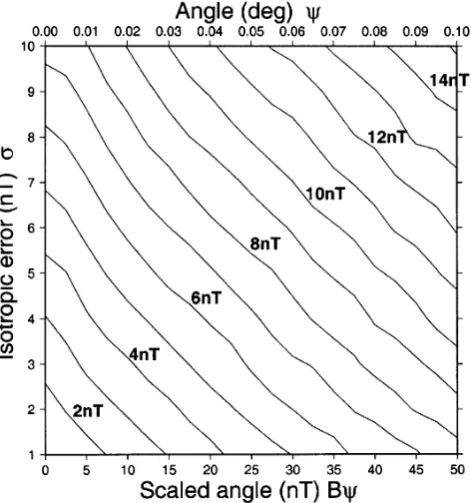
A set of such simulations is performed for a range of values ofσ andψ, assuming the simplest case of isotropic attitude error, modelled by data covariance matrix (8). The results are averaged over 100 simulations, and the rms vector mis-fit plotted in Fig. 2. This figure suggests an approximate empirical linear relationship:
Misfit= A(σ+0.2Bψ) (13)
whereAis a constant depending on simulation details (num-ber of data, harmonic truncation, etc.). Bψis generally taken
Fig. 2. Contour plot (in nT) of rms deviation of the vectorfield from the input model, averaged over the Earth’s surface (Eq. (12)), for a range of applied data errors. Averages of 100 simulations with 2070 data triples grouped around 400 km (satellite altitude), least squaresfit, truncation at degree 14. Scaled angle error calculated assuming a conservative value of satellite altitudeB=29000 nT. Exact misfit values depend on simulation details and so are not meaningful; relative values are robust.
as the estimate of the magnitude offield error; however, with this estimate these simulations show that correctly treated attitude error is only 20% as damaging as isotropic instru-ment error of the same magnitude. Further, forØrsted, the damage from poorly determined attitude will be even less, as only one of the eigenvectors of the covariance matrix, rather than two as here, is badly affected (see Eq. (9)). However, as shown in Papers 1 and 2, should the error be modelled incorrectly as isotropic, much larger errors will result (see in particularfigure 3, Paper 1).
5.
Data
Fig. 3. Data distribution. (a) May—946 vector data triples (circles), 392 total-intensity data (crosses). (b) December—1169 vector data triples, 547 total-intensity data.
Table 1. RMS misfits (in nT) forfield models to the data, calculated assuming (i) isotropic errors (σ=3 nT), and (ii) an additional angular uncertainty in the SIM rotation ofχ=60 .eFis for the high latitude total intensity data.(eX,eY,eZ)are the misfits in the Earth-centred spherical coordinate system. (eB,e⊥,e3)are respectively the misfits in the mainfield direction, the direction perpendicular to both the mainfield and the star camera axis, and the
third orthogonal direction.
eF eX eY eZ eB e⊥ e3
(i) Isotropic (a) May 3.11 5.82 5.60 5.19 2.83 8.49 3.47
modelling (b) December 3.53 5.39 5.61 4.79 2.64 8.10 3.28
(ii) Anisotropic (a) May 2.87 5.90 5.73 5.63 2.24 9.17 3.18
modelling (b) December 3.39 5.50 5.70 5.11 2.00 8.68 3.10
has been lost. Were the purpose of this work to produce an accurate model of the geomagneticfield, such gaps would be unacceptable; however, within the framework of this study, it was decided to restrict the data to the one (vector) instrument alone. At high latitudes (>50◦) only intensity measurements (F) (calculated from the vector data) were used, to limit pos-sible contamination by field aligned currents, and also to mimic standardfield modelling treatments as closely as pos-sible. Outliers were removed during the modelling process, resulting in the elimination of some high latitude intensity data, and, for the May data, 10 vector data with extremely large attitude error (probably arising from periods when the star imager (SIM) was not fully functional). The resulting data distributions are shown in Fig. 3.
The modelling technique used is extremely (possibly overly) simple, since the externalfields are not parameterised with a Dst dependence (Langelet al., 1996; Olsen et al., 2000), and secular variation over the period of each data set is ignored. The major complication is that the data must be transformed from spacecraft coordinates. The angular transformation between the SIM and CSC is solved for si-multaneously with the calculation of a main field model, using transformation programs developed by Dr. Karlheinz Goedderz (GFZ CHAMP team) (see also Olsenet al., 2000). Fortunately, the determination of these angles turns out to be essentially independent of the treatment of attitude error.
I begin by modelling the vector data errors isotropically, and with vector and scalar data weighted equally (σ =3 nT). Thefits of the models to the data are listed in Table 1(i). The results for the two data sets are remarkably similar.
In the standard Earth centred spherical coordinate system, where(X,Y,Z)are North, East, and Down, the misfit to the
data is of order 5–6 nT for each component. However, as-suming that the predicted attitude error is indeed the major cause of error, it is instructive to examine the misfit to the data in the natural coordinate system. The three axes are given by the vectors forming the dyadics of the covariance matrix in Eq. (9), namely the direction of thefield (denotedB), the di-rection perpendicular to both thefield and the SIM boresight (denoted⊥), and the third direction making up the orthogo-nal set (denoted 3). This reference frame obviously depends on both the direction of thefield and the direction of the SIM, and so is newly defined for each data point. The much larger error in the perpendicular direction is obvious. This error, in combination with thefield geometry and star camera direc-tion, also explains the lower value of eZ relative toeX and
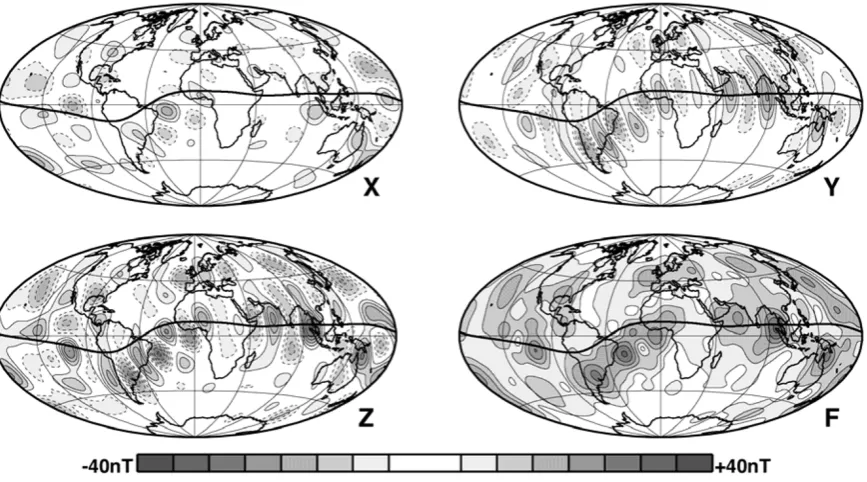
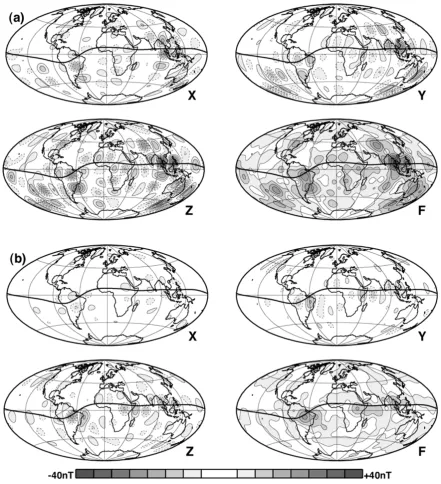
Fig. 4. Plot of differences in the three magnetic components between the two models at the Earth’s surface. Dotted contours denote negative values. The solid line marks the dip equator. TheFplot is the rms total vector error, not the difference between total intensities.
datafield magnitude (2.24 nT in May, and 2.00 nT in De-cember) are particularly good. The rms vector difference between the two models at the Earth’s surface is 10.7 nT, and it peaks at over 30 nT. Differences of this magnitude are very important; for example, they are comparable in magnitude to large crustal anomalies.
In Fig. 4, I plot the difference in thefield models for May of Tables 1(ia) and (iia). The X, Y, and Z plots are the differences in these components, and F the rms value of these three components (not the difference in the value of the total intensity between the two models). The pattern of the difference arises from several effects. First, there are large differences in areas with data gaps (for example, the South Atlantic anomaly), where thefield model is controlled by thefit to data around the edges of the gaps. Second, the largest changes are close to the magnetic equator. As the star camera lies in the plane perpendicular to the orbit, and thefield is (by definition) horizontal, the large attitude error direction is approximately vertical. This gives rise to a weak form of the Backus effect or perpendicular error effect (Stern and Bredekamp, 1975; Lowes 1975), which is well known to be most significant near the magnetic equator. Third, other strong differences (in the South Pacific and the South East United States) are in regions where the magnitude ofnˆ ∧ B is particularly large, and so the effects of attitude error particularly significant.
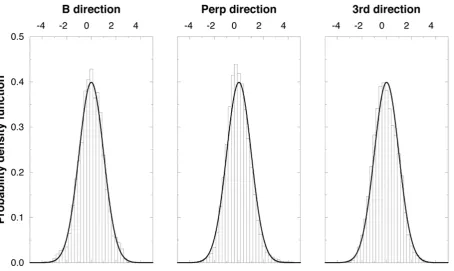
Is the predicted error of 60 consistent with the data resid-uals? To address this question I examine the statistics of the data misfit in the three orthogonal directions(B,⊥,3). If the various errors are assumed of known distribution (most simply, normally distributed), then estimates ofσ, χ, ψcan be obtained from the data residuals by the solution of the appropriate maximum likelihood problem; this procedure is described in Appendix C. For greater accuracy, all available data, not just the decimated data, were used (although the
Table 2. Estimates for isotropic and attitude standard deviation from max-imum likelihood analysis for full 1.13 s data.
# data σ χ ψ
May 36942 2.2 nT 75 17
December 49082 1.9 nT 75 18
decimated data give very similar results). The results are presented in Table 2. The differentσ values between May and December probably reflect different levels of magnetic activity (noise from externalfields) during the two periods, but the angular parameters remarkably consistent, if slightly larger than expected. This may be due to non-normality of the errors; in particular, it is not clear that the uncertainty in the star camera angles will necessarily be normally dis-tributed, and longer-tailed distributions would increase the variance estimates. In Fig. 5 I plot the distributions of the weighted residuals against a normal curve for comparison. The general shape of the histograms is correct, although the high peaks in the eB ande⊥ directions suggest long tails to the distribution, resulting in an increased estimate of the variances.
Fig. 5. Histograms of the normalised data misfits for the December data in the three perpendicular directions, with each residual normalised to unit variance with the parameter values given in Table 2. The continuous curves are predictions assuming a normal distribution.
Table 3. Results for simulations of attitude errors. Values listed are rms differences between the true model, and the estimate derived from modelling noisy synthetic data. Averages of 1000 simulations for the data distribution of the May data set. Misfits are rms misfit to the input model at the Earth’s surface (Eq. (12)). The percentage quantity in brackets is the worsening of the solution over the optimal arising from incorrect treatment of attitude error.
Input errors Assumed modelling error
σ χ 0 30 60
2 nT 60 8.04 nT (64%) 5.25 nT (7%) 4.91 nT
2 nT 30 5.32 nT (16%) 4.58 nT 4.74 nT (3%)
2 nT 0 4.03 nT 4.33 nT (7%) 4.69 nT (16%)
5 nT 60 12.23 nT (10%) 11.48 nT (3%) 11.16 nT
5 nT 30 10.67 nT (1%) 10.53 nT 10.73 nT (2%)
5 nT 0 10.10 nT 10.20 nT (1%) 10.59 nT (5%)
The misfit in theBˆ direction (eB) is surprisingly small, and approaches the expected contribution from the crustal field (degrees 14 and higher) of around 2 nT. With better modelling of external and ionosphericfields, it may become important to consider error anisotropy arising from crustal contamination. This is outlined briefly in Appendix D.
6.
Simulations
In the previous section, I have shown that modelling for attitude error inØrsted data produces a large (over 30 nT for this example) change in thefield model. However, this does not prove that the change is an improvement. To investigate this, I use simulations to examine the penalty resulting from modelling the data incorrectly. I take the identical data dis-tribution (in scalar and vector data) from the real May dataset described above, and using the model determined from those data, calculate synthetic data, as in Section 4 adding both isotropic and attitude Gaussian errors. I consider an isotropic
error σ of 2 nT or 5 nT (covering the optimistic and pes-simistic ends of what could be achievable withØrsted data) and attitude errors ofχ =0 , 30 , and 60 . For simplicity, ψis set to 0. A model is thenfit to the data assuming attitude errors of 0 , 30 , and 60 . I average the results of 1000 sim-ulations, and present the results in Table 3, giving again the rms misfit to the inputfield model at the Earth’s surface. As usual, the absolute values depend on the simulation details, but relative values should be robust. An incorrect estimate of the attitude error increases model misfit. For ease of com-parison I include the percentage increase of the misfit from the correct (self-consistent) modelling.
Fig. 6. Error distribution for synthetics, input uncertaintiesσ=2 nT,χ=60 . (a) Errors modelled isotropically. (b) Errors modelled correctly. Dashed contours denote negative values.
It is also interesting to examine the spatial distribution of the errors, particularly in comparison with model differences between different error treatments for the real data, plotted in Fig. 4. The error details differ considerably from simulation to simulation, but for an impression of the pattern, I select a characteristic simulation (σ =2 nT,χ =60 ) with errors similar to the mean values. The error distributions for these simulations are plotted in Fig. 6, in (a) with an incorrect (isotropic) error treatment, and in (b) with error covariance correctly modelled. The improvement in model from using a correct error model needs no further emphasis. As with the real data (Fig. 4), the largest model differences are in data gaps, and near the dip equator. However, this error pattern is less clear in the simulation than with the real data. This
is probably due to error correlations between locations for the real data (correlated external noise, crustal effects, and especially correlated attitude error).
isotropic error only usingZ data rather than all three com-ponents).
7.
Conclusions
By now, it should be obvious that I recommend modelling of the attitude error inØrsted data to allow the extraction of the maximum amount of information from the data. Such modelling is particularly important for the data sets consid-ered here, but will also apply even if in future the attitude error can be reduced. If the reader doubts this, consider the alternative. It is customary to regard data with large misfit to the model as outliers, and remove them from the modelling process. However, if the error is not modelled, how is this to be achieved? If attitude error is the cause, and (say) theY -component is compromised, should theXandZcomponents be trusted? As should hopefully be clear from the formalism, and is discussed in Paper 2, the implementation of the method is straightforward. The only information required in addi-tion to the magneticfield components is the direction of the star camera. Should this for some reason be lacking, I would recommend modelling evenØrsted data as having isotropic attitude error (Eq. (8)). The loss of information from the 3rd direction is more than compensated for by the removal of the biasingnˆ ∧Bdirection, and as noted in Section 5, there is evidence of some attitude error, or attitude-likefield-aligned current error, in the 3rd direction. As more data become available, it could prove fruitful to model this error as well; indeed, parameterising forfield-aligned currents using this formalism was previously suggested in Paper 2. However, the anisotropy due to this direction is smaller than the rota-tional direction, and so the effect on thefield model is much smaller.
Why shouldχ be so large? At time of writing, this has not been explained. Pre-flight tests of the SIM suggested a much smaller value; uncertainties of 2–3 in the pointing direction, and 10–18 in rotation, and it appears to be per-forming according to these specifications (J. L. Jørgensen, pers. comm.). One possibility would be a small error in the timing calibration between the SIM and CSC, although this will not account for the whole effect. The error is certainly not completely random; there is evidence of correlation in the error between successive orbits (Nils Olsen, pers. comm.), and a plot ofe⊥ shows significant power over a period of about 8 minutes; interestingly, this is the approximate time for a star to cross thefield of view of the camera.
I have presented a statistical method to deal with the at-titude uncertainty arising from the anisotropy of theØrsted star camera, so as to produce the minimum contamination in mainfield modelling. However, ideally it would be best to eliminate or reduce the uncertainty, rather than have to model it. Efforts are continuing to characterise, explain and eliminate this error at source, and attempts are being made to smooth the attitude data, although its anisotropy and corre-lated nature make this difficult. These issues are beyond the scope of the current paper. However, a third issue is related to this study, so I mention it here. As noted in the theory section, the effect of the attitude error is highly dependent on the angle between the magneticfield and the SIM. If the SIM axis is aligned with thefield, the large attitude uncertainty does not affect the measurements. Currently, the satellite is
positioned in its orbit such that the star camera points approx-imately perpendicular to the orbital plane. This has many operational advantages; for example, it limits the chance of the star camera being blinded by the sun when the satellite is in a noon-midnight orbit. As the magnetic field broadly speaking lies in or close to the orbital plane, the effect of the attitude error is maximised. However, it is planned for operational reasons to rotate the satellite at some point. If this was done so that the SIM axis lay in the plane of the orbit, the effects of uncertainty in the attitude error would be significantly reduced (by reducing the average of|ˆn∧B|
over the orbit). This might be particularly useful when the satellite orbit is close to the dawn-dusk meridian (probably at any local time between 3 o’clock and 9 o’clock), when the risk of pointing the star camera towards the sun will be reduced.
Acknowledgments. The basic formalism reviewed here was de-veloped in collaboration with Jeremy Bloxham and Andy Jackson. Frank Lowes has been especially helpful in forcing me to think in more detail about the problem; he also pointed out that maximum likelihood was the appropriate way to estimate the parameter vari-ances. I was supported for part of this work by a NERC postdoctoral fellowship held at the University of Edinburgh.
This work would naturally have been impossible without the Ørsted project. Nils Olsen has been extremely helpful in providing data, and in answering questions. I am grateful for the support of the Ørsted Project Office and theØrsted Science Data Centre at the Danish Meteorological Institute. TheØrsted Project is funded by the Danish Ministry of Transport, Ministry of Research and Information Technology, and Ministry of Trade and Industry. Ad-ditional support was provided by National Aeronautics and Space Administration (NASA), European Space Agency (ESA), Centre Nationale d’Etudes Spatiales (CNES), and Deutsche Agentur f¨ur Raumfahrtangelegenheiten (DARA).
Appendix A. Combined Treatment of Vector and
Scalar Satellite Magnetic Data
Magsat carried both a vector and scalar magnetometer (Langelet al., 1982). When operating correctly, the scalar instrument was twice as accurate as the vector instrument. Modelling of Magsat data has used either vector or scalar data, but not both at the same time and place. However, Lowes and Martin (1987) suggested modelling thefield us-ing both vector and scalar data, combinus-ing the advantages of the two data sets (accurate scalar intensity from the scalar instrument, plus directional information from the vector in-strument). They argued that because the vector uncertainties were dominated by attitude uncertainty, error correlations between the scalar and vector data could be neglected. How-ever, with correctly modelled attitude error, correlations will be significant. Here, we describe how to combine the two data sets correctly.Following Magsat rather thanØrsted, the orientation of the spacecraft is assumed equally well known in all directions, so the appropriate covariance matrix for the vector data is given by Eq. (8). It follows that in the reference frame defined by thefield, the three“field components”(thefield strength and the two null directions1) are independent. Hence, assuming
that the sampling times of the two data sets are the same, the
1This can be thought of in terms of modelling the data by its magnitude and
Fig. 7. Simulation of effect of combining vector and scalar data. Each data point is an average of 100 simulations. Scalar data accuracy 2 nT, vector data as given by axis, attitude by symbol type.
measurement of total intensity from the vector instrument can simply be replaced by a best estimate combined from the vector and scalar data. If the two measurements are un-correlated (errors in the data are dominated by instrumental noise rather than externalfields or unmodelled crustalfield, for example), this best estimate of thefield is one with direc-tion measured by the vector instrument, but with amplitude
F calculated from a suitably weighted combination of the vector and scalar measurements:
B = F
|B|B; F =
σ2
sB2+σv2Bs2 σ2
s +σv2
; σ2
F = σ2
sσv2 σ2
s +σv2 (A.1)
whereB is the newfield vector,Bthe vector measurement,
Bsthe scalar measurement, andσs2andσ
2
v are the
measure-ment uncertainties of the scalar and vector measuremeasure-ments respectively. The covariance matrix is then
C=σF2BB
T
B2 +(σ 2
v +B2ψ2)(ˆ
n∧B)(nˆ∧B)T
(nˆ∧B)2
+(σ2
v +B2ψ2)(
B∧(nˆ∧B))(B∧(nˆ∧B))T
(B∧(nˆ∧B))2 . (A.2)
Ifσs < σv(for Magsat,σv≈2σs), a significant improvement in model quality could be expected from using this form of the data and covariance matrix. Note also that the scalar (intensity) data are incorporated while keeping the modelling linear. This consideration is not important for main field modelling, where with modern computing the solution for, e.g.,lmax =13 is very rapid. However, with much higher truncation levels (such as the degree 63 model of Cainet al.(1989)) to include crustalfields, a linear problem with a unique solution which can be determined without iteration is still very valuable.
To confirm that the formalism works, I consider some sim-ulations, similar to those described above in Section 4, but with added scalar data at each point. Data are synthesised with scalar data errorσ =2 nT, isotropic attitude error of either ψ = 0.005◦ or ψ = 0.05◦, and vector data errors σv from 3 nT to 9 nT. In each case, three simulations are
considered, thefirst with vector data only, the second with vector data and scalar data at each point (considered inde-pendent), and third with the data combined as described in this section. The resulting errors are plotted in Fig. 7. As earlier, the absolute values of the misfits are not meaningful, only the ratio of misfits between the different curves. In both cases the addition of scalar data significantly improves the model, and there is little difference between considering the scalar data separately or with the new formalism (the small difference probably arises from the fact that the errors in the new formalism are no longer exactly Gaussian). It might seem that scalar and vector data can be considered together, as advocated by Lowes and Martin (1987), but this ideal case includes no correlations between the two instruments. In practice, noise sources (for example, externalfields) are likely to be correlated, and this can be treated much more simply in the new formalism (essentially by just increasing the variance estimate) than by formally considering the cor-relation between separate scalar and vector data.
How-ever, that drift was slow, and is calculated from many vector and scalar data. Thus, the resulting correlation between in-dividual data from the two data sets should be negligible. However, if correlation is a worry, or the noise in the vector measurements is much larger than that in the scalar measure-ments, it may be better just to adopt the scalar measurement
BsforF along with its associated standard deviationσs. This problem is not purely of historical interest. The Cassini mission to Saturn will provide similar data: at clos-est approach, the proton magnetometer is to be switched to scalar mode, but less accurate vector measurements will be provided by thefluxgate magnetometer (Dunlopet al., 1999). The production of the best possible models of the Saturnian field will require correct treatment of these data.
Appendix B. Using Only Directional Information
from Three Component Data
It is well known that field modelling using total inten-sity data only is compromised by the perpendicular error or Backus effect (Stern and Bredekamp, 1975; Lowes, 1975). When vector data are not available (for example, due to a satellite carrying only a scalar magnetometer, or because of gaps in attitude information as found for Ørsted over the South Atlantic anomaly), it is common to try to replace these data, for example either by using data from other epochs forward or backward continued with a model of secular vari-ation, or by construction of synthetic data (see, for example, Macmillan and Quinn, 2000). However, such “data” are obviously less reliable than real data. Only the vector infor-mation is required; the scalar intensity of the data should not be considered as an alternative to real measured scalar inten-sity. This could be accomplished by using declination and inclination values. A simple alternative (which also keeps the modelling problem linear) is to downweight the field magnitude information of the synthetic data. For simplic-ity assuming isotropic attitude error (Eq. (7)), this can be achieved with the covariance matrix
C=σ2I+ψ2B2I−BBT+ the modelled variance of the synthetic data in the direction of the mainfield is enormous, and therefore that this information does not influence the model. In my preferred dyadic form, this matrix is written
Appendix C. Maximum Likelihood Estimation of
Variances
We wish to estimate from the data residuals the three pa-rametersσ, ψ, χas defined in the covariance matrix (9). The errors are supposed uncorrelated and normally distributed, so that
First, consider only thee⊥ ≡ X direction. The probability that a particular misfitXi lies in the range XtoX+X is given by the appropriate normal probability density function
exp−X2/(2(σ2+χ2B2
The likelihood function that a particular set ofnobservations
{Xi}arises from such a distribution with definedσ, ψ, χ is
Given a particular data set, the maximum likelihood esti-mates ofσ, ψ, χare those which maximise this function, or equivalently minimise the function
showing that the maximum likelihood estimate gives the mean value of the weighted variance as unity, as required. This expression can also easily be seen to be consistent with various limiting cases; for example, ifχ=ψ=0, then
σ2=
n
i=1
X2in (C.10)
the standard expression for the sample variance.
Solution of the equation system ((C.6)–(C.8)) is not pos-sible in closed form; in practice it is easiest to seek estimates of σ, ψ, χ by direct numerical minimisation of Eq. (C.5). Because the“data”are inherently noisy (by definition, the signal to noise ratio of one datum is unity) all three error directions are used to obtain the parameters. Thus, writing
Y ≡e3andZ ≡eB, the generalisation of Eq. (C.5) which is minimised in this paper to estimate the parameters is
f(σ, χ, ψ)=
As discussed in Paper 3 and a number of other references, unmodelled crustalfield creates an anisotropic contribution to thefield error; the error in the vertical direction is√2× that in either horizontal direction. For high-degree models, when the crustalfield is included, this effect can be ignored, as externalfields will provide the largest source of error in the measurement. For lower-degree truncated models, however, even atØrsted altitude, crustal error may be important. Then, for no attitude error, the covariance matrix would be
ˆ
xxˆTσ2+ ˆyyˆTσ2+ ˆzˆzT2σ2 (D.1)
where(xˆ,yˆ,zˆ)are the unit vectors in the North, East, and Down directions. In Paper 3, it was demonstrated that a 5% degradation offield model quality would be likely if this error was not properly accounted for. In combination with attitude error forØrsted, the correct covariance matrix becomes
C=σ2BB
It is possible to calculate an analytic inverse for this matrix, but it is very messy, and a numerical calculation is almost certainly more useful.
References
Cain, J. C., Z. Wang, C. Kluth, and D. R. Schmitz, Derivation of a geomag-netic model ton=63,Geophys. J.,97, 431–441, 1989.
Dunlop, M. W., M. K. Dougherty, S. Kellock, and D. J. Southwood, Opera-tion of the dual magnetometer on Cassini: science performance,Planet. Space Sci.,47, 1389–1405, 1999.
Gubbins, D. and J. Bloxham, Geomagneticfield analysis—III. Magnetic
fields on the core-mantle boundary,Geophys. J. R. Astron. Soc.,80, 695–
713, 1985.
Holme, R. and J. Bloxham, Alleviation of the Backus effect in geomagnetic
field modelling,Geophys. Res. Lett.,22, 1641–1644, 1995.
Holme, R. and J. Bloxham, The treatment of attitude errors in satellite geomagnetic data,Phys. Earth Planet. Int.,98, 221–233, 1996. Holme, R. and A. Jackson, The cause and treatment of anisotropic errors
in near-Earth geomagnetic data,Phys. Earth Planet. Int.,103, 375–388, 1997.
Langel, R. A. and R. H. Estes, The near-Earth magneticfield at 1980 deter-mined from Magsat data,J. Geophys. Res.,90, 2495–2509, 1985. Langel, R. A., G. Ousley, J. Berbert, J. Murphy, and M. Settle, The Magsat
mission,Geophys. Res. Lett.,9, 243–245, 1982.
Langel, R. A., T. J. Sabaka, R. T. Baldwin, and J. A. Conrad, The near-Earth magneticfield from magnetospheric and quiet-day ionospheric sources and how it is modeled,Phys. Earth Planet. Int.,98, 235–267, 1996. Lowes, F. J., Mean-square values on sphere of spherical harmonic vector
fields,J. Geophys. Res.,71, 2179, 1966.
Lowes, F. J., Vector errors in spherical harmonic analysis of scalar data, Geophys. J. R. Astron. Soc.,42, 637–651, 1975.
Lowes, F. J. and J. E. Martin, Optimum use of satellite intensity and vector data in modelling the main geomagneticfield,Phys. Earth Planet. Int., 48, 183–192, 1987.
Macmillan, S. and J. M. Quinn, The 2000 revision of the joint UK/US geomagneticfield models and an IGRF 2000 candidate model,Earth Planets Space,52, this issue, 1149–1162, 2000.
Olsen, N., T. J. Sabaka, and L. Tøffner-Clausen, Determination of the IGRF 2000 model,Earth Planets Space,52, this issue, 1175–1182, 2000. Rygaard-Hjalsted, C., C. G. Constable, and R. L. Parker, The influence
of correlated crustal signals in modelling the main geomagneticfield, Geophys. J. Int.,130, 717–726, 1997.
Shure, L., R. L. Parker, and G. E. Backus, Harmonic splines for geomagnetic modelling,Phys. Earth Planet. Int.,28, 215–229, 1982.
Stern, D. P. and J. H. Bredekamp, Error enhancement in geomagnetic models derived from scalar data,J. Geophys. Res.,80, 1776–1782, 1975. Whaler, K. A. and D. Gubbins, Spherical harmonic analysis of the
geomag-neticfield: an example of a linear inverse problem,Geophys. J. R. Astron. Soc.,65, 645–693, 1981.