Clinical Interventions in Aging 2017:12 557–577
Clinical Interventions in Aging
Dove
press
submit your manuscript | www.dovepress.com 557
R e v I e w
open access to scientific and medical research
Open Access Full Text Article
effects of dual tasks and dual-task training
on postural stability: a systematic review
and meta-analysis
Shashank Ghai1,2
Ishan Ghai3
Alfred O effenberg1 1Institute of Sports Science, Leibniz
University, Hannover, Germany;
2Department of Sports Science,
University of waikato, Hamilton, New Zealand; 3School of
engineering & Life Sciences, Jacobs University, Bremen, Germany
Abstract: The use of dual-task training paradigm to enhance postural stability in patients with balance impairments is an emerging area of interest. The differential effects of dual tasks and dual-task training on postural stability still remain unclear. A systematic review and meta-analysis were conducted to analyze the effects of dual task and training application on static and dynamic postural stability among various population groups. Systematic identification of published literature was performed adhering to Preferred Reporting Items for Systematic Reviews and Meta-analysis (PRISMA) guidelines, from inception until June 2016, on the online databases Scopus, PEDro, MEDLINE, EMBASE, and SportDiscus. Experimental studies analyzing the effects of dual task and dual-task training on postural stability were extracted, critically appraised using PEDro scale, and then summarized according to modified PEDro level of evidence. Of 1,284 records, 42 studies involving 1,480 participants met the review’s inclusion criteria. Of the studies evaluating the effects of dual-task training on postural stability, 87.5% of the studies reported significant enhancements, whereas 30% of the studies evaluating acute effects of dual tasks on posture reported significant enhancements, 50% reported significant decrements, and 20% reported no effects. Meta-analysis of the pooled studies revealed moderate but significant enhancements of dual-task training in elderly participants (95% CI: 1.16–2.10) and in patients suffering from chronic stroke (-0.22 to 0.86). The adverse effects of complexity of dual tasks on postural stability were also revealed among patients with multiple sclerosis (-0.74 to 0.05). The review also discusses the significance of verbalization in a dual-task setting for increasing cognitive–motor interference. Clinical implications are discussed with respect to practical applications in rehabilitation settings.
Keywords: multitasking, fall, balance, cognition, rehabilitation, training, coordination
Introduction
Postural stability is an integral component of the motor control and coordination process of the body, which is required for preserving steadiness during static and dynamic activities.1 This component relies upon proprioceptive afferents and complex
sensori motor actions.2–4 Posture is mediated by both higher “controlled” and lower
“automatic” levels of processing,5,6 implying the involvement of basal ganglia–cortical
loop for higher level processing7 and brainstem synergies for lower level processing.8
Studies have suggested that any alleviation in conscious-controlled attention toward postural control increases the likelihood of disrupting coordination and stability,9,10
possibly, as a consequence of movement-specific reinvestment.9,11 The theory of
reinvestment suggests that directing attention internally to control movement, which is usually automatic, can disrupt its performance.9,10 The theory also suggests that
Correspondence: Shashank Ghai Institut für Sportwissenschaft, Leibniz Universität, Am Moritzwinkel 6, Hannover 30167, Germany Tel +49 511 7621 7290
email [email protected]
Journal name: Clinical Interventions in Aging Article Designation: Review
Year: 2017 Volume: 12
Running head verso: Ghai et al
Running head recto: Review of dual-task and dual task training on posture DOI: http://dx.doi.org/10.2147/CIA.S125201
Clinical Interventions in Aging downloaded from https://www.dovepress.com/ by 118.70.13.36 on 20-Aug-2020
For personal use only.
Number of times this article has been viewed
This article was published in the following Dove Press journal: Clinical Interventions in Aging
Dovepress Ghai et al
aging12 and neurological diseases9 are common conditions
that increase reinvestment. Seidler et al13 reaffirmed these
suggestions and associated physiological changes with aging and injury to loss in gray/white matter within the central nervous system, resulting in differential-reorganized cortical activation. Here, the authors suggested that differential corti-cal activation within the higher neural centers can affect task prioritization, further allowing increased conscious attention while carrying out cognitive or motor tasks.14
To resolve this issue, distracting dual tasks have been used in several studies.9,15–17 A dual task acutely directs the
performer’s attention toward an external source of attention (eg, n-back, random letter generation tasks), while performing a primary task. According to the constrained action hypothesis, this attentional change might allow motor systems to function in an automatic manner, resulting in more effective performance.10 Practical applications for enhancing
the automation of postural control have been demonstrated in studies evaluating complex motor skills,18,19 postural
stability,17 and gait.15
However, with an increase in complexity, a subsequent increase in cognitive processing and eventually cognitive– motor interference has been reported.20–23 This increase in
central interference adversely affects both cognitive and motor performance.6,23 Studies speculate that inhibition of
cognitive and balance ability post dual-task inclusion can be because of the bottleneck and central sharing model theories.21,24 According to these theories, functioning of a
neurological pathway mediating both cognitive and motor functions might be affected, when a continuous input as in a dual-task setting is directed with a primary task. This might adversely affect cognitive tasks or stability performance.
Similarly, a complexity-related decrease in cortical reciprocal inhibition in fall-prone population groups (elderly, patients with history of fall, with neurological diseases) has been identified as an important factor to promote postural instability.25,26 Studies suggest reduced gamma-aminobutyric
acid B-mediated cortical inhibition27 and elevated muscular
coactivation26,28 to be the primary reasons for this effect.
Boisgontier et al,6 Ruffieux et al,26 and Smith et al29 in their
review studies concluded that application of dual task on fall-prone population groups results in postural instability and poor cognitive performance. However, minimal effects of cognitive–motor interference have been reported in a few reviews for diseased fall-prone population groups, which theoretically should exhibit poorer cognitive resources as compared to their healthy older counterparts.30,31 Therefore,
there is a need to determine specific factors that in terms
of complexity for a cognitive or motor task might result in differential effects on stability.
Furthermore, studies have extensively mentioned the beneficial effects of motor,32,33 dual-task training,34–36 for
enhancing cognitive and motor performance even in fall-prone population groups. Another important determinant that is commonly utilized to enhance stability and cognitive performance is physical exercise.32,33,37 The studies report
these training maneuvers to be crucial for smoothening of various cognitive abilities and reducing cognitive–motor interference.38–40 Müller and Blischke41 suggested that the
training allows modulation of consciousness-dependent motor activities to be more automatic, thereby reducing dual-task costs. Likewise, Bherer et al42 while reporting the beneficial
effects in fall-prone population groups suggested freeing up of cognitive resources meant for monitoring performance to be the primary reason. The change in modulation of motor activity has been suggested to allow automatization by “structural displacement”,43,44 where a shift in the operation
control of motor planning and executive control occurs from higher cognitive centers to basic noncognitive centers.45,46
This training maneuver has recently drawn a lot of interest as compared to its older counterpart and speculations persist as to which protocol overlays beneficial effects on postural stability among different population groups.47,48 Recent review
studies evaluating the effects of dual-task training in elderly38,49
and population groups with neurological diseases50,51
conclusively report the beneficial effects of dual-task training for enhancing cognitive abilities and stability, whereas some review studies report no identifiable benefits.33,52 The studies
also mentioned the increased heterogeneity of the training protocols within the studies to cause difficulties in identifying a specific method’s effectiveness. Wang et al,51 for instance,
in their meta-analysis reported benefits of dual-task training on static stability, however, with considerable heterogeneity (I2: 88%). This review was an attempt to extend the efforts of
the previous reviews and comparatively examine the effects of dual tasks, dual-task training methodologies on the postural stability of healthy and fall-prone population groups. The review also aimed to conduct meta-analysis across homo-geneous groups for determining effective methodologies in terms of complexity and training methodologies for dual task and dual-task training scenarios.
Methods
This review was conducted according to the guidelines out-lined in Preferred Reporting Items for Systematic Reviews and Meta-analysis (PRISMA) statement.53
Clinical Interventions in Aging downloaded from https://www.dovepress.com/ by 118.70.13.36 on 20-Aug-2020
Dovepress Review of dual-task and dual task training on posture
Data sources and search strategy
The databases Scopus, PEDro, SportDiscus, EMBASE, and MEDLINE were searched from inception until June 2016. The search was limited to the abovementioned databases due to access regulations of the university. Keywords for search strategy were included using medical subject headings (MeSH). An example of the search strategy for EMBASE database has been provided in Table S1. The inclusion criteria for the studies were as follows: 1) studies that were random-ized controlled trials (RCTs), cluster RCTs, and controlled clinical trials (CCTs); 2) measurement of postural stability using highly valid and reliable methods (static and dynamic posturographic analyses, center of pressure, center of grav-ity analysis, sensory orientation test, Berg balance scale, time up and go test, star excursion balance test, modified star excursion balance test, and active movement extent discrimination apparatus); 3) dual tasks performed during the
research were reliable and valid; 4) studies that scored $4 on the PEDro methodological quality scale; 5) experiments that were conducted on human participants; 6) published in a peer-reviewed academic journal; and 7) articles that were published in English language. Studies evaluating the abovementioned parameters in participants below the age of 18 years were not included, as development of postural control centers has been reported to take place during this developmental phase.54 Studies were excluded if they
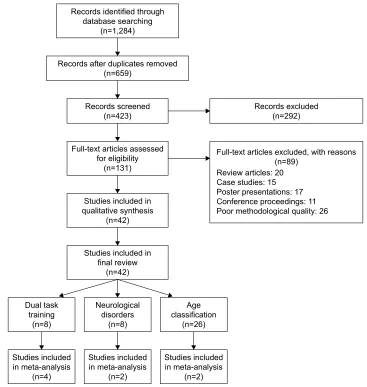
ana-lyzed postural stability in a sitting position or while using a picture analysis software. All the studies identified during the search were independently screened (Figure 1) for eligibility by a primary researcher and every effort was undertaken to avoid subjective bias.55 Preliminary analysis for selection was
performed by analyzing titles and abstracts, and, wherever necessary, the entire text of the article was studied. Where further clarification of the published data was required, the
5HFRUGVDIWHUGXSOLFDWHVUHPRYHG Q
5HFRUGVH[FOXGHG Q
5HYLHZDUWLFOHV &DVHVWXGLHV 3RVWHUSUHVHQWDWLRQV &RQIHUHQFHSURFHHGLQJV 3RRUPHWKRGRORJLFDOTXDOLW\ )XOOWH[WDUWLFOHVH[FOXGHGZLWKUHDVRQV
Q )XOOWH[WDUWLFOHVDVVHVVHG
IRUHOLJLELOLW\ Q 5HFRUGVLGHQWLILHGWKURXJK
GDWDEDVHVHDUFKLQJ Q
5HFRUGVVFUHHQHG Q
6WXGLHVLQFOXGHGLQ TXDOLWDWLYHV\QWKHVLV
Q
6WXGLHVLQFOXGHGLQ ILQDOUHYLHZ
Q
6WXGLHVLQFOXGHG LQPHWDDQDO\VLV
Q 'XDOWDVN
WUDLQLQJ Q
$JH FODVVLILFDWLRQ
Q 1HXURORJLFDO
GLVRUGHUV Q
6WXGLHVLQFOXGHG LQPHWDDQDO\VLV
Q
6WXGLHVLQFOXGHG LQPHWDDQDO\VLV
Q
Figure 1 Flow diagram illustrating studies for inclusion in the review study (PRISMA flow diagram).
Abbreviation: PRISMA, Preferred Reporting Items for Systematic Reviews and Meta-analysis.
Clinical Interventions in Aging downloaded from https://www.dovepress.com/ by 118.70.13.36 on 20-Aug-2020
Dovepress Ghai et al
first researcher attempted to contact the respective authors. Bibliographic sections of all the articles were retrieved for evaluations. Citation search for all the included articles was performed using Web of Science. A classification of studies based on their experimental design56 and country of origin
was also made (Supplementary material).
Data extraction
Upon selection for review, the following data were extracted from each article: author, date of publication, selection criteria, sample size, sample description (gender, age, health status), intervention, dual-task, outcome measures, results, and conclusions. The data were then summarized and tabu-lated. Furthermore, classification of studies was made based on their experimental application,56 and the population groups
were assessed.
Quality and risk of bias assessment
The quality of the studies was assessed using the PEDro methodological quality scale. The scale consists of eleven items addressing external validity, internal validity, and interpretability. The PEDro scale can detect potential bias with fair to good reliability57 and is a valid measure of
the methodological quality of trials. A blinded rating of the methodological quality of the studies was carried out by the primary reviewer. Ambiguous issues were discussed between reviewers, and consensus was reached. For the included CCTs, a scoring of 9–10, 6–8, and 4–5 was con-sidered to be of “excellent”, “good”, and “fair” quality,58
respectively. Likewise, the level of evidence was suggested to be of level 1a (strong) if more than one RCT ($6), 1b if one RCT ($6), and 2 if one RCT (,6), or CCTs with similar methodological approaches were consistent with the results.58
With differential results among paired groups of studies, the result of the study(s) with higher PEDro score was given more consideration. Inadequate randomization, nonblinding of assessors, no intention to treat analysis, and no measurement of compliance were major threats to biasing.2
Data analysis
This systematic review also included a random-effect meta-analysis approach to develop a better understanding of the incorporated interventions. A narrative synthesis of the findings structured around the intervention, population characteristics, methodological quality (Table 1), and the type of outcome is provided. Likewise, summaries of inter-vention effects for each study were provided in a tabular form (Table S1). A meta-analysis was conducted between
pooled studies using comprehensive meta-analysis (CMA V 3.0; Englewood, NJ, USA). Heterogeneity between the studies was assessed using I2 statistics. The data in this review
were systematically distributed and for each available vari-able pooled, dichotomous data were analyzed and forest plots with 95% confidence intervals (CIs) are reported. The effect sizes were adjusted and reported as Hedge’s g. Thresholds for interpretation of effect sizes were as follows: a standard mean effect size of 0 means no change, negative effect size means a negative change, mean effect size of ,0.1 is con-sidered a small effect, 0.1–0.3 a medium effect and .0.30 a large effect.59,60 Interpretation of heterogeneity via I2 statistics
was as follows: 0–40% might not be significant, 30%–60% represents moderate heterogeneity, 50%–90% represents substantial heterogeneity, and 75%–100% represents con-siderable heterogeneity. Meta-analysis reports including heterogeneity among studies were evaluated to determine the reason of heterogeneity, and the included studies were then pooled separately and analyzed again. The alpha level was set at 95%.
Results
Characteristics of included studies
The initial search yielded 1,284 studies, which on implementing the inclusion/exclusion criteria were reduced to 42 (Figure 1). Data from the included studies are summarized in Table 1. Of the 42 studies, three were RCTs,34–36 and 39 were CCTs. Eight
studies evaluated the effects of dual-task training on postural stability.34–36,48,61–64 Eight studies evaluated the effects of dual
tasks on participants suffering from neurological diseases, such as degenerative cerebellar disorder, Parkinson’s disease, and multiple sclerosis.21,65,66 Twenty-six studies evaluated
the effects of dual tasks on postural stability among healthy young and/or elderly participants.16,17,20,67–89 Within these 26
studies, 14 studies compared the effects between young and elderly participants, eleven studies evaluated only young and one study evaluated only elderly participants.
Participants
Of the included studies, 33 studies incorporated mixed-gender participant groups.16–18,20–22,36,61–67,69–78,81–84,87,88,90–94
Four studies incorporated only female participants,35,79,85,86
and two studies incorporated only male participants.34,89
Three studies did not specify the gender of the included participants.48,61,80 The included studies provided data on
1,480 participants (n=796 females/581 males). Descriptive statistics related to the age (mean ± standard deviation) of the participants were tabulated across the studies. Three studies
Clinical Interventions in Aging downloaded from https://www.dovepress.com/ by 118.70.13.36 on 20-Aug-2020
Dovepress Review of dual-task and dual task training on posture
Table 1
Studies analyzing the effects of dual-task training and dual tasks on posture
Study
Research aim
Sample description
PEDro score and (level of evidence)
Research design
Postural analysis
Dual-task
(C:
cognitive,
Cm: cognitive–motor and M: motor components)
Conclusion
Dual-task training Choi et al (2015)
34
Assess the effects of DT training on postural stability among participants suffering from subacute stroke
8 F, 12 M (59
±
12)
DT training (10), Ct (10)
5 (1b)
Postural stability assessed post DT training for 30
min, five
times a week for 4
weeks
Sway analysis and Berg balance scale Cm: computer-based cognitive memory test Significantly enhanced postural stability post DT training DT performance significantly enhanced post DT training
An et al (2014)
48
Assess the effects of DT training on postural stability among participants suffering from chronic stroke 33 chronic stroke patients Motor (11), cognitive (11), motor–cognitive (12) training group
4 (1b)
Postural stability assessed post DT training for 30
min, three
times a week for 8
weeks
Sway analysis, time up and go test and functional reach test C: mental arithmetic task Cm: Stroop, verbal analogical and counting backward task
Significantl
y enhanced postural
stability in motor–cognitiv
e training
gr
oup as compar
ed to motor or
cognitiv
e alone training gr
oup
Kim et al (2013)
62
Assess the effects of DT training on postural stability among participants suffering from chronic stroke
v
UDT: 5 F, 7 M (52
±
2)
v
DT: 8 F, 5 M (59
±
3)
UDT: 9 F, 4 M (57
±
3)
4 (1b)
Postural stability assessed post DT training for 30
min, three
times a week for 8
weeks
with/without unstable base, visual restriction, dual task Sway analysis, functional reach test and Berg balance scale Cm: trial making and Stroop task Significantly enhanced postural stability post DT training especially in v
UDT group
DT performance significantly enhanced post DT training in vUDT group
Hiyamizu et al (2012)
36
Assess the effects of DT training on postural stability among healthy elderly participants elderly: DT training – 10 F, 7 M (72
±
5)
DT: 16 F, 3 M (71
±
4)
7 (1b)
Postural stability assessed post DT training twice a week for 3 months (ST) with/without ST,
eO/
eC
Berg balance scale, activity- based confidence scale Cm: visual search, verbal fluency, calculation task and Stroop task M: strength and balance training task No significant difference in postural sway after DT training DT performance significantly enhanced post DT training
Buragadda et al (2012)
61
Assess the effects of DT training on postural stability among elderly participants with balance impairments
30 participants
4 (1b)
Postural stability assessed post DT training (variable
, fix
ed
priority),
45
min session,
thr
ee
times a w
eek f
or 4
w
eeks
Chair stand test, func
tio
na
l r
ea
ch
te
st
, t
im
e
up
a
nd
go test
Cm: word spelling task and memory task
Significantl
y enhanced postural
stability post variable priority DT training as compar
ed to fix
ed
priority
Li et al (2010)
63
Assess the effects of DT training on postural stability among healthy elderly participants
DT training: 7 F, 3 M (74
±
5)
Ct: 6 F, 4 M (77
±
7)
4 (1b)
Static, dynamic posture, and mobility stability assessed post DT training during five sessions separated by 2
days
Single suppor
t
balance
, s
wa
y
anal
ysis,
and sit
to stand test
Cm: n-back task
Significantl
y enhanced postural
stability during single and double suppor
t dynamic balance
DT performance significantly enhanced post DT training
Silsupadol et al (2009)
35
Assess the effects of DT training on postural stability among elderly participants
ST training: 7 F (74
±
7)
DT
training
(fixed):
6
F
(74
±
6)
DT training (variable): 4 F
(76
±
4)
6 (1b)
Postural stability assessed post DT training (variable, fixed priority),
45
min
session,
three
times a week for 4
weeks
Berg balance scale, activity-based confidence scale Cm: random letter generation task Significantly enhanced postural stability post variable priority DT training as compared to fixed priority DT training
(
Continued
)
Clinical Interventions in Aging downloaded from https://www.dovepress.com/ by 118.70.13.36 on 20-Aug-2020
Dovepress Ghai et al
Table 1
(
Continued
)
Study
Research aim
Sample description
PEDro score and (level of evidence)
Research design
Postural analysis
Dual-task
(C:
cognitive,
Cm: cognitive–motor and M: motor components)
Conclusion
Pellecchia (2005)
81
Assess the effects of DT training on postural stability
9 F, 9 M (18–46)
5 (1b)
Postural stability assessed during single and DT training conditions, within three sessions
Sway analysis
Cm: counting backward in three tasks
Significantl
y enhanced postural
st
ab
ili
ty
p
os
t D
T
tr
ai
ni
ng
a
s
co
m
pa
re
d
to
s
in
gl
e
ta
sk
tr
ai
ni
ng
condition,
DT perf
ormance
sig
ni
fic
an
tly
e
nh
an
ce
d
po
st
D
T
training No diff
er
ence in DT perf
ormance
post DT training
Neurological disorder Jacobi et al (2015)
91
Assess the effects of DT on postural stability among healthy and participants suffering from DCD
Healthy: 10 F, 10 M (58
±
11)
DCD: 10 F, 10 M (58
±
11)
4 (2)
Static and dynamic postural stability
assessed
while
eO/
eC,
with platform stable/unstable, with/without DT Sensory organization test Cm: verbal working memory task Significantly reduced postural stability in participants with DCD as compared to healthy participants DT performance significantly reduced
Prosperini et al (2015)
66
Assess the effects of DT on postural stability among healthy and participants suffering from MS
Healthy: 30 F, 16 M (39
±
9)
MS: 60 F, 32 M (39
±
10)
4 (2)
Postural stability assessed with/without
eO/
eC, DT
Sway analysis
Cm: Stroop word color task
Significantl
y r
educed postural
stability in par
ticipants with MS as
compar
ed to health
y par
ticipants
DT performance significantly reduced in MS patients
Andrade et al (2014)
22
Assess the effects of DT on postural stability among participants suffering from AD, PD, and healthy participants
AD: 9 F, 3 M (72
±
5)
PD: 7 F, 6 M (71
±
6)
Healthy: 7 F, 6 M (66
±
4)
4 (2)
Postural stability assessed with/without DT
Sway analysis
Cm: counting backward task
Significantly reduced postural stability with ST performance in AD, PD participants as compared to their healthy counterparts DT performance significantly reduced in patients with AD and PD
Boes et al (2012)
21
Assess the effects of DT on postural stability among participants suffering from MS
MS: mild – 17 F, 2 M (46
±
13)
Moderate: 24 F, 3 M (58
±
7)
6 (2)
Postural stability assessed with/without DT
Sway analysis
Cm: word list generation task Significantly reduced postural stability in participants classified in moderate MS as compared to mild MS group
Negahban et al (2011)
65
Assess the effects of DT on postural stability among healthy and participants suffering from MS
Healthy: 15 F, 8 M (31
±
7)
MS: 15 F, 8 M (32
±
7)
6 (2)
Postural stability assessed on rigid/foam surface, while
eO/
eC, with/without DT
Sway analysis
C: silent backward counting task
Significantly enhanced postural stability in MS and healthy participants DT performance not affected in patients with MS as compared to healthy participants
Clinical Interventions in Aging downloaded from https://www.dovepress.com/ by 118.70.13.36 on 20-Aug-2020
Dovepress Review of dual-task and dual task training on posture
Holmes et al (2010)
94
Assess the effects of
DT
on
postural stability among healthy elderly and parti
-cipants suffering from PD
Healthy: 4 F, 8 M (62
±
8)
PD: 4 F, 8 M (64
±
9)
5 (2)
Postural stability assessed with/without DT
Sway analysis
Cm: numeral recitation and monologue generation task
Significantl
y enhanced postural
stability obser
ved in par
ticipants
aff
ected b
y PD as compar
ed to
health
y contr
ols with/without DT
,
especiall
y in monologue generation
task
Marchese et al (2003)
92 A ss es s th e ef fe ct s of D T on p os tu ra l s ta bi lit y am on g he al th y pa rt ic ip an ts a nd pa rt ic ip an ts s uf fe ri ng from PD
Healthy: 7 F, 13 M (60
±
7)
PD: 8 F, 16 M (66
±
7)
5 (2)
Postural stability assessed with/without
eO/
eC, DT
Sway analysis
Cm: calculation task M: thumb opposition task Reduced postural stability observed in participants affected by PD as compared to healthy controls with/without DT and motor tasks during eyes closed/open.
w
ith
PD Fa performing significantly poorer
Morris et al (2000)
93
Assess the eff
ects of DT
on p os tu ra l s ta bi lit y am on g health
y and par
ticipants su ffe ri ng fr om id io pa th ic P D (with/without histor y of fall) PD fall: 8 F
, 7 M (67
±
8)
PD no fall: 8 F, 7 M (68
±
7)
Health
y: 8 F
, 7 M (68
±
7)
5 (2)
Postural stability assessed with/without internal/external perturbation, with/without DT Internal and exte
rn al pe rt ur ba tio ns to
center of mass
Cm: verbal recital task
Significantly reduced postural stability with DT in PD fall-prone . nonfall-prone
.
healthy
participants
Age classification Lanzarin et al (2015)
20
Assess the effects of DT on postural stability among healthy young participants
Young: 10 F, 10 M (25
±
4)
5 (2)
Postural stability assessed with/without
eO/
eC, with/
without DT
Sensory organization test
C: mental arithmetic task
Significantly reduced postural stability during ST, while
eO and
eO with oscillating platform
Bergamin et al (2014)
68
Assess the effects of DT on postural stability among healthy young and elderly participants
Young: 15 F, 15 M (23
±
1)
elderly: 15 F, 15 M (72
±
5)
4 (2)
Postural sway assessed with/ without DT
Sway analysis
C: mental arithmetic task Cm: spatial memory and counting backward aloud task Significantly enhanced postural stability during mental arithmetic, spatial memory task Significantly poor stability during counting backward aloud task
Hwang et al (2013)
77
Assess the effects of DT on postural stability among healthy young participants
9 F, 11 M (28
±
4)
5 (2)
Postural stability assessed with/without vibration, with/ without DT
Sway analysis
Cm: verbal and nonverbal task with hand-held button press Significantly enhanced postural stability during nonverbal tasks, but less during verbal tasks
Haggerty et al (2012)
74
Assess the effects of DT on postural stability among healthy elderly participants
elderly: 4 F, 6 M (74
±
4)
5 (2)
Postural stability assessed with/without
v
Tf, DT
Sway analysis and biofeedback Cm: verbal auditory and push button dual task Significant enhancement of postural stability when DT performed with vTf as compared to DT alone DT performance significantly reduced
Mak et al (2011)
78 A ss es s th e ef fe ct o f d el ay ed vi su al fe ed ba ck a nd D T on posture among healthy young
and elderly participants
Young: 10 F, 5 M (24
±
3)
elderly: 5 F, 10 M (age not specified)
4 (2)
Posture stability assessed with eO, delayed visual feedback, with/without DT
Sway analysis
C: mental arithmetic task
Significantly enhanced postural stability in young participants. Significantly reduced postural stability in elderly participants
(
Continued
)
Clinical Interventions in Aging downloaded from https://www.dovepress.com/ by 118.70.13.36 on 20-Aug-2020
Dovepress Ghai et al
Table 1
(
Continued
)
Study
Research aim
Sample description
PEDro score and (level of evidence)
Research design
Postural analysis
Dual-task
(C:
cognitive,
Cm: cognitive–motor and M: motor components)
Conclusion
Resch et al (2011)
17
Assess the effects of ST on postural stability among healthy young participants
Young: 10 F, 10 M (20
±
1)
5 (2)
Postural stability assessed by using SOT with/without DT
Sensory organi
-zation test
Cm: auditory switch task
Significantly enhanced postural control DT performance significantly reduced
Doumas et al (2008)
73
Assess the effects of DT on postural stability and vice versa among healthy young and elderly participants
Young: 10 F, 8 M (21
±
2)
elderly: 10 F, 8 M (71
±
3)
4 (2)
Postural stability assessed with/without DT
Sway analysis
Cm: n-back task
Significantly reduced postural stability for elderly participants in sway reference somatosensory condition.
No
difference
in
postural
stability of young participants DT performance significantly reduced in elderly participants during sway reference somatosensory condition
Ramenzoni et al (2007)
82
Assess the effects of DT on postural stability among healthy young participants
Young: 10 F, 13 M (28–25
y)
5 (2)
Postural stability assessed with/without DT, during encoding and rehearsal with combination of verbal and visual interference
Sway analysis
Cm: verbal and visual cognitive task
Significantly reduced postural stability during encoding of verbal and visual task as compared to rehearsal period DT performance significantly re duced during verbal and visual tasks
Donker et al (2007)
16
Assess the effects of DT on postural stability among healthy young participants
Young: 20 F, 10 M (19–30
y)
5 (2)
Postural stability assessed while
eO/
eC and with/
without DT
Sway analysis
Cm: uttering name backwards task Significant enhancement of postural stability when DT performed with eyes closed
Swan et al (2007)
85
Assess the effects of DT on postural stability among healthy female young participants
Young: 98 F (18–27
y)
4 (2)
Postural stability assessed with/without DT
Sway analysis
Cm: Brook spatial and nonsense memory task Significant enhancement in postural stability with enhanced DT difficulty. No effect of difficulty enhancement in balance task DT
performance
significantly
re
duced
with increased complexity of DT
v
uillerme et al (2006)
89
Assess the effects of DT on postural stability among healthy young participants
Young: 9 M (23
±
1)
4 (2)
Postural stability assessed with/without
eO/
eC, ST
Sway analysis
Cm: probe reaction time task Significantly enhanced postural stability during
eO, closed DT as
compared to
eC
Huxhold et al (2006)
79
Assess the effects of ST, DT on postural stability among healthy young and elderly participants
Young: 10 F, 10 M (24
±
2)
elderly: 9 F,10 M (69
±
3)
4 (2)
Postural stability assessed with/without ST and DT
Sway analysis
Cm:
digit choice r
eaction
time
, tw
o back digit
w
orking
memor
y,
tw
o
back
spatial w
orking memor
y
and watching digit conditions task Significantly enhanced postural stability in both age groups with simple DT DT
pe
rf
or
m
an
ce
s
ig
ni
fic
an
tly
re
du
ce
d
in
e
ld
er
ly
p
ar
tic
ip
an
ts
d
ur
in
g
digit and spatial tw
o back tasks
Clinical Interventions in Aging downloaded from https://www.dovepress.com/ by 118.70.13.36 on 20-Aug-2020
Dovepress Review of dual-task and dual task training on posture
Swan et al (2004)
86
Assess the effects of DT on postural stability among healthy young and elderly participants
Young: 18 F (19–25
y)
Elderly: 15 F (60–74
y)
5 (2)
Postural stability assessed under, with/without, ST and eO/
eC
Sway analysis
Cm: Brooks spatial and nonspatial task Significantly enhanced postural stability for both age groups DT performance significantly reduced in elderly as compared to young participants
Pellecchia (2003)
76
Assess the effects of DT on postural stability among healthy young participants
Young: 10 F, 10 M (18–30
y)
4 (2)
Postural stability assessed with/without DT
Sway analysis
Cm:
digit r
ev
ersal task,
counting backwar
d in tw
os
and counting backwar
d
task
Significantl
y r
educed postural
stability with DT DT performance significantly reduced as DT complexity increased
Brauer
et
al
(2002)
69
Assess the effects of ST on postural stability among healthy young and elderly participants with and without history of fall
Young: 5 F, 10 M (22
±
5)
elderly: Nfa – 4 F, 11 M (72
±
6)
Fa – 6 F, 7 M (79
±
6)
5 (2)
Postural stability assessed with sudden movement at the balance platform, with/ without DT Postural recovery via sway analysis Cm: vocal reaction time task Reduced postural stability in elderl
y par
ticipants (Fa) and
young par
ticipants during DT as
compar
ed to elderl
y (Nfa).
Also
poor r
eco
ver
y b
y Fa with DT and
limited eff
ect of DT on Nfa and
young par
ticipants
DT performance significantly reduced among elderly Fa as compared to elderly Nfa and young participants
Andersson et al (2002)
67
Assess the eff
ects of DT
,
calf stim
ulation,
and
self-balance f
ocus on postural
stability among health
y
par
ticipants
exp 1: 17 F, 13 M (27
±
8)
exp 2: 10 F, 10 M (30
±
8)
4 (2)
Postural stability assessed with (Exp 1)/without (Exp 2) mental task, ie, focus on balance, with/without DT
Sway analysis
C: silent backward counting task
Significantl
y r
educed postural
stability during DT DT performance significantly reduced with balance pertubations
Dault et al (2001)
72
Assess the effects of DT on postural stability among healthy young participants
Young: 12 F, 12 M (20–40
y)
5 (2)
Static and dynamic postural stability assessed with/ without DT
Sway analysis
Cm: Stroop word color task
Significantly reduced postural stability when dynamic stability assessed with ST performance. No significant difference in postural sway during static ST performance DT
pe
rf
or
m
an
ce
s
ig
ni
fic
an
tly
re
du
ce
d
w
ith
in
cr
ea
se
d
co
m
pl
ex
ity
of DT task
Hunter and Hoffman (2001)
75
Assess the effects of DT on postural stability among healthy young participants
Young: 15 F, 15 M (24
y)
4 (2)
Postural stability assessed with modulation of e
ye mo
vement
and modality of pr
esentation
of DT
Sway analysis and video- motion analysis Cm: visual and auditory cognitive task Significantly reduced postural stability within visual condition DT performance unaffected
(
Continued
)
Clinical Interventions in Aging downloaded from https://www.dovepress.com/ by 118.70.13.36 on 20-Aug-2020
Dovepress Ghai et al
Table 1 ( Continued ) Study Research aim Sample description
PEDro score and (level of evidence)
Research design
Postural analysis
Dual-task
(C:
cognitive,
Cm: cognitive–motor and M: motor components)
Conclusion Melzer et al (2001) 80
Assess the effects of DT on postural stability among healthy young and elderly participants
Young: 20 (26
±
3)
elderly: 20 (77
±
2)
5 (2)
Postural stability assessed with/without narrow/wide BoS DT and
eMG
Sway analysis
Cm: modified stroop test
Significantl
y r
educed postural
stability among elderl
y par
ticipants
during DT perf
ormance and nar ro w BoS. e nhancement in
stability during DT perf
ormance in
young par
ticipants
Teasdale and Simoneau (2001)
88
Assess the effects of DT on postural stability among healthy young and elderly participants
Young: 5 F, 3 M (24
±
0)
elderly: 2 F, 6 M (68
±
0)
4 (2)
Postural stability assessed with/without DT
Sway analysis
Cm: probe reaction time task
Si gn ifi ca nt ly r ed uc ed p os tu ra l s ta bi lit y
as compared to young participants DT performance significantly reduced in elderly as compared to younger participants
Brauer
et
al
(2001)
70
Assess the effects of DT on postural stability among healthy young and elderly participants with and without history of fall
elderly: Nfa – 5 F, 9 M (72
±
6)
Fa – 6 F, 7 M (79
±
6)
5 (2)
Postural stability assessed with sudden movement at the balance platform, with/ without DT
Sway analysis
Cm: vocal reaction time task
Si gn ifi ca nt ly r ed uc ed p os tu ra l
stability in elderl
y par
ticipants (Fa)
during DT as compar
ed to elderl
y (N fa ). A lso p oo r re co ve ry b y Fa w ith
DT and no eff
ect of DT on Nfa
DT perf
ormance significantl
y
reduced in elderl
y Fa par
ticipants
as compar
ed to Nfa elderl
y
par
ticipants
Shumway- Cook and woollacott (2000)
83
Assess the effects of DT on postural stability among healthy young and elderly participants with and without history of fall
Young: 3 F, 15 M (34
±
8)
elderly: Nfa – 4 F, 14 M (74
±
6)
Fa – 3 F, 15 M (85
±
6)
5 (2)
Postural stability assessed with balance disturbances, with/without
eO/
eC,
somatosensory input, DT
Sway analysis
Cm: choice reaction time auditory task
Significantly reduced postural stability among elderly participants Fa as compared to young and elderly Nfa participants during DT DT performance unaffected, similar in younger and elderly participants
Marsh and Geel (2000)
79
Assess the effects of DT on postural stability among healthy young and elderly participants
Young: 14 F (25
±
2)
elderly: 16 F (71
±
3)
5 (2)
Postural stability assessed, with
eO/
eC, with/without DT
Sway analysis
Cm: vocal reaction time task
Significantly reduced postural stability among elderly participants as compared to young participants DT performance significantly reduced in elderly as compared to younger participants
Brown et al (1999)
71
Assess the effects of DT on postural stability among healthy young and elderly participants
Young: 5 F, 10 M (25
±
5)
elderly: 3 F, 7 M (78
±
4)
5 (2)
Postural stability assessed with balance disturbances, with/ without DT Postural reco
ver y via swa y anal ysis and
video-motion capturing Cm: backward digit recall task Reduced postural stability among elderly as compared to young participants during balance disturbances
Clinical Interventions in Aging downloaded from https://www.dovepress.com/ by 118.70.13.36 on 20-Aug-2020
Dovepress Review of dual-task and dual task training on posture
Shumway- Cook et al (1997)
84
Assess the effects of DT on postural stability among healthy young and elderly participants with and without history of fall
Young: 10 F, 10 M (31
±
6)
elderly: Nfa – 11 F, 9 M (74
±
6)
Fa – 13 F, 7 M (78
±
8)
5 (2)
Postural stability assessed on flat and compliant surfaces, with and without DT
Sway analysis
Cm: sentence completion, language processing, visual perception, and judgment of line orientation task
Significantly reduced postural stability in elderly participants (Fa) during dual tasks on both surfaces as compared to young participants No significant effect on young and elderly (Nfa) on flat surface under simple DT DT performance significantly reduced in Fa as compared to young participants
Teasdale et al (1993)
87
Assess the effects of DT among healthy young and elderly participants
Young: 8 M (24
±
0)
elderly: 3 F, 6 M (71
±
0)
4 (2)
Postural stability assessed while making postural adjustments, with/without DT
Sway analysis
Cm: auditory reaction time task
Significantl
y r
educed postural
stability among elderl
y par
ticipants
as compar
ed to y
oung par
ticipants
during DT DT performance significantly decreased in elderly as compared to younger participants
Notes:
Significant:
P
,
0.05; nonsignificant:
P
.
0.05. Data presented as mean
±
standard dev
iation.
Abbreviations:
AD,
Alzheimer’s
disease;
BoS,
base
of
support;
Ct,
control
group;
DCD,
degenerative
cerebellar
disorder;
DT,
acute
dual-task
application;
exp,
experimental
group;
eMG,
electromyography;
eO,
eyes
open;
eC,
eyes
closed;
F,
female;
Fa,
history
of
fall;
M,
male;
MS,
multiple
sclerosis;
Nfa,
no
history
of
falls;
PD,
Parkinson’s
disease;
SOT,
sensory
orientation
test;
ST,
single
task;
UDT,
unstable
base
with
dual-task;
v
UDT,
visual
restriction
and
unstable
base
with
dual task;
v
DT, visual restriction with dual task;
v
Tf, vibro-tactile feedback.
provided the median age of participants,75,87,88 and five studies
mentioned the age of participants in range.16,81,82,85,86
Risk of bias within studies
In order to efficiently reduce the risks of bias, the studies had to score $4 on PEDro scale to be included in the review. The criteria for research studies to be included in the review were limited to gold standard RCTs, cluster RCTs, and CCTs. The individual scores attained by the studies using the PEDro scale are reported in Tables 1 and S2. The aver-age PEDro score for the 42 included studies was computed to be 4.7 out of 10, indicating fair quality of the overall studies. One study scored 7,36 three studies scored 6,21,35,65
20 studies scored 5,16,17,20,34,69–72,74,77,79–84,86,92–95 and 18 studies
scored 4.22,48,61–63,66–68,73,75,76,78,81,85,87–89,91
Risk of bias across studies
Common methodological shortfalls observed in this review were inadequate concealment, intention-to-treat, nonblind-ing of participants, therapists, and assessors. One study reported blinding of assessors and confirmed intention-to-treat the included participants. Furthermore, only two studies confirmed concealed allocation of subjects.35,36 The authors
could not interpret concealed allocation of participants in three studies,65,82,85 and, therefore, no points were awarded
to the studies. The overall risk of bias for quality assessment within studies is illustrated in Figure 2.
Meta-analysis
The evaluation of research studies via meta-analysis requires strict inclusion criteria to efficiently limit the heterogeneity.96 However, among the pooled group of studies
the authors observed unexplained heterogeneity, suggesting incorporation of a random-effect meta-analysis under such conditions. The researchers added that a random-effect meta-analysis involves an assumption that the estimated effects in various studies are unidentical but follow some distribution. Therefore, studies analyzing similar variables were pooled, and a random-effect meta-analysis was conducted across four categories (dual-task training: elderly participants, dual task: multiple sclerosis, young, old). The main reason for not including the statistical approach within the studies was major differences in training duration, assessment methods, age/gender, complexity of dual tasks, and lack of descriptive statistics within the manuscript. The descrip-tive statistics mentioned within illustradescrip-tive figures were not included in the study. The authors included ten studies in the meta-analysis which incorporated evaluation of postural
Clinical Interventions in Aging downloaded from https://www.dovepress.com/ by 118.70.13.36 on 20-Aug-2020
Dovepress Ghai et al
stability in participants similar at baseline and were evaluated with similar methodological approaches, but with different dual tasks. The aim of such analysis was to demonstrate the differential effects of complexity of dual tasks on postural stability. Additionally, the reasons for specific studies are mentioned subsequently.
Dual-task training
Eight studies under this category analyzed the effects of dual-task training on postural stability, whereas four studies, in two different categories, were included in the meta-analysis.35,48,61,62 From the nonincluded studies, one study
analyzed the effects of dual-task training on subacute stroke patients,34 two studies analyzed the effects on elderly
participants,36,63 and one study on younger participants.64
The two studies analyzing the effects of dual-task training on elderly participants considerably differed based on train-ing duration and incorporated dual tasks. Hiyamizu et al36
incorporated Stroop task with a dual-task training duration of two sessions per week for 3 months; however, Li et al63
used an n-back task with a training duration spread over five sessions with a 2-day gap within each session.
Neurological impairment
Eight studies under this category analyzed the effects of dual task on postural stability of participants affected by neurological disorders. Two studies analyzing the effects of dual task on multiple sclerosis were included in the meta-analysis. However, the third study despite having similar variables could not be included as the descriptive statistics were not available in the text and were not obtained even after contacting the corresponding author. Similarly, three other studies analyzing patients affected by Parkinson’s disease could not be included due to lack of descriptive statistics.22,92,93 Only one study analyzed the effects of dual
tasks on postural stability of participants affected from degenerative cerebellar disorder.91
Young and elderly participants
Twenty-six studies under this category analyzed the effects of dual task on young and/or elderly participants. Four studies analyzing the effects of dual task on young and elderly par-ticipants were included in the meta-analysis.17,20,80,94 Thirteen
studies analyzing similar variables in terms of age and dual tasks were not included in the meta-analysis as they did not include descriptive statistics explicitly, but in figures, ie, bar diagrams.16,67,68,72,75,76,79,82,85–89 Shumway-Cook and Woollacott83
and Shumway-Cook et al84 evaluated the effects of dual task
on postural stability during balance perturbations in partici-pants predisposed to falls, their healthy counterparts, and young participants, while the studies differed in terms of uti-lized dual tasks. Mak et al,78 on the contrary, included a rather
novel aspect of visual feedback during standing and utilized dual tasks in conjugation with this feedback approach. Hwang et al77 also utilized one leg standing as compared to the
coun-terpart studies, which utilized a basic two-legged standing under different conditions. Brauer et al69,70 analyzed postural
recovery post balance perturbation with dual tasks among participants predisposed to falls, their healthy counterparts, and young participants with similar dual tasks. Likewise, Brown et al71 also utilized a similar approach and effective
comparisons could have been drawn between studies to evaluate the effects of dual task on postural stability. Due to lack of descriptive statistics, and not heterogeneity, the studies could not be included in the analysis.
Outcomes
The results suggest clear evidence for a positive impact of dual-task training for enhancing postural stability among fall-prone elderly population groups and participants affected (OLJLELOLW\FULWHULD
5DQGRPDOORFDWLRQ
&RQFHDOHGDOORFDWLRQ %DVHOLQHFRPSDUDELOLW\ %OLQGVXEMHFWV %OLQGWKHUDSLVWV %OLQGDVVHVVRUV $GHTXDWHIROORZXS ,QWHQWLRQWRWUHDW %HWZHHQJURXSFRPSDULVRQV 3RLQWHVWLPDWHVDQGYDULDELOLW\
<HV 1R
Figure 2 Risk of bias across studies.
Clinical Interventions in Aging downloaded from https://www.dovepress.com/ by 118.70.13.36 on 20-Aug-2020
Dovepress Review of dual-task and dual task training on posture
from stroke. A negative impact of dual tasks was observed in studies evaluating the effects of dual tasks on postural stability among fall-prone population groups affected by neurological disorders and/or with prior history of fall, as compared to their younger healthier counterparts.
Meta-analysis report
Dual-task training
Eight studies evaluated the effects of dual-task training on postural stability.34–36,48,61–64 One RCT34 and two CCTs
evaluated the effects of dual-task training on postural sta-bility in subacute and chronic stroke patients, respectively. Two RCTs35,36 and three CCTs evaluated the effects of
dual-task training on elderly and young participants. Significant enhancements in postural stability were reported in one good35 and six fair-quality studies.34,48,61–64 However, one
good-quality study reported no significant enhancements in postural stability. A random-effect meta-analysis was con-ducted across two categories. First, two studies evaluated the effects of fixed and variable priority dual-task training on postural stability among elderly population groups.35,61 A
random letter generation task was utilized during the training phase which lasted for a 45-min session, three times a week for 4 weeks. Scores from Berg balance scale were utilized to assess the postural stability. Upon analysis, a large effect size
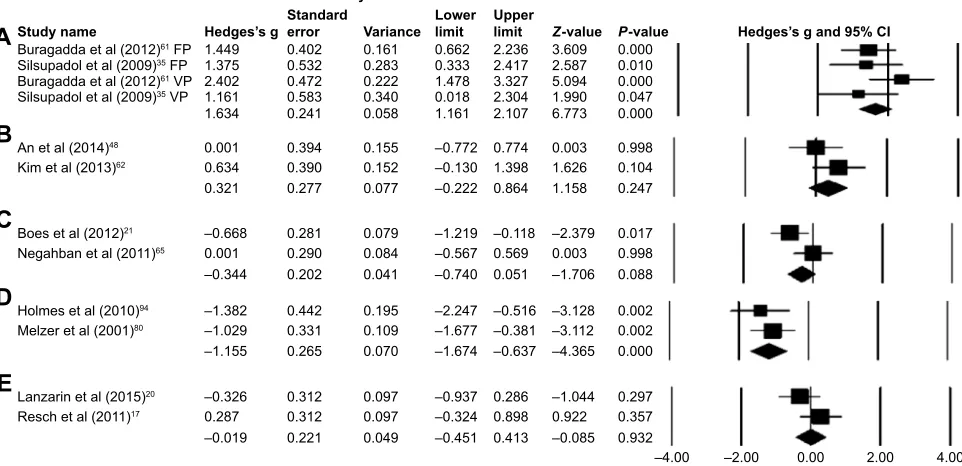
was observed (Hedge’s g: 1.63), and 95% CI (1.16–2.10) was reported in the positive domain, demonstrating a beneficial effect of variable task priority within dual-task training to enhance postural stability (Figure 3A). Heterogeneity tests reported negligible heterogeneity (I2: 20.26%, P,0.01).
Moreover, the studies were then reevaluated on the basis of fixed and variable priority dual-task training. In the condition of fixed priority dual-task training, upon analysis, a large effect size was observed (Hedge’s g: 1.42) and 95% CI (0.79–2.05) in the positive domain. Similarly, in the condition of variable priority dual-task training, a large effect size was observed (Hedge’s g: 1.91) and 95% CI (1.19–2.63) in the positive domain. Thereby, demonstrating a beneficial effect of variable priority over fixed priority dual-task training method.
Second, two studies analyzing the effects of dual-task training on postural stability among patients affected from chronic stroke were included in the meta-analysis.48,62
The studies utilized a similar dual-task training duration phase of a 30-min session, three times a week for 8 weeks. Postural stability in the studies was assessed using functional reach test. Upon analysis, a large effect size was observed (Hedge’s g: 0.32), and 95% CI (-0.22 to 0.86) cm was reported in the positive domain, demonstrating a beneficial effect of within dual-task training to enhance postural sta-bility (Figure 3B). Heterogeneity tests reported negligible
%XUDJDGGDHWDO)3
6LOVXSDGROHWDO)3
%XUDJDGGDHWDO93
6LOVXSDGROHWDO93
$QHWDO .LPHWDO %RHVHWDO 1HJDKEDQHWDO +ROPHVHWDO 0HO]HUHWDO /DQ]DULQHWDO 5HVFKHWDO 6WXG\QDPH 6WDWLVWLFVIRUHDFKVWXG\ +HGJHV¶VJDQG&,
(
'
&
%
$
6WDQGDUGHUURU9DULDQFH /RZHU OLPLW ± ± ± ± ± ± ± ± ± ± ± ± 8SSHU OLPLW ± ± ± ± =YDOXH ± ± ± ± ± ± ± 3YDOXH ± ± +HGJHV¶VJ ± ± ± ± ± ± ±
Figure 3 Forest plot illustrating individual studies evaluating the effects of (A) dualtask training with fixed (FP) and variable (VP) priority in elderly participants, (B) dualtask
training in elderly participants affected from stroke, (C) dualtask in postural stability of participants affected from multiple sclerosis, (D) dualtask in postural stability of
elderly participants, (E) dualtask in postural stability of young participants.
Notes: Adjusted effect sizes; Hedge’s g (boxes), and 95% CI (whiskers) are presented, demonstrating repositioning errors for individual studies. Diamond represents pooled effect sizes and 95% CI. A negative mean difference indicates a favorable outcome for control groups; a positive mean difference indicates a favorable outcome for experimental groups.
Abbreviation: CI, confidence interval.
Clinical Interventions in Aging downloaded from https://www.dovepress.com/ by 118.70.13.36 on 20-Aug-2020
Dovepress Ghai et al
heterogeneity (I2: 23.2%, P=0.24). The studies according
to the PEDro methodological scale computed an average score of 4.8, indicating the average quality of the studies to be fair.
Neurological impairments
Eight studies evaluating the effects of dual-task performance on postural stability among participants affected by neuro-logical disorders, such as cerebellar disorder, Parkinson’s disease,22,92–94 and multiple sclerosis,21,65,66,91 were included
in the review. Significant enhancements in postural stabil-ity were reported in one good65 and one fair-quality study.94
Additionally, five fair-quality studies reported a significant reduction in postural stability among individuals affected by Parkinson’s disease,22,93,94 multiple sclerosis,66 and
degenera-tive cerebellar disorder.91 One good-quality study reported a
reduction in postural stability (not significant) among partici-pants affected by Parkinson’s disease.92 Five studies
evalu-ated the comparative effects between healthy participants and participants affected by neurological disorders,66,91,92,94
but one study evaluated the comparison between participants affected by mild and moderate multiple sclerosis.21 Also,
two studies evaluated the inclusion of stable and unstable surfaces for maintaining postural stability while performing a dual task.65,91
A random-effect meta-analysis was conducted across one category, for evaluation of the effects of dual task on multiple sclerosis.21,65 Even though the two included
studies conducted the tests using different dual tasks, the methodology and included participants were similar at base-line. The meta-analysis comprehensively demonstrated the differential effects of complexity of dual tasks on postural stability, ie, where on the one hand silent backward counting task improved the postural stability of the participants with multiple sclerosis, on the other hand incorporating word list generation task, incorporated by Boes et al,21 adversely
impacted postural stability. Upon analysis, a large effect size was observed (Hedge’s g: -0.34) and 95% CI (-0.74 to 0.05) cm was reported marginally in the negative domain, demon-strating a differential effect of dual-task complexity on the pos-tural stability of participants with multiple sclerosis (Figure 3C). Heterogeneity tests reported considerable heterogeneity (I2: 63.6%, P=0.08). The increased heterogeneity could be
attributed to the differential complexity of dual tasks within the studies, which according to Vuillerme and Vincent97 might
affect the outcome of the primary task. According to PEDro methodological scale, the studies overall scored an average of 4.8, indicating the quality of the studies to be fair.
Young and elderly
Twenty-six studies evaluated the effects of dual-task performance on postural stability among young, elderly, young/elderly, and participants with/without history of falls.16,17,20,67–80,82–89 Eleven fair-quality studies evaluated
the effects of dual tasks on young participants.16,17,20,67,72, 75,77,81,82,85,89 Four fair-quality studies reported significant
enhancements in postural stability,16,17,77,85 whereas seven
fair-quality studies reported significant reduction in postural stability.20,67,72,75,81,82,89
Two fair-quality studies evaluated the effects of dual tasks on elderly participants.70,74 Both the studies reported
a significant reduction in postural stability post dual-task intervention.
Thirteen fair-quality studies compared the effects of dual tasks between young and elderly participants.68,69,71,73,76,78–80, 83,84,86–88 Four studies included a comparison between
elderly participants with/without history of falls.69,70,83,84
Three studies reported significant enhancements in postural stability among both young and elderly participants.68,76,86
Eight studies reported significant reductions in postural stability of elderly participants as compared to younger participants where enhancements in postural stability were observed.21,73,79,80,83,84,87,88 Two studies reported reduced
pos-tural stability (nonsignificant) among elderly participants; however, enhancements were observed in younger coun-terparts. Similarly, significantly reduced posturasl stability was reported for participants with prior history of fall as compared to their healthy counterparts.69,70,83,84 A
random-effect meta-analysis was conducted across two categories for evaluation of the effects of dual task on healthy young participants. The two studies analyzed the postural stability using sensory orientation test; however, differential dual tasks were incorporated in the review.17,20 The
methodol-ogy and included participants were similar at baseline. The meta-analysis comprehensively demonstrated the differential effects of complexity of dual tasks on postural stability, ie, where on the one hand auditory switch task improved the postural stability of the participants,17 on the other hand,
incorporating a complex mental arithmetic task adversely impacted postural stability among young participants. Upon analysis, a trivial effect size was observed (Hedge’s g: -0.02) and 95% CI (-0.45 to 0.41)% was reported marginally in the negative domain, demonstrating a differential effect of dual-task complexity on the postural stability of young participants (Figure 3E). Heterogeneity tests reported con-siderable heterogeneity (I2: 48.2%, P=0.93), which could
possibly be related to the differential complexity of the dual
Clinical Interventions in Aging downloaded from https://www.dovepress.com/ by 118.70.13.36 on 20-Aug-2020