MILP-Aided Bit-Based Division Property for
ARX-Based Block Cipher
Ling Sun1, Wei Wang1, Ru Liu1, Meiqin Wang?1,2
1 Key Laboratory of Cryptologic Technology and Information Security, Ministry of
Education, Shandong University, Jinan, 250100, China 2
State Key Laboratory of Cryptology, P.O. Box 5159, Beijing, 100878, China
[email protected]; [email protected]; [email protected]
Abstract. The huge time and memory complexities of utilizing bit-based division property, which was first presented by Todo and Morri at FSE 2016, bothered cryptographers for quite some time and it had been solved by Xianget al.at ASIACRYPT 2016. They applied MILP method to search integral distinguisher based on division property, and used it to analyze six lightweight block ciphers. Later on, Sunet al.handled the feasibility of MILP-aided bit-based division property for primitives with non-bit-permutation linear layers. Although MILP-aided bit-based divi-sion property has gave many perfect results since its appearance, there still are many left problems when we want to develop its further applica-tions. In this paper, we focus on the feasibility of MILP-aided bit-based division property for ARX-based primitive. More specifically, we consid-er the construction of MILP models for some components of ARX-based structure. Firstly, the Modulo model is proposed by using its iterated expression and introducing some auxiliary variables. Then, to propagate the operations of AND and ORwith a constant (or a subkey), we prove that the known-region deduced by the input division property is always included in the known-region derived from the output division property, which allows us to ignore these operations. Furthermore, with its help, we also handle theModulooperation with a constant (or a subkey). As a result, these new models are exploited to search integral distinguishers for some ARX-based block ciphers. For HIGHT and LEA, the lengths of the distinguishers both are improved by one round. Some 15-round integral distinguishers for TEA/XTEA are presented. Comparing with the existing one transformed by utilizing the equivalence between zero-correlation and integral cryptanalysis, our newly obtained distinguishers either reduces the data requirement or increases the number of zero-sum bits. Moreover, the bit-based division properties for KATAN and KTANTAN families of block ciphers are also provided.
Keywords:MILP-aided bit-based division property, HIGHT, LEA, TEA, XTEA, KATAN, KTANTAN
?
1
Introduction
Division property, which was proposed by Todo [12] at EUROCRYPT 2015, is a generalization of integral property. It could explicitly depict the obscure prop-erty between the traditional ALL and BALANCE properties, which made it an effective method to search integral distinguishers even if the internal compo-nents of the objective primitives had non-bijective, bit-oriented, and low-degree structures. However, the utilization of the algebraic degree alone did not maxi-mize the advantage of the division property. At CRYPTO 2015, after analyzing the Algebraic Normal Form (ANF) ofS7 for MISTY1 [7], Todo [11] observed a vulnerable property consisted inS7, and constructed a 6-round integral distin-guisher. With this newly proposed distinguisher, he provided the first theoretical attack for full MISTY1.
By restricting the underlying space to be the direct product of a series of binary fields, Todo and Morri [13] proposed bit-based division property, which could be treated as a special case of division property. The bit-based division property broke the internal states into bits, which allowed it to use not only the algebraic degree but also the details of the round function’s structure, and directly traced the division property at the bit-level. It was applied to construct a 14-round integral distinguisher for SIMON32 [1], which achieved four more rounds than the one given in [12]. However, the complexity of utilizing bit-based division property was roughly equal to 2n for an n-bit primitives. On the one hand, the huge complexity restricted the wide applications of bit-based division property. On the other hand, whether it could be used to find integral distinguishers for other block ciphers with S-boxes was not known.
To solve the restriction of the huge complexity, Xiang et al. [17] applied MILP-method to search integral distinguisher based on bit-based division prop-erty3, which allowed us to analyze primitives whose block sizes were larger than
32. With the help of MILP-method, bit-based division property was successfully applied to search integral distinguishers for six lightweight block ciphers. Later on, the feasibility of MILP-aided bit-based division property for primitives with non-bit-permutation linear layers, which was an open problem left by Xianget al., was settled by Sunet al. [10]. After generalizing the formerCopy andXOR models, they considered the primitive representations of the linear layers and proposed a new method to construct the model used to propagate bit-based division property of linear layers by introducing some intermediate variables according to the primitive representations.
Although MILP-aided bit-based division property has gave many wonderful results since its appearance, there still are many left problems when we want to develop its further applications. In this paper, we focus on the feasibility of MILP-aided bit-based division property for ARX-based primitive. More specif-ically, we consider the construction of MILP models for some components of ARX-based structure. ARX, which refers to as Addition/Rotation/XOR, is a
3
class of block ciphers that only use the following simple operations4:
Modulo, bitwise rotation andXOR. In contrast to those block ciphers with S-boxes, their nonlinearities rely on the Modulo operation. ARX designs are simple, efficient and easy to implement. Given their flexibility and efficiency, it is expected that ARX designs will continue to be popular. However, the security analysis of this kind of ciphers has not been extensively studied and any general method for analyzing them will influence future cipher designs.
1.1 Our Contributions
In this paper, we aim at solving the feasibility of MILP-aided bit-based division property for ARX-based primitive and expending its application range. The contributions are summarized as follows.
1. Note that the ANF of theModulo operation becomes more and more com-plicated with the increasing of modulus and directly using the ANF to con-struct MILP model is very hard, we consider an iterated expression of the Modulooperation. After introducing some auxiliary variables and allocating these variables according to the iterated expression, theModulomodel is con-structed by successively invoking Copy, AND, and XOR models. This linear inequality system can be absorbed into the original MILP model of bit-based division property to find integral distinguishers for some ARX-based block ciphers.
2. To propagate the bit-based division property for the operations of ANDand ORwith a constant (or a subkey), we prove that the known-region deduced by input division property is always included in the known-region derived from the output division property, with which these operations can be ig-nored during our analysis. Although doing this way may lose some useful information, sometimes we can not know such constants in advance5. As a
result, dealing with it in this way is reasonable. With its help, we also handle theModulooperation with a constant. Up to now, we solve the feasibility of MILP-aided bit-based division property for ARX-based block cipher. 3. These newly constructed models are applied to search integral
distinguish-ers for some ARX-based block ciphdistinguish-ers. HIGHT [6], which was proposed at CHES 2006, was designed for usage in lightweight applications such as sen-sor network and RFID tags, and has been adopted as ISO standard. We construct two 18-round integral distinguishers for HIGHT, and our newly obtained distinguishers gain one more round comparing with the former t-wo 17-round distinguishers provided by Zhang et al. at CANS 2009. For
4 Broadly, some ciphers that also involve the
AND operation are also included in this class, such as SIMON and KATAN/KTANTAN. The nonlinearities of these ciphers are also provided by theANDoperation.
5
LEA [5], we find a 7-round integral distinguisher with data complexity 296, which also attains one more round than the one mentioned by the design-ers. TEA [16] and XTEA [8] being rather popular ciphers, both are imple-mented in the Linux kernal. Some 15-round integral distinguishers for TEA and XTEA are presented. Comparing with the 15-round one transformed from the 15-round zero-correlation linear approximation [3] by utilizing the equivalence between zero-correlation linear cryptanalysis and integral crypt-analysis for ARX-based block ciphers proposed by Wen and Wang [15], our newly obtained distinguishers either reduces the data requirement or increas-es the number of zero-sum bits. Bincreas-esidincreas-es, the bit-based division propertiincreas-es for KATAN and KTANTAN [4] families of block ciphers are also provided.
Some comparison between our newly obtained integral distinguishers and some former results can be found inTable 1.
Outline of the Paper. The remainder of this paper is organized as follows. In Section2, we briefly review some notations, division property, and MILP-aided bit-based division property.Section3focuses on the construction of MILP mod-els for some components of ARX-based structure and illustrates how to apply MILP-aided bit-based division property to ARX-based block ciphers.Section4
gives the applications of some ARX-based block ciphers. We conclude the pa-per in Section 5. Some auxiliary materials are supplied inAppendix A and Appendix B.
2
Priliminary
2.1 Notations
Some notations, which are used throughout this paper, are introduced in this section.
In order to simplify the representation, a bit-string will be written in hex-adecimal format and is always written in italic verbatim font. We follow the notations defined in [12] and [11].
For any a ∈ Fn2, the i-th element is expressed as a[i], where the bit posi-tions are labeled in big-ending, and the Hamming weightwt(a) is calculated by wt(a) =Pn−1
i=0 a[i].
For any setK,|K|denotes the number of elements inK. Let∅be an empty set.
For any a = (a0, a1, . . . , am−1) ∈ F`02 ×F `1
2 × · · · ×F
`m−1
2 , the vectorial Hamming weight of a is defined asW t(a) = (wt(a0), wt(a1), . . . , wt(am−1))∈
Table 1: Summarization of Results.
Cipher BlockLength Data #{Zero-Sum Bits} Ref. Size Requirement
HIGHT 64
11 28 1
[18]
12 216 1
17 256 1
18 263 1 Section4.1
LEA 128
6 232 1 [5]
6 232 2
Section4.2
7 296 1
TEA/XTEA 64 15
263 1 [3]†
262 1
Section4.3
263 2
KATAN
32 90 2
30
1
Section4.4
(KTANTAN)
99 231 1
48 77 2
46 1
83.5 247 1
64 67.3 2
62 1
72.3 263 1
Length: The length of the resulting distinguisher.
#{Zero-Sum Bits}: The number of zero-sum bits of the distinguisher.
†
Note that the 15-round zero-correlation linear approximation in [3] can be transformed into a 15-round integral distinguisher by applyingProposition 2 in [15].
Definition 1 (Bit Product Function [12]). Assume u ∈ Fn
2 and x ∈ Fn2.
The Bit Product Functionπu is defined as
πu(x) = n−1 Y i=0
x[i]u[i].
Foru= (u0, u1, . . . , um−1)∈F`0 2 ×F
`1
2 ×· · ·×F `m−1
2 , letx= (x0, x1, . . . , xm−1)∈
F`20×F `1
2 × · · · ×F `m−1
2 be the input, the Bit Product Functionπu is defined as
πu(x) =
m−1 Y i=0
πui(xi).
The bit product function also appears in the Algebraic Normal Form (ANF) of a Boolean function. The ANF of a Boolean functionf :Fn2 →F2is represented as
f(x) = M u∈Fn2
afu n Y i=1
x[i]u[i] !
= M
u∈Fn2
afuπu(x),
whereaf
2.2 Division Property and Bit-Based Division Property
The division property, which was proposed by Todo [12], was a generalization of the integral property. It could precisely describe the implicit properties between the traditional ALL and BALANCE properties, which made division property an efficient tool to search integral distinguishers for some ciphers with non-bijective, bit-oriented, or low-degree components. Bit-based division property [13] handled a special case of division property, where the underlying space was restricted to be the direct product of a series of binary fields. Comparing with the traditional division property, bit-based division property could trace the division property at the bit-level, and showed its power by finding longer integral distinguisher for SIMON32. In this subsection, we will briefly review division property and bit-based division property, and summarize some propagation rules for bit-based division property.
Definition 2 (Division Property [12]).Let Xbe a multi-set whose elements take values fromF`02 ×F`12 × · · · ×F
`m−1
2 . When the multi-set Xhas the division
property D`0,`1,...,`m−1
K , where K denotes a set of m-dimensional vectors whose
i-th element takes a value between0and`i−1, it fulfills the following conditions:
M x∈X
πu(x) =
unknown if there isk∈Ks.t.W t(u)k,
0 otherwise.
Remark 1 If there are k ∈ K and k0 ∈ K satisfying k k0 in the division property D`0,`1,...,`m−1
K ,k can be removed fromKbecause the vector k is redun-dant.
Remark 2 (Known-Region & Unknown-Region) In this paper, we call the region where the parity is equal to0 the known-region and the region where the parity becomes unknown is called the unknown-region.
Remark 3 Note that `0, `1, . . ., `m−1 are restricted to 1 when we consider
bit-based division property.
Bit-Based Division Property Propagation Rules for Some Basic Oper-ations Todo [12] proved some propagation rules for division property and these rules were summarized into five rules in [11], which were respectively Substitu-tion,Copy,XOR,Split, andConcatenation. Among the five rules, onlyCopy and XORare necessary for bit-based division property. The two necessary rules are restated in a bit-based look in the following.
Rule 1 (Copy) Let F be a Copy function, where the inputxtakes a value of F2 and the output is calculated as (y0, y1) = (x, x). Let X and Y be the input multi-set and output multi-set, respectively. Assuming that the multi-set X has the division propertyD1
{k}, the division property of the multi-setYisD 1×1
K0 . Then the propagation only have two possible cases:
Rule 2 (XOR) LetFbe a function compressed by anXOR, where the input(x0, x1)
takes a value ofF2×F2 and the output is calculated asy =x0⊕x1. Let Xand Y be the input multi-set and output multi-set, respectively. Assuming that the multi-setX has division propertyD{1×1k}, the division property of the multi-setY isD1
K0. Then the propagation only have four possible cases:
K0={(0)}, ifk= (0,0) K0={(1)}, ifk= (0,1) K0={(1)}, ifk= (1,0) K0=∅, ifk= (1,1)
For some bit-oriented block ciphers such as SIMON,ANDis a necessary non-linear operation. The propagation forANDis given in [13], and we summarize it as follows.
Rule 3 (AND) LetFbe a function compressed by anAND, where the input(x0, x1)
takes a value of F2×F2 and the output is calculated asy =x0∧x1. LetXand Y be the input multi-set and output multi-set, respectively. Assuming that the multi-setX has division propertyD{1×1k}, the division property of the multi-setY
isD1
K0. Then the propagation only have four possible cases:
K0={(0)}, ifk= (0,0) K0={(1)}, ifk= (0,1) K0={(1)}, ifk= (1,0) K0={(1)}, ifk= (1,1)
We do not introduce the bit-based division property propagation of S-box, since the objectives of this paper do not involve primitives with S-box.
2.3 MILP-Aided Bit-Based Division Property
Although bit-based division property showed its power by finding longer integral distinguisher for SIMON32 [13], the time and memory complexities of utilizing it were roughly 2n for ann-bit block cipher. To handle the huge complexities of bit-based division property, Xianget al.[17] integrated MILP method with bit-based division property. After transforming division property propagation into a series of linear inequalities6, the integral distinguisher searching problem by
using bit-based division property became solving MILP problem. With the help of some openly available MILP optimizers such as Gurobi7, the complexities of
calling bit-based division property dramatically decreased. In this subsection, we will briefly review MILP-aided bit-based division property.
The main technique of MILP-aided bit-based division property is to model those bit-based division property propagation rules introduced in Section 2.2
with a series of linear inequalities. Again, the construction of MILP model for S-box is not covered in this paper.
6 We do not distinguish linear equality with linear inequality in this paper, since MILP
model can include linear inequality as well as linear equality. 7
Modeling Copy,AND, andXORCorresponding to three basic operations (Copy, AND, andXOR), there are three models which are used to depict them. Note that Sun et al.[10] have generalized the Copy and XORmodels proposed by Xiang
et al.. For simplicity, we only list the generalized Copyand XORmodels in the following.
Model 1 (Generalized Copy, [10]) Denote(a)−−−→Copy (b0, b1, . . . , bm) a divi-sion trail of Copy function, the following inequalities are sufficient to describe the division propagation ofCopy.
a−b0−b1− · · · −bm= 0
a, b0, b1, . . . , bm are binaries
Model 2 (Generalized XOR, [10]) Denote (a0, a1, . . . , am)−−→XOR (b)a division trail through XOR function, the following inequalities can describe the division trail through XORfunction.
a0+a1+· · ·+am−b= 0 a0, a1, . . . , am, bare binaries
Model 3 (AND, [17]) Denote (a0, a1) AND
−−→ (b) a division trail of AND function, the following linear inequalities are sufficient to describe this propagation.
b−a0>0 b−a1>0 b−a0−a160 a0, a1, bare binaries
Until now, for block ciphers based on the three basic operations, like SI-MON [1], we are able to construct a set of linear inequalities characterizing one round division property propagation. Iterating this processr times, we can get a linear inequality systemLdescribingrrounds division property propagation. All feasible solutions of L correspond to all r-round division trails, which are defined below.
Definition 3 (Division Trail [17]). Let fr denote the round function of an iterated block cipher. Assume that the input multi-set to the block cipher has initial division property D1n
{k}, and denote the division property after i-round
propagation through fr by D1n
Ki. Thus we have the following chain of division property propagations:
{k},K0 fr
−→K1
fr
−→K2
fr −→ · · ·.
Moreover, for any vector k∗
i ∈ Ki (i > 1), there must exist an vector ki−1∗ ∈
Ki−1 such thatki−1∗ can propagate tok∗i by division property propagation rules.
Initial Division Property and Stopping Rule Denote (a0
0, a01, . . . , a0n−1)→
· · · → (ar
0, ar1, . . . , arn−1) anr-round division trail, L is a linear inequality sys-tem defined on variables aji (i = 0,1,· · ·, n−1, j = 0,1,· · ·, r) and some auxiliary variables. Let D1n
{k} denote the initial input division property with k= (k0, k1, . . . , kn−1), we need to adda0
i =ki (i= 0,1, . . . , n−1) intoL, and all feasible solutions ofL are division trails which start from vectork. And the objective function is set as
Obj :M in{ar0+ar1+· · ·+arn−1}.
Let D1n
Ki denote the output division property after i rounds of encryption and
the input division property is denoted byD1n
K0. IfKr+1 contains all the nunit vectors for the first time, the division property propagation should stop and an r-round distinguisher can be derived fromD1n
Kr.
Note that we only review some key points here. For more details, please refer to [9–13, 17].
3
MILP-Aided Bit-Based Division Property for
ARX-Based Primitive
Even though MILP-aided bit-based division property illustrated by Xiang et al. [17] handled the huge complexities of bit-based division property, the fea-sibility of MILP-aided bit-based division property for primitives with non-bit-permutation linear layers was not considered. By generalizing the formerCopy and XORmodels and introducing some intermediate variables among the linear layer according to the primitive representation of the linear layer, Sunet al.[10] settled this open problem, and successfully applied MILP-aided bit-based divi-sion property to search integral distinguishers for various primitives with non-bit-permutation linear layers.
However, there still are many left problems when we want to develop its further applications. The feasibility of MILP-aided bit-based division property for ARX-based primitive is not known. In this section, we focus on this problem, and consider the construction of MILP model for some components of ARX-based structure.
3.1 Modelling the Modulo Operation
For some ARX-based block ciphers,Modulooperation is an important constitu-tion which is used to provide nonlinearity. In this secconstitu-tion, we will illustrate how to model it in MILP-aided bit-based division property.
and z = (z0, z1, . . . , zn−1) are n-bit vectors, and z=xy. Then the Boolean functions of zican be expressed with (1).
zi=xi⊕yi⊕ci
ci=xi+1yi+1⊕(xi+1⊕yi+1)ci+1, i=n−2, n−3, . . . ,0 cn−1= 0
(1)
With this iterated expression, we can model the Modulo operation step by step. In the following, we take a 4-bitModulooperation as an illustration. Firstly, we represent the 4-bit Modulo operation with the iterated expression, which is given in (2).
z3=x3⊕y3
z2=x2⊕y2⊕c2, c2=x3y3
z1=x1⊕y1⊕c1, c1=x2y2⊕(x2⊕y2)c2 z0=x0⊕y0⊕c0, c0=x1y1⊕(x1⊕y1)c1
(2)
After observation, we find that the input bits xi’s and yi’s are firstly copied a certain number of times. Then, these copies will combine with each other by usingXORorANDoperation to constitute the final output bits. Since we already have the models of describing three basic operations (Model1,Model2, and Model 3), we can generate linear inequality system used to depict division property propagation for theModulooperation step by step by introducing some auxiliary variables.
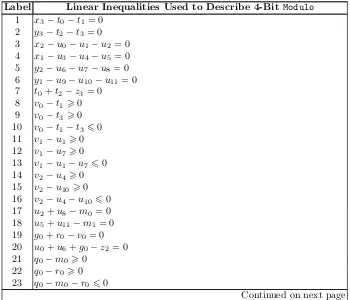
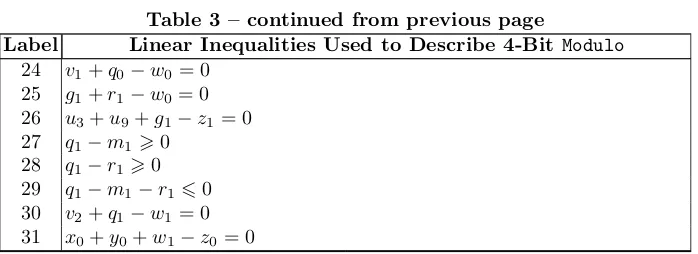
More specifically, intermediate variablest0∼t3,u0∼u12,v0∼v2,m0∼m1, r0∼r1, g0∼g1, q0∼q1, andw0 ∼w1 are introduced. The allocation of these intermediate variables is illustrated in Table 2. The linear inequality system used to propagate the bit-based division property of the 4-bitModulooperation can be found inTable 3, and we do not distinguish between the input bitsxi’s, yi’s (output bitszi’s) and their corresponding input (output) division properties here. We will give a brief explanation of the linear inequalities in Table3.
– The linear inequalities used to describe the Copy operations are given in the first line to the sixth line of Table 3, where ti(06i 63) and uj(06 j 612) are introduced to represent different copies of xk(1 6 i 63) and yl(1 6l 63). Note that the frequencies of occurrences of x0 and y0 in (2) are equal to 1, sox0andy0do not needed to be copied.
– Then, according to the iterated expression of the Modulo operation, the remaining intermediated variables are called. For example, to depictx3y3in the expression ofc2, we introducev0as an auxiliary variable, and the eighth line to the tenth line of Table 3are explained by calling Model 3. It is noteworthy that the intermediate valuesc2 and c1 also need to be copied, andgi’s andri’s bear this responsibility.
Table 2: Allocation of Intermediate Variables for 4-bit Modulo.
Bit Variable Allocation Bit Variable Allocation z3 x3 |{z} t0 ⊕ y3 |{z} t2 z2 x2 |{z} u0 ⊕ y2 |{z} u6 ⊕ c2 |{z} g0 c2 v0 z }| {
x3 |{z} t1 y3 |{z} t3 z1 x1 |{z} u3 ⊕ y1 |{z} u9 ⊕ c1 |{z} g1 c1 |{z} w0 v1 zx2}| { |{z} u1 y2 |{z} u7 ⊕ q0
z }| {
( m0 z }| {
x2 |{z} u2 ⊕ y2 |{z} u8 ) r0 z}|{c2
z0 x0⊕y0⊕c0 c0 |{z}
w1 v2 zx1}| { |{z} u4 y1 |{z} u10 ⊕ q1
z }| {
( m1 z }| {
x1 |{z} u5 ⊕ y1 |{z} u11 ) r1 z}|{c1
Table 3: Linear Inequality System of 4-BitModulo.
Label Linear Inequalities Used to Describe 4-Bit Modulo 1 x3−t0−t1= 0
2 y3−t2−t3= 0 3 x2−u0−u1−u2= 0 4 x1−u3−u4−u5= 0 5 y2−u6−u7−u8= 0 6 y1−u9−u10−u11= 0 7 t0+t2−z3= 0
8 v0−t1>0 9 v0−t3>0 10 v0−t1−t360 11 v1−u1>0 12 v1−u7>0 13 v1−u1−u760 14 v2−u4>0 15 v2−u10>0 16 v2−u4−u1060 17 u2+u8−m0= 0 18 u5+u11−m1= 0 19 g0+r0−v0= 0 20 u0+u6+g0−z2= 0 21 q0−m0>0
22 q0−r0>0 23 q0−m0−r060
Table 3 – continued from previous page
Label Linear Inequalities Used to Describe 4-Bit Modulo 24 v1+q0−w0= 0
25 g1+r1−w0= 0 26 u3+u9+g1−z1= 0 27 q1−m1>0
28 q1−r1>0 29 q1−m1−r160 30 v2+q1−w1= 0 31 x0+y0+w1−z0= 0
To ensure the validity of the model, we do some experiments on a small variant of SPECK [1], and we call it Small-SPECK. The description of Small-SPECK and the detailed experimental procedure can be found inAppendixA. We use MILP-aided bit-based division property to find integral distinguishers for Small-SPECK, and these distinguishers constitute a set which is calledSM ILP. Then we traverse particular parts of the plaintexts, which are determined by the concrete forms of distinguishers inSM ILP, to verify the validity of these already obtained distinguishers. From the experimental results, we ensure that all zero-sum bits found by MILP-aided bit-based division property are indeed zero-zero-sum bits. Thus, theModulomodel proposed in this paper is a valid method, and can be applied to construct MILP models for ARX-based structures.
3.2 Modelling the Operation of AND/ORwith a Constant
After observing various primitives, we find that there are cases where a constant (or a key) is involved into the cipher by using logical operationANDorXOR. For example, the F L function of MISTY1 [7] involves the operations of AND and ORwith some subkeys. Besides, thefa functions for all KATAN/KTANTAN [4] variants import an irregular constantIR byANDing it with certain internal bit. And the problem of modelling these operations with MILP models has not been concerned. In this section, we will show how to deal with these cases.
In the remaining of this subsection, we suppose that x, y, and c are n -bit vectors and the division properties of the input and output multi-sets are respectively denoted by X and Y. Then, for the AND and ORoperations with a constant, we have the following two proposition.
Proposition 1. Let y=x∧c. LetXand Ybe the input multi-set and output multi-set, respectively. Assuming that the multi-set X has the division property D1n
KX, the division property of the multi-set Y is D
1n
KY. Then the known-region deduced byKY covers the known-region deduced byKX.
Proof: We only need to prove that the vectors located in the known-region ofKX are also involved in the known-region ofKY. Suppose thatv= (v0, v1, . . . , vn−1) is a vector located in the known-region of KX. Thus we haveL
x∈Xπv(x) = 0. To decide the value of L
y∈Yπv(y) = L
1. Ifv∧c=v, we have
M
y∈Y
πv(y) =
M
x∈X
πv(x∧c) =
M
x∈X
πv(x) = 0.
2. If v v∧c, we know that there is at least one index i such that vi = 1 andci = 0. Then we know that πv(y) is always equal to 0 for all y, since
yi=xi∧ci=xi∧0 = 0. Thus
M
y∈Y
πv(y) =
M
x∈X
πv(x∧c) = 0.
Now we have proved that the known-region ofKXis included in the known-region ofKY.
Proposition 2. Let y=x∨c. LetXand Ybe the input multi-set and output multi-set, respectively. Assuming that the multi-set X has the division property D1n
KX, the division property of the multi-set Y is D
1n
KY. Then the known-region deduced byKY contains the known-region deduced byKX.
Proof: The only thing we need to prove is that the vectors which are included in the known-region ofKXare also included in the known-region ofKY. Suppose that v is a vector in the known region of KX. Then by using the definition of division property, we know that L
x∈Xπv(x) = 0, and L
x∈Xπu(x) = 0 for all uwithv u. Two cases should be considered.
1. Ifv∧c=0, we have
M
y∈Y
πv(y) =
M
x∈X
πv(x∨c) =
M
x∈X
πv(x) = 0.
2. If v∧c6=0, then there is at least one indexisuch that vi = 1 andci= 1, and
πv(y) =πv(x∨c) =πv⊕(v∧c)(x).
Sincevv⊕(v∧c), we have
M
y∈Y
πv(y) =
M
x∈X
πv(x∨c) =
M
x∈X
πv⊕(v∧c)(x) = 0.
Thus, we prove thatv is also included in the known-region ofKY.
3.3 Modelling the Operation of Modulo with a Constant
InSection3.1, we consider the case where the two input branches of theModulo operation both are variable. But if we look more closely, we will find that there is a case where only one input branch of theModulooperation is variable, while the other one is constant (or subkey). For example, the round functions of HIGHT [6] and TEA [16] contain this kind of operation. In this subsection, we will consider how to build MILP model for this operation.
Again, we will consider the iterated expression of theModulooperation, and take a 4-bit Modulo operation as an illustration. Suppose x = (x0, x1, x2, x3) and k= (k0, k1, k2, k3) are two input branches, wherexrepresent the variable andkis the constant branch. Let z= (z0, z1, z2, z3) be the output branch. The iterated expression of this operation is provided in (3).
z3=x3⊕k3
z2=x2⊕k2⊕c2, c2=x3k3
z1=x1⊕k1⊕c1, c1=x2k2⊕(x2⊕k2)c2 z0=x0⊕k0⊕c0, c0=x1k1⊕(x1⊕k1)c1
(3)
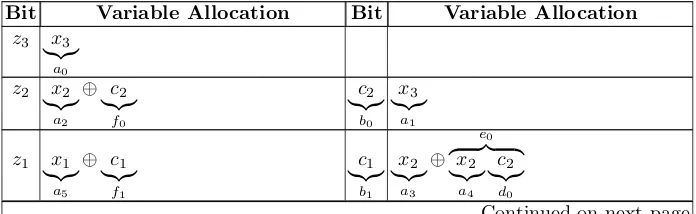
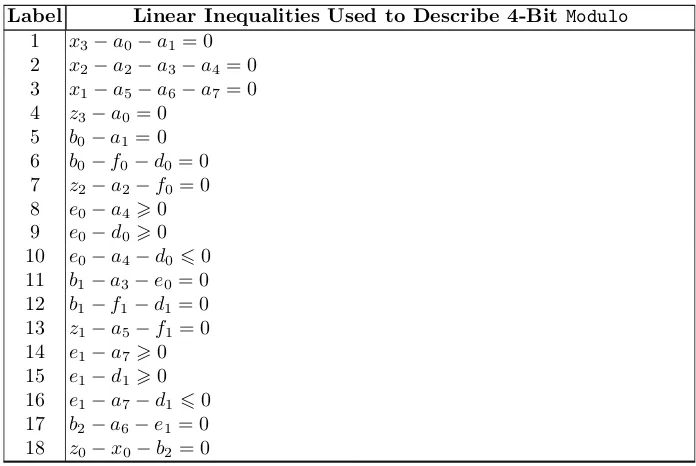
Note that all the operations involvingki’s areXORandAND. It is already known to us thatXORing with a constant does not influence the division property, and Proposition 1 indicates that the operation of AND with a constant can be ignored when we trace the bit-based division property. Thus (3) can be trans-formed into a much simpler look, which can be found inTable 4. InTable 4, we wipe all those operations comprising ki’s, and it is sufficient to construct MILP model for these reduced expressions. Again, some auxiliary variables need to be involved to describe the propagation of bit-based division property, and a0 ∼a7,b0∼b2,f0∼f1,d0 ∼d1, ande0∼e1 are introduced for this reason. The allocation of variables for 4-bitModulooperation with a constant also giv-en in Table 4. A similar analysis like the one in Section 3.1 gives the linear inequality system used to describe the bit-based division property propagation forModulooperation with a constant, which can be found inTable 5.
Table 4: Allocation of Intermediate Variables for 4-bitModuloOperation with a Constant.
Bit Variable Allocation Bit Variable Allocation z3 x3
|{z} a0 z2 x2 |{z}
a2
⊕ c2
|{z} f0
c2 |{z}
b0 x3 |{z}
a1 z1 x1
|{z} a5
⊕ c1
|{z} f1
c1 |{z}
b1 x2 |{z}
a3
⊕
e0 zx2}| { |{z}
a4 c2 |{z}
d0
Table 4 – continued from previous page
Bit Variable Allocation Bit Variable Allocation
z0 x0⊕c0 c0
|{z} b2
x1 |{z}
a6
⊕
e1 zx1}| { |{z}
a7 c1 |{z}
d1
Table 5: Linear Inequality System for 4-bitModuloOperation with a Constant.
Label Linear Inequalities Used to Describe 4-Bit Modulo 1 x3−a0−a1= 0
2 x2−a2−a3−a4= 0 3 x1−a5−a6−a7= 0 4 z3−a0= 0
5 b0−a1= 0 6 b0−f0−d0= 0 7 z2−a2−f0= 0 8 e0−a4>0 9 e0−d0>0 10 e0−a4−d060 11 b1−a3−e0= 0 12 b1−f1−d1= 0 13 z1−a5−f1= 0 14 e1−a7>0 15 e1−d1>0 16 e1−a7−d160 17 b2−a6−e1= 0 18 z0−x0−b2= 0
Thus, with the methods explained in Section 3.1, Section 3.2 and Sec-tion3.3, we are sufficient to construct MILP models for some ARX-based prim-itives, and these models can help us search integral distinguishers with MILP optimizer. The applications of MILP-aided bit-based division property are pro-vided inSection4.
4
Applications of MILP-Aided Bit-Based Division
Property for Some ARX-Based Block Ciphers
4.1 MILP-Aided Bit-Based Division Property for HIGHT
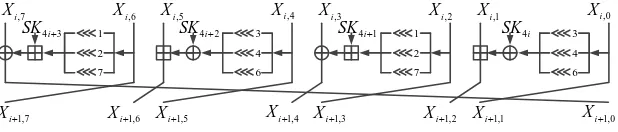
HIGHT [6] HIGHT is an ARX-based block cipher with 64-bit block length and 128-bit key length. The 64-bit plaintext and ciphertext are considered as concate-nations of 8 bytes and denote byP =P7kP6k · · · kP0 andC =C7kC6k · · · kC0, respectively. The 64-bit intermediate values are analogously represented asXi= Xi,7kXi,6k · · · kXi,0 fori= 0,1, . . . ,32. The 128-bit master key is considered as a concatenation of 16 bytes and is denoted byM K=M K15kM K14k · · · kM K0. The key schedule of HIGHT consists of two algorithms,WhiteningKeyGeneration which generates 8 whitening key bytes W K0, W K1, . . . , W K7, and the func-tion calledSubkeyGenerationgenerates 128 subkey bytesSK0, SK1, . . . , SK127. Each round function uses 4 subkey bytes SK4i, SK4i+1, SK4i+2, SK4i+3. It is important to note that the distinguishers we found in this paper for HIGHT does not include the initial transformation and the final transformation which load the whitening-key into the cipher. The basic structure of one round HIGHT encryption is depicted inFig.1.
1 2 7
3 4 6
1 2 7
3 4 6
,7
i
X Xi,6 Xi,5 Xi,4 Xi,3 Xi,2 Xi,1 Xi,0
1,7
i
X Xi1,6 Xi1,5 Xi1,4 Xi1,3 Xi1,2 Xi1,1 Xi1,0 4i3
SK SK4i2 SK4i1 SK4i
Fig. 1: Round Function of HIGHT.
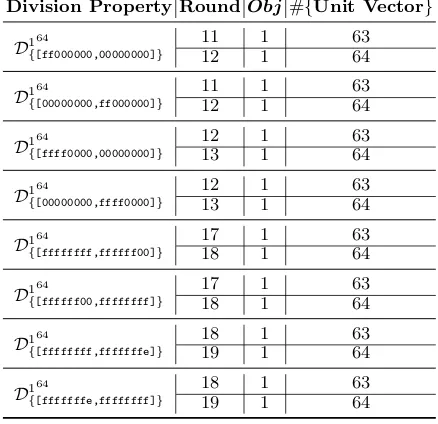
Former Results The designers [6] showed that there exist 12-round integral distinguishers with data complexity 28. But Zhang et al. [18] pointed out and corrected an error in the round distinguishers, and showed that the former 12-round distinguisher was only a 11-12-round one. They also proposed some 12-12-round and 17-round distinguishers.
Table 6: Summarization of Experimental Results for HIGHT. Division Property RoundObj #{Unit Vector}
D164
{[ff000000,00000000]}
11 1 63
12 1 64
D164
{[00000000,ff000000]}
11 1 63
12 1 64
D164
{[ffff0000,00000000]}
12 1 63
13 1 64
D164
{[00000000,ffff0000]}
12 1 63
13 1 64
D164
{[ffffffff,ffffff00]}
17 1 63
18 1 64
D164
{[ffffff00,ffffffff]}
17 1 63
18 1 64
D164
{[ffffffff,fffffffe]}
18 1 63
19 1 64
D164
{[fffffffe,ffffffff]}
18 1 63
19 1 64
Division Property: The initial division property. #{Unit Vector}: The number of unit vectors in the resulting division property.
1 0 i RK 1 1 i RK 9 1 2 i RK 1 3 i RK 1 4 i RK 1 5 i RK 5 3 1 0 i
X 1
1
i
X 1
2
i
X 1
3 i X 0 i X 1 i X 2 i X 3 i X
4.2 MILP-Aided Bit-Based Division Property for LEA
LEA [5] LEA is an ARX-based block cipher designed by Hong et al.and pro-vides a high speed software encryption on general-purpose processors. The block size is 128 bits and the key size can take 128, 192, or 256 bits. The number of roundsris 24 for 128-bit keys, 28 for 192-bit keys, and 32 for 256-bit keys. The encryption of LEA maps a plaintext of four 32-bit wordsX0= (X0
0, X10, X20, X30) to a ciphertextXr= (Xr
0, X1r, X2r, X3r). The round function for LEA is illustrat-ed in Fig. 2, where RK0i−1, RK1i−1, RK2i−1, RK3i−1, RK4i−1, and RK5i−1 are subkeys used in thei-th round.
Since XORing with a constant does not affect the propagation of division property, we do not consider the operation ofXORwith subkeys. The key schedule is left behind. For more information about LEA, please refer to [5].
Former Results A 6-round integral distinguisher is proposed in [2], whose data complexity is 232.
Applying MILP-Aided Bit-Based Division Property to LEA We inte-grate theModulomodel introduced inSection3.1into the construction of MILP model used to depict bit-based division property propagation for LEA. Different initial division properties are loaded into the MILP model and the experimen-tal results can be found inTable 7. Table 7indicates that there is a 7-round distinguisher with data complexity 296, which attains one more round than the one provided in [2]. The specific expressions of these newly found distinguishers are given in Appendix B.2.
Table 7: Summarization of Experimental Results for LEA. Division Property RoundObj #{Unit Vector}
D1128
{[ffffffff,00000000,00000000,00000000]}
6 1 127
7 1 128
D1128
{[00000000,00000000,00000000,ffffffff]}
6 1 126
7 1 128
D1128
{[00000000,ffffffff,ffffffff,ffffffff]}
7 1 127
8 1 128
Division Property: The initial division property.
#{Unit Vector}: The number of unit vectors in the resulting division property.
4.3 MILP-Aided Bit-Based Division Property for TEA and XTEA
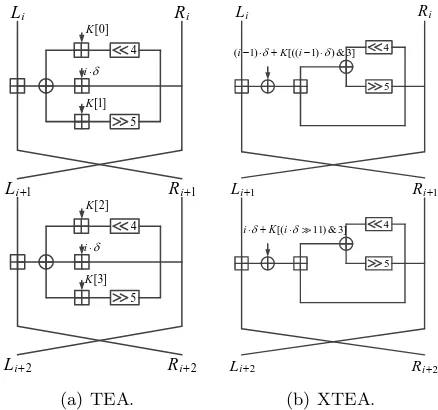
wordsK[0],K[1],K[2], andK[3]. TEA does not have any key schedule and the key words are used directly in round functions. For XTEA, the derivation of the subkey word number is slightly more complex. The round constant is derived from the constant δ =9e3779b9and the round number. Denote the plaintext by P = (PL, PR), the ciphertext by C = (CL, CR), and the input of the i-th round by (Li, Ri). The round functions of two contiguous rounds for TEA and XTEA are illustrated inFig. 3(a)andFig. 3(b), respectively.
4
5
i
L Ri
1
i
L Ri1
[0]
K
[1]
K i
4
5
2
i
L Ri2
[2]
K
[3]
K i
(a) TEA.
5 4
i
L Ri
1
i
L Ri1
(i 1) K[((i 1)) & 3]
5 4
2
i
L Ri2
[( 11) & 3]
i K i
(b) XTEA.
Fig. 3: Illustrations of TEA and XTEA.
Former Results At FSE 2012, Bogdanov and Wang [3] proposed a 15-round zero-correlation linear approximation for TEA/XTEA. By utilizing the equiv-alence between zero-correlation linear cryptanalysis and integral cryptanalysis for ARX-based block ciphers proposed by Wen and Wang [15], this approxima-tion can be equivalently transformed into a 15-round integral distinguisher for TEA/XTEA with data complexity 263.
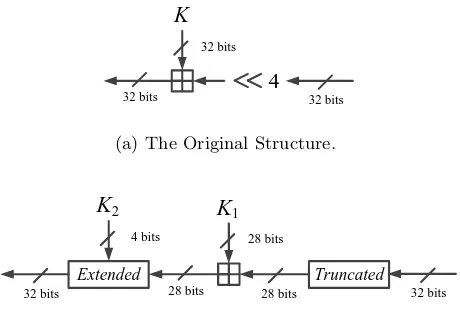
Considering the Combination of Left Shift Operation and Modulo Op-eration Let the input and the output ofFig.4(a)bex= (x0, x1, . . . , x31) and z= (z0, z1, . . . , z31), respectively. Thenz= (x4)K. More specifically, we have
(z0, z1, . . . , z31) = (x0, x1, . . . , x27,0, . . . ,0 | {z }
4
)(K0, K1, . . . , K31).
Combining the fact with the iterated expression of 32-bit Modulo operation, we know that the output bits zi’s and the input bits xi’s satisfy the relations listed in (4). From (4), we find that the output z can be treat as the con-catenation of two parts, i.e., z = (x0K1)kK2, where x0 = (x0, x1, . . . , x27), K1 = (K0, K1, . . . , K27), K2 = (K28, K29, K30, K31), and K=K1kK2. Thus, the original structure in TEA’s round function can be equivalently transformed into the structure illustrated inFig.4(b). The functions used inFig. 4(b)are explained as follows.
– T runcated is a function and its output is equal to (x0, x1, . . . , x27) if the input is (x0, x1, . . . , x31).
– Extendedis a function taking two branches of inputs, which are respectively denoted as (x0, x1, . . . , x27) and (k0, k1, k2, k3), and output is equal to
(x0, x1, . . . , x27, k0, k1, k2, k3).
After transformation, the MILP model can be constructed in an general way.
z31=K31 z30=K30 z29=K29 z28=K28 z27=x27⊕K27
z26=x26⊕K26⊕c5, c5 =x27K27
z25=x25⊕K25⊕c6, c6 =x26K26⊕(x26⊕K26)c5 z24=x24⊕K24⊕c7, c7 =x25K25⊕(x25⊕K25)c6
· · ·
z1 =x1⊕K1⊕c30, c30=x2K2⊕(x2⊕K2)c29 z0 =x0⊕K0⊕c31, c31=x1K1⊕(x1⊕K1)c30
(4)
Considering the Combination of Right Shift Operation and Modulo
Operation Let the input and output of Fig.5(a)bex= (x0, x1, . . . , x31) and z= (z0, z1, . . . , z31), respectively. Thenz= (x5)K,i.e.,
(z0, z1, . . . , z31) = (0, . . . ,0 | {z }
5
, x0, x1, . . . , x26)(K0, K1, . . . , K31).
4
32 bits
K
32 bits
32 bits
(a) The Original Structure.
32 bits
K
128 bits
28 bits
Truncated
28 bits
Extended
K
24 bits
32 bits
(b) The Equivalently Transformed Structure.
Fig. 4: Illustrations of Equivalent Transformation for Left Shift.
follow, which are provided in (5).
z31=x26⊕K31
z30=x25⊕K30⊕c1, c1 =x26K31
z29=x24⊕K29⊕c2, c2 =x25K30⊕(x25⊕K30)c1 z28=x23⊕K28⊕c3, c3 =x24K29⊕(x24⊕K29)c2
· · ·
z5 =x0⊕K5⊕c26, c26=x1K6⊕(x1⊕K6)c25 z4 =K4⊕c27, c27=K5c26
z3 =K3⊕c28, c28=K4c27 z2 =K2⊕c29, c29=K3c28 z1 =K1⊕c30, c30=K2c29 z0 =K0⊕c31, c31=K1c30
(5)
With (5), we can construct MILP model in the usual fashion. Also note that the original structure shown in Fig. 5(a) can be changed into an equivalent form, which can be found in Fig. 5(b). The function named T runF ill operates as follows.
(0, . . . ,0 | {z }
5
, x0, x1, . . . , x26) =T runF ill(x0, x1, . . . , x31).
5
32 bits
K
32 bits
32 bits
(a) The Original Structure.
32 bits
K
32 bits
32 bits
TruncFill
32 bits
(b) The Equivalently Transformed Structure.
Fig. 5: Illustrations of Equivalent Transformation for Right Shift.
zero-sum bit while reducing the data complexity by half. At the same time, the newly obtained distinguisher with data complexity 263gains one more zero-sum bit than the previously proposed one. The concrete expressions of these newly obtained distinguishers can be found inAppendix B.3and Appendix B.4.
Table 8: Summarization of Experimental Results for TEA and XTEA. Cipher Division Property RoundObj#{Unit Vector}
TEA/XTEA D164
{[ffffffff,fffffffc]}
15 1 63
16 1 64
D164
{[ffffffff,fffffffe]}
15 1 62
16 1 64
Division Property: The initial division property.
#{Unit Vector}: The number of unit vectors in the resulting division property.
4.4 MILP-Aided Bit-Based Division Property for KATAN and KTANTAN
The integral structure of KATAN/KTANTAN consists of two LFSR’s, called L1 and L2, loaded with the plaintext and then transformed by two nonlinear Boolean functions,fa andfb as follows.
fa(L1) =L1[x1]⊕L1[x2]⊕(L1[x3]∧L1[x4])⊕(L1[x5]∧IR)⊕ka fb(L2) =L2[y1]⊕L2[y2]⊕(L2[y3]∧L2[y4])⊕(L2[y5]∧L2[y6])⊕kb
For KATAN/KTANTAN48, in one round of the cipher the functions fa and fb are applied twice. The first pair of fa and fb is applied, and then after the update of the registers, they are applied again, using the same subkeys. In KATAN/KTANTAN64, each round applies fa and fb three times (again, with the same key bits).IRused infa represents irregular update rule,i.e.,L1[x5] is XORed in the rounds where the irregular update is used.IR’s are the output of an LFSR.
Since the subkey is involved in the ciphers by theXORoperation andXORing with constants does not affect the propagation of division property, we do not introduce the key schedules of KATAN and KTANTAN here. Note that this fact also indicates that the integral distinguishers found by using bit-based division property hold not only for KATAN but also for KTANTAN. Also by the Propo-sition 1, we can ignore the operation of ANDwith a constant. So the definition of IRis also left behind. For more details of KATAN/KTANTAN, please refer to [4].
Applying MILP-Aided Bit-Based Division Property to KATAN and KTANTAN We construct the MILP models and analyze the integral properties for different versions of KATAN/KTANTAN. Different initial division properties are inserted into the MILP model and the experimental results are listed in Table9, which shows that the longest distinguishers for KATAN/KTANTAN32, 48, and 64 are 99-round, 83.5-round, and 72.3-round, respectively. The concrete forms of these distinguishers are provided in Appendix B.5.
5
Conclusion
Table 9: Summarization of Experimental Results for KATAN/KTANTAN. Cipher Division Property RoundObj#{Unit Vector}
KATAN/KTANTAN32
D132
{[3fffffff]}
88
1
29
89 30
90 31
91 32
D132
{[7fffffff]}
97
1
29
98 30
99 31
100 32
KATAN/KTANTAN48† D148
{[3fffff,ffffff]}
76
1
45
76.5 46
77 47
77.5 48
D148
{[7fffff,ffffff]}
82.5
1
45
83 46
83.5 47
84 48
KATAN/KTANTAN64† D164
{[3fffffff,ffffffff]}
66.6
1
61
67 62
67.3 63
67.6 64
D164
{[7fffffff,ffffffff]}
71.6
1
61
72 62
72.3 63
72.6 64
Division Property: The initial division property.
#{Unit Vector}: The number of unit vectors in the resulting division prop-erty.
†
Note that one round of KATAN/KTANTAN32 and KATAN/KTANTAN64 apply the functionsfa and fb twice and thrice, respectively. 0.5-round for KATAN/KTANTAN48 indicates thatfa and fb are used once. 0.3-round and 0.6-round for KATAN/KTANTAN64 can be explained similarly.
References
1. Ray Beaulieu, Douglas Shors, Jason Smith, Stefan Treatman-Clark, Bryan Weeks, and Louis Wingers. The SIMON and SPECK lightweight block ciphers. In Pro-ceedings of the 52nd Annual Design Automation Conference, San Francisco, CA, USA, June 7-11, 2015, pages 175:1–175:6, 2015.
2. A. Bogdanov, K. Varici, N. Mouha, V. Velichkov, E. Tischhauser, M. Wang, D. Toz, Q. Wang, and V. Rijmen. Security evaluation of the block cipher lea. Technical report, Technical report, July, 2011.
3. Andrey Bogdanov and Meiqin Wang. Zero correlation linear cryptanalysis with reduced data complexity. InFast Software Encryption - 19th International Work-shop, FSE 2012, Washington, DC, USA, March 19-21, 2012. Revised Selected Pa-pers, pages 29–48, 2012.
4. Christophe De Canni`ere, Orr Dunkelman, and Miroslav Knezevic. KATAN and KTANTAN - A family of small and efficient hardware-oriented block ciphers. In Cryptographic Hardware and Embedded Systems - CHES 2009, 11th International Workshop, Lausanne, Switzerland, September 6-9, 2009, Proceedings, pages 272– 288, 2009.
5. Deukjo Hong, Jung-Keun Lee, Dong-Chan Kim, Daesung Kwon, Kwon Ho Ryu, and Donggeon Lee. LEA: A 128-bit block cipher for fast encryption on com-mon processors. InInformation Security Applications - 14th International Work-shop, WISA 2013, Jeju Island, Korea, August 19-21, 2013, Revised Selected Papers, pages 3–27, 2013.
6. Deukjo Hong, Jaechul Sung, Seokhie Hong, Jongin Lim, Sangjin Lee, Bonseok Koo, Changhoon Lee, Donghoon Chang, Jaesang Lee, Kitae Jeong, Hyun Kim, Jongsung Kim, and Seongtaek Chee. HIGHT: A new block cipher suitable for low-resource device. InCryptographic Hardware and Embedded Systems - CHES 2006, 8th International Workshop, Yokohama, Japan, October 10-13, 2006, Proceedings, pages 46–59, 2006.
7. Mitsuru Matsui. New block encryption algorithm MISTY. InFast Software En-cryption, 4th International Workshop, FSE ’97, Haifa, Israel, January 20-22, 1997, Proceedings, pages 54–68, 1997.
8. Roger M Needham and David J Wheeler. Tea extensions. Report, Cambridge University, Cambridge, UK (October 1997), 1997.
9. Ling Sun and Meiqin Wang. Towards a further understanding of bit-based division property. IACR Cryptology ePrint Archive, 2016:392, 2016.
10. Ling Sun, Wei Wang, and Meiqin Wang. Milp-aided bit-based division property for primitives with non-bit-permutation linear layers. IACR Cryptology ePrint Archive, 2016:811, 2016.
11. Yosuke Todo. Integral cryptanalysis on full MISTY1. InAdvances in Cryptology -CRYPTO 2015 - 35th Annual Cryptology Conference, Santa Barbara, CA, USA, August 16-20, 2015, Proceedings, Part I, pages 413–432, 2015.
12. Yosuke Todo. Structural evaluation by generalized integral property. InAdvances in Cryptology - EUROCRYPT 2015 - 34th Annual International Conference on the Theory and Applications of Cryptographic Techniques, Sofia, Bulgaria, April 26-30, 2015, Proceedings, Part I, pages 287–314, 2015.
14. Qingju Wang, Zhiqiang Liu, Kerem Varici, Yu Sasaki, Vincent Rijmen, and Yosuke Todo. Cryptanalysis of reduced-round SIMON32 and SIMON48. In Progress in Cryptology - INDOCRYPT 2014 - 15th International Conference on Cryptology in India, New Delhi, India, December 14-17, 2014, Proceedings, pages 143–160, 2014. 15. Long Wen and Meiqin Wang. Integral zero-correlation distinguisher for ARX block cipher, with application to SHACAL-2. In Information Security and Privacy -19th Australasian Conference, ACISP 2014, Wollongong, NSW, Australia, July 7-9, 2014. Proceedings, pages 454–461, 2014.
16. David J. Wheeler and Roger M. Needham. Tea, a tiny encryption algorithm. In Fast Software Encryption: Second International Workshop. Leuven, Belgium, 14-16 December 1994, Proceedings, pages 363–366, 1994.
17. Zejun Xiang, Wentao Zhang, Zhenzhen Bao, and Dongdai Lin. Applying MILP method to searching integral distinguishers based on division property for 6 lightweight block ciphers. IACR Cryptology ePrint Archive, 2016:857, 2016. 18. Peng Zhang, Bing Sun, and Chao Li. Saturation attack on the block cipher HIGHT.
In Cryptology and Network Security, 8th International Conference, CANS 2009, Kanazawa, Japan, December 12-14, 2009. Proceedings, pages 76–86, 2009.
A
Experiments on Small-SPECK
To verify the validity of our newly proposed model for the Modulo operation. We do some experiments on a toy example calledSmall-SPECK.
A.1 A Brief Introduction of Small-SPECK
Small-SPECK is an ARX-based block cipher. The block size of Small-SPECK is 8-bit. The subkeys used in Small-SPECK are randomly generated. The round function of Small-SPECK is illustrated inFig. 6, where (Xi
L, X i
R) is the input of thei-th round,ki is the subkey used in thei-th round.
2
1
ki
i L
X i
R X
1
i L
X i1
R X
A.2 Experimental Procedures and Experimental Results
The experimental procedures are listed below.
1. For different initial division properties, we first use MILP-aided bit-based division property to find zero-sum bits of each round.
2. We randomly generate 210 subkeys and exhaustively search zero-sum bits just like what have done for SIMON in [14].
3. By comparison, we check whether the zero-sum bits found by using MILP-aided bit-based division property are indeed zero-sum bits or not.
The comparison of zero-sum bits found by MILP-aided bit-based division prop-erty and those found by exhaustively searching under different input multi-sets is shown inTable 10. FromTable 10, we know that the zero-sum bits found by MILP-aided bit-based division property indeed satisfy zero-sum property. And the Modulo model proposed in this paper is a valid method to help us to construct integral distinguishers for ARX-based block ciphers.
B
Summarization of Integral Distinguishers
In this section, we will adopt the following symbols to present the newly obtained integral distinguishers. ‘Ai’ represents ani-bit vector with every bit active. ‘Bi’ denotes ani-bit vector with every bit satisfying zero-sum property. ‘Ci’ indicates ani-bit vector with every bit being constant. ‘Ui’ means ani-bit vector and the properties of its internal bits are unknown.
B.1 Integral Distinguishers for HIGHT
11-Round Integral Distinguisher with Data Complexity28
(A8,C8,C8,C8,C8,C8,C8,C8) 11 Rounds
−−−−−−→(U8,U8,U8,U8,U7B1,U8,U8,U8)
11-Round Integral Distinguisher with Data Complexity28
(C8,C8,C8,C8,A8,C8,C8,C8)−−−−−−→11 Rounds (U7B1,U8,U8,U8,U8,U8,U8,U8)
12-Round Integral Distinguisher with Data Complexity216
(A8,A8,C8,C8,C8,C8,C8,C8) 12 Rounds
−−−−−−→(U8,U8,U8,U8,U7B1,U8,U8,U8)
12-Round Integral Distinguisher with Data Complexity216
(C8,C8,C8,C8,A8,A8,C8,C8)−−−−−−→12 Rounds (U7B1,U8,U8,U8,U8,U8,U8,U8)
17-Round Integral Distinguisher with Data Complexity256
(A8,A8,A8,A8,A8,A8,A8,C8) 17 Rounds
Table 10: Comparison of Zero-Sum Bits Found by Using Two Methods for Small-SPECK
Input RoundMILP-Aided Bit-Based Theory Exhaustively Searching Obj #{Bits} Bits #{Bits} Bits
D18
{[01111111]}
1 6 8 0∼7 8 0∼7
2 3 8 0∼7 8 0∼7
3 1 6 1∼3, 5∼7 6 1∼3, 5∼7
4 1 1 3 1 3
5 1 0 − 0 −
D18
{[11111110]}
1 7 8 0∼7 8 0∼7
2 4 8 0∼7 8 0∼7
3 1 6 1∼3, 5∼7 6 1∼3, 5∼7
4 1 1 3 3 2∼3,6
5 1 0 − 0 −
D18
{[00001111]}
1 2 8 0∼7 8 0∼7
2 1 4 2∼3,6∼7 4 2∼3,6∼7
3 1 0 − 0 −
D18
{[11110000]}
1 4 8 0∼7 8 0∼7
2 2 8 0∼7 8 0∼7
3 1 2 3,7 2 3,7
4 1 0 − 0 −
D18
{[11111000]}
1 5 8 0∼7 8 0∼7
2 2 8 0∼7 8 0∼7
3 1 4 2∼3,6∼7 4 2∼3,6∼7
4 1 0 − 0 −
D18
{[11111000]}
1 6 8 0∼7 8 0∼7
2 3 8 0∼7 8 0∼7
3 1 6 1∼3,5∼7 6 1∼3,5∼7
4 1 1 3 1 3
5 1 0 − 0 −
Input: The division property of the input multi-set. Obj: The value of the objective function.
17-Round Integral Distinguisher with Data Complexity256
(A8,A8,A8,C8,A8,A8,A8,A8)−−−−−−→17 Rounds (U7B1,U8,U8,U8,U8,U8,U8,U8)
18-Round Integral Distinguisher with Data Complexity263
(A8,A8,A8,A8,A8,A8,A8,A7C1) 18 Rounds
−−−−−−→(U8,U8,U8,U8,U7B1,U8,U8,U8)
18-Round Integral Distinguisher with Data Complexity263
(A8,A8,A8,A7C1,A8,A8,A8,A8) 18 Rounds
−−−−−−→(U7B1,U8,U8,U8,U8,U8,U8,U8)
B.2 Integral Distinguishers for LEA
6-Round Integral Distinguisher with Data Complexity232
(A32,C32,C32,C32) 6 Rounds
−−−−−−→(U32,U4B1U27,U32,U32)
6-Round Integral Distinguisher with Data Complexity232
(C32,C32,C32,A32) 6 Rounds
−−−−−−→(U32,U3B2U27,U32,U32)
7-Round Integral Distinguisher with Data Complexity296
(C32,A32,A32,A32) 7 Rounds
−−−−−−→(U32,U4B1U27,U32,U32)
B.3 Integral Distinguishers for TEA
15-Round Integral Distinguisher with Data Complexity262
(A32,A30C2) 15 Rounds
−−−−−−→(U31B1,U32)
15-Round Integral Distinguisher with Data Complexity263
(A32,A31C1) 15 Rounds
−−−−−−→(U30B2,U32)
B.4 Integral Distinguishers for XTEA
15-Round Integral Distinguisher with Data Complexity262
(A32,A30C2) 15 Rounds
−−−−−−→(U31B1,U32)
15-Round Integral Distinguisher with Data Complexity263
(A32,A31C1) 15 Rounds
B.5 Integral Distinguishers for KATAN/KTANTAN Family of Block Ciphers
Integral Distinguisher for KATAN/KTANTAN32
88-Round Integral Distinguisher with Data Complexity230
(C2A6,A8,A8,A8)−−−−−−→88 Rounds (U8,U8,B3U5,U8)
89-Round Integral Distinguisher with Data Complexity230
(C2A6,A8,A8,A8)−−−−−−→89 Rounds (U8,U8,U1B2U5,U8)
90-Round Integral Distinguisher with Data Complexity230
(C2A6,A8,A8,A8)−−−−−−→90 Rounds (U8,U8,U2B1U5,U8)
97-Round Integral Distinguisher with Data Complexity231
(C1A7,A8,A8,A8)−−−−−−→97 Rounds (U8,U8,B3U5,U8)
98-Round Integral Distinguisher with Data Complexity231
(C1A7,A8,A8,A8)−−−−−−→98 Rounds (U8,U8,U1B2U5,U8)
99-Round Integral Distinguisher with Data Complexity231
(C1A7,A8,A8,A8)−−−−−−→99 Rounds (U8,U8,U2B1U5,U8)
Integral Distinguisher for KATAN/KTANTAN48
76-Round Integral Distinguisher with Data Complexity246
(C2A10,A12,A12,A12) 76 Rounds
−−−−−−→(U12,U12,U2B3U7,U12)
76.5-Round Integral Distinguisher with Data Complexity246
(C2A10,A12,A12,A12) 76.5 Rounds
−−−−−−−−→(U12,U12,U3B2U7,U12)
77-Round Integral Distinguisher with Data Complexity246
(C2A10,A12,A12,A12) 77 Rounds
−−−−−−→(U12,U12,U4B1U7,U12)
77.5-Round Integral Distinguisher with Data Complexity247
(C1A11,A12,A12,A12) 77.5 Rounds
78-Round Integral Distinguisher with Data Complexity247
(C1A11,A12,A12,A12) 78 Rounds
−−−−−−→(U12,U12,U3B2U7,U12)
78.5-Round Integral Distinguisher with Data Complexity247
(C1A11,A12,A12,A12)−−−−−−−−→78.5 Rounds (U12,U12,U4B1U7,U12)
Integral Distinguisher for KATAN/KTANTAN64
66.6-Round Integral Distinguisher with Data Complexity262
(C2A14,A16,A16,A16)−−−−−−−−→66.6 Rounds (U16,U16,U4B3U9,U16)
67-Round Integral Distinguisher with Data Complexity262
(C2A14,A16,A16,A16) 67 Rounds
−−−−−−→(U16,U16,U5B2U9,U16)
67.3-Round Integral Distinguisher with Data Complexity262
(C2A14,A16,A16,A16)−−−−−−−−→67.3 Rounds (U16,U16,U6B1U9,U16)
71.6-Round Integral Distinguisher with Data Complexity263
(C1A15,A16,A16,A16) 71.6 Rounds
−−−−−−−−→(U16,U16,U4B3U9,U16)
72-Round Integral Distinguisher with Data Complexity263
(C1A15,A16,A16,A16)−−−−−−→72 Rounds (U16,U16,U5B2U9,U16)
72.3-Round Integral Distinguisher with Data Complexity263