ISSN(Online): 2320-9801
ISSN (Print): 2320-9798
I
nternational
J
ournal of
I
nnovative
R
esearch in
C
omputer
and
C
ommunication
E
ngineering
(An ISO 3297: 2007 Certified Organization)
Vol. 3, Issue 4, April 2015
EABPF: Efficient Algorithm to Overcome
Battery Power Failures in Mobile Ad Hoc
Networks
Thota Subhashini, Reeshma K
M.Tech Student (CNE), Dept of ISE, The Oxford College of Engineering, Bangalore, India
Assistant Professor, Dept of ISE, The Oxford College of Engineering, Bangalore, India
ABSTRACT: Wireless mobile devices such as high-end cell phones, PDAs, portable gaming devices, tablet PCs etc. all having wireless networking capabilities have a tremendous increase in recent years. These devices when used in Mobile Ad Hoc Networks (MANETs) may extend their capabilities, e.g., to reach the Internet when no Wi-Fi base stations are within range, or to have communication with each other over multiple hops when no other networking infrastructure is provided. Major problem of continuous participation in a MANET is energy consumption which is the main characteristic of MANETs. Wireless devices mentioned are battery powered and since energy is a rare resource and the devices are mobile, optimization of energy consumption in MANETs has greater impact as it directly corresponds to lifetime of networks. In cooperative MANETs, data replication is done on different mobile devices in order to improve system‟s availability. A master node is assigned to act as a coordinator for the data copies that are shared among the mobile nodes. When this master node failure occurs, another node has to be elected to replace the failed one. Since mobile devices have a limited battery power, the master node may fail at any time. Moreover, current master node election protocols in MANETs employ a notable wireless communication overhead which consumes a considerable amount of battery power. An Efficient algorithm to overcome battery power failures in MANETs(EABPF) is proposed to replace the exhausted master node before its battery dies with a healthy node with much less communication overhead thus overcoming the battery power failures in MANETs .
KEYWORDS
:
Mobile Ad Hoc Networks, Replication in MANETs, Master node election.I. INTRODUCTION
A MANET that stands for Mobile Ad Hoc Network is a set of nodes in mobile which can communicate via message passing over wireless links [1]. Nodes having same transmission range can communicate directly with each other. If it is not the case, they communicate via other intermediate nodes [4, 12]. In Many mobile applications, mobile users share information known as collaborative work such as rescue operations at a disaster site, collaborative multimedia applications, multi-user games and robotic pets entertainment, and collaborative white board in a university campus. For such applications, improving data availability, accessibility, and consistency plays crucial role.
ISSN(Online): 2320-9801
ISSN (Print): 2320-9798
I
nternational
J
ournal of
I
nnovative
R
esearch in
C
omputer
and
C
ommunication
E
ngineering
(An ISO 3297: 2007 Certified Organization)
Vol. 3, Issue 4, April 2015
having power shortage by measuring its remaining battery power, before it fails. EABPF replaces the master node that got exhausted with a node that is healthy when its remaining battery power reaches a threshold value that is predefined. Very less communication overhead is incurred with this EABPF algorithm. Hence, this approach has two major contributions: 1) Early detection of power failure thus reducing the chance of master node outage, 2) Increasing the lifetime of mobile nodes by saving the power when compared to that consumed by traditional master node election algorithms.
The rest of this paper is organized as follows: section II presents a literature survey and discusses related work, section III describes the system architecture that supports the idea of master node replacement algorithm, section IV introduces the proposed approach, section V evaluates the performance of this approach through simulation experimental results, finally section VI gives our conclusions and suggestions for future work. This paper extends our preliminary work introduced in [14].
II. LITERATURESURVEY
In general failures of master node can be of two types which may occur due to predictable or unpredictable events in MANETs. Unpredictable failures are the failures that cannot be known or predicted beforehand. Examples of unpredictable failures include hardware/software failure, network signal loss and disconnection due to mobility. Predictable failures are those which can be estimated or monitored .Examples of predictable failures include excessive energy consumption, unbalanced CPU utilization, or shortage of available memory. When master node failure occurs, a new master should be elected for maintaining data consistency and accessibility. Various algorithms study this master election problem in MANETs [1, 9, 10, 21, 22].We can divide these algorithms into two main categories. We describe them below:
Under normal operation, a simple heartbeat monitoring technique for detection of node failure is adopted by the first category of algorithms .Mobile nodes exchange simple “alive” messages continuously to indicate that nodes are functioning properly. If the master node‟s heartbeat gets ceased for a predefined set of time period, then an election algorithm is employed. These algorithms are presented in [8], and are classified as Non-Compulsory and Compulsory protocols. These protocols are not realistic as they require information exchange by nodes in order to elect a master node to act as a coordinator for the shared data copies. A Routing algorithm called Temporally Ordered Routing Algorithm, TORA [15] for routing the data in wireless mobile ad hoc networks is the basis for the algorithms presented in [10, 22, 1] in which node adjustment is acquired by employing a locally maintained variable, called the height. This local variable points to the master node, in a decrementing manner over a Directed Acyclic Graph (DAG). Another work [21] is presented for other master node election algorithm. Classical termination-detection algorithm for diffusing computations by Dijkstra and Scholten [2] is the basis for this algorithm. In this algorithm, each and every node should always maintain information dynamically about its neighborhood that is mobile .The master node which is a coordinator sends periodic heartbeat messages to other nodes. The absence of such messages at a particular node for certain amount of predefined time indicates a departure from the master node and a diffusing computation is triggered at that particular node to elect a new master. The algorithm in [11] presented a consensus–based master node election algorithm. This algorithm elects a local extreme as a master node. This algorithm can also be tuned to the global extreme of the network. In the global extreme of the network, all the nodes are visited instead of the majority.
Algorithms based on a game theory using Volunteers „Dilemma [9, 17] are employed in second category. In this, a replica sends a “ping” message to the master node, whenever it wants to update data copies. If there is no response from the master node within a time window (tw), the master node election algorithm is invoked. Otherwise, a message consisting of set of metrics indicating its health such as remaining battery life and the frequency of complete disconnection from the network are sent to the master node by the replica. Upon receiving all of the metrics, the master node would compute an ordered list of best candidates to take over as the new master node from all replicated nodes, and it should go off line. The new master node would then broadcast out its nearest neighborhood list to the replicating node. In the event that the master node should go offline the replicating nodes would ping the neighborhood list in order. The top one that responds would be the new master node.
ISSN(Online): 2320-9801
ISSN (Print): 2320-9798
I
nternational
J
ournal of
I
nnovative
R
esearch in
C
omputer
and
C
ommunication
E
ngineering
(An ISO 3297: 2007 Certified Organization)
Vol. 3, Issue 4, April 2015
been proposed for managing the planned master node outages without using traditional master node election protocol. MSR protocol shifts the master role from the current master to another replica that is scheduled, when a planned outage is about to occur. Experiments showed that MSR protocol reduces significantly number of communication messages to N+3 messages in which N is the number of nodes or replicas. The work proposed in this paper is inspired from MSR protocol and it is applicable in mobile environments.
III. SYSTEMARCHITECTURE
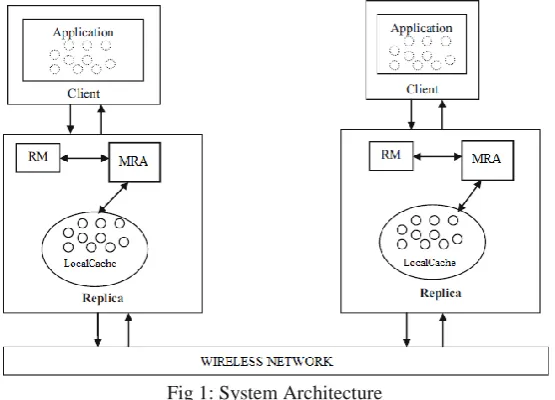
EABPF system architecture includes three major components as shown in Fig. 1: local object cache, clients and replicas. A local object cache is a set of data objects that are uniquely identified in memory and are replicated at each replica in the system. A client is the one that acts as an interface between applications and replicas .Through this , an application can add a new data object, update an existing one, or receive notifications on the objects. A transaction, Ttid (Otid, Mtid), can be defined as a procedure employing a set of methods called Mtid = {m1,…, mk}, in order to modify the states of a subset of objects Otid = {o1,..,oz}, in which tid refers to transaction ID. A procedure known as transaction procedure (TransProc) is sent by the application through the client interface to the replica and it is executed there. A client communicates through API with the replica such as add_object (Oi, Class), where Oi is a unique object identifier and Class is the class definition code, and trans (TransProc).
Fig 1: System Architecture
When a transaction call is received by the replica, it extracts the objects belonging to TansProc and try to reserve these objects through the master node replica. The master node controls object access permission via a lock_table which is a 3-field table containing the locked object ID, the ID of the replica requested to update/lock the object, and the active transaction ID. The total energy of nodes is spent in following modes: (1) Transmission Mode (2) Reception Mode (3) Idle Mode and (4) Overhearing Mode.
These modes of power consumption are described as:-
Transmission Mode
A node is said in transmission mode when it sends data packet to other nodes in network. These nodes require energy to transmit data packet, such energy is called Transmission Energy (Tx), of that nodes. Transmission energy is depended on size of data packet (in Bits), means when the size of a data packet is increased the required transmission energy is also increased. The transmission energy can be formulated as:
Tx = (330*Plength)/2*106 And P
ISSN(Online): 2320-9801
ISSN (Print): 2320-9798
I
nternational
J
ournal of
I
nnovative
R
esearch in
C
omputer
and
C
ommunication
E
ngineering
(An ISO 3297: 2007 Certified Organization)
Vol. 3, Issue 4, April 2015
Where Tx is transmission Energy, P
T is Transmission Power, Tt is time taken to transmit data packet and
Plengthis length of data packet in Bits.
Reception Mode
When a node receives a data packet from other nodes then it said to be in Reception Mode and the energy taken to receive packet is called Reception Energy (Rx). Then Reception Energy can be given as:
R
x = (230* Plength)/2*10 6
And P
R = Rx / Tr
Where R
x is a Reception Energy, PR is a Reception Power, Tr is a time taken to receive data packet, and
Plength is length of data packet in Bits.
Idle Mode
In this mode, generally the node is neither transmitting nor receiving any data packets. But this mode consumes power because the nodes have to listen to the wireless medium continuously in order to detect a packet that it should receive, so that the node can then switch into receive mode from idle mode.
Despite the fact that while in idle mode the node does not actually handle data communication operations, it was found that the wireless interface consumes a considerable amount of energy nevertheless. This amount approaches the amount that is consumed in the receive operation. Idle energy is a wasted energy that should be eliminated or reduced. Then power consumed in Idle Mode is:
P
I = PR
Where P
I is power consumed in Idle Mode and PR is power consumed in Reception Mode. Overhearing Mode
When a node receives data packets that are not destined for it, then it said to be in over-hearing mode, and it may consume the energy used in receiving mode. Unnecessarily receiving such packets will cause energy consumption. Then power consumed in overhearing mode is:
P
over = PR
Where P
over is power consumed in Overhearing Mode and PR is power consumed in Reception Mode.
In our algorithm, a transaction may be active (under processing), committed (finish processing), or aborted (cancel processing) at the replica. A notification is used to refer a response to a request from replica to client such as trans_abort and trans_commit or from replica to another replica such as ok_lock/ko_lock. In this algorithm, replica is the crucial component in the system and it is uniquely identified by a parameter replica reference Rm. Replica reference Rm has two main roles: 1) It executes client‟s requests and notifies clients on the results of these requests e.g., it manages and coordinates transactions issued from the connected client(s); 2) the master node replica owns the whole local object cache, it gives privileges or permission to lock/unlock object(s). We assume the following:
Each client is connected to single replica.
Asynchronous message communication is used by replicas in a Mobile Ad hoc Network(MANET)
A replica does not crash and even the network does not crash as the replicas work in a fault free environment.
Replicas have a resource manager (RM) to notifies them when a predefined battery level is reached
IV. PROPOSEDAPPROACH
ISSN(Online): 2320-9801
ISSN (Print): 2320-9798
I
nternational
J
ournal of
I
nnovative
R
esearch in
C
omputer
and
C
ommunication
E
ngineering
(An ISO 3297: 2007 Certified Organization)
Vol. 3, Issue 4, April 2015
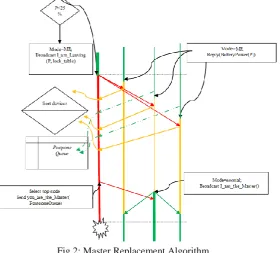
master backup approach having the advantage of avoiding election in case of master node power failure by transferring the leadership to another node when the master node‟s battery power reaches a predefined threshold. The proposed algorithm is described in the following steps and is illustrated in Fig. 2 shown below.
Fig 2: Master Replacement Algorithm
1. The master node receives notification from Resource Manager (RM) when its battery power level reached a
predefined threshold of 25 %.
2. There are two different modes in this algorithm. Normal mode and Master Replacement mode. The master
node changes its mode from Normal mode to Master Replacement (MR) mode. Then it broadcasts the message “I am Leaving (P,LockTable)” message to all replicas. Where P is the battery power level and LockTable is the lock table of the master node.
3. During lock table transfer time (LTTrans), all new requests (i.e., UpdateDataObject(X)) received by the
master node from other replicas are stored in a PostponeQueue and can be handled later by the new master node.
4. Once the message “I_am_leaving (P,LockTable)” is received , the battery power is measured by replica and
then it changes its mode from Normal mode to MR mode, and responds to the master node by sending a message “batteryPower(P)”. It is obvious that in MR mode replicas cannot issue new requests to the master node.
5. Master node collects batteryPower (P) values from all replicas and then sorts them in descending order.
6. Master node will then select the replica at the top of the list having the highest battery power to be the new
master.
7. The ex-master node sends message (you_are_the_master(PostponeQueue)) to the new master
8. The new master node then executes the postponed requests appropriately until the PostponeQueue is empty.
Now at this point, it changes its mode from MR to Normal.
9. The new master node will now announce itself to all other nodes by broadcasting a message “I am the master
()”.
10. Finally replicas change their mode from MR mode to Normal mode. The number of communication messages
ISSN(Online): 2320-9801
ISSN (Print): 2320-9798
I
nternational
J
ournal of
I
nnovative
R
esearch in
C
omputer
and
C
ommunication
E
ngineering
(An ISO 3297: 2007 Certified Organization)
Vol. 3, Issue 4, April 2015
a set of 64 nodes, EABPF needs 66 messages which are much less than the number of messages estimated in [18].
We can summarize the properties of EABPF algorithm as follows:
At any time, there is a unique master node.
The new master will start working only when the old master node stopped (handshaking by delivering the
lock table and the postpone queue)
This algorithm is fault tolerant. If the master node failure occurs before it completes the replacement process,
other nodes will select a new master node by exchanging their battery powers. In this case, the loss is very less as only requests that are in the postpone queue will be lost.
V. RESULTS
ISSN(Online): 2320-9801
ISSN (Print): 2320-9798
I
nternational
J
ournal of
I
nnovative
R
esearch in
C
omputer
and
C
ommunication
E
ngineering
(An ISO 3297: 2007 Certified Organization)
Vol. 3, Issue 4, April 2015
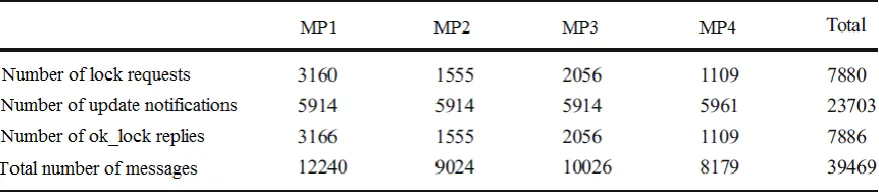
Fig 3: Distribution of Messages in MBR
ISSN(Online): 2320-9801
ISSN (Print): 2320-9798
I
nternational
J
ournal of
I
nnovative
R
esearch in
C
omputer
and
C
ommunication
E
ngineering
(An ISO 3297: 2007 Certified Organization)
Vol. 3, Issue 4, April 2015
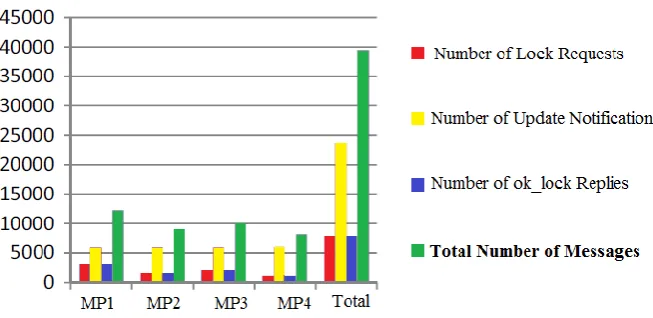
Fig 4: Distribution of Messages in MRA
VI. CONCLUSIONANDFUTUREWORK
In this paper, a new algorithm is proposed for master node replacement in MANETs based on the battery power level of the nodes. The proposed algorithm replaces the exhausted master node with a healthy node by early discovery of it outage when its remaining battery power reaches a predefined threshold. This replacement can be accomplished with much less communication overhead. Therefore, our approach reduces the chance of master node outage by taking precaution of early detection of potential power failure and thus this saves the battery power consumed by traditional master node election algorithms due to communication overhead. In the future, this research can be continued by investigating other performance metrics in addition to battery power such as memory capacity and CPU power which is the main characteristics for Mobile ad hoc Networks survivability .We can select the next highest node in the sorted list, if the top node with highest battery power does not have sufficient memory capacity or CPU power.
REFERENCES
[1]. Melit L, Badache N (2011) An energy efficient leader election algorithm for mobile ad hoc networks. In:Programming and systems (ISPS), 2011 10th International Symposium on (pp 54–59). IEEE
[2]. Mostafa A, Youssef AE (2013) A leader replacement protocol based on early discovery of battery power failure in MANETs. In: IT convergence and security (ICITCS), 2013 International Conference on (pp 1–4). IEEE
[3]. Frederickson GN, Lynch NA (1987) Electing a primary in a synchronous ring. J ACM 34(1):98–115
[4]. Fernando N, Loke SW, Rahayu W (2013) Mobile cloud computing: a survey. Futur Gener Comput Syst 29: 84–106
[5]. EffatParvar M, Yazdani N, EffatParvar M, Dadlani A, Khonsari A (2010) Improved algorithms for leader election in distributed systems. In: Computer engineering and technology (ICCET), 2010 2nd International Conference on (vol. 2, pp V2-6). IEEE
[6]. Singh S, Kurose JF (1994) Electing "good" leaders. J Parallel Distrib Comput 21(2):184–201
[7]. Hatzis KP, Pentaris GP, Spirakis PG, Tampakas VT, Tan RB (1999) Fundamental control algorithms in mobile networks. In: Proceedings of the eleventh annual ACM symposium on Parallel algorithms and architectures (pp 251–260). ACM
[8]. Mostafa AM, Youssef AE (2013) A primary shift protocol for improving availability in replication systems. Int J Comput Appl 72(4):37–44 [9]. Vasudevan S, Kurose J, Towsley D (2004) Design and analysis of a leader election algorithm for mobile adhoc networks. In: Network Protocols, 2004. ICNP 2004. Proceedings of the 12th IEEE International Conference on (pp 350–360). IEEE
[10]. Vasudevan S, DeCleene B, Immerman N, Kurose J, Towsley D (2003) Leader election algorithms for wireless ad hoc networks. In: DARPA Information Survivability Conference and Exposition, 2003.Proceedings (vol 1, pp 261–272). IEEE .
[11]. Dijkstra EW, Scholten CS (1980) Termination detection for diffusing computations. Inf Process Lett 11(1):1–4
[12]. Derhab A, Badache N (2008) A self-stabilizing primary election algorithm in highly dynamic ad hoc mobile networks. IEEE Trans Parallel Distrib Syst 19(7):926–939
[13]. Guerraoui R, Rodrigues L (2006) Reliable distributed programming (vol. 138). Springer Verlag, Berlin
[14]. Masum SM, Ali AA, Bhuiyan MT-yI (2006) Asynchronous leader election in mobile ad hoc networks, Advanced Information Networking and Applications, AINA 2006. 20th International Conference on vol. 2, no., pp 5 pp 18–20
[15]. Park VD, Corson MS (1997) A highly adaptive distributed routing algorithm for mobile wireless networks.In: INFOCOM'97. Sixteenth Annual Joint Conference of the IEEE Computer and Communications Societies. Driving the Information Revolution. Proceedings IEEE (vol. 3, pp 1405– 1413). IEEE
[16]. Shirali M, Toroghi AH, Vojdani M (2008) Leader election algorithms: history and novel schemes. In:Convergence and Hybrid Information Technology, 2008. ICCIT'08. Third International Conference on (vol.1, pp 1001–1006). IEEE
ISSN(Online): 2320-9801
ISSN (Print): 2320-9798
I
nternational
J
ournal of
I
nnovative
R
esearch in
C
omputer
and
C
ommunication
E
ngineering
(An ISO 3297: 2007 Certified Organization)
Vol. 3, Issue 4, April 2015
[18]. Shinohara M, Hara T, Nishio S (2007) Data replication considering power consumption in ad hoc networks.In: Mobile Data Management, 2007 International Conference on (pp 118–125). IEEE
[19]. Garcia-Molina H (1982) Elections in a distributed computing system. IEEE Trans Comput 31(1):48–59
[20]. Malpani N, Welch JL, Vaidya N (2000) Leader election algorithms for mobile ad hoc networks. In:Proceedings of the 4th international workshop on discrete algorithms and methods for mobile computing and communications (pp 96–103). ACM
[21]. Hirsch D, Madria SK (2011) A cooperative game theoretic approach for data replication in mobile ad-hoc networks. In: Collaborative computing: networking, applications and worksharing (CollaborateCom), 2011
7th International Conference on (pp 115–124). IEEE
[22]. Stoller SD (2000) Primary election in asynchronous distributed systems. IEEE Trans Comput 49(3):283–284
BIOGRAPHY
Mrs. Thota Subhashini a Student of Information Science and Engineering Department at The Oxford College of Engineering-Bangalore, affiliated to VTU pursuing M.Tech in Computer Networking and Engineering. She received her Bachelors of Engineering in Computer science and Information Technology Engineering from Nagarjuna Institute of Technology-Vijayawada affiliated to JNTU. She is currently working as a research assistant under the guidance of Assistant Prof. K Reeshma. Her research interests are Mobile Ad hoc Networks and Cloud Computing.