REVIEW
Long Noncoding RNAs: Past, Present, and Future
Johnny T. Y. Kung,*,†,‡David Colognori,*,†,‡and Jeannie T. Lee*,†,‡,1 *Howard Hughes Medical Institute,†Department of Molecular Biology, Massachusetts General Hospital, and‡Department of Genetics, Harvard Medical School, Boston, Massachusetts 02114
ABSTRACTLong noncoding RNAs (lncRNAs) have gained widespread attention in recent years as a potentially new and crucial layer of biological regulation. lncRNAs of all kinds have been implicated in a range of developmental processes and diseases, but knowledge of the mechanisms by which they act is still surprisingly limited, and claims that almost the entirety of the mammalian genome is transcribed into functional noncoding transcripts remain controversial. At the same time, a small number of well-studied lncRNAs have given us important clues about the biology of these molecules, and a few key functional and mechanistic themes have begun to emerge, although the robustness of these models and classification schemes remains to be seen. Here, we review the current state of knowledge of the lncRNAfield, discussing what is known about the genomic contexts, biological functions, and mechanisms of action of lncRNAs. We also reflect on how the recent interest in lncRNAs is deeply rooted in biology’s longstanding concern with the evolution and function of genomes.
T
HE past several years have witnessed a steep rise of in-terest in the study of lncRNAs. Almost on a weekly basis, it seems that a new lncRNA is found to be up- or down-regulated in a particular disease, or a new class of noncoding transcripts is uncovered by a transcriptomic study, or a new article heralds a paradigm shift that lncRNAs will bring to our understanding of biology. Without a doubt, the advent of sensitive, high-throughput genomic technologies such as microarrays and next-generation sequencing (NGS) has re-sulted in an unprecedented ability to detect novel tran-scripts, the vast majority of which seem not to be derived from annotated protein-coding genes. Despite this explosion of data, however, surprisingly little is known about how lncRNAs function, how many different types of lncRNAs exist, or even whether most of them carry biological signif-icance.In this review, we focus on recently discovered lncRNAs of.200 nt, place these new discoveries in historical context, and outline areas where additional work is needed. The re-view does not cover“classic”ncRNAs such as ribosomal (r) RNAs, ribozymes, transfer (t)RNAs, small nuclear (sn)RNAs, small nucleolar (sno)RNAs, and telomere-associated RNAs (TERC, TERRA); nor does it cover small ncRNAs such
as microRNAs (miRNAs), endogenous small interfering (endo-si)RNAs that participate in RNA interference (RNAi), and Piwi-associated (pi)RNAs. We refer readers to the many excellent recent reviews on these topics (Peculis 2000; Xiao
et al.2002; Henraset al.2004; Okamura and Lai 2008; Kim
et al. 2009; Feuerhahn et al. 2010; Blackburn and Collins 2011; Czech and Hannon 2011; Siomiet al.2011). Although lncRNAs are found across many taxa, and many crucial dis-coveries have been made in plants, fungi, and invertebrates (Gelbart and Kuroda 2009; Auet al.2011), we largely limit our discussion to mammalian examples, with occasional ref-erence to lncRNAs of other taxa.
Historical Overview of the lncRNA Field: Where Did It Come From? What Is It? Where Is It Going?
The C-value enigma and junk DNA
While widespread attention on lncRNAs is a rather recent phenomenon, it fits into the broader historical interest in studying the size, evolution, and function of genomes. Since the 1950s, theC-value, or the amount of DNA in the haploid genome (i.e., genome size), has been known to show little correlation with organism size or developmental complexity (Mirsky and Ris 1951; Thomas 1971; Gall 1981). “Lower” animals such as the salamander can have a genome 15 times larger than that of “higher” animals like humans (Gall 1981). This“C-value paradox”(Thomas 1971) troubled sci-entists with a human-centric point of view: “Being a little
Copyright © 2013 by the Genetics Society of America doi: 10.1534/genetics.112.146704
Manuscript received November 1, 2012; accepted for publication December 3, 2012 1Corresponding author: Massachusetts General Hospital/Harvard Medical School, 50
chauvinistic toward our own species, we like to think that man is surely one of the most complicated species on earth and thus needs just about the maximum number of genes” (Comings 1972, p. 313).
The paradox was arguably “solved” with the discovery that much of the genome does not encode protein-coding genes. Based on both DNA–RNA hybridization experiments (Lewin 1980, Chap. 24) and calculations of mutational load in the genome (i.e., the cost to evolutionaryfitness due to deleterious mutations, which depends on the mutation rate per gene and the number of genes) (Ohno 1972), it was determined in the 1970s that humans are unlikely to have
.20,000–30,000 (protein-coding) genes, remarkably close to the current estimate based on the human genome se-quence [unlike the overestimates of 50,000–100,000 from the early days of the Human Genome Project (Pertea and Salzberg 2010)]. The remaining noncoding space was termed“junk DNA”(Comings 1972; Ohno 1972) due to its overwhelming burden of transposons, pseudogenes, and simple repeats [in total accounting for 50–70% of the hu-man genome (de Koninget al.2011)].
Although the discrepancy in genome size may no longer be“paradoxical”, there remains a“C-value enigma”(Gregory 2001). Even among species that are morphologically simi-lar and phylogenetically close [e.g., onion, garlic, and their relatives in the genus Allium (T. R. Gregory, personal communication)], genome size and thus, presumably, non-coding content can vary by four- to fivefold, even when counting only diploid species (Ricroch et al. 2005). Whole-genome sequencing in recent years suggests that noncod-ing content may correlate with organismic “complexity” (Taftet al.2007), but such a conclusion must await a more extensive and varied sample of nonmammalian genome sequences.
Despite their status as “junk”, noncoding sequences re-ceived sustained interest during the period between the 1970s and the present. Early pioneers had the foresight to realize that “being junk doesn’t mean it is entirely useless” (Comings 1972, p. 316), and“it would be surprising if the host organism did not occasionallyfind some use for”a por-tion of these sequences (Orgel and Crick 1980, p. 606). Among a multitude of hypothesized functions are chromo-somal pairing, genome integrity, gene regulation, messen-ger (m)RNA processing, and serving as a reservoir for evolutionary innovation (Britten and Davidson 1971; Yunis and Yasmineh 1971; Comings 1972; John and Miklos 1979; Lewin 1980, Chap. 17–19; Orgel and Crick 1980; Lewin 1982). In light of recent discoveries, these early genomi-cists may not have been too far from the truth.
Pervasive transcription: Useful junk or transcriptional noise?
In the 1970s, hints had begun to emerge that more of the genome is transcribed than could be attributed to coding genes and various known RNAs such as rRNAs and tRNAs. These so-called “heterogeneous nuclear RNAs” (hnRNAs)
are transcribed from repetitive and heterochromatic regions, as well as from upward of 20% of all nonrepetitive regions in mammalian genomes (.10-fold higher by the same mea-sure than the amount of transcription into mRNA). It was also known that 50% of hnRNAs are restricted to the nu-cleus and do not contain coding sequences (Holmes et al.
1972; Pierpont and Yunis 1977; Lewin 1980, Chap. 25). Introns, discovered in 1977 (Berget et al. 1977; Chow
et al. 1977), accounted for only a small part of the non-coding sequences. Shortly after, in the 1980s, snRNAs and snoRNAs became recognized as major players in post-transcriptional RNA processing.
The scale of “pervasive transcription,”however, was not fully appreciated until the arrival of whole-genome technol-ogies in the late 1990s and early 2000s. From microarray hybridization and deep sequencing analyses, it is now esti-mated that as much as 70–90% of our genome is transcribed at some point during development (Okazaki et al. 2002; Rinn et al. 2003; Bertone et al. 2004; Ota et al. 2004; Carninci et al. 2005; Birney et al. 2007; Kapranov et al.
2010; Mercer et al.2011; Djebaliet al.2012). However, it should be pointed out that the idea of pervasive transcrip-tion, while popular, has been challenged on a number of grounds, including the low cross-species conservation rate (Wanget al.2004) and extremely low expression levels for many transcripts. Some recently identified transcripts are calculated to be present at as low as 0.0006 copies per cell (Merceret al. 2011). There has also been criticism of tech-nical limitations with tiling microarrays, including problems with false positives, low dynamic range, resolution, and low concordance between studies (Agarwal et al. 2010; van Bakel et al. 2010, 2011). Some high-throughput RNA se-quencing (RNA-Seq) analyses suggest that much of perva-sive transcription might be explained by alternative splicing and/or extensions of known protein-coding genes (Heet al.
2008; Mortazavi et al.2008; Sultanet al.2008; van Bakel
et al. 2010, 2011). Evidence supporting the existence of noncoding transcription in intergenic regions has come from correlations with chromatin signatures, such as DNase1 hy-persensitivity; histone modifications like H3K9ac, H3K4me3, and H3K36me3; or binding of transcription factors (TFs) at the loci and dependence of expression levels on these TFs (Guttmanet al.2009, 2011; van Bakelet al.2010; Encode Project Consortium 2012). These studies have revealed prom-ising, novel, conserved lncRNAs, but the new transcripts num-ber in only a few thousand—not enough to explain 70–90% of the genome.
elements, to receptor elements that affect coding gene pro-duction (although formally, the identity of the intermediar-ies could be proteins) (Britten and Davidson 1969). Some of the first cases of gene-specific regulatory roles of lncRNAs were uncovered in the early 1990s, with the discovery of lncRNAs involved in epigenetic regulation, such as H19
(Brannan et al. 1990) and Xist (Brockdorff et al. 1992; Brown et al. 1992). However, the idea of “transcriptional noise” (Hüttenhofer et al. 2005) continues to resonate in thefield, with the argument that the proper null hypothesis is lack of function, and the burden of proof is on supporters to find function. Calculations for TF binding (Wunderlich and Mirny 2009) and RNA polymerase II (Pol II) initiation of transcription (Struhl 2007) in eukaryotes have shown that Pol II can initiate “nonspecifically” and that as much as 90% of Pol II transcription can be spurious. Transcription events also seem to have a tendency to spill over or“ripple” away from “legitimate” transcripts, potentially leading to leaky expression of neighboring regions (Ebisuya et al.
2008). How, then, should one approach thefield of lncRNAs in 2013?
Genomic Contexts of lncRNAs
One way tofind order in the plethora of reported lncRNAs is to classify them according to genomic location—i.e., from where in the genome these RNAs are transcribed, relative to well-established markers such as protein-coding genes (Figure 1). In this manner, lncRNAs can be grouped intofive broad but mutually nonexclusive categories. The caveat to this approach, however, is that genomic context does not necessarily provide any information about lncRNA function or evolutionary origin, but it does serve as a convenient shorthand to organize these diverse species.
Stand-alone lncRNAs
These lncRNAs are distinct transcription units located in sequence space that do not overlap protein-coding genes. Some of these have been referred to as“lincRNAs”for“large intergenic (or intervening) noncoding RNAs” (Guttman
et al.2009; Cabiliet al.2011; Ulitskyet al.2011). A large number were identified through chromatin signatures for actively transcribed genes (H3K4me3 at the promoter,
H3K36me3 along the transcribed length). Many of the char-acterized ones are transcribed by RNA Pol II, polyadeny-lated, and spliced (usually with alternative isoforms, but with fewer exons than coding mRNAs) and have an average length of 1 kb. Known examples include Xist (Brockdorff
et al. 1992; Brown et al. 1992), H19 (Brannan et al.
1990), HOTAIR (Rinn et al. 2007) and MALAT1 (Ji et al.
2003).
Natural antisense transcripts
Abundant transcription appears to occur opposite the sense DNA strand of annotated transcription units; as much as 70% of sense transcripts have reported antisense counter-parts (Katayama et al. 2005; He et al. 2008; Faghihi and Wahlestedt 2009). The overlap between these sense– antisense (SAS) pairs can be complete, with either transcript nested within the other, but natural antisense transcripts (NATs) tend mostly to be enriched around the 59(promoter) or 39 (terminator) ends of the sense transcript. There are a number of well-documented SAS pairs formed by two coding mRNAs, as well as dual lncRNA SAS pairs like Xist/
Tsix, two RNAs that control X chromosome inactivation (Lee
et al. 1999a). In addition, many imprinted regions contain coding/noncoding SAS pairs, such as Kcnq1/Kcnq1ot1
(Kanduriet al.2006) andIgf2r/Air(Lyleet al.2000). Fewer of the newly discovered NATs are spliced or polyadenylated when compared to mRNAs or stand-alone lncRNAs, and while the expression of SAS pairs is more intercorrelated (either positively or negatively) than expected by chance alone, whether most NATs have biological function remains to be seen.
Pseudogenes
a portion of pseudogenes are transcribed (estimates ranging from 2 to 20%) and sometimes have high levels of sequence conservation; a few rare examples have even been shown to be translated. Expressed pseudogenes may be intermediates on their way to complete pseudogenization (Harrisonet al.
2005), or they may be dead pseudogenes that have been “resurrected” and acquired new functions (Bekpen et al.
2009). Some transcribed pseudogenes have been found to regulate gene expression (often of their ancestral coding genes) by epigenetic or post-transcriptional mechanisms. In fact, Xistis hypothesized to have evolved by the pseudo-genization of the protein-coding gene Lnx3and integration of various transposon-derived repeat elements (Duret et al.
2006; Elisaphenko et al.2008).
Long intronic ncRNAs
Introns have long been known to harbor small ncRNAs such as snoRNAs and miRNAs. Recently, many long transcripts have been reported, by large-scale transcriptomic or com-putational analyses, to be encoded within the introns of annotated genes (Louro et al. 2009; Rearick et al. 2011). Many of these are observed to have differential expression patterns, respond to stimuli, or be misregulated in cancer, but only a few have been studied in detail to date (Guilet al.
2012). One example that has been implicated in plant ver-nalization isCOLDAIR, which is located in thefirst intron of theflowering repressor locusFLC(Heo and Sung 2011).
Divergent transcripts, promoter-associated transcripts, and enhancer RNAs
Abundant short transcripts (ranging from 20 to 2500 nt) have been found to be produced from the vicinity of transcription start sites in both sense and antisense direc-tions, corresponding to peaks of Pol II occupancy due to pausing (Buratowski 2008; Coreet al.2008; Heet al.2008; Prekeret al.2008; Seilaet al.2008). The shortest of these, called transcription start site-associated (TSSa-)RNAs, may be degradation products or processed from the longer up-stream antisense (ua)RNAs or promoter upup-stream tran-scripts (PROMPTs). These heterogeneous trantran-scripts are usually capped and polyadenylated, have low abundance (as little as 0.1 copy per cell), and are subject to rapid deg-radation by exosomes. It is currently unclear whether these are simply transcriptional by-products from nucleosome-free regions around promoters, whether the act of their of tran-scription helps maintain this environment of open chroma-tin, or whether the transcripts themselves play a regulatory role, especially since a subset called promoter-associated short (pas)RNAs has been found to interact with epigenetic factors such as Polycomb proteins (Kanhereet al.2010). In addition to promoters, another class of genomic regulatory elements, the enhancers, has also been found to produce short (,2 kb) bidirectional transcripts [enhancer (e)RNAs], but these tend not to be processed, and as of yet no known biological function has been found (Kimet al.2010; Wang
et al.2011a).
lncRNAs: A Functional Perspective
Before surveying molecular mechanisms, it is helpful to summarize what is currently known about lncRNA function. From a variety of screens and expression analyses, it is increasingly evident that changes in expression levels of many lncRNAs are correlated with developmental processes and disease states. Functional studies indicate important roles for several lncRNAs, but the majority of lncRNAs await further verification.
Regulation of allelic expression: X chromosome inactivation
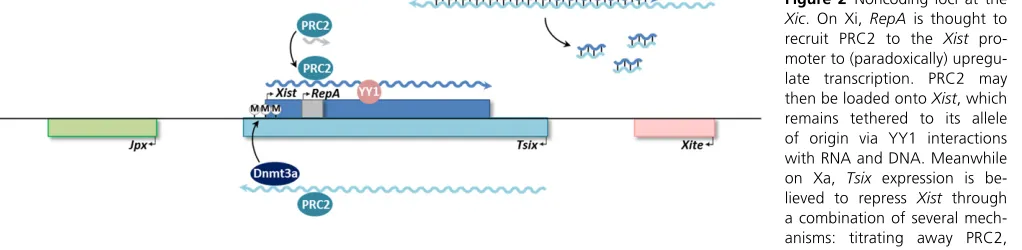
Arguably the best-studied biological function for lncRNAs occurs in the epigenetic regulation of allelic expression, such as the processes of dosage compensation and genomic imprinting. The difference in X-linked gene dosage between XX females and XY males in therian mammals is compen-sated for by a mechanism known as X chromosome in-activation (XCI), in which one of the two X chromosomes in females is heterochromatinized and silenced (the inactive X, or Xi) such that only one X remains active and is expressed in each female cell (the active X, or Xa) (Lyon 1961; Lee 2011). In placental mammals there are two types of XCI: imprinted XCI in the fertilized embryo and extraembryonic tissues, where the paternal X is always inactivated (Takagi and Sasaki 1975; Okamoto et al. 2004), and random XCI, occurring in the inner cell mass (which becomes the embryo proper), where epigenetic marks have been erased after the embryo’s implantation into the uterus (Monk and Harper 1979; Maket al.2004). In random XCI, either the paternal or the maternal X is randomly chosen for inactivation, lead-ing to a mosaic female (McMahon et al.1983). XCI in pla-cental mammals is largely controlled by a cluster of lncRNA loci known as the X-inactivation center (Xic) (Brown et al.
1991) (Figure 2). The 17-kb X (inactive)-specific transcript (Xist) is highly expressed from Xi during the onset of XCI, but not from Xa.XistRNA then coats the X chromosome and forms an “Xist cloud” (Brown et al. 1992; Clemson et al.
1996), which acts as a scaffold for the recruitment of silenc-ing factors such as Polycomb repressive complex 2 (PRC2) (Zhaoet al.2008).
As it turns out, Xist itself is also regulated by other lncRNAs.Tsix, transcribed in the antisense orientation from a promoter downstream of Xist, is highly expressed before XCI initiates and then disappears from the future Xi while persisting on the presumptive Xa, thus exhibiting the reverse pattern as Xistexpression (Leeet al.1999a).Tsixhas been demonstrated to coordinate X chromosome pairing to gen-erate epigenetic asymmetry within the Xist locus (Bacher
et al. 2006; Xu et al. 2006) and to downregulate Xist by a number of potential mechanisms (Sado et al. 2005; Sun
et al.2006; Ogawaet al.2008; Zhaoet al.2008).Xistis also positively regulated in trans by the upstream Jpx RNA, although its mechanism of action is currently unclear (Chureau
Regulation of allelic expression: Imprinting
lncRNAs are also important in genomic imprinting, the process by which a gene is expressed monoallelically according to its parent of origin (Edwards and Ferguson-Smith 2007; Wan and Bartolomei 2008). As in XCI, imprint-ing is usually regulated by specific genomic loci called imprinting control regions, from which lncRNAs often ema-nate, similar to the Xic. Many imprinted clusters contain protein-coding genes and lncRNAs that are reciprocally expressed, such as Igf2r/Air (Lyle et al. 2000), Dlk1/Gtl2
(Schmidt et al. 2000;da Rocha et al. 2008), Nesp/Nespas/
Gnas(Williamsonet al.2006), and the Beckwith–Wiedemann syndrome (BWS)-associated Kcnq1/Kcnq1ot1 (Lee et al.
1999b;Kanduriet al.2006). Some of these lncRNAs may
function by recruiting epigenetic factors, such as PRC2 and G9a, to control the imprinted expression of neighboring coding genes (Naganoet al.2008; Pandeyet al.2008; Zhao
et al.2010).H19, another lncRNA from the BWS locus, was one of thefirst mammalian lncRNAs to be identified and is one of the most highly expressed transcripts in the embryo (Brannanet al.1990; Bartolomeiet al.1991). It is reciprocally imprinted with the protein-coding gene Igf2. Although H19
does not seem to function as a lncRNA (Jones et al. 1998; Gaboryet al.2010), it serves as a miRNA precursor (Cai and Cullen 2007; Keniryet al.2012).
Other roles in development
Beyond allelic regulation, the role of lncRNAs extends to other aspects of development, from the control of pluri-potency to lineage specification. As explained above, the process of XCI is tightly coupled to early embryonic de-velopment, as well as to pluripotency in embryonic stem (ES) cells and induced pluripotent stem cells (Deuve and Avner 2011). Members of the core network of pluripotency transcription factors (e.g., Oct4, Sox2, and Nanog) have been shown to colocalize to Xist intron 1 (Navarro et al.
2008; Donohoe et al. 2009; Nesterova et al. 2011), and Oct4 has been demonstrated to regulate the expression of
TsixandXite(an upstream regulator ofTsixalso found in the
Xic), in turn controlling X chromosome pairing and setting off the XCI cascade (Donohoe et al. 2009). More recently,
Oct4 has been tied to expression of a series of pluripotency-associated lncRNAs (Sheikh Mohamedet al.2010), some of which might serve as scaffolds for Sox2 and the PRC2 com-ponent Suz12 in regulating downstream targets (Ng et al.
2011). The expression of Oct4 may itself be regulated by a lncRNA antisense to one of its pseudogenes (Hawkins and Morris 2010).
lncRNAs are additionally implicated in processes later in animal development. The Hox genes encode homeodomain TFs that are crucial for anterior–posterior pattern formation in all bilaterian metazoans (Pearsonet al.2005). Hox genes are arranged in linear clusters along the chromosome, and mammals possess four paralogous clusters, HOXA, -B, -C, and -D. A number of lncRNAs are encoded within these clusters, including HOTAIR from HOXC, and HOTTIP and
Mistral from HOXA(Rinnet al. 2007; Bertaniet al. 2011; Wanget al.2011b). These lncRNAs are proposed to regulate expression of Hox genes from either the host or a distant cluster. Neuronal development is another process where lncRNAs have been implicated. The noncoding Evf2 locus, which is associated with an enhancer located between two homeodomain TFs, Dlx5 and Dlx6, was shown by in vivo
knockout experiments to regulate the development of GABAnergic interneurons in the postnatal mouse forebrain. It acts through both cis(transcription-based) repression of
Dlx6 andtrans(transcript-based) activation of Dlx5(Bond
et al. 2009). In addition, a number of lncRNAs might be necessary in the specification of neuronalvs.glial fate, per-haps through the recruitment of epigenetic complexes such as PRC2 (Nget al.2011).
Implications in cancer
lncRNAs have also been associated with disease, most notably cancer (Gutschner and Diederichs 2012). For exam-ple, a recent RNA-Seq study in prostate cancer tissues and cell lines uncovered a lncRNA, PCAT-1, that promotes cell proliferation and is a target of PRC2 regulation (while also possibly interacting with PRC2 itself) (Prensneret al.2011).
ANRIL, also upregulated in prostate cancer, is required for the repression of the tumor suppressors INK4a/p16 and INK4b/p15 (Yap et al. 2010; Kotake et al. 2011). HOTAIR
(Gupta et al. 2010), liver (Z. Yanget al. 2011), colorectal (Kogo et al. 2011), gastrointestinal (Niinumaet al. 2012), and pancreatic (Kimet al.2012) cancers and is proposed to increase tumor invasiveness and metastasis (Gupta et al.
2010). MALAT1 (metastasis-associated lung adenocarci-noma transcript 1), another lncRNA associated with various cancers and metastasis (Ji et al. 2003; Lin et al. 2011), is found to affect the transcriptional and post-transcriptional regulation of cytoskeletal and extracellular matrix genes (Tano et al. 2010). lincRNA-p21 (named for its vicinity to the CDKN1A/p21 locus) is upregulated by p53 upon DNA damage and implicated in downstream repressive effects of the p53 pathway, particularly on genes regulating apoptosis, possibly by directing the recruitment of hnRNP-K to its ge-nomic targets (Huarte et al.2010). Another DNA damage-responsive, p53-induced lncRNA that lies upstream ofp21,
PANDA (P21 associated ncRNA DNA damage activated), is also implicated in the repression of pro-apoptotic genes, such asFASandBIK, by acting as a decoy for the transcrip-tion factor NF-YA. In some cancer types, p53 mutatranscrip-tions have been found that maintain the protein’s ability to induce the
PANDA pathway (and its antiapoptotic effects) while abol-ishing its ability to induce p21 and its promotion of cell-cycle arrest, thus leading to increased tumor cell survival (Hung
et al.2011). The above examples suggest that lncRNAs may be used as diagnostic markers or therapeutic targets in the treatment of cancer, but much work needs to be done before such applications become clinically practical.
Mechanisms of Action: Finding Pattern in Chaos
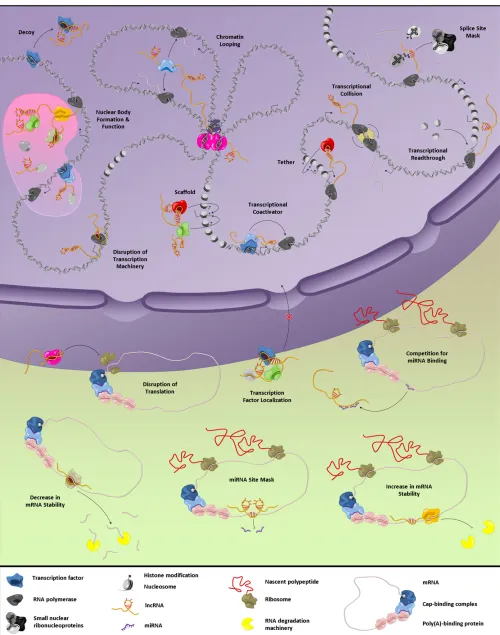
Although the vast majority of lncRNAs described in the literature have not yet been studied in mechanistic detail, the few that have provide clues regarding how lncRNAs might carry out their biological roles (Figure 3). However, it will be seen that many lncRNAs blur the lines between cat-egories or employ more than one mechanism of action. The continued discovery of new lncRNAs and more thorough characterization of those already known will surely reveal additional themes.
lncRNAs in epigenetics: Recruiters, tethers, and scaffolds
A major recurrent theme in lncRNA biology is the ability to function in the recruitment of protein factors for regulation of chromatin states (Campos and Reiberg 2009). Members of this class of lncRNAs may function incis, acting on linked genes in the vicinity of the RNA’s site of synthesis; or they might act in trans, regulating genes located in other, often distant domains or chromosomes. Large-scale and genome-wide studies of RNA–protein interactions have shown that chromatin-modifying complexes, such as PRC2, interact with a large number of lncRNAs (Khalilet al.2009; Kanhere
et al. 2010; Zhao et al. 2010; Guil et al. 2012). The Poly-comb proteins,first discovered inDrosophilaas regulators of homeotic gene expression during development (Schwartz and Pirrotta 2007), include a number of factors that bind
or modify chromatin marks. These include Ezh2 in PRC2, which is a key H3K27 methyltransferase, and the Pc/Cbx family proteins in PRC1, chromodomain-containing proteins that can bind trimethylated H3K27 (Sparmann and Van Lohuizen 2006; Schwartz and Pirrotta 2007). The mecha-nisms by which the Polycomb complexes are recruited to specific genomic loci in mammals have been elusive, espe-cially in the absence of definitive consensus binding sequen-ces, unlike the well-defined Polycomb response elements (PREs) in fruitflies (Schwartz and Pirrotta 2007). However, observed interactions of Polycomb proteins with lncRNAs suggest that Polycomb recruitment in mammals might be directed by RNA.
HOTAIRin theHOXCcluster has been observed to repress transcription of HOXD in trans through interaction with PRC2 (Rinn et al. 2007), although the mechanism of
trans-action has not been defined. XistRNA and a related 1.6-kb transcript calledRepAalso recruit PRC2 (Zhaoet al.
2008). The mechanism of action appears different from
HOTAIR’s in thatXist/RepAtargets PRC2 incisto its site of synthesis to initiate XCI. RepAtargets PRC2 to theXist pro-moter and is associated with Xist upregulation; full-length
Xistthen binds and recruits PRC2 to the rest of the X chro-mosome. The RepA/Xist interaction with PRC2 may be blocked by the antisense Tsix transcript, which also binds PRC2 and may therefore competitively inhibit interaction with the sense transcripts (Zhaoet al.2008). Further inves-tigation revealed that the RNA–protein complex loads onto a“nucleation center”within thefirst exon ofXist, a process that depends on another Polycomb group transcription fac-tor, YY1 (homolog of thefly Pho protein that forms part of the PRE-binding complex), which is bound only to Xi and leads to Xi-specific recruitment of PRC2 (Jeon and Lee 2011). By cotranscriptionally tethering XistRNA to theXic, YY1 serves as a bridge between lncRNA and chromatin and explains the allele-specific binding ofXistto Xi incis. Nev-ertheless, in post-XCI cells,Xistis capable oftrans-silencing autosomal regions where nucleation centers have been ectopically introduced, bypassing the developmental pro-gramming that would normally block these centers in differ-entiated cells (Jeon and Lee 2011). Thus, a strict cis/trans
distinction in describing lncRNA function may not be as feasible as once thought.
Other epigenetic complexes are likely to interact with lncRNAs as well, such as the H3K9 methyltransferase G9a, which interacts with the imprinted lncRNA Air (Nagano
et al.2008). In some cases, the RNA acts as a scaffold onto which multiple protein complexes can assemble, allowing the coordination of multiple layers of chromatin modifi ca-tions. For example,Kcnq1ot1has been hypothesized to re-cruit both PRC2 and G9a to the promoter ofKcnq1(Pandey
demethylates histone H3K4 to prevent gene activation (Tsai
et al. 2010), thereby potentially synergizing the repressive effects. A number of other lncRNAs might dually bind both PRC2 and CoREST complexes (Khalilet al.2009).
lncRNAs can also act by recruiting factors involved in gene activation. From the HOXAcluster, two lncRNAs, Mis-tralandHOTTIP, have been implicated in recruiting the MLL complex incis(Bertaniet al.2011; Wanget al.2011b). MLL, an H3K4 trimethylase, is a member of the Trithorax group of developmentally important gene-activating proteins that, like Polycomb, were discovered in flies (Schuettengruber
et al.2011). Using a technique called chromosome confor-mation capture, which assays long-range interactions among distant chromosomal regions in 3D space, it was found that multiple loci as far apart as 40 kb in theHOXAcluster are in close physical proximity, potentially enabling epigenetic fac-tors such as MLL to coordinately regulate their expression. On the basis of knockdown analyses, bothMistraland HOT-TIPare hypothesized to recruit MLL to distinct sets of genes that are sequentially proximal to the respective lncRNA locus, and Mistral may do so by facilitating formation of long-range chromosomal loops. This observation may lend sup-port to the longstanding hypothesis that regulatory elements in the genome, such as enhancers, could assert their effects on distant gene loci via chromosomal looping (Dean 2011).
Beyond histone modifications, lncRNAs also influence epigenetic regulation through modulation of DNA methyla-tion at CpG dinucleotides, which is crucial for the stable repression of genes (Law and Jacobsen 2010). During embryogenesis, methylation marks are first laid down on previously unmethylated DNA by the de novo methyltrans-ferases Dnmt3a and -3b, and are later perpetuated through DNA replication by the maintenance methyltransferase Dnmt1. One way by which Tsix might function to repress
Xist is to recruit Dnmt3a activity to methylate and silence theXistpromoter (Sadoet al. 2006; Sunet al.2006). Sim-ilarly, Kcnq1ot1 may recruit Dnmt1 (Mohammad et al.
2010).
lncRNA-directed methylation has also been implicated in the regulation of ribosomal (r)DNA. rDNA exists in the genome as tandemly repeated units, of which some always remain silenced by heterochromatic histone marks and DNA methylation (McStay and Grummt 2008). Each rDNA repeat unit encodes a polycistronic transcript comprising the vari-ous rRNAs, and each unit is separated by intergenic spacers (IGSs) that are transcribed by RNA Pol I (Mayeret al.2006). The IGS transcripts have recently been shown to be pro-cessed into 150- to 300-nt fragments called promoter (p) RNAs, which may act as scaffolds to recruit poly(ADP-ribose)-polymerase-1 (PARP1) (Guetget al.2012), the ATP-dependent chromatin remodeling complex NoRC (Mayer
et al. 2008), and the methyltransferase Dnmt3b (Schmitz
et al. 2010). pRNA forms a conserved hairpin structure that binds both PARP1 and the TIP5 subunit of NoRC, leading to a conformation change in TIP5 that facilitates the recruit-ment of NoRC to the nucleolus, where rDNA is located
(Mayeret al.2008; Guetget al.2010). Particularly intrigu-ing is that the recruitment of Dnmt3b by pRNA may be dependent on DNA:RNA triplexing, possibly via Hoogsteen base pairing, between the rDNA promoter and the 59end of pRNA (Schmitz et al. 2010). If proved, DNA:RNA triplex formation may be a general mechanism by which lncRNAs recruit transfactors to specific DNA loci.
While mechanisms of trans-action remain undefined, it seems clear that several features make lncRNAs excellent candidates for cis-acting molecular tethers (Lee 2009). Be-cause lncRNAs are inherently attached to chromatin via DNA:RNA hybridization during transcription, and because they are generally transcribed from a single locus in the genome, they are poised to direct allele- and locus-specific control in cis. This is a feat that cannot be performed by protein TFs, which do not retain allelic or positional memory once translated in the cytoplasm and can recognize short DNA sequence motifs only a few nucleotides in length that occur thousands of times in the genome. Furthermore, the length of lncRNAs allows them to reach out and capture epigenetic complexes while tethered (either by Pol II or by bridging factors like YY1), and the unmasking of 39 -degradation signals upon transcriptional termination would limit the RNA’s half-life and prevent diffusion and action at ectopic sites. This cis-acting mechanism is somewhat remi-niscent of the RNAi-based transcriptional gene silencing used by the fission yeast Schizosaccharomyces pombe in as-sembling centromeric heterochromatin (Cam et al. 2009; Moazed 2009).
lncRNAs in transcription: Decoys, coregulators, and Pol II inhibitors
In addition to regulating gene expression by recruiting epigenetic complexes, lncRNAs can directly affect the pro-cess of transcription. Some act as decoys for TFs, as in the case of PANDAsequestering NF-YA away from its pro-apoptotic target genes (Hunget al.2011). Others compete for TF binding, such as the Gas5 RNA that, in addition to being a host for snoRNAs (Smith and Steitz 1998), binds the DNA-binding domain of nuclear glucocorticoid receptors and precludes contact with glucocorticoid response elements on genomic DNA (Kino et al.2010). lncRNAs may even
in-fluence the cellular localization of TFs. The cytoplasmic
NRON(noncoding repressor of NFAT) RNA was found to pre-vent NFAT from shuttling into the nucleus, possibly by inter-fering with NFAT’s interactions with the importin family of nuclear transport proteins (Willingham et al. 2005). NRON
may also sequester the TF in a cytoplasmic ribonucleoprotein complex that contains kinases, further counteracting nuclear import as only unphosphorylated NFAT can localize to the nucleus (Liuet al.2011; Sharmaet al.2011).
including ATP-dependent chromatin remodeling complexes and histone acetyltransferases (HATs) (Gronemeyer et al.
2004). Interestingly, SRA is a bifunctional transcript, with one isoform functioning as ncRNA and another as mRNA that is translated into the protein SRAP (Kawashima et al.
2003; Chooniedass-Kothariet al.2004), which may in turn antagonize the function of its noncoding counterpart (Hubé
et al.2011). Conversely, an example of a lncRNA corepressor can be found at the cyclin D1 (CCND1) locus, where a series of independently transcribed, variable-length lncRNAs called ncRNACCND1are upregulated during stress (Klein and Assoian
2008; Wanget al.2008). These transcripts may remain par-tially tethered to DNA as RNA:DNA hybrids and thereby re-cruit and allosterically modulate the protein TLS, which can then inhibit HAT activity of the coactivators p300/CBP. In this sense, ncRNACCND1serve as both recruiters and
effec-tors of TLS.
In addition to acting through TFs, lncRNAs can directly interfere with Pol II activity. One case is the inhibition of the major, coding transcript of dihydrofolate reductase (DHFR) (Schnellet al.2004). In quiescent cells, an upstream minor promoter of DHFR produces a lncRNA that apparently dis-rupts formation of the transcription preinitiation complex at the major promoter. This is thought to occur through direct binding with the general transcription factor TFIIB, as well as possibly through DNA:RNA triplex formation at the major promoter (Martianovet al.2007). lncRNAs transcribed from SINEs, an abundant class of retrotransposons that includes
B2in mice andAluin humans, may also block transcription of heat-shock genes by binding Pol II to prevent formation of preinitiation complexes (Espinozaet al.2004; Marineret al.
2008; Yakovchuket al.2009).
lncRNAs and nuclear compartments
lncRNAs may also emerge as key regulators of nuclear compartments. The interior of the nucleus is a dynamic place consisting of multiple “nuclear bodies”that perform important functions (Mao et al. 2011b). Perhaps the best known of these is the nucleolus, the major site of rRNA transcription and ribosome assembly, and the role of pRNA in regulating the function of this compartment has been discussed above. The nucleolus, along with the perinucleo-lar compartment, might have roles beyond ribosome biogen-esis though, as bothXistandKcnq1ot1have been shown to target Xi and the imprintedKcnq1 domain, respectively, to the perinucleolar compartment to maintain silencing (Zhang
et al.2007; Pandeyet al.2008).
The structure and function of several other nuclear bodies likewise seem to involve RNA. NEAT1 (nuclear enriched abundant transcript 1) seeds the formation and maintains stability of paraspeckles, which are believed to participate in the nuclear retention of mRNAs that have un-dergone adenosine-to-inosine hyperediting (Chen and Car-michael 2009; Sunwoo et al. 2009). NEAT1 interacts with paraspeckle proteins such as p54/NONO and PSP (Chen and Carmichael 2009; Clemson et al.2009; Sasakiet al.2009),
and recent evidence suggests that the recruitment of these proteins to form paraspeckles is a dynamic process that requires continuous transcription of NEAT1 (Mao et al.
2011a). Its neighbor, NEAT2 or MALAT1, has been shown to localize serine/arginine (SR) splicing factors to a compart-ment called nuclear speckles where they can be stored and modified by phosphorylation (Bernardet al.2010).MALAT1
is associated with proper relocation of these splicing factors to sites of transcription, where splicing occurs, and thus may have a role in controlling alternative splicing of certain mRNA precursors (Tripathi et al. 2010). More recently,
MALAT1has been shown to interact with the PRC1 subunit Cbx4/Pc2 and participate in the shuttling of genes between nuclear compartments for silencing and activation. In the presence of extracellular growth signals, unmethylated Cbx4 binds MALAT1 and localizes its target genes, along with coactivating factors such as LSD1, to“transcription fac-tories” called interchromatin granules that usually cluster around nuclear speckles; in the absence of signal, Cbx4 becomes methylated and instead binds another lncRNA
TUG1, associates with corepressors such as Ezh2, and trans-locates to silencing compartments called Polycomb bodies (L. Yanget al.2011). This example illustrates the complex interplay among cell-signaling pathways, chromatin-modifying factors, lncRNAs, and nuclear bodies in regulating gene expression.
A most puzzling fact, however, is that in spite of their abundance and association with some of the most prom-inent subnuclear structures, knockouts of neither NEAT1
nor MALAT1 have robust phenotypes (Nakagawa et al.
2011, 2012; Eissmann et al. 2012; Zhang et al. 2012). These recent observations add to the mystery surrounding lncRNAs and support the assertion that quantity and func-tion do not necessarily correlate. They also underscore the importance of performing conventional knockout studies to test the function of newly discovered lncRNAs, a crucial test that an overwhelming number of lncRNAs have not been subjected to.
Transcript or act of transcription?
The above examples postulate that the mature lncRNA transcript is required for the regulatory mechanism. How-ever, in some cases it may be the act of transcription, and not the transcript itself, that is important. For example, in the
b-globin locus control region (Linget al.2004, 2005), poly-adenylated transcripts of varying lengths are generated from the HS2 enhancer site. No biological function has been as-cribed to these transcripts, but because HS2 is unable to activate globin expression when a transcriptional terminator is placed between it and the globin promoter, the phenom-enon has been interpreted to be transcription rather than transcript dependent (Ling et al. 2004). In fact, intergenic transcription has been seen to occur throughout the globin locus (Ashe et al. 1997) and plays a role in establishing open chromatin domains (Bender et al. 2000; Gribnau
such as H3K4me2/3 and H3 acetylation (Mileset al.2007). A similar scenario has been observed in chicks. During the stimulation of lysozyme expression in macrophages by mi-crobial lipopolysaccharide (LPS) (Lefevre et al. 2008), the onset of LPS inductionfirst leads to the transcription of an upstream, antisense lncRNA (calledLINoCR) and the rapid deposition of chromatin-opening histone marks (namely, H3S10 phosphorylation and H3K9 acetylation) in the re-gion.LINoCRtranscription seems to drive nucleosome repo-sitioning away from an enhancer toward a silencer, leading to the eviction of CTCF and cohesin from the latter while allowing the binding of C/BEP at the former, ultimately resulting in the upregulation of lysozyme expression. It should be noted, however, that in these examples, the avail-able evidence cannot definitively rule out involvement of the lncRNA transcript, but the act of transcription remains the most parsimonious explanation.
Better-established examples of noncoding genes func-tioning through the act of transcription can be found in fungi. In Saccharomyces cerevisiae, a key enzyme in serine synthesis, SER3, is repressed in the presence of serine by “transcriptional interference” (TI) from an upstream non-coding locus, SRG1, that extends past the SER3 promoter (Martens et al.2004, 2005). Replacement of theSRG1 se-quence with a coding sese-quence provided strong support for the idea that SER3 repression is dependent on the act of transcription alone (Martens et al. 2004). This effect was found to be mediated by the transcription elongation factors
Spt6 and Spt16, which reassemble nucleosomes in scribed regions in the wake of Pol II, inhibiting further tran-scription from downstream promoters (Haineret al.2011). An opposite mechanism is observed for the fission yeast
S. pombe gluconeogenesis enzyme fbp1+, where the tran-scription of multiple upstream noncoding loci, in the event of glucose starvation, leads to the opening of chromatin at the fbp1+ promoter and removal of the TUP corepressors, allowing other transcription factors such as Rst2 to bind and inducefbp1+expression (Hirotaet al.2008). Blocking tran-scription with an inserted terminator abrogates this induc-tion, and reintroducing the ncRNA intransfails to rescue the defect, again supporting a transcription-based mechanism.
The discovery of eRNAs (Kimet al.2010) raises the possi-bility that similar transcription-based mechanisms may operate at mammalian enhancers, although at present, the biological function of these RNAs is under debate. Another group of lncRNAs with enhancer-like function, called ncRNA-a, seems to be associated with robust expression of coding genes within 3 kb of the ncRNA locus, but reporter-based assays support the idea that they function as mature transcripts and not through the act of transcription (Øromet al.2010).
One particular form of TI, called “transcriptional colli-sion,”has been proposed as a possible mechanism of action for NATs, where the RNA polymerases on the two strands transcribing toward each other literally crash and stall. While this phenomenon has been observed in bacteria (Crampton et al. 2006) and budding yeast (Prescott and
Proudfoot 2002), none has been reported in mammals. However, computational analyses of genes with NATs have found an anticorrelation between the length of overlap and the expression levels of SAS pairs (i.e., the greater the over-lap is, the lower the expression of either transcript) (Osato
et al.2007), consistent with a transcriptional collision model in which convergent transcripts sterically hinder transcrip-tion of one another.
lncRNAs in post-transcriptional regulation: mRNA processing, stability, and translation
lncRNAs also act at various steps of mRNA processing and stability control. The case of MALAT1 affecting alternative splicing through interactions with splicing factors has al-ready been mentioned above. Another lncRNA, Gomafu/ MIAT, which localizes to a novel nuclear domain and has a neuron-restricted expression, may hinder spliceosome for-mation and affect the splicing of a subset of mRNAs by sequestering splicing factor 1 (SF1) (Soneet al.2007; Tsuiji
et al.2011).
NATs may affect the alternative splicing of their over-lapping transcripts by virtue of masking splice sites through base complementarity. Early observations that the ratio of splice isoforms for a number of mRNAs can be influenced by expression of overlapping antisense transcripts, and that the latter can form RNA duplexes with the mRNAs opposite them in vivoand/or inhibit splicingin vitro, led to specula-tion that NAT-mediated alternative splicing may be a com-mon method of post-transcriptional regulation (Munroe 1988; Krystalet al. 1990; Khochbinet al. 1992; Yanet al.
2005; Beltranet al. 2008; Anniloet al.2009). More recent genome-wide analysis has indeed revealed correlations between overlapping SAS pairs and alternative splicing (namely, enrichment of alternative exons in overlapping regions and increased number of alternative splice isoforms) (Morrissy et al. 2011). One notable case is the a-thyroid hormone receptor geneerbAa, which produces two mRNA isoforms and has a downstream, translated antisense tran-script called RevErb (thus, not a lncRNA per se) whose 39 -untranslated region (UTR) overlaps the last splice acceptor site of the long erbAa isoform (Lazar et al. 1989). RevErb
expression is correlated with lower levels of the longerbAa
isoform without affecting its transcription or stability, and the antisense RNA has been implicated by bothin vivoand
in vitro experiments to repress splicing at the overlapping acceptor site, thus tilting the balance in favor of the short
erbAaisoform (Lazar et al.1990; Munroe and Lazar 1991; Hastingset al.1997). Antisense transcripts can theoretically affect alternative polyadenylation site selection in a similar manner, as was shown for two convergent mRNAs encoded by the mouse polyomavirus (Guet al.2009).
transcript through deadenylation, decapping, and degrada-tion via the acdegrada-tion of cellular machineries such as the exo-some (Barreauet al.2006). A NAT produced from the 39-UTR ofiNOS(inducible nitric oxide synthase) has been found to interact with its sense counterpart and with HuR, an ARE-binding factor that increases the stability of ARE-containing transcripts (Matsui et al. 2008). This suggests a potential mechanism whereby a NAT helps stabilize its sense counter-part by aiding in the recruitment of stabilizing factors. In a more intricate example, the protein Staufen1 (STAU1), in complex with the nonsense-mediated decay factor Upf1, is involved in the regulated decay of1% of coding transcripts, a process named“STAU1-mediated decay”(Kimet al.2005, 2007). While STAU1 was found to bind its first identified target, ARF1, at a STAU1-binding site in the 39-UTR of ARF1 that forms a double-stranded (ds)RNA stem structure, the same motif could not be found in other STAU1 targets. Instead, it was discovered that a subset of these mRNA tar-gets contains anAluelement in its 39-UTRs that can base pair with a group of cytoplasmic and polyadenylated lncRNAs, named half-STAU1-binding site RNAs (1/2-sbsRNAs), that contain complementary Alu elements necessary to form the dsRNA structure (Gong and Maquat 2011). Thus, in contrast to the NAT that serves to stabilizeiNOS, these 1/2-sbsRNAs promote the decay of their target mRNAs by permitting re-cruitment of destabilizing factors.
lncRNAs may even exert their effects at the level of trans-lational regulation. PU.1, an important TF involved in hemato-genesis, has an overlapping NAT that was found to negatively influence PU.1 protein level but not polysome-boundPU.1sense mRNA level, and the antisense RNA seems to compete with the sense transcript for binding to the translation initiation factor eIF4A (Ebralidzeet al.2008). While failure to detect siRNA-like small RNAs potentially rules out involvement of RNAi, whether this kind of antisense regulation of translation is a common alternative to RNAi-based mechanisms remains to be seen. Ad-ditionally, it has been reported thatlincRNA-p21associates with polysome-boundb-catenin and JunB mRNAs in a manner de-pendent on the general translation repressor Rck, leading to decreased polysome number, and thus translation, of these mRNAs (Yoonet al.2012).
Intersection of the long and the small: lncRNAs as sources and sinks
It seemed inevitable that the long and small ncRNA worlds would eventually intertwine. Indeed, lncRNAs have been suggested to interfere with miRNA-mediated mRNA de-stabilization. For example, the antisense transcript of the Alzheimer-associatedb-secretase-1 (BACE), known as BACE-AS, increases BACE mRNA stability (Faghihi et al. 2008), most likely by masking the binding sites for miR-485-5p (Faghihiet al.2010).
Rather than competing for miRNA-binding sites, lncRNAs can compete for the miRNAs themselves. A number of mammalian pseudogenes, including PTENP1 and KRASP1
(Poliseno et al. 2010), and other lncRNAs (Wang et al.
2010; Cesanaet al.2011) have miRNA-binding sites in their 39-UTRs and may therefore serve as“sponges”to sequester miRNAs away from their mRNA targets. First discovered in plants (Franco-Zorrilla et al. 2007), this phenomenon has been hypothesized to be part of a genome-widefine-tuning regulatory network composed of miRNA “pseudotargets” (Seitz 2009) and/orbonafidetargets called“competing en-dogenous RNAs”(ceRNAs) (Salmenaet al.2011). Changes in the expression level of one member of this network, and thus the amount of miRNAs bound up by it, would affect the overall accessible pool of shared miRNAs, leading to concor-dant changes in the transcript levels of other members of the network. For example, the developmentally regulated linc-MD1 is reported to influence the mRNA levels of miRNA-targeted muscle differentiation genes (Cesanaet al.2011). The task now is to determine whether this actually repre-sents a new layer of post-transcriptional regulation directed by precise and signal-responsive changes in a ceRNA’s ex-pression level or if this is simply an inevitable consequence of several mRNAs and ncRNAs being regulated by the same pool of miRNAs.
lncRNAs can themselves be host genes for small RNAs.
H19is host to miR-675 (Cai and Cullen 2007; Keniryet al.
2012); Gas5 gives rise to 10 highly conserved snoRNAs (Smith and Steitz 1998); and the imprinted Gtl2, anti-Rtl1, and Mirg RNAs are hosts to almost 50 miRNAs and 40 snoRNAs (da Rochaet al.2008). Moreover, a large num-ber of endo-siRNAs have been found in mammalian germ cells that are produced from the complementarily base-paired regions between coding and/or noncoding SAS pairs, between mRNAs and expressed pseudogenes, or from within pseudogenes containing inverted repeats (Tam et al.2008; Watanabeet al.2008). In XCI, it has been proposed thatTsix
might repressXistpartly through an RNAi-related pathway, by base pairing to form an RNA duplex that yields Dicer-dependent small RNAs (Ogawaet al.2008). Thus, observed biological outcomes of lncRNA knockout, knockdown, or overexpression studies could be consequences of the long transcript itself and/or the small RNAs therein.
Translated lncRNAs: Pervasive Translation or Gene Evolution in Progress?
A transcript is usually considered to act as ncRNA, rather than protein, if it lacks any substantial open reading frame (ORF) or fails to produce protein duringin vitrotranslation experiments (Brannan et al. 1990; Brockdorff et al.1992; Niazi and Valadkhan 2012). However, an interesting twist in the ncRNA debate occurred when a developmentally impor-tantDrosophilatranscript previously thought to be noncod-ing, called tarsal-less or polished rice, was found to be a polycistronic mRNA that encodes multiple short (11–32 amino acids) but functional peptides, and this gene struc-ture is conserved among insects (Galindoet al.2007; Kondo
lncRNAs are in fact translated into small peptides (Ingolia
et al.2011). Like the identification of new transcripts, how-ever, just because an RNA is translated should not automat-ically be taken to mean that these peptides are functional, but could instead be “translational noise.” Moreover, it would be a false dichotomy to maintain that a transcript must either be coding or be noncoding—the example of
SRA/SRAP demonstrates that an RNA could potentially function at multiple levels, both as a ncRNA performing a regulatory role and as an mRNA for protein synthesis (Kawashimaet al.2003; Chooniedass-Kothariet al.2004).
Another interesting possible explanation is that these short translated ORFs are “protogenes” in the making. A number of studies in the past several years across multiple taxa, including primates, suggest that new protein-coding genes can arisede novofrom previously nongenic sequences, by first becoming transcribed noncoding genes and then evolving into translated protein-coding genes (Tautz and Domazet-Loˇso 2011). Recently, a survey ofS. cerevisiaeORFs identified .1000 short (,400 nt) and poorly conserved
(found only in the closest relatives ofS. cerevisiaeand with no sequence similarities to any known genes) ORFs that are nonetheless translated, as assayed by ribosome profiling, but only less than one-quarter show any sign of purifying selec-tion (Carvunis et al.2012). In other words, it may be com-mon in our genome for a large number of protein-coding units to have been generated by random processes, most of which have no meaningful biological function and will be weeded out by natural selection, leaving the few that have acquired adaptive functions to become newbonafidegenes. By the same token, it is plausible that most of the tens of thousands of RNA transcripts produced from our genome do not actually have active functions, but instead serve as a res-ervoir for evolution to tinker with and generate new tools (whether ncRNA or protein) for the species.
Conclusions
mechanisms of lncRNAs. A large fraction of the genome in many organisms is likely transcribed, but the characteristics and function of the overwhelming majority of these lncRNAs are currently not known. Some are nuclear, some cytoplas-mic; some are highly expressed, some barely detectable. In the end, it may not be possible or meaningful to try to apply criteria such as stability, conservation, and expression level to
find order in this chaos. High-turnover, poorly conserved, and low-abundance transcripts could still have essential functions. For instance,Kcnq1ot1has a half-life of 1 hr (Clark et al.
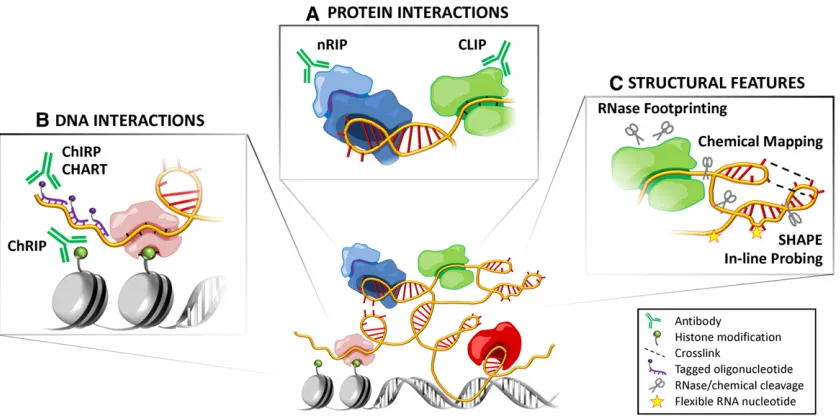
2012), the lncRNAs in the Xic are found only in placental mammals and have low conservation even within this taxon (Davidowet al.2007), andRepAexists at5–10 copies per cell (Zhao et al.2008). Yet even fully processed transcripts that interact with protein factors might not be essential (Ponting and Belgard 2010; van Bakelet al.2010; Schorderet and Duboule 2011; Eissmannet al.2012). Ultimately, the true test for function lies in the detailed, mechanistic dissection of the genetic pathways and cellular activities for each individ-ual putative lncRNA (see Figure 4). We must also keep in mind that the genome may not be a streamlined, highly sculp-ted space honed by natural selection; it could instead be quite noisy, even wasteful, where genomic junk and evolutionary relics accumulate but may yet adopt useful functions eventu-ally (Lynch 2007; Koonin and Wolf 2010). Thus, at present, it may be best to avoid blanket statements about structure, function, and mechanism, as indeed we have barely begun to scratch the surface of the lncRNA world. There is still plenty to learn and much work to be done. This is an exciting time for the study of RNA biology!
Acknowledgments
We thank members of the laboratory and T. R. Gregory for many helpful discussions, and we apologize to any of our colleagues whose work could not be cited here for space constraints. J.T.Y.K. was supported by a Postgraduate Schol-arship from the Natural Sciences and Engineering Research Council of Canada, and J.T.L. is supported by the National Institutes of Health (R01-GM090278). J.T.L. is an Investi-gator of the Howard Hughes Medical Institute.
Literature Cited
Agarwal, A., D. Koppstein, J. Razowsky, A. Sboner, L. Habegger
et al., 2010 Comparison and calibration of transcriptome data from RNA-Seq and tiling arrays. BMC Genomics 11: 383. Annilo, T., K. Kepp, and M. Laan, 2009 Natural antisense
tran-script of natriuretic peptide precursor A (NPPA): structural or-ganization and modulation of NPPA expression. BMC Mol. Biol. 10: 81.
Ashe, H. L., J. Monks, M. Wijgerde, P. Fraser, and N. J. Proudfoot, 1997 Intergenic transcription and transinduction of the hu-man beta-globin locus. Genes Dev. 11: 2494–2509.
Au, P. C., Q. H. Zhu, E. S. Dennis, and M. B. Wang, 2011 Long non-coding RNA-mediated mechanisms independent of the RNAi pathway in animals and plants. RNA Biol. 8: 404–414.
Bacher, C. P., M. Guggiari, B. Brors, S. Augui, P. Clerc et al., 2006 Transient colocalization of X-inactivation centres accom-panies the initiation of X inactivation. Nat. Cell Biol. 8: 293–299. Balakirev, E. S., and F. J. Ayala, 2003 Pseudogenes: Are they
“junk”or functional DNA? Annu. Rev. Genet. 37: 123–151. Barreau, C., L. Paillard, and H. B. Osborne, 2006 AU-rich
ele-ments and associated factors: Are there unifying principles? Nucleic Acids Res. 33: 7138–7150.
Bartolomei, M. S., S. Zemel, and S. M. Tilghman, 1991 Parental imprinting of the mouse H19 gene. Nature 351: 153–155. Bekpen, C., T. Margues-Bonet, C. Alkan, F. Antonacci, M. B. Leogrande
et al., 2009 Death and resurrection of the human IRGM gene. PLoS Genet. 5: e1000403.
Beltran, M., I. Puig, C. Peña, J. M. García, A. B. Alvarez et al., 2008 A natural antisense transcript regulates Zeb2/Sip1 gene expression during Snail1-induced epithelial-mesenchymal tran-sition. Genes Dev. 22: 756–769.
Bender, M. A., M. Bulger, J. Close, and M. Groudine, 2000 Beta-globin gene switching and DNase I sensitivity of the endogenous beta-globin locus in mice do not require the locus control region. Mol. Cell 5: 387–393.
Berget, S. M., C. Moore, and P. A. Sharp, 1977 Spliced segments at the 59terminus of adenovirus 2 late mRNA. Proc. Natl. Acad. Sci. USA 74: 3171–3175.
Bernard, D., K. V. Prasanth, V. Tripathi, S. Colasse, T. Nakamura
et al., 2010 A long nuclear-retained non-coding RNA regulates synaptogenesis by modulating gene expression. EMBO J. 29: 3082–3093.
Bertani, S., S. Sauer, E. Bolotin, and F. Sauer, 2011 The noncod-ing RNA Mistral activates Hoxa6 and Hoxa7 expression and stem cell differentiation by recruiting MLL1 to chromatin. Mol. Cell 43: 1040–1046.
Bertone, P., V. Stolc, T. E. Royce, J. S. Rozowsky, A. E. Urbanet al., 2004 Global identification of human transcribed sequences with genome tiling arrays. Science 306: 2242–2246.
Birney, E., J. A. Stamatoyannopoulos, A. Dutta, R. Guigó, T. R. Gingeraset al., 2007 Identification and analysis of functional elements in 1% of the human genome by the ENCODE pilot project. Nature 447: 799–816.
Blackburn, E. H., and K. Collins, 2011 Telomerase: an RNP en-zyme synthesizes DNA. Cold Spring Harb. Perspect. Biol. 3: a003558.
Bond, A. M., M. J. Vangompel, E. A. Sametsky, M. F. Clark, J. C. Savageet al., 2009 Balanced gene regulation by an embryonic brain ncRNA is critical for adult hippocampal GABA circuitry. Nat. Neurosci. 12: 1020–1027.
Brannan, C. I., E. C. Dees, R. S. Ingram, and S. M. Tilghman, 1990 The product of the H19 gene may function as an RNA. Mol. Cell. Biol. 20: 28–36.
Britten, R. J., and E. H. Davidson, 1969 Gene regulations for higher cells: a theory. Science 165: 349–357.
Britten, R. J., and E. H. Davidson, 1971 Repetitive and non-repetitive DNA sequences and a speculation on the origins of evolutionary novelty. Q. Rev. Biol. 46: 111–138.
Brockdorff, N., A. Ashworth, G. F. Kay, V. M. McCabe, D .P. Norris
et al., 1992 The product of the mouse Xist gene is a 15 kb inactive X-specific transcript containing no conserved ORF and located in the nucleus. Cell 71515 526.
Brown, C. J., R. G. Lafrenière, V. E. Powers, G. Sebastio, A. Ballabio
et al., 1991 Localization of the X inactivation centre on the human X chromosome in Xq13. Nature 349: 82–84.
Brown, C. J., B. D. Hendrich, J. L. Rupert, R. G. Lafrenière, Y. Xing
et al., 1992 The human XIST gene: analysis of a 17 kb inactive X-specific RNA that contains conserved repeats and is highly localized within the nucleus. Cell 71: 527–542.
Cabili, M. N., C. Trapnell, L. Goff, M. Koziol, B. Tazon-Vegaet al., 2011 Integrative annotation of human large intergenic non-coding RNAs reveals global properties and specific subclasses. Genes Dev. 25: 1915–1927.
Cai, X., and B. R. Cullen, 2007 The imprinted H19 noncoding RNA is a primary microRNA precursor. RNA 13: 313–316. Cam, H. P., E. S. Chen, and S. I. Grewal, 2009 Transcriptional
scaffolds for heterochromatin assembly. Cell 136: 610–614. Campos, E. I., and D. Reiberg, 2009 Histones: annotating
chro-matin. Annu. Rev. Genet. 43: 559–599.
Carninci, P., T. Kasukawa, S. Katayama, J. Gough, M. C. Frithet al., 2005 The transcriptional landscape of the mammalian ge-nome. Science 309: 1559–1563.
Carvunis, A. R., T. Rolland, I. Wapinski, M. A. Calderwood, M. A. Yildirimet al., 2012 Proto-genes and de novo gene birth. Na-ture 487: 370–374.
Cesana, M., D. Cacchiarelli, I. Legnini, T. Santini, O. Sthandier
et al., 2011 A long noncoding RNA controls muscle differenti-ation by functioning as a competing endogenous RNA. Cell 147: 358–369.
Chen, L. L., and G. G. Carmichael, 2009 Altered nuclear retention of mRNAs containing inverted repeats in human embryonic stem cells: functional role of a nuclear noncoding RNA. Mol. Cell 35: 467–478.
Chooniedass-Kothari, S., E. Emberley, M. K. Hamedani, S. Troup, X. Wanget al., 2004 The steroid receptor RNA activator is the first functional RNA encoding a protein. FEBS Lett. 566: 43– 47.
Chow, L. T., R. E. Gelinas, T. R. Broker, and R. J. Roberts, 1977 An amazing sequence arrangement at the 59ends of adenovirus 2 messenger RNA. Cell 12: 1–8.
Chu, C., K. Qu, F. L. Zhong, S. E. Artandi, and H. Y. Chang, 2011 Genomic maps of long noncoding RNA occupancy reveal principles of RNA-chromatin interactions. Mol. Cell 44: 667– 678.
Chureau, C., M. Prissette, A. Bourdet, V. Barbe, L. Cattolicoet al., 2002 Comparative sequence analysis of the X-inactivation cen-ter region in mouse, human, and bovine. Genome Res. 12: 894– 908.
Clark, M. B., R. L. Johnston, M. Inostroza-Ponta, A. H. Fox, E. Fortini et al., 2012 Genome-wide analysis of long noncoding RNA stability. Genome Res. 22: 885–898.
Clemson, C. M., J. A. McNeil, H. F. Willard, and J. B. Lawrence, 1996 XIST RNA paints the inactive X chromosome at inter-phase: evidence for a novel RNA involved in nuclear/chromo-some structure. J. Cell Biol. 132: 259–275.
Clemson, C. M., J. N. Hutchinson, S. A. Sara, A. W. Ensminger, A. H. Foxet al., 2009 An architectural role for a nuclear noncoding RNA: NEAT1 RNA is essential for the structure of paraspeckles. Mol. Cell 33: 717–726.
Comings, D. E., 1972 The genetic organization of chromosomes. Adv. Hum. Genet. 3: 237–431.
Core, L. J., J. J. Waterfall, and J. T. Lis, 2008 Nascent RNA se-quencing reveals widespread pausing and divergent initiation at human promoters. Science 322: 1845–1858.
Crampton, N., W. A. Bonass, J. Kirkham, C. Rivetti, and N. H. Thomson, 2006 Collision events between RNA polymerases in convergent transcription studied by atomic force microscopy. Nucleic Acids Res. 34: 5416–5425.
Czech, B., and G. J. Hannon, 2011 Small RNA sorting: matchmak-ing for Argonautes. Nat. Rev. Genet. 12: 19–31.
da Rocha, S. T., C. A. Edwards, M. Ito, T. Ogata, and A. C. Ferguson-Smith, 2008 Genomic imprinting at the mammalian Dlk1-Dio3 domain. Trends Genet. 24: 306–316.
Davidow, L. S., M. Breen, S. E. Duke, P. B. Samollow, J. R. McCarrey
et al., 2007 The search for a marsupial XIC reveals a break with vertebrate synteny. Chromosome Res. 15: 137–146.
Dean, A., 2011 In the loop: long range chromatin interactions and gene regulation. Brief. Funct. Genomics 10: 3–10.
de Koning, A. P., W. Gu, T. A. Castoe, M. A. Batzer, and D. D. Pollock, 2011 Repetitive elements may comprise over two-thirds of the human genome. PLoS Genet. 7: E1002384. Deuve, J. L., and P. Avner, 2011 The coupling of X-chromosome
inactivation to pluripotency. Annu. Rev. Cell Dev. Biol. 27: 611– 629.
Djebali, S., C. A. Davis, A. Merkel, A. Dobin, T. Lassmannet al., 2012 Landscape of transcription in human cells. Nature 489: 101–108.
Donohoe, M. E., S. S. Silva, S. F. Pinter, N. Xu, and J. T. Lee, 2009 The pluripotency factor Oct4 interacts with Ctcf and also controls X-chromosome pairing and counting. Nature 460: 128– 132.
Duret, L., C. Chureau, S. Samain, J. Weissenbach, and P. Avner, 2006 The Xist RNA gene evolved in eutherians by pseudoge-nization of a protein-coding gene. Science 312: 1653–1655. Ebisuya, M., T. Yamamoto, M. Nakajima, and E. Nishida,
2008 Ripples from neighbouring transcription. Nat. Cell Biol. 10: 1106–1113.
Ebralidze, A. K., F. C. Guibal, U. Steidl, P. Zhang, S. Lee et al., 2008 PU.1 expression is modulated by the balance of func-tional sense and antisense RNAs regulated by a shared cis-regulatory element. Genes Dev. 22: 2085–2092.
Edwards, C. A., and A. C. Ferguson-Smith, 2007 Mechanisms reg-ulating imprinted genes in clusters. Curr. Opin. Cell Biol. 19: 281–289.
Eissmann, M., T. Gutschner, M. Hämmerle, S. Günther, M. Caudron-Herger et al., 2012 Loss of the abundant nuclear non-coding RNA MALAT1 is compatible with life and development. RNA Biol. 9: 1–12.
Elisaphenko, E. A., N. N. Kolesnikov, A. I. Shevchenko, I. B. Rogozin, and T. B. Nesterova, 2008 A dual origin of the Xist gene from a protein-coding gene and a set of transposable elements. PLoS ONE 3: e2521.
ENCODE Project Consortium, 2012 An integrated encyclopedia of DNA elements in the human genome. Nature 489: 57–74. Espinoza, C. A., T. A. Allen, A. R. Hieb, J. F. Kugel, and J. A. Goodrich,
2004 B2 RNA binds directly to RNA polymerase II to repress transcript synthesis. Nat. Struct. Mol. Biol. 11: 822–829. Faghihi, M. A., and C. Wahlestedt, 2009 Regulatory roles of
nat-ural antisense transcripts. Nat. Rev. Mol. Cell Biol. 10: 637–643. Faghihi, M. A., F. Modarresi, A. M. Khalil, D. E. Wood, B. G. Saha-ganet al., 2008 Expression of a noncoding RNA is elevated in Alzheimer’s disease and drives rapid feed-forward regulation of beta-secretase. Nat. Med. 14: 723–730.
Faghihi, M. A., M. Zhang, J. Huang, F. Modarresi, M. P. van der Brug et al., 2010 Evidence for natural antisense transcript-mediated inhibition of microRNA function. Genome Biol. 11: R56. Feuerhahn, S., N. Iglesias, A. Panza, A. Porro, and J. Lingner, 2010 TERRA biogenesis, turnover and implications for func-tion. FEBS Lett. 584: 3812–3818.
Franco-Zorrilla, J. M., A. Valli, M. Todesco, I. Mateos, M. I. Puga
et al., 2007 Target mimicry provides a new mechanism for regulation of microRNA activity. Nat. Genet. 39: 1033–1037. Gabory, A., H. Jammes, and L. Dandolo, 2010 The H19 locus: role
of an imprinted non-coding RNA in growth and development. Bioessays 32: 473–480.
Galindo, M. I., J. I. Puevo, S. Fouix, S. A. Bishop, and J. P. Couso, 2007 Peptides encoded by short ORFs control development and define a new eukaryotic gene family. PLoS Biol. 5: e106. Gall, J. G., 1981 Chromosome structure and the C-value paradox.
J. Cell Biol. 91: 3s–14s.