ISSN (Online) : 2319 - 8753
ISSN (Print) : 2347 - 6710
I
nternationalJ
ournal ofI
nnovativeR
esearch inS
cience,E
ngineering andT
echnologyAn ISO 3297: 2007 Certified Organization, Volume 2, Special Issue 1, December 2013
Proceedings of International Conference on Energy and Environment-2013 (ICEE 2013)
On 12th to 14th December Organized by
Department of Civil Engineering and Mechanical Engineering of Rajiv Gandhi Institute of Technology, Kottayam, Kerala, India
Development of an Artificial Neural Network Surface
Roughness Prediction Model in Turning of
AISI 4140 Steel Using Coated Carbide Tool
Sajeev A, Benphil C Mathew, Chindhu C Kaippallil
Professor, Kottayam. Kerala India
Student, Kottayam, Kerala India
Student, Kottayam, Kerala India
ABSTRACT
Manufacturers focus on developing manufacturing systems that produce superior quality products with acceptable features of safety, quality and with on time delivery at minimum cost. Turning is one of the common machining processes and is widely used in variety of manufacturing industries. And the performance is indicated by surface quality. The determination of optimum cutting parameters achieving better surface roughness is a matter of research for the past few decades.Lot of studies are going on in this field and several models were developed to predict surface roughness of different materials used in turning process but only few studies have been carried out for the prediction of surface roughness in turning of AISI 4140 STEEL.
In this study we developed an artificial neural network (ANN) model for prediction of surface roughness with independent variables feed rate, cutting speed and depth of cut. Turning was conducted on AISI 4140 STEEL work pieces using CVD coated carbide cutting tool. Surface roughness was measured with different cutting speed, feed rate and depth. Also the effect of parameters of surface roughness was studied by keeping two variables constant and other one varying.
NOMENCLATURE
ANN Artificial Neural Network CVD Chemical Vapour Deposition
Ra Value that measures the roughness of a surface Rpk Roughness peak value
Rvk Roughness valley value RMSE Root Mean Square Error
1. INTRODUCTION
focused on producing high quality products in time at minimum cost. Surface finish is one of the crucial performance parameters that have to be controlled within suitable limits for a particular process. Therefore, prediction or monitoring of the surface roughness of machined components has been an important area of research. Cutting parameters such as speed feed depth of cut strongly influence the surface roughness of the machined product. Producing a desired surface roughness, which is one of the most important factors in measuring the quality of machined products, presents mechanical and economic issues in manufacturing environments. Not only does producing the appropriate surface roughness affect the functional attributes of products also affects manufacturing costs.
In this experiment only the Ra value is taken into consideration. Several works has been reported in the broad field of tool condition monitoring. Researchers are trying to develop a robust and accurate model that can find a correlation between the cutting parameters and the surface roughness of the machined products. Also Rpk, Rvk values are obtained for further progress of project.
2. LITERATURE REVIEW
K.Kadigrama European Journal of Scientific Research,2009 Surface Roughness Prediction Using Statistical Method, Model of 6061-T6 Aluminium Alloy Machining, surface roughness of milling. Feed rate is the most significantly influencing factor. Sakir tasdemir (iccs & tech-2008) Prediction using artificial neural network,AISI 1040 steel in dry cutting condition, Surface roughness of Turning process, parameters: TOOL RAKE ANGLE,TOOL OVER HANG & TOOL NOSE RADIUS(using coated carbide tool) K.pal Surya( 2005).Surface roughness prediction using ann network Surface roughness in turning operations, Mild steel work piece Sahin and Motorcu (2004) Regression model,AISI 4140 steel - CVD coated carbide cutting tool. Feed rate, cutting speed , depth of cut, nose radius, Feed rate - more influence on surface roughness. Ozel and Karpat (2004)ANN and Regression models ,Hardened AISI 52100 and AISI H-13 steels,Cubic Boron Nitride (cBN) cutting tool. Neural Networks better performance than regression models. Increase in feed rate decreased surface quality Ahmed (2006) Developed prediction model for surface roughness in finish turning of Aluminum using carbide tool in CNC lathe ,Nonlinear regression analysis with logarithmic data transformation was applied in developing the model. Model found to be satisfactory in prediction. Singh and Kumar (2006) Obtained optimal setting of turning process parameters (cutting speed, feed rate and depth of cut) to get optimal range of feed force when machining of EN 24 steel with titanium carbide coated tungsten carbide inserts using Taguchi technique.
We had gone through several journal regarding surface roughness prediction model & we find that there are only a few work is done on AISI 4140 thus we decided to do our project to predict surface roughness model in turning work of AISI 4140 by using CVD coated carbide tool
3. PRESENT STUDY
We studied the different properties, applications and scope of AISI4140 steel & CVD tool, Also gone through several journals and concluded that prediction using ANN network is more advantageous than regression & taguchi method.
We have to develop a prediction model of surface roughness of AISI 4140 in turning operation using CVD coated tool and also we have to develop a prediction model for functional aspects of AISI 4140.
The objectives of the study are
To study the characteristics and applications & scope of the AISI 4140
To study about CVD coated carbide tool
To study the different prediction models
This study is restricted to AISI 4140 steel using CVD coated carbide tool using artificial neural network.
3.1 Tool and work piece specification
3.1.1 Tool Used: CVD coated carbide: CVD coated carbide for efficient steel machining.CVD coated carbide grades use ceramic thin film coating technology and provide stable, efficient machining at high speeds or heavy interrupted applications.
CVD coated carbide is applicable for low to high speed machining and finishing to roughing. Stable machining is obtained due to high toughness and crack resistance. The various types of combination with 3D chip breaker solves chip evacuation troubles and enables to shorten machining time by high speed and high feed machining.
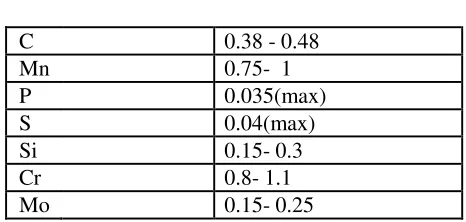
3.1.2 Workpiece Used: AISI 4140
TABLE 3.1.2
WORK PIECE COMPOSITION
C 0.38 - 0.48
Mn 0.75- 1
P 0.035(max)
S 0.04(max)
Si 0.15- 0.3
Cr 0.8- 1.1
Mo 0.15- 0.25
3.2 Experimental Procedure
There are many parameters which affects surface roughness. In this experimental study structural parameters for the machine tool are constant for every experiment in as much as all the experiments have been completed on the same machine tool. Similarly cutting tool parameters are constant because all of the cutting tools used have the same characteristics & in order to minimize the effect of tool wear, Which could affect surface quality, The inserts are changed fairly often. Also the cutting parameters have been reduced to three parameters to simplify matters. In this context,36 different cutting conditions have been considered and obtained the accurate values.
The cutting test have been carried out on an ordinary lathe(PANTHER) .The test parts used was of diameter 48mm x 310.25mm in size and it was AISI4140 steel, First all of the test parts have been machined by fine turning under the same cutting conditions after that 36 parts have been machined. Surface roughness value Ra have been measured with RUGOSURF 10G.Finally these training data and test data was interpreted in artificial neural network to obtain the mathematical model.
4. EFFECT OF CUTTING PARAMETERS ON SURFACE ROUGHNESS
The analysis was conducted by studying the variation of surface roughness by keeping one of the parameters varying and the other two constant.
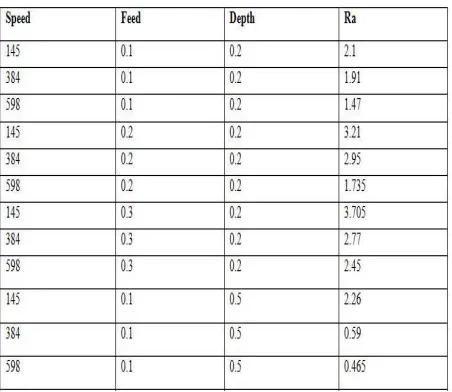
TABLE 4VALUES OBTAINED
The study of the effect of various parameters on surface roughness was carried out. Surface roughness has a regular variation with change in cutting speed and feed rate. While it has an irregular variation with change in depth of cut.
5. DEVELOPMENT OF PREDICTION MODELS
5.1 Introduction
The experimental results were used to develop the surface roughness prediction models. The observed data was used to develop Multiple linear and Nonlinear Regression models as well as Artificial Neural Network (ANN) models. Both linear and nonlinear regression models were developed along with ANN models. The models developed were used to predict the surface roughness of the validation data set. The actual and predicted values were compared with Root Mean square Error (RMSE) Deviation.
5.2 Development Of Ann Model
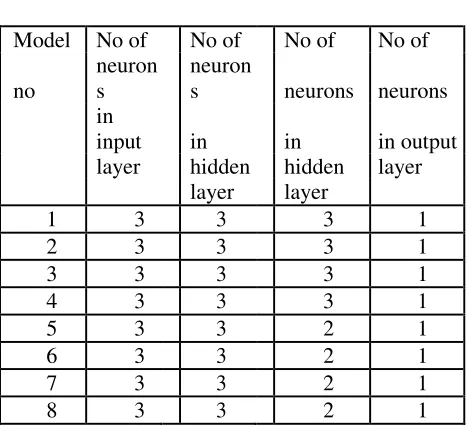
TABLE 5.2.1 ANN ARCHITECTURE
Model No of No of No of No of
no
neuron s
neuron
s neurons neurons in
input in in in output layer hidden hidden layer
layer layer
1 3 3 3 1
2 3 3 3 1
3 3 3 3 1
4 3 3 3 1
5 3 3 2 1
6 3 3 2 1
7 3 3 2 1
8 3 3 2 1
TABLE 5.2.2 VALIDATION OF ANN MODELS
Model RMSE
Model 1 0.3824
Model 2 0.4899
Model 3 0.4872
Model 4 0.4298
Model 5 0.9066
Model 6 0.574
Model 7 0.4228
Model 8 0.4852
In Table 5.2.2 Model 1 has the least RMSE and was chosen as the best Network Architecture. This network has 3 neurons in input layer, 3 neurons in hidden layers and one neuron in output layer (3-3-1).The network architecture is shown in Figure 5.2.1
6. RESULT
Turning operation was performed over a wide range of cutting condition: Spindle speed from 145 rpm to 598 rpm, feed from .1 mm/rpm to .3 mm/rpm, and depth of cut from.2 mm to 1mm.Different combination of spindle speed, feed and depth of cut, were adopted to perform 27 different turning operations.Also corresponding to each cutting condition, the surface roughness of machined part was measured. The results of the experiment are tabulated. To train the neural network, speed, feed and depth of cut are used are used as input parameters, and corresponding surface roughness of the machined product as the output parameter.36 data set obtained from the experiment,27 have been selected at random for training the network, and the remaining nine are used for the testing. The normalized data sets are used for training the network. RMSE- 0.380
TABLE 6.1 ACTUAL VERSUS PREDICTED
ACTUAL PREDICTED
2.135 1.9552
1.79 1.8287
3.49 3.6169
3.34 3.6169
1.45 1.8287
3.09 3.6169
2.37 1.8287
1.15 1.8287
1.964643 1.8287
7.CONCLUSION
Following conclusions may be drawn from the cutting conditions in machining AISI4140 steel using CVD coated carbide tool. A methodology for the prediction of surface roughness in turning using feed forward back propagation neural network has been developed. The optimum network architecture has been found out based on mean square error and the convergence rate of actual and predicted value. The predicted surface roughness from the obtained artificial neural network architecture model is very close to the values measured experimentally, thus showing feed forward back propagation neural network for predicting surface roughness in turning. And finally we conclude that our neural network obtained can be used for predicting surface roughness for various speed, feed and depth of cut having the above cutting and material specifications.
8. SUMMARY
From our literature survey various cutting parameters such as speed, feed and depth of cut has been obtained. Also material to be used for the work is AISI4140 steel and tool used is CVD coated carbide tool is obtained from literature survey analysis.
Turning operation was performed over a wide a range of cutting condition: spindle speed from 145 rpm to 598 rpm, feed from 0.1 mm/rev to 0.3 mm/rev, and depth of cut from 0.2 mm to 1mm.Different combinations of spindle speed, feed and depth of cut, were adopted to perform 36 different turning operations.
obtaining developing ANN model has been done. Behalf of these studies we made analysis on the future scope of this study.
REFERENCES
[1] Kadirgama,,Surface roughness Prediction using Statistical Method, Euro Journel Publishing.
[2] SakirTasdemir, 2008, Prediction using artificial neural network,AISI 1040 steel in dry cutting condition,Surface roughness of Turning process. [3] Reddy B.S., Padmanabhan G., and K. Reddy KVK, (2008), Surface Roughness Prediction Techniques for CNC Turning, Asian Journal of Scientific Research, 1(3), 256-264. [4]SurjyaK.Pal , 2005, Surface roughness prediction using, ANN network.
[5] T. S.Suneel, S.S.Pande and P. P.Date,2002 “A technical note on integrated product quality model using artificial neural networks,” J.
Mater.Process.Technol., vol. 122, pp. 77–86.
[6] W.S. Lin, B.Y. Lee and C.L. Wu, “Modeling the surface roughness and cutting force for turning,” J. Mater. Process.Technol., vol. 108, pp.
286–293, 2001.
[7] DamusKarayel, “Prediction and control of surface roughness in CNC lathe using artificial neural network,” J. Mater. Process.Technol., vol.
209, pp. 3125–3137,2009.
[8]J. Paulo Davim, V.N. Gaitonde and S.R. Karnik, “Investigations into the effect of cutting conditions on surface roughness in turning of free
machining steel by ANN models,” J. Mater. Process.Technol., vol.205, pp. 16–23, 2008. [9] Chen Lu, “Study on prediction of surface