Enhancement of Security in Visual
Cryptography using DES Algorithm
Er. Rimsy Dua(1), Er. Narender Singh(2)
M.Tech. Student, Department of Computer Science & Engineering, GITM, Bilaspur, Haryana, India(1)
Assistant Professor, Department of Computer Science & Engineering, GITM, Bilaspur, Haryana, India(2)
ABSTRACT: A new technique of Visual Cryptography is used for securing the visual content such as texts or images. In the proposed scheme mentioned below, the concept of visual cryptography is extended in terms of security, meaningful shares and the grid of the final image(extracted secret image) that is formed. Here, We have successfully implemented the proposed methodology using DES (Data Encryption Standard)algorithm. The concept is enhanced by the transformation of meaningless to meaningful shares and the security is enhanced by encrypting the shares of the secret image by using DES. The tool that we have used for implementing the proposed scheme is MATLAB(short for Matrix Laboratory).A software package i.e MATLAB is used for high-performance numerical computations having high performance and visualization. MATLAB provides an interactive environment in which there are hundreds of built-in functions for technical computation, animation, graphics etc.
KEYWORDS:Visual Cryptography;Secret; Shares; Data Encrytion Standard; Security; Encryption; Image quality; Number of shares; Decryption
I.INTRODUCTION
In the modern era the security over the network has become an important concern as in Internet it is now very easy to find any information. It is really a big challenge to make some information fully protected from hackers. The solution of this problem is to encrypt the data so that even if the hackers steal the encrypted data, they cannot get any information from the data. Visual Cryptography is a new Cryptography technique which is used to secure the visual content such as texts or images. In Visual Cryptography the image is divided into parts called shares which are then distributed to the participants. The Decryption side just stacking the share images gets the image. The initial model developed only for the binary images or monochrome images. The authors alter it to suit for the Color Images means Gray Images and RGB/CMYK images. For the RGB/CMYK images different methods are developed based on the color decomposition techniques[11].
One of the approach to keep a secret safe is secret sharing. Visual Cryptography is the well-known approach if the secret is an image. Most of the studies discuss the concept of visual cryptography for binary images. Later on, Visual Cryptography was extended for Gray Scale Images. Another visual cryptography scheme is (k, n)-threshold scheme. This scheme was described by Naor and Shamir. In this, a secret image is encoded into n shadow images also called shares .Recovering secret image involves stacking any k of the n shares but if k-1 or less stacking shares are there then no information about the secret image can be revealed[1].
Individual shares in the layers cannot reveal any useful information to attackers because these shares are random noise. If there is limited availability of share, then it is not possible to decrypt the message or information even with the availability of the computer. Randomness is the limitation of the above method and that is without any visual information. Extended form of Visual Cryptography have been suggested which has the same drawbacks of randomness[3].
VISUAL CRYPTOGRAPHY BASIC MODEL
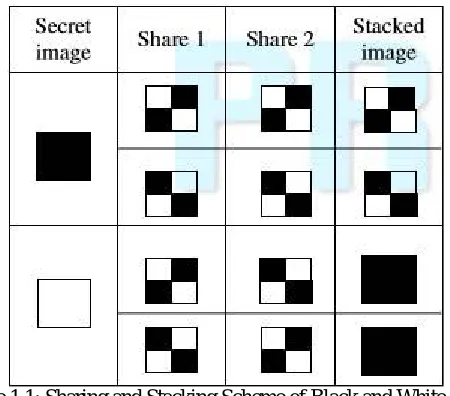
specifically done for the color visual cryptography. The white pixels of black-and-white images are taken as transparent for ensuring transparencies in the gray scale model. Typically, in the black-and-white visual cryptography, decomposition of every pixel is done in a secret image into a block of 2×2 in the two transparencies according to the rules of the basic model. There are basically two combinations of white pixels for forming the content of the block in the two transparencies depending on whether the pixel is white or black .If pixel is white, it chooses one of the two combinations and if the pixel is black, it chooses one of the other two combinations. Therefore, when two transparencies are stacked then there will be blocks corresponding to black pixels in the secret image and also corresponding to white pixels. Blocks corresponding to black pixels are full black, and corresponding to white pixels, blocks are half- black-and-half-white, which can be observed as 50% gray pixels.
There are six possible patterns for information security from which every block in a transparency can choose randomly and so we cannot identify secret image from a single transparency. Before printing, There is a transformation of the gray-level images into halftone ones , and also the transformed Halftone images are black-and-white only.
Figure 1.1: Sharing and Stacking Scheme of Black and White Pixels
This type of image format is very suitable for the traditional method to generate visual cryptography shares. Each black or white pixel in the halftone image is decomposed into a 2×2 block of the two transparencies according to the rules. In case the pixel is white, then we randomly select one combination from the former two rows as the content of the blocks in Shares 1 and 2. If there is black pixel , then one combination is randomly selected from the latter two rows as the content of the blocks in the two transparencies. This process is repeated until every pixel in the halftone image is decomposed. As a result, two transparencies of visual cryptography are there to share the secret image.
The RGB (Red, Green and Blue) color image is taken in the proposed method for the information sharing. The Floyd – Steinberg dithering algorithm is used for the manipulation of the 256 code image to low code image. Dithering is achieved using error diffusion, and the nearest neighbor pixel is taken to create the share. CMY color image format is used by the existing algorithm which is converted into eight color codes. In this method, the color code of RGB is separated into 16 standard color code formats without any reduction of the resolution. Instead of image half-toning, the dithering algorithm is used .Separate array is created and manipulated for every share by dithering. Decryption is involved for the secret image sharing and stacking. The intensity of the original image is maintained by using this method as well as 16 shares can be created and used[14].
II.RELATED WORK
III.SCOPE OF RESEARCH
In the proposed scheme, we have used the concept of cover image.Cover image is that image which is used for hiding secret image i.e the user will misinterpret it as original secret image but in fact it is just cover image.Here,in the proposed methodology ,it is necessary that the size of the secret and cover image must be same .Our future scope is that the size of secret image and cover image is not the mandatory requirement i.e if the size of the secret and cover image is different then still it must be possible to extract the secret image from the cover image with same quality as when the size of the secret and cover image was similar.
IV.PROPOSED METHODOLOGY AND DISCUSSION
4.1 PROPOSED WORK
Presently the generated shares are meaningless i.e. the shares do not express any meaning, There can be generation of meaningful shares by the use of cover image so that just by viewing the shares no one can guess that there is some secret data encrypted in that image. The shares can be encrypted using DES algorithm to ensure more security to shares so the present work can be improved by removing the unwanted colors from the decrypted image and extended to (4,4) cryptography scheme.
4.1.1 PROPOSED ALGORIHTM AND FLOWCHART
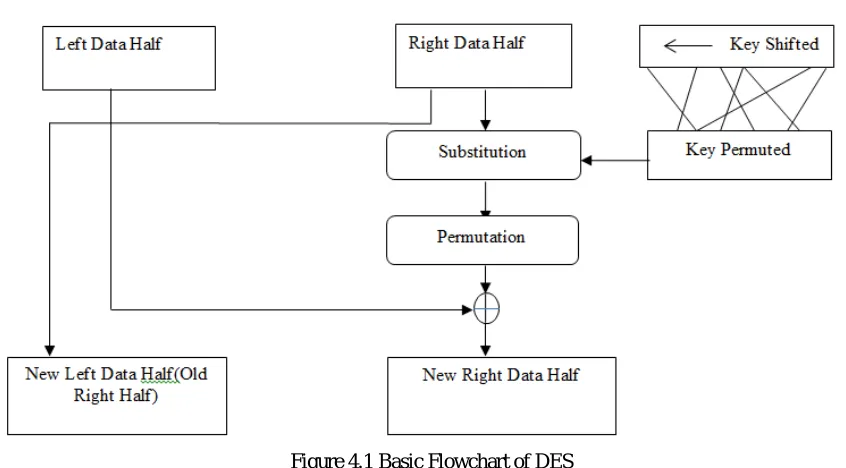
The proposed algorithm for our research is DES i.e Data Encryption Standard. Its proper name is Data Encryption Algorithm as this was based on Lucifer algorithm .This algorithm provides very strong encryption by using a combination of two fundamental building blocks of encryption i.e Substitution and Transposition. Two other alternative terms are linked with substitution and diffusion. These terms are Confusion and Diffusion. Confusion means to create cipher text in such a way that its plain text is not apparent .The basic tool for confusion is substitution. Diffusion means to spread the effect of change in plain text throughout the resulting cipher-text and the basic tool for diffusion is Transposition. Basically, Substitution is represented by S-Boxes and Transposition is represented by P-Boxes. Data Encryption algorithm is an iterative algorithm that uses table look ups and simple bit operations. First of all, Input to the DES is arranged in the form of 64 bit blocks. We know that this algorithm basically operates on data blocks.So the 64 bit input is divided into two halves (Left half and Right Half) each of 32 bits. Each half is scrambled independently, key is combined with one half and then the two halves are swapped. This is called 1 cycle and the process is repeated 16 times. The following are the steps of an algorithm along with its flowchart.
4.1.1.1 EXPANSION PERMUTATION
Figure 4.1 Basic Flowchart of DES
4.1.1.2 KEY TRANSFORMATION
Here the key length is of 64 bits but we will use only 56 bits as a key in our proposed algorithm by removing every 8th
bit (8,16,24,…….,64).This is because these 8 bits are used as parity bits and no information is carried by these parity bits in the key. This process is called Key Transformation. There is a splitting of a key into two 28 bit halves at each step in the cycle. There is a left shifting of these two halves by a specified number of bits which are then pasted together again. Out of 56 bits,48 bits are permuted to use as a key during this cycle. After key transformation,48 bit key is combined with expanded right half by using an exclusive-OR operation.
4.1.1.3 S-BOXES
S-Boxes are used to perform substitution based on a table of 4 rows and 16 columns. It is a permuted choice function in which there is a replacement of 6 bits of data by 4 bits. There are 8 S-Boxes.Here,48 bit input is divided into eight 6 bit
blocks identified as B1,B2,B3………B8. S-Box Sj operates on block Bj. Suppose that block Bj is 6 bits i.e b1, b2, b3, b4, b5,
b6 .Bits b1 and b6 having a decimal value from 0 to 3 form a two bit binary number and is equal to the value of row i.e
represented by r .Bits b2, b3, b4, b5 having a decimal value from 0 to 15 form a decimal number which is equal to the
value of the column that is represented by c.
4.1.1.4 P-BOXES
All 32 bits of the result obtained after an S-Box Permutation are permuted by straight permutation. Here the bits will be moved to different positions and there will be 8 bits on each row. Basically, there are two types of permutations that are employed in this algorithm .One is Initial Permutation in which the 64 bits of each input block is reordered. Another is Final Permutation that is used at the conclusion of 16 substitution-permutation rounds.
4.1.1.5 COMPLETE DES
V.EXPERIMENTALRESULTS
Figure no. 5.1 Figure no. 5.2 Figure no. 5.3 Figure no. 5.4
Cover Image Secret Image Stegnographic Image Extracted Image
Figure 5.1 shows the cover image for the process of Visual Cryptography. This cover image is basically used to hide the secret message. The cover image and the secret image must be of same size. Figure 5.2 shows the secret message to be hidden. This secret message will be hidden in the cover image. The use of cover image is to misrepresent the identity of the cover image to any unauthorized person. He or she will think that the cover image they are visualizing is original image. In this way, there will be safe secret image. Figure 5.3 shows the stegnographic image in which secret message is hidden in the cover image but it is difficult to identify the secret image from the cover image by just looking at the stegnographic image.This is because Stegnographic image will show the original image in front .Figure 5.4 shows the secret message is extracted from the stegnographic image. The main focus is on enhancing the quality of the extracted image approximately equal to that of original secret image.
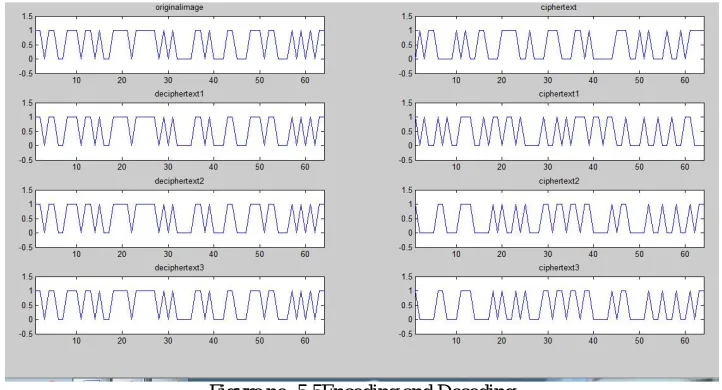
Figure no. 5.5Encoding and Decoding
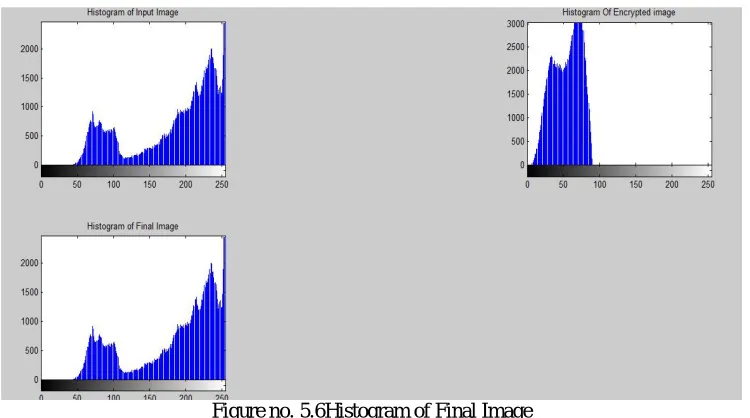
Figure no. 5.6Histogram of Final Image
This figure shows the histogram of the input image, encrypted image and the final image. It can be observed that the histogram of the input image and final image is same but that of the encrypted image is different. This is because encrypted image also contains the cover image.
VI.CONCLUSION
We have successfully implemented the proposed scheme using Data Encryption Standard algorithm.The detailed evaluation of the proposed scheme is done with the help of histogram.The histogram of the input image,encrypted image and the final image is shown in the previous chapter.From histogram,it is analysed that the histogram of the input image and final image is same but that of the encrypted image is different. This is because encrypted image also contains the cover image.
VII.ACKNOWLEDGEMENT
The process of implementation of the proposed scheme “Secured Visual Cryptography Using Meaningful Shares” was carried out at Ganpati Institute Of Technology And Management ,Bilaspur (Yamuna Nagar).All the faculty members of computer science and engineering department helped me a lot in retrieving the desired results .Also,I would like to thank head of Ganpati Group Of Institutions ,Principal and management of GITM,Bilaspur(Yamuna Nagar) for supporting me during the dissertation period.
REFERENCES
[1]. Kun-Yuan Chao* , Ja-Chen Lin,”(2, 3)-threshold visual cryptography for color images”, Proc. of the 6th WSEAS Int. Conf. on Signal Processing, Computational Geometry & Artificial Vision, Elounda, Greece, August 21-23, 2006 (pp89-94).
[2]. Prabir Kr. Naskar, Ayan Chaudhuri ,Atal Chaudhuri,” Image Secret Sharing Scheme Using a Novel Secret Sharing Technique with Steganography”, IEEE CASCOM , pp 62-65, Nov. 27, 2010.
[3]. Shiny Malar F.R, Jeya Kumar M.K,” Error Filtering Schemes for Color Images in Visual Cryptography”, International Journal of Advanced Computer Science and Applications, Vol. 2, No. 11, 2011.
[4]. Shiny Malar F.R , Jeya Kumar M.K ,” A novel algorithm for color visual cryptographic images using error filtering schemes”, International journal of computer engineering & technology (ijcet):ISSN 0976 – 6367(print) ,ISSN 0976 – 6375(online),volume 3, issue 2, pp. 323-336, july- september 2012.
[5]. Ch. Priyanka, Prof.ThaduriVenkataRamana, and T.Somashekar,” Analysis of Secret Sharing & Review on Extended Visual Cryptography Scheme”, International Journal of Engineering Inventions, ISSN: 2278-7461, ISBN: 2319-6491Volume 1, Issue 10 (November2012) PP: 43-51, 2012.
[7]. L M Varalakshmi, Prithy R and Radhika Parameswari.” Extended Visual Cryptography for Color Images and its PSNR Analysis”,International Journal of Computer Applications:67(17):17-22, April 2013.
[8]. Andal devi k, ilamathi k and packialakshmi T,”A Visual Cryptography Scheme for Colour Images using Halftone Pattern”, International Journal of Research in Engineering & Advanced Technology : ISSN: 2320 – 8791, Volume 2, Issue 2, Apr-May, 2014.
[9]. PoonamBidgar, NehaShahare ,”Secret Image Transmission through Image Sharing using Secret Key and LSB Embedding”, International Journal of Electronics Communication and Computer Engineering Volume 5, Issue (4) July, Technovision-2014.
[10].Young-Chang Hou, Zen-Yu Quan, and Hsin-Yin Liao, ”New Designs for Friendly Visual Cryptography Scheme”, International Journal of Information and Electronics Engineering, Vol. 5, No. 1, January 2015.
[11].Sankar Das, Sandipan Chowdhury and Dibya Chakraborty,”Visual Cryptography using Three Independent Shares in Color Images”, International Journal of Innovative Research in Advanced Engineering (IJIRAE) ISSN: 2349-2163 Issue 4, Volume 2 (April 2015).
[12].Ritesh D.Yelane*, Dr. Nitiket. N. Mhala and Prof. B. J. Chilke,”Security Approach by Using Visual Cryptographic Technique”, International Journal of Advanced Research in Computer Science and Software Engineering:ISSN: 2277 128X Volume 5, Issue 1, January 2015.
[13].Jainthi.k, Prabhu.P ,”A novel cryptographic technique that emphasis visual quality and efficieny by floyd steinberg error diffusion method”,International Journal of Research in Engineering and Technology, eISSN: 2319-1163 pISSN: 2321-7308,Volume: 04, Issue: 02 Feb-2015.
[14].M.Karolin, Dr.T.Meyyapan,”RGB based secret sharing scheme in color visual cryptography”,International Journal of Advanced Research in Computer and Communication Engineering, ISSN : 2278-1021,Vol. 4, Issue 7, July 2015.
[15].Anuja R. Yeole*, Prof. Mahip, M. Bartere,”A X-or base image encryption and data security through higher lsb data hiding approach: a review”, International Journal Of Engineering Sciences & Research Technology, ISSN: 2277-9655, February, 2016.
BIOGRAPHY