IOP Conf. Series: Earth and Environmental Science 18 (2014) 012091 doi:10.1088/1755-1315/18/1/012091
Development of a mobile application for amphibian species
recognition
B Parveen1,3, Chew T H \ M S Shamsir1, N Ahmad 2
1 Bioinformatics Research Group, Universiti Teknologi Malaysia, Johor, Malaysia 2 Faculty o f Science and Technology, Universiti Kebangsaan Malaysia, Bangi, Malaysia
Email: [email protected]
Abstract. The smartphones mobility and its pervasiveness are beginning to transform practices in biodiversity conservation. The integrated functionalities o f a smartphone have created for the public and biodiversity specialists means to identify, gather and record biodiversity data while simultaneously creating knowledge portability in the digital forms o f mobile guides. Smartphones enable beginners to recreate the delight o f species identification usually reserved for specialist with years of experience. Currently, the advent of Android platform has enabled stakeholders in biodiversity to harness the ubiquity o f this platform and create various types o f mobile application or “apps” for use in biodiversity research and conservation. However, there is an apparent lack o f application devoted to the identification in herpetofauna or amphibian science. Amphibians are a large class o f animals with many different species still unidentified under this category. Here we describe the development of an app called Amphibian Recognition Android Application (ARAA) to identify frog amphibian species as well as an accompanying field guide. The app has the amphibian taxonomic key which assists the users in easy and rapid species identification, thus facilitating the process of identification and recording o f species occurrences in conservation work. We will also present an overview o f the application work flow and how it is designed to meet the needs a conservationist. As this application is still in its beta phase, further research is required to improve the application to include tools such automatic geolocation and geotagging, participative sensing via crowdsourcing and automated identification via image capture. We believe that the introduction o f this app will create an impetus to the awareness of nature via species identification.
1. Introduction
1.1. Smart phones
Mobile phone usages have been drastically growing in recent years. It could be surely said that at least three quarter o f the world’s population own at least one mobile phone. Based on a study conducted in the United States, children now are more likely to own a mobile phone than a book, with 85% o f them owning a phone while only 73% owns books. Without exception, Malaysia is one of the countries riding the wave o f telecommunication evolution [1,2]. In recent years, the mobile phone has evolved from essentially an interpersonal communication device to a multimedia machine which is publicly known as smartphone. The use of smart phones has triggered consumer market demand as it forms a new dimension of virtual mobility to a continuing trend for geographically extended, faster and more
3To whom any correspondence should be addressed.
IOPConf. Series: Earth and Environmental Science 18 (2014) 012091 doi:10.1088/1755-1315/18/1/012091
personalized social interaction[2]. Hence with such an advancement and demand in mobile technology, it is believe that the biodiversity community should also follow through this advancement and not to be left behind, in advancing their approach in species identification.
1.2. Biodiversity
Biodiversity conservation is a global issue, where many government and non-government bodies have come up with many methods, techniques and even policy to ensure, the conservation of biodiversity[3,4]. But up till now majority of the identification of species in the conservation process only involves specialist researchers, policy makers and government bodies, whereas the general public involvement is very minimal and only limited to common minded enthusiast.[3]. With the development o f this application, it allows knowledge sharing not only between people o f the biology research community but also bridging to the general public, where it could create interest and awareness among the community [4]. As we could see that the application is very straight forward and easy even for a child. With such advantages, it will issue easier to share knowledge on biodiversity and also to encourage more individual from the general public community to be involved directly with biodiversity conservation.
1.3. Application
Identifying amphibian species is a challenging task considering the large number o f existing species in the world. The interspecies similarity and the intra-species variability make the identification task particularly difficult and time consuming[5]. We present here a practical amphibian identification tool based on the visual information provided by the dichotomous key. This application is intended for mobile devices to allow a user to identify amphibian on the spot. It can also be used as an observation collector tool to enrich the knowledge database. Amphibian Recognition Android Application (ARAA) that was developed to greatly speed up the manual process o f plant species identification, collection, and monitoring. Without visual recognition tools such as ARAA, a dichotomous key must be manually navigated to search the many branches and seemingly endless nodes o f the taxonomic identifier[5]. Identifying a single species using this process, whereby a new and ixpereinced user have to answer endless questions regarding the taxonomic identifier, may take several minutes or even hours. This is difficult even for experienced biologist, and exceedingly and may perhaps becoming an impossible task that may discourage budding amateurs[5]. It is believe that with the development of ARAA it would provide an impetusin the research community where it could reduce the time taken to identify amphibian species in the wild, hence reducing the work load o f any researcher or student. It also provides rapid and mobile data retrieval from amphibian database on the query amphibian species. We predict that it would promote the understanding on amphibian species and further increases the user knowledge on the amphibian species available in Peninsular Malaysia.
2. Methodology
IOPConf. Series: Earth and Environmental Science 18 (2014) 012091 doi:10.1088/1755-1315/18/1/012091
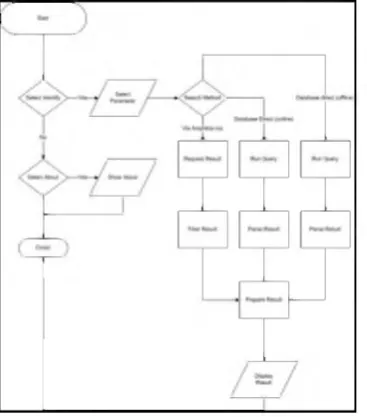
online, and finally search via offline database. The flow chart and data flow diagram shows how the work flows of the application and the data retrieval flow from the database (Fig. 1 and Fig. 2).
Figure 1. Flow chart showing how is Figure 2. Data flow diagram showing
the flow of the application. data retrieval from the database.
3. Result
The result can be divided into three parts based on the search selection by the user.
3.1 Search via amphibia.my
User will choose the query selection from the drop down menu button in the identify page and select the search via amphibia.my before submitting the search. Once the search is submitted, the result will be extracted from amphibian.my using its search form. Here the result are presented with minimum elaboration for a much faster data retrieval and less accuracy, Results are displayed in two forms which is an image and text. The image shows the suggested species and the text describes the information on the species, that includes scientific name, snout length, tympanum, skin type, dorsal colour and as well as the ventral colour.
ARAA > Result (1/45) ARAA > R esult (1 /4 5 )
A ttrib u te (s ) M atched : N ot A v a ila b le
S cientific N am e
A m o lo p s L a ru te n sis
S nout Length
3 5 -4 5 m m (males); 5 3 -7 5 m m (fem ales)
T y m p a n u m
Sm all, o c a ss io n a lly hid d en, 1/3 e ye d ia m e te r
Skin Type
Sk in a b o v e fa irly g ra n u la r, w ith s o m e flat e n la rg e d t u b e rc le s o n sides; b e lly g ra nu la r; th ro a t a nd chin s m o o th
Dorsal C o lo u r
Pale y e llo w is h g re e n , w ith d a rk blotches, lim b s w ith black bars; w e b b in g blackish.
V e n tra l C o lo u r
Belly, throat, chin w hite
IOPConf. Series: Earth and Environmental Science 18 (2014) 012091 doi:10.1088/1755-1315/18/1/012091 3.2 Search via database (Online)
Users will choose the query selection from the drop down menu button in the identify page and select the search via online database option. Once the search has been submitted, the result will be extracted from ukm_katak database which is hosted in the UT server. Here the result is presented in a more elaborated manner and with more accuracy. The results are displayed as an image o f the species and descriptive text containing information on the species’ scientific name, snout length, tympanum, skin type, dorsal colour and as well as the ventral colour.
Hli ■ 'O' 14:38
•?93
Attribute(s) Matched : 4
Scientific Name
Ansonla jeetsukumarani
Snout Length
M ales up to 19.9mm; Females up to 25.3 m m
Tym panum
Visible, large, about 7 0 % eye diameter
Skin Type
Covered with warts of varying sizes; small white wart at angle of jaw; single row of mandibular asperities in m ales capped with keratinized spine row s of tubercles on dorsum; abdom en
Dorsal Colour
D orsum nearly uniform dark brow n with faint orangish-yellow spot on back between shoulders; thin, faint, vertebral stripe; r»*drti«;h-0Mnc7f> small n ih e rrle * nn dorsum
t o * O It ml i t f 14:38
ARAA > Result (1/66)
white wart at angle oi jaw; single ro w or m andibular asperities in m a le s capped with keratinized spine row s of tubercles on dorsum ; abdom en
Dorsal Colour
D orsum nearly uniform dark brow n with faint o rangish-yellow spot on back between shoulders; thin, faint, vertebral stripe; reddish-orange small tubercles on dorsum and flanks; a rm s and iegs orargish; ventral re g io ns of flanks with whitish-yellow
V entral Colour
Unde rside of hind lim b s in fe m ales brow nish- red, brow n in
AX * a $41
Home Identify About Back
Figure 4. The result for search via database online.
3.3 Search via database (Offline)
User will choose the query selection from the drop down menu button in the identify page and select search via offline database function before submitting the search. Once the search is submitted, the result will be extracted from ukm_amphibia database which is embedded within the application, but in order to retrieve the species image, the user is required to have internet excess because the image is hosted in the server to reduce the application size. The result is similar to the second function albeit without the species image.
O " t m ■ 14:33 I t C t
Attribute(s) Matched : Not Available
Scientific Name Ansonia endauensis
Snout Length
At least 17.4mm (Male), 28.5mm (Female)
Tympanum
distinct and vertically elliptical
Skin Type
Dorsally and laterally, the skin is tubercular, with small, rounded tuberdes bearing a brown tip. The tubercles are not regularly arranged, with the exception of a single row of small spinose tubercles underneath the mandibles, and three rows of tubercles in the mental region. The abdominal skin Is coarsely granular.
Dorsal Colour
Dorsum is black. An orange spot below the
m e n u u le g io n , iiie auiJoiiiiikdi ik m & coarse ly granular.
Dorsal Colour
Dorsum is black. An orange spot below the eye. as well as orange spots on the side of the head and neck, and small orange spots on the flanks. Prominent orange bars are found on the upper and lower parts of the limbs.
Ventral Colour
Ventral is grey. Light spotting is present on the belly as well as the underside of the hindlimbs, but there is no spotting in the gular region or on the underside o f the forelimbs
Sc re e n captured. Sa v e d a s im a g e file
EH
IOPConf. Series: Earth and Environmental Science 18 (2014) 012091 doi:10.1088/1755-1315/18/1/012091 4. Discussion
4.1 System strengths
The ARAA strength is that it could provide amphibian species identification. The user are able to retrieve data rapidly and real-time, where once they submitted the query selection in a matter o f few seconds the will obtained results o f possible match complete with its image and information. ARAA is also a tool to lighten researcher and students work load, where they no longer require to refer to books or manual in the wild to identify the query species, they can simply utilize the application.
4.2 System limitations
ARAA is a pilot phase application and naturally it has some limitations that require attention. The limitations that could be found in this application are that the Dichotomous key selection is not yet 100% accurate. In addition this application does not have a geo-tagging function to narrow down the search. Furthermore ARAA could not record any new amphibian species discovery, where user comes across any new species that is not present in the database they cannot submit details of their finding a new record addition into the database.
5. Conclusion
In conclusion, the ARAA could assist and lighten a burden o f a researcher when they are doing their work in the field. It also could make amphibian an interesting subject for technologically savvy student, with an interactive tool for them to use as reference, but further enhancement and development is needed to make this app better. For further development, we plan to feature future functionality where users will be able to upload their findings in the field onto the database, improvements on the dichotomous key to increase the search accuracy and a geo-tagging function to narrow the search radius.
References
[1] Osman M A, Talib A Z, Sanusi Z A, Shiang-Yen T and Alwi A S. 2012 International Journal o f New Computer Architectures and their Applications (IJNCAA) 2 274-85
[2] Ting D H, Lim S F, Patanmacia T S, Low C G and Ker G C 2011 Dependency on smartphone and the impact on purchase behaviour. Young Consumers: Insight and Ideas for Responsible Marketers 12 193-203
[3] Buijs A E, Fischer A, Rink D, Young J C 2008 The International Journal o f Biodiversity Science and Management 4 65-80
[4] Lindemann-Matthies P and Bose E 2008 Human Ecology 36 731-42
[5] Kumar N, Belhumeur P, Biswas A, Jacobs D, Kress WJ, Lopez I, 2012 Leafsnap: A Computer Vision System fo r Automatic Plant Species Identification. In: Fitzgibbon A, Lazebnik S, Perona P, Sato Y, Schmid C, editors. Computer Vision - ECCV 2012. Lecture Notes in
Computer Science: Springer Berlin Heidelberg 502-16