ISSN(Online): 2320-9801 ISSN (Print): 2320-9798
I
nternational
J
ournal of
I
nnovative
R
esearch in
C
omputer
and
C
ommunication
E
ngineering
(A High Impact Factor, Monthly, Peer Reviewed Journal) Website: www.ijircce.com
Vol. 7, Issue 11, November 2019
Effective Utilization of Hello Packets for
Reduce Network Partitioning and Node
Mobility in MANET
P.Paruthi Ilam Vazhuthi
1, Dr.S.P.Manikandan
2Assistant Professor, Department of ECE, V.R.S. College of Engineering and Technology, Villupuram,
Tamilnadu, India1
Professor, Department of Computer Science Engineering, Jerusalem Engineering College, Chennai, Tamilnadu, India 2
ABSTRACT: Mobile ad hoc networks is a self-organizing wireless networks for mobile devices. It does not require any fixed infrastructure due to no wired backbone. It is suitable to use in environment that have a need of on the fly set-up. Every host is a router and packet forwarder. Each node may be mobile, and topology changes frequently and unpredictably due to the arbitrary mobility of mobile nodes. This aspect leads to frequent path failure and route rebuilding. One of the most common problems of MANETs is network partitioning. In this situation, the network splits up into several isolated fragments incapable of communicating with each other. Network partitioning can lead to dramatic consequences especially in disaster scenarios. In this proposal, Using hello packets each and every nodes periodically can update their presence in the networks. While updating, the update packets may also have information about power level, location of the nodes. If the nodes detects that neighbor nodes is keep going away from nodes. It will send Recover Packets (RCP) to the neighbor nodes which is partitioning from networks, later the relieving nodes will come towards in opposite direction. This leads to do effective path finding, control the node mobility and reduce network partitioning.
KEYWORDS: Network Partitioning; MANET; hello packets; mobility; network lifetime
I. INTRODUCTION
ISSN(Online): 2320-9801 ISSN (Print): 2320-9798
I
nternational
J
ournal of
I
nnovative
R
esearch in
C
omputer
and
C
ommunication
E
ngineering
(A High Impact Factor, Monthly, Peer Reviewed Journal) Website: www.ijircce.com
Vol. 7, Issue 11, November 2019
II. RELATED WORK
It is vitally important for a node in a MANET to discover live neighbour nodes through Hello messaging or a link layer feedback mechanism. For neighbor discovery, periodically exchanging Hello messages is preferred over link layer feedback because the former does not restrict usage and implementation to a specific link layer technology such as ACK packets [9]. Many Hello messaging schemes focus on figuring out dynamic network topology [10] or discovering live neighbours with an energy saving scheme [5], which requires all network nodes to continuously exchange Hello messages or beacons while they are awake. In such traditional Hello messaging schemes no start/end condition is described [11]. This can cause unnecessary bandwidth usage and hidden energy consumption if an on-demand MANET routing protocol (e.g., Ad hoc Demand Distance Vector (AODV) [12], or Dynamic MANET On-demand (DYMO) [13]) is used, where a new path is discovered through Route Request (RREQ) and Route Response (RREP) packet exchanges.
If a constant Hello interval is used, the risk of attempting to transmit a packet through a broken link decreases as the event interval increases. Instead of using a constant Hello interval, our proposed scheme uses a constant risk level. As the event interval increases, the Hello interval can also increase without increasing risk. If the event interval is extremely large, the Hello messaging interval is also correspondingly large; that is Hello messaging is practically suppressed. When a node receives or sends a packet, the Hello messaging interval is reset to a default value so that up-to-date information is kept in a neighbor table for active communication [15].
Giruka and Singhal proposed two approaches for suppressing Hello messages when they are not required [14]: an on-demand mechanism (reactive Hello protocol), and a monitoring activity mechanism (event-based Hello protocol). The reactive Hello protocol enables Hello messaging only when it is demanded using a Hello request-reply mechanism, but increases delay due to additional packet exchange before communication. The event-based Hello protocol enables only active nodes (i.e., those either sending or receiving data packets) to broadcast Hello packets based on a threshold called an activity timer. However, a threshold that is set too high rarely reduces the Hello messaging overhead, whereas a low threshold results in local connectivity information loss. Thus, there is an outstanding need to effectively suppress unnecessary Hello messaging while minimizing the risk of losing local connectivity information.
III.PROPOSED ALGORITHM
A. Description of the Proposed Algorithm:
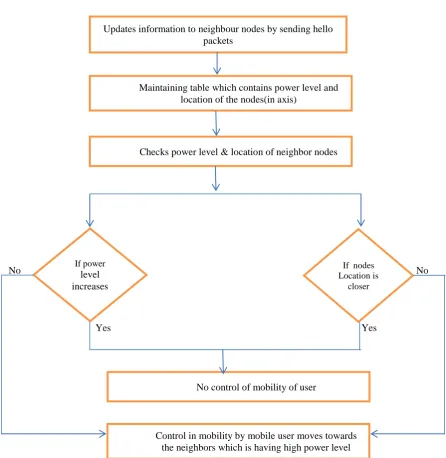
As far as Adhoc networks concerned network partitioning and link breaks in path play as major issue. In this proposal the mobility of user can control by the power level and location of the mobile user. The location of the mobile user is represented by X axis and Y axis. If the axis value is increased when the nodes are in mobility, it seems that the neighbour nodes are moves away from the network.
The proposed algorithm as follows is going to implement to control of path breaks.
Step1: Nodes are periodically updated with neighbor nodes by sending hello packets. Hello packets (power level, location)
Step2: Calculate which nodes have power level and distance axis reduced.
Step3: If the neighbor nodes reached threshold level.
ISSN(Online): 2320-9801 ISSN (Print): 2320-9798
I
nternational
J
ournal of
I
nnovative
R
esearch in
C
omputer
and
C
ommunication
E
ngineering
(A High Impact Factor, Monthly, Peer Reviewed Journal) Website: www.ijircce.com
Vol. 7, Issue 11, November 2019
Step5: Neighbor nodes make changes in topologies by receiving Recover packets. That is mobile
user will keep moves in reverse direction
IV.FLOWCHART
No No
Yes Yes
Fig No.1 : Flow chart in process of proposed method
A. Location or Distance Calculation
Here is how to calculate the distance between two nodes when you know their coordinates. Let us call the two nodes A and B. the node B is send the update packets to neighbor node A. It calculates the mobility behavior of the
Updates information to neighbour nodes by sending hello packets
Maintaining table which contains power level and location of the nodes(in axis)
If power
level increases
If nodes Location is
closer
Checks power level & location of neighbor nodes
No control of mobility of user
ISSN(Online): 2320-9801 ISSN (Print): 2320-9798
I
nternational
J
ournal of
I
nnovative
R
esearch in
C
omputer
and
C
ommunication
E
ngineering
(A High Impact Factor, Monthly, Peer Reviewed Journal) Website: www.ijircce.com
Vol. 7, Issue 11, November 2019
neighbor node B. By receiving power level and location of the neighbor nodes , node a calculates by below algorithm. We can run lines down from A, and along from B, to make a Right Angled Triangle. And with a little help from
Pythagoras we know that: a2 + b2 = c2
Now label the coordinates of points A and B
xA means the x-coordinate of point A
yA means the y-coordinate of point A
The horizontal distance "a" is (xA - xB) The vertical distance "b" is (yA - yB)
Fig No 2 : Distance Calculation
Likewise each and every neighbor’s calculates the distance or location of the corresponding neighbor nodes. In the above, its considered only two nodes for the easy understanding. Periodically the node calculates the distance among the group of nodes. If the distance reduces from the previous cases of calculation, the node will do unicasting by sending recover packets to change the reverse direction of mobility.
FFFFThe performance analysis and simulation are carried out to evaluate network performance using network
simulator NS-2 [2] based on the quantitative basic parameters like throughput, delay and Packet Delivery Ratio (PDR) in term of number of nodes and various mobility rates.
V. SIMULATIONRESULTS
A. Design Considerations:
SIMULATION PARAMETERS
Parameter Value
Target area 220 x 220 m2
Number of nodes 10
Initial energy of nodes 2J
Communication range of each SN 20–40 m
Speed of mobile sink 2 m/s
ISSN(Online): 2320-9801 ISSN (Print): 2320-9798
I
nternational
J
ournal of
I
nnovative
R
esearch in
C
omputer
and
C
ommunication
E
ngineering
(A High Impact Factor, Monthly, Peer Reviewed Journal) Website: www.ijircce.com
Vol. 7, Issue 11, November 2019
transmission energy performs better than the maximum number of hops in terms of network lifetime, energy consumption and total number of packets transmitted through the network.
Fig. 3. Energy Consumption by Each Node Fig. 4. Energy Consumption Vs packet delivery time
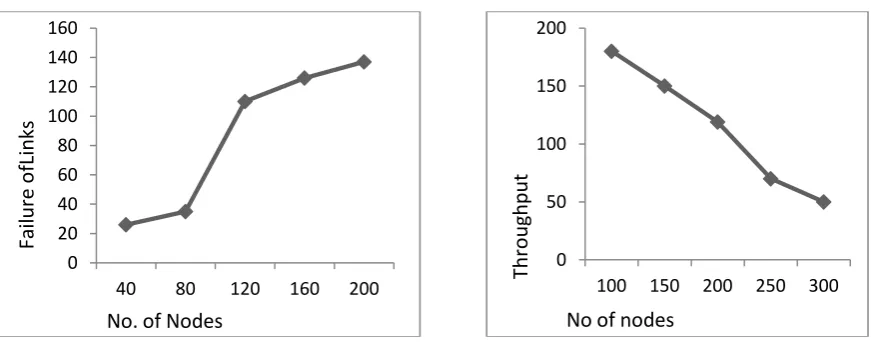
Fig. 5. Link failure Vs No of Nodes Fig. 6. Throughput Vs No of Nodes
VI.CONCLUSIONANDFUTUREWORK
Using hello packets each and every nodes periodically can update their presence in the networks. While updating, the update packets may also have information about power level, location of the nodes. The mobility of the node may vary with the transmission power level of neighbor nodes. This leads to do effective path finding, control the node mobility and reduce network partitioning. The network partitioning and remerging problem can be solved
through this method.Wehave used very small network of 10 nodes, as number of nodes increases the complexity will increase.
We can increase the number of nodes and analyze the performance.This paper may be extended for more number of nodes and also speed. 0 20 40 60 80 100 120 140 160
40 80 120 160 200
No. of Nodes
N
et
wo
rk
Energ
y
co
n
sumptio
n
in
J
0 50 100 150 200100 150 200 250 300
Packet delivery time in secs
N
et
wo
rk
Energ
y
co
n
sumptio
n
in
0 20 40 60 80 100 120 140 16040 80 120 160 200
No. of Nodes
Fa
ilu
re
o
fL
in
ks
0 50 100 150 200100 150 200 250 300
No of nodes
ISSN(Online): 2320-9801 ISSN (Print): 2320-9798
I
nternational
J
ournal of
I
nnovative
R
esearch in
C
omputer
and
C
ommunication
E
ngineering
(A High Impact Factor, Monthly, Peer Reviewed Journal) Website: www.ijircce.com
Vol. 7, Issue 11, November 2019
REFERENCES
1. Dealing with node mobility in ad hoc wireless network Mario Gerla, Ling-Jyh Chen, Yeng-Zhong Lee, Biao Zhou, Jiwei Chen, Guang Yang,
Shirshanka Das Computer Science Department, UCLA, Los Angeles, CA 90095, USA
2. The ns-2 Network Simulator. http://www.isi.edu/nsnam
3. R. Senthil Kumar, P. Kamalakkannan “A Novel Energy Based Routing Algorithm to Reduce Link Break in Mobile Ad Hoc Networks
“International Journal of Innovative Technology and Exploring Engineering (IJITEE) ISSN: 2278-3075, Volume-2, Issue-5, April 2013.
4. J¨org H¨ahner, Dominique Dudkowski,”Quantifying Network Partitioning in Mobile Ad Hoc Networks” Leibniz Universit¨at Hannover, SRA
Appelstr. 4, 30167 Hannover, Germany.
5. Grossglauser, M., Vetterli, M.: Locating nodes with ease: Last encounter routing in ad hoc networks through mobility di®usion. In: IEEE
Infocom. (2003)
6. Zhao, W., Ammar, M.: Proactive routing in highly-partitioned wireless ad hoc networks. In: 9th IEEE International Workshop on Future Trends
of Distributed Computing Systems. (2003)
7. Gerla, M., Hong, X., Pei, G.: Landmark routing for large ad hoc wireless networks. In: IEEE Globecom. (2000)
8. Xu, K., Hong, X., Gerla, M.: Landmark routing in ad hoc networks with mobile backbones. Journal of Parallel and Distributed Computing
(JPDC), Special Issues on Ad Hoc Networks (2003).[3] C. Gomez, M. Catalan,
9. X. Mantecon, J. Paradells, and A. Calveras, “Evaluating performance of real ad-hoc networks using AODV with hello message mechanism for
maintaining local connectivity,” in Proc. 2005 IEEE International Symposium on Personal, Indoor and Mobile Radio Communications, vol. 2, pp. 1327–1331.
10. R. Oliveira, M. Luis, L. Bernardo, R. Dinis, and P. Pinto, “The impact of node’s mobility on link-detection based on routing hello messages,” in
Proc. 2010 IEEE Wireless Communications and Networking Conference, pp. 1–6.
11. C.-M. Chao, J.-P. Sheu, and I.-C. Chou, “An adaptive quorum-based energy conserving protocol for IEEE 802.11 ad hoc networks,” IEEE
Trans. Mobile Computing, vol. 5, no. 5, pp. 560–570, May 2006.
12. T. Clausen, C. Dearlove, and J. Dean, “Mobile ad hoc network(MANET) neighborhood discovery protocol (NHDP),” 2010.
13. E. Belding-Royer and S. D. C. Perkins, “Ad hoc on-demand distance vector (AODV) routing,” July 2003.
14. D. Chakeres and C. E. Perkins, “Dynamic MANET on-demand (AODVV2) routing,” Feb. 2008.
15. V. C. Giruka and M. Singhal, “Hello protocols for ad-hoc networks: overhead and accuracy tradeoffs,” in Proc. Sixth IEEE International
Symposium on a World of Wireless Mobile and Multimedia Networks, pp. 354–361.
16. Seon Yeong Ha, and Dongman Lee “,An Adaptive Hello Messaging Scheme for Neighbor Discovery in On-Demand MANET Routing