University of Windsor University of Windsor
Scholarship at UWindsor
Scholarship at UWindsor
Electronic Theses and Dissertations Theses, Dissertations, and Major Papers
2017
Joint CFO Estimation and Data Detection in OFDM systems
Joint CFO Estimation and Data Detection in OFDM systems
Chunyu Mao
University of Windsor
Follow this and additional works at: https://scholar.uwindsor.ca/etd
Recommended Citation Recommended Citation
Mao, Chunyu, "Joint CFO Estimation and Data Detection in OFDM systems" (2017). Electronic Theses and Dissertations. 5910.
https://scholar.uwindsor.ca/etd/5910
This online database contains the full-text of PhD dissertations and Masters’ theses of University of Windsor students from 1954 forward. These documents are made available for personal study and research purposes only, in accordance with the Canadian Copyright Act and the Creative Commons license—CC BY-NC-ND (Attribution, Non-Commercial, No Derivative Works). Under this license, works must always be attributed to the copyright holder (original author), cannot be used for any commercial purposes, and may not be altered. Any other use would require the permission of the copyright holder. Students may inquire about withdrawing their dissertation and/or thesis from this database. For additional inquiries, please contact the repository administrator via email
Joint CFO Estimation and Data Detection in OFDM systems
by
Chunyu Mao
A Thesis
Submitted to the Faculty of Graduate Studies
through Electrical and Computer Engineering
in Partial Fulfilment of the Requirements for
the Degree of Master of Applied Science at the
University of Windsor
Windsor, Ontario, Canada
2016
c
Joint CFO Estimation and Data Detection in OFDM systems
by
Chunyu Mao
APPROVED BY:
Dr. Robin Gras School of Computer Science
Dr. Esam Adbel-Raheem
Department of Electrical and Computer Engineering
Dr. Behnam Shahrrava, Advisor
Department of Electrical and Computer Engineering
AUTHOR’S DECLARATION OF ORIGINALITY
I hereby certify that I am the sole author of this thesis and that no part of this
thesis has been published or submitted for publication.
I certify that, to the best of my knowledge, my thesis does not infringe upon
anyones copyright nor violate any proprietary rights and that any ideas, techniques,
quotations, or any other material from the work of other people included in my
thesis, published or otherwise, are fully acknowledged in accordance with the standard
referencing practices. Furthermore, to the extent that I have included copyrighted
material that surpasses the bounds of fair dealing within the meaning of the Canada
Copyright Act, I certify that I have obtained a written permission from the copyright
owner(s) to include such material(s) in my thesis and have included copies of such
copyright clearances to my appendix.
I declare that this is a true copy of my thesis, including any final revisions, as
approved by my thesis committee and the Graduate Studies office, and that this thesis
ABSTRACT
Orthogonal frequency division multiplexing (OFDM) is a multicarrier modulation
technique that is widely used in wireless broadband communication systems. The
spectral efficiency of OFDM is very high since the subcarriers are spaced as closely as
possible while maintaining orthogonality. However, one of the major problems with
OFDM that can cause performance degradation is carrier frequency offset (CFO)
which impairs the orthogonality among OFDM subcarriers, as a consequence, results
in inter-subcarrier interference.
In this thesis, an iterative algorithm for joint CFO estimation and data detection
in OFDM systems over frequency selective channels is proposed. The proposed
algo-rithm is performing both CFO estimation and data detection in the frequency domain
based on the Expectation-Maximization (EM) algorithm. The proposed algorithm
can achieve the same bit-error-rate (BER) performance as that of its time-domain
counterpart with much lower complexity.
Simulation results show that the proposed algorithm can converge after three
DEDICATION
To my parents, Huibin Mao and Yukun Wang, for their selfless contribution to
ACKNOWLEDGEMENTS
I would like to thank my supervisor Dr. Behnam Shahrrava, professor of the
department of Electrical and Computer Engineering at University of Windsor first.
The door to Prof. Shahrrava office was always open whenever I ran into a trouble
spot or had a question about my research. He consistently allowed this thesis to be
my own work, but steered me in the right direction whenever he thought I needed it.
I would also like to appreciate my thesis committee members Dr. Robin Gras
and Dr. Esam Adbel-Raheem. Without their passionate participation and input, the
thesis could not have been successfully conducted. I also want to thank Dr. Shervin
Erfani for his guidance of my research.
I would also like to acknowledge my uncle Dr. Yingming Zhao and my aunt Li
Wang for their support. They encourage me to chase my dream without any heisitate,
and I am gratefully indebted to their very valuable comments on my life.
Finally, I must express my very profound gratitude to my parents for providing
me with financial support and continuous encouragement throughout my years of
study and through the process of researching and writing this thesis. I would also
express my appreciate to my colleagues and friends, Siyu Zhang, Huyuan Li, Lin Li,
Pengzhao Song, Peibo Zhao, Akilan Thangarajah for their support and help. This
accomplishment would not have been possible without them. At last, I would like to
extend my gratitude to University of Windsor. Thank you.
TABLE OF CONTENTS
AUTHOR’S DECLARATION OF ORIGINALITY iii
ABSTRACT iv
DEDICATION v
ACKNOWLEDGEMENTS vi
LIST OF TABLES x
LIST OF FIGURES xi
LIST OF ACRONYMS xii
1 Introduction 1
1.1 Wireless Communications and OFDM Technique . . . 1
1.1.1 The Development of OFDM Technique . . . 1
1.1.2 The Advantages of OFDM Technique . . . 2
1.2 Challenges of OFDM . . . 3
1.3 Research Background on CFO effect . . . 5
1.3.1 Current Approach . . . 6
1.3.2 Novel Approach . . . 9
1.4 Objectives of the Thesis . . . 10
1.5 Organization of the Thesis . . . 11
2 OFDM Structure 12 2.1 The Basis of OFDM system . . . 12
3 The Wireless Channel 17
3.1 Fundamentals of the Wireless Channel . . . 17
3.2 The Wireless Channel and System Model in OFDM . . . 21
3.3 Techniques of Channel Estimation in OFDM . . . 24
4 Estimation Algorithms 25 4.1 Review of Estimation Algorithms . . . 25
4.1.1 Cramer-Rao Lower Bound . . . 27
4.1.2 Rao-Blackwell-Lehmann-Scheffe . . . 28
4.1.3 Best Linear Unbiased Estimatore . . . 28
4.1.4 Least Squared . . . 29
4.1.5 Method of Moments . . . 29
4.1.6 Maximum Likelihood . . . 30
4.2 Expectation Maximization Algorithm . . . 31
5 Joint CFO Estimation and Data Detection Algorithm for Time Do-main 37 6 Proposed Algorithm 45 7 Simulation Results and Analysis 52 7.1 Convergence of the Proposed Algorithm . . . 53
7.2 Performance of the Proposed Algorithm . . . 54
7.3 Estimated CFO . . . 56
8 Conslusion and Further Research 57 8.1 Overview . . . 57
8.2 Further Research . . . 60
Appendix A Conditional Channel Statistics in Time Domain 67
Appendix B Conditional Channel Statistics in Frequency Domain 71
LIST OF TABLES
LIST OF FIGURES
1.1 Multicarriers . . . 3
1.2 Orthogonal Subcarriers . . . 3
1.3 Doppler Effect . . . 5
1.4 CFO Effect . . . 5
1.5 Different Approachs . . . 7
2.1 Block Diagram of OFDM system . . . 12
2.2 4-PSK . . . 13
2.3 16-QAM . . . 13
3.1 The Wireless Channel . . . 17
3.2 Characterization of the Wireless Channel . . . 20
4.1 EM Algorithm Procedure . . . 36
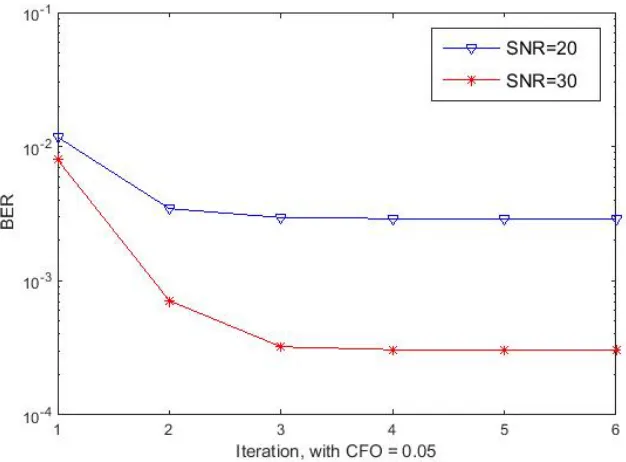
7.1 Convergence of the proposed algorithm . . . 53
7.2 BER with CFO=0 . . . 54
7.3 BER with CFO=0.03 . . . 54
7.4 BER with CFO=0.05 . . . 55
LIST OF ACRONYMS
AWGN Additive White Gaussian Noise
BER Bit Error Rate
BLUE Best Linear Unbiased Estimator
CDMA Code Division Multiple Access
CFO Carrier Frequency Offset
CIR Channel Impulse Response
CP Cyclic Prefix
CRLB Cramer-Rao Lower Bound
DFT Discrete Fourier Transform
E-step Expectation Step
EM Expectation Maximization
ICI Intercarrier Interference
IDFT Inverse Discrete Fourier Transform
ISI Intersymbol Interference
LMMSE Linear Minimum Mean Squared Error
LS Least Squares
LTI Linear Time Invariant
LTV Linear Time-Varying
MAP Maximum A Posteriori
MC Multicarrier
ML Maximmum Likelihood
MVU Minimum Variance Unbiased
OFDM Orthogonal Frequency Division Multiplexing
PAPR Peak to Average Power
PDF Probability Density Function
PSK Phase shift Keying
RBLS Rao-Blackwell-Lehmann-Scheffe
TDMA Time Division Multiple Access
WCDMA Wideband Code Division Multiple Access
1
Introduction
For the past centuries, people desire to communicate with each other in a convenience
and economical way. Due to this demand, communications has been a vibrant field
of research for more than hundred years. Thanks to the development of Very Large
Scale Integration (VLSI) and Signal Processing technology since the 1960s, wireless
communications has become one of the most significant research areas in the field
of modern communications, [1]. A tremendous advantage of wireless communication
compared with wired communication is that it does not require any physical cables.
This superiority not only enables devices to work anywhere without considering the
limitation of the wires but also saves the money.
1.1
Wireless Communications and OFDM Technique
1.1.1 The Development of OFDM Technique
In modern society, wireless communication has various excellent applications, such as
smart buildings, telecommunication, process industry, etc. As the technology
devel-opment, several techniques have been developed for wireless communication, such as
Time Division Multiple Access (TDMA), Code Division Multiple Access (CDMA),
Wideband Code Division Multiple Access (WCDMA), etc. Currently, Orthogonal
Frequency Division Multiplexing (OFDM) is the most popular multicarrier
band-efficient physical layer technique for wireless communication [2]. Multicarrier (MC)
modulation technique was first developed by Chang [3] in 1966. Todays OFDM was
introduced by Weistein and Ebert [4] in 1971, which is a special form of MC
trans-mission. In 1985, Crmini first applied OFDM in mobile wireless communication [5].
After these years development, OFDM is the most recognized technique in wireless
communication. It has various popular applications, such as digital audio
telecommunication.
1.1.2 The Advantages of OFDM Technique
OFDM has several outstanding advantages in compared with other techniques [6].
First of all, frequency domain modulation is easy to deal with the physical channel
without complex time domain equalization. Secondly, OFDM can be implemented
efficiently by using Fast Fourier Transform (FFT). Moreover, OFDM has not only
low sensitivity to time synchronization errors but also easy to integrate with
multi-antenna systems. Furthermore, intersymbol interference (ISI) can be simply handled
by adding the cyclic prefix (CP). An essential feature of OFDM [7] is that it employs
multiple narrowband orthogonal subcarriers. Due to this feature, not only the
avail-able spectrum can be used efficiently but also intercarrier interference (ICI) can be
completely eliminated. At last, this kind of subcarriers can preserve a high
trans-mission speed. Because of the above advantages, OFDM has become an excellent
technique for wireless communication.
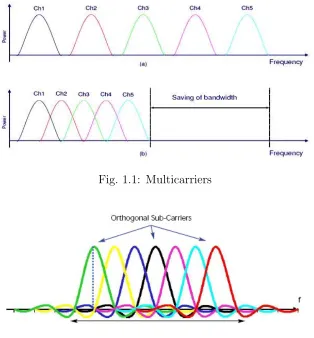
The essential characteristic of OFDM system is that it employs orthogonal
sub-carriers. In a conventional frequency division multiplexing (FDM), to eliminate ICI,
the subcarriers are spaced apart by inserting guard bands between them in the
fre-quency domain, as shown in Fig. 1.1a. However, this kind of arraignment for the
subcarriers wastes bandwidth. An alternative method is to overlap the subcarriers
to save the bandwidth as shown in Fig. 1.1b. But overlapping the subcarriers could
introduce ICI. Thus, to save bandwidth without having ICI, orthogonal subcarriers
are the best choice. OFDM is the technique that employs orthogonal subcarriers to
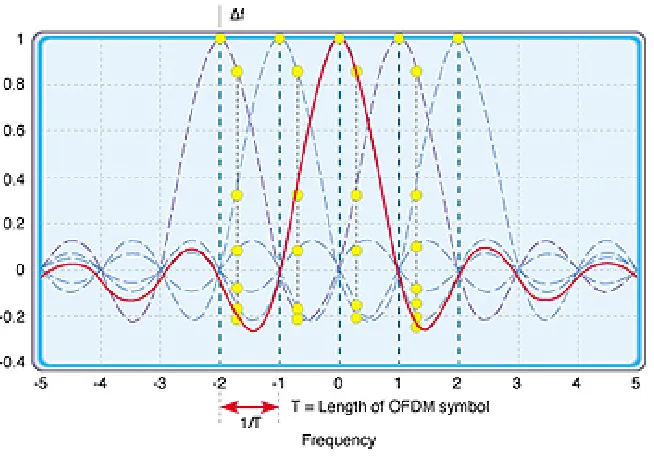
transmit the data. Figure 1.2 shows that the OFDM subcarriers exhibit
orthogonal-ity on a symbol interval if they are spaced in the frequency domain exactly at the
reciprocal of the symbol interval, which can be accomplished by utilizing the discrete
Fig. 1.1: Multicarriers
Fig. 1.2: Orthogonal Subcarriers
1.2
Challenges of OFDM
Nonetheless, due to the imperfect channel condition, OFDM still has several
limita-tions that would affect the performance of the system. First, in practice, a wireless
channel cannot be considered as an ideal channel [1]. As a result, the received signal is
not the same as the transmitted signal. Thus the data need to be recovered according
to the actual channel. Also, an OFDM signal can have a large peak-to-average-power
ratio (PAPR) value with high probability [8]. Moreover, strict frequency
synchro-nization is impossible to OFDM system [9] which is related to carrier frequency offset
(CFO). Furthermore, both CP and null guard tones at the edge of the spectrum can
decrease the spectral efficiency of the system. However, this thesis will focus only on
When considering the performance of a wireless communication system, the bit
error rate (BER) plays an essential role. The probability of bit error, also called,
the BER is a measure of deterioration in digital communications. Lower BER means
higher performance. In OFDM systems, due to the characteristics of the physical
channel, the BER is highly related to both parameters estimation and data
detec-tion. Generally speaking, the parameters contain timing error, channel information
and carrier frequency offset (CFO). These parameters are independent of each other.
Since the OFDM system is not sensitive to timing error [10], and the channel can be
estimated accurately by inserting a set of known symbols, called pilots, [11]. Hence,
the performance of the system is slightly affected by these two parameters. However,
the CFO cannot be easily estimated by using the pilots. The CFO is the
normal-ized frequency error between the transmitter and the receiver. In practical OFDM
systems, the CFO can be caused by the mismatch between the oscillator in the
trans-mitter and the receiver or the Doppler shift in frequency selective channels, [12]. In
practical mobile communication systems, the channel is a frequency selective
chan-nel. The details of communication channels will be given in Chapter 3. Fig. 1.3
shows how the Doppler shift leads to a frequency error. As seen in, in OFDM
sys-tems, the existence of CFO destroys the orthogonality among OFDM subcarriers, as
a consequence, results in inter-subcarrier interference [13]. And this inter-subcarrier
interference can cause BER performance degradation. As seen from Fig. 1.4, OFDM
is very sensitive to CFO [14], even a small CFO in an OFDM system can lead to a
Fig. 1.3: Doppler Effect
Fig. 1.4: CFO Effect
1.3
Research Background on CFO effect
In the literature, the CFO in an OFDM signal is modeled as a multiplicative
expo-nential function of time in the received signal in the time domain. Thus, if the CFO
can be estimated accurately, its impact can be simply eliminated by multiplying the
received symbol in the time domain with the following factor
e
which will be explained in Chapter 2. As a result, the problem is leading to how to
accurately estimate the CFO. In [12], the CFO was divided into two parts: integer
part and fractional part. The integer part does not cause inter-subcarrier interference
and only introduces a cyclic shift of data subcarriers. The integer part of CFO can
be estimated accurately by using the pilots. However, the fractional part can cause
interference among subcarriers, which results in destroying the orthogonality of the
subcarriers. The OFDM system is extremely sensitive to the fractional part of the
CFO. Since the fractional part of the CFO cannot be estimated with high accuracy
by using pilots.
Since CFO is a key issue of OFDM systems, thus there has been numerous
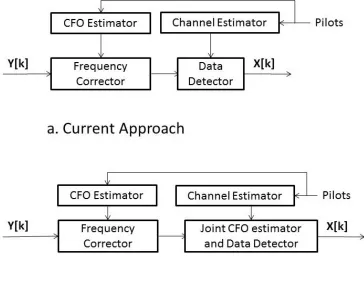
re-searches on how to estimate the CFO and how to compensate it. The current approach
in the literature is to estimate the CFO first, and then correct the frequency of the
received signal based on the estimated CFO. At last, the transmitted data is being
detected based on the assumption that there is no CFO in the system. The drawback
of this approach is that an accurate estimate of the CFO cannot be obtained and
any estimation error in the CFO estimate can affect the accuracy of data detection.
As a result, if the data is detected with the assumption that the frequency
synchro-nization is perfect, then the would be larger than the real one, which means decrease
the performance of the system. From [15], current techniques prefer to estimate the
CFO by exploiting the pilots, which is called pilots-aided CFO estimation. And then
detect the data without considering the impact of CFO. In this chapter, an overview
of both current and a novel approach for CFO estimation and data detection is being
presented. Figure 1.5 shows the differences between these two approaches.
1.3.1 Current Approach
Most of current CFO estimation algorithms are based on the pilots inserted either
preamble blocks in compared to the known symbols inserted in the selected subcarrier
of the OFDM system in the frequency domain. These pilots need to be designed
carefully to increase the accuracy of the CFO estimation.
In [16], with pilots are in the time domain, a Maximum Likelihood (ML) algorithm
was developed for CFO estimation. The algorithm exploited repeated data symbols
to track the CFO by exploring the relation between the repeated blocks. The author
in [17] extends this idea by using one specified training sequence to estimate the
CFO. Furthermore, an improved CFO estimation algorithm was proposed in [18], by
redesigning the training symbols, to increase the accuracy at the expense of increasing
computational complexity.
Fig. 1.5: Different Approachs
data in the frequency domain. An estimation algorithm based on this approach,
which had two stages, was presented in [19]. Considering the performance of the
CFO estimation algorithm, pilots needed to be designed carefully. The author in [20]
proposed two novel methods to design the pilots. In [21], another method to design
pilots was presented.
The accuracy of the CFO estimation can be improved by exploiting the statistical
information about the wireless channel. A pilot-aided CFO estimator based on the
ML algorithm has been proposed in [22], and the estimation range can be improved
without decreasing accuracy [23]. By taking the channel error into consideration, two
simple methods were proposed in [24]. A joint ML-based CFO and channel estimation
algorithm was developed in [25] that has excellent performance on accuracy but with
a relatively high computational complexity.
Figure 1.5a shows that after frequency correction, the data would be detected
without considering the estimation error associated with the CFO estimate. There
are four different detection algorithms. Specifically, zero forcing (ZF) equalizer, least
squares (LS) equalizer, maximum likelihood (ML) detector, and expectation
maxi-mization (EM) detector.
ZF and LS are the algorithms based only on the transmitted symbols, the received
symbols, and the estimated channel impulse response (CIR), [26]- [27]. The ZF
equalizer is a single-tap frequency-domain linear equalizer [26]. This type of equalizer,
proposed by Robert Lucky, is simply set to the inverse of the channel frequency
response, and it can be applied to the received symbols to recover the transmitted
symbols. The term zero-forcing means when there is no noise in the system, the
ISI will be equal to zero. Based on that condition, the estimated symbols with
perfect channel information can be equal to the transmitted symbols. The idea of
ZF is simple, but it works well when the ISI is significant compared to the noise.
the modulated transmitted symbols and the received symbols. From this aspect, LS
cannot eliminate the ISI. However, the total power of noise can be minimized by this
algorithm.
In addition to the ZF and LS equalizers, the ML and EM detectors take advantage
of the statistical information of the channel estimation. The ML detector is an
al-gorithm that estimates the data symbols by maximizing the likelihood function [28].
The ML algorithm can be easily implemented compared with the EM algorithm.
However, one of the major problems with the ML detector is that it requires that
both the pilot symbols and the data symbols are equipowered. The simulation
re-sults show that the ML detector performs better than the other three detectors, [28].
However, the ML algorithm as a sequence detector in fading channels typically has
prohibitive computational complexity. The EM algorithm can be used an iterative
method for finding ML or maximum a posterior (MAP), which can be applied for
data detection in OFDM systems[29]. There are two steps for EM algorithms which
are being called Expectation and Maximization.
1.3.2 Novel Approach
Due to the limitation of the accuracy of pilot-aided CFO estimation, the novel
ap-proach, shown in Fig. 1.5b is employed for improving the accuracy of CFO estimate.
Even after the frequency corrector, the estimation error associated with CFO
esti-mate must be taken into consideration while performing data detection. There are a
few researches on the idea of joint CFO estimation and data detection.
In [30], an algorithm was proposed for joint CFO estimation and data detection
based on pilots in OFDM systems. The algorithm employs linear approximation to
present the system function and then obtains the approximated function by going
through a linear search method, such as those in [31] and [32]. Then, to reduce the
data detector. That algorithm requires linear approximation and pilots information.
However, this technique highly depends not only on the pilots, which reduce the
spec-tral efficiency of the system but also the accuracy of the pilot estimator. In [33, 34],
another algorithm for performing joint estimation that was based on a linear search
method was proposed. In each iteration, the parameters were updated based on the
minimum mean-squared error (MMSE) criterion. Moreover, in [35], an iterative
EM-based algorithm that still separately performed CFO estimation and data detection
was designed. In [36], the EM algorithm was employed for joint estimate CFO and
detect data in the time domain for OFDM systems over frequency selective fast
fad-ing channel. However, there were two major problems with this algorithm. First,
the computational complexity of the algorithm was extremely high due to the matrix
inversion and partial eigendecomposition. Second, the frequency shift in fast fading
channel cannot be separated as a constant from the channel impulse response. In
ad-dition, the frequency selective fast fading channel can only happen in high mobility,
such as avionic communications. In most cases, frequency selectivity and fast fading
cannot happen at the same time as it will be explained in Chapter 2. Thus, in most
mobile communication systems, channels are frequency selective. Hence, the idea of
jointly CFO estimation and data detection by using an iterative EM algorithm for
OFDM systems over frequency selective channels is stimulated by this research.
1.4
Objectives of the Thesis
Motivated by the issues mentioned in the section above, the objectives of this thesis
are stated as follows:
• Considering the novel approach for OFDM systems to solve the problem caused
by CFO.
• Comparing the performance of the proposed algorithm with those of the
con-ventional algorithms.
1.5
Organization of the Thesis
This thesis is mainly focused on reducing the effect of CFO on the performance
of the OFDM systems over frequency selective channels. The rest of this thesis is
organized as follows. Chapter 2 gives a background of the basic structure of OFDM
systems. Chapter 3 presents an introduction of the wireless channel. Chapter 4 gives
an overview of the algorithms related to estimation theory. Also, the
expectation-maximization (EM) algorithm, which is related to the proposed algorithm, will be
introduced in chapter 4. In chapter 5, a joint CFO estimation and data detection
algorithm in the time domain is presented. In chapter 6, a joint CFO estimation and
data detection algorithm in the frequency domain is proposed. Simulation results
and analysis are presented in chapter 7. A summary of the results abstained in this
research and suggestions for further studies are given in Chapter 8. The relevant
2
OFDM Structure
In this chapter, first, the basic structure of an OFDM system is introduced. Then, the
signal transmission procedure is stated from the mathematical point of view. Beyond
this, the effect of CFO on the transmitted signal is presented in the second part of
this chapter.
2.1
The Basis of OFDM system
Fig. 2.1: Block Diagram of OFDM system
In an OFDM system, there are mainly two components, transmitter and receiver.
Each component has several steps to process the signal in order to properly transmit
the data from the transmitter to the receiver. Fig. 2.1 illustrates is a block diagram
of a typical OFDM communication system.
The source data are a sequence of binary bits, for example, 11100100. The
incom-ing bit stream of 1s and 0s is multiplexed into N parallel bit streams. Then, the N
parallel bit stream are independently mapped in the frequency domain into complex
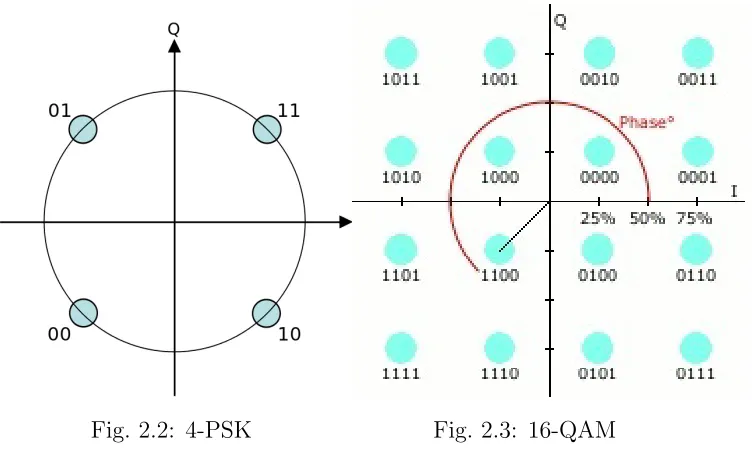
symbols, denoted by X[k], in a given constellations such as phase shift Keying (PSK)
Fig. 2.2: 4-PSK Fig. 2.3: 16-QAM
PSK is a digital modulation scheme that transfers the source data by modulating
the phase of the carrier (or subcarriers), which uses a finite number of phases, each
assigned to a unique pattern of data bits. Usually, each phase encodes an equal
number of bits. Each pattern of bits forms the symbol that is represented by the
particular phase. Fig. 2.2 shows the constellation diagram for 4-PSK modulation.
QAM is another digital modulation scheme that transfers source data by
modu-lating the phase and amplitude at the same time. QAM arranges the source data in a
square grid with equal vertical and horizontal spacing, each constellating point within
the grid represent a set of bits. The constellation diagram for 16-QAM is shown in
Fig. 2.3.
Moreover, the Discrete Fourier Transform (DFT) is an essential tool for a
DFT-based OFDM system since the orthogonality of its subcarriers is preserved by the
DFT. The DFT and Inverse Discrete Fourier Transform (IDFT) are being used to
transfer the data between the time domain and the frequency domain. In an OFDM
system, ISI caused by a time-dispersive channel can be eliminated by adding a cyclic
prefix (CP) as a guard interval to a block of OFDM signal. The length of the CP
copied from the last part of each OFDM symbol block after the IDFT operation and
then it is appended to the beginning of the block. Finally, the receiver can completely
eliminate ISI by discarding the samples of the CP part before the DFT operation, as
shown in Fig. 2.1.
A mathematical expression for an OFDM signal is derived in this section. The
carrier modulated signal for an OFDM signal with a block of N symbols can be
expressed in the following complex envelope form
s(t) = Re{s˜(t)ej2πfct} for 0≤t ≤N T
s (1)
where the complex envelope ˜s(t) can be written in the following form
˜ s(t) =
N−1
X
n=0
IDFT{X[k]}p(t−nTs), (2)
and p(t) which is known as the baseband pulse shape, may, for example, be a simple
unit-energy rectangular pulse of duration Ts, or it could be a raised-cosine pulse, a
bandlimited pulse, etc. Computing the N-point IDFT of {X[k]} gives a
complex-valued sequence {x[n]} as
x[n] = IDFT{X[k]}= 1 N
N−1
X
k=0
X[k]ej2πnk/N, n= 0,1, . . . , N −1. (3)
For convenience the following notation is used:
xn(t) =x[n]p(t−nTs). (4)
Now the OFDM signal given in (1) can be written as follows:
s(t) = Re{s˜(t)ej2πfct}= Re{
N−1
X
n=0
or
s(t) = Re{s˜(t)}cos(2πfct)−Im{s˜(t)}sin(2πfct) (6)
= N−1
X
n=0
Re{xn(t)}cos(2πfct)− N−1
X
n=0
Im{xn(t)}sin(2πfct) (7)
At the receiver part, in an ideal communication system, which means a system with
perfect time and frequency synchronization, an ideal channel, and with no additive
noise, the received signal r(t) and the transmitted signal s(t) are identical. After all
the operations are shown in Fig. 2.1, it can be easily shown that the detected symbols
y[n] and the transmitted symbolsx[n] are equal.
2.2
The Basis of CFO Effect in OFDM system
In this section, the effect of CFO on the received signal under perfect channel condition
is investigated from a mathematical point of view. The demodulation operation at
the receiver is performed by multiplying the received signal r(t) by the signal of the
local oscillator as follows:
z(t) = ˜s(t)ej2πfct·ej2πfrt (8)
where fr is the frequency of the local oscillator. In order to show the CFO caused
by the mismatch between the oscillator in the transmitter and that in the receiver,
or the Doppler shift in the channel, the frequency of the local oscillator is written as
follows:
fr =fc+ ∆f (9)
where ∆f represents the CFO in the system. Then, the output signal of the
demod-ulator after lowpass filtering is given by
or
y(t) = N−1
X
n=0
xn(t)ej2π∆f t, (11)
Finally, after sampling y(t) at sampling rate Ts, the received symbol in the time
domain can be obtained as follows:
y[n] =x[n]·e
j2π∆f n
fs (12)
where fs is the sampling rate and ∆f
fs
is called normalized CFO (or just CFO for
simplicity).
As seen in Equation (12), the effect of CFO in the system appears as a phase error
between the transmitted symbol and the received symbol. Also, if the CFO can be
accurately estimated, the impact of CFO on the received symbol in the time domain
can be completely eliminated. This can be simply done by multiplying y[n] by the
correction factor e−j2π∆f n/fs, which is the reciprocal of the exponential term in Eq.
3
The Wireless Channel
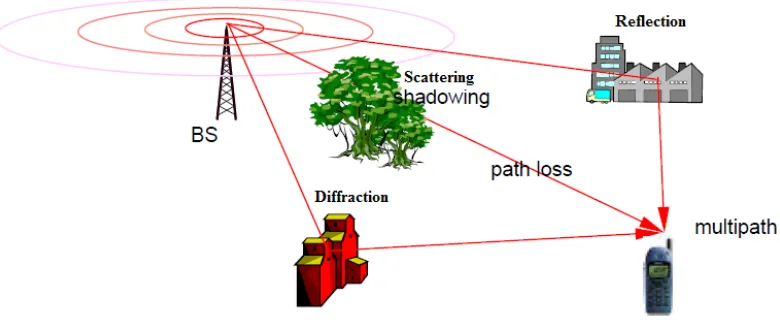
Fig. 3.1: The Wireless Channel
As mentioned in the 1st chapter, the key advantage of wireless communication
com-pared with wireline communication is that the former one has no limitation on the
communication channel. For wireline communication, the channel is a fixed
envi-ronment which means that the channel would stay constant for a relatively long
time. However, in wireless communication, the signal is transmitted via
electromag-netic waves. Due to the variation of the wave paths and the mobility of both the
transmitter and the receiver, the wireless channel becomes a significant factor to the
communication system. Figure 3.1 is a typical diagram of the wireless channel. In this
chapter, the fundamentals of the wireless channel are presented first, and then
focus-ing on the channel model in OFDM system. Current channel estimation techniques
are stated in the last section of this chapter.
3.1
Fundamentals of the Wireless Channel
Since the power of the radio waves is affected by the physical phenomenon of the
environment. Thus the environment lays the foundation of the wireless channel.
fading [38].
Large scale fading represents the average signal power attenuation due to path loss
and shadowing. More specially, path loss means the strength of the radio wave decay
with respect to a function of distance. As the distance goes longer, the power of the
wave becomes lower. In addition, even if two receivers have the same distance with the
transmitter, they may still receive a different signal due to the shadowing. Shadowing
is related to the environment between the transmitter and the receiver. Specifically,
the shadowing effect caused by obstacles in the signal paths. In most cases, this
fading effect can be accurately modeled as a random variable [39]. Fortunately, both
path loss and shadowing are typically frequency independent and could be modeled
properly. However, small scale fading does depend on the frequency which would
severely decrease the performance the communication system.
Small scale fading is caused not only by the constructive and destructive
interfer-ence of the different signal paths from the transmitter to the receiver which is being
called multipath propagation but also by the mobility. Considering multipath
propa-gation first, because of the different lengths of individual paths, each path would suffer
different delays, which also termed as time shift or time spread. If the maximum time
spread is greater than the symbol time, then ISI would be introduced by the channel.
Under this condition, the received symbol combines two or more transmitted
sym-bols which leading to difficulty in data detection. Otherwise, if all the spreads are
within the symbol time, then the channel induced ISI would not occur. Since time
spread in the time domain is equal to frequency selective in the frequency domain.
Thus the wireless channel under multipath propagation effect could be characterized
as frequency selective fading channel and frequency non-selective (flat) fading
chan-nel. Flat means all the subcarriers would suffer almost the same distortion. The
frequency selectivity is related to the symbol rate and channel coherence bandwidth
If the symbol rate is greater than the channel coherence bandwidth, the channel
would be frequency selective fading channel. Otherwise, the channel would be a flat
fading channel. Furthermore, there is a relation between the multipath delay and
the channel coherence bandwidth. In most wireless communication, such as mobile
communication, the channel is frequency selective channel which is being interested
in this thesis.
Moreover, if both the transmitter and the receiver are moving, then the Doppler
Effect and time variation of the channel need to be taken into consideration. The
author in [38] proves that the Doppler Effect caused by the motion leads to a spectral
compression or dilation, which is also called frequency shift. The frequency shift is
related to both the moving speed of the terminal and the carrier frequency.
Fur-thermore, due to the motion of the terminals, the propagation paths would change
all the time. This effect makes the channel as a time-varying system from nature.
Under both Doppler effect and time variation conditions, the wireless channel can
be characterized as slow fading channel and fast fading channel with respect to the
symbol time and the channel coherence time. The channel coherence time shows how
rapidly a fading channel changes with time. The fast fading channel is corresponding
to the channel with channel coherence time less than the symbol interval. For fast
fading channel, the channel is modeled as a linear time varying system which both
contain the Doppler shift and time-varying channel impulse response. The slow
fad-ing channel is used to described the channel with the channel coherence time greater
than the symbol duration. The slow fading channel can be approximately modeled
as a linear time-invariant system with frequency shift within each symbol interval.
Under this model, the frequency shift can be characterized as CFO. In most wireless
communication, the channel is slow fading channel.
From above analysis, it has been figured out that multipath propagation leading
time-varying channel impulse response. It is desired to transmitted signal in flat slow
fading channel in order to make the transmission efficient. Thus the symbol time
should be greater than the maximum multipath time spread regarding the frequency
selectivity, and smaller than the channel coherence time with respect to the time
variation. In mobile communication, the channel coherence time is much larger than
the multipath time spread (milliseconds compared to microsecond or nanosecond). As
a result, frequency selective fading and fast fading could not happen at the same time
in relative low mobility wireless communication. But for avionic communication, both
frequency selectivity and fast fading can appear at the same time. Both of the model
of frequency selective fast fading channel and frequency selective slow fading channel
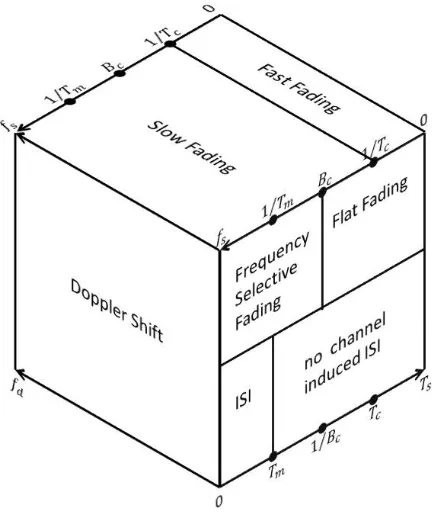
would be derived in this thesis. Figure 3.2 is the block diagram of characterization
of the wireless channel in relative low mobility.
3.2
The Wireless Channel and System Model in OFDM
The last section shows that the wireless channel is an LTV system with frequency
selectivity due to the multipath propagation and moving transmitter and receiver.
One important advantage of OFDM system is that it converts a frequency selective
fading channel into flat fading channel by transmitting high-speed data to low speed
data stream via multicarrier technique. Thus the channel induced ISI is avoided, but
the signal distortion still there.
Since the effect of frequency selectivity is overcome by the multicarrier technique
in OFDM system, then only fast fading and slow fading should be considered. For
fast fading channel, the channel is modeled as an LTV system which both contain the
Doppler effect and the time-varying path propagation. One important assumption
for most of the communication system is that the major noise is at the receiver
and independent of the channel. Under this assumption, the noise is modeled as an
Additive White Gaussian Noise (AWGN). Then the relation between the transmitted
signal and received signal can be presented as
r (t) = h (t)∗s (t) + w (t)
=
∞
Z
−∞
h (t, τ) s (τ)dτ+ w (t) (13)
where s (t) is the transmitted signal, r (t) is the received signal, h (t) is the channel
impulse response, w (t) is the AWGN.
If this equation is properly sampled, then the system model in discrete form would
be
r [n] = h [n]∗s [n] + w [n]
=
∞
X
m=−∞
After removing the CP, equation (14) can be expressed in matrix form as
y=CIR(h)x+w (15)
wherey[n] is the received symbols,x[n] is the transmitted symbols, and the channel
coefficients matrix is as follow
CIR(h) =
h(0,0) 0 . . . h(0,2) h(0,1)
h(1,1) h(1,0) . . . h(1,3) h(1,2) ..
. ... . . . ... ...
0 0 . . . h(N −2,0) 0
0 0 . . . h(N −1,1) h(N −1,0)
(16)
This channel is a frequency selective fast fading channel. However, this kind of
channel is only for high mobility, like avionic communication. In most cases, the
transmitter and receiver are not moving that fast, under this situation, the channel
is modeled as a Linear Time Invariant (LTI) system with frequency shift within each
symbol interval.
Alternatively, for an LTI system, the relation would change to
r (t) = h (t)∗s (t) + w (t)
=
∞
Z
−∞
h (t−τ) s (τ)dτ+ w (t) (17)
After sampling equation (17), the system model would be
r [n] = h [n]∗s [n] + w [n]
=
∞
X
m=−∞
After removing the CP, equation (18) can be expressed as
y=H(h)x+w (19)
where
H(h) =
h(0) 0 . . . h(2) h(1)
h(1) h(0) . . . h(3) h(2) ..
. ... . . . ... ...
0 0 . . . h(0) 0
0 0 . . . h(1) h(0)
(20)
Now, considering frequency shift to the system, then system in time domain can
be modeled as
y=T()H(h)x+w (21)
where T=diag
h
1, e−j2Nπ, . . . , e−
j2π(N−1)
N
iT
is the CFO effect matrix.
The channel model in the above equation is called frequency selective slow fading
channel, short for frequency selective channel. Note that, for OFDM system, the
frequency shift is not only coming from Doppler effect, but also from the difference of
the oscillator between the transmitter and the receiver. The effect of frequency shift
which is termed as CFO which has already been proved in the 2nd chapter.
The corresponding frequency domain system model would be
Y =FT()H(h)x+W
=FT(ε)F−1HX+W (22)
where Y= [Y0, . . . , YN−1]T is the frequency domain received symbols and X=
[X0, . . . , XN−1]T is the frequency domain transmitted symbols, and F is theN ×N
the channel frequency response diagonal matrix and also H = diag{FLh}, where
h= [h (0), . . . ,h (L−1)]T stands for CIR vector while L is the length of channel.
Since in most applications, the system is not under high mobility, thus the
fre-quency selective channel is more adaptive. This thesis would only consider the CFO
effect in OFDM system over frequency selective channel. There is two statistic model
of frequency selective channel: Rician fading channel and Rayleigh fading channel.
If the channel has a fixed light of sight, then the CIR have a Rician distribution.
Otherwise, the CIR follows Rayleigh distribution. Since in most cases, the light of
sight is not possible, thus Rayleigh fading channel model is being used in this thesis.
3.3
Techniques of Channel Estimation in OFDM
Before properly detecting the data, the channel should be estimated first. In an
OFDM system, pilot-aided channel estimation is the most popular used technique.
The pilots can be either inserted in time domain as a preamble or in frequency domain
[40, 41, 42]. Two key factors that affect the performance of the pilot-aided channel
estimation are pilot design and interpolation. There have many researches on
pi-lots design related problems. The author in [43] proposes an algorithm to estimate
the channel by using pilot tones. The optimal design of pilots has been researched
for frequency selective channel in [44] and [45]. An overview of pilot-aided channel
estimation for wireless communication has been presented in [46]. The accuracy of
channel estimation can be improved by involving channel statistic information [42].
This thesis would focus on joint CFO estimation and data detection for OFDM
system over frequency selective channel. Thus perfect channel information is assumed
to be achieved as a prior. In addition, in order to perform joint estimation, the
estimation algorithm should be considered. In next chapter, a review of estimation
algorithms would be given. And the joint estimation algorithm would be picked based
4
Estimation Algorithms
As a result from previous chapters, it is desired to design a joint estimation algorithm
to deal with the CFO effect for an OFDM system with frequency selective channel.
From the previous chapters, we can see that the system model which both
consid-ering the CFO and the transmitted data is a linear complex matrix equation with
nonlinear parameters. Although it is extremely difficult to jointly solve this kind of
problem, there are still several algorithms that can be considered to deal with it. In
the following paragraphs, the estimation theory and associated algorithms would be
reviewed first. Then based on the comparison of the presented algorithms, the EM
algorithm would be picked to deal with the joint estimation problem and explained
in the second part of this chapter.
4.1
Review of Estimation Algorithms
Estimation can be found in many signal processing systems which designed to extract
the desired information, such as Speech, Communication, Control, etc. In order to
properly estimate the parameters, various algorithms had been developed to handle
the estimation problem. Based on the characteristic of the unknown parameters, there
are two approaches: classical approach and Bayesian approach [47]. Specifically, in
classical approach, the unknown parameter is assumed to be a deterministic constant
which means the probability density function (PDF) of the parameter is not available,
and the observed data information is summarized by the PDF that depends on the
parameter. In contrast, in Bayesian approach, the unknown parameter is modeled
as a stochastic process, and the PDF of it is known as a prior. According to this
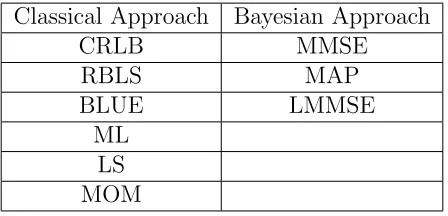
Table 4.1: Classification Of Estimation Algorithm
Classical Approach Bayesian Approach CRLB MMSE
RBLS MAP BLUE LMMSE
ML LS MOM
Since the problem that being interested is to estimate parameter vector based
on an observed data vector, which means a discrete estimation problem, then we
start with a general discrete estimation problem. After that, the algorithm is picked
by both considering the conditions and comparing different algorithms. From the
mathematical point of view, the problem is modeled as follow:
Y =S(X) +W (23)
whereYis the observed data vector,Xis the unknown parameter vector that need to
be estimated,W is the AWGN vector in most cases, but in general, it does not have
to be white Gaussian noise,S(·) represents a general transformation on the unknown
parameter.
Based on above information, the estimation problem is to derive a solution as
ˆ
X =f(Y) (24)
where ˆX is the estimated parameters, f(·) is a specified operation on the observed
data. Moreover, since the noise is modeled as AWGN, then the conditional PDF of
the observed data p(Y|X) is available.
Minimum Mean Squared Error, Maximum A Posteriori, and Linear Minimum Mean
Squared Error, respectively. Since all of these algorithms require statistic information
of the unknown parameter X as a prior, nonetheless the CFO and data are actually
deterministic without the required prior information. As a result, Bayesian approach
is not suitable for the joint estimation problem in this thesis. The algorithm for joint
estimation should be selected from the classical approach.
For classical approach, a good estimator of unknown parameters is to see whether
the average of the estimated value yields the true value and whether the variance
has the minimum value. If the average is equal to the true value, EnXˆo = X, the
estimator is called unbias estimator. And if the variance is minimized, V arnXˆo =
V armin
n
ˆ
Xo, the estimator is called minimum variance estimator. Thus the goal in
classical approach is to find a minimum variance unbiased (MVU) estimator. Based
on this criteria, several algorithms are reviewed as follows.
4.1.1 Cramer-Rao Lower Bound
First of all, Cramer-Rao Lower Bound (CRLB) is the easiest method to determine
the lower bound of the variance of any unbiased estimator. Then the estimator can
be found according to the first derivative of the ln conditional PDF.
It first assumes that
E
∂lnp(Y|X) ∂X
=0 (25)
Then the varince of the estimator would satisfy
V ar
∂lnp(Y|X) ∂X
≥ 1
−Eh∂2ln∂p2(XY|X)
i (26)
Then if the first derivative of the ln conditional PDF can be expressed as
∂lnp(Y|X)
As a result, X would be estimated as
ˆ
X=g(Y) (28)
From equation (28), CRLB is a straightforward method to estimate the parameters
under MVU condition. However, for nonlinear transformation as CFO, the derivative
can not be achieved easily. And even if the derivative can be achieved, the specified
expression would be a problem. Thus CRLB is not appropriate.
4.1.2 Rao-Blackwell-Lehmann-Scheffe
Moreover, Rao-Blackwell-Lehmann-Scheffe (RBLS) is another MVU estimator. By
factorizing the conditional PDF in the following form
p(Y|X) = g(T (Y),X)h(Y) (29)
The estimator can be found as
ˆ
X=k(T (Y)) (30)
where k(T(Y)) is a function that satisfy E{k(T (Y))} = Y, and T (Y) is called
sufficient statistic.
The process of finding the estimator is simple. Nevertheless, it is hard to find
the sufficient statistic and factor the PDF in the required form. Thus RBLS is not
suitable either.
4.1.3 Best Linear Unbiased Estimatore
In addition, Best Linear Unbiased Estimator (BLUE) is a suboptimal MVU estimator
that if
S(X) =HX (31)
where H is a known matrix, which means Y is linearly related to X. Moreover, the
noise has zero mean and known covariance matrix as C. Then the estimator would
be
ˆ
X= HTC−1H−1HTC−1Y (32)
Since complete PDF of the observed data Y is not necessary, BLUE is more
suitable for practical implementation. However, a key issue of BLUE is that it requires
the system has a linear relation which can not be satisfied because of the CFO as
equation (22). Thus BLUE is also not appropriate.
4.1.4 Least Squared
Furthermore, LS estimator is a basic algorithm that only minimizes the squared error.
It does not need any statistic information. The estimated parameter is the value that
minimizes the squared error function, where the squared error function is
J(X) = (Y−S(X))T (Y−S(X)) (33)
But the drawbacks are that it is neither an MVU estimator nor optimal in general.
Moreover, the direct solution is not available. Thus this algorithm is not proper to
be chosen to perform the joint estimation.
4.1.5 Method of Moments
Besides that, Method of Moments is another algorthm that do not need entire PDF of
the observed data. It only requires theN moments of the observed data Y, where N
as
ˆ
X =h−1(ˆµ) (34)
where ˆµi = N1 PNn=0Xi[n]
The advantage of this method is that it is easy to implement. However, due to
the none optimality and the requirement of multiple moments, it can not be selected
as the joint estimation algorithm.
4.1.6 Maximum Likelihood
At last, ML estimator would be the one that being chosen to solve the problem that
mentioned in the 1st chapter because of the advantages specified in the following
paragraph.
Compared with above algorithms, ML has several advantages. First of all, ML is
an optimal algorithm if the MVU estimator exists. If not, it is the approximate MVU
estimator. Moreover, it can be implemented for complicated estimation problem.
Lastly, the only requirement of it is the PDF of the observed data. Due to these
reasons, almost all practical estimators are based on the ML principle. Thus ML is
being selected at the beginning. The idea of ML is simple, the unknown parameter
X is merely the value that maximize the likelihood function p(Y|X). However, due
to the nonlinearity of the parameters in our system model, the direct form of ML
estimator can not be solved easily. Then alternative algorithms are being considered
to solve the ML problem.
Firstly, since the ML can always be found for a given data set numerically, thus
grid search is the safest method. However, considering the huge computation problem,
grid search is not a suitable solution. Under this condition, we are forced to consider
the iterative procedure. The Newton-Raphson method and the scoring approach are
two iterative methods that had been considered. Nonetheless, the convergence of these
[48], is being considered as the algorithm to maximize the likelihood function.
In comparing with the mentioned algorithms in the last paragraph, EM algorithm
is a better choice since it can maximize the likelihood function in an iterative way
with guaranteed convergence. Then the problem can be solved iteratively by treating
the observations as incomplete data. In addition, the EM algorithm does not require
any approximation and pilots information in solving the CFO problem. At last, the
EM algorithm is excellent also because of its computation simplicity. Due to above
advantages, EM algorithm is being picked to jointly estimate the CFO and detect the
data for OFDM system with frequency selective channel in this thesis. In the following
paragraphs, more details would be given to help understand the EM algorithm.
4.2
Expectation Maximization Algorithm
As stated in the last chapter, EM algorithm is a better method to solve ML detection
problem. Let’s start from ML algorithm.
Suppose that the PDF of a random known vector Y is given as f(Y|X), where
X is the vector of interest. Then the given conditional PDF of Y is the likelihood
function for ML algorithm. As a result, the solution of the ML algorithm in this
condition would be the X that maximize the likelihood function or log likelihood
function. However, if the likelihood function f(Y|X) highly nonlinear depends on
any parameters or variables, then analytical solution would not be easy to derive.
Alternatively, if there exist another random vector H which can not be observed
directly but has a relation withX, then according to Leibiz Integral Rule, we have:
f(Y|X) =
Z
f(Y,H|X)dH (35)
Under this condition, the ML problem convert to maximize the integral of the
H is called missing data, {Y,H} is called complete data.
By using Bayes’ rule, we have
f(Y,H|X) =f(H|Y,X)f(Y|X) (36)
To proceed, take the log to equation (36) and rearrange the equation, then
logf(Y|X) = logf(Y,H|X)−logf(H|Y,X) (37)
Assume we have the conditional PDF of H conditioned on Y and Xi, where Xi
represents the estimated X in the ith iteration. Then take expectation with respect
toH in equation (37) on both sides, we have
EH{logf(Y|X)} = EH{logf(Y,H|X)} −EH{logf(H|Y,X)}
=
Z
logf(Y,H|X)f H|Y,XidH
− Z
logf(H|Y,X)f H|Y,XidH (38)
Since f(Y|X) is nothing do with H, then
EH{logf(Y|X)}= logf(Y|X) (39)
Combining equation (38) and (39), we have
logf(Y|X) =
Z
logf(Y,H|X)·f H|Y,XidH− Z
logf(H|Y,X)·f H|Y,XidH
(40)
For simplicity, define
QX|Xi=
Z
logf(Y,H|X)·f H|Y,XidH (41)
P X|Xi =
Z
logf(H|Y,X)·f H|Y,XidH (42)
In order to increase the value of logf(Y|X) in each iteration, we should ensure
that
logf Y|Xi+1≥logf Y|Xi (43)
which means
Q Xi+1|Xi−P Xi+1|X1≥Q Xi|Xi−P Xi|Xi (44)
Notice that
P Xi|Xi−P Xi+1|Xi =
Z
logf H|Y,Xi·f H|Y,XidH
− Z
logf H|Y,Xi+1·f H|Y,XidH
= − Z
f H|Y,Xi·logf H|Y,X i+1
f H|Y,Xi dH (45)
Since for natural logarithm inequality, logx≤x−1whenx≥0, then
Z
f H|Y,Xi·logf H|Y,X i+1
f H|Y,Xi dH ≤ Z
f H|Y,Xi· f H|Y,X i+1
f H|Y,Xi −1 !
dH
=
Z
f H|Y,Xi+1dH− Z
f H|Y,XidH
= 1−1 = 0 (46)
Thus
for any X.
Then according to equation (44), what we need to do is to find Xi+1 that satisfies
Q Xi+1|Xi≥Q Xi|Xi (48)
By performing this operation, the Q function increases iteration by iteration,
which means iteratively maximize the likelihood function.
The method introduced above is called EM algorithm, since it constructs an
ex-pectation function first, and then maximizing the exex-pectation function iteration by
iteration. There are two steps which are called Expectation Step (E-step) and
Max-imization Step (M-step). The E-step is used to handle the randomness of some
parameters. Then the solution can be searched through maximizing the function
de-rived in E-step. In the following paragraphs, in order to give a clear idea of how the
EM algorithm works, the algorithm would be introduced via solving a simple linear
model.
Considering a general linear model as:
Y =H(h)X+W (49)
where Y is a known column vector, h is a column vector that can not be observed,
but independent of any other parameters and follow a specified distribution, such as
Gaussian Distribution. Moreover, H is nonlinear depend on h. And X stands for a
column vector need to be estimated. W is the AWGN column vector.
X should be estimated by using the above knowledge. The solution of the ML
estimate of X is
X=argmaxf(Y|X) (50)
ML estimate would not be solved easily. At this point, the EM algorithm is being
introduced to solve this problem in a relatively easy way. Within EM algorithm, Y
is called incomplete data, h is called the missing data, and {Y,h}is called complete
data. Then the likelihood function can be expressed as the integration of the marginal
likelihood function as
f(Y|X) =
Z
f(Y,h|X)dh (51)
Then ML estimation can be simplified by using the marginal PDF. The solution of
the EM algorithm is the variables that maximize the expectation of the log marginal
likelihood function as follow
X =argmaxEh
logf Y,h|Xi |Y,Xi−1 (52)
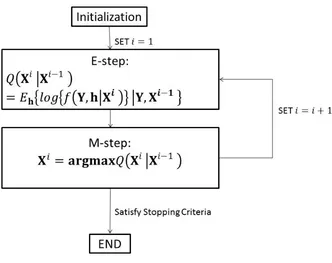
There are two iterative steps to solve this problem:
E-step:
Forming the Q function as
Q Xi|Xi−1
=Eh
log
f Y,h|Xi |Y,Xi−1 (53)
M-step:
Solving the Qfunction to find the solution at current iteration as
X =argmaxQ( Xi|Xi−1 (54)
Fig. 4.1: EM Algorithm Procedure
From this chapter, we would have a clear idea about how the EM algorithm
derived and the procedure of the algorithm. It is obvious that this algorithm is a
better choice for those systems with nonlinear parameters or variables that can not
be solved directly via ML algorithm. However, although the algorithm is simple
which only involves two steps in each iteration, the mathematical derivation for an
individual case is not as simple as the procedure. In next chapter, the EM algorithm
would be applied to an OFDM system with frequency selective channel to jointly
5
Joint CFO Estimation and Data Detection
Al-gorithm for Time Domain
In this chapter, a joint CFO estimation and data detection algorithm for OFDM
system over frequency selective channel is presented based on EM algorithm. As I
mentioned before, this joint algorithm is proposed in [36] which deal with frequency
selective fast fading channel. However, for fast fading channel, the Doppler shift can
not be characterized as CFO as described in [36]. Thus the method is not correct
in that paper. But in this thesis, the EM algorithm is being applied to frequency
selective channel which is appropriate as explained in chapter 3, and the requirement
of the pilot information is eliminated for computation simplicity. The time domain
system model is derived in chapter 3 as equation (21). The details would be given in
the following paragraphs.
The time domain OFDM system can be modeled as follow:
y=TH(h)x+w (55)
where T = diag
h
1, e−j2Nπ, . . . , e−
j2π(N−1)
N
iT
represents the matrix of CFO, y =
[y0, . . . , yN−1]T is the time domain received symbols and x = [x0, . . . , xN−1]T is the
time domain transmitted symbols with the size of N, w is the AWGN matrix with
the covariance σ2nIN. Thus the received symbol vector y follows Complex Gaussian
distribution with mean TH(h)x and covariance matrix σ2nIN as
f(y|x,h, ) = 1 πNσ2
n exp
(
−(y−TH(h)x) H
(y−TH(h)x) σ2
n
)
H(h) is theN ×N convolution matrix, h= [h (0), . . . ,h (L−1)]T is the CIR and
H(h) =
h(0) 0 . . . h(2) h(1)
h(1) h(0) . . . h(3) h(2) ..
. ... . . . ... ...
0 0 . . . h(0) 0
0 0 . . . h(1) h(0)
(57)
Since H(h)xrepresents the convolution, then the following property hold:
H(h)x=D(x)h (58)
where
D(x) =
x0 xN−1 . . . xN−L+2 xN−L+1
x1 x0 . . . xN−L+3 xN−L+2
..
. ... . . . ... ...
xN−2 xN−3 . . . xN−L xN−L−1
xN−1 xN−2 . . . xN−L+1 xN−L
(59)
For the ML algorithm,the joint marginal likelihood function would be maximized
as
(x, ) = argmaxf(y|x, ) (60)
However the direct solution for the marginal likelihood cannot be found. Thus it
is desired to use EM algorithm to iteratively maximize the likelihood function.
The Rayleigh fading channel with covariance matrix R is being used as
p(h) = 1
πLdetRexp
By using Bayes’ rule
f(y,h|x, ) = f(y|x,h, )p(h|x, )
= f(y|x,h, )p(h) (62)
Now the solution of equation (60) can be found iteratively through EM algorithm
as follows.
E-step:
log{f(y,h|x, )}= log{f(y|x,h, )}+ logp{(h)} (63)
Putting equation (56) and (61) into equation (63), and dropping the terms
indepen-dent of xand
log{f(y|x,h, )} ∝log{f(y|x,h, )}
= log
(
1 πNσ2
n exp
(
−(y−TH(h)x) H
(y−TH(h)x) σ2 n )) = log 1 πNσ2
n
−(y−TH(h)x) H
(y−TH(h)x) σ2
n
= log
1 πNσ2
n
−yy
H −2Re
yHTH(h)x +xHH(h)HTHTH(h)x σ2
n
= log
1 πNσ2
n −yy H σ2 n + 2Re
yHTH(h)x −xHH(h)H
H(h)x σ2
n
= log
1 πNσ2
n −yy H σ2 n + 2Re
yHTD(x)h −hHD(x)H
D(x)h σ2
n
= log
1 πNσ2
n −yy H σ2 n +
2ReyHTD(x)h −TrnD(x)H
D(x)hhHo σ2
n
∝2ReyHTD(x)h −Tr
n
D(x)HD(x)hhH o
Then the expectation of the joint log likelihood function is
Q xi, i = Eh
logf y,h|xi, i |y,xi−1, i−1
= 2Re
yHTD xi
E
h|y,xi−1, i−1
−TrnD xiHD xiEhhH|y,xi−1, i−1 o
(65)
In order to simplify the above euqation, make
µ µ
µ=E{h|y,xi−1, i−1} (66)
cov=En(h−µµµ) (h−µµµ)H|y,xi−1, i−1o (67)
Then
EhHh|y,xi−1, i−1 =cov+µµµµµµH (68)
Now, equation (65) can be expressed as
Q(xi, i) = 2Re
yHTD xi
µµµ −TrnD xiH
D xi
cov+µµµµµµHo
= 2ReyHTD xiµµµ −µµµHD xiHD xiµµµ−TrnD xiHD xicovo
(69)
Based on eigen-decomposition
cov=XβffH (70)
where β is the mth eigenvalue of cov, f is the corresponding eigenvector, then
TrnD(xi)HD(xi)covo = TrnD xiH
D xi XβffHo
Then equation (69) would be changed to
Q xi, i|xi−1, i−1 = 2ReyHTD xiµµµ −µµµHD xiHD xiµµµ
−XβfHD xiH
D xi f
= 2ReyHTD xiµµµ
−xiHH(µµµ)HH(µµµ)xi−XβxiHH(f)HH(f)xi
(72)
M-step:
In M-step, Q(xi, i|xi−1, i−1) in equation (69) is maximized with respect toxand
. Dropping those terms independent of xand .
xi, i = argmaxQ xi, i|xi−1, i−1
= argmax2ReyHTD xiµµµ
−xiHH(µµµ)HH(µµµ)xi−XβxiHH(f)HH(f)xio (73)
By setting the first derivative of argmaxQ(xi, i−1|xi−1, i−1) in equation (72) with
respect to xto zero,x maximizing the function in the ith iteration as
ˆ
xi =argmaxQ xi, i−1|
xi−1, i−1
=hH(µµµ)HH(µµµ) +XβH(f)HH(f)i
−1
H(µµµ)HTHy (74)
Then demapping this continues data to discrete data according to the constellation
algorithm, then the estimated symbols in the ith iteration are
xi =F−1·DemappingnFxˆio (75)
conditional mean and conditional correlation matrix. Both of them are derived in
Appendix A as follows
µ
µµ= R−1+aHb−1
a−1aHb−1
y (76)
cov= R−1+aHb−1
a−1 (77)
For the ith CFO, it can be estimated by using thexi as
i = argmaxQ xi, i|xi−1, i−1
= argmax n
2ReyHTD xiµµµ −xiHH(µµµ)HH(µµµ)xi
−XβxiHH(f)H H(f)xio (78)
Since is only a real number, then only one dimension numerical search is required
to get i that maximize the Q function. Then repeat the E-step and M-step until
satisfy the stopping criteria.
Convergence is a key issue for an iterative algorithm. For the above algorithm,
the convergence can be proof.
Since
Q xi, i−1|xi−1, i−1
≥ Q xi−1, i−1|xi−1, i−1
(79)
Q xi, i|xi−1, i−1 ≥ Q xi, i−1|xi−1, i−1 (80)
Then
Q xi, i|xi−1, i−1≥Q xi−1, i−1|xi−1, i−1 (81)
The Q function is decreased iteration by iteration. Thus the convergence of this
algorithm is proved.
Initialization:
At the beginning, simply setting0 = 0. Then the system model reduce to normal
linear model without CFO as
y=H(h)x+w (82)
Using LS data detector with the help of the estimated channel to have the initial
x0 as
x0 =F−1 |H|2−1
HHY (83)
F−1 represents the IDFT. Hand Y is the corresponding frequency domain CIR and
received symbols, respectively.
Then compute in each iteration:
µ
µµ= R−1+aHb−1
a−1aHb−1
y (84)
cov= R−1+aHb−1a−1 (85)
Based on eigen-decomposition, we have
cov=XβffH (86)
Then
ˆ
xi = hH(µµµ)H H(µµµ) +XβH(f)HH(f)i
−1
H(µµµ)HTHy (87)
xi = F−1·DemappingnFxˆio (88)
i = argmaxn2Re
yHTD xi
µ
µµ −xiHH(µµµ)HH(µµµ)xi
−XβxiHH(f)HH(f)xio (89)