University of Windsor University of Windsor
Scholarship at UWindsor
Scholarship at UWindsor
Electronic Theses and Dissertations Theses, Dissertations, and Major Papers
2017
Schrödinger’s Daughter
Schrödinger’s Daughter
Christina Angeli
University of Windsor
Follow this and additional works at: https://scholar.uwindsor.ca/etd
Recommended Citation Recommended Citation
Angeli, Christina, "Schrödinger’s Daughter" (2017). Electronic Theses and Dissertations. 5964.
https://scholar.uwindsor.ca/etd/5964
Schrödinger’s Daughter
by
Christina Angeli
A Creative Writing Project
Submitted to the Faculty of Graduate Studies
through the Department of English Language, Literature, and Creative Writing
in Partial Fulfilment of the Requirements
for the Degree of Master of Arts at the
University of Windsor
Windsor, Ontario, Canada
2017
Schrödinger’s Daughter
by
Christina Angeli
APPROVED BY:
______________________________________________
R. P. Datta
Department of Sociology, Anthropology, and Criminology
______________________________________________
N. Ricci
Department of English Language, Literature, and Creative Writing
______________________________________________
N. Markotić, Advisor
Department of English Language, Literature, and Creative Writing
AUTHOR’S DECLARATION OF ORIGINALITY
I hereby certify that I am the sole author of this thesis and that no part of this
thesis has been published or submitted for publication.
I certify that, to the best of my knowledge, my thesis does not infringe upon
anyone’s copyright nor violate any proprietary rights and that any ideas, techniques,
quotations, or any other material from the work of other people included in my thesis,
published or otherwise, are fully acknowledged in accordance with the standard
referencing practices. Furthermore, to the extent that I have included copyrighted
material that surpasses the bounds of fair dealing within the meaning of the Canada
Copyright Act, I certify that I have obtained a written permission from the copyright
owner(s) to include such material(s) in my thesis and have included copies of such
copyright clearances to my appendix.
I declare that this is a true copy of my thesis, including any final revisions, as
approved by my thesis committee and the Graduate Studies office, and that this thesis has
ABSTRACT
“Schrödinger’s Daughter,” explores the societal norms which govern grief and
mourning. The project, which is comprised of a series of interconnected short stories and
found text prose poems, follows a family dealing with the loss of their patriarch. The
narrative is told through the perspective of the three remaining immediate family
members: Trista, the deceased’s daughter, acts as primary narrator, while Brigitte, the
wife, and Ulisse, the son, act as secondary narrators. Each story weaves together to create
a multilayered representation of the public and private grieving process, often
reinterpreting events through multiple perspectives, illustrating the varied nature of grief.
Through these speculative pieces, I develop a critique of performative cultural practices,
such as funerals and wakes, which regulate the way individuals mourn on a public level
and how these public practices weave into the private expressions of grief.
The accompanying critical essay, “Act ‘Sad’ the Neighbours are Watching:
Writing About the Performative Societal and Linguistic Conventions which Govern
Death, Grief, and Mourning in Schrödinger’s Daughter,”breaks the critique down into
three main avenues: 1) exploring how grief operates as a performative action within
societal systems such as the workplace, the neighbourhood, social media, and healthcare;
2) the utilization of elements of magical realism on a macro level (narrative and structure)
to create defamiliarization and promote critical reception in an audience; 3) and the
utilization of elements of speculative fiction on a micro level (language and metaphor) to
DEDICATION
I dedicated this project to my brother, Nicholas; my mother, Elizabeth; and
especially, my father, Frank.
This wouldn’t exist without you.
ACKNOWLEDGEMENTS
I would like to thank the University of Windsor and the Department of English
Language, Literature, and Creative Writing for providing me with the space, resources,
and freedom to pursue this project. I would like to extend special thanks to my advisor,
Nicole Markotić, who has been with me at every step of this process: from the final year
of my undergraduate where the concept for this manuscript began to solidify to this year
where that idea began to flourish into the text in your hands, she has provided me with
better verbs than looking and made me aware of very "to be"; and Susan Holbrook,
whose guidance in my graduate creative writing seminar helped mould this project
further and made me unafraid to confront the banal. And finally, I would like to thank my
family: thank you for supporting me and allowing me to take the hurt we've been
TABLE OF CONTENTS
AUTHOR’S DECLARATION OF ORIGINALITY iii
ABSTRACT iv
DEDICATION v
ACKNOWLEDGEMENTS vi
Vigil for the Moon 1
Projected Progression through Grief, Bastardized from Kübler-Ross by Armchair
Psychologists Everywhere: A Flow Chart 12
Projected Progression through Grief Bereavement, According to Hospice: A Flow Chart 13
Belonging(s) 14
Are You an Orphan? 21
Projected Immediacy of Grief 24
O’ Death v. Toddlers 25
Dismember 31
Living Progression through Grief: A Flow Chart Case I 37
Hello Promised Land 38
Living Immediacy of Grief 41
So You’re an Orphan 42
Your Husband’s Nineteen Other Loves 45
Thumbs Aren’t Made for Talking 55
Living Progression through Grief: A Flow Chart Case II 71
Dictionary for the Dying: A Guide to Corporeal Linguistics 72
Living Progression through Grief: A Flow Chart Case III 81
Schrödinger’s Daughter 82
Act “Sad” the Neighbours are Watching: Writing About the Performative Societal and Linguistic Conventions which Govern Death, Grief, and Mourning in “Schrödinger’s
Daughter” 90
WORKS CITED 110
WORKS CONSULTED 112
Vigil for the Moon
Three days before the ceremony, Mother informs the neighbours and The
Homeowner’s Association. Starting with the Collins family. Trista’s delicate and gentle
mother shrouded in oxblood red, the silver dagger already strapped to her waist.
Shoulders sinking with the mantle of widow. Trista and Ulisse at Mother’s side, stepping
left to her left, right to her right. They tell those in close proximity to the house, and those
who will smell the smoke and see the flicker of the flame (The Collins, the Yangs, the
Johnstons, the Lauriers). Or possibly peppered in the ash (the Joneses, the Grants, the
Stevenses). Each neighbour opens their doors, brows concern creased and eyes hungry.
“Oh dear, has he passed? How if you don’t mind us asking” They all ask.
“Yes, he goes to the hunt now.” All Mother can say, ignoring the question. Sister
and brother take turns with the next part.
“He’ll burn in three days, the 28th.” And with that the family departs to the next
house.
They leave a buzz of whispers in their wake. Come watch the cultists. The family
now a novelty on the block: more of a juicy tidbit than Mr. Collins’s affair and
subsequent divorce from Mrs. Collins last spring. Few worship the old gods the way this
family worships. Few pay their faith with blood: Mrs. Levesque fainted when she went to
ask for lawn bags and found them skinning a deer in their backyard. The sacerdos have
lost their Rex Nemorensis. Hunters falter when they lose their king. Sister, brother, and
mother/wife: a solemn procession shuffling from house to house in a public display of
“Can you two get the bows from the basement and hook them to the fence posts
and the alter?” Mother stands in the middle of the backyard, right where the swing set
used to sit, willow tall directing brother and sister back and forth as they shift kindling
piles and hang ceremonial bows along the fence. There’s a hastily drawn diagram
courtesy of Carlo detailing where to erect the altar and pyre. Also helpful notes about
pleasing rack and bow arrangements: 6 bows per rack, three arrows titled across each
bow; how to place the banners: frame the altar; and how to weave flowers into the
antlers: marigolds, beebalm, but never toadflax.
Trista’s twisting the petals off one of the bloodroot arrangements. Undoing her
busy work of hours before. Unmaking and waiting. Her arms start to itch, but fingers
keep twisting and untwisting blossoms until her lap is littered in torn yellows, pinks and
carmines. The sky still the same stretch of smoke boarded with flame. Antler tips dig into
her calves, she’s nested in bone.
He hated bloodroot.
Rip. Twist. Wait.
Her hair smells like smoke, her mourning clothes stained. Blood tracing twitching
patterns in black. Red martyr hands. Viscera lodged to the nail beds. She doesn’t flinch
like she thought she would, her own silver dagger never faltering. No flipping stomach or
desperate demands for Purell like she’s sure Ryan would have emitted, he’s a vegetarian
now, because of his new flame. She knows this because they happen to share the same
cruelties of bear baiting. She cups the blood, letting it drip and pool. More kin to bear and
dog than girl. Dried flakes of copper brown, she wonders if her classmates would notice
if she never washed this night from her hands. Sneaking her clan into the 21st century,
fleck by fleck. Make them all carry a talisman of the hunt on their body. She’d give
Sarah, the girl who sits in front of her during Rhetoric, the bloody chalice: something to
sip her lattes in. Dave, the boy who has a tendency to man-splain in Gender and Lit,
would take a trophy tongue; muscle still dripping saliva. Ryan gets a rack strapped to his
crown; let him carry the weight of something beyond himself for once. New Girlfriend
can have one arrow, for when it’s her turn to be the new ex.
Maybe Trista was made for bow strings after all. Because she feels miles away
from the girl who used to dismiss waking up at 5:30 am and driving out to the county to
sit in blinds and wade through fields as not for her. “Who finds solace in mud and
blood?” she asked when a cousin opted for the traditional engagement ceremony. Now, it
tempers her inhales. Her father might have always seen in her this girl who can bare the
weight of a god in her spine and bows in her sternum.
She’s still waiting.
The yard smells like copper.
Red slashes oxidize into brown leaving the altar muddy with sacrifice.
The pyre still burns.
The wake still rages. Nothing like war stories between brothers in arms. Nino,
Dad’s hunting buddy from a misspent youth of fletching and chaos, weaves his version
in college, since Ulisse’s earlier telling missed several key details. Her father is Jupitar
this night: capable of lightning, the reason for all their boyhood success and the rallying
call that connects into adulthood. Another toast rings beyond the screen door into the
backyard. They’ve found another bottle of Scotch or possibly grappa. Ulisse cuts Nino
off and begins the saga of the day they decided to drag race the chariots outside the
temple with her father leading the charge. Ghosts are given no chance to linger, banished
with a boozy exorcism.
The screen door squeals as a body shuffles outside. “Why aren’t you inside?” Her
brother holds a tumbler of amber liquid in his hands. Scotch then. And still a small streak
of blood on his thumb.
“I’m guarding his way home.” She’s sitting on the deck he built for her and her
brother over the sandbox he built for them first. In the space between flame and sky,
smoke curls and dips, embers sparking like fireflies.
He used to help her catch fireflies in Nonno and Nonna’s backyard.
“That’s what the flames are for. Why we sacrificed those bulls. Diana knows he’s
coming, she’ll welcome him home.”
“I know,” Trista says, “but, I’m waiting anyway. I’m waiting for the moon to be
sure.”
She expects her brother to go soon after that. No reason for Ulisse to linger, not
while there’s fire in his veins and stories to be told with the rest of the hunt. But the
nervous clink of ice cubes against glass tells her he’s staying.
“There’s someone out front.” His gruff voice catches on ‘someone’, getting extra
Her chin rises, posture following suit, “I’ll go through the side gate.” She’s not
surprised that she’s being summoned. She dealt with the rental company for the chairs,
and all six casseroles brought out “just in case!” Her thin veneer of pooling ice and ability
to still smile when asked “how’re you holding up?” and “how did it happen?” make her
the ambassador for nosey neighbours and concerned friends. “Who’s with Mom?”
“One of the aunties.”
“Good. Keep her attention inside.”
“Will do, kiddo.”
She rises from her seat, thighs twinging and imprinted with slats. She skirts
around Ulisse, pulled from the pyre and already reaching past the gate. There’s work to
be done and this she can do. The weight of his hand, the weight of that bloody thumb, on
her shoulder putting the siblings in step today. He pushes the tumbler into her hand. She
gulps down half the glass, harsh liquid cutting a path from throat to stomach and sparking
at the gut. An answering sharp curve of lips. The mask won’t be so cool tonight.
Her brother never said who waited out front. She stumbles as she makes her way
around kindling piles and reaches for the side gate’s rusty latch. Could be Mrs. Alvarez
from six doors down. The elderly woman means well, treats Mother like her own
soft-spoken daughter, but she’s set in her staunch Catholic ways. Even the constant stream of
casserole dishes and prayers hint at Old Testament judgment. But Mrs. Alvarez, for all
she worries about their eternal souls, respects tradition. Her own Sunday ritual
symbolizes blood; she won’t spit on theirs even if they take their blood and booze
And not the Yangs, their immediate neighbours to the left. Stuart, with their baby
boy comfortable in his arms, and Jen, with her hand tucked into her husband’s pocket,
caught her this morning while she cleared out space in the garage to stash the patio
furniture. Pyres take up more room than you think. She superimposes images of her
father and mother and brother and her over the Yang family and she lets that picture
scratch at her ribs in her mother’s honour.
“We’re lighting incense in your father’s honour tonight,” Stewart declares.
Jen cuts off her thanks. A soft delicate hand and a slim wedding ring rest against
her cheek. “Don’t thank us. It’s the least we can do. If you need anything, just let us
know.”
Trista can feel that wedding ring on her molars, she opens her mouth to respond; a
shiver building from cheek to spine. But Jen cuts in once more, “Focus on your family
tonight, sweetheart. This is for you. No one else.” Then the Yangs leave.
No, after that, not the Yangs.
Maybe the Smiths or the Vandecamps or the Millers or the Bauders. It could be
any of them. Curiosity hasn’t exactly been subtle. She’s been questioned at the mailbox
almost daily. Thursday: “What will happen to the remains?” Because that’s something
they’re apparently allowed to ask. Friday: “Is it true that you burn things with him?”
Sure, you want to be one of them? This morning: “Do you really kill the bulls yourself?”
No, we bring in a special-effects make up team from Hollywood. It’s all props and corn
syrup dyed red. Every day: a totally sincere inquiry into her wellbeing.
Musing carries her past the gate and into the crowded driveway. She can just
glimpse the top of a head beyond the forest of cars crowding the concrete. The chariots
have gone back to the temple, no longer idling in the middle of the street. Nothing left but
the perfectly suburban. Any other house and the crowd of cars would herald a happy
celebration. A reunion, a retirement party, a birthday. It should’ve been a belated
birthday, a 65th in fact. Should’ve been. But this pack of cars and trucks, all speckled with
mud at the wheel wells but shining proud and crowned with racks, don’t’ gather here to
celebrate with the man, but to puzzle at the lack of him.
Trista pauses amid the steel sentinels. It’s Ryan. Ryan Collins waiting at the end
of her driveway. He doesn’t notice her sheltered in racks and frames; he’s fiddling with
his pockets, thumb nail biting into index finger and sliding across sweaty palm. Ryan
always does that when he’s nervous; she’s surprised he isn’t emitting uncertain chuckles;
usually he’d be popping from the diaphragm. The June to October frosts haven’t done
him justice. Brown hair still crew-cut athlete. Khaki clad in a golf club approved polo, a
lurid blue that muddies moss eyes, still attractive even with that plastic sheen. The shoes
seem new though, must be the new girlfriend’s influence.
“Ryan.” No cleared throat here or a deliberate weighting of steps. Not tonight and
not for him.
He startles. Scared little rabbit, she can hear her brother scoff. For the first time
she finds herself agreeing: gutless little bunny. He hops from the door to her. He’s still
achingly familiar, but she must register as completely foreign to him now. Gone is her
carefully curated make-up, and styled outfits. Instead, she’s how her father liked her best:
taming heat, there’s a chunk of connective tissue just above her ear, and a fresh
make-up-less face, the freckles she usually erases indistinguishable from the arterial spray across
her nose. Clad in a ground skimming robe, layers of red so deep it reads as black, her
figure obscured in a way that her usual skinny jeans couldn’t. She knows she smells like
smoke, the char wafting from fabric and body. She feels the tacky pull of blood and ash
slashed on her cheeks and forehead, gloved from finger tips to elbow in a rapidly
oxidizing mixture. What’s this civilised boy makes of her now?
Ryan’s eyes have caught on her bare feet, but he doesn’t say a thing.
“You need something?” The moon could come any moment and she will not miss
it.
“I’m sorry about your dad.”
“Thank you.” Not what she should be waiting for. “You need something?”
He shuffles again. Gaze darting from her feet to her collar bones to her hair. He
can’t read her for shit, but she still has his tells imprinted on her teeth. “Mom was
wondering if you guys could quiet it down.”
“Why?”
The question pitches him into fight or flight, “Uhm… She has work early and I’ve
got classes too? And I totally understand what you guys are going through, this is
obviously a very tough time and you guys need to do what you need to do, but we… I …
could you mind the noise?”
She considers Ryan’s crawling back to the “I.” He takes her tragedy and moulds it
into something he can own; his lack of sleep, her of a father.
“What? But I—”
“We posted the funeral banns. That public notice on our lawn went up two hours
after he died. You can read it every time you walk to the mailboxes.” Where Ryan used
to hide dried leaves and rose petals for her.
“I know, but—”
“You need something else?”
“No, I mean I wanted to see how you’re really doing…”
“How do you think?”
“That’s not fair.”
“Too bad.”
There’s nothing left in her here, not for him, not now.
“Goodbye Ryan.”
She has better things to wait for.
Back in front of the pyre once, she twists Ryan’s—no the Collins’s—request
through her incisors. They were given warning. Nothing for them to complain about.
They haven’t had to sit by hospital beds while nurses whisper over the handmade bone
and herb charms well-wishing aunties tie to the metal bed railings. Haven’t pulled pens
from Mother’s hands when she fails to summarize a life in a paragraph of newsprint.
Hasn’t gathered into a formal circle with temple elders trying to pin-point the wishes of a
man who can’t speak for himself, before his body had even gone cold. Trying to channel
a whole entire man into chants and perfume and animal regalia and two-syllable
“How will you honour his life? A traditional ceremony of course, yes?”
Father always complained that funeral ceremonies run too long. Too public. In the
hospital, he says he doesn’t want fuss, but something small. Intimate. Just the family. A
short ceremony and short words. And the hunt.
“Should the chariots follow the traditional processional route or should they stop
at the charm store? The locksmith? The Casino?”
“Will there be a procedural viewing?”
“Would you like to include a photo, a pocket watch, a spear head in the casket?
Some token to show what he loved.”
We want to say us. But we settle for a pack of cigarettes, one of his Roman coins,
and the last picture of all four of us from Ulisse’s graduation.
“What will make this process easier for you?”
Bring him back.
City officials ask the same questions:
“How long will the ceremony at your residence last?”
“Can you give a limit to how tall the flames will reach?”
“Have you scheduled an appointment with a property inspector?”
“Have you begun the permit process for the open burn to occur?”
“Have you obtained the permit to allow the chariots to enter into a residential
area?”
“The city requires a minimum of three days’ notice: flyers, as well as a sign on
your property.”
Everything burns in the end. He’s almost gone, casket nothing but embers and
bones popping marrow.
Flame and incense curl bloody and black. The air tastes of pennies and sage.
Spice. Power, a streaming forest fire from tongue and hand. The pyre still going and she’s
too caught in monitoring the sparks and her vigil for the sky when the doe quietly
approaches. Delicately emerging from the oaks. Her brother would have shot it, but she
holds out her moss covered sleeves. Stopping just at the edge of the flames, the doe bows.
Then scents, tipping nose to the stars.
Through the smoke, the moon.
Sit tibi terra levis. May the ground rest lightly upon you. Diana’s will.
Projected Progression through Grief, Bastardized from Kübler-Ross by Armchair Psychologists Everywhere: A Flow Chart
DENIAL
“This can’t be happening to me.”
ANGER
“Why is this happening? Who is to blame?”
BARGAINING
“Make this happen and in return I will ___.”
DEPRESSION
“I’m too sad to do anything.”
ACCEPTANCE
“I’m at peace with what happened.”
1.
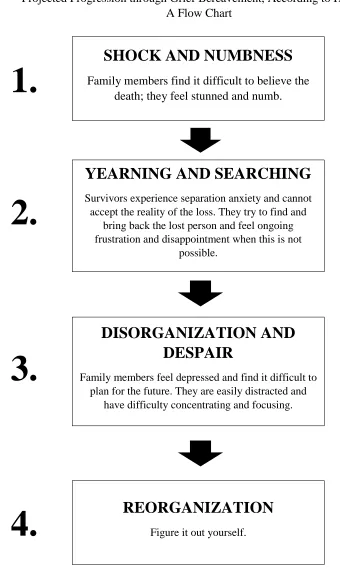
Projected Progression through Grief Bereavement, According to Hospice: A Flow Chart
SHOCK AND NUMBNESS
Family members find it difficult to believe the death; they feel stunned and numb.
YEARNING AND SEARCHING
Survivors experience separation anxiety and cannot accept the reality of the loss. They try to find and
bring back the lost person and feel ongoing frustration and disappointment when this is not
possible.
DISORGANIZATION AND
DESPAIR
Family members feel depressed and find it difficult to plan for the future. They are easily distracted and
have difficulty concentrating and focusing.
REORGANIZATION
Figure it out yourself.
1.
Belonging(s)
“Would Wednesday be a good day for you guys to come and grab his things?”
Ulisse feels like a deer, just like that first doe Dad taught him to butcher. A bolt to
the eye and left gapping and gutted. Wednesday?
“I’ll have to check with Mom.”
“Ok, let us know. We’re moving Vincenzo into that office.”
“Yeah, no. We’ll let you know soon.”
“Ok.”
“Ok.”
He peers at Ulisse’s eyes, seems to linger around the brows and at the corners of
his mouth, “You’re doing good kid.” And with a hearty smack to the shoulder, the new
temple president heads back to his table.
Dad’s table. With the whole family’s initials on the left table leg that Ulisse
started carving in a fit of preteen boredom, and Trista coloured in when her Barbie
colouring book proved to be a less than challenging canvas. Dad just laughed. Called it
their table for good. They never sat anywhere else after that.
Ulisse would sit there today, but as he and the boys trailed into the member’s bar
their table, Dad’s table, was already occupied. The wrong glass creating rings on the
scarred oak table top. The wrong brand of cigarettes gasping into ashtrays. The wrong
pair of loafers scuffing at ceramic floors. The wrong initials.
“Fine,” he mutters through a gulp of scotch. As palm presses against a too-smooth
table edge.
If he slams the tumbler down harder than he should, the boys don’t mention it.
It’s empty.
The Searchers poster gone: just nails and dark rectangle phantoms left on the
walls to mark where vintage firearm diagrams hung between crayon family portraits and
vacation photos (Disney, San Diego, bucket hats and sunscreen-cloaked noses). The
green vinyl covered office chair not creaking. Bookshelves clear for the first time he can
remember, the picture frames and ash trays and coasters Ulisse and Trista fashioned from
popsicle sticks and grade school encouragement not acting as bookends for WWII
memoirs and Tom Clancy paperbacks. Not an empty office, but a vacated one. An
abandoned office, a former-but-no-longer office.
“Can you get the last set of boxes?” Trista pokes her head around the door jamb.
It’s still Dad’s office. Even if the name plate is gone, spirited away as Mom went
to double check with the receptionists to see if any of the furniture needed to go as well
(fuck, let’s take it all). Even if all the desk drawers had been emptied of their pens and
files and cigar boxes and key rings into nondescript brown boxes. Even if the window
was cracked open to let fresh air in instead of funneling smoke trails out.
Still his.
“Uly, can you just grab something please?” Pushing her way past him as he
stands stag still in the doorway, Trista snaps from behind a tower of boxes, grabbing
handfuls of any old thing.
She butts the stack in her hands into his chest, making sure to rap against the
sternum just enough so his breath cracks out in a single puff. “If you won’t help pack,
start taking boxes to the car.”
“Who died and made you queen?” snarling Ulisse grips the boxes, pulling them
even tighter to his chest so the edge digs between his ribs.
Trista huffs and sweeps back into the office, “Do something, would you? And
while you’re at it get better comebacks.” She’s an acidic little thing, his sister.
Acidic but not wrong.
With a huff of his own, he resettles the boxes and stomps back toward the car,
each step putting distance between him and that yawning gap of an ex-office.
The boxes take up residence in the basement only for a couple days.
A couple days to let the boxes assimilate to the house. Let the house assimilate to
the boxes. Get used to the idea that books and keys and locks and flashlights don’t live in
the drawers and shelves where he put them.
Ulisse expects them to stay put. He expects Mom to horde and hide them.
Cardboard more precious than any gold. Letting them collect dust and wait until she’s
ready to crack them open, clean them off, absorb the warmth of what Dad left behind,
garage-sale paperback there. They’ll keep the heat that way. Crisp and crackling. Each item
prompting a Scotch shot that sizzles and blooms from the gut outward.
But she doesn’t.
Mom dives right in, sorting and cataloguing, listing the inventory of what he’s left
behind. Box after box. Dividing the contents into a new set of clearly labelled plastic bins
with air-tight lids: Keep, Donate, Throw out.
Keep: hunting knife. Donate: paperbacks. Throw out: crumpled magazine article
about barbequing salmon. Keep: silver coin from 1895. Donate: drill bit set. Throw out:
empty Bic lighters. Keep: brass lantern. Donate: 6 flashlights. Throw out: scribbled
reminder to pick up milk. Donate: beige puffy winter coat with too long sleeves and a
stain on the bottom hem. Throw out: a pair of silk thermal leggings with blown out toes.
Throw out: copy of Cabela’s catalogue from 1984. Throw out: cracked Tim Horton’s
travel mug. Donate: three pairs of never worn Levi’s jeans. Throw out: empty gas station
lighter shaped like a pin-up girl. An endless cycle with the piles growing larger and
larger.
Ulisse only steals from two of those piles.
“Ulisse, would you want this?” Mom hovers over his shoulder. He hears the
nervous tick of her house shoes against the plastic floor mat.
“Want what?” He types another line into the report. Each blink of the curser
prompting an answering twitch in his left nostril.
“Well, it’s Dad’s—”
“But—”
“Mom, at work, I got assigned another project on top of the one I already have,
they’re implemented daily progress logs for the codes which I have to fill out, one of the
servers went down for two hours, and I’m secondary on-call for the rest of the week
because the person who’s supposed to do it has the flu. It’s a lot. It’s stressful. I’ll look
later.”
“Ok.”
He hears the brush of her house shoes from plastic to carpet to hardwood,
characteristic loud stomping steps, meek and quiet.
He’ll look later. Just later.
Much later. Maybe just reach in and transfer from one bin to the other.
(Why can’t it all stay?)
Ulisse gathers his Under Armour boxer briefs, an over-sized t-shirt, and his
mustard coloured towel to go to the gym. Then mixes his preworkout at the kitchen
counter, hovering over the wooden cutting board. Scoop, stir, drink.
Mom and Trista are in the living room. The hum of some cooking competition
almost drowning out their murmur.
“I found the oddest thing in Dad’s things last night.” Mom forms that single
syllable as lovingly as she can.
“Yeah?”
“Mhm, this old beat up gas mask.”
“Really? Why’d you think he had it?”
“I’d never seen it before; your father must have bought it before we started
dating.”
He bought it at auction.
“It was so damaged though; I had to throw it out.”
Throw it out?
“Too bad. Would’ve been a cool thing to keep in the family.”
It was supposed to.
“It would’ve…Oh! Michelle had the best story abou—”
“You threw it out?”
“Pardon honey?”
“You threw it out.”
“Yes?”
“It was supposed to be mine. You had no right!”
“I’m—”
“We were going to… we were going to…”
Going to restore it. Already spent hours meticulously searching through the
internet, talking to amateur historians and hobbyists on forums, while Dad highlighted
and circled examples in auction catalogues. Already picked out a display case in the Lee
Valley catalogue (dark stained maple with antique brass hardware). It was theirs. It was
his. It. Was. His.
“—sorry.”
“I don’t—”
“It wasn’t yours to throw away!”
Mom starts leaving notes. Two- or three-line missives, signed with a heart, and
stuffed underneath the latest artifact from the boxes. The latest:
Ulisse,
I found this. Thought you might want to take a look.
Mom <3
left on his desk, underneath a set of Allen keys, butting up against his keyboard.
Allen keys. Allen keys are important. Grease stained fingers quick and sure,
teaching him to take the measure of when a twist has gone too tight or not tight enough.
Allen keys must stay.
Ulisse brings the set down the stairs and to the basement. He shoves them back
into one of the boxes near the bottom of the pile, under the Cabela’s catalogue from
yesterday, the red flannel shirt from Tuesday, the shark tooth paper weight etched with a
battleship from Monday, the dog-eared copy of Band of Brothers from Sunday.
They’re not leaving yet.
Projected Immediacy of Grief Magnitude Time
Can’t get up because you refuse to enact a day without him.
All you do is cry. You’re just going through the motions. Finding his favourite shirt doesn’t make you cry. You can remember them fondly (notears!).
Days after Death (D.A.D.s)
Magn it ude of Gr eif ( Ho w Cl
ose to Te
ars a
re
You
?)
O’ Death v. Toddlers
“…Where O’ Death is your victory? Where O’ Death is your sting?...’”
Mom worries at her lip as the priest weaves St. Paul and his Corinthians into his
send off for Mrs. Schneider. Central and lateral incisors kneading to match the cadence of
the verse.
“…The sting of death is sin…”
Tooth-pull.
“…and the power of sin is the Law…”
Lip-tuck.
Seeking the sting the padre seems to have lost. Head slightly bowed in respectful
contemplation; a remnant of her own childhood faith. Not the same branch of Christianity
as the Schneiders’ but close enough. Keeping focus forward, always forward, never
letting attention wander to the empty spaces on the pew.
The screams of the various Schneider grandchildren and great grandchildren call
to Trista more than the measured pleasant tones of the man at his pulpit. One of the great
grandchildren, only 6 months old, gives the microphone and speaker set up a run for its
money. His shrill screeches creating a counter rhythm, a little touch of chaos. His speech
echoes from chancel to narthex, a progressive ricochet like the calls of gothic ghosts or
the bloodied saints immortalized in stained glass. These wild little heathens sound like
her brother and his friends before a night out or after a hunt. All piss and volume; vitality
ringing from each twisting vocal cord. An accompanying howl builds at the base of
The howl stays trapped behind her uvula until she swallows it down. Trista feels
the empty spaces of the pews just as much as her mother does. They’re missing Ulisse’s
stoic bulk to shield them, but he’d cited impending deadlines to stay home. They’re
sitting at the back of the nave so the other mourners won’t notice when neither of them
stand for communion. The high backs of creaking wooden benches creating a barricade
between believers and non; they’re communing in the feeling but not the rites.
This isn’t their show. The immediacy of their own loss supposedly tempered by
months. Daughter’s elbow brushes mother’s through matching thin black cardigans.
“…But, thanks be to God, who gives us the victory through our Lord Jesus
Christ...”
Tension radiates from mother’s elbow into daughter’s. Tendons tighter than bow
strings. Microscopic trembles vibrate the base of the pew; about a three on the Richter
scale. At each peak, a thought loosens: why are we here? Mom gets glassier by the
minute as the priest continues to lose the battle against toddler oration. But maybe this is
what Mom needs: the faith she grew up with, the faith her parents were buried under, her
faith, instead of her husband’s. Breathing isn’t that harsh pre-sob tempo that’s been
typical since he died. Glassy and trembling but it’s only a three; Mom hasn’t been at a
three for a while.
Bible verses whisk away the cloudy mass of single coffee cups and missing
ashtrays that underlie the loss. Mother, like Schneiders and their accompanying brood,
lets these phrases work: syllables create gossamer thin threads of connection. Each
utterance echoing back Sundays with her own parents. Shades of that communion settling
While Trista sits, heels tapping softly in time with the great-grandson’s constant shrieks,
her mother begins to mouth along to St. Paul presented by Father First-Name-Basis.
“…Therefore my beloved brothers and sisters, be steadfast and immovable.
Always excel in the work of the Lord, because you know that your labour in the Lord is
not in vain…”
Mom exhales a little. Each push outward falling in synch with the Schneiders in
the seats at the front. Maybe they should’ve added a father to oversee their father off,
Mom’s very own surrogate St. Paul to stand amid the flames and flesh.
Maybe.
The Schneider great grandchildren take no heed of St. Paul. Tiny bodies spill into
the aisles: the squirmy blond bowl-cut in the polka-dot bow tie and khakis that had been
nine pews ahead of them now tears pages out of a hymn book, the white flower headband
perched in oak waves with glittery purple Mary Janes that have butterfly buckles (eight
pews ahead and to the left) is using a bright red crayon to scrawl a herd cats on those
separated pages and the central aisle runner.
The senior Schneiders never leave their seats.
6 months still cries.
Her hands itch for a crayon of her own.
The cabin on the Envoy is freezer chilled. The AC cranked to combat June
humidity, but her thighs still stick to the leather passenger side seat in an echo of the
suction between quads and church pews. They’re near the back end of the funeral
The little purple flag flaps listlessly on the hood of the SUV; mud flaps gleam factory
pristine, no racks to be found, perfectly generic. Mom made sure to scrub the truck from
axel to axel, the faint scent of Armour All wafting from between body panel joints.
The column of purple flags inches forward intersection by intersection. Thirty
kilometres per hour. Snails in a rat race. A rusty beige Buick cuts them off as the column
tries to make a left, a bird flies out of the driver’s side window.
The response is a chorus of chirping car horns.
Senior Schneiders still in a column, delicately picking their way around grave
markers and placards. A shuffling procession of black and grey shrouds. Brogues and
sensible black pumps sticking to grassy borders. The miniature versions trotting wherever
they please. Patent red Mary Janes step on Mr. Clemmons. Newly shined brown dress
shoes meet the final resting place of Ms. Perkins. Butterfly buckles and crayons loudly
complains about the heat. Bow tie and destruction has acquired a fistful of fake
carnations in a particularly lurid shade of yellow, and as the column continues toward the
Schneider quadrant of the cemetery, he sprinkles mangled petals on markers and grass
alike.
It feels wrong to leave these people in the ground, to shackle them to these plots,
to bury them so they can’t join the next hunt. Trista swears the grass crunches and
shatters around them instead of bends.
She makes sure to give avoid visible mounds.
“Praise be to the God and Father of Our Lord Jesus Christ, the Father of
They’ve arrived at Mrs. Schneider’s final resting place. Mom once again nods
along to Father Your-Pal, in tandem with the senior Schneiders. But Trista’s watching
one of the older great-grandkids twirl between a pair of goliath marble headstones. Pink
princess dress covered in cabbage roses, each rotation revealing a glittery tulle petticoat.
Face turned up towards the angel statue which holds watch. White ballet flats already
stained green at the edges.
“…who comforts us in all our troubles, so that we can comfort those in any
trouble with the comfort we ourselves receive from God…”
They’re once again standing near the back, so no one notices when she separates
herself from the shuddering mass of black and picks her path toward the dancer.
Mom stays put, letting Trista go with a single disapproving sniff.
“… Hi.” She feels like her knees aren’t sitting right over her ankles.
“Hi.” Pink and twirling responds in the abbreviated tone for those below the age
of nine.
She pulls at the hem of her sensible black shift dress, “why’re you spinning?”
“Gam Gam liked it when I danced.”
“She did?”
“Yeah,” punctuated by a decisive nod. “She always clapped. Even before I
finished.”
“…For just as we share abundantly in the sufferings of Christ, so also our
comforts abounds through Christ.”
She pulls out her phone, fingers tapping through YouTube, as that little girl keeps
flats, she settles on those stain giving blades. Soft melodies floating from tinny iPhone
speakers as tulle and pink roses keeps spinning.
Gam Gam liked it best.
Dismember
Your eardrum vibrating propels you awake. You can feel a little mass of cartilage
and tissue migrating down your ear canal, so twist until your face points toward the
ceiling, settle there until your internal timpani tilts away from the precipice and slides
back into place. A tiny victory, but you can’t bring yourself to take advantage of the
momentary cooperation of your body. You stay right where you are; only skin cells
falling off. That happened even before. With tympanic membrane righted, each alarm
clock tic echoes from pinna to cochlea, pinballing from cartilage to tissue and back until
each note blurs into white noise. You revel in the stillness as much as possible. Wrapped
in cotton sheets, shroud still, you convince yourself there isn’t a chasm of air on the
mattress beside you, instead of his body.
The faint slap of bare feet on hardwood disturbs, knocking more skin cells off
with each echo.
“Mom?” Your daughter. It’s always her this time in the morning. The boy has
already gone in a whirl of caffeine and coding. Or he’s still sitting in front of his
computer.
Your left incisor seems to sag into the meat of your tongue. You keep your mouth
closed.
“My ride should be here any minute…I’m coming home right after class. I’ll see
you later. And I love you.”
“I love you too.”
You almost lose all the skin off your back attempting to peal yourself upright and
off the mattress. You have to go to the bank today. Derma tangles with cotton sheets and
almost sucks you back in. You have to go to the bank today. You lose a toe nail the
second your foot touches the hardwood floor. A trail of blood marks your slow plodding
journey across the ten feet between bed and en suite. You have to go to the bank today.
When you pull your night gown off you almost take your ear with it.
It takes minutes to sort through the hygiene debris crowding the bathroom
shelves. Your hair clumps with slices of scalp, rivulets of tissue and keratin tangling
between shoulder blades. The Dove body wash that claimed to combat the dryness of
weakening skin, intimidates your Tresemme for colour-treated hair. You reach for the
Dove anyway. You pour a quarter’s worth into the palm of your hand and let the steam
carry the scent into your nose. Soft, clean, like his shirts before his first cigarette: the
dollop slips between digits and fades down down down. Your stomach lining almost
clogs the shower drain. Intestines are looped around the new safety bars screwed into the
title walls. You grab the Tresemme. Shampoo mixes with stomach acid and body wash,
staining nickel hardware yellow. Guts draining and dragging.
You flush stray suds from your eyes. And try to mop up the overflow with towels.
Towels already tie-dyed with bile, you stopped putting out fresh ones after the first week.
Your feet are intact this time so there’s no blood trail to mark your progress from
bathroom to closet. Reaching between his shirts you leave your thumb print on the collar
grab onto your purple fleece sweater just in time. Finding pants so much less treacherous:
you don’t share a closet.
You stuff your small and large intestine into the waist band of your pants. They’re
elastic since you always become caught in zippers and buttons now. You have to do this
before you put on your socks otherwise you’ll trip and molt into the hardwood. You wear
two pairs of socks on each foot to strap those rogue toenails in place. You forgot a week
ago and left your pinky toenail in the produce aisle of Sobeys right next to the tomatoes.
You go to Food Basic now.
Your knees tremble as you head downstairs. Keeping your left hand on the railing
just in case, your other arm wrapped tightly around your stomach, trying to corset your
guts to they won’t spill out again.
The coffee maker already on. Looks like your son actually left you with a cup this
time. Your optic nerve bobs in your morning coffee. The pumpkin blend from that
pretentious grocery store in Toronto. The beige mug with a triplicate name hovers on the
cutting bored. Silver teaspoon spinning ciliary body round and round and round. Iris
breaking the surface on every fourth or fifth rotation. You debate adding the Belgian
chocolate toffee creamer. Pros: sweet, something to wash the bitter copper of flaking
taste buds out of your mouth. Cons: creamer only for one cup, not prompting an uptick of
cheek and a gruff murmur of appreciation at the sweet taste from a rebellious diabetic.
You skip the creamer. Vitreous gel will suffice.
You settle down to watch the news. Your spinal column blocks the cable box
control. Every attempt to change the channel adds to the increasing web of infrared
missed connections lingering in the living room. You’re folded on the couch cradling
your left arm, head touching ankle, wrapped in that cigarette burnt fleece. If you keep
eyes front and centre you can fashion another body from the bits of you scattered on the
furniture.
You should vacuum before you go to the bank. You really should. There’s a rusty
stain by the fireplace, and a chunk of your hair under the side table his ashtray is on. Your
skin cells pepper carpet so it looks like snow. The dust mostly comprised of skin cells.
You haven’t cleaned in a while, so he could still be in there. His cells mixing within
yours.
You decide to leave the Food Network on. You’ll vacuum tomorrow. But not
around his spot.
The bank.
Yes, you need to go to the bank. The lawyer’s bill came in. You have to go to the
bank.
You pull on a hat to keep your ears secure, can’t have them impeding your
shoulder checks. You pull on a pair of oversized gloves as well. The bank manager glared
at you the last time you went in. Must’ve gotten capillaries tangled in the ATM buttons.
You almost snap your thumb off around the gear shift as you reverse out of the
driveway.
The ride is uneventful: the combination of your seat belt, your gloves, the hat, and
Your bottom lip slides down to your collar bones, exposes your grimacing teeth as
you type in your pin number. 10-9-49. You make a note to buy surgical masks. You
extract an alcohol wipe from your purse and wipe the pink tinged spittle from the ATM
screen. You also wipe down the buttons just to be safe.
It’s four. You have to go home and start dinner.
Your lungs pile in the kitchen sink again. Less chest and more cavity. They
dropped into the dirty dishwater when you started to clean the wooden spoon. Now
floating, a kindred spirit to errant cauliflower florets and schnitzel gristle. Your lungs
take on water, collapsing in failed buoyancy. But you’re not drowning yet.
You try to fish them out with salad tongs, before they start to smell too lemony
fresh.
The kids will be coming through the door any minute now. You turn to the
cabinets and carefully pull out only three dinner plates. Last night, you took out four. So
now, your left hand sits in the middle of the kitchen table. The ring finger twitches every
so often, creating a shuddering rhythm against the glass bottle of barbeque sauce.
Tendons wind around roasted Brussel sprouts and sliced tomatoes.
You pass the platter of chicken legs back and forth. As you question the
tenderness of the meat, a soap bubble emerges from your mouth.
The kids assure you that, “it’s fine.”
The only sounds after that: knives scraping against plates and forks clanging
Your heart acts as a pie weight. Uncooked shell already inked cherry. Sugar
crystals make their way into each ventricle as they’re sprinkled over pastry to create the
perfect baked crust.
Living Progression through Grief: A Flow Chart Case I Put off fixing the sink because he always took care of that. Take over as
hospice patient.
Keep doing yoga. He’s gone. Worry
about your kids.
Go to work mandated therapy Feel the absence settle around your shoulders like a mantle. Leave group therapy because you have your own salt water.
Take the year off work. Make Sunday Gravy. Meet with grief counselor. Do yoga. Breathe.
Try not to pick at scabs. Walk away
sensitive to the touch.
Hello Promised Land
The Tunnel’s the path to the Fillmore, Detroit’s Mecca for inquiring minds and
aspiring anarchists in too clean high tops and zoot suits. The world weary concrete lacks
the romance of the old world cobbled roads Chaucer would favour for his tales, but for
her concrete’s good enough. Today, she doesn’t need whetstone tried daggers or soot
covered hands and Latin hymns. She needs lip synch lyric spit and the heat that comes
from the press of too many bodies in too little space. She’s not twenty-one yet, but
September is close to November. To pound the tension away from the two square inches
right at the base of her skull: a drum line loud enough to cancel out the pitch of the EKG
buried in auditory canal.
This is a pilgrimage because she can’t keep breaking down at every health
commercial that flickers across her TV screen. And she does break, snapping every time
a hospital bed covered in those odd pastel mint sheets that can’t be found anywhere else
looms into shots real and orchestrated or whenever the “c” word gets uttered in that
too-soft too-delicate tone. She’s spread so thin she feels like organic cling film. Spread so
thin there isn’t room for the nausea clamoring at her gut, the iron heavy pulling at her
wrists, or the inertia in the arches of her feet that tells her to go. When there’s only a
hospital gown’s thickness between gut and heart there’s no room for much at all.
So she’s taking the time that the repeating self-help soundtrack echoing between
her eyes at elevator music volume says she should. Less than two months from
twenty-one. Letting go. She’s an age that’s painted as very MTV; a remix of Macklemore and
wannabe indie rockers who rarely make it out of a basement. Her ear drums might bleed
but, she shouldn’t be dancing but she is, but she…
Keeps spinning the ring on her right thumb, round and round like a record baby.
Round and round hoping the hangover-like nausea and champagne bubbles will
stop.
Round and round: she deserves some dancing. How can she dance on this day,
this week, this century?
Hello Promised Land, what will you promise me?
The ring is her grandfather’s. Her father’s father’s. Pressed into her hands before
they’d even grown into their life lines. Heavy in her palm: silver and scarred with a
diamond, and two lines gouging into the embossed angles. Too big for her ring finger so
she wears it on her thumb. Who needs the string of fate on your pinky, when you can
anchor duty to your thumb?
Detroit’s Mecca the closest thing to her mother’s version communion she’s had in
years.
Bass beats a staccato rhythm behind her sternum and she’s got some metal head’s
neck sweat in her hair (or maybe it’s beer, she really hopes it’s beer). And she’s light.
Lighter than she’s been in 12 months. Her right hand rises above her head in helium
waves. Up and up, as her body jumps and sways to the electric melodies that these Jersey
back, “I’m on that train!” She’s all open wounds, but “Bruce Clash-stein” style punk
rock, and Detroit destitute smog cauterizes.
The iron heavy ring rolls around the mosh mangled hardwood.
Her helium right hand rises above her head. Again and again.
Her thumb so light. And she feels the need for some personal gravity to come
back.
Her right hand rises above her head.
Gravitas can wait; twelve months of mornings.
Hello Promised Land.
Living Immediacy of Grief Magnitude Time
Can’t get up because you refuse to face a day without him.
All you do is cry.
You’re just kind of going through the motions. Finding their favourite shirt doesn’t make you cry. You can remember them fondly (notears!). Magn it ude of Gr eif ( Ho w Cl
ose to Te
ars a
re
You
Your Husband’s Nineteen Other Loves
- Lanterns
There’s a massive brass one next to the stairs, in the alcove below his
mother’s, your mother-in-law’s, cuckoo clock. You have no idea where he
found it, but he brought it home one day cradled between calloused palms
the same way he’d carry your children when they still demanded apple
juice and teeth charms under their pillows to chase away nightmares.
“Might’ve been on a ship during WWI or II or a train during the Great
Depression,” he crowed while shining away an imagined spot with his
shirt sleeve. Either way he kept it polished and puffed up anytime Nina
Vito, the organist at the temple, commented, “Oh, it’s just magnificent.
Like something you’d see in a magazine or at one of those fancy auctions!
Such a stately piece, dear. And in such good condition too!”
- Binoculars
Any kind. From cheap plastic cases he’s find at the Dollarama to 12 times
optical zoom, with built in LED range finder display special order from
Cabela’s when Canadian Tire’s available stock did not provide the
appropriate breadth of bridge widths or technical capabilities. ”I want to
be able to see individual nostril hairs for at least 100 yards away, Brig!”
You and the kids ended up with at least three pairs of binoculars each.
He’d give them as stocking stuffers or pass them out as favours at his
- Flashlights
He put one in each bathroom (3). One in your bedside table (4). Your
daughter reveals two in hers (6). He gave her another when she went to
Europe for the first time, called it a tactical flashlight and spent twenty
minutes explaining all of the features, “See the serrated edge around the
lens? That’s if someone gets close and tries to grab you. A couple nasty
cuts to the face will scare them off. But we don’t want it to come to that
so this button is your first line of defense. It has three settings: your basic
steady light, a brighter light, and seizure inducing flash sequence to blind a
possible attacker. Don’t roll your eyes at me missy! Better safe than
sorry.” (7). Your son claims five to seven in unknown condition in the
hunting gear but he won’t show them to you (12-14, condition unknown).
- Knives
He grew up with knives, your children have grown up with knives (a son
with steady hands, and a daughter who doesn’t flinch), and you have only
just started learning how to trim silver skin off a pork tenderloin. Each cut
slow and miniscule, and according to your son, “too deep, bring the blade
closer to the surface; you won’t catch your fingers.” He carried a pocket
knife at all times. Another to cut fruit, can’t have packing tape or paper
slivers ruining his snack. Both kids have matching ones with hand stitched
leather holsters. You keep his on top of the fridge in a ceramic tulip
basket. You can’t find any of the hunting knives. They aren’t in any of the
in the cabinets in the garage. Your daughter suggests that your son has
squirreled them away, probably under his bed, or in his bottom desk
drawer, or hidden under his gym gear, or stashed behind the upright
freezer downstairs. .
- Coins
They used to crack against his keys. He’d have a piggy bank worth of
change on him at all times; quarter, dimes, loonies, toonies, nickels,
always enough for a coffee or three. Those were the everyday coins, but
his real pride and joy included silver dollars, commemorative coins; you
remember him showing you one that was calcified and black with age; he
said with a school boy gleam in his eye, “it’s Roman and belonged to my
ancestors.” He placed it in your hand so softly you almost didn’t register
the weight of it in your palm; his fingers registered as more. You hold it in
your hand now, and try feeling its weight for the first time. Still his fingers
on your palm.
- Lighters
Butane, cheap Bics from gas stations, barbeque lighters with their long
necks and trigger handles, a silver Zippo with his father’s, your
father-in-law’s, name engraved on the front. Your daughter has the Zippo now,
tucked in her bedside table right next to those flashlights. He had a callous
on his thumb from flicking the flint over and over and over, it would
scrape against your knuckles whenever he’d pass you the remote so you
- Brass or copper
Wind chimes, watering cans, flower pots, the bird house in front of the
hibiscus flowers you brought back from Hawaii that he spray-painted one
summer day, burnt-amber replacing greying wood. The very next summer
every home and gardens magazine touted brass and copper as the hot
metals, right now.
- Catalogues
Lee Valley, Cabela’s, Canadian Tire, Ikea, and even some battered copies
of Sears. He’d sift through page by page, circling and writing notes: need
for garage, Trista could use for school, get this for Uly, use to fix creak on
third stair from bottom on way to basement. You’d find an ear-marked
page with a lurid red circle around a spatula designed to keep flaky fish
from breaking when removed for the pan, since you’d complained about
the halibut steaks the week before. The last catalogue full of can openers
designed to leave no burs on the cut edge and flip the lid out of the way
once removed so you wouldn’t have to stick your hand into the can. The
seven he bought still in the drawer, but when you crank that handle it
really slices smoother. You find yourself eating canned tuna and soup five
times a week.
- Lee Valley
Gadgets, gardening, and where he’d find stocking stuffers every
Christmas. He’d make the kids, their friends, the mailman guess what the
season. The smile on his face as the kids kept throwing out one elaborate
theory after the other (a spy camera, a training tool to improve pinch
strength, a pedometer, an expandable document clip); closed-mouth, like
he held in a laugh with the answer; both would’ve tumbled if he didn’t
keep his teeth tight. Near the end (but before you knew it was the end
end), you heard that there would be a Lee Valley opening up near the mall.
You promised you’d take him. You never got to, but you keep the
subscription to the catalogue.
- Fasteners
Screws and nails by the bucket load. Enough to refasten every baseboard,
door frame, and window frame in the entire home, with enough left over
to hang and display every picture you ever took of him, ever took of your
daughter, son, and their ever shifting friend arcs. You consider. The house
might feel less empty with replicas of him and you hanging from every
wall.
- Recipes: books, cards, magazines
Crumpled and worn, with notes and Post Its tacked to the margins. Ripped
from America’s Test Kitchen and Food Network. But, he never stuck to
the recipe. You remember him in the kitchen standing over a pot of
Sunday Gravy (rich marinara sauce, with spice, and meatballs and
sausage, and short ribs) with a crinkled, stained magazine article. You
smooth the article down and peer at the ingredients (basil, oregano, garlic,
across the counter tops. The bases are all covered but he’s obviously made
some tweaks (more garlic, and chili flakes, and some anchovy paste). He
offered you the spoon even though you hate the way wooden spoons
splinter across your tongue. You try it. Sunday Gravy becomes Saturday
Gravy, and Friday Gravy, and Wednesday Gravy, and Any Day Gravy.
- John Wayne
The Searchers, True Grit, and his every other western. An old-school
cowboy. That became the standard gift from the kids. John Wayne DVD
after DVD. He had at least two copies of each film, not counting the box
sets. So in actuality at least four copies of each of the more well-known
films and two copies of the earlier works. But each DVD he treated like a
monumental acquisition, the second he pulled it from its wrapping paper.
He’d start rattling off production statistic. Even if he’d gotten the same
movie the year before, he’d declare, “Just what I needed!” As he’d hook
both kids around their necks and into a group hug, depositing bows on the
tops of their heads as they drew back. You find empty jewel cases on the
shelves, inside a scrap piece of paper with Trista or Ulisse’s name and a
date.
- War/history
WWI and II. Ancient Rome also rang loud. He always read with his head
half turned back. So aware of what had come before and what will be left
after. Your son repeats the same fascination (his history papers in high
research). Your daughter to a lesser extent (she’s more obsessed with
history as stories). You wonder if it’s the blood, if these people of Diana
always search for glory long past. You wonder if he found his.
There had to be at least forty different accounts and examinations of the
entire progression of WWII. He had 1939 to 1944 covered in paperback
and hardcover. Detailed analysis of each front from air, land, and sea.
Topographical maps and troop censuses and battlefield photos and
microfiche letters. The history books rest against museum catalogues. He
said they’d go to Vimy and the beaches and Rome one day. To each
museum, and every site. They’d trace the stories together; stand where
history was made and leave a bone charm for every man lost so they could
be there that day.
- Sweets
Chocolate and ice cream. You found mini chocolate bars in his shoes: Kit
Kats and Aero Bars hidden in loafers and brogues. He’d finish an entire
tub of Black Jack Cherry flipping through a garden catalogue. You’d get
mad; ask him if he knew what that did to his blood sugar, if he knew what
it would do to him. You buy tubs of ice cream for weeks, after. But you
take Black Jack Cherry off the grocery list.
- Coffee
Black, or with just a drop of cream: before the chemo and the hospital
beds and the bone charms wrapped to his wrists to ward off the sickness.
skin felt like dry phyllo and his spine couldn’t hold him up anymore. You
swear you saw him put a scoop of French vanilla ice cream in the mug.
When you took the mug to the sink, the liquid swirling in the bottom
looked watery beige, white with the slightest tinge of brown. You couldn’t
even smell the roast.
- Fire pits
He put a chiminea in the backyard on the patio. When the kids jumped
between swimming lessons and soccer games, you’d sit outside after
they’d gone to bed. The middle of summer and every time he’d stoke the
embers and add broken down clementine boxes to keep the flames going,
the sparks would arc like fireflies. You’d sit together basking in the
flames. You swear the warmest part of the patio wasn’t near the chiminea
but near him. Then sickness made him cold. You wish you could’ve
bottled those nights and tucked them like hot water bottles around his
sides, since the new electric heater never seemed to keep him warm
enough.
- Author: Tom Clancy
Rainbow 6, The Hunt for Red October, he owned the entire Clancy library
in paperback. Spies and soldiers up against impossible odds: having to
counter bomb threats when you suspect every member of your team is a
sleeper agent, infiltrating the enemy base with a paper clip and no shoes.
You never got the appeal, but he loved that every protagonist typified
underwear would most definitely be stars and stripes printed. That Diana
boy of yours found comfort in these parodies of heroism. You flip through
page one of every novel, but he’s not there. He’s not there.
- Documentaries: Antiques Roadshow, war journalism, history re-enactments
PBS used to be the soundtrack to his Saturday naps. Then once he
convinced you to get cable (the premium package with HBO and all the
channels you could imagine, actually more channels than that, there’s a
channel all about knitting) PBS still made an appearance but History
Channel and HBO thrived. The cinematic interpretations of fire fights (on
land, air, or sea) narrated by stern and solemn older British gentlemen
became the only sounds that would lull him into slumber beyond the haze
of pain medication. You can’t fall asleep without the gun fire now, but the
splatter of cooking oil seems to be close enough so Food Network will do.
- Locks and keys
The massive key ring he’d carry. If you somehow missed the door
creaking open when he arrived home, you could never miss the clacking
of that key ring getting pulled out of the pocket of his chinos. Metal on
metal. You buy 12 more wind chimes and hang them in front of the garage
door, but the sound doesn’t pull up at the corners of your mouth or spark a
tingle at your pulse points.
If he had a ludicrous amount of keys, he had an accompanying number of
locks. Colossal rust covered padlocks and tiny TSA approved luggage
of bolts and pins relative to space for teeth, trying to match them to their