Learning dialog act processing
S t e f a n W e r m t e r a n d M a t t h i a s L S c h e l C o m p u t e r S c i e n c e D e p a r t m e n t
U n i v e r s i t y o f I t a m b u r g 2 2 7 6 5 H a m b u r g
G e r m a n y
w e r m t e r @ i n f o r m a t i k . u n i - h a m b u r g . d e 15chel @ i n f o r m a t i k . u n i - h a m b u r g . d e
A b s t r a c t
In this paper we describe a new approach for learning dialog act processing. In this approach we integrate a symbolic se- mantic segmentation parse,: with a learn- ing dialog act network. In order to sup- port the unforeseeable errors and varia- tions of spoken language we have con- centrated on robust data-driven learn- ing. This approach already compares fa- vorably with the statistical average plan- sibility method, produces a segmenta- tion and dialog act assignment for all utteranccs in a robust manner, and re- daces knowledge engineering since it can be bootstrapped from rather small cor- pora. Therefore, we consider this new approach as very promising for learning dialog act processing.
1 I n t r o d u c t i o n
For several decades, the pragmatic interpretation at a dialog act level belongs to the most diffi- cult and challenging tasks tbr natural language processing and computational linguistics (Austin, 1962; Searle, 1969; Wilks, 1985). Recently, we can see an i m p o r t a n t development in natural lan- guage processing and computational linguistics towards the use of empirical learning methods (for instance, (Charniak, 1993; Marcus et al., 1993; Wermter, 11995; Jones, 1995; Werml;er et al., 1996)).
Primarily, new learning approaches have been successful for leo~'ically or syntactically tagged text corpora. In this paper we want to examine the potential of learning techniques at highcr prag- matic dialog levels of spoken language. Learn- ing at least part of the dialog knowledge is de- sirable since it could reduce the knowledge engi- neering effort. Furthermore, inductive learning al- gorithms work in a data-driven mode and have the
ability to extract gradual regularities in a robust manner. This robustness is particularly impor- tant for processing spoken language since spoken language can contain constructions including in- terjections, pauses, corrections, repetitions, false starts, semantically or syntactically incorrect con- structions, etc.
Tile use of learning is a new approach at the level of dialog acts and only recently, there have been some learning approaches for dialog knowl- edge (Mast et al., 1996; Alexanderson et al., 1995; Reithinger and Maier, 1995; Wang and Waibel, 1995). Different from these approaches, in this pa- per we examine the combination of learning tech- niques in simple recurrent networks with symbolic segmentation parsing at a dialog act level.
Input to our dialog component are utterances h'om a corpus of business meeting arrangements like: "Tuesday at 10 is for me now again bad because I there still train I think we should [de- lay] the whole then really to the next week is this for you possible" 1. For a fiat level of dialog act processing, the incrementM o u t p u t is (1) utter- ance boundaries within a dialog turn and (2) the specific dialog act within an utterance. The pa- per is structured as follows: First we will out- line the domain and task and we will illustrate the dialog act categories. Then, we will describe the overall architecture of the dialog component in the SCREEN system (Symbolic Connectionist Robust Enterprise for Natural language), consist- ing of the segmentation parser and the dialog act network. We will describe the learning and gen- eralization results for this dialog component and we will point out contributions and further work. l'Phis is ahnost a literal translation of the Ger- mau utterance: "l)ienstags um zehn ist bei mir nun wiederum schlecht weft ich da noch trainieren bin ich denke wir sollten das Ganze dann doch auf die niichste Woche verschieben geht es bei ihnen da." We have chosen the literal word-by-word trauslation since our processing is incremental and knowledge about the or- der of the German words matter for processing.
2
T h e Task
'Fb.e main task is the examinatiotl of learning h)r (liMog act processing and the donlain is (,]tc ar- rangement of business dates. For this domain we have developed a classification of dialog acts which is shown in table 1 together with examples. Our guideline for the choice of these dialog acts was based on (l) the particular domMn and corpus and (2) our goal to learn rather few dialog <:at<;: gories but in a robusl; n]anucr 2.
Dialog act (Abbreviation) acceptance (ace)
query (query) rejection (rej)
request comment (re-c) request suggestion (re-s) statement (state)
date/loc, suggestion (sag) miscellaneous (mist)
Example
That would be [ine 1)o you know ttamburg This is /,oo late for mc Is that possible When wouM it be ok Right, it's a Tuesday [ propose April 13th So long, bye
Table I: Dialog acts and examples For example, in our example turu below there arc several utterances and each of them has a par- ticular dialog act as shown below. The turn starts with a reiection, followed by all explaining state- ment. rl'hen a suggestion is made and a request for commenting on this suggestion:
* l)ienstags nm zehn ist bei mir mm wiederum s(:hlecht (Tuesday at I0 is for me now again bad) -+ rejection
- well ich da noch trainieret, bin (because I there still train) --~ statement
• ich denke (I think) -+ miscellaneous
• wit sollten das Ganze dann doch auf die naechstc Woche verschieben (we should tile whole then really to the next week delay; we should delay the whole then really to the next week) -+ suggestion
• geht es bei ihnen da (is that for you possible) -+ request c o m m e n t
It is i m p o r t a n t to note that segmentation pars- ing and dialog act processing work increinentM and in parallel on the incoming stream of word hypotheses. Alter each incoming word the seg- mentation parsing and dialog act processing an- alyze the current input. For instance, dialog act hypotheses are available with the first input word, although good hypotheses may only be possible 2This is also motivated by our additional goal of re- ceiving noisy input directly from a speech recognizer.
after most of an utterance has been seen. Our genera] goal here is to produce hypotheses about segmentation and diMog acts as early as possible in an incremental manner.
3
T h e Overall A p p r o a c h
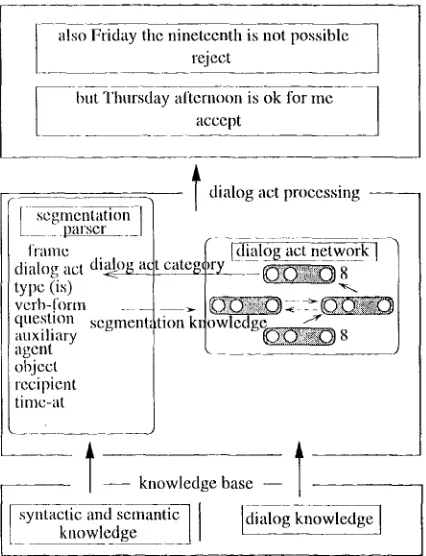
The research presented here is embedded in a larger effort for examining hybrid eonnectionist learning capabilities for the analysis of spoken language at various acoustic, syntactic, semantic and pragmatic levels. To investigate hybrid con- nectionist architectures for speech/language anal- ysis we devek)l)ed the SCREEN system (Sym- bolic Connectionist ll.obust E n t e r p r i s e for Natu- ral language) (Wermter and Weber, 1996). For the task of analyzing
spontancous
language we pursue a shallow screening analysis which uses prima,> ily flat representations (like category sequences) wherever possible.also Friday the nineteenth is
not possible
rejectbut Thursday afternoon is ok for mc accept
segmetq
fr;ntle dialog act type (is) verb-[onn questmn auxiliary agent otject recipient
Jmc-at
~ dialog act nrocessint~ - -
l - -
knowledge base -- I
]
[+_+
aM semantic[
knowledge ]1 ldial°g kn°wledge ]
/
[image:2.596.63.286.203.299.2] [image:2.596.296.509.316.594.2]m e n t a t i o n parser and to the dialog act network. T h e dialog act network provides the currently rec- ognized dialog act for the current fiat fl'ame rep- resentation of the u t t e r a n c e part. T h e segmen- t a t i o n parser provides knowledge a b o u t utterance boundaries. This is i m p o r t a n t control knowledge for the dialog act network since w i t h o u t know- ing a b o u t u t t e r a n c e boundaries the dialog network m a y assign incorrect dialog acts.
4
T h e S e g m e n t a t i o n P a r s e r
T h e s e g m e n t a t i o n parser receives one word at a time and builds up a flat frame s t r u c t u r e in an i n c r e m e n t a l m a n n e r (see tables 2 and 3). Together with each word the s e g m e n t a t i o n parser receives s y n t a c t i c a n d s e m a n t i c knowledge a b o u t this word based on other s y n t a c t i c and semantic modules in S C R E E N . Each word is associated with 1. its m o s t plausible basic s y n t a c t i c c a t e g o r y (e.g. noun, verb, adjective), 2. its m o s t plausible a b s t r a c t s y n t a c t i c c a t e g o r y (e.g. n o u n group, verb group, prepositional group), 3. basic semantic c a t e g o r y (e.g., a n i m a t e , abstract), and 4:. a b s t r a c t semantic c a t e g o r y (e.g., agent,
object,
recipient).Slots 3. Phrase Final l'hrase dialog act
type verb-form question auxiliary agent object recipient time-at cat? is ((is)) nil nil nil nil ((Tuesday)
(at :tO))
reject is ((is)) nil nil nil nil
((for n,e))
((Tn~sday)
(at
1o))
time-from nil timeoto nil location-at nil location-from nil location-to nil confirm nil negation nil miscellaneous nil
input %msday at 10 is nil nil nil nil nil nil ((bad))
((now a~ai~))
Tuesday at 10 is for me now again bad
Table 2: I n c r e m e n t a l slot filling in frame 1 : literal incremental t r a n s l a t i o n : Dienstags m n zehn ist bet m i r nun w i e d e r u m schlecht (Tuesday at 10 is for me now again bad)
This s y n t a c t i c and s e m a n t i c category knowl- edge is used by the s e g m e n t a t i o n parser for two m a i n purposes. First, this c a t e g o r y knowledge is needed for our s e g m e n t a t i o n heuristics. For o u r d o m a i n we have developed s e g m e n t a t i o n rules
which allow the s y s t e m to split t u r n s into utter- ances. For instance, if we know t h a t the basic syn- tactic category of a word "because" is col\junction and it is p a r t of a c o n j u n c t i o n group, then this is an indication to close the current f r a m e a n d trig- ger a new fl:ame for the next; utterance. Second, the c a t e g o r y knowledge, p r i m a r i l y the a b s t r a c t se- m a n t i c knowledge, is used for :filling the flames, so t h a t we get a s y m b o l i c a l l y accessible s t r u c t u r e rather t h a n a tagged word sequence.
Slots 1.-3. Phrase Final Phrase dialog act
type verb-form question auxiliary agent object recipient time-at time-from time-to location-at location-fl'om location-to c o nt~r 11(1 negation miscellaneous input cat? Inove nil nil nil ((I)) nil nil nil nil lfil nil nil nil nil nil ((because) (there still)) because I there still
statement move
((t,-ain))
nil aIn((t))
nil nil nil nil nil nil nil nil nil nil ((because) (there still)) because I there still train amTable 3: I n c r e m e n t a l slot filling ill f r a m e 2;...well ich (la noch trainieren bin (because I there still train [am])
T h e s e g m e n t a t i o n parser is able to s e g m e n t 84% of the 184 turns with 314 utterances correctly. T h e r e m a i n i n g 16% are m o s t l y difficult a m b i g u - ous cases some of which could be resolved if m o r e knowledge could be used. For instance, while m a n y c o n j u n c t i o n s like "because" are g o o d indi- cators for u t t e r a n c e borders, s o m e c o n j u n c t i o n s like "and" and "or" m a y n o t start new coordi- nated subsentences but c o o r d i n a t e n o u n groups. F u n d a m e n t a l s t r u c t u r a l d i s a m b i g u a t i o n could be used to deal with these cases. Since t h e y occur relatively rarely in our spoken u t t e r a n c e s we have chosen not to i n c o r p o r a t e s t r u c t u r a l d i s a m b i g u a - lion. F u r t h e r m o r e , a n o t h e r class of errors is char- acterized by time and location specifiers which can occur at the end or start of an utterance. For in- stance, consider the example: "On T u e s d a y the sixth of April [ still have a slot in the a f t e r n o o n - is t h a t possible" versus " O n T u e s d a y the sixth of April I still have a slot --- in the a f t e r n o o n is t h a t possible". Such decisions are difficult and ad-
[image:3.596.323.522.193.419.2] [image:3.596.84.293.372.599.2]ditional knowledge' like prosody might help here. Currently, there is a pref>rence for @ling the ear- lier Dame.
5 T h e D i a l o g A c t N e t w o r k
In t, able I we have described the dialog acts w(' use in our domain. Before we start to describe, any experiments on learning dialog acts we show the distributioll of dialog acts across our tr;dning and test, sets. Table ,1 shows the distribution for ore: set of 1184 turns with 3:14 utterances. There were 100 utterances in the training set att(l 21d in the test set. As we can see, st,ggestions and ex- l>lanatory st~d;ements often occur but in general all dialog acts occur reasonably of'ten. This disl, ribu-- Lion analysis is iml)orl,;mt [br judging tit(: leat'ltiug and generalization behavior.
Category
sug 371%
state 20%
rej 12%
m i s t I 1%
re-s 10%
aec 9%
query 5%
re-e 2%
'Fal)le d: l)istribution of the dialog acts and test sot,
Training Test
26%
21% 1 0% 18%
8%
12%
3%
:/%
in training
After this initial distribution aualysis we now describe ore: nel, work architectur(, for learning di- alog acts. I)iaJog acts depend a lot on signiti- cant words and word order. Certain key words are much more significant R)r n certain dialog act than others. For instance "prol)ose" is highly sig- nificanl; for the dialog act, su.qgcsl, while "in" is nol,. 'Fherefore we COlnputed a, smoothed dialog act plausibility vector for each word w which re- [lects the i)lausilility of the cat,egol:ies [br a par- ticular word. T h e sm-n of all values is 1 and each wdue is at leasl, 0.01. The plausibility value of a word w in a. dialog category chti with the frequency f is c o m p u t e d as describ('d in tJtc formula below.
J~,+, (,,t,) - ( A , (',,,) * A , := 0(,%) * o.ol) Total frcq.uc, ucy f ( w ) in cortms
'1%1)1(; 5 shows ex~unples of plausibility w'.cl,ors rot some words. As we can see, "bad" has the highest plausibility Rw 1,he reject dialog act, aml "l)ropose" for the 8tty!leSl, dialog act. On I;he other haud the word "is" is not i)articul,u'ly significant for certain dialog acts and therefore has a plau-
sibility vector with relatively evenly distributed V~|lteS.
bad propose is
t.cc 0.28 0.01 0.22
nisc 0.0l 0.38 0.02
lucry 0.01 0.01 0.07
cj 0.66 0.01 0.34
e-c 0.0J 0.0J 0.01
e-s 0.0:1 0.01 0.02
tate 0.01 0.01 0.27
ug 0.01 0.56 0.05
'l'aloh" 5: Three examples for plausibility vectors
We have experimented with dilferent variations of simple recurrent networks (Elman, 1990) for learning dialog ~mt assignment. We had chosen simple recurrent networks since these networks can represent the previous context in an utter- ante in their recurrent context layer. The best performing network is shown in figure 2.
output layer
hidden l ; a ~ ' t ~
in mJ3~ayer
+% % %5. % %+ % %
Figm:e 2: I)ia]og act network with dialog plausi- 1)ilil;y vectors a.s input
ance. While processing a whole utterance, each word is presented with its plausibility vector and at the o u t p u t layer we can check the incrementally assigned dialog acts for each incoming word of the utterance.
We have experimented with different input knowledge (only dialog act plausibility vectors, additional a b s t r a c t semantic plausibility vectors, etc.), different architectures (different numbers of context layers, and different n u m b e r of units in hidden layer, ere). l)ue to space restrictions it is not possible to describe all these comparisons. Therefbre we just focus on the description of the network with the best generalization performance.
Dialog acts
a C C
state misc query
r~j
sug re-c re-s Total'Ih:aining Test
88.9 72.0
90.0 90.9
54.5 73.7
40.0 0.0
9]..7 85.7
90.3 92.9
0.0 0.0
90.0 82.4
82.0 79.4
Table 6: Performance of simple recurrent network with dialog plausibility vectors in percent
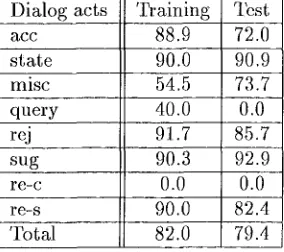
Table 6 shows the results for our training and test utterances. T h e overall performance on the training set was 82.0% on the training set and 79.4% on the test set. An utterance was counted as classified in the correct dialog act class if the m a j o r i t y of the o u t p u t s of the dialog act network corresponded with the desired dialog act. This good performance is partly due to the distributed representation in the dialog plausibility vector at the input layer. Other second best networks with additional local representations tbr abstract se- m a n t i c category knowledge could perform better on the training set but failed to generalize on the test set and only reached 71%.
The remaining errors are partly due to seldomly occurring dialog acts. Por instance, there are only 2% of the training utterances and 2.8% of the test utterances which belong to the request-comment dialog act. T h e network was not able to learn cor- rect assignments due to the little training data. T h e drop in the performance for the query dia- log act from training to test set can be explained by the higher variability of the queries compared to all other categories. Since queries differ much more from each other than all other dialog acts they could not be generalized. However they do
not occur very often. All other often occurring dialog act categories performed very well as the individual percentages and the overall percentage show.
6
D i s c u s s i o n a n d C o n c l u s i o n s
W h a t do we learn from this? When we started this work it was not clear to what extent a symbolic segmentation parser and a connectionist learning dialog act network could be integrated to p e r f o r m an analysis at the semantics and dialog level. We have shown that a symbolic segmentation parser and a learning dialog network can be integrated to perform dialog act assignments for spoken ut- terances. While other related work has focused on statistical learning we have explored the use of learning in simple recurrent networks. Our corpus of 2228 words is still m e d i u m size. Nevertheless, we consider the results as promising, given t h a t it is - to the best of our knowledge - the first at- t e m p t go integrate symbolic segmentation parsing with dialog act learning in simple recurrent net- works.
How well do we p e r f o r m c o m p a r e d to related work? In spite of m a n y projects in the ATIS and V E R B M O B I L domains there is not a lot of work on
learning
for the dialog level. However, recently there have been some investigations of statistical techniques (Reithinger and Maier, 1995) (Alexan- derson et al., 1995) (Mast et al., 1996). For in- stance Mast and colleagues report 58% for learn- ing dialog act assignment with semantic classifica- tion trees and 69% for learning with p e n t a g r a m s but they also used more categories t h a n in our approach so t h a t the approaches are not directly comparable.For a further evaluation of our trMned network architecture we c o m p a r e d our results with a sta- tistical approach based on the same data. Pl£u- sibility vectors for dialog acts represent the dis- tribution of dialog acts for each word for the cur- rent corpus, t]owever, for assigning a dialog act to a whole utterance all the words of this utter- ance have to be considered. A simple but efficient approach would be to c o m p u t e the average plau- sibility vector: for each utterance which has been tbund. Then the dialog act with the highest aver- aged plausibility vector for a complete utterance would be taken as the c o m p u t e d dialog act. This statistical approach reached a performance of 62% correctness on the training and test set c o m p a r e d to the 82% and 79% of our dialog network. So simple recurrent networks performed better t h a n the statistical average plausibility m e t h o d . In comparison to statistical techniques which have
[image:5.596.121.263.248.374.2]also been used successflllly on large corpora, it is our understanding that simple recurrent networks m a y be particularly suitable tbr domains where only smaller corpora are awdlable or where clas- s|liter|on d a t a is hard to got (as it is the case {'or pragmatic dialog acts.)
W h a t will be further work? So far we llave con- centratcd on single utterances and we do not ac- count for the relationship between utl;erances in a dialog. While we could demonstrate that such a local strategy could assign correct dialog acts in many eases, it might be interesting to explore to what extent knowledge about previous dialog acts in previous utterances could oven improve our re- salts. Furthermore, we have developed tim seg- mentation parser and dialog act network as very robust components, lit fact, both are very ro- bust in the sense that they will always produce the best possible segmentation and dialog act cat- egorization, hi the future we plan to explore how the o u t p u t from a speech recognizer can be pro-
cessed by our dialog conlponent. ~qenteiice and
word hypotheses from a speech recognizer are still far fl'om optimal for continuously spoken spon- taneous speech. Therefore we have to account for highly ungrammaticM constructions. The seg- mentation parser and the dialog network already contain the robustness which is a precondition for dealing with real-world speech input.
A c k n o w l e d g e m e n t s
This research was funded by the German Federal Ministry for fteseareh and '['echnology (BMBF) under G r a n t @01IV101A0 and by the German l{e- search Association (DI,'G) under contract I)I"G IIa 1026/6-2. We would like to thank S. Ilaack, M. Meurer, U. Sauerland, M. Schrattenholzer, and V. Weber for their work on SCREEN.
R e f e r e n c e s
J. Alexanderson, E. Meier, and N. lh;ithinger. 1995. A robust and efficient three-layered di- alogue component tbr a speech-to-speech trans- lation system. In Proceedings of the Euro- pean Association for Computational Linguis-
tics, l)ublin.
J. Austin. 1962. tlow to do things wilh words. Clarendon Press, Oxford.
E. Charniak. 1993. Statistical Language Learning. MIT Press, Cambridge, MA.
J. 1,. l,Jhnan. 1990. Finding structure in time. Cognitive £'cience., 14:179 221.
1). Jones, editor. 1995. New Methods in Language Processing. University College London.
M. Marcus, B. Santorini, and M. Marcinkiewicz. 1993. Building a large annotated corpus of En- glish: the Penn treebank. Computational Lin- guistics, 19(1).
M. Mast, E. Noeth, 11. Niemann, and
E. G. Schukat 'l'alanmzzini. 1996. Automatic classification of dialog acts with semantic clas- sification trees and polygrarns. In S. Wermter, E. Rilotf, and G. Scheler, editors, Connection|st, Slatistical and Symbolic Approaches to Learning for Nalural Language P'wcessing, pages 217- 229. Springer, tleidelberg.
N. l{eithinger and E. Maim:. 1995. Utilizing sta- tistical dialogue act processing in verbmobil. In
Computational Linguistics A~hive.
I). E. lt.uinelhart, G. E. Hinton, and IL. J. Williams. 1986. Learning internal representa- tions by error propagation. In D. E. Rumel- hart and J. L. MeClelland, editors, Parallel Dis- tribaled Processing, volume 1, pages 318-362. MIT Press, Cambridge, MA.
J. R. Searle. 1969. £'pecch Acts. Cambridge Uni- versity Press, Cambridge.
Y. Wang and A. Waibel. 1995. Connection|st traust'cr in machine translation. In Proceedings o]" the International Conference on Recent Ad- vances in Natural Language Processing, pages 37 44, Tzigov Cliark.
S. Wcrmter and V. Weber. 1995. Artificial neurM networks for automatic knowledge acquisition in multiple real-world language domains. In Proceedings of the International Conference on Neural Networks and their Applications, Mar- seille.
S. Wermter and V. Weber. 1996. Interactive spo- ken language processing in the hybrid connec- tion|st system SCREEN: learning robustness in the real world. IEEE Computer, 1996. in press. S. Wermter, E. l{iloff, and G. Scheler. 1996. Con- nectionist, Statistical and Symbolic Approaches to Learning for Natural Language Pwccssing. Springer, Berlin.
S. Wermter. 1995. Hybrid Connection|st Natu- ral Language Processing. C h a p m a n and tIall, London, UK.
![Table 3: Incremental slot filling ill frame 2;...well ich (la noch trainieren bin (because I there still train [am])](https://thumb-us.123doks.com/thumbv2/123dok_us/791780.1092486/3.596.323.522.193.419/table-incremental-slot-filling-frame-noch-trainieren-train.webp)