Learning Lineal" P r e c e d e n c e Rules
V l a d i m i r P e r i c l i e v
M a t h e m a . t i c a l L i n g u i s t i c s D e p a r t m e n t
I n s t i t u t e o f M a t h e m a t i c s ~md C o m p u t e r S c i e n c e , b l . 8 B u l g ~ r i a n A c a d e ~ n y o f S c i e n c e s , 1 113 S o f i a B u l g a r i a
p e r i Q b g e a r n , a c a d . bg
A b s t r a c t
A s y s t e m is descril)ed which learns fl'om examples the Linear Precedence rules in an I m m e d i a t e D o m i n a n c e / L i n e a r Prece- dence g r a m m a r . Given a particular hn- mediate Dominance g r a m m a r and hier- archies of feature values potentially rel evant for linearization ( = t h e systelu's bias), the leanler generates a p p r o p r i a t e naturM language expressions to be ewd- uated as positive or negative by a teach- er, and produces as o u t p u t IAnear Prece- dence rules which can be directly used 1)y the gralnmar.
1 I n t r o d u c t i o n
The lnanual cotnpilation of a. sizable g r a m m a r is a difficult and time-consuming task. An impor- t a n t subtask is the construction of word ordering rules in the g r a m m a r . '['hough some languages are proclaimed as having simple ordering rules, e.g. either complete scrambling or strictly "fixed" order, most languages exhibit quite complex reg- ularities (Steele, 198l), and even the rigid word order languages (like 1,;nglish) and those with to tal scrambling (like Warlpiri; cf. (H ale, 1983) m a y show intricate rules (Kashket, 11981); hence the need for their a u t o m a t i c acquisition. 'Fhis I;ask however, to the best of our knowledge, has not heen previously addressed.
This p a p e r describes a prograln which, given a g r a m m a r with no ordering relations, l)roduces as outpu_t a set of linearization, or Linear Prece- dence, rules which can be directly employed by that g r a m m a r . T h e learning step uses the ver- sion space algorithm, a familiar techlfique from ma.chine learning for learning from examples. In contrast to m o s t previous uses of the algorithnl for various learning tasks, which rely on priorly giv- en classified examples, our learner generates itself tile training instances olte at a tinie, and they are then classed as positive or negative by a teach- er. A selective generation of training instances is employe, d which facilitates the learning by mini-
mizing the nu,nl)er of evaluations t h a t the teacher needs to make.
T h e next section (h.'scribes the h m n e d i a t e Dom- inance/Linear I)recedence g r a m m a r format. In section 3, tlle lask of learning l,inear Precedence rules is interpreted as a task of learning from ex- amples, and section 4 introduces the version space ]nethod. Section 5 is a system overview, and sec- tion 6 focuses on implementation. Finally, some limitations of the system a.re discussed as well as some directions for future research.
2 h n m e d i a t e D o m i n a n c e / L i n e a r P r e c e d e n c e G r a m m a r s
A standard way of expressing tile ordering of nodes in a g r a m m a r is I)y means of l,inear Precedence rules in hnme(liate l)ominance/IAnear I','ocede,,ce. (ID/LI') ,~ra.,,,,ai's. The m / U ' for:- m a t was first introduced by ( G a z d a r and Pullmn, 1981) and ( G a z d a r el.. al., 1985) and is usually associated with G P S ( ] , but is also used by I I P S G (l'ollard and Sag, 1987) and, under different guis- es, by other formMisins a.s well.
LP rule, but we shall use it here, as we need an explicit ~hference to it.)
3
T h e Task of LP R u l e s
A c q u i s i t i o n V i e w e d As Learning
from E x a m p l e s
A p r o g r a m which learns f r o m examples usual- ly reasons f r o m very specific, low-level, instances (positive or b o t h positive and negative) to more general, high-level, rules that adequately describe those instances. Upon a c o m m o n understanding (Lea and Simon, 1974), learning from examples is a cooperative search in two spaces, the instance space, i.e. the space of all possible training in- stances, and the rule (=h.ypotheses) space, i.e. the space of all possible general rules. Besides these two spaces, two additional processes are needed, intermediating them: interpretatioT~ and instance selection. T h e interpretation process is needed, in moving f r o m the instance space to the rule space, to interpret the raw instances, which m a y be far removed in f o r m froln the form of the rules, so that instances can guide the search in the rule space. Analogously, the instance selection rules serve to t r a n s f o r m the high-level hypotheses (rules) to a representation useflfl for guiding the search in the instance space.
A general description of our task is as follows: Given a specific ID grammar with no LP rules, find those L P rules. 1 In this task we also need to reason f r o m very specific instances of LP rules (language phrases like small childreu, *children s- malt) to rnore general LP rules (adjective < noun), therefore it can be interpreted in terms of tile two- space model, described above.
Our instance space will consist of all strings gen- erable by the given ID g r a m m a r (the size of this instance space for any non-toy g r a m m a r will be very large). The LP rules space will be an un- ordered set, whose elements are pairs ot' nodes, connected by one of the relations <, > or < > , e. a LP set = [[A < B], [B < l';], [E > C], ... ]. (The size of the LP rules space will deperid upon the size of the specific ID g r a m m a r whose LP rnles are to be learned.)
We also need to define the interpretation and instance-selection processes. In the learning sys- t e m to be described, for b o t h purposes serves (basically) a mete-interpreter for l l ) / L P g r a m - mars, which can parse tile concrete g r a m m a r , giv- en at the outset, for b o t h analysis and generation. In an interpretation phase, the mete-interpreter will parse a n a t u r a l language expression out- p u t t i n g an LP-rules-space approriate representa- tion, whereas in the instance-selection phase the
1Though indeed this is the usual way of looking at the task, sometimes we may need to start with some LP rules already known; the program we shMl describe supports both regimes.
meta-interpreter, given an LP space representa- tion as input, will generate a language expression to be classified as positive (i.e. not violating word order rules) or negative (i.e. violating those rules) by a teacher.
4
T h e Version Space M e t h o d
There are a variety of m e t h o d s in the AI litera- ture for learning from exarnples. For handling our task, we have chosen tile so called "version space" m e t h o d (also known as the "candidate elimination algorithm"), cf. (Mitchell, 1982). So we need to have a look at this m e t h o d .
Tile basic idea is, t h a t ill all representation lan- guages for the rule space, there is a partial order- ing of expressions according to their generality. This fact allows a c o m p a c t representation of the set of plausible rules ( = h y p o t h e s e s ) in the rule s- pace, since the set of points in a partially ordered set can be represented by its most general and its most specific elements. Tile set of most general rules is called the G-set, and tile set of m o s t spe- cific rules tile S-set.
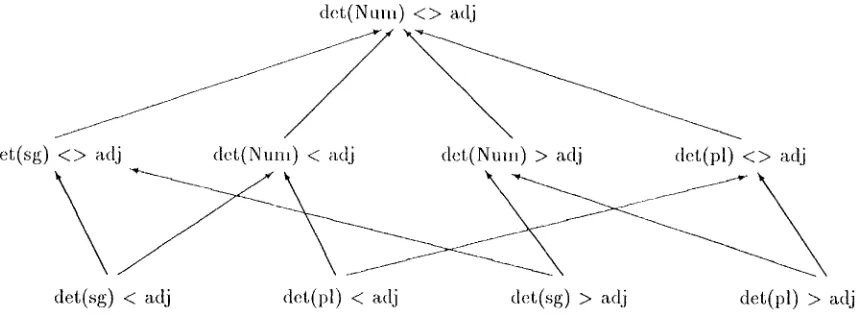
Figure 1 illustrates the LP rules space of a de- terminer of some g r a m m a t i c a l nulnber (singular or l)lura.l) and an adjective, expressed in predicate logic.
Viewed top-down, the hierarchy is in descending order of generality (arrows point from specific to general). T h e t o p m o s t LP rule is most general and covers all the other rules, since d e t ( N u m ) , where Nnm is a variable, covers both det(sg) and det(pl), and < > covers b o t h < and >. Each of the rules at level 2 are neither more general nor more specific than each other, but are more general than the most specific rules at the bottorn.
T h e learT~ing method assumes a set of positive and negative examples, and its aim is to induce a rule which covers all the positive examples and none of the counterexamples. Tile basic algorithm is as follows:
(1) The G-set is instantiated to the most gener- al rule, and the S-set to the first positive example (i.e. a positive is needed to s t a r t the learning pro- cess).
(2) T h e next training instance is accepted. If it is positive, frorn the G-set are removed the rules which do not cover the example, and the elements of S-set are generalized as little as possible, so that they cover the new instance. If the next instance is negative, then fl'om the S-set are removed the rules t h a t cover the counterexample, and the elements of the G-set are specialized as little as possible so that the counterexample is no longer covered by any of the elements of the G-set.
deL(Nun,) < > a~ti
det(sg) < > adj det(Num) < adj det(Nuni) > adj de.t(pl) < > adj
det(sg) < adj det(pl) < adj do.t(sg) > adj det(pl) > adj
Figure 1: A Generalization hierarchy
Now, let us see how this works with the l,P rules version space in Figure 1, asslllning further the following classitied exaanplcs ((+) nteans l)ositiw~, and ( - ) negative instance):
(+)
det(sg) < a,ti (--) det(sg) > adj(+) dct(pl) < adj
The algorithni will instanLiate the {i-set to the n:iost general rule iii tile version space, and tim
,5'-set to the first positive, obl, aining:
G-set: [[dot(Nu,n) < > ad.i}]
s-set: [[det(sg) < add]]
'/'hen the next exmnple will lie accepted, which is negative. T h e current ~g-sel does not cover it, so it relnains the sanle; the G-set is specialized as little as possible to exchlde tile negative, which yields:
G-sot: [[det(Num) < adj]] S-set: < adj]]
The last example is positive. ]'lie (;-sol reliiaill-
s l, he same since it covers the positive. The ,5'-set however does not, so it has to be uiilliinally gen- eralized to cover it, obtaining:
G-set: [[de.t(Nuui) < a~ti]]
S-sot: [ [ d e t ( N u m ) < acid]]
These are singleton sets which are identical, and the resultant (consistent) generalization is there-- fore: [det(Num) < adj]. T h a t is, a determiner of any grarrniiatical lunnber niust precede a,n adjec-- rive.
5
O v e r v i e w o f t h e L e a r n e r
Our learning program has two basic modules: IAm version space learner which performs the olenmn-. tary learning Step (as descril)ed in 1.he previous
section), and a nmta-hiterpretcr for l l ) / I , P grain- iiiars which serves the processes of interpretai.ion
alld instance selection (as described in section 3).
The learning proceeds in a dialog forni with tile teacher: for the learning of each individual l,P rule, the system produces natural language phras- es to be classitied by the teacher mttil it can con- verge to a single concept (rule). The whole process ends when all LP rules are learned.
At tile outset, the prograrn is supplied with the specific H) grallHl-lar whose l,P rules are to be ac- quired, and the user-provided bias of the. system. The latl;er implies an explicit statement Oil the part of tlw user of what featm'es and values are relevant to the task, by ilqmtting the correspond- ing generalization hierarchies (the precedence gen- eralization hierarchy is taken for granted).
In the particular implementation, the accept- able 11) grammar format is essentially that of a logic gt'ammar (Pereira and Warren, 1980), (l)ahl and Abramson, 1990). We only use a double arrow (to avoid mixing up with the often built-in Deft- nite Clause ()irammar notation), and besides emp- ty productions and sisters ha.ving the very same nallm are not allowed, since they interfere with 1,1 > rules statmnenl.s, of. e.g. (Sag, 1987), (Saint- l)izier,
1988).
6
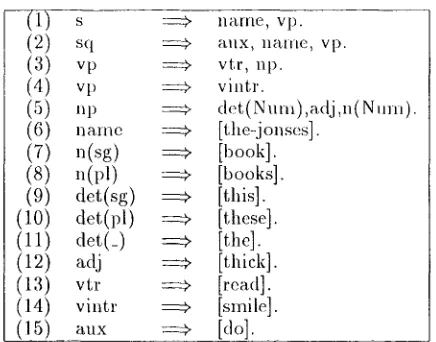
T i l e i m p l e m e n t a t i o nBelow we discuss the basic aspects of tile imple- mentation, illustrating it; with the ll) grannnar wil, h no LP restrictions, given on Figure 2.
The grammar will generate simple declarative and interrogative sentences like The Jonses read this thick book, The 3onses read these thick
books,
Do the Jonses smile, etc. as well as all their (un- granuimtical) permutations Read this thick book the ,lo,lscs, 7'he Jonses read thick this book do, ct, c.The progranl knows at the outset that the val- ues "sg" and "pl" are hoth more specitic than l, he varial)lc "N ran", mal;ching any mmtber (this is tilt bias of the system).
[image:3.596.82.512.60.219.2](1) s ==> name, vp. (2) sq ~ aux, name, vp.
(3)
vp
==> vtr, np.(4) vp - - > vintr.
(5) np =:=> det(Num),adj,n(Nm,,). (6) , arno [the-jonses].
(7) n(sg) ~ [book].
(8)
n(pl)
=:~
[books].
(9)
det(sg)
~
[this].
(10)
det(p,)
[these].
(11)
act(_)
[the].
(12) adj ==> [thick].
(la) vtr [read].
(14) vintr ~ [smile].
(15)
aux
[do].
Figure 2:
A simple i1) grammar with no LP constraints( = t h e right-hand sides of ID rules) that will later have to be linearized, by collecting them in a par- tially ordered list. Singleton right-hand sides (rule (4) above and all dictionary rules) are therefore left out, and so are cuts, and "escapes to Pro- log" in curly brackets, since they are not used to represent tree nodes, but are rather coustraints on such nodes. Also, if some right-hand side is a set which (properly) includes another right-hand side (as in rule (2) and rule (1) abowe), the latter is not added to the sibling list, since we do not want to learn twice the linearization of some two nodes ("name" and "vp" in our case). The sib- ling list then, after the hierarchical sorting frollt lower-level to higher-level nodes, becomes:
[[aux,name,vp] ,[vtr,np],[det (Nurn),adj ,n(Num)]]
Now, despite the fact that the set of LP rules we need to learn is itself unordered, the order in which the program learns each individual LP rule rnay be very essential to the acquisition process. Thus, starting Dom the first, element of the above sib- ling list, viz. [aux, name, vp], we will be in trouble when a t t e m p t i n g to locate the misorderings in any negative example. Considering just a single nega- tive instance, say The Jonses read thick this book do: W h a t is(are) the misplacenmnt(s) and where do they occur? In the higher-level tree nodes [aux, name, vp] or in the lower-level nodes [vtr, np] or in the still lower [det(Num),adj,n(Num)] ?
Our program solves this problem by exploiting the fact, peculiar to our application, that the n- odes in a grammar are hierarchically structured, therefore we may try to linearize a set of nodes A and B higher up in a tree o~lly after all lower- level nodcs dominated by both A and ft have al- ready been ordered. Knowing these lower-lewq LP rules, our rneta-interpreter would never generate instances like The Jonses read thick this book do, but only some repositionings of the nodes
[aux,
name, vp], their internal ordering being gua.ran-
teed to be correct. The sibling list then, after hi- erarchical sorting from lower-level to higher-level nodes, becomes:
[[det(Num),adj,n(Sum)],[vtr,np],[aux,,mme,vp]]
and the lirsl; element of this list, is first passed to the learning engine.
Slep ~. The. program now needs to produce a first positive example, as required by the version sl)ace method. Taking as input the first elelneu- t of tim sibling list, the. I I ) / L P meta-interpret.er generates a phrase conforming to this description and asks the teacher to re-order it correctly (if needed). In our case, tile first positiw', example would be this thick book. The phrase will be re- parsed in order to determine the linearization of constituents.
A word about the I1)/I,P parser/generator. Its analysis role is needed in processing the firs|; pos- itive example, and the generation role in the pro- duction of language examples for all intermediate stages of the learning process which are then e- valuated by the teacher. The predicate observes two types of LP constraints: tile globally valid LP rules tha.t have been acquired by the system so far, " and the "transitory" LP constraints, serving to produce an ordering, as required by an intermedi- ate stage of the learning process.
l)isposing of the ordering of constituents in the positive example, the tra~silive closure of these partial orderings is computed (in our case, from [[det(Num) < adj],[adj < n(Num)]] we get [[de- t(Num) < adj], [ad.i < n(Num]), [det(Num) < n(Num)]]). This result is t h e . east into a rop- resentation that SUl)ports our learning process. :3
20r are priorly known, in the case when the system starts with some LP rules declared by the user.
[image:4.596.208.426.62.233.2]Dialog with, user
this t h i c k b o o k
(+)
(?)
(-)
this b o o k t h i c k
(-)
t h i c k this b o o k
(-)
t h e s e t h i c k b o o k s
(+/
LP rules space ~ , a l representation) i
,,;x.: [ d o t , ~ ; a ~ ( ~ j , ~ , , l , _ V - -
(;: [[det,N,< >,a~0,#,ad.i,< >,,~,_,#,det,_,< >,n,j]
S:[[det,sg, <,adj,#,adj,<,n,_,#,det,_,<,n,_]]
Ex.: ] ' ( t e t , s g , < , a d j , # , a d j , < , n , _ , # , ( t e t , _ , > , n , _ ] - - -
G: [[det,N,< >,ad.i,#,adj,< >,,l,_,#,det,_, <,n,_]]
s: [[det,sg,<,adj,#,a4i,<,n,_,#,det,_, <,,*,all
F-EST.: [det,sg,<,adj,#,adj,>,n,_,},det,_,<,n,_]
G: [[(let, N,<> ,a dj,#,ad i,< ,n,_, # ,d0t,_, <
,.,_]]
S:[[det,sg,<,adj,#,adj,<,n,_,#,det,_,<,n,_]]
t;;x. : [det,sg, > , a d j , # , a d j , <,n,_,#,det,_,< ,n,_]
G:
[[det, N,<,ad, i,#,adj, <,n,_, #,det,_,<,,~,_]]
S:
[[det,sg, <,adi,#,adj, <,,~,_,#,det,_, <,n,_]]
~det,l,l,<,adj,#,ad.i,<,n,_,#,do<,<,,,,_I----
G:
[[tier,N, <,~dj,#,ad.i,<,,,,_,#,det,_,<,,l,_]]
S: [[det,sg, < ,adj, # ,adj, <,n,_, # ,det,_, <,n,_]]
-A c ~ , , - 7 7 7
adj < n(sg)
det(sg) < n(sg) det(sg) < adj
adj < n(sg)
det(sg) > n(sg)
~ e t ( s g ) < adj adj > n(sg)
,let(sg) < ,,(sg)
--~let(sg) > ~dj
adj < n(sg)
det(sg) < .(sg)
adj < n(pl) det(pl) < n(pl)
Consistent generalization: - ~ d e t ( N ) < adj
[det,N,<,adj,#,adj,<,,,,_,#,det,_,<,n,_]
ad.i < ,I(N)
det(N) < n(N)
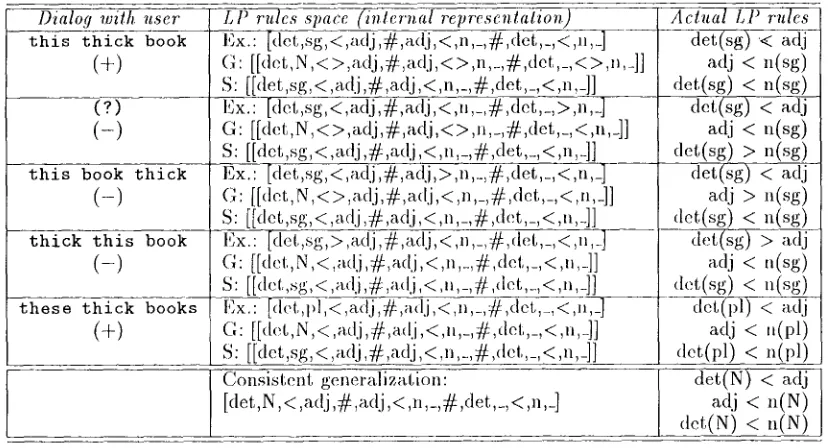
Figure 3: A sample session
Step 3. q'he version space method is applie(I and the individual 1,1 ) rules, resulting fron, lind- ing a consistent generalization, are asserted in the I I ) / b P granmm.r datal)ase to lie resl)eete,l by any
4 further generation process.
Figure 3 gives a learning cycle starting ['rein the sibling list ele,nent [det(Nun,),adj,n(Nu,,,)]. The first column gives the dialog with the teacher, the second the program's internal representation of the l,P rules space., and the third those |'ules a.re expressed in their nnore familiar, and final, form that can be utilized directly by the 11) gra.nmmr.
Afl,er processing the lirst 1)ositive (tirst row), tile system generalizes by varying a paraluet(:r (imnd)er or l)recedenec), verbalizes 1,he general- ization, the generated phrase is class|tied by the teacher, then another generalization is made, de- pending on the classiiication, it is verbalized, eval- uated and so on. The 1)rocess results in the three l,P rules: det(Num) < adj; adj < ,,(Num); and
det(N.,n) < ,~(N.,,,).
A remark on notation: # delimits individual l,P rules, allowing their recovery in terms of Prolog structures. The underbars, _, are nmrely place- holders for bound variables (in our case. those bound to "N"). Clearly, mutually depemhmt flea- ture values need to be eonsidcre(l (i.e. wu'ie(I I)y the program) only once, and so they occtu"
just
once in the expressions.
Severa.1 additional points regarding the learning process need to be lnadc.
4Assertions are actually made after (:he(:king for consistency with LP's already present in the database. Though no contradictions may ~u'isc with acquired rules, they may come from LP's declared by the user it, the case when the system is started with some such LP's.
The firsl i~ t h a t after couw.q'ging to a. single l,p
rule, it is tesl.e(l wlmther 1.his rule covers allluost specific instnnces. For doing this, the stated gen- ¢~ralization hierarchies are t.aken into account a- longside with the fact that in an I I ) / L P format a rule of tile type d > 13 logically implies the nega- lion of its "inverse rule" A < IL Thus, the rule det(Num) < adj covers all potential most specif~ ie instances since the rule itself and its inverse rule det(Nmn) > adj cover them, which is clearly seen on the generalization hierarchy in Figure 1. [[" SO]fie lllOSt sl)eci[i(: i l l s t a , l | ( ' e s r e t t l a i l l /lllcovere(.l~ theu they are fed again to the version space algo~ ril.hlzl for a second pass.
The second point is that when it is impossible ['or SOll|e s t r u c t u r ( " t o b e verbalized due to cont, ra- dictory LP statelnellts (as ill the second row), the system itself evaluates this exa.ml)le as negative and l)roceeds fln'ther.
[image:5.596.86.500.63.287.2]We also nee(I to emphasize that the program selectively, rather than randomly, wries the po- tentially relevant parameters (munber and prece- dence, in this particular case), ~ttempting to converge the. generalization process most quick- ly. This is done in order to minilnize the nunnber of training iustanees that need to be generated, and hence (,o nfinimize the number of evMuations that tim teach(~r lice(Is to Ina.ke. In other words, being generalization-driven, the generator never produces training instances which arc superfluous to the generalization pro('ess. ']'his, in particu- lar, allows the program to avoid o u t p u t t i n g all strings generable by the g r a m m a r whose LP rules are being acquired {notice, for instance, in the lh'st colunm of Figure 3 that no language expres- sion involving the dictionary rule (11) det(_)
In this respect our approach is in sharp contrast to a learning process whose training examples are given en bloc, and hence the teacher would, of necessity, make a great lot of assessions that the learner would never use.
Step ~. T h e learning terminates successfully when all LP rules are found (i.e. all elements of the sibling list are processed) and fails when no consistent generalization may be found for some data. T h e latter fact needs to be interpreted in the sense that these data are not correctly describable within the I D / L P format.
7
C o n c l u s i o n a n d F u t u r e W o r k
We have described a program that learns the LP rules of an I D / L P logic grammar in a form that can be directly utilized by that grammar. This task has not been addressed in previous work.
We conclude by mentioning some limitations of the system suggesting future directions for inves- tigation.
It is known that the version space method mis- behaves on encountering noisy data: an instance mistakenly classed as negative e.g. may lead to p r e m a t u r e pruning of a search branch where the solution may actually lie. This may be a prob- lem in our task (and perhaps in many other lin- guistic tasks) since our assessments of grammati- cM/ungrammaticM word order are in some cases far from definite yes/no's. So haudling uncertain input is one way our research may evolve.
Another direction for filture research is address- ing the learning of word order expressed in more complex formalisms than I1)/LP grammars. It has been proposed in the (computational) linguistics literature (e.g. (Zwicky, 1986), Ojeda, 11988, Per- icliev and Grigorov, 1994) that LP rules of the standard f o r m a t may be insufficient in some ca.s- es, and need to be augmented with other ordering relations like "immediate precedence" < < , "fist", "last", etc., and more generally, that linearization needs to be stated in complex logic expressions connected by conjunction, disjunction and nega- tion. We can trivially add the relation < < to the present learner, but the other parts of such pro- posals seem beyond its immediate capacity, as it stands. From our previous work on word order we despose of a parser/generator that can ham dle complex expressions, however we shall need to modify (or perhaps, even replace) our learning m e t h o d with one which is better suited to handle logic constructions like disjunction and negation.
Acknowledgements. The research reported in this paper was partly supported by contract
1-
526/95.
R e f e r e n c e s
v . Dahl and H. Abramson. 1990. mars, Springer.
G. Gazdar and G. Pullum. 1981.
Logic Gram-
Subcatego- rization, constituent order and the notion of "head". In M. Moortgat et. al. (eds). The S- cope of Lexical Rules, Dordrecht, llolland, pages 107-123.
G. Gazdar, E. Klein, G. Pullum and I. Sag. 1985. Generalized Phrase Structure Grammar, liar- yard, Cambr. Mass.
K. Hale. 1983. Warlpiri and the grammar of non- configurational languages. Natural Language and Linguistic Th.eory, v. 1, pages 5-49.
M. Kashket. 1987. A GB-based parser for Warlpiri, a free-word order language. MIT AI Laboratory.
G. Lea and I1. Simon. 1974. Problem solving and rule induction: A unified view. In L. Gregg (ed). l(nowledge and Co;inition, Lawrence Erl- baum Associates.
T. Mitchell. 1982. Generalization as search. Ar- tificial Intellige,ee, 18, pages 203-226.
A. Qieda. 1988. A linear precedence account of cross-serial dependencies. Linguistics aand Phi- losophy, l l , pages 457-492.
F.C.N. Pereira and D.H.D Warren. 1980. Definite Clause G r a m m a r s for Natural Language Anal- ysis. Artificial Intelligence, 13, pages 231-278.
V. Pericliev and A. Grigorov. 1994. Parsing a flexible word order language. COLING'g/t, Ky- oto, pages 391-395.
C. Pollard and I. Sag. 1987. b~formation-Based Syntax and Semanties,vol.l: Fnndamentals. C- SLI Lecture Notes No.
13,
Stanford, CA.P. Saiut-1)izier. 1988. Contextual discontinuous grammars. In Natural Language Understand-
ing and Logic Programming, lI, North-Holland, pages 29-43.
I. Sag. 1987. Grammatical hierarchy and lin- ear precedence. In S?lulax and Semantics, v.12. Discontinuous Constituency, Academic Press, pages 303-340.
Richard Steele. 1981. Word order variation. In J. Greenberg (ed). In Universals of Language, v./t, Stanford.