Acquisition Across the Web
Marius Pa¸sca and P´eter Dienes
Google Inc.,
1600 Amphitheatre Parkway, Mountain View, California, 94043, USA
{mars, dienes}@google.com
Abstract. This paper presents a lightweight method for unsupervised extraction of paraphrases from arbitrary textual Web documents. The method differs from previous approaches to paraphrase acquisition in that 1) it removes the assumptions on the quality of the input data, by using inherently noisy, unreliable Web documents rather than clean, trustworthy, properly formatted documents; and 2) it does not require any explicit clue indicating which documents are likely to encode parallel paraphrases, as they report on the same events or describe the same sto-ries. Large sets of paraphrases are collected through exhaustive pairwise alignment of small needles, i.e., sentence fragments, across a haystack of Web document sentences. The paper describes experiments on a set of about one billion Web documents, and evaluates the extracted para-phrases in a natural-language Web search application.
1
Introduction
The information captured in textual documents frequently encodes semantically equivalent ideas through different lexicalizations. Indeed, given the generative power of natural language, different people employ different words or phrases to convey the same meaning, depending on factors such as background knowledge, level of expertise, style, verbosity and personal preferences. Two equivalent frag-ments of text may differ only slightly, as a word or a phrase in one of them is paraphrased in the other, e.g., through a synonym. Yet even small lexical variations represent challenges to any automatic decision on whether two text fragments have the same meaning, or are relevant to each other, since they are no longer lexically identical. Many natural-language intensive applications make such decisions internally. In document summarization, the generated summaries have a higher quality if redundant information has been discarded by detecting text fragments with the same meaning [1]. In information extraction, extrac-tion templates will not be filled consistently whenever there is a mismatch in the trigger word or the applicable extraction pattern [2]. Similarly, a question answering system could incorrectly discard a relevant document passage based on the absence of a question phrase deemed as very important [3], even if the passage actually contains a legitimate paraphrase.
R. Dale et al. (Eds.): IJCNLP 2005, LNAI 3651, pp. 119–130, 2005. c
In information retrieval, deciding whether a text fragment (e.g., a document) is relevant to another text fragment (i.e., the query) is crucial to the overall out-put, rather than merely useful within some internal system module. Indeed, relevant documents or passages may be missed, due to the apparent mismatch between their terms and the paraphrases occurring in the users’ queries. The previously proposed solutions to the mismatch problem vary with respect to the source of the data used for enriching the query with alternative terms. In auto-matic query expansion, the top documents provide additional query terms [4]. An alternative is to attempt to identify the concepts captured in the queries and find semantically similar concepts in external resources, e.g., lexical databases [5, 6]. This paper explores a different direction, namely the unsupervised acquisition of large sets of paraphrases from unstructured text within Web documents, and their exploitation in natural-language Web search.
We present a lightweight method for unsupervised extraction of paraphrases from arbitrary, textual Web documents. The method taps the textual contents provided by millions of anonymous Web document contributors. The remainder of the paper is structured as follows. After a condensed overview of the para-phrase acquisition method and a contrast to previous literature in Section 2, Section 3 presents the method in more detail. Section 4 describes evaluation results when applying the method to textual documents from a Web repository snapshot of the Google search engine.
2
Method at a Glance
The proposed acquisition method collects large sets of word and phrase-level paraphrases via exhaustive pairwise alignment of small needles, i.e., sentence fragments, across a haystack of Web document sentences. The acquisition of paraphrases is a side-effect of the alignment.
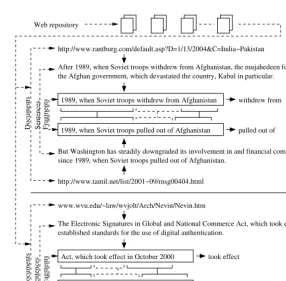
In the example in Figure 1, if two sentence fragments have common word sequences at both extremities, then the variable word sequences in the middle are potential paraphrases of each other. A significant advantage of this extraction mechanism is that it can acquire paraphrases from sentences whose information content overlaps only partially, as long as the fragments align. Indeed, the source sentences of the paraphrase (withdrew from, pulled out of), as well as of (took effect,came into force), are arguably quite different overall in Figure 1. Moreover, the sentences are part of documents whose content intersection is very small.
Web repository
http://www.rantburg.com/default.asp?D=1/13/2004&C=India−Pakistan
After 1989, when Soviet troops withdrew from Afghanistan, the mujahedeen fought a civil war against the Afghan government, which devastated the country, Kabul in particular.
Documents Fragments
1989, when Soviet troops withdrew from Afghanistan
1989, when Soviet troops pulled out of Afghanistan pulled out of withdrew from
But Washington has steadily downgraded its involvement in and financial commitment to the region since 1989, when Soviet troops pulled out of Afghanistan.
http://www.tamil.net/list/2001−09/msg00404.html
www.wvu.edu/~law/wvjolt/Arch/Nevin/Nevin.htm
The Electronic Signatures in Global and National Commerce Act, which took effect in October 2000, established standards for the use of digital authentication.
Sentences
Documents Sentences Fragments
Act, which took effect in October 2000
Act, which came into force in October 2000
took effect
came into force
The United States passed federal e−commerce legislation, the Electronic Signatures in Global and National Commerce Act, which came into force in October 2000.
www.ahbl.ca/library/High−Tech%20&%20Innovation/lookback−lookforward−mar2001.pdf
Fig. 1.Paraphrase acquisition from unstructured text across the Web
from external search engines, and its quality benefits implicitly from the rank-ing functions of the search engines. Third, the input documents here are not restricted to a particular genre, whereas virtually all other recent approaches are designed for collections of parallel news articles, whether the articles are part of a carefully-compiled collection [11] or aggressively collected from Web news sources [12]. Fourth, the acquisition of paraphrases in this paper does not rely on external clues and attributes that two documents are parallel and must report on the same or very similar events. Comparatively, previous work has explicit access to, and relies strongly on clues such as the same or very similar timestamps being associated to two news article documents [11], or knowledge that two documents are translations by different people of the same book into the same language [13].
3
Mining the Web for Paraphrases
collections. In contrast, Web documents contain extraneoushtmlinformation, formatting errors, intra- and inter-document inconsistencies, spam and other adversarial information, and in general they lack any assumptions regarding a common document structure. Consequently, the acquisition of paraphrases must be robust, handle Web documents with only minimal linguistic processing, avoid expensive operations, and scale to billions of sentences.
3.1 Document Pre-processing
As a pre-requisite to the actual acquisition of paraphrases, the Web documents are converted from raw string representations into more meaningful linguistic units. After filtering out html tags, the documents are tokenized, split into sentences and part-of-speech tagged with the TnT tagger [14]. Many of the candidate sentences are in fact random noise caused by the inconsistent structure (or complete lack thereof) of Web documents, among other factors. To improve the quality of the data, sentences are retained for further processing only if they satisfy the following lightweight sanity checks: 1) they are reasonably sized: sentences containing less than 5 words or more than 30 words are discarded; 2) they contain at least one verb that is neither a gerund nor a modal verb; 3) they contain at least one non-verbal word starting in lower-case; 4) none of the words is longer than 30 characters; and 5) less than half of the words are numbers. Since the experiments use a collection of English documents, these checks are geared towards English.
3.2 Acquisition via Text Fragment Alignment
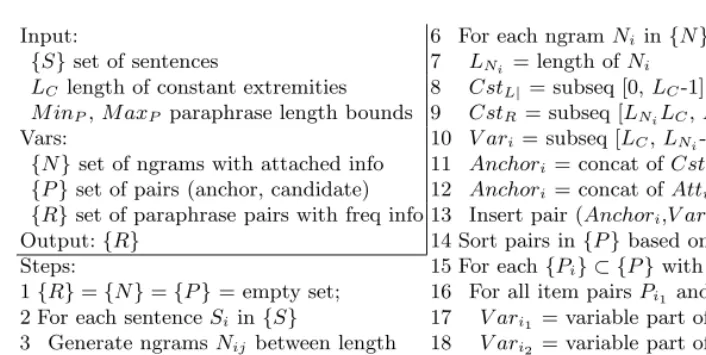
At Web scale, the number of sentences that pass the fairly aggressive sanity checks during document pre-processing is still extremely large, easily exceed-ing one billion. Any brute-force alignment of all pairs of document sentences is therefore unfeasible. Instead, the acquisition of paraphrases operates at the level of text fragments (ngrams) as shown in Figure 2.
The extraction algorithm roughly consists of the following three phases:
– Generate candidate ngrams from all sentences (steps 1 through 5 in Figure 2);
– Convert each ngram into a ready-to-align pair of a variable fragment (a candidate paraphrase) and a constant textual anchor (steps 6 through 13);
– Group the pairs with the same anchors; collect the variable fragments within each group of pairs as potential paraphrases of one another (steps 14 to 20). The algorithm starts with the generation of candidate ngrams, by collecting all possible ngrams such that their length varies within pre-defined boundaries. More precisely, an ngram starts and ends in a fixed number of words (LC); the count of the additional (ngram) words in-between varies within pre-defined limits (M inP and M axP, respectively).
Input: 6 For each ngramNiin{N}
{P}set of pairs (anchor, candidate) 12 Anchori = concat ofAttiandAnchori
{R}set of paraphrase pairs with freq info 13 Insert pair (Anchori,V ari) into{P}
Output:{R} 14 Sort pairs in{P}based on their anchor
Steps: 15 For each{Pi} ⊂ {P}with same anchor
Fig. 2.Algorithm for paraphrase acquisition from Web document sentences
(S1)Together they form the Platte River,which eventually
Whenever the anchors of two or more ngrams are the same, their variable frag-ments are considered to be potential paraphrases of each other, thus implement-ing a const-var-const type of alignment.
3.3 Alignment Anchors
According to the simplified discussion from above, the algorithm in Figure 2 may align two sentence fragments “decided to read the government report published last month”and“decided to read the edition published last month”to incorrectly produce government report and editionas potential paraphrases of each other. To avoid such alignments, Steps 4 and 12 of the algorithm enrich the anchoring text around each paraphrase candidate, namely by extending the anchors to in-clude additional information from the source sentence. By doing so, the anchors become longer and more specific, and thus closer to expressing the same informa-tion content. In turn, this reduces the chances of any two ngrams to align, since ngram alignment requires the complete matching of the corresponding anchors. In other words, the amount of information captured in the anchors is a trade-off between coverage (when anchors are less specific) and accuracy of the acquired paraphrases (when the anchors are more specific). At the low end, less specific anchors include only immediate contextual information. This corresponds to the algorithm in Figure 2, when nothing is attached to any of the ngrams in Step 4. At the high end, one could collect all the remaining words of the sentence outside the ngram, and attach them to more specific anchors in Step 4. This is equivalent to pairwise alignment of full-length sentences.
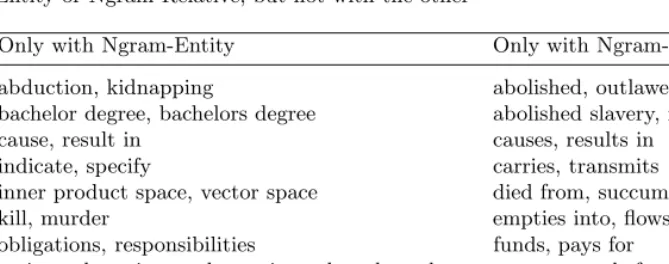
Table 1.Examples of paraphrase pairs collected from the Web with one of Ngram-Entity or Ngram-Relative, but not with the other
Only with Ngram-Entity Only with Ngram-Relative
abduction, kidnapping abolished, outlawed
bachelor degree, bachelors degree abolished slavery, freed the slaves
cause, result in causes, results in
indicate, specify carries, transmits
inner product space, vector space died from, succumbed to
kill, murder empties into, flows to
obligations, responsibilities funds, pays for
registered service marks, registered trademarks means, stands for
video poker betting, video poker gambling penned, wrote
x-mas gift, x-mas present seized, took over
– Ngram-Only: The anchor includes only the contextual information assembled from the fixed-length extremities of the ngram. Nothing else is attached to the anchor.
– Ngram-Entity: In addition to Ngram-Only, the anchor contains the preced-ing and followpreced-ing named entities that are nearest to the ngram. Sentences without such named entities are discarded. The intuition is that the ngram contains information which relates the two entities to each other.
– Ngram-Relative: On top of Ngram-Only, the anchor includes the remain-ing words of the adverbial relative clause in which the variable part of the ngram appears, e.g.,“when Soviet Union troops pulled out of Afghanistan”, or “which came into force in 2000” in Figure 1. The clause must modify a named entity or a date, which is also included in the anchor. Sentences not containing such clauses are rejected. 1 The intuitive motivation in that the entity is related to part of the ngram via the adverbial particle.
For illustration, consider the earlier example of the sentence S1 from
Sec-tion 3.2. With Ngram-Entity,Platte River (preceding entity) and Mexico (fol-lowing entity) are included in the anchor. In comparison, with Ngram-Relative the additional information combinesPlatte River(entity) andof Mexico (remain-der of relative clause). In this example, the difference between Ngram-Entity and Ngram-Relative happens to be quite small. In general, however, the differences are more significant. Table 1 illustrates paraphrases collected from the Web by only one of the two anchoring mechanisms.
To ensure robustness on Web document sentences, simple heuristics rather than complex tools are used to approximate the additional information attached to ngrams in Ngram-Entity and Ngram-Relative. Named entities are approxi-mated by proper nouns, as indicated by part-of-speech tags. Adverbial relative clauses, together with the entities or dates they modify, are detected according to a small set of lexico-syntactic patterns which can be summarized as:
[Date|Entity] [,|-|(|nil] [Wh]RelClause [,|-|)|.]
1
whereWhis one ofwho,when,whichorwhere. The patterns are based mainly on wh-words and punctuation. The matching adverbial clauseRelClause must sat-isfy a few other constraints, which aim at avoiding, rather than solving, complex linguistic phenomena. First, personal and possessive pronouns are often refer-ences to other entities. Therefore clauses containing such pronouns are discarded as ambiguous. Second, appositives and other similar pieces of information are confusing when detecting the end of the current clause. Consequently, during pattern matching, if the current clause does not contain a verb, the clause is either extended to the right, or discarded upon reaching the end of the sentence.
4
Evaluation
The input data for paraphrase acquisition is a collection of 972 million Web documents, from a Web repository snapshot of the Google search engine taken in 2003. All documents are in English. The parameters controlling the length of the ngrams and candidate paraphrases, introduced in Figure 2, areLC=3,M inP=1 and M axP=4. 2 The anchors use additional information from the sentences, resulting in separate runs and sets of paraphrases extracted with Ngram-Only, Ngram-Entity and Ngram-Relative respectively. The experiments use a parallel programming model [15]. The extracted paraphrase pairs that co-occur very infrequently (i.e., in less than 5 unique ngram pairs) are discarded.
4.1 Quantitative Results
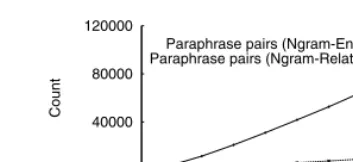
The sanity checks applied in document pre-processing (see Section 3.1) discard a total of 187 billion candidate sentences from the input documents, with an average of 3 words per sentence. In the case of Ngram-Only, paraphrases are ex-tracted from the remaining 9.5 billion sentences, which have 17 words on average. As explained in Section 3.3, Ngram-Entity and Ngram-Relative apply a set of ad-ditional constraints as they search the sentences for more anchoring information. Ngram-Entity discards 72 million additional sentences. In contrast, as many as 9.3 billion sentences are rejected by the constraints encoded in Ngram-Relative. The number of paraphrase pairs extracted from the Web varies with the particular kind of anchoring mechanism. The simplest one, i.e., Ngram-Only, produces 41,763,994 unique pairs that co-occur in at least 5 different ngrams. With Ngram-Relative, the output consists of 13,930 unique pairs. In comparison, Ngram-Entity generates 101,040 unique pairs. Figure 3 shows that the number of acquired paraphrases varies more or less linearly in the size of the input data. The large majority of the paraphrase pairs contain either two single-word phrases (40% for Ngram-Entity, and 49% for Ngram-Relative), or one single-word and one multi-single-word phrase (22% for Entity, and 43% for Ngram-Relative). Table 2 illustrates the top paraphrase pairs with two multi-word phrases, after removal of paraphrases containing only stop words, or upper/lower
2 No experiments were performed with higher values for M ax
P (to collect longer
0 40000 80000 120000
10 20 30 40 50 60 70 80 90 100
Count
Percentage of input data Paraphrase pairs (Ngram-Entity) Paraphrase pairs (Ngram-Relative)
Fig. 3.Variation of the number of acquired paraphrase pairs with the input data size
Table 2.Top ranked multi-word paraphrase pairs in decreasing order of frequency of co-occurrence
# Ngram-Entity Ngram-Relative
1 DVD Movie, VHS Movie became effective, took effect
2 betting is excited, wagering is excited came into force, took effect
3 betting is, wagering is became effective, went into effect
4 betting is excited, gambling is excited became effective, came into force
5 Annual Meeting of, meeting of became effective, came into effect
6 center of, centre of entered into force, took effect
7 betting is, gambling is one hour, two hours
case variation. Top multi-word phrases extracted by Ngram-Relative tend to be self-contained syntactic units. For instance, entered into force is a verb phrase in Table 2. In contrast, many of the top paraphrases with Ngram-Entity end in a linking word, such as the pair (center of,centre of). Note that every time this pair is extracted, the smaller single-word paraphrase pair that folds the common linking word into the anchor, e.g., (center,centre), is also extracted.
4.2 Quality of Paraphrases
Table 3.Quality of the acquired paraphrases
Ngram-Only Ngram-Entity Ngram-Relative
Classification of Pairs Top Mid Low Top Mid Low Top Mid Low
100 100 100 100 100 100 100 100 100
(1) Correct; punct., symbols, spelling 1 5 11 12 6 20 18 11 15
(2) Correct; equal if case-insensitive 0 5 0 27 2 11 9 2 14
(3) Correct; both are stop words 4 0 0 3 0 1 1 0 0
(4) Correct; hyphenation 0 1 4 10 35 8 2 19 43
(5) Correct; morphological variation 8 1 10 9 10 20 20 15 6
(6) Correct; synonyms 16 8 21 5 32 14 33 23 6
Total correct 29 20 46 66 85 74 83 70 84
(7) Siblings rather than synonyms 63 29 19 32 8 15 5 7 7
(8) One side adds an elaboration 0 0 3 0 0 0 1 2 1
(9) Entailment 0 3 2 0 0 1 3 1 0
Total siblings 63 32 24 32 8 16 9 10 8
(10) Incorrect; antonyms 6 0 2 0 1 4 4 3 4
(11) Incorrect; other 2 48 28 2 6 6 4 17 4
Total incorrect 8 48 30 2 7 10 8 20 8
with Ngram-Only in Table 3 are precisely such words. Class (8) contains pairs in which a portion of one of the elements is a synonym or phrasal equivalent of the other element, such as (poliomyelitis globally, polio) and (UNC, UNC-CH), whereas (9) captures what can be thought of as entailment, e.g., (governs, owns) and (holds,won). Finally, the last two classes from Table 3 correspond to incorrect extractions, due to either antonyms like (lost,won) and (your greatest strength,your greatest weakness) in class (10), or other factors in (11).
The aggregated evaluation results, shown in bold in Table 3, suggest that Ngram-Only leads to paraphrases of lower quality than those extracted with Ngram-Entity and Ngram-Relative. In particular, the samples from the middle and bottom of the Ngram-Only paraphrases contain a much higher percentage of incorrect pairs. The results also show that, for Entity and Ngram-Relative, the quality of paraphrases is similar at different ranks in the paraphrase lists sorted by the number of different ngrams they co-occur in. For instance, the total number of correct pairs has comparable values for the top, middle and bot-tom pairs. This confirms the usefulness of the heuristics introduced in Section 3.3 to discard irrelevant sentences with Ngram-Entity and Ngram-Relative.
4.3 Paraphrases in Natural-Language Web Search
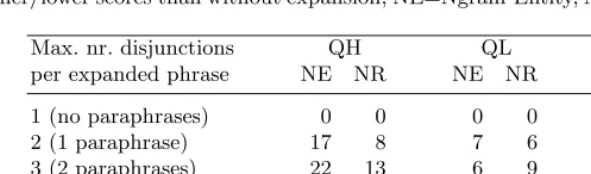
Table 4. Impact of expansion of the test queries (QH/QL=count of queries with higher/lower scores than without expansion, NE=Ngram-Entity, NR=Ngram-Relative)
Max. nr. disjunctions QH QL Score
per expanded phrase NE NR NE NR NE NR
1 (no paraphrases) 0 0 0 0 52.70 52.70
2 (1 paraphrase) 17 8 7 6 64.50 57.62
3 (2 paraphrases) 22 13 6 9 70.38 60.46
4 (3 paraphrases) 23 15 6 7 71.42 60.39
5 (4 paraphrases) 26 18 12 5 71.73 63.35
sentence fragment occurred according to the text, e.g.,1937,Golden Gate was built, and 1947,Bell Labs invented the transistor.
A test set of temporal queries is used to extract direct results (dates) from the repository of factual nuggets, by matching the queries against the sentence fragments, and retrieving the associated dates. The test queries are all queries that start with eitherWhenorWhat year, namely 207 out of the total count of 1893 main-task queries, from the Question Answering track [16] of past editions (1999 through 2002). The metric for measuring the accuracy of the retrieved results is the de-facto scoring metric for fact-seeking queries, that is, the recip-rocal rank of the first returned result that is correct (in the gold standard) [16]. If there is no correct result among the top 10 returned, the query receives no credit. Individual scores are aggregated (i.e., summed) over the entire query set. In a series of parallel experiments, all phrases from the test queries are expanded into Boolean disjunctions with their top-ranked paraphrases. Query words with no paraphrase are placed into the expanded queries in their origi-nal form. The other query words are expanded only if they are single words, for simplicity. Examples of implicitly-Boolean queries expanded disjunctively, before removal of stop words andwh-words, are:
– When did Amtrak (begin|start|began|continue|commence) (operations
| operation|activities|Business|operational)?
– When was the De Beers (company|Co.|firm|Corporation|group) (founded
| established|started|created| co-founded)?
5
Conclusion
The Web has gradually grown into a noisy, unreliable, yet powerful resource of human knowledge. This knowledge ranges from basic word usage statistics to in-tricate facts, background knowledge and associated inferences made by humans reading Web documents. This paper describes a method for unsupervised acqui-sition of lexical knowledge across the Web, by exploiting the numerous textual forms that people use to share similar ideas, or refer to common events. Large sets of paraphrases are collected through pairwise alignment of ngrams occur-ring within the unstructured text of Web documents. Several mechanisms are explored to cope with the inherent lack of quality of Web content. The quality of the extracted paraphrases improves significantly when the textual anchors used for aligning potential paraphrases attempt to approximate, even at a very coarse level, the presence of additional information within the sentences. In addition to the known role of the extracted paraphrases in natural-language intensive applications, the experiments in this paper illustrate their impact in returning direct results to natural-language queries.
The final output of the extraction algorithm lacks any distinction among paraphrases that apply to only one of the several senses or part of speech tags that a word or phrase may have. For instance, hearts, center and middle mix the medical and positioning senses of the word heart. Conversely, the extracted paraphrases may capture only one sense of the word, which may not match the sense of the same word in the queries. As an example, in the expansion of one of the test queries, “Where is the massive North Korean (nuclear|atomic) (complex|real) (located|situated|found)?”, a less-than-optimal paraphrase of com-plexnot only provides a sibling rather than a near synonym, but may incorrectly shift the focus of the search towards the mathematical sense of the word (com-plex versus real numbers). Aggregated contextual information from the source ngrams could provide a means for selecting only some of the paraphrases, based on the query. As another direction for future work, we plan to revise the need for language-dependent resources (namely, the part of speech tagger) in the cur-rent approach, and explore possibilities of minimizing or removing their use for seamless transfer of the approach to other languages.
References
1. Hirao, T., Fukusima, T., Okumura, M., Nobata, C., Nanba, H.: Corpus and eval-uation measures for multiple document summarization with multiple sources. In: Proceedings of the 20th International Conference on Computational Linguistics (COLING-04), Geneva, Switzerland (2004) 535–541
2. Shinyama, Y., Sekine, S.: Paraphrase acquisition for information extraction. In: Proceedings of the 41st Annual Meeting of the Association of Computational Lin-guistics (ACL-03), 2nd Workshop on Paraphrasing: Paraphrase Acquisition and Applications, Sapporo, Japan (2003) 65–71
4. Mitra, M., Singhal, A., Buckley, C.: Improving automatic query expansion. In: Proceedings of the 21st ACM Conference on Research and Development in Infor-mation Retrieval (SIGIR-98), Melbourne, Australia (1998) 206–214
5. Schutze, H., Pedersen, J.: Information retrieval based on word senses. In: Pro-ceedings of the 4th Annual Symposium on Document Analysis and Information Retrieval. (1995) 161–175
6. Zukerman, I., Raskutti, B.: Lexical query paraphrasing for document retrieval. In: Proceedings of the 19th International Conference on Computational Linguistics (COLING-02), Taipei, Taiwan (2002) 1177–1183
7. Barzilay, R., Lee, L.: Learning to paraphrase: An unsupervised approach using multiple-sequence alignment. In: Proceedings of the 2003 Human Language Tech-nology Conference (HLT-NAACL-03), Edmonton, Canada (2003) 16–23
8. Jacquemin, C., Klavans, J., Tzoukermann, E.: Expansion of multi-word terms for indexing and retrieval using morphology and syntax. In: Proceedings of the 35th Annual Meeting of the Association of Computational Linguistics (ACL-97), Madrid, Spain (1997) 24–31
9. Glickman, O., Dagan, I.: Acquiring Lexical Paraphrases from a Single Corpus. In: Recent Advances in Natural Language Processing III. John Benjamins Publishing, Amsterdam, Netherlands (2004) 81–90
10. Duclaye, F., Yvon, F., Collin, O.: Using the Web as a linguistic resource for learning reformulations automatically. In: Proceedings of the 3rd Conference on Language Resources and Evaluation (LREC-02), Las Palmas, Spain (2002) 390–396
11. Shinyama, Y., Sekine, S., Sudo, K., Grishman, R.: Automatic paraphrase acqui-sition from news articles. In: Proceedings of the Human Language Technology Conference (HLT-02), San Diego, California (2002) 40–46
12. Dolan, W., Quirk, C., Brockett, C.: Unsupervised construction of large
para-phrase corpora: Exploiting massively parallel news sources. In: Proceedings of
the 20th International Conference on Computational Linguistics (COLING-04), Geneva, Switzerland (2004) 350–356
13. Barzilay, R., McKeown, K.: Extracting paraphrases from a parallel corpus. In: Proceedings of the 39th Annual Meeting of the Association for Computational Linguistics (ACL-01), Toulouse, France (2001) 50–57
14. Brants, T.: TnT - a statistical part of speech tagger. In: Proceedings of the 6th Conference on Applied Natural Language Processing (ANLP-00), Seattle, Wash-ington (2000) 224–231
15. Dean, J., Ghemawat, S.: MapReduce: Simplified data processing on large clus-ters. In: Proceedings of the 6th Symposium on Operating Systems Design and Implementation (OSID-04), San Francisco, California (2004) 137–150