A Two-Stage Classifier for Sentiment Analysis
Dai Quoc Nguyen
and
Dat Quoc Nguyen
and
Son Bao Pham
Faculty of Information Technology
University of Engineering and Technology
Vietnam National University, Hanoi
{
dainq, datnq, sonpb
}
@vnu.edu.vn
Abstract
In this paper, we present a study applying re-ject option to build a two-stage sentiment po-larity classification system. We construct a Naive Bayes classifier at the first stage and a Support Vector Machine at the second stage, in which documents rejected at the first stage are forwarded to be classified at the second stage. The obtained accuracies are comparable to other state-of-the-art results. Furthermore, experiments show that our classifier requires less training data while still maintaining rea-sonable classification accuracy.
1
Introduction
The rapid growth of the Web supports human users to easily express their reviews about such entities as prod-ucts, services, events and their properties as well as to find and evaluate the others’ opinions. This brings new challenges for building systems to categorize and un-derstand the sentiments in those reviews.
In particular, document-level sentiment classifica-tion systems aim to determine either a positive or neg-ative opinion in a given opinionated document (Tur-ney, 2002; Liu, 2010). In order to construct these systems, classification-based approaches (Pang et al., 2002; Pang and Lee, 2004; Mullen and Collier, 2004; Whitelaw et al., 2005; Kennedy and Inkpen, 2006; Martineau and Finin, 2009; Maas et al., 2011; Tu et al., 2012; Wang and Manning, 2012) utilizing machine learning to automatically identify document-level sen-timent polarity are still mainstream methods obtaining state-of-the-art performances. It is because of possibly combining various features such as: bag of words, syn-tactic and semantic representations as well as exploit-ing lexicon resources (Wilson et al., 2005; Ng et al., 2006; Taboada et al., 2011) like SentiWordNet (Bac-cianella et al., 2010). In these systems, Naive Bayes (NB) and Support Vector Machine (SVM) are often ap-plied for training learning models as they are frequently used as baseline methods in task of text classification (Wang and Manning, 2012). Although NBs are very fast classifiers requiring a small amount training data, there is a loss of accuracy due to the NBs’ conditional independence assumption. On the other hand, SVMs
achieve state-of-the-art results in various classification tasks; however, they may be slow in the training and testing phases.
In pattern recognition systems, reject option (Chow, 1970; Pudil et al., 1992; Fumera et al., 2000; Fumera et al., 2004) is introduced to improve classification re-liability. Although it is very useful to apply reject op-tion in many pattern recogniop-tion/classificaop-tion systems, it has not been considered in a sentiment classification application so far.
In this paper, we introduce a study combining the advantages of both NB and SVM classifiers into a two-stage system by applying reject option for document-level sentiment classification. In the first stage of our system, a NB classifier, which is trained based on a feature representing the difference between numbers of positive and negative sentiment orientation phrases in a document review, deals with easy-to-classify doc-uments. Remaining documents, that are detected as “hardto be correctly classified” by the NB classifier in the use of rejection decision, are forwarded to process in a SVM classifier at the second stage, where thehard
documents are represented by additional bag-of-words and topic-based features.
2
Our approach
This section is to describe our two-stage system for sentiment classification. Figure 1 details an overview of our system’s architecture.
Figure 1:The architecture of our two-stage classifier.
In this positive (pos) and negative (neg) classifica-tion problem of sentiment polarity, we reject every sen-timent document D satisfying the following rejection decision based on conditional probabilities:
(τ1> P(pos|D)andP(pos|D)≥P(neg|D)) OR
(τ2> P(neg|D)andP(neg|D)> P(pos|D))
where thresholdsτ1, τ2 ∈[0,1]. Otherwise, if doc-ument D does not satisfy the rejection decision, it is accepted to be classified by the NB.
A NB classifier at the first stage is to categorize accepted documents. Rejected sentiment documents, that are determined as hardto be correctly classified (most likely to be miss-classified) by the NB classi-fier in applying reject option, are processed at the sec-ond stage in a SVM classifier. In our system, the NB classifier categorizes document reviews based on a fea-ture namely DiffPosNeg while the SVM one classifies document reviews with additional bag-of-words (BoW) and topic features.
DiffPosNeg feature
We exploit the opinion lexicons1of positive words and
negative words (Hu and Liu, 2004) to detect the senti-ment orientation of words in each docusenti-ment. We then employ basic rules presented in (Liu, 2010) to iden-tify the sentiment orientation of phrases. The numerical distance between the numbers of positive and negative opinion phrases in a documentD is referred to as its DiffPosNeg feature value.
BoW features
The BoW model is the most basic representation model used in sentiment classification, in which each docu-ment is represented as a collection of unique unigram words where each word is considered as an indepen-dent feature. We calculate the value of featureiin using
term frequency - inverse document frequencyweighting scheme for the documentDas following:
BoWiD =log(1 + tfiD)∗log
|{D}|
dfi
wheretfiDis the occurrence frequency of word
fea-tureiin document D,|{D}|is the total number of doc-uments in the data corpus{D}, anddfiis the number of
documents containing the featurei. We then normalize
BoW feature vector of the documentDas below:
−−−−−→
ηBoWD= P
δ∈{D}k
−−−−→
BoWδk
|{D}| ∗ k−−−−→BoWDk
∗−−−−→BoWD
Topic features
Our system also treats each document review as a “bag-of-topics”, and considers each topic as a feature. The topics are determined by using Latent Dirichlet Allo-cation (LDA) (Blei et al., 2003). LDA is a generative probabilistic model to discover topics for a corpus of documents. LDA represents each document as a proba-bility distribution over latent topics, where each topic is modeled by a probability distribution over words. Us-ing Bayesian inference methods, LDA computes poste-rior distribution for unseen documents. In our system, we refer to topic probabilities as topic feature values.
1http://www.cs.uic.edu/∼
liub/FBS/opinion-lexicon-English.rar
3
Experimental results
3.1 Experimental setup
We conducted experiments on the publicly available standard polarity dataset V2.02of 2000 movie reviews constructed by Pang and Lee (2004).
We did not apply stop-word removal, stemming and lemmatization because such stop-words as negation words (e.g: no, not, isn’t) were used in the basic rules to reverse the sentiment orientation of phrases, and as pointed out by Leopold and Kindermann (2002) stem-ming and lemmatization processes could be detrimen-tal to accuracy. We kept 4000 most frequent words for each polarity class, after removing duplication, we had total 5043 BoW features.
For extracting LDA topic features, we used the JGibbLDA implementation3 developed by Phan and
Nguyen (2007), in which αis set to 0.5, β is set to 0.1 and the number of Gibbs sampling iterations is set to 3000. We exploited a corpus4 of 50000 unlabeled
movie reviews published by Maas et al. (2011) to build LDA topic models. We then applied these models to compute the posterior probability distribution over la-tent topics for each movie review in the experimented dataset of 2000 reviews.
In order to compare with other published results, we evaluate our classifier based on 10-fold cross-validation. We randomly separate the dataset into 10 folds; giving one fold size of 100 positive and 100 neg-ative reviews. This evaluation procedure is repeated 10 times that each fold is used as the testing dataset, and 9 remaining folds are merged as the training dataset. All our performance results are reported as the average accuracy over the testing folds.
We utilized WEKA’s implementations (Hall et al., 2009) of NB and SVM’s fast training Sequential Min-imal Optimization algorithm (Platt, 1999) for learning classification with the WEKA’s default parameters (e.g: the linear kernel for SVM).
3.2 Results without reject option
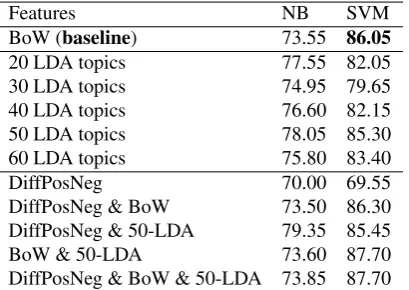
Table 1 provides accuracies achieved by the single NB and SVM classifiers without the reject option: our NB and SVM classifiers were trained on the whole train-ing dataset of 9 folds accordtrain-ing to the above 10-fold cross-validation scheme. We consider BoW model as a baseline, similar to other approaches (Pang and Lee, 2004; Whitelaw et al., 2005; Tu et al., 2012).
In table 1, the accuracy results based on only Diff-PosNeg feature are 70.00% for NB and 69.55% for SVM. The highest accuracies in utilizing LDA topics are 78.05% for NB classifier and 85.30% for SVM clas-sifier due to 50 topic features. Besides, the accuracy accounted for SVM at 86.30% over the combination of
2
http://www.cs.cornell.edu/people/pabo/movie-review-data/
3
http://jgibblda.sourceforge.net/
Table 2:Results in applying reject option (8 folds for training), and in other SVM-based methods
τ1 τ2 rP os rN eg NB SVM Accuracy
0.79 0.81 0.764 0.987 236 13 1519 232 (tuned thresholds) 87.75
0.82 0.80 0.796 0.990 205 9 1554 232 87.95
1.0 1.0 1.0 1.0 0 0 1752 248 87.60
Pang and Lee (2004) BoW 87.15
BoW with minimum cuts 87.20
Whitelaw et al. (2005) BoW (48314 features) 87.00 BoW and appraisal groups (49911 features) 90.20 Kennedy and Inkpen (2006) Contextual valence shifters with 34718 features 86.20 Martineau and Finin (2009) BoW with smoothed delta IDF 88.10
Maas et al. (2011) Full model and BoW 87.85
Full model + additional unlabeled data + BoW 88.90
Tu et al. (2012) BoW 87.05
BoW & dependency trees with simple words 88.50
Wang and Manning (2012) NBSVM-Unigram 87.80
NBSVM-Bigram 89.45
Table 1:Results without reject option
Features NB SVM
BoW (baseline) 73.55 86.05
20 LDA topics 77.55 82.05 30 LDA topics 74.95 79.65 40 LDA topics 76.60 82.15 50 LDA topics 78.05 85.30 60 LDA topics 75.80 83.40 DiffPosNeg 70.00 69.55 DiffPosNeg & BoW 73.50 86.30 DiffPosNeg & 50-LDA 79.35 85.45 BoW & 50-LDA 73.60 87.70 DiffPosNeg & BoW & 50-LDA 73.85 87.70
DiffPosNeg and BoW features is greater than the base-line result of 86.05% with only BoW features. By ex-ploiting a full combination of DiffPosNeg, BOW and 50 LDA topic features, the SVM classifier gains the exceeding accuracy to 87.70%.
3.3 Results in applying reject option
In terms of evaluating our two-stage approach, if the foldith is selected as the testing dataset, the
fold(ith+1)%10 will be selected as the development
dataset to estimate reject thresholds while both NB and SVM classifiers will be learned from 8 remaining folds. By varying the thresholds’ values, we have found the most suitable valuesτ1of 0.79 andτ2of 0.81 to gain the highest accuracy on the development dataset.
Table 2 presents performances of our sentiment clas-sification system in employing reject option, where the NB classifier was learned based on the DiffPosNeg fea-ture, and the SVM classifier was trained on the full combination of DiffPosNeg, BoW and 50 LDA topic features (total 5094 features). In the table 2, rP osand
rN eg are reject rates corresponding with positive label
and negative label in thetestingphase:
rP os=
number of rejected positive reviews
1000
rN eg=
number of rejected negative reviews
1000
Overall reject rate= rP os+rN eg 2
With the valuesτ1of 0.79 andτ2 of 0.81, our two-stage classifier achieves the result of 87.75% on the testing dataset that as illustrated in table 2, it is com-parable with other state-of-the-art SVM-based classifi-cation systems, many of which used deeper linguistic features. In total 10 times of cross fold-validation ex-periments for this accuracy, the NB accepted 249 docu-ments to perform classification and rejected 1751 doc-uments to forward to the SVM. Specifically, the NB correctly classified 236 documents whilst the SVM cor-rectly categorized 1519 documents.
Additionally, in the setup of taking 8 folds for train-ing NB and SVM, and not taktrain-ing 1 fold of development into account, by directly varying valuesτ1andτ2on the
testing dataset, our system can reach the highest result of 87.95% which is 1.9% and 0.35% higher than the SVM-based baseline result (86.05%) and the accuracy (87.60%) of the single SVM classifier without reject option, respectively.
3.4 Results in using less training data
To assess the combination of advantages of NB (re-quiring small amount of training data) and SVM (high performance in classification tasks), we also carried out experiments of using less training data. In this evaluation, if the foldi is selected as testing data, the
fold(i+1)%10 will be selected as training dataset to
build the NB classifier. Applying the rejection deci-sion on 8 remaining folds with given reject thresholds, the dataset of rejected documents are used to learn the SVM classifier.
is approximately equal to the accuracy on 9-fold train-ing dataset at 70% as provided in the table 1. This comes from that our proposed DiffPosNeg feature is simple enough to obtain a good NB classifier from small training set. In these experiments, the given thresholds applied in the training phase to learn the SVMs are reused in the testing phase (i.e. the same thresholds for both training and testing phases).
Table 3:Reject option results using less training data τ1 τ2 r∗P os r∗N eg rP os rN eg AccS Accuracy
0.95 0.63 0.722 0.478 0.722 0.475 84.80 80.55 0.64 0.75 0.483 0.723 0.486 0.729 84.80 82.35 0.72 0.65 0.495 0.496 0.491 0.494 83.75 80.50 0.78 0.69 0.606 0.605 0.609 0.600 84.65 82.30 0.88 0.74 0.764 0.770 0.765 0.770 85.80 84.35 0.97 0.78 0.906 0.905 0.908 0.910 86.65 85.75
Table 3 summaries some reject option-based results taking less training data to learn the SVMs based on the full combination of 5094 features, where r∗P osand r∗N eg are reject rates in thetrainingphase, and AccSdenotes
the accuracy of the single SVM classifier without reject option. With the modest overall reject rate of 0.493 in testing phase, our classifier reached an accuracy of 80.50%, which it outperformed the single NB.
Table 4:Results with SVM trained onDiffPosNegand BoW τ1 τ2 r∗P os r∗N eg rP os rN eg AccS Accuracy
0.95 0.63 0.722 0.478 0.722 0.475 84.50 80.55 0.64 0.75 0.483 0.723 0.486 0.729 84.00 81.60 0.80 0.68 0.618 0.591 0.622 0.585 83.90 81.05 0.85 0.73 0.726 0.745 0.732 0.753 84.65 83.65 0.97 0.78 0.906 0.905 0.908 0.910 85.70 84.85 0.92 0.80 0.854 0.941 0.861 0.945 85.70 85.35
In other experiments using less training data as pre-sented in table 4, we trained the SVM classifier based on the combination ofDiffPosNegand BoW features. For the overall reject rate of 0.903 in testing phase, our system gained a result of 85.35% that is a bit of differ-ence against the accuracy of the single SVM at 85.70%. Table 3 and table 4 show that our classifier produced reasonable results in comparison with single NB and SVM classifiers without reject option.
3.5 Discussion
It is clearly that a different set of features could be used for learning the NB classifier at the first classification stage in our system. However, as mentioned in section 3.4, it is sufficient to have a good NB classifier learned from an uniqueDiffPosNeg feature. Furthermore, an obvious benefit of having the NB based on only one
easy-to-extract feature is to enhance the efficiency in terms of time used in the document classification pro-cess. That is the reason why we applied only the Diff-PosNeg feature at the first stage.
With regards to the processing time efficiency, it is because there are no recognition time evaluations asso-ciated to the other compared systems as well as it is not straightforward to re-implement those systems, hence, the comparison over processing time with the other sys-tems is not crucial to our evaluation. Nevertheless, we believe that our classifier enables to get a fast complete recognition in which time spent to extract features is also taken into accounts, where the majority amount of the classification time is allocated to the feature extrac-tion process.
Considering to feature extraction time, letΓ1be the
time taken to extract DiffPosNeg feature andΓ2be the
time spent for extracting other features (i.e. BoW and LDA topic features): our two-stage system then costs (Γ1+overall reject rate∗Γ2) as opposed to (Γ1+Γ2)
by the single SVM without reject option. Depending on the overall reject rate, our system could get a significant increase in the complete recognition time while the re-turned accuracy of our system is promising compared to that of the single SVM classifier.
4
Conclusion
In this paper, we described a study combining NB and SVM classifiers to construct a two-stage sentiment po-larity system by applying reject option. At the first stage, a NB classifier processes easy-to-classify doc-uments. Hard-to-classify documents, which are identi-fied as most likely to be miss-classiidenti-fied by the first NB classifier in using rejection decision, are forwarded to be categorized in a SVM classifier at the second stage. The obtained accuracies of our two-stage classi-fier are comparable with other state-of-the-art SVM-based results. In addition, our classifier outperformed a bag-of-words baseline classifier with a 1.9% abso-lute improvement in accuracy. Moreover, experiments also point out that our approach is suitable for under-resourced tasks as it takes less training data while still maintaining reasonable classification performance.
Acknowledgment
The authors would like to thank Prof. Atsuhiro Takasu at the National Institute of Informatics, Tokyo, Japan for his valuable comments and kind support.
References
Stefano Baccianella, Andrea Esuli, and Fabrizio Se-bastiani. 2010. Sentiwordnet 3.0: An enhanced lexical resource for sentiment analysis and opinion mining. InProceedings of the Seventh International Conference on Language Resources and Evaluation (LREC’10), pages 2200–2204.
C. Chow. 1970. On optimum recognition error and reject tradeoff. IEEE Trans. Inf. Theor., 16(1):41– 46, September.
Giorgio Fumera, Fabio Roli, and Giorgio Giacinto. 2000. Reject option with multiple thresholds. Pat-tern Recognition, 33(12):2099–2101, December.
Giorgio Fumera, Ignazio Pillai, and Fabio Roli. 2004. A two-stage classifier with reject option for text cat-egorisation. InProceedings of Joint IAPR Interna-tional Workshops SSPR 2004 and SPR 2004, volume 3138, pages 771–779.
Mark Hall, Eibe Frank, Geoffrey Holmes, Bernhard Pfahringer, Peter Reutemann, and Ian H. Witten. 2009. The weka data mining software: an update.
SIGKDD Explor. Newsl., 11(1):10–18, November.
Minqing Hu and Bing Liu. 2004. Mining and summa-rizing customer reviews. InProceedings of the tenth ACM SIGKDD international conference on Knowl-edge discovery and data mining, pages 168–177.
Alistair Kennedy and Diana Inkpen. 2006. Senti-ment Classification of Movie Reviews Using Con-textual Valence Shifters. Computational Intelli-gence, 22(2):110–125.
Edda Leopold and J¨org Kindermann. 2002. Text cate-gorization with support vector machines. how to rep-resent texts in input space? Mach. Learn., 46(1-3):423–444, March.
Bing Liu. 2010. Sentiment analysis and subjectiv-ity. In Nitin Indurkhya and Fred J Damerau, editors,
Handbook of Natural Language Processing, Second Edition, pages 1–38.
Andrew L. Maas, Raymond E. Daly, Peter T. Pham, Dan Huang, Andrew Y. Ng, and Christopher Potts. 2011. Learning word vectors for sentiment analysis. In Proceedings of the 49th Annual Meeting of the Association for Computational Linguistics: Human Language Technologies - Volume 1, pages 142–150.
Justin Martineau and Tim Finin. 2009. Delta tfidf: an improved feature space for sentiment analysis. In
Proceedings of the Third Annual Conference on We-blogs and Social Media, pages 258–261.
Tony Mullen and Nigel Collier. 2004. Sentiment anal-ysis using support vector machines with diverse in-formation sources. InProceedings of the 2004 Con-ference on Empirical Methods in Natural Language Processing, EMNLP ’04, pages 412–418.
Vincent Ng, Sajib Dasgupta, and S. M. Niaz Arifin. 2006. Examining the role of linguistic knowledge sources in the automatic identification and classifica-tion of reviews. InProceedings of the COLING/ACL on Main conference poster sessions, pages 611–618.
Bo Pang and Lillian Lee. 2004. A sentimental educa-tion: Sentiment analysis using subjectivity summa-rization based on minimum cuts. InProceedings of the 42nd Meeting of the Association for Computa-tional Linguistics (ACL’04), pages 271–278.
Bo Pang, Lillian Lee, and Shivakumar Vaithyanathan. 2002. Thumbs up?: sentiment classification using machine learning techniques. InProceedings of the ACL-02 conference on Empirical methods in natural language processing - Volume 10, pages 79–86.
Xuan-Hieu Phan and Cam-Tu Nguyen. 2007. Gibb-sLDA++: A C/C++ Implementation of Latent Dirichlet Allocation (LDA).
John C. Platt. 1999. Fast training of support vec-tor machines using sequential minimal optimization. In Bernhard Sch¨olkopf, Christopher J. C. Burges, and Alexander J. Smola, editors,Advances in kernel methods, pages 185–208.
P Pudil, J Novovicova, S Blaha, and J Kittler. 1992. Multistage pattern recognition with reject option. In
Proceedings 11th IAPR International Conference on Pattern Recognition (ICPR’92), pages 92–95.
Maite Taboada, Julian Brooke, Milan Tofiloski, Kim-berly Voll, and Manfred Stede. 2011. Lexicon-based methods for sentiment analysis. Comput. Lin-guist., 37(2):267–307, June.
Zhaopeng Tu, Yifan He, Jennifer Foster, Josef van Gen-abith, Qun Liu, and Shouxun Lin. 2012. Identify-ing high-impact sub-structures for convolution ker-nels in document-level sentiment classification. In
Proceedings of the 50th Annual Meeting of the As-sociation for Computational Linguistics (Volume 2: Short Papers), ACL ’12, pages 338–343.
Peter D. Turney. 2002. Thumbs up or thumbs down?: semantic orientation applied to unsupervised classi-fication of reviews. InProceedings of the 40th An-nual Meeting on Association for Computational Lin-guistics, ACL ’02, pages 417–424.
Sida Wang and Christopher D. Manning. 2012. Base-lines and bigrams: simple, good sentiment and topic classification. In Proceedings of the 50th Annual Meeting of the Association for Computational Lin-guistics (Volume 2: Short Papers), ACL ’12, pages 90–94.
Casey Whitelaw, Navendu Garg, and Shlomo Arga-mon. 2005. Using appraisal groups for sentiment analysis. In Proceedings of the 14th ACM inter-national conference on Information and knowledge management, CIKM ’05, pages 625–631.