Training and Evaluation of a
Spoken Language Understanding System
D e b o r a h A.. Dahl, Lynette Hirschman, Lewis M. N o r t o n ,
Marcia C. Linebarger, D a v i d M a g e r m a n ,
N g h i N g u y e n and Catherine N. Ball
Unisys Defense Systems
Center for Advanced Information Technology PO Box 517
Paoli, PA 19301
I n t r o d u c t i o n
This paper describes our results on a spoken language application for finding directions. The spoken language system consists of the MIT SUMMIT speech recognition system ([20]) loosely coupled to the UNISYS PUNDIT language understanding system ([9]) with SUMMIT pro- viding the top N candidates (based on acoustic score) to the P U N D I T system. The direction finding capability is provided by an expert system which is also part of the M I T VOYAGER system [18]). 1
One major goal in this research has been to under- stand issues of training vs. coverage in porting a lan- guage understanding system to a new domain. Specifi- cally, we wished to determine how much data it takes to train a spoken language system to a given level of per- formance for a new domain. We can use the answer to this question in the process of designing data collection tasks to decide how much data to collect. We address a related question, that is, how to quantify the growth of a system as a function of training, in [12].
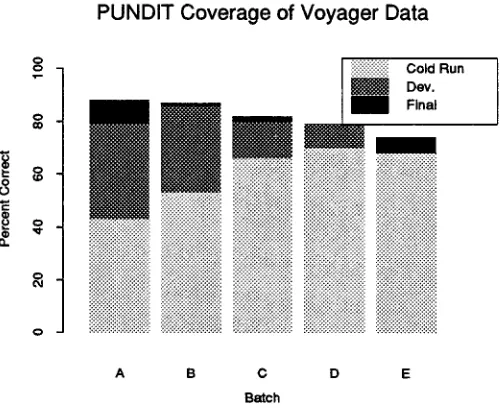
To explore the relationship of training to coverage, we have developed a methodology to measure coverage of unseen material as a function of training material. Using successive batches of new material, we assessed coverage on a batch of unseen material, then trained on this material until we reached a certain level of coverage, then repeated the experiment on a new batch of material. The system coverage seemed to level off at about 70% coverage of unseen data after 1000 sentences of training data.
A second goal was to develop a methodology for auto- matically tuning a broad-coverage grammar to a new
application domain. This approach avoids repeating
domain independent grammar development work over again for each new domain. To do this we developed a method for deriving a minimal grammar and a minimal
1 T h i s w o r k was s u p p o r t e d b y D A R P A c o n t r a c t N000014-89- C0171, a d m i n i s t e r e d b y t h e Otl'ice of Naval R e s e a r c h . W e are g r a t e f u l to V i c t o r Zue of M I T for m a k i n g t h e S U M M I T a n d V O Y - A G E R s y s t e m s available to us, a n d for p r o v i d i n g u s w i t h t h e direction-finding d a t a . W e also w i s h to t h a n k M i t c h M a r c u s of t h e U n i v e r s i t y of P e n n s y l v a n i a for m a k i n g t h e services of o u t s i d e e v a l u a t o r s available to us, a n d Beatrice Santorini for c o o r d i n a t i n g t h e e v a l u a t i o n . Bill Scholz of t h e U n i s y s C e n t e r for A d v a n c e d I.n- f o r m a t i o n T e c h n o l o g y p r o v i d e d valuable a s s i s t a n c e in t h e d e s i g n a n d a n a l y s i s of t h e b l a c k b o x e v a l u a t i o n t a s k .
lexicon from a corpus of training material. The applica- tion of this technique to the DIRECTION-FINDING corpus will be described in this paper. We then compared the coverage and performance of the minimal g r a m m a r and lexicon on a test set, and found that a two-fold decrease in parse time was achieved with only a small loss of cov- erage.
Our second major focus was on evaluation of spe- cific algorithms, using the natural language system as a testbed. In particular, we compared the performance of two algorithms for reference resolution processing. Fi- nally, our third major focus has been to evaluate the overall coverage and accuracy of the entire spoken lan- guage system. We did this using two test corpora col- lected at MIT ([17]), containing a total of 1015 utter- ances. The system was evaluated on the basis of the first utterance of the N-best o u t p u t of S U M M I T accepted by PUNDIT, or the first candidate of the N-best if no utter- ance was accepted by PUNDIT. This paper reports results for word accuracy, sentence accuracy, application accu- racy (generating an answer judged reasonable by naive evaluators), and finally false alarm rate (incorrect, inco- herent or incomplete answers).
S y s t e m Overview
The VOYAGER system has been described in detail else- where, ([18]) so we will only briefly describe it here. VOYAQER is a spoken language system for finding di- rections in Cambridge, Massachusetts. For example the user can ask questions about the locations of objects such as restaurants, universities, and hotels and distances be- tween them. It provides o u t p u t in the form of a m a p dis- play as well as natural language. We have used the SUM- MIT speech recognition system as well as the direction- finding expert system from VOYACER in the system we are reporting on.
The architecture of the system which we report on here has also been largely described elsewhere ([1]), with the exception of the N-best processing, and so will only be summarized here. There are five major components of the system, the speech recognition system ( S U M M I T ) ,
the dialog manager (VFE), the PUNDIT natural language
processing system, the module which formats P U N D I T ' s
o u t p u t for the direction finder (QTIP), and the direction finder itself. VFE takes SUMMIT'S N-best output (com- p u t e d using a word-pair g r a m m a r of perplexity 60), and sends it to PUNDIT for syntactic and semantic analysis. T h e first candidate which PUNDIT accepts is sent to qTIP, where it is formatted and sent to the direction finder. When the direction finder's English response is returned to VFE, it is sent to PUNDIT as well, so t h a t the informa- tion from the direction finder's response can be processed and incorporated into the discourse context. This fea- ture allows the user to refer to things t h a t the direction finder has mentioned, and in general allows the user and the expert system to engage in a dialog. T h e P U N D I T
natural language processing system ([9])is implemented in Prolog and consists of a top-down backtracking parser ([10]), a semantic interpreter ([13]), and a pragmatics component ([5]). The system uses a semantic-net based knowledge representation system ([6]).
T r a i n i n g
Training Data and Coverage
In order to measure the effect of training on coverage, we developed a standardized training technique. We be- gan by training the system on a set of 176 development sentences to a level of 96% percent apphcation accuracy. We then ran a batch of 300 previously unseen sentences through the system and measured accuracy. This was followed by a development stage where we trained the system to about 80% accuracy. T h e n the system was given a new set of 300 unseen sentences. This cycle of testing and development was repeated for approximately 1000 sentences, and we observed a leveling off of the performance of the system on unseen d a t a at approx- imately 70%. The growth of coverage is illustrated in Figure 1. The cold run coverage is coverage measured on each batch of sentences before any development had taken place. Development coverage was the coverage af- ter the system was developed for t h a t b a t c h of sentences, and final coverage was the increased coverage that was achieved after development on later batches of sentences.
G r a m m a r P r u n i n g E x p e r i m e n t s
Use of tight syntactic and semantic constraints is an im- p o r t a n t source of constraint in a spoken language un- derstanding system. There are two approaches to con- structing a tight g r a m m a r for a given corpus of train- ing material. One approach is to build the g r a m m a r incrementally, based on the observed training data, as in TINA ([14]). This approach has the disadvantage of constructing a basic g r a m m a r of English over again for each domain. The other approach is to prune a general g r a m m a r of English to cover only those constructions seen in the training data. This approach has the advan- tage of making available a 'library' of constructions (that is, the full g r a m m a r ) which can easily be added to the system when additional d a t a indicates a need for them.
In both cases, the coverage of the g r a m m a r will directly reflect the a m o u n t of training d a t a seen.
We have developed a technique for pruning our gen- eral English g r a m m a r , based on supervised training. We make use of the fact t h a t PUNDIT provides a detailed parse tree, reflecting the set of BNF definitions used in parsing the sentence. The parse tree also contains each word labeled by p a r t of speech. Given a corpus of train- ing sentences with their correct parses, a p r o g r a m can identify those constructions used to obtain t h a t parse and can extract the associated rules from the general g r a m m a r . Similarly, it can identify how each word is ac- tually used in the training d a t a and extract a minimal lexical definition reflecting the word's usage in context.
Using these techniques, we performed a small set of experiments on the effects of pruning b o t h the g r a m m a r and the lexicon. There are several ways to analyze how pruning affects overall system behavior. We can look for reduction in perplexity; however, given the heavily context-dependent nature of our g r a m m a r , the effects of pruning seemed quite small (10-15% reduction). We also looked at the effect of pruning on overall system per- formance. Given a g r a m m a r based on some 500 train- ing sentences, we observed a two-fold speed-up when the same sentences were run using the pruned g r a m m a r and lexicon (reducing the average time to correct parse from 4.2 sec to 2.1 seconds, on a Sun 3-60). We also looked at the relation between coverage and a m o u n t of train- ing data. Our tests indicated t h a t we did not lose much coverage by pruning the g r a m m a r (-3 % after training on 226 sentences and -2 % after training on 526 sen- tences). We lost more coverage from pruning the lexicon (-33 % after training on 226 sentences, and -7 % after training on 526 sentences), but this was largely to the "unknown" word problem, more t h a n to pruning away needed meanings.
PUNDIT Coverage of Voyager Data
m
... m
I iiiiiiiiiiiiiiiiiiiii!iiiiiii!
A B C D E
B~tch
[image:2.612.316.566.506.712.2]These experiments, though limited, indicate that g r a m m a r and lexicon pruning may offer significant re- ductions in processing time with only small losses in coverage. Furthermore, although we have not yet exper- imented with the pruned grammar on spoken input, we expect that the pruned grammar will improve the abil- ity of PUNDIT to reject ungrammatical candidates from a speech recognizer.
E v a l u a t i o n
We have explored several new approaches to evaluation, including using the natural language system as a tool for comparing specific algorithms, and subjective black box evaluation of accuracy as well as standard word and sentence accuracy measurements.
R e f e r e n c e R e s o l u t i o n
A l g o r i t h m sUsing the language understanding system to compare algorithms gives a very tightly controlled comparison of two or more specific approaches to a problem, and is appropriate when the algorithms of interest are modular, as they are in this case.
We investigated the performance of two reference res- olution algorithms, using P U N D I T as a testbed. The d a t a consisted of a set of 68 discourses (the set of discourses with inter-sentential anaphoric references) taken from the 1000 direction finding utterances which had been
processed by P U N D I T . The reference resolution algo-
rithms were both variations of the focusing/centering ap- proach ([7],[8], [15])). We compared object and subject preference. Object preference means that the direct ob- ject from the previous sentence is preferred over the sub- ject as the referent of a pronoun in the current sentence. Subject preference means that the subject is preferred. Both approaches have been advocated in the literature, ([2],[3],[11]) but have not been tested using naturally oc- curring data. We ran the set of 68 discourses and tabu- lated accuracy of reference resolution for each pronoun. No significant difference in accuracy was found. Accu- racy was near 100 % in both cases. The amount of time spent by the system performing reference resolution was also measured and was found not to differ significantly in each condition. These findings suggest that both algo- rithms perform equally well in this domain. This reflects the fact that there are very few instances where both a subject and an object are competing candidates for a ref- erent in this data. Additional details of this investigation are reported in [4].
S y s t e m
E v a l u a t i o n
We used a subjective black box measure and word and sentence accuracy to evaluate the the system as a whole. Subjective black box evaluation allows us to evaluate performance on queries which have an unspecified num- ber of acceptable answers. For example, we can evaluate vague queries, which require a clarification dialog to elicit
more information before they can be submitted to the application back end. We can also ask questions of hu- man judges that cannot be asked of an automatic evalu- ation technique, such as whether an answer was partially correct, or whether an error message was helpful or not. Although there is always a question of reliability when human judges are used, when judges are provided with clear and explicit instructions, h u m a n judgements can be quite reliable.
Methodology
The system was evaluated at the level of word, sentence and application accuracy. Word and sentence level accu- racy were measured using the NIST evaluation software. In order to evaluate the system at the application level, we designed a black box evaluation task, using h u m a n evaluators to score each interchange of a dialog between the system and a user. The evaluators were five stu- dents at the University of Pennsylvania and one Unisys employee who was not a system developer.
This evaluation task was similar to one reported by MIT ([19]) in that the evaluators were asked to cate- gorize both the queries and the responses. The queries were categorized as to whether they were appropriate or inappropriate, given the capabilities of the applica- tion. They were also categorized on a three point scale of clarity, where 1 represents a clear and fluent query, 2 a partially garbled or badly stated query, and 3 repre- sents a query that is partially or entirely uninterpretable. The responses were categorized first as to whether they were answers or error messages. The answers were then subdivided into 'correct', 'partially correct', and 'incor- rect or misleading'. The error messages were categorized as either 'helpful', 'unhelpful', or 'incorrect or mislead- ing'. The logs from Test Set 1, containing the original orthographic transcription of the query plus the system's response, were scored by three judges. Due to time con- straints, the logs of Test Set 2, also containing the refer- ence utterance and the system's response, were scored by only one judge. The logs were presented to the judges via an interactive program which displays a query/response interchange (including intermediate clarification dialog) and elicits responses for each category.
Restdts
Word accuracy with PUNDIT as a filter was computed on the basis of the first candidate accepted by the syntac- tic and semantic components of PUNDIT, or if no candi- date was accepted, on the first candidate. Word accu- racy without PUNDIT was computed on the basis of the first candidate of the N-best (i.e., the candidate with the highest acoustic score).
W / PUNDIT as filter W / O PUNDIT as filter
Word Accuracy Sentence Correct Error Accuracy
80.0 26.1 76.4 31.1
Application Accuracy Correct False Alarm 34.3 45.7 10.7 20.6 22.0 9.3
Table 1: Word, sentence and application accuracy with and without PUNDIT filter for Test Set 1 (11 speakers, 519 query/response pairs) (PUNDIT interpreting the utterance in all cases)
alarms' include partially correct responses, incorrect re- sponses, and incorrect error messages. The natural lan- guage component in our current system plays two roles; t h a t is, as filter for the speech recognizer and as inter- preter of recognized utterances. For this reason, we have distinguished these roles in the tables. Using PUNDIT as a filter means t h a t the utterance recognized by the spoken language system is the candidate accepted by PUNDIT. Not using PUNDIT as a filter means t h a t the utterance recognized by the spoken language system is the first candidate of the N-best. Using PUNDIT to in- terpret the utterance means that the candidate selected from the N-best (by whatever means) is sent to P U N D I T
for interpretation and translation into function calls to the direction finding expert system.
A n a l y s i s
Using h u m a n judges for the black box evaluation requires assessing their reliability. Judges must be able to agree on their classifications or this approach will not be useful. We measured the reliability of the judges in the black b o x evaluation by using an analysis of variance technique described in [16]. For the judgement of most interest, t h a t is, whether the answer was correct, partially correct, or incorrect, the mean reliability averaged over speakers was .78 with a standard deviation of .09 for the Test Set 1. Since we had only one judge for Test Set 2, we do not have reliability measurements for that data.
This reliability score can be interpreted as saying t h a t if a new set of judges did these tasks we would expect the correlation between the new judgements and the old j u d g m e n t s to have this value. The high reliability of the correctness j u d g e m e n t is not surprising, since this is a fairly objective judgement. The other, more subjec- tive, judgements which we asked the evaluators to make were less reliable t h a n correctness. For example, the reliability of the fluency judgements on the test d a t a was only .34. We believe that this could be improved through more explicit instructions and some additional training for the evaluators, although it m a y be that the fluency j u d g e m e n t is of only marginal interest anyway. Disagreements among the judges were mediated by an expert judge who was familiar with the evaluation task, but was not a system developer.
Tables 1 and 2 show that, while PUNDIT as a filter did not provide a large i m p r o v e m e n t in word accuracy, it did provide a fairly large i m p r o v e m e n t in sentence accuracy, and it roughly doubled application accuracy. Applica-
tion accuracy went from 22.0 to 45.7 percent for Test Set 1 and from 28.0 to 51.6 percent for Test Set 2. This i m p r o v e m e n t results from P U N D I T ' S ability to reject un- interpretable candidates in the set of N-best candidates, so t h a t only meaningful candidates are considered for interpretation. It is also interesting to note t h a t word accuracy and application accuracy do not covary com- pletely. There are two reasons for this. First, it is possi- ble for a candidate t h a t is semantically equivalent to the reference answer to be accepted by the natural language system and for the answer to be judged correct. For ex- ample, this would be the case if the reference utterance was How do I get to the nearest bank? but the natural language system accepted How would I get to the nearest bank?. T h e upshot of this situation is a correct score for application accuracy but a lower score for word accuracy. On the other hand, it is possible for the reference can- didate to be accepted by the n a t u r a l language system, but to then be misunderstood and consequently give an incorrect response. This means t h a t word accuracy is good even though application accuracy is bad.
Reference Reference
in N-best not in N-best Overall Pundit right 76.0 91.9 83.6 Pundit wrong 24.0 9.1 17.4
Table 3: PUNDIT's performance on Test Set 1 (11 speak- ers, 519 q u e r y / r e s p o n s e pairs), depending on whether or not reference query occurred in N-best (N=40).
Reference Reference
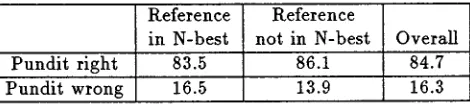
in N-best not in N-best Overall Pundit right 83.5 86.1 84.7 Pundit wrong 16.5 13.9 16.3
Table 4: PUNDIT's performance on Test Set 2 (10 speak- ers, 496 q u e r y / r e s p o n s e pairs), depending on whether or not reference query occurred in N-best (N=100).
Over and above these s u m m a r y scores, we wished to investigate the performance of P U N D I T depending on the state of affairs in the N-best. For example, we looked at what P U N D I T did when the reference query occurrs in the N-best and when it does not. If the reference query
[image:4.612.138.487.48.99.2] [image:4.612.322.563.430.483.2] [image:4.612.326.561.568.620.2]W / PUNDIT as filter W / O PUNDIT as filter
Word Accuracy Sentence Correct Error Accuracy
77.5 29.1 33.7
74.1 33.4 20.8
Application Accuracy Correct False Alarm
51.6 9.3 28.0 2.2
Table 2: Word, sentence and application accuracy with and without PUNDIT filter for Test Set 2 (10 speakers, 496 q u e r y / r e s p o n s e pairs), PUNDIT interpreting the utterance in all cases)
occurs in the N-best then the right thing for the natural language system to do is to find it, or find a semantically equivalent candidate, and give a correct answer. On the other hand, if the reference query is not in the N-best, then the right thing to do is either to find a semantically equivalent candidate and give a correct answer, or to reject all candidates. Table 3 shows how often PUNDIT
did the right thing, by these criteria, for Test Set 1 with N=40, and Table 4 shows similar results for Test Set 2 with N=100.
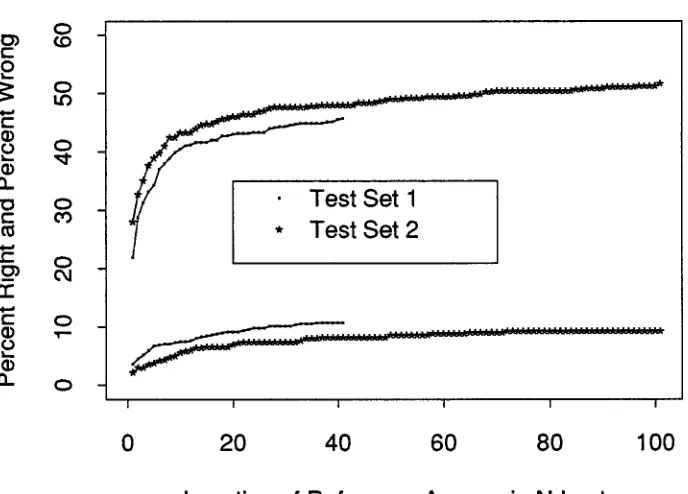
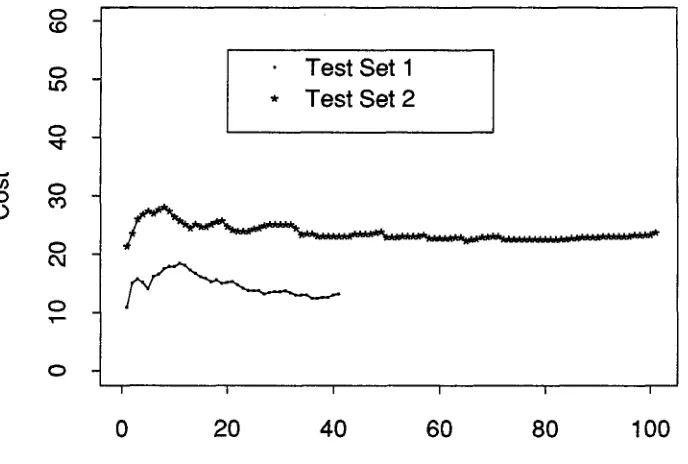
We were also interested in looking at the performance of the system as a function of the location of the refer- ence answer in the N-best. This bears on the question of what the optimal setting is for N. Intuitively, looking at more candidates increases the probability t h a t the ref- erence utterance or a semantic equivalent will be found, but at the same time it increases the probability of a false alarm, with the natural language system finding an acceptable candidate t h a t differs semantically from the reference utterance in crucial ways. If we could quantify the relationships among N, the rate of correct responses, and the false a l a r m rate, it would give us a technique for setting N for optimal accuracy of the spoken language system, given a particular speech recognizer and a par- ticular language understanding component. 2 In Figure 2, we show the cumulative correct answers and the cu- mulative false alarms as a function of the location of the reference utterance in the direction finding d a t a from Test Set 1 and Test Set 2. In order to determine the o p t i m a l setting of N for the SUMMIT/PUNDIT system, we looked at the difference between the cumulative correct responses and false alarms as a function of the location of the reference utterance in the N-best. Figure 3 shows this difference, assuming t h a t correct responses and false alarms have an equal weighting. Obviously they do not have an equal weighting in general. In fact, in most applications false alarms should probably be heavily pe- nalized. If we weight the cost of a false alarm at three times the benefit of a correct response, then the optimal performance of this system is obtained with N = 10 for Test Set 1 and N = 11 for Test Set 2. T h a t is, if the answer is not found in the top 10-11 candidates, the cost of false alarms exceeds the benefit of increased correct responses.
C o n c l u s i o n s
This paper has described several approaches to training and evaluation of spoken language systems. In the area of training we described an a p p r o a c h to measuring the performance of the system on previously unseen d a t a as increasing a m o u n t s of training d a t a are used. This ex- periment d e m o n s t r a t e d t h a t a level of 70 % coverage of unseen d a t a was reached after the system was trained on 1000 sentences. We also described how a general, broad coverage g r a m m a r and lexicon can be a u t o m a t i - cally pruned to fit a specific application, thus saving the effort involved in building g r a m m a r s from scratch for each application.
We also described several approaches to evaluation. We used the system as a tool to evaluate alternative algorithms for reference resolution, and we also evalu- ated the entire system on word, sentence, and applica- tion accuracy. Application accuracy was evaluated using a black box technique with evaluators who were not sys- t e m developers. We found t h a t the evaluators used in this task were relatively reliable, and we expect t h a t im- p r o v e m e n t s in training and instructions would improve the reliability. Overall application accuracy for the test d a t a was 51.6 %. Separating the performance o f P U N D I T
from t h a t of the entire spoken language system, we found t h a t PUNDIT did the "right thing" 84.7 % of the time for the test data. Finally we d e m o n s t r a t e d a new technique for determining the o p t i m a l setting of N for the N-best o u t p u t from the speech recognizer in a loosely coupled system, for a given speech recognizer, language under- standing system, and application.
R e f e r e n c e s
[1] Catherine N. Ball, Deborah Dahl, Lewis M. Nor- ton, Lynette Hirschman, Carl Weir, and Marcia Linebarger. Answers and questions: Processing messages and queries. In Proceedings of the DARPA Speech and Natural Language Workshop, Cape Cod, MA, October 1989.
[2]
2 T h i s leaves o u t a n o t h e r i m p o r t a n t c o m p o n e n t off o p t i m a l N, of
course, w h i c h is t i m e , since t~ larger N w o u l d normM.ly be e x p e c t e d [3] to r e s u l t in i n c r e a s e d p r o c e s s i n g t i m e .
2 1 6
Susan E. Brennan, Marilyn W. Friedman, and Carl J. Pollard. A centering a p p r o a c h to pronouns. In Proceedings of the 25th Annual Meeting of the Association for Computational Linguistics, pages 155-162, Stanford, CA, 1987.
[image:5.612.136.489.48.98.2]O I ~ ¢.o
c2
"O O
E~
0_ O
Test Set 2
I I I I I I
0
20
40
60
80
100
Location of Reference Answer in N-best
Figure 2: Percent right and percent false alarm vs. location of reference query in N-best, for Test Set 1 and Test Set 2
Conference on Artificial Intelligence, Philadelphia, [9] PA, August 1986.
[4] Deborah A. Dahl. Evaluation ofpragmatics process- ing in a direction finding domain. In Proceedings of the FiSh Rocky Mountain Conference on Artificial Intelligence, Las Cruces, New Mexico, 1990.
[10] [5] Deborah A. Dahl and Catherine N. Ball. Refer-
ence resolution in PUNDIT. In P. Saint-Dizier and S. Szpakowicz, editors, Logic and logic grammars for language processing. Elfis I-Iorwood Limited, in press.
[6] Michael Freeman, Lynette Hirschman, Donald [11] McKay, and Martha Palmer. KNET: A logic-based associative network framework for expert systems. Technical Memo 12, SDC--A Burroughs Company, P.O. Box 517, Paoli, PA 19301, September 1983. [12]
[7] Barbara Grosz, Aravind K. Joshi, and Scott Wein- stein. Providing a unified account of definite noun phrases in discourse. Proceedings of the ~lst An- nual Meeting of the Association for Computational Linguistics, pages 44-50, 1983.
[8] Barbara J. Grosz, Aravind K. Joshi, and Scott We- [13] instein. Towards a computational theory of dis- course interpretation, unpubhshed mss., 1986.
217
Lynette Hirschman, Martha Palmer, John Dowd- ing, Deborah Dahl, Marcia Linebarger, Rebecca Passonneau, Frangois-Michel Lang, Catherine Ball, and Carl Weir. The PUNDIT natural-language pro- cessing system. In A I Systems in Government Con- ference. Computer Society of the IEEE, March 1989.
Lynette Hirschman and Karl Puder. Restriction grammar in prolog. In Proceedings of the First In- ternational Logic Programming Conference, pages 85-90. Association pour la Diffusion et le Devel- oppement de Prolog, Marseilles, 1982.
Megumi Kameyama. Zero Anaphova: The Case of Japanese. PhD thesis, Stanford University, Stan- ford, CA, 1985.
Lewis M. Norton, Deborah A. Dahl, Donald P. McKay, Lynette Hirschman, Marcia C. Linebarger, David Magerman, and Catherine N. Ball. Manage- ment and evaluation of interactive dialog in the air travel domain. In Proceedings of the Darpa Speech and Language Workshop, Hidden Valley, PA, June 1990.
[image:6.612.127.471.38.285.2]O CD
O i..D
O
(n O
O 03
o
O
O,.I
O
~r~
O
Test Set 1
*
Test Set 2
I i I I I I
0
20
40
60
80
100
Location of Reference Answer in N-best
Figure 3: Percent right - percent false alarm vs. location of reference query in N-best, for Test Set 1 and Test Set 2
[14] Stephanie Seneff. Tina: a probabilistic syntactic parser for speech understanding systems. In Pro- ceedings of the First DARPA Speech and Natural Language Workshop, Philadelphia, PA, February 1989.
[15] C.L. Sidner. Towards a computational theory of def- inite anaphora comprehension in English discourse. PhD thesis, MIT, 1979.
[16] B. J. Winer. Statistical Principles in Ezperimental Design. McGraw-Hill Book Company, New York, 1971.
[17] Victor Zue, Nancy Daly, James Glass, David Good- ine, Hong Leung, Michael Phillips, Joseph Polifroni, Stephanie Seneff, and Michal Soclof. The collection and preliminary analysis of a spontaneous speech database. In Proceedings of the DARPA Speech and Natural Language Workshop, Cape Cod, MA, Oc- tober 1989.
[18] Victor Zue, James Glass, David Goodine, Hong Leung, Michael Phillips, Joseph Polifroni, and Stephanie Seneff. The VOYAGER speech understand- ing system: A progress report. In Proceedings of the DARPA Speech and Natural Language Workshop, Cape Cod, MA, October 1989.
[19] Victor Zue, James Glass, David Goodine, Hong Leung, Michael Phillips, Joseph Polifroni, and
[20]
218
Stephanie Seneff. Preliminary evaluation of the voy- ager spoken language system. In Proceedings of the DARPA Speech and Natural Language Workshop, Cape Cod, MA, October 1989.
Victor Zue, James Glass, Michael Phillips, and Stephanie Seneff. The MIT SUMMIT speech recog- nition system: A progress report. In Proceedings of the First DARPA Speech and Natural Language
[image:7.612.130.474.45.277.2]