Probabilistic named entity verification
Yi-Chung Lin and Peng-Hsiang Hung
Advanced Technology Center, Computer and Communications Laboratories, Industrial Technology Research Institute, Taiwan
{lyc,phhung}@itri.org.tw
Abstract
Named entity (NE) recognition is an impor-tant task for many natural language applica-tions, such as Internet search engines, document indexing, information extraction and machine translation. Moreover, in ori-ental languages (such as Chinese, Japanese and Korean), NE recognition is even more important because it significantly affects the performance of word segmentation, the most fundamental task for understanding the texts in oriental languages. In this paper, a prob-abilistic verification model is designed for verifying the correctness of a named entity candidate. This model assesses the confi-dence level of a candidate not only accord-ing to the candidate’s structure but also ac-cording to its context. In our design, the clues for confidence measurement are col-lected from both positive and negative ex-amples in the training data in a statistical manner. Experimental results show that the proposed method significantly improves the F-measure of Chinese personal name recog-nition from 86.5% to 94.4%.
Introduction
Named entity (NE) recognition (or proper name recognition) is a task to find the entities of per-son, location, organization, date, time, percent-age and monetary value in text documents. It is an important task for many natural language applications, such as Internet search engines, document indexing, information extraction and machine translation. Moreover, in oriental lan-guages (such as Chinese, Japanese and Korean), NE recognition is even more important because it significantly affects the performance of word segmentation, the most fundamental task for
understanding the texts in oriental languages. Therefore, a high-accuracy NE recognition method is highly demanded for most natural language applications in various languages.
There are two major approaches to NE recognition: the handcrafted approach (Grish-man, 1995) and the statistical approach (Bikel, 1997; Chen, 1998; Yu, 1998). In the first ap-proach, a system usually relies on a large num-ber of handcrafted rules. This kind of systems can be rapid prototyped but are hard to scale up. In fact, there will be numerous exceptions for most handcrafted rules. It is generally expensive and impossible to code for every exception we can imagine, not to mention those exceptions we are not able to think of. Another serious problem with the handcrafted approach is that systems are hard to be ported across different domains and different languages. Porting a handcrafted system usually means rewriting all its rules. Therefore, the statistical approach is becoming more and more popular because of its cost-effectiveness in scaling up and porting systems.
one. The scores obtained from the statistical model can be used for a comparison of compet-ing token sequences, but not for an assessment of the probability that a spotted named entity is correct.
To reduce the recognition errors, we pro-pose a probabilistic verification model to verify the correctness of a named entity. This model assesses the confidence level of a named entity candidate not only according to the candidate’s structure but also according to its contexts. In our design, the clues for confidence measure-ment are collected from both positive and nega-tive examples in the training data. Therefore, the confidence measure has strong discriminant power for judging the correctness of a named entity. In the experiments of Chinese personal name recognition, the proposed verification model increases the F-measure from 86.5% to 94.4%, which corresponds to 58.5% error re-duction rate, where “error rate” is defined as “100%−F-measure”.
1. Named Entity Verification
As mentioned before, there are several kinds of named entities, including person, location, or-ganization, date, time, percentage and monetary value. In the following description, we use the task of verifying Chinese personal name as an example. However, our proposed method is also applicable on verifying other kinds of named entities in different languages.
Before introducing our approach, we first describe the notations that will be used. In this proposal, a random variable is written with a boldface italic letter. An outcome of a random variable is written with the same italic letter but in normal face. For example, an outcome of the random variable o is denoted as o . If there is no confusion, we usually use P o( ) to denote the probability P(o=o). A symbol sequence “x1,",xn” is denoted as “x1n”. Likewise, “ ,
,1
Y n Y
x ” denotes the sequence “xY,1,",xY n, ”.
The task of verifying a named entity can-didate is viewed as making an acceptance or rejection decision according to the text segment consisting of the candidate and its context. Without loss of generality, a text segment is
considered as an outcome of the random vector
, , , ,1 ,1 ,1
[ LL x, CC y, RR z]
=
O o o o . The outcome of each ran-dom variable in O is one basic element of text. In Chinese, the basic elements of text are Chine-se characters. However, in English, the basic elements are English words. Figure 1 shows an example of a text segment in which the size of the candidate to be verified is 3 (i.e., consists of three Chinese characters) and the sizes of its left context and right context are set to 2 (i.e., two Chinese characters).
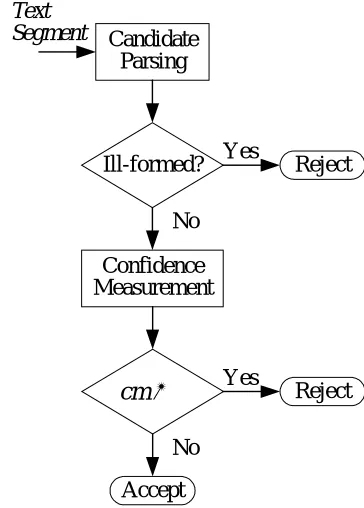
Figure 2 depicts the flowchart of our veri-fication approach. First, the candidate in the input text segment is parsed by a predefined grammar. If the candidate is ill-formed (i.e., fail
Figure 1: Example of a text segment.
Candidate Parsing
Confidence Measurement
Ill-formed? Yes Reject
No
cm<
δ
Yes Reject NoAccept Text
Segment
Figure 2: Flowchart of the verification method.
shi
,1
L o
zhang ma ying jiu biao shi
,2
L
o oC,1 oC,2 oC,3 oR,1 oR,2
Left Context Right Context
to be parsed), it will be rejected immediately. Otherwise, the text segment is passed to the confidence measurement module to assess the confidence level that the candidate in the text segment is to be a named entity. If the confi-dence measure is less than a predefined thresh-old, the candidate will be rejected. Otherwise, it will be accepted.
2. Confidence Measurement
The basic idea of our approach is to formulate the confidence measurement problem as the problem of hypothesis testing. The null hypothe-sis H0 in which the candidate is a name is tested against the alternative hypothesis H1 in which the candidate is not a name. According to Neyman-Pearson Lemma, an optimal hypothesis test involves the evaluation of the following log likelihood ratio: the candidate and its left and right contexts given the hypothesis that the candidate is a name
and , , ,
,1 ,1 ,1 1
( L x, C y, R z| )
L C R
P o o o H is the likelihood of the candidate and its left and right contexts given the hypothesis that the candidate is not a name. The hypothesis test is performed by
com-paring the log likelihood ratio
, , , ,1 ,1 ,1
( L x, C y, R z)
L C R
LLR o o o to a predefined critical
threshold δ . If , , ,
,1 ,1 ,1
( L x, C y, R z)
L C R
LLR o o o ≥δ , the null hypothesis will be accepted. Otherwise, it will be rejected.
In our design, as shown in Figure 3, the confidence measurement module consists of two models, named NE model and anti-NE model. The NE model is used to assess the value of
, , , ,1 ,1 ,1 0
log (P oLL x,oCC y,oRR z|H ) and the anti-NE model
is used to assess the value of
, , , ,1 ,1 ,1 1
log (P oLL x,oCC y,oRR z|H ).
2.1. NE Model
The purpose of the NE model is to evaluate the
value of , , ,
,1 ,1 ,1 0
log ( L x, C y, R z | )
L C R
P o o o H , the log like-lihood of the candidate and its left and right contexts given the hypothesis that the candidate is a name. Since it is infeasible to directly esti-mate the probability , , ,
,1 ,1 ,1 0
where the subscript of P0( )⋅ indicates the prob-ability is evaluated given that the null hypothesis is true. The probability ,
0( ,1)
L x L
P o is further ap-proximated according to the bigram model as follows: that we do not assume that the random sequence
, ,1
L x L
o is time invariant. For example, the
prob-ability P(oL i, =x|oL i, 1− = y) is not assumed to be equal to P(oL,2 =x|oL,1= y) for i≥3. Likewise, the probability P o0( R zR,1, ) is also fur-ther approximated as follows:
,
The probability corresponding to the can-didate is evaluated by applying the SCFG
(Sto-NE
( )
chastic Context-free Grammar) model (Fujisaki,
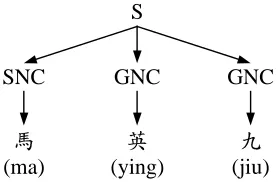
where T stands for one possible parse tree that derive the candidate, A→α indicates a rule in the parse tree T , A stands for the left-hand-side symbol of the rule and α stands for the sequence of right-hand-side symbols of the rule. Figure 4 shows an example of a parse tree of the Chinese personal name candidate “(ma ying jiu)”, where “(ma)” is the surname and “(ying jiu)” is the given name. In this figure, the symbol “S” denotes the start symbol, the symbol “SNG” denotes the nonterminal deriving surname characters and the symbol “GNC” denotes the nonterminal deriving given name characters. As a result, according to equations (2) -(5), the scoring function in the NE model is defined as equation (6) to assess the log likeli-hood of the text segment “oLL x,1, ,oCC y,1, ,oRR z,1, ” given
where T is one possible parse tree that derive
the candidate “oCC y,1, ”.
2.2. Anti-NE Model
The purpose of the anti-NE model is to evaluate
the value of , , ,
,1 ,1 ,1 1
log ( L x, C y, R z| )
L C R
P o o o H , the log
likelihood of the candidate and its left and right contexts given the hypothesis that the candidate is not a name. Since it is infeasible to directly estimate the probability P o( LL x,1, ,oC yC,1, ,oRR z,1, |H1), it is approximated as follows:
, , , , , ,
≡ . Therefore, the following scoring function is used in the anti-NE model to assess the log likelihood of the text segment
“ , , ,
,1, ,1, ,1
L x C y R z
L C R
o o o ” given the alternative hypothesis that “ ,
The proposed named entity verification method is used to recognize Chinese personal names from news. In Chinese, most of the personal names consist of three Chinese characters. The first character is a surname. The last two char-acters are a given name. Therefore, our prelimi-nary experiments are focused on recognizing the personal names of three Chinese characters.
In our experiments, the training corpus consists of about 14,339,000 Chinese characters collected from economy and industry news. This corpus should be annotated to estimate the prob-abilistic parameters of the scoring functions
NE( )
S ⋅ and Santi-NE( )⋅ . However, labeling such large amount of data is too costly or prohibited even if it is possible. Therefore, labeling
methods that can be bootstrapped from a little seed data or a few seed rules (Collins, 1999; Cucerzan, 1999) are highly demanded to auto-matically annotate the training data. In the fol-lowing section, we propose an EM-style boot-strapping procedure (Cucerzan, 1999) for anno-tating the training data automatically.
3.1. EM-Style Bootstrapping
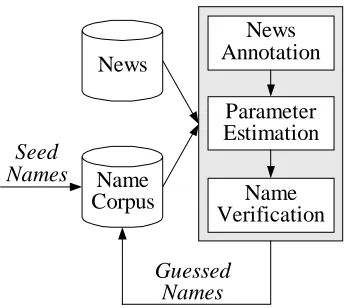
The Expectation-Maximization (EM) algorithm (Moon, 1996) has been widely used to estimate model parameters from incomplete data in many different applications. In this section, an EM-style bootstrapping procedure is proposed to automatically annotate the named entities in the training corpus. It iteratively uses the proposed verification model to label the training corpus (expectation step), and then uses the labeled training corpus to re-estimate the parameters of the verification model (maximization step). Figure 5 shows the flowchart of the bootstrap-ping procedure. First, we collect the names of 541 famous people, including government offi-cers and CEOs of big companies. These names are used as seed names of the name corpus. Then, the news is automatically annotated ac-cording to the name corpus. The annotated cor-pus is used to estimate the probabilistic parameters of the scoring functions. Afterward, the proposed verification procedure is used to verify every possible name candidate in the news. The candidates whose confidence meas-ures are larger than a predefined threshold are determined to be names. Currently, if the
confi-dence measures of two overlapped candidates (such as “ma ying jiu” and “ying jiu biao” in Figure 1) pass the threshold, both of them are determined as names. Although this strategy is inadequate, it does not make too much trouble because the chance to get overlapped names is very small in our experiments. Finally, these guessed names are added to the name corpus which will be used to annotate the news in next iteration.
In our case, after four iterations, the size of name corpus is enlarged from 541 to 6,296, as shown in Table 1. The total occurrence frequen-cy of these 6,296 names in the training corpus is 40,345.
3.2. Baseline Model
In the past, many researchers have studied the problem of Chinese personal name recognition. Chang (1994) used the 0-order Markov model to segment a text into words, including Chinese personal names. In his approach, a name ability model is proposed to estimate the prob-abilities of Chinese personal names. Sproat (1994) proposed to recognize Chinese personal names with the stochastic finite-state word seg-mentation algorithm. His approach is similar to Chang’s, except that the name probability model is slightly different. In addition to name prob-ability, Chen (1998) also add extra scores to a name candidate according to context clues (such as position, title, speech-act verbs). In the re-searches mentioned above, the reported F-measure performances on recognizing Chinese personal names are somewhere between 70% and 86%. Since these performances are meas-News
Name
Corpus Name
Verification
Guessed Names Seed
Names
News Annotation
Parameter Estimation
Figure 5: EM-style bootstrapping.
Iteration Nunber of distinct names
Total frequency of names
0 541 18310
1 3389 31157
2 5327 37423
3 6055 39977
4 6296 40345
ured based on different data, higher reported performance does not imply better. In fact, the name probability models used in these re-searches are very similar. Their performances should be comparable to each other. Therefore, in this paper, Chang’s approach, whose reported F-measure is 86%, is chosen as the baseline model.
The baseline model is additionally equipped with a dictionary of 72,333 Chinese words. The prior probabilities of words are esti-mated from Academia Sinica Balanced Corpus, which contains about 2 million Chinese words.
4. Experimental Results and Discussions
Both the baseline model and the proposed name entity verification model (named NEV model) are tested on the same testing corpus. The testing corpus, also collected from economy and indus-try news, consists of about 737,000 characters. This corpus is annotated manually and contains totally 2,545 Chinese personal names.
The F-measure of the baseline model is 86.5% (as indicated by the dashed line in Figure 6). The precision and recall rates of the baseline model are 79.1% and 95.5% respectively. Alt-hough the recall rate of the baseline model is high, the precision rate is pretty low. Over 20% of the name candidates proposed by the baseline model are incorrect.
In our experiments, the sizes of the left-and right-context windows of the NEV model
are set to 2. In Figure 6, the solid line with trian-gle markers depicts the F-measure of the NEV model versus the iteration number of bootstrap-ping. The F-measure saturates after 3 iterations. After 4 iterations, the F-measure of the NEV model reaches 94.4%. The corresponding preci-sion and recall rates are 96.4% and 92.5% re-spectively. Compared with the baseline model, the precision rate is greatly improved from 79.1% to 96.4% with a little sacrifice in recall rate. The F-measure is improved from 86.5% to 94.4%, which corresponds to 58.5% error re-duction rate, where “error rate” is defined as “100%−F-measure”.
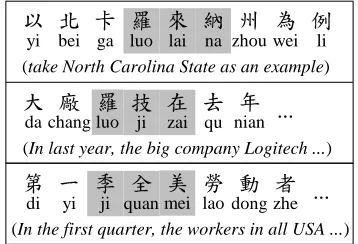
Table 2 lists three examples of the mis-recognized names made by the baseline model. These examples clearly show that the baseline model tends to incorrectly group consecutive single characters, either from unknown words or single-character words, into names. In the first two examples, the single characters come from the unknown location name “(ga luo lai na; Carolina) and the unknown company name “(luo ji; Logitech)”. The single char-acters in the last example are single-character words “ (gi; quarter)”, “(quan; all)” and “ (mei; USA)”.
Without the inadequate strong tendency of grouping single characters, the NEV model is able to avoid the misrecognition errors made by the baseline model. The NEV model assesses the confidence measure of each name candidate according to the context around the candidate. In Table 2, the name candidates in the shaded boxes are rejected by the NEV model because
0 1 2 3 4
0.85 0.90 0.95 1.00
Iteration
F−measure
NEV Baseline
Figure 6: The performances of baseline and name entity verification (NEV).
dachang luo ji zai qu nian ... (In last year, the big company Logitech ...)
dong
di yi ji quan mei lao zhe ... (In the first quarter, the workers in all USA ...)
bei ga luo lai na zhou wei li
yi
(take North Carolina State as an example)
their confidence measures are too low.
To sum up, the experimental results de-monstrate that the contextual information, either from positive examples or from negative exam-ples, is very helpful for named entity verification. Besides, the superiority of the NEV model also shows that the proposed probabilistic score functions SNE( )⋅ and Santi-NE( )⋅ are effective in providing the scores to produce a reliable confi-dence measure. Especially, the proposed named entity verification approach does not require any dictionary in advance.
Conclusion
Named entity (NE) recognition is an important task for many natural language applications, such as Internet search engines, document in-dexing, information extraction and machine translation. Moreover, in oriental languages (such as Chinese, Japanese and Korean), NE recognition is even more important because it significantly affects the performance of word segmentation, the most fundamental task for understanding the texts in oriental languages.
In this paper, a probabilistic verification model is proposed to verify the correctness of a named entity. This model assesses the confi-dence level of a name candidate not only ac-cording to the candidate’s structure but also according to its contexts. The clues for confi-dence measurement are collected from both positive and negative examples in the training data. Therefore, the confidence measure has strong discriminant power for judging the cor-rectness of a named entity. In the experiments of Chinese personal name recognition, the pro-posed verification model greatly increases the precision rate from 79.1% to 96.4% with a little sacrifice in recall rate. The F-measure is im-proved from 86.5% to 94.4%, which corre-sponds to 58.5% error reduction rate, where “error rate” is defined as “100%−F-measure”.
Acknowledgements
This paper is a partial result of Project A311XS1211 conducted by ITRI under sponsor-ship of the Ministry of Economic Affairs, R.O.C. Especially thanks to the CKIP group of
Acade-mia Sinica for providing the AcadeAcade-mia Sinica Balanced Corpus.
References
Bikel, D., Miller S., Schwartz R., and Weischedel R. (1997) Nymble: A High-performance Learning Name Finder. In Proceedings of the Fifth Confer-ence on Applied Natural Language Processing, pp. 194–201.
Borthwick, A. (1999) A Maximum Entropy Approach to Named Entity Recognition. Ph.D. Thesis, New York University.
Chang J., Chen S., Ker S., Chen Y. and Liu J. (1994) A Multiple-Corpus Approach to Recognition of Proper Names in Chinese Texts. Computer Proc-essing of Chinese and Oriental Languages, Vol. 8, No. 1, pp. 75-85.
Chen, H., Ding Y., Tsai S. and Bian G. (1998) De-scription of the NTU System used for MET2. in Proceedings of the 7th Message Understanding Conference (MUC-7)
Collins, M. and Singer, Y. (1999) Unsupervised Models for Named Entity Classification. In Pro-ceedings of the Joint SIGDAT Conference on Em-pirical Methods in Natural Language Processing and Very Large Corpora, pp. 100-110.
Cucerzan S. and Yarowsky D. (1999) Language independent named entity recognition combining morphological and contextual evidence. In Pro-ceedings of the Joint SIGDAT Conference on Em-pirical Methods in Natural Language Processing and Very Large Corpora, pp. 90-99.
Fujisaki, T., Jelinek F., Cocke J., Black E. and Nishi-no T. (1989), A Probabilistic Parsing Method for Sentence Disambiguation. In Proceedings of the International Workshop on Parsing Technologies, pp. 85-94.
Grishman, R. (1995) The NYU system for MUC-6 or where's the syntax? In Proceedings of the 6th Mes-sage Understanding Conference (MUC-6), pp. 167-175.
Moon, T. K. (1996) The Expectation-Maximization Algorithm, IEEE Signal Processing Magazine, No-vember, 1996, pp. 47-60.
Sproat R. and Chang N. (1994) A Stochastic Finite-State Word-Segmentation Algorithm for Chinese. In Proceeding of 32nd Annual Meeting of the As-sociation for Computational Linguistics, pp. 66-73.