Open Access
Research
Different rates of (non-)synonymous mutations in astrovirus genes;
correlation with gene function
Formijn J van Hemert, Vladimir V Lukashov* and Ben Berkhout
Address: Laboratory of Experimental Virology, Department of Medical Microbiology, Center for Infection and Immunity Amsterdam (CINIMA), Academic Medical Center, University of Amsterdam, The Netherlands
Email: Formijn J van Hemert - [email protected]; Vladimir V Lukashov* - [email protected]; Ben Berkhout - [email protected]
* Corresponding author
Abstract
Background: Complete genome sequences of the Astroviridae include human, non-human mammalian and avian species. A consensus topology of astroviruses has been derived from nucleotide substitutions in the full-length genomes and from non-synonymous nucleotide substitutions in each of the three ORFs. Analyses of synonymous substitutions displayed a loss of tree structure, suggesting either saturation of the substitution model or a deviant pattern of synonymous substitutions in certain virus species.
Results: We analyzed the complete Astroviridae family for the inference of adaptive molecular evolution at sites and in branches. High rates of synonymous mutations are observed among the non-human virus species. Deviant patterns of synonymous substitutions are found in the capsid structural genes. Purifying selection is a dominant force among all astrovirus genes and only few codon sites showed values for the dN/dS ratio that may indicate site-specific molecular adaptation during virus evolution. One of these sites is the glycine residue of a RGD motif in ORF2 of human astrovirus serotype 1. RGD or similar integrin recognition motifs are present in nearly all astrovirus species.
Conclusion: Phylogenetic analysis directed by maximum likelihood approximation allows the inclusion of significantly more evolutionary history and thereby, improves the estimation of dN and dS. Sites with enhanced values for dN/dS are prominent at domains in charge of environmental communication (f.i. VP27 and domain 4 in ORF1a) more than at domains dedicated to intrinsic virus functions (f.i. VP34 and ORF1b (the virus polymerase)). Integrin recognition may play a key role in astrovirus to target cell attachment.
Background
Human astrovirus has been recognized as the second most common cause of diarrhoea among children under 5 years old [1]. In animal and bird farms, an astrovirus infection is fatal for a considerable part of the livestock [2,3]. The family of Astroviridae is divided in two genera:
Mamastrovirus (mammalian astroviruses) and Avastrovirus
(avian astroviruses). The pathogen is a non-enveloped vir-ion with a single-stranded, positive-sense RNA of approx-imately 6.8 kb in size [4]. The virus genome contains three open reading frames designated ORF1a (2.8 kb), ORF1b (1.6 kb) and ORF2 (2.4 kb). Translation of ORF1b Published: 7 March 2007
Virology Journal 2007, 4:25 doi:10.1186/1743-422X-4-25
Received: 11 January 2007 Accepted: 7 March 2007
This article is available from: http://www.virologyj.com/content/4/1/25
© 2007 van Hemert et al; licensee BioMed Central Ltd.
depends on translation of ORF1a by a ribosomal frame-shift mechanism [5]. The primary translation products are processed into the virus protease (ORF1a) and the virus polymerase (ORF1b). ORF2 encodes a structural protein that is intracellularly processed at the C-terminal part by caspase protease, by which genome packaging and virus particle release is promoted [6]. As part of the released virus particle, ORF2 protein is processed further by trypsin to acquire the mature capsid proteins VP34 and VP27/25, a process accompanied by a considerable increase of virus infectivity [7]. Consensus on the post-translational processing routes of ORF1a, ORF1b and ORF2 polypro-teins has not yet been attained [8,9].
An inventory of evolutionary relationships among astrovi-ruses has been published confirming the topology that is generally accepted for the astroviruses and pointing to a strong selection against non-synonymous substitutions [10]. Phylogenetic analyses based solely on the synony-mous substitutions resulted in loss of tree structure due to the shortening of specific ancestral branches in trees of all ORFs. Avian, sheep, and human virus species appeared to be virtually equidistant in these trees. Such a loss of tree structure or tree compression may be interpreted either as the result of saturation of synonymous substitutions or to a peculiar pattern of synonymous substitutions that is typ-ical for specific members of the astrovirus family. To address this issue, we analyze the astrovirus genes by means of nucleotide substitution models based on maxi-mum likelihood approximation because these models are better suited for the estimation of mutational rates in highly divergent genes than models relying on the Jukes-Cantor correction for multiple hits at the same site.
Phylogenetic analysis by maximum likelihood (PAML3.14) [11] offers a set of sophisticated models to assess the extent of (non-) synonymous substitutions in genes. The current status of the PAML programs displays a profound documentation for the inference of sites and branches prone to molecular adaptation and is supported by validated statistics [12-14]. For instance, adaptive evo-lution is observed in the hemagglutinin gene of human influenza virus type A [15].
Applying PAML to the genes of the complete astrovirus family, we show that tree compression (shortening of ancestral branches) can be ascribed to deviant rates of syn-onymous mutation at discrete regions of ORF2 in certain astrovirus species. Tree compression is absent in ORF1a and ORF1b as revealed by PAML due to its ability to include more evolutionary history. Sites that tend to escape from purifying selection correlate to protein domains dedicated to environmental communication rather than to replication and assembly of the virus. Finally, we propose that integrin recognition of ORF2
domains plays a key role in the process of cell binding by astrovirus.
Results
(Non-) synonymous substitutions in astrovirus genes: branch models
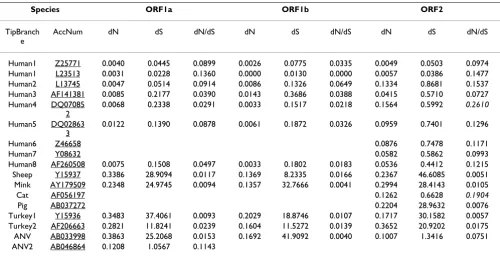
The values for dN/dS of the branch model applied to the astrovirus ORFs are all far below the value of 1 (Table 1), by convention considered as the lower limit for positive selection. In fact, dN/dS values do not exceed 0.16, except for ORF2 in the cat and human4 isolates (0.1904 and
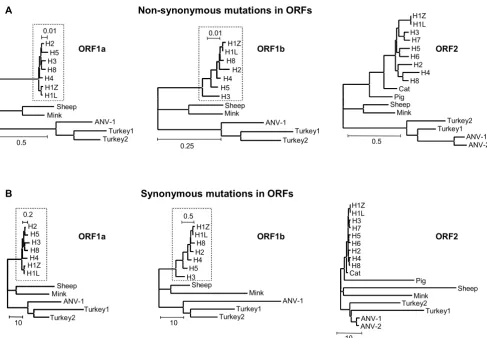
0.2610, respectively). Obviously, purifying selection is very dominant in branches specifying astrovirus species. The individual values of dN and dS may be more easily interpreted in a tree format (Fig 1) than as raw data in a table. Unrooted dN and dS trees are part of PAML's output and have been constructed by pasting the dN and dS val-ues from Table 1 as branch length onto the amino acid tree topology supplied to PAML as input tree file.
The dN trees of the three ORFs (Fig 1A) are in close agree-ment with the widely accepted astrovirus phylogeny [10,16-21]. The ORFs evolve independently and muta-tional rates are lower in ORF1b than in ORF1a or ORF2 as indicated by the different scale bars. Also, the relative lengths of the individual branches mimic those in trees inferred by other means. For instance, the sequence of ORF2 in human astrovirus serotype 4 is known as the most distant among the human ORF2 sequences [19]. Apparently, the alignment attained by the multi-step MUSCLE procedure (see Materials & Methods) displayed an average accuracy and is at least as good as more labori-ous ClustalW based protocols, despite the sequence diver-sity typical for the astrovirus data set.
Synonymous rates of mutation in astrovirus genes differ from non-synonymous mutational rates by as much as one to two orders of magnitude as indicated by the dN/dS ratio in Table 1 and the scale bars in Fig 1B. Nevertheless, dS trees of ORF1a and ORF1b based on synonymous sub-stitutions are close to the corresponding trees derived from non-synonymous substitutions or amino acid replacements. Loss of tree structure [10] or tree compres-sion caused by the virtual disappearance of ancestral branches can hardly be observed illustrating the power of the substitution model to incorporate multiple hits at the same site. In contrast, loss of tree structure and shortening of ancestral branches is observed in the dS tree of ORF2 and appears to be due to enhanced accumulation of syn-onymous substitutions in ORF2 sequences of the astrovi-ruses of pig, sheep, mink and turkey compared to viastrovi-ruses in humans, cats and both avian nephritis viruses.
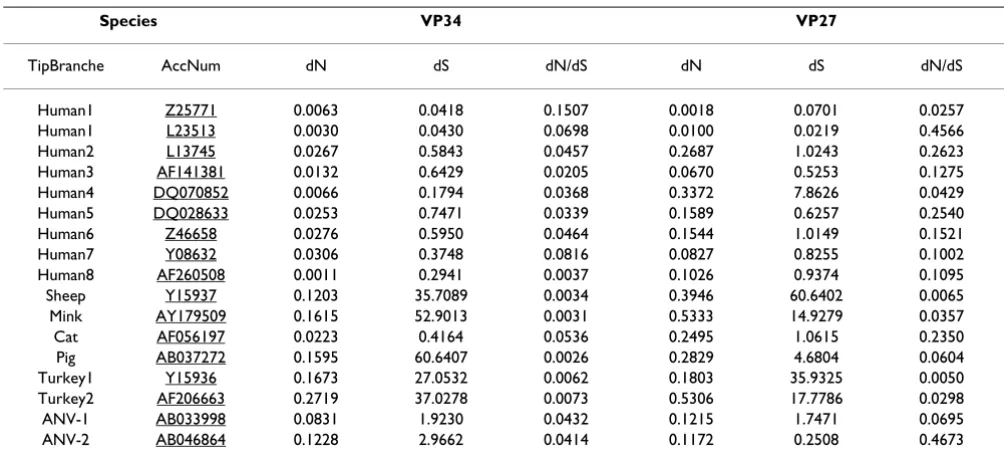
synon-ymous substitutions. To test this, the ORF2 alignment was divided in two portions based on the cleavage by trypsin. VP34 is slightly more conserved than VP27, but most ORF2 values are close to the average of the corresponding values for VP34 and VP27 (Table 2). Indeed, dN trees of VP34 and VP27 (not shown) are nicely deep-rooted and nearly identical to the dN tree of the complete ORF2 (Fig 1A). By contrast, dS values of sheep virus capsids increase from 36.5 in VP34 to 64.4 in VP27, while these values decrease from 53.3 to 12.3 in mink. In pig, the difference is even more dramatic, 60.6 in VP34 and only 4.8 in VP27. Both turkey isolates exchange their dS values of about 20 and 33 for VP34 and VP27, respectively. Trees with values for synonymous substitutions pasted as branch lengths onto the same topology more clearly show the species-specific differences in synonymous mutational rates between VP34 and VP27 (Fig 2). With respect to VP34, tree compression is due to high values of dS in pig, sheep, mink and turkey, similar to the results for ORF2. In the dS tree of VP27, however, the sheep virus and to a lesser extent both turkey viruses are responsible for tree com-pression. The viruses of pig and mink are essentially con-forming the human, feline and avian viruses. Apparently, the VP34 and VP27 domains tolerate considerable differ-ences with respect to the extent of synonymous muta-tional rates as estimated by means of PAML. Similar to ORF1a and ORF1b, the domains VP34 and VP27 of ORF2
display mutually independent patterns of molecular evo-lution.
Currently, it cannot be excluded that even PAML encoun-ters saturation-related problems at high rates of mutation in a properly aligned set of sequences [22]. However, this may only be a partial explanation to the large variation of synonymous mutational rates in adjacent domains of spe-cific astrovirus genes and genomes.
Site models: dN/dS values in relation to domain functions
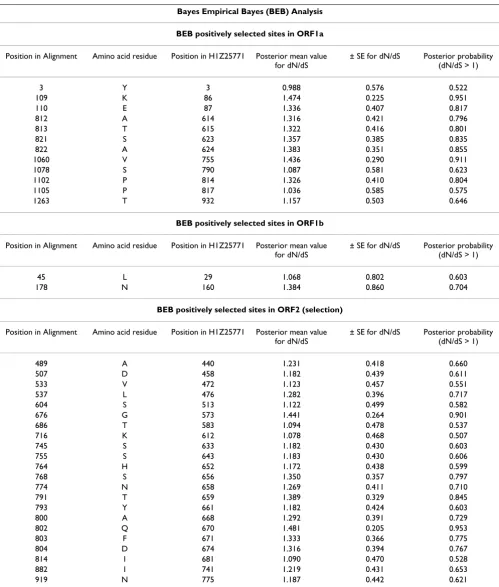
[image:3.612.55.555.99.355.2]Site models of CODEML allow for the estimation of dN/ dS ratios at individual codon sites in an alignment of sequences. Because of the skewed astrovirus population – large distances between the few clades and overrepresen-tation of closely related human virus species – statistical support was taken only from the Bayes-Empirical-Bayes (BEB) output [14]. With respect to ORF2 of the human virus species, we confined the analysis to one virus repre-sentative per human serotype (except for H1). All three ORFs display sites that tend to escape from purifying selection (Table 3). Posterior mean values of dN/dS for BEB-selected sites are between 1 and 1.5 in all ORFs with high standard errors and low posterior probabilities. Con-ventionally, a dN/dS value of 1 marks the transition from neutral evolution to weakly positive selection. BEB-selected sites (dN/dS = 1) are not distributed randomly in Table 1: Values for (non-)synonymous mutational rates and dN/dS ratios in astrovirus genes
Species ORF1a ORF1b ORF2
TipBranch e
AccNum dN dS dN/dS dN dS dN/dS dN dS dN/dS
Human1 Z25771 0.0040 0.0445 0.0899 0.0026 0.0775 0.0335 0.0049 0.0503 0.0974 Human1 L23513 0.0031 0.0228 0.1360 0.0000 0.0130 0.0000 0.0057 0.0386 0.1477 Human2 L13745 0.0047 0.0514 0.0914 0.0086 0.1326 0.0649 0.1334 0.8681 0.1537 Human3 AF141381 0.0085 0.2177 0.0390 0.0143 0.3686 0.0388 0.0415 0.5710 0.0727 Human4 DQ07085
2
0.0068 0.2338 0.0291 0.0033 0.1517 0.0218 0.1564 0.5992 0.2610
Human5 DQ02863 3
0.0122 0.1390 0.0878 0.0061 0.1872 0.0326 0.0959 0.7401 0.1296
Human6 Z46658 0.0876 0.7478 0.1171
Human7 Y08632 0.0582 0.5862 0.0993
Human8 AF260508 0.0075 0.1508 0.0497 0.0033 0.1802 0.0183 0.0536 0.4412 0.1215 Sheep Y15937 0.3386 28.9094 0.0117 0.1369 8.2335 0.0166 0.2367 46.6085 0.0051 Mink AY179509 0.2348 24.9745 0.0094 0.1357 32.7666 0.0041 0.2994 28.4143 0.0105
Cat AF056197 0.1262 0.6628 0.1904
Pig AB037272 0.2204 28.9632 0.0076
Turkey1 Y15936 0.3483 37.4061 0.0093 0.2029 18.8746 0.0107 0.1717 30.1582 0.0057 Turkey2 AF206663 0.2821 11.8241 0.0239 0.1604 11.5272 0.0139 0.3652 20.9202 0.0175 ANV AB033998 0.3863 25.2068 0.0153 0.1692 41.9092 0.0040 0.1007 1.3416 0.0751 ANV2 AB046864 0.1208 1.0567 0.1143
ORF1a and ORF2 but appear to cluster. This is more easily observed when all sites are plotted as a string of local dN/ dS values of the ORF's codons superimposed on a map of virus functions embedded in the ORF as described in lit-erature and/or predicted by servers (Fig 3). In ORF1a (Fig 3A), clusters with relatively high dN/dS values are located around amino acid 620, at position 775, 777 and 812– 817. The 614–624 cluster maps near the N-terminus of the nsp1a-4 domain. The exact position of this N-termi-nus is still under debate, being either T568 or I655 [8,23]. A coiled coil, a nuclear localization signal and a death domain for the induction of cellular apoptosis are found in this region [24]. Also, this part of ORF1a displays enhanced amino acid variability and may be prone to O-glycosylation and phosphorylation. The BEB-selected sites between 775–814 mark the borders of the interspecies
hypervariable region (760–838) that also harbors the peptide that is deleted by cell culture adaptation of the virus [25]. At the C-terminus, the ribosomal frame-shift signal is decorated with a BEB-selected threonine residue next to a predicted motif for retention at the endoplasmic reticulum. As expected from the branch model analysis (see above), sites with dN/dS values less than 0.1 consti-tute a large majority in ORF1a.
[image:4.612.64.551.91.428.2]The dN/dS distribution in ORF1b illustrates the power of purifying selection even more dramatically (Fig 3B). Nearly all sites in the conserved polymerase domain have dN/dS values far below 0.25 to 0.3 being the transition region from purifying selection to neutral evolution. Out-side the conserved domain, but within the virus polymer-ase, the asparagine residue at position 160 shows a PAML trees of non-synonymous (A) and synonymous (B) substitutions in ORF1a (left panel), ORF1b (middle panel) and ORF2 (right panel) of astrovirus
Figure 1
PAML trees of non-synonymous (A) and synonymous (B) substitutions in ORF1a (left panel), ORF1b (middle panel) and ORF2 (right panel) of astrovirus. PAML trees have been constructed by decorating the topology supplied by the input treefile with the branch lengths estimated by means of PAML approximation. The scale bars indicate the relative extent of mutational rates as (non-) synonymous substitutions per (non-) synonymous site corrected for multiple hits at the same site.
0.2 H2
H5 H3 H8 H4 H1Z H1L
Sheep Mink
ANV-1 Turkey1 Turkey2
10
Sheep Mink
ANV-1 Turkey1 Turkey2 0.5
H2 H5 H3 H8 H4 H1Z H1L 0.01
Sheep Mink
ANV-1
Turkey1 Turkey2 0.25
H1Z H1L
H8 H2 H4 H5 H3 0.01
Sheep
Mink
ANV-1 Turkey1
Turkey2 10
H1Z H1L
H8 H2 H4 H5 H3 0.5
H1Z H1L H3
H7 H5 H6 H2
H4 H8 Cat Pig Sheep
Mink
Turkey2 Turkey1
ANV-1 ANV-2 0.5
H1Z H1L H3 H7 H5 H6 H2 H4 H8 Cat
Pig
Sheep Mink
Turkey2 Turkey1 ANV-1
ANV-2
10
Non-synonymous mutations in ORFs
Synonymous mutations in ORFs A
B
ORF1a ORF1b ORF2
posterior mean value of 1.384 for dN/dS, but with weak statistical support. The same holds for the leucine residue 29 (dN/dS = 1.068), between the frameshift stem-loop
[image:5.612.53.555.98.328.2]and the predicted furin-type cleavage site. All sites possi-bly prone to phosphorylation in ORF1b are subjected to strong purifying selection.
Table 2: Values for (non-)synonymous mutational rates and dN/dS ratios in astrovirus capsid protein genes
Species VP34 VP27
TipBranche AccNum dN dS dN/dS dN dS dN/dS
Human1 Z25771 0.0063 0.0418 0.1507 0.0018 0.0701 0.0257
Human1 L23513 0.0030 0.0430 0.0698 0.0100 0.0219 0.4566
Human2 L13745 0.0267 0.5843 0.0457 0.2687 1.0243 0.2623
Human3 AF141381 0.0132 0.6429 0.0205 0.0670 0.5253 0.1275
Human4 DQ070852 0.0066 0.1794 0.0368 0.3372 7.8626 0.0429
Human5 DQ028633 0.0253 0.7471 0.0339 0.1589 0.6257 0.2540
Human6 Z46658 0.0276 0.5950 0.0464 0.1544 1.0149 0.1521
Human7 Y08632 0.0306 0.3748 0.0816 0.0827 0.8255 0.1002
Human8 AF260508 0.0011 0.2941 0.0037 0.1026 0.9374 0.1095
Sheep Y15937 0.1203 35.7089 0.0034 0.3946 60.6402 0.0065
Mink AY179509 0.1615 52.9013 0.0031 0.5333 14.9279 0.0357
Cat AF056197 0.0223 0.4164 0.0536 0.2495 1.0615 0.2350
Pig AB037272 0.1595 60.6407 0.0026 0.2829 4.6804 0.0604
Turkey1 Y15936 0.1673 27.0532 0.0062 0.1803 35.9325 0.0050
Turkey2 AF206663 0.2719 37.0278 0.0073 0.5306 17.7786 0.0298
ANV-1 AB033998 0.0831 1.9230 0.0432 0.1215 1.7471 0.0695
ANV-2 AB046864 0.1228 2.9662 0.0414 0.1172 0.2508 0.4673
The viral species available are mentioned in the first column and specified by their accession numbers. One representative per human serotype was included. See also text and legend to Table 1.
PAML trees of synonymous substitutions in the astrovirus capsid proteins VP34 (left panel) and VP27 (right panel) Figure 2
PAML trees of synonymous substitutions in the astrovirus capsid proteins VP34 (left panel) and VP27 (right panel). See text and legend to Fig 1.
H1Z
H1L
H3
H7
H5
H6
H2
H4
H8
Cat
Pig
Sheep
Mink
Turkey2
Turkey1
ANV-1
ANV-2
10
VP34
H1Z
H1L
H3
H7
H5
H6
H2
H4
H8
Cat
Pig
Sheep
Mink
Turkey2
Turkey1
ANV-1
ANV-2
10
Table 3: Sites prone to positive selection in astrovirus genes
Bayes Empirical Bayes (BEB) Analysis
BEB positively selected sites in ORF1a
Position in Alignment Amino acid residue Position in H1Z25771 Posterior mean value for dN/dS
± SE for dN/dS Posterior probability (dN/dS > 1)
3 Y 3 0.988 0.576 0.522
109 K 86 1.474 0.225 0.951
110 E 87 1.336 0.407 0.817
812 A 614 1.316 0.421 0.796
813 T 615 1.322 0.416 0.801
821 S 623 1.357 0.385 0.835
822 A 624 1.383 0.351 0.855
1060 V 755 1.436 0.290 0.911
1078 S 790 1.087 0.581 0.623
1102 P 814 1.326 0.410 0.804
1105 P 817 1.036 0.585 0.575
1263 T 932 1.157 0.503 0.646
BEB positively selected sites in ORF1b
Position in Alignment Amino acid residue Position in H1Z25771 Posterior mean value for dN/dS
± SE for dN/dS Posterior probability (dN/dS > 1)
45 L 29 1.068 0.802 0.603
178 N 160 1.384 0.860 0.704
BEB positively selected sites in ORF2 (selection)
Position in Alignment Amino acid residue Position in H1Z25771 Posterior mean value for dN/dS
± SE for dN/dS Posterior probability (dN/dS > 1)
489 A 440 1.231 0.418 0.660
507 D 458 1.182 0.439 0.611
533 V 472 1.123 0.457 0.551
537 L 476 1.282 0.396 0.717
604 S 513 1.122 0.499 0.582
676 G 573 1.441 0.264 0.901
686 T 583 1.094 0.478 0.537
716 K 612 1.078 0.468 0.507
745 S 633 1.182 0.430 0.603
755 S 643 1.183 0.430 0.606
764 H 652 1.172 0.438 0.599
768 S 656 1.350 0.357 0.797
774 N 658 1.269 0.411 0.710
791 T 659 1.389 0.329 0.845
793 Y 661 1.182 0.424 0.603
800 A 668 1.292 0.391 0.729
802 Q 670 1.481 0.205 0.953
803 F 671 1.333 0.366 0.775
804 D 674 1.316 0.394 0.767
814 I 681 1.090 0.470 0.528
882 I 741 1.219 0.431 0.653
919 N 775 1.187 0.442 0.621
Values for dN/dS of amino acid sites in relation to domain functions in astrovirus ORF1a (A), ORF1b (B) and ORF2 (C) Figure 3
Values for dN/dS of amino acid sites in relation to domain functions in astrovirus ORF1a (A), ORF1b (B) and ORF2 (C). For each site, the BEB-derived value of dN/dS (Y-axis) is plotted against the position of the residue in the polypro-tein encoded by the ORF (X-axis). Arrows and scale bars indicate sites proposed for proteolytic digestion and predicted for phosphorylation (T, Y and S in ORF1b) as well as domain functions described in publications or predicted by servers. Number-ing is accordNumber-ing to human astrovirus serotype 1 Z25771. 3A: CC: coiled coil, TMH: transmembrane helix Nsp1a: non-struc-tural protein 1a. 1: Region putatively involved in viral RNA helicase activity (1–80). 2: Protease domain (447–589). 3: Reported death domain and nuclear localization signal (620–714). 4: Hypervariable region and cell-growth induced deletion (760–838). 5: Ribosomal frameshifting signal (918–935). 6: Variable region prone to O-glycosylation and phosphorylation (608–632). 7: Puta-tive VPg region associated with viral RNA replication (664–757). 8: KKXX-like ER retention (931–934). 3B: 1: Ribosomal frameshifting signal (1–28). 2: Predicted furin-type cleavage site (32–38). 3: Conserved polymerase domain (...-...). 3C: Rxxx: Arg-residues reported to mark tryptic digestion. T227: Thr-residue reported to bind viral RNA. 1a & 1b: NGR, RGD-like cell attachment motif (16–52). 2: LDV, RGD-like cell attachment motif (182–184). 3: Reported common epitope (340–376). 4: RGD: integrin recognition motif for cell attachment (572–574). 5: Predicted serotypic epitope (580–606). 6: Region of intracel-lular caspase digestion (701–787). 7: Region of extracelintracel-lular tryptic digestion (300–423). 8, 9, 10: VP34, VP27, VP25, viral capsid proteins. 0.0 0.4 0.8 1.2 1.6
1 31 61 91 121 151 181 211 241 271 301 331 361 391 421 451 481 511 541 571 601 631 661 691 721 751 781 811 841 871 901 931
dN
/dS
Aminoacid site in Astroviral ORF1a polyprotein
A174/H175 V409/A410 Q567/T568 E654/I655 Proteolytic cleavage sites
CCTMH TMH TMH TMH TMH CC CC
nsp1a-1 nsp1a-2 nsp1a-3 nsp1a-4
1 2 3 4 5
6 7 8
A
0.0 0.4 0.8 1.2 1.61 31 61 91 121 151 181 211 241 271 301 331 361 391 421 451 481 511 541 571 601 631 661 691 721 751 781 811 841 871 901 931
dN /dS 0.0 0.4 0.8 1.2 1.6
1 31 61 91 121 151 181 211 241 271 301 331 361 391 421 451 481 511 541 571 601 631 661 691 721 751 781 811 841 871 901 931
dN
/dS
Aminoacid site in Astroviral ORF1a polyprotein
A174/H175 V409/A410 Q567/T568 E654/I655 Proteolytic cleavage sites
A174/H175 V409/A410 Q567/T568 E654/I655 Proteolytic cleavage sites
CCTMH TMH TMH TMH TMH CC CC
nsp1a-1 nsp1a-2 nsp1a-3 nsp1a-4 CCTMH TMH TMH TMH TMH CC CC
nsp1a-1 nsp1a-2 nsp1a-3 nsp1a-4
1 2 3 4 5
6 7 8
A
0.0 0.4 0.8 1.2 1.61 31 61 91 121 151 181 211 241 271 301 331 361 391 421 451 481 511
dN/d
S
S S S SS S S S T T T T TT T T T Y
Y Y Y Y Y Y Y Predicted
phosphorylation
Aminoacid site in Astroviral ORF1b polyprotein
1 2 3
B
0.0 0.4 0.8 1.2 1.61 31 61 91 121 151 181 211 241 271 301 331 361 391 421 451 481 511
dN/d
S
S S S SS S S S T T T T TT T T T Y
Y Y Y Y Y Y Y Predicted
phosphorylation
Aminoacid site in Astroviral ORF1b polyprotein
1 2 3
B
0.0 0.4 0.8 1.2 1.61 31 61 91 121 151 181 211 241 271 301 331 361 391 421 451 481 511 541 571 601 631 661 691 721 751 781
dN/dS
Aminoacid site in Astroviral ORF2 polyprotein
R423 R393 R361 R70 T227
1a 1b 2 3 4 5 6
8 7 9 10
C
0.0 0.4 0.8 1.2 1.61 31 61 91 121 151 181 211 241 271 301 331 361 391 421 451 481 511 541 571 601 631 661 691 721 751 781
dN/dS
Aminoacid site in Astroviral ORF2 polyprotein
R423 R393 R361 R70 T227 R423
R393 R361 R70 T227
1a 1b 2 3 4 5 6
8
7 9
10
The dN/dS profile of ORF2 polyprotein (Fig 3C) clearly shows the distinction between capsid functions either dedicated to virus replication and assembly or involved in environmental communication. The N-terminal VP34 protein is involved in the packaging of virus RNA. Replacement of the much conserved threonine residue at position 227, for instance, abolishes the formation of virus particles due to loss of the ability to bind virus RNA [26]. Nearly all sites in mature VP34 are under strong puri-fying selection, indicating the involvement of VP34 in conserved virus functions. Mature VP25/27 encoded by the C-terminal part of ORF2 constitutes the virus' spike protein and carries the region of serotypic antibody recog-nition (580–606). Variation is beneficial for immune escape and sequence homology decreases to levels that locally even hamper a proper alignment of the available data set. As a result, dN/dS values tend to increase towards neutral evolution. The limited data set prevents a statisti-cal discrimination between sites with dN/dS values = 1 due to either weak but bona fide positive selection or merely site-specific heterogeneity. However, clusters of sites with dN/dS values exceeding 1 can be observed. The region 440–476 contains four amino acid residues with dN/dS values of about 1.2 and constitutes the N-terminal part of VP25. At the C-terminus of VP25 (633–681), 12 amino acids display dN/dS values = 1, with Q670 having the highest dN/dS value of 1.481 ± 0.205 with a posterior probability of 0.953. Finally, two residues (I741 and N775) with dN/dS values of about 1.2 reside in the C-ter-minal part of ORF2. Proteolysis by caspase of this region is the first step in the maturation process of the ORF2 polyprotein [6]. RNA packaging and cellular release
can-not occur without cleavage by caspase, which in turn is probably activated by the death domain in ORF1a.
Cell attachment by integrin recognition
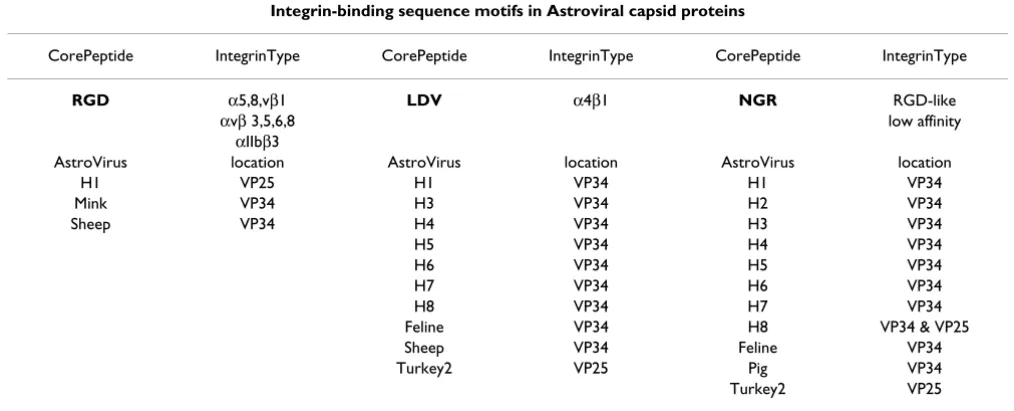
The glycine residue at position 573 in ORF2 is among the top three of all sites having a dN/dS value of 1.441 ± 0.264 and a posterior probability of 0.901. Surprisingly, this Gly573 is identified by PROSITE as the core residue of a RGD tripeptide being a recognition sequence for cellular attachment to an integrin-type cell surface receptor [27]. It seems a paradox that a site prone to adaptive molecular evolution also participates in an important replication function. However, integrin binding can also be fulfilled by similar motifs, for instance KGD, RHD, NGR and LDV, and may be enhanced by synergy sites like the tripeptide RNS [28]. RNS, KGD and RHD oligopeptides are absent in the collection of ORFs2, but the integrin-binding motifs RGD, LDV and NGR are present in astrovirus ORF2 except for Turkey1 (Table 4). Most of these putative integrin-binding sequences are located in VP34 rather than in the spike protein VP25. The LDV tripeptide is located at posi-tion 183 and NGR is present (sometimes even in dupli-cate) at the positions 17 and 51 of VP34 (H1Z25771 numbering).
Discussion
Previous research showed that avian astrovirus species dis-played different topologies in trees based on either synon-ymous or non-synonsynon-ymous substitutions suggesting a deviant pattern of synonymous substitutions specifically in these species [10]. More specifically, tree compression due to shortening of ancestral branches caused loss of
res-Table 4: Integrin-binding sequence motifs in astrovirus capsid proteins
Integrin-binding sequence motifs in Astroviral capsid proteins
CorePeptide IntegrinType CorePeptide IntegrinType CorePeptide IntegrinType
RGD α5,8,vβ1 LDV α4β1 NGR RGD-like
αvβ 3,5,6,8 low affinity
αIIbβ3
AstroVirus location AstroVirus location AstroVirus location
H1 VP25 H1 VP34 H1 VP34
Mink VP34 H3 VP34 H2 VP34
Sheep VP34 H4 VP34 H3 VP34
H5 VP34 H4 VP34
H6 VP34 H5 VP34
H7 VP34 H6 VP34
H8 VP34 H7 VP34
Feline VP34 H8 VP34 & VP25
Sheep VP34 Feline VP34
Turkey2 VP25 Pig VP34
Turkey2 VP25
[image:8.612.51.558.497.702.2]olution among the non-human mammalian and the avian species in all ORFs leaving solely the human sero-types properly resolved. Recently, we demonstrated a switch in the recent evolution of Astroviridae driving the synonymous codon usage in genes of specifically the non-human mammalian viruses towards the mean codon usage in genes of their hosts [21]. The present study employs phylogenetic analysis by maximum likelihood approximation to assess the extent of (non-) synonymous mutational rates at the expense of tree-building capacity. Fortunately, there is consensus in literature on the phylo-genetic topology of astrovirus species derived from amino acid replacements or non-synonymous nucleotide substi-tutions [10,16-21]. This provides the opportunity to dec-orate a tree carrying this consensus topology with the branch lengths estimated by PAML for synonymous or non-synonymous substitutions in astrovirus ORFs. By these means, we obtained standard-like trees without sig-nificant compression for astrovirus ORF1a and ORF1b, despite the large extent of synonymous substitutions in the non-human species. Apparently, substitution models subjected to maximum likelihood approximation tolerate considerably higher levels of mutational saturation than "classic" substitution models relying on the Jukes-Cantor correction for multiple hits at the same site and hence allow the inclusion of significantly more evolutionary his-tory during phylogenetic analysis. Improvement of dN and dS estimation is the result.
With respect to astrovirus ORF2, the tree based on non-synonymous substitutions is very much standard-like, whereas the tree based on synonymous substitutions clearly suffers from compression due to the extended branch lengths of pig, sheep, mink and turkey astrovirus species. A bipartition of ORF2 into the two regions encod-ing the VP34 and VP27 capsid proteins shows that the branch extension of these species is observed in the VP34 domain, but confined to sheep and the turkeys in VP27. In mink and particularly pig, enhanced rates of synony-mous mutation are present in the VP34 domain, but absent in the VP27 domain of ORF2. At present, we can-not offer a proper explanation for this species- and domain-specific enhancement in the rates of synonymous mutation. The consistency of dN trees with data in litera-ture [10,16-20] argues against an improper alignment of the astrovirus sequences. It is conceivable that the substi-tution model applied reaches its limit at a certain level in the rate of mutation. However, VP34 carries the majority of elongated branch lengths, but is slightly better con-served than its ORF2 colleague VP27. The avian clade may pose a biological argument relevant to the problem. As shown above, turkey astroviruses consistently do and avian nephritis viruses do not display branch length extension indicating a possibly relevant difference between these species. Investigation at the source of the
sequences involved has pointed out that the sequences of turkey species have been determined by RT-PCR of virus RNA extracted directly from stools and organs [18,29], whereas RNAs of avian nephritis virus have been prepared from cell-culture supernatants after three consecutive rounds of plaque purification before being subjected to RT-PCR amplification [30]. It has already been mentioned that adaptation of human astroviruses to grow in contin-uous cell lines induces a 45-nucleotide deletion near the 3'-end of ORF1a [25]. In coronavirus, mutations have been associated with isolation and passage in primate cell lines [31,32]. In conclusion, selection at the level of isola-tion and purificaisola-tion as well as mutaisola-tion at the level of propagation may affect the difference between the rates of synonymous and non-synonymous substitution in astro-virus genes. Future research may address this issue.
The relationship between negative and positive selection carries an antagonistic character. Random mutations that may be a menace to intrinsic virus functionality are meshed during cycles of virus replication and propagation and are subsequently removed from the virus population leading to conservation of the sequences involved. Astro-virus protease, polymerase and VP34 are exemplary for this process of negative or rather purifying selection. Pos-itive selection of substitutions on the other hand occurs in response to environmental changes and hence is also des-ignated as molecular adaptation or adaptive molecular evolution. Obviously, sites prone to positive selection may be expected at domains in charge of communicative functionality like host range and immune response. It is therefore not surprising that sites belonging to the pre-dicted serotypic epitope and to the putative RGD site for cell attachment in astrovirus ORF2 as well as to the two variable regions in astrovirus ORF1a display dN/dS values indicative for weak positive selection. The two clusters with dN/dS values >1 at the borders of VP25 may mark adaptive responses to maintain the structure of the virus spike protein allowing variability in the central part of VP25 that carries the serotypic epitope. The range of neu-tral evolution (0.3 < dN/dS < 1) is not very popular in astrovirus ORFs indicating that during evolution astrovi-rus has reached equilibrium between purifying selection and molecular adaptation.
Routing of astrovirus sequence data from GenBank to PAML input data files Figure 4
Routing of astrovirus sequence data from GenBank to PAML input data files. Main features of astrovirus genomes are given at the top. Numbers in parentheses indicate the length of an ORF in nucleotides. RFS points to the ribosomal frame shift signal between ORF1a and ORF1b. In GenBank, the number of complete ORF2 sequences surpasses those of ORF1a or ORF1b. At the ultimate right side, resources are boxed to indicate the actions undertaken and results obtained.
Human
Non-human
Mammalian
Avian
Alignment
Alignment
Alignment
Multiple protein sequence alignment
Cycles of manual refinement
Optimized sequence alignment
of astroviral proteins
Aminoacid
tree.nwk
Corresponding coding sequences
(alignment not required)
Multiple sequence alignment of
codons matching
the parent aminoacid alignment
dN/dS of branches and sites
GenBank Species
Mouse & keyboard
MUSCLE
MUSCLE -profile
PAL2NAL
PAML
MEGA
Astroviruses
Translation and grouping of ORFs1a, ORFs1b and ORFs2
MEGA
ORF1a and ORF1b: 7 human, 3 avian and 2 non-human mammalian
ORF2: 4 avian 4 non-human mammalian
31 human (8 serotypes, 1 specimen per serotype) ORF1a (2754)
ORF1b (1557)
ORF2 (2361)
Protease
Polymerase
being the only species with all three integrin-binding motifs present in the sequence. Data on the process of cell entry by astrovirus have not been reported since 1992 [33]. Although experimental support is lacking, we tend to propose that integrin recognition plays a key role in astrovirus to target cell attachment.
Methods
Phylogenetic Analysis by Maximum Likelihood (PAML)
Sequences of astroviruses were obtained from GenBank and annotated previously [10]. Recently obtained sequences of mink [3] and human serotypes 4 and 5 [34] were also included in the present study. GenBank acces-sion numbers are mentioned in Table 1 (Results section). The genomes of the astrovirus species include many human species with high sequence homology and few non-human mammalian and avian species, which are very divergent. Initial charges of PAML 3.14 for the esti-mation of (non-) synonymous rates of mutation in astro-virus genes demonstrated the need of a proper alignment of astrovirus sequences to avoid unconnected Markov chains, likelihood convergence problems and a collapse of the substitution model. Therefore, a novel strategy was developed to obtain properly aligned astrovirus sequences (Fig 4). In order to avoid overrepresentation of human astrovirus species (ORF2 analyses only), we included one specimen per human serotype except for human serotype 1. Besides a few point mutations, the human virus species Z25771 differs from L23513 (and from the other astrovi-rus species as well) by the presence of the oligopeptide that was reported to be deleted by cell culture adaptation of astrovirus [25]. Multiple sequence comparison by log-expectation (MUSCLE) [35] was used for the alignment of the polypeptide chains encoded by each astrovirus read-ing frame. A multi-step procedure was used. Firstly, three separate protein alignments were generated from the human, non-human mammalian and avian virus species, respectively. Secondly, these three alignments were com-bined into a single alignment file for each astrovirus ORF by means of the profile-profile operation of MUSCLE. Thirdly, refinements were introduced manually (BioEdit) [36] with special attention to sites near alignment gaps. An amino acid neighbor-joining tree was constructed in MEGA [37] and stored in newick format.
The PAL2NAL program was used for the conversion of a sequence alignment of proteins into the corresponding codon-based nucleotide alignment [38] that in turn was used for input into the CODEML module of PAML3.14 [11]. Most CODEML settings have been adapted from the small lysozyme data set of Yang [39]. The parameter-rich-ness of the substitution model was effectively reduced by choosing F3x4 for CodonFreq and by attaching fore-ground labels to tip branches of the input tree instead of allowing a free determination of all these parameters. The
choice F3x4 specifies the use of the correct nucleotide fre-quency for each of the different codon positions in the ORF involved [21]. Tree and branch labels were inspected for their integrity (TreeViewX) [40]. In order to apply the site models of CODEML, the parameter "model" was set to zero and "NSsites" was set to 0, 1, 2, 7 and 8 specifying different models of dN/dS variation to run in one batch [41].
This multi-step MUSCLE procedure for optimal sequence alignment required considerably less manual refinements than a one-step ClustalW alignment. It takes the PAL2NAL program only a few seconds to convert a collection of nucleotide sequences into a multiple sequence alignment of codons corresponding to the parent amino acid align-ment. A single charge of 200 PAML iterations takes 4 to 24 hours of calculation on a P4/2.8 GHz with 504 MB of RAM under XP/SP1 depending on the length of the align-ment and the number of species. Values of dN and dS in the branch models and of the ratio dN/dS in the site mod-els of CODEML represent the number of (non-) synony-mous substitutions per (non-) synonysynony-mous site corrected for multiple hits at the same site according to the PAML model in charge.
Server support and program downloads were received from CBS [42], PROSITE [43], PAML [44], MUSCLE [45] and PAL2NAL [46].
Competing interests
The author(s) declare that they have no competing inter-ests.
Authors' contributions
FJvH carried out the computer analyses. All authors partic-ipated in writing the manuscript. VVL and BB are the prin-cipal investigators.
References
1. Guix S, Bosch A, Pinto RM: Human astrovirus diagnosis and typ-ing: current and future prospects. Lett Appl Microbiol 2005,
41:103-105.
2. Mittelholzer C, Englund L, Hedlund KO, Dietz HH, Svensson L:
Detection and sequence analysis of Danish and Swedish strains of mink astrovirus. J Clin Microbiol 2003, 41:5192-5194. 3. Mittelholzer C, Hedlund KO, Englund L, Dietz HH, Svensson L:
Molecular characterization of a novel astrovirus associated with disease in mink. J Gen Virol 2003, 84:3087-3094.
4. Matsui SM, Greenberg HB: Astroviruses. In Fields virology Fourth edition edition. Edited by: Knipe DM, Howley PM and al. . Philadelphia, Lippincott-Raven Publishers; 2001:875-893.
5. Jiang B, Monroe SS, Koonin EV, Stine SE, Glass RI: RNA sequence of astrovirus: distinctive genomic organization and a puta-tive retrovirus-like ribosomal frameshifting signal that directs the viral replicase synthesis. Proc Natl Acad Sci U S A
1993, 90:10539-10543.
6. Mendez E, Salas-Ocampo E, Arias CF: Caspases mediate process-ing of the capsid precursor and cell release of human astro-viruses. J Virol 2004, 78:8601-8608.
Publish with BioMed Central and every scientist can read your work free of charge
"BioMed Central will be the most significant development for disseminating the results of biomedical researc h in our lifetime."
Sir Paul Nurse, Cancer Research UK
Your research papers will be:
available free of charge to the entire biomedical community
peer reviewed and published immediately upon acceptance
cited in PubMed and archived on PubMed Central
yours — you keep the copyright
Submit your manuscript here:
http://www.biomedcentral.com/info/publishing_adv.asp
BioMedcentral 8. Kiang D, Matsui SM: Proteolytic processing of a human
astrovi-rus nonstructural protein. J Gen Virol 2002, 83:25-34.
9. Mendez E, Fernandez-Luna T, Lopez S, Mendez-Toss M, Arias CF:
Proteolytic processing of a serotype 8 human astrovirus ORF2 polyprotein. J Virol 2002, 76:7996-8002.
10. Lukashov VV, Goudsmit J: Evolutionary relationships among Astroviridae. J Gen Virol 2002, 83:1397-1405.
11. Yang Z: PAML: a program package for phylogenetic analysis by maximum likelihood. Comput Appl Biosci 1997, 13:555-556. 12. Yang Z, Nielsen R: Synonymous and nonsynonymous rate
var-iation in nuclear genes of mammals. J Mol Evol 1998,
46:409-418.
13. Nielsen R, Yang Z: Likelihood models for detecting positively selected amino acid sites and applications to the HIV-1 enve-lope gene. Genetics 1998, 148:929-936.
14. Yang Z, Wong WS, Nielsen R: Bayes empirical bayes inference of amino acid sites under positive selection. Mol Biol Evol 2005,
22:1107-1118.
15. Yang Z: Maximum likelihood estimation on large phylogenies and analysis of adaptive evolution in human influenza virus A. J Mol Evol 2000, 51:423-432.
16. Jonassen CM, Jonassen TO, Saif YM, Snodgrass DR, Ushijima H, Shimizu M, Grinde B: Comparison of capsid sequences from human and animal astroviruses. J Gen Virol 2001, 82:1061-1067. 17. Wang QH, Kakizawa J, Wen LY, Shimizu M, Nishio O, Fang ZY, Ush-ijima H: Genetic analysis of the capsid region of astroviruses.
J Med Virol 2001, 64:245-255.
18. Jonassen CM, Jonassen TTO, Sveen TM, Grinde B: Complete genomic sequences of astroviruses from sheep and turkey: comparison with related viruses. Virus Res 2003, 91:195-201. 19. Monceyron C, Grinde B, Jonassen TO: Molecular
characterisa-tion of the 3'-end of the astrovirus genome. Arch Virol 1997,
142:699-706.
20. Taylor MB, Walter J, Berke T, Cubitt WD, Mitchell DK, Matson DO:
Characterisation of a South African human astrovirus as type 8 by antigenic and genetic analyses. J Med Virol 2001,
64:256-261.
21. van Hemert FJ, Berkhout B, Lukashov VV: Host-related nucleotide composition and codon usage as driving forces in the recent evolution of the Astroviridae. Virol 2006, doi:10.1016/j/ virol.2006.11.021:.
22. Anisimova M, Bielawski JP, Yang Z: Accuracy and power of bayes prediction of amino acid sites under positive selection. Mol Biol Evol 2002, 19:950-958.
23. Mendez E, Salas-Ocampo MP, Munguia ME, Arias CF: Protein prod-ucts of the open reading frames encoding nonstructural pro-teins of human astrovirus serotype 8. J Virol 2003,
77:11378-11384.
24. Guix S, Bosch A, Ribes E, Dora ML, Pinto RM: Apoptosis in astro-virus-infected CaCo-2 cells. Virol 2004, 319:249-261.
25. Willcocks MM, Ashton N, Kurtz JB, Cubitt WD, Carter MJ: Cell cul-ture adaptation of astrovirus involves a deletion. J Virol 1994,
68:6057-6058.
26. Matsui SM, Kiang D, Ginzton N, Chew T, Geigenmuller-Gnirke U:
Molecular biology of astroviruses: selected highlights.
Novartis Found Symp 2001, 238:219-233.
27. Ruoslahti E: The RGD story: a personal account. Matrix Biol
2003, 22:459-465.
28. Ruoslahti E: RGD and other recognition sequences for integrins. Annu Rev Cell Dev Biol 1996, 12:697-715.
29. Koci MD, Seal BS, Schultz-Cherry S: Molecular characterization of an avian astrovirus. J Virol 2000, 74:6173-6177.
30. Imada T, Yamaguchi S, Mase M, Tsukamoto K, Kubo M, Morooka A:
Avian nephritis virus (ANV) as a new member of the family Astroviridae and construction of infectious ANV cDNA. J Virol 2000, 74:8487-8493.
31. Poon LL, Leung CS, Chan KH, Yuen KY, Guan Y, Peiris JS: Recurrent mutations associated with isolation and passage of SARS coronavirus in cells from non-human primates. J Med Virol
2005, 76:435-440.
32. Dijkman R, Jebbink MF, Wilbrink B, Pyrc K, Zaaijer HL, Minor PD, Franklin S, Berkhout B, Thiel V, van der HL: Human coronavirus 229E encodes a single ORF4 protein between the spike and the envelope genes. Virol J 2006, 3:106.
33. Donelli G, Superti F, Tinari A, Marziano ML: Mechanism of astro-virus entry into Graham 293 cells. J Med Virol 1992, 38:271-277.
34. Silva PA, Cardoso DD, Schreier E: Molecular characterization of human astroviruses isolated in Brazil, including the com-plete sequences of astrovirus genotypes 4 and 5. Arch Virol
2006, 151:1405-1417.
35. Edgar RC: MUSCLE: multiple sequence alignment with high accuracy and high throughput. Nucleic Acids Res 2004,
32:1792-1797.
36. Hall TA: BioEdit: a user-friendly biological sequence align-ment editor and analysis program for Windows 95/98/NT.
Nucleic Acids Res Symposium Series 1999, 41:95-98.
37. Kumar S, Tamura K, Nei M: Molecular evolutionary genetics analysis (MEGA). Comput Appl Biosc 1994, 10:189-191.
38. Suyama M, Torrents D, Bork P: PAL2NAL: robust conversion of protein sequence alignments into the corresponding codon alignments. Nucleic Acids Res 2006, 34:W609-W612.
39. Yang Z: Likelihood ratio tests for detecting positive selection and application to primate lysozyme evolution. Mol Biol Evol
1998, 15:568-573.
40. Page RD: TreeView: an application to display phylogenetic trees on personal computers. Comput Appl Biosci 1996,
12:357-358.
41. Yang Z, Swanson WJ, Vacquier VD: Maximum-likelihood analysis of molecular adaptation in abalone sperm lysin reveals vari-able selective pressures among lineages and sites. Mol Biol Evol
2000, 17:1446-1455.
42. CBS Prediction Servers 2006 [http://www.cbs.dtu.dk]. 43. ExPASy Proteomics Server 2006 [http://www.expasy.org]. 44. Phylogenetic Analysis by Maximum Likelihood (PAML) 2004
[http://abacus.gene.ucl.ac.uk/software/paml.html].
45. MUSCLE, multiple sequence alignment software 2005 [http:/ /www.drive5.com/muscle].