COLING82, Z Homck)(ed.) North.HollandPublishingCompany © Academ~ 1982
RECOGNITION'OF ABSTRACT OBJECTS - A DECISION THEORY
APPROACH WITHIN NATURAL LANGUAGE PROCESSING Gerhard Knorz
Fachbereich Informatik,- FG Datenverwaltungssysteme I I Technische Hochschule Darmstadt
K a r o l i n e n p l a t z 5 D-6100 Darmstadt
W-Germany
The DAISY/ALIBABA-system developed w i t h i n the WAl-project represents both a s p e c i f i c s o l u t i o n to the automatic indexing problem and a general framework f o r problems in the f i e l d of natural language processing, characterized by fuzziness and uncertainty• The WAI approach to the indexing problem has already been published [ 3 ] , [ 5 ] . This paper however presents the under- l y i n g paradigm o f recognizing a b s t r a c t objects. The basic concepts are described, including the decision theory approach used f o r r e c o g n i t i o n .
1 THE "WAI" AND THE "AIR" PROJECT 1
The DAISY/ALIBABA system [ 1 ] , [ 2 ] , [ 3 ] , as developed a t the Technical U n i v e r s i t y Darmstadt analyses abstracts and describes them according to the coordinate i n - dexing philosophy using a prescribed set of d e s c r i p t o r s . To perform t h i s task, a domain dependent d i c t i o n a r y is needed. Estimating the non-existence of s u i t a b l y sized d i c t i o n a r i e s to be one of the main problems f o r research and development of automatic indexing [ 4 ] , in 1978 the WAI p r o j e c t started with d i c t i o n a r y construc- t i o n . The two completed d i c t i o n a r i e s are
• FST, covering the scope of food science and technology 3 and
• PHYS, covering the scopeofPhysics, a part of INIS ( I n t e r n a t i o n a l Nuclear
I n f o r m a t i o n §ystem) 4 . - -
D i f f e r e n t procedures f o r generating d i c t i o n a r y data were developed and applied. To c l a s s i f y them and to u n i f y the created data is one of the main tasks of d i c t i o n - ary construction (described in d e t a i l in [ 3 ] , [ 4 ] ) . This cannot be done without examination of t h e i r influence on the q u a l i t y of the r e s u l t i n g indexing. To perform indexing t e s t s , the development of DAISY and ALIBABA was another important objec- t i v e of WAI.
Indexing r e s u l t s are reported in [ 4 ] , [ 5 ] , [ 6 ] which are based on consistency tests o n l y , using the manual indexing as a standard. To confirm or to modify these re- s u l t s , the AIR p r o j e c t is now preparing a r e t r i e v a l t e s t on the physics data base INKA-PHYS of the Fachinformationszentrum FIZ 4 (Energie, Physik, Mathematik; Karls- ruhe) (order of magnitude: I0.000 documents, 200 search requests). The indexing w i l l be based upon the new d i c t i o n a r y PHYS-2 which is to be constructed using about 80.000 documents of the INKA-PHYS data base.
2 THE BASIC PRINCIPLES UNDERLYING THE "WAI"/"AIR" APPROACH
The WAI/AIR approach represents both a s p e c i f i c s o l u t i o n o f the indexing problem
and a general framework f o r a wide class of problems w i t h i n natural language pro- cessing and other f i e l d s .
This paper w i l l only give reference to details of the particular solution publi- shed elsewhere. The objective of this work is to present the general framework derivable from the basic principles underlying the WAI and the AIR project: (I) Knowledge bases are very important for problem solving. But to presuppose
knowledge for an automatic system must n o t q u e s t i o n i t s a p p l i c a b i l i t y , caused by non-existent procedures for construction of knowledge bases of an indispens- able size. The r e a l i s t i c appropriate solution is the main aim rather than a perfect one.
(2) Controlling the q u a l i t y and expenditure of e f f o r t of a system must not wait until i t is put into practice. System development has to be guided by a control derivable from the task to be performed,
(3) The algorithms that make the bases of the procedure should not be assumed to be perfect. Applied to complex tasks, i t is a fundamental fact that they are based on simplified models.
The principles can be considered to be a guideline for designing application oriented systems. With good reason i t is claimed that the q u a l i t y of such a system can be determined by evaluation in application environments only (see for example [ 7 ] , [ 8 ] ) . This cannot be done without empirical studies of the user-system i n t e r - action.
The paradigm of recognizing abstract objects presented here is an approach to integrate the evaluation aspect into system development. I t is also an approach to problems, for which no perfect solutions exist or seem to be applicable.
3 RECOGNITION OF ABSTRACT OBJECTS
3.1 THE DEFINITION OF THE RECOGNITION TASK
The basic idea is to use the application environment i t s e l f to get an i m p l i c i t description of the problem. Whenever talking about a particular application environment there is no other way then to take a conceptual model M E as a basis which determines the adequate concepts (see [9 ] , or see also [1015).
Here, a conceptual model has to be formulated in this way, that i t defines ( a b s t r a c t ) objects ( x , k ) , ~EX, k~K. ~ denotes those aspects o f an o b j e c t which can be observed d i r e c t l y with regard to the problem, K denotes a set of o b j e c t classes. A model m E o f the a p p l i c a t i o n environment gives an i m p l i c i t d e f i n i t i o n of the ( r e c o g n i t i o n ) problem, by forming a continuous stream o f abstracts objects. To develop a r e c o g n i t i o n system (RS) is nothing more than the f i n d i n g of a s u i t a b l e mapping e: x÷e(x) that recognizes an actual x to be (x, e(x)).
RECOGNITION OF ABSTRACT OBJECTS 163
This is also adequate, whenever human cognitive c a p a b i l i t i e s are to be simulated. We give some examples:
• Information r e t r i e v a l can be based upon recognition of document-query r e l a t i o n - ships (described in [ 6 ] ) . ~ can be represented by (d,f) where d denotes the document, f denotes the query, k may be in the most simple case a member of the set {is relevant, is not relevant}, refering to the user's judgement• • Expressions, possibly within the scope of a quantifier as well as hypotheses
for inferences, can both be regarded as abstract objects. Determining the scope of a q u a n t i f i e r or drawing inferences can be based on the recognition of those objects by simulating human decisions•
Two other examples are given - avoiding the simulation approach:
• Complex tasks often require the testing of many hypotheses, which can be regarded as abstract objects, m E may refer to the f i n a l results of the processing.
• In [6] a decision theory approach to optimal r e t r i e v a l forms a basis for m E , defining the task of indexing as recognition of document-descriptor r e l a t i o n - ships•
3.2 STRUCTURE OF THE RECOGNITION SYSTEM
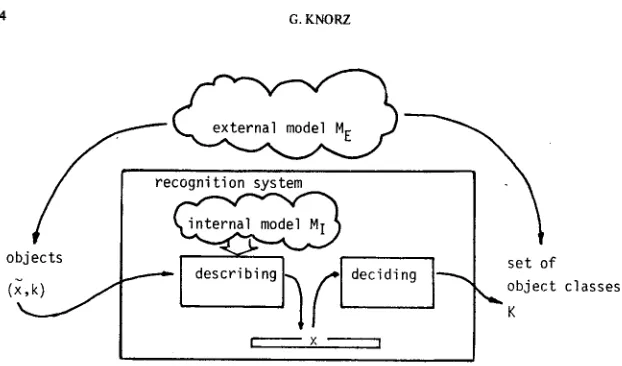
The structure of the recognition system as presented here makes evident tbat the recognition problem arises essentially at the interface of two models:
• The (external) conceptual model M E defining the recognition problem. • The (internal) conceptual model M I used to describe the object with respect
to the recognition task.
M I is part of the recognition system (Figure 1). I t structures the object using the knowledge base, so that a l l available aspects that may influence the decision of the RS are included. In many cases i t also i n i t i a t e s the recognition process, i . e . i t constructs the hypothesis, represented by the object.
According to M I a formal description x of ~ is produced. We do not consider here ' t h e nature of M I , that can be a sophisticated one with a strong theoretical
objects
l
l ;l
setof
. ~ d e s c r i b i n g deciding ~ o b j e c t classesK
( ~ x ~ I
Figure 1 The r e c o g n i t i o n system and i t s environment
system RS MI - provided i t is a d e t e r m i n i s t i c one - to make i n c o r r e c t decisions in some cases. That means, an 'optimal r e c o g n i t i o n systems' cannot be defined w i t h o u t t a k i n g the number of cases causing f a u l t s i n t o c o n s i d e r a t i o n or - more p r e c i s e l y - the s t a t i s t i c a l p r o p e r t i e s of the a p p l i c a t i o n environment represented by m E . The d e s i s i o n theory approach a p p r o p r i a t e to the given s i t u a t i o n is d e s c r i - bed in [ 5 ] and [ 6 ] with respect to the indexing problem. The approach requires t h a t every s i n g l e d e c i s i o n of RS is c l a s s i f i e d . This task is f o r the most p a r t a n t i - cipated by M E , which defines the set of o b j e c t classes K. K determines the scope of p o s s i b l e f a u l t s . Those can be weighted independently by a loss f u n c t i o n c: ( e ( x ) , k ) +w. With the model m E given, a p a r t i c u l a r r e c o g n i t i o n system w i l l cause an expected value E(w). The optimal system RS~!tvp i s t h e r e s u l t of s e a r c h i n g f o r t h i s RsMI which minimizes E(w). I t can be shown t h a t the optimal d e c i s i o n R S ~ t ( x ) can
W
be based on the r e s t r i c t e d p r o b a b i l i t i e s p ( k l x ) . The mappings ek(x ) = p ( k l x ) c a n b( approximated by polynomial functions to be constructed a u t o m a t i c a l l y using a sample of objects ( ~ , k ) . This way has been choosen by the ALIBABA system, t h a t uses polynomial c l a s s i f i e r s , adapted in the mean square sense [11] . The indexing r e s u l t s in [ 5 ] and [ 6 ] demonstrate t h a t - a p p l i e d to the indexing problem - the r e c o g n i t i o n approach and in p a r t i c u l a r the method of approximation is adequate f o r the problem.
4 DISCUSSION
[image:4.612.161.472.135.318.2]RECOGNITION OF ABSTRACT OBJECTS 165
r e t r i e v a l process but to the decisions of human indexers. I f a consistency factor (comparing manual and automatic indexing) measures the quality of automatic in- dexing, the set K requires two elements only. I f a more sophisticated evaluation is intended, the set K can be increased, according to the kind of faults that should be considered. The classification of faults can for example depend on the descriptor under consideration.
For the model M I used see for example [5] and [12].
We summarize the essentials of the suggested approach (the f i r s t point refers in particular to the indexing paradigm).
- The recognition problem causes one to regard two independent models: one with
respect to r e t r i e v a l and one with respect to analysis of abstracts. This point of view is important for an approach to optimal indexing [6 ] , but i t is not self-obvious. In [14] the r e t r i e v a l oriented approach of Robertson and the indexing oriented approach of Harter [13] are brought together. The result is a one model approach l i k e also other approaches in this f i e l d (for example [ 1 5 ] ) .
- The i n t e r n a l model M I is r e s t r i c t e d to the base of the decision to be made.
This f a c t makes i t very easy to a d d i t i o n a l l y include a l o t of knowledge and h e u r i s t i c procedures, t h a t might play a r o l e only f o r decision making. There is no r i s c of causing f a u l t s by determining how to compute the decision, using t h i s k n o w l e d g e . A r t i f i c i a l i n t e l l i g e n c e approaches use a correspondant model M I to determine the decision [1G].
- The need f o r a model m E implies an educational aspect with respect to e v a l u a t i o n . ensures, t h a t the gap between the optimal system RsM~ t and the ideal
m E system
(equivalent to mE) is.under c o n t r o l .
FOOTNOTES
WAI means W~rterbuchentwicklung fUr automatisches Indexing (dictionary construc- tion for automatic indexing), [3]. The research was supported by the BMFT contract PT 131.05 to Technische Hochschule Darmstadt (march I , 1978 - december 12, 1981).
AIR means Weiterentwicklung der automatischen Indexierung und des Information Retrieval (further development of automatic indexing and information r e t r i e v a l ) . Supported by the BMFT contract PT 131.10 to Technische Hochschule Darmstadt (march I , 1981 - december 31, 1983).
3 The two volumes 3 and 4 of the abstract journal Food Science and Technology
Abstracts (FSTA 71/72) containing about 33.000 documents were used as a basis for dictionary.construction.
4 The scope of Physics (INIS) is represented by about 40.000 documents.
5 In [10] the term paradigm is used instead of 'conceptual model' that is taken here from [9].
REFERENCES
[ I ] Putze-Meier, G., DAISY - Darmst~dter Indexierungssystem, to appear as a report, Technische Hochschule Darmstadt, Fachbereich Informatik, DVS I I (1982).
[2] Knorz, G., Softwaresystem ALIBABA, Adaptives lernstichprobenorientiertes In~ dexierungssystem, basierend auf Beschreibungen abstrakter Objekte, Berich~ DV II 82-I, Techni~che Hochschule Darmstadt, FB-Informatik, FG DVS I I , (1982). [3] Lustig, G., Das Projekt WAI: W~rterbuchentwicklung fur automatisches Indexing,
to appear in the proceedings of the Deutscher Dokumentartag 1981 (Saur KG, MUnchen, 1982).
[4] Lustig, G., Ober die Entwicklung eines automatischen Indexierungssystems, in: Krallmann, D. (ed.), Dialogsysteme und Textverarbeitung (LDV-Fittings, Essen, 1980).
[5] Knorz, G., Automatic Indexing as an Application of Pattern Recognition Methods to Document-Descriptor Relationship, applied informatics I (1982) 1-10. [6] Knorz, G., A Decision Theory Approach to Optimal Automatic Indexing, to appear
in the proceedings ofthe GI/ACM/BCS Conference (Berlin, May 1982).
[7] Krause, J., Lehmann, H., User Speciality Languages. A natural language based information system and i t s evaluation, in: Krallmann, D. (ed.), Dialogsysteme und Textverarbeitung (LDV-Fittings, Essen, 1980).
[8] Ackermann, Ammon, Ebert, Krause, Krug, Marschke, Sauerer, Zimmermann (ed.~ , Cobis. ComputergestUtztes BUro-lnformationssystem als Pilotanwendung von CONDOR, BMFT-report (Karlsruhe, 1982).
[9] Schmitt, B., Computer Science and the General Theory of Models - An Intro- duction, applied informatics i (1982), 35-42.
[10] Kuhn, T.S., The structure of S c i e n t i f i c Revolutions. (Chicago, 1970). [11] SchUrmann, J., Polynomklassifikatoren fur die Zeichenerkennung - Ansatz,
Adaption, Anwendung -, (Oldenbourg Verlag, MUnchen, 1977).
[12] Knorz, G., Mustererkennung im B~reich der i n h a l t l i c h e n Erschlie~ung von Texten, in: Radig, Bo (ed.), Modelle und Strukturen (Springer Verlag, Berlin Heidelberg New York, 1981).
[13] Harter, S.P., A p r o b a b i l i s t i c approach to automatic kexword indexing. Part I: On the d i s t r i b u t i o n of s p e c i a l i t y words in a technical l i t e r a t u r e , Journal of the ASIS, 26 (1975), 197-206, Part I I : An alogorithm f o r p r o b a b i l i s t i c in- dexing, Journal of the ASIS,26 (1975) 280-289.
[14] Robertson, S.E., van Rijsbergen, C.J., Porter, M.F., P r o b a b i l i s t i c models of indexing and searching, in Oddy, R.N., Robertson, S.E., van Rijsbergen, G.J., Williams,P.W. (ed.), Information Retrieval Research,(Butterworth,London,1981). [15] Cooper, W.S., Maron, M.E., Foundation of P r o b a b i l i s t i c and U t i l i t y - T h e o r e t i c
Indexing, IACM, 1/25 (1978) 67-80.