MATHEMATICAL MODELING OF TRANSIENT FLOW AND HEAT TRANSFER IN A PRODUCING GAS WELL
JIBRIN HELMA MBAYA
A thesis submitted in fulfilment of the requirements for the award of the degree of
Doctor of Philosophy (Mathematics)
Faculty of Science Universiti Teknologi Malaysia
ACKNOWLEDGEMENT
I begin this acknowledgement by giving thanks to Allah (SWT) for giving me the strength and good health to undertake this research. Next I wish to express my gratitude to my supervisor, Prof. Dr. Norsarahaida Amin who despite her tight schedule spared her time and trained me how to conduct good research, giving much encouragement and help during the course of this study. Definitely I lack words to thank you. I also appreciate the effort of Dr Baba Galadima Agaie for his guidance and suggestions.
I would like to extend my thanks to my colleagues, Norazlina Subani, Ibrahim Yale, Ahmad, Esam, and Tang for their valuable advice and support. I also appreciate the effort of other friends whose names have not been mentioned, I say thank you all.
ABSTRACT
ABSTRAK
TABLE OF CONTENTS
CHAPTER TITLE PAGE
DECLARATION ii
DEDICATION iii
ACKNOWLEDGEMENT iv
ABSTRACT v
ABSTRAK vi
TABLE OF CONTENTS vii
LIST OF TABLES x
LIST OF FIGURES xi
LIST OF SYMBOLS xiv
LIST OF APPENDICES xvii
1 INTRODUCTION 1
1.1 Research Background 1
1.2 Statement of Problem 5
1.3 Research Objectives 6
1.4 Scope of the Research 7
1.5 Significance of the Study 7
1.6 Organization of Thesis 7
2 LITERATURE REVIEW 9
2.1 Introduction 9
2.2 Analytical Model 9
2.3 Pressure Model in Producing Well 10
2.4 Temperature Model in Producing Well 14
2.5 Gas Flow Models 18
2.7 Gas compressibility 21
2.8 Incline Well 22
2.9 Methods of Solution 24
3 MATHEMATICAL FORMULATIONS 27
3.1 Introduction 27
3.2 Derivation of Governing Equations 27
3.3 Continuity Equation 30
3.3.1 Differential form of Continuity Equation 32
3.3.2 Continuity Equation with Source Term 33
3.4 Momentum Equation 34
3.4.1 Momentum Equation with Inclination 38
3.5 Energy Equation 41
3.5.1 Energy Equation with Heat Transfer 44
3.6 Initial Conditions 47
3.7 Boundary Conditions 48
4 SOLUTION PROCEDURE 50
4.1 Introduction 50
4.2 Flux Vector Form 50
4.3 Flux Splitting Technique 52
4.4 Implicit Steger-Warming Procedure 54
4.4.1 Linearization of FSM 57
4.4.2 Tridiagonal Decomposition 59
4.5 Treatment of Boundary Conditions 60
4.6 Formula for Calculating Wellhead and Bottomhole 63
4.7 Analytical Solution 65
4.8 Stability Analysis 65
5 PREDICTION OF TRANSIENT FLOW IN PRODUCING AND INJECTION WELLS 68
5.1 Introduction 68
5.2 Results for Producing and Injection Wells 68
5.2.1 Results Comparison Small and Large Flow Rate Conditions 69
5.2.3 Bottomhole Pressure in Injection Well 75
5.2.4 Temperature in Producing and Injection Well 76
5.2.5 Density and Velocity Profile in Producing Well. 78
5.3 Results for Producing Well with inflow and in Inclined Position 81
5.3.1 Pressure Comparison 82
5.3.2 Temperature Comparison 83
5.4 New Results 84
5.5 Results Comparison with and without Inflow for Producing Well 89
5.6 Summary 93
6 TRANSIENT FLOW CHARACTERISTICS IN FULLY DEVELOPED FLOW 94
6.1 Introduction 94
6.2 Results and Discussion 94
6.2.1 Temperature Comparison 95
6.2.2 Pressure Comparison 96
6.3 New Results for Thermal Conductivities, Inclination and Area Changes 97
6.4 Comparison of Present Model, FSM and Steady State 106
6.5 Stability of the Analysis 106
6.5 Summary 108
7 SUMMARY AND CONCLUSION 109
7.1 Summary of Work 109
7.2 Conclusion 113
7.3 Suggestion for Feature Work 114
REFERENCES 116
LIST OF TABLES
TABLE NO. TITLE PAGE
4.1 Control direction 64
5.1 Well parameters and fluid properties 82 5.2 Comparison of Steger-Warming flux vector splitting
method with finite difference. 92 5.3 Computational time with respect to temperature 93 6.1 Producing well structure 107 6.2 Comparative results in respect of wellhead temperature
LIST OF FIGURES
FIGURE NO. TITLE PAGE
1.1 Producing Gas well 2
1.2 Gas flaring (Climate Guest Contributor, 2011) 3
1.3 Sound Sensor to Detect Gas Reservoir (IAGC, 2014) 4
2.1 Rock permeability 23
2.2 Horizontal and vertical drilling 23
3.1 Moving control volume (Anderson, et al, 2009) 28
3.2 Model used for the derivation of momentum equation in x-component direction 35
3.3 Control Volume for gravitation (Jiuping et al., 2013) 38
3.4 Schematic diagram of producing gas well with heat transfer 44
3.5 Domain of Boundary Condition 49
4.1 A computational domain for equation (4.20), (Hoffman and Chain, 2000) 60
4.2 Computational Algorithm Chart 67
5.1 Pressure profile of injection well with small mass flow rate of 2.2135 kg/s condition 69
5.2 Pressure profile of injection well with different injection temperature under large flow rate of 9.057.2 kg/s condition. 70
5.3 Pressure profile of production well with different injection temperature under small mass flow rate of 2.2135 kg/s condition. 71
5.4 Pressure profile of production well with different injection temperature under large flow rate of 9.057.2 kg/s condition. 72
5.6 Variation of bottom-hole pressure with the increase of
mass flow rate 74
5.7 Wellhead pressure of in injection well under large flow rate of 9.0572kg/s 75
5.8 Bottomhole pressure in injection well with mass flow rate 9.0572kg/s 76
5.9 Temperature of injection well under large flow rate 9.0572kg/s 77
5.10 Temperature of production well under large flow rate 9.0572 kg/s 77
5.11 Density profile at different time 78
5.12 Velocity profile at different time 79
5.13 Temperature profile with geothermal gradient 80
5.14 Density profile with geothermal gradient at t=0.5s 80
5.15 Compressibility factor on density profiles. 81
5.16 Pressure comparison 83
5.17 Temperature comparism Steger-Warming and (Pinanm et al., 2003) 84
5.18 Inflow velocities at well pressure P=5800 Mpa 85
5.19 Temperature with or without inflow kinetic energy 86
5.20 Temperature with or without axial kinetic energy 86
5.21 Inflow temperature at reservoir pressure PR=6000 Mpa 87
5.22 Well temperature at P=5800 Mpa 88
5.23 Inflow temperature at different time 89
5.24 Pressure profile with and without inflow 90
5.25 Temperature profile with and without inflow 90
5.26 Pressure comparisons of Steger Warming and Analytical Solutions 91
5.27 Velocity comparisons of Steger Warming and Analytical Solutions 92
6.1 Temperature distributions at different depth and time 95
6.2 Pressure distribution at different depth and time 96
6.3 Earth thermal conductivities at different time. 97
6.4 Thermal conductivity of cement on temperature distribution 98
6.5 Thermal conductivity of tube 99
6.6 Overall heat transfer on velocity 99
6.7 Pressure at different inclination angles 100
6.8 Velocity at different inclination angles 101
6.9 Density at different inclination angles 101
6.11 Well temperature at different tubing diameter with
different production time. 103 6.12 Well temperature at different casing outer diameter
with production time. 103
6.13 Well temperature at different wellbore diameter with
production time. 104 6.14 Sound wave profiles at the upper part of the well at
Different times (min) 105
6.15 Sound wave profiles at the lower part of the well at
different times (min) 105
LIST OF SYMBOLS
A - Area of Wellbore
ALR - Relaxation Distance Coefficient
a - Sound Wave (Speed of Sound)
Cp - Specific Heat at Constant Pressure
Cv - Specific Heat at Constant Volume
d - Diameter
f - Fanning Friction Factor
g - Gravitational Acceleration
hf - Fluid Film Coefficient
hr - Radiation Heat Transfer Coefficient
hc - Convection Heat Transfer Coefficient
J - Productivity Index
KJT - Joule Thomson Coefficient
ke - Thermal Conductivity of Earth kcem - Thermal Conductivity of Cement kcas - Thermal Conductivity of Casing kan - Thermal Conductivity of Annulus ktub - Thermal Conductivity of Tubing
L - Well Length
rti - Radius of Inner Tubing
rto - Radius of Outer Tubing rci - Radius of Inner Casing
rco - Radius of Outer Casing
rw - Radius of Wellbore
R - Natural Gas Constant
R - Reservoir Radius
T - Temperature
Tei - Temperature of Undisturbed Earth Formation (initial) Tr - Temperature of Radiation
Tw - Temperature of Wellbore
t - Time
DF t - Dimensionless Function Time to
U - Overall Heat Transfer Coefficient of Outer Tubing
uI - Inflow Velocity
u - Fluid Velocity
M - Molar Mass
x
M - Mass Flow Rate
P - Pressure
x - Space
Z - Compressibility Factor
- Inclination Angles
e - Internal Energy
- Pipe Roughnessg
- Specific Heat of Gas
- Density of Gas
I
- Inflow Density
- Viscosity
g
- MassGravitational Acceleration V - Velocity VectorV = V
x y z t, , ,
v - Control Volume
S - Control Surface
dS - Change in Surface
V - Time Rate of Change of the Volume of a Moving Fluid Element. n - Unit Vector Perpendicular to the Surface
p
- Pressure Gradient
dv - Incremental Area inside the Finite Volume
- Gradient
- Divergence
- Curl
s
v
- Integration over Volume
V dS - Positive Outflow
V dS - Negative Inflow d
LIST OF APPENDICES
APPENDIX TITLE PAGE
A1 Natural Gas Reserves 130
A2 Natural Gas Production 131
A3 Natural Gas Utilization 132
A4 Flow of Gas in Wells 134
A5 Flowing Bottomhole Pressure 135
A6 Prediction of Flowing Temperature 137
A7 Heat Transfer in Wellbore 137
A8 Gas Pressure 139
A9 Pressure Drop in Gas Wells 139
A10 Solution of Energy Generation Problem 140
B1 Physical Laws for Motion of a System 141
B2 Reynolds Transport Theorem 144
C Perturbation Procedure 148
D Wellhead and Bottomhole Steady State Equations 154
E Boundary Flow Equation 157
F Inflow Equation 159
G Flow Chart for Numerical Procedure 168
H Matlab M-File Code for Computing One Dimensional Transient Compressible Gas Flow in a Well 169
CHAPTER 1
INTRODUCTION
1.1 Research Background
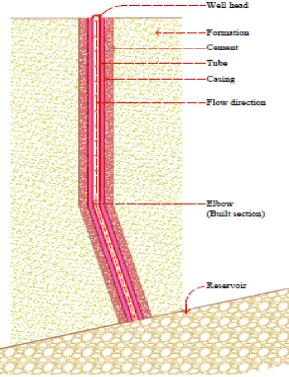
A producing well refers to the type of well that has enough pressure to push the gas to the surface (wellhead), but when the pressure is low and cannot push the fluid to the wellhead a gas is injected into the reservoir to boost the pressure and the well is now refers to as injection well. In a continuous gas production, the formation gas is supplemented with additional high pressure gas from outside surface by injecting gas into the producing conduit at a maximum pressure that depend on the injection pressure and depth. The injected gas mixed with the produced well fluid and decreases the density and subsequently the flowing pressure gradient which causes the flowing bottomhole pressure to create a pressure differential that allows the fluid to flow into the wellbore. On the other hand when it is completely flowing, such that no fluid is injected it is refers to as fully developed well flow. Producing wells are drilled thousands of feet into the earth directly into gas rich deposits contained in underground formations but where rock permeability is strong or in offshore (water well) they are drilled in inclined positions (Figure 1.1). In producing gas well there is no oil production.
been highlighted by the International Energy Agency (IEA) in May 2013, that the global demand for gas could likely rise more than 50% by 2035 and over 56% by 2040 from 2010 levels. These reasons motivated engineers to search for gas reservoirs and to drill gas wells in order to meet the world demand as gas produced along with oil are flared as unwanted products.
Figure 1.1: Producing Gas well
Figure 1.2: Gas flaring (Climate Guest Contributor, 2011)
Figure 1.3: Seismic Sound Sensor to detect Gas Reservoir (Bob, 2013)
Transient flow in a gas well is a situation where the flow characteristics are changing with both space and time. Well geometry, friction, starting or stopping of a pump, well inclination, thermal conductivities of the flow environment are some of the factors that causes changes to the flow characteristics with space and time. Transient condition in producing gas well is only applicable for relatively short period after disturbances has been created in the reservoir.
The complex well geometry consists of different layers where each layer has different thermal conductivities that cause temperature of a flowing fluid to change with both space and time. In the wellbore heat transfer also occurs when there is an exchange of temperature between the flow environment and the undisturbed formation. In heat transfer application it has been observed the steady state transient over estimates the temperature increase in the wellbore at early time but at long time it disappear (Wu, 1990). For this reason the steady state solution is always considered as initial when solving the transient condition (Zhou and Adewumi, 1995).
1.2 Statement of the Problem
During production or injection, flow characteristics of gas moving from reservoir to the wellhead change as time goes on because the distance it covers has different thermal conductivities due to their permeable formations. In the past focus was mainly on studying the producing well and its formation under steady state conditions but this may lead to partial prediction of the distribution of the flow characteristics since they occurs in transient conditions. Traditionally, it relies on pressure gauge, thermometer and empirically derived graph based on steady state flow conditions but the disadvantage of these methods is that in high pressure and high temperature gas wells, it is not easy to install these materials and sometimes may lead to well accident or inaccurate prediction. There are many factors in the well which may cause the changes in the flow with time during production; these factors are well roughness, casing and tubing, cementing, thermal conductivities, thermal resistance and convection. To predict the transient flow in a producing well these factors which are always neglected in the past analysis must to be considered because knowing them will help to improve, analyze and forecast reservoir/well performance.
Wellhead and bottomhole has been in used for calculating the behavior of static flow characteristics but the transient aspect has always been neglected it is therefore important to study the behavior of the flow characteristics at the wellhead and the bottomhole under the transient condition.
Compressibility of a fluid is basically a measure of change in density that will be produced from the well by a specified change in pressure. Gases are, in general, highly compressible and assuming it to be constant will not give its actual flow behavior during production. This is because pressure change will induce density changes since it is a function of density and sound wave (celerity), therefore this will have an influence on the flow.
well analysis will give the general behavior of the flowing fluid. What effect does well inclination have on the transient flow characteristics? Most analysis shows that the inflow properties from the reservoir to the producing well are always constant; this assumption also cannot give the real situation of the flow due the change in the flow characteristics.
In a fully developed flow the assumption that it is in uniform flow will not give a reliable results because of the flow geometry it is therefore important to investigate the behavior of the flow characteristics when the flow is fully developed. Well geometry consists of transient temperature distribution due to thermal conductivity effect between the formation and the flow medium (tubing) where the flow occurs and such heat exchange between the flowing fluid and formation experiences changes both in time and space. For good understanding of flow within the producing well, the effect these changes on the flow characteristics need to be investigated. Most producing well analysis uses different method of solutions depending on their problem without considering sound wave propagation conditions. A method that can numerically solve a model with propagation effect is most needed therefore this research will apply the most suitable method that will solve our model which has propagation effect.
1.3 Objectives of the Study
Based on the problems above, the main objective of the research is to develop a mathematical model that can determine the behavior of the flow characteristics in a producing gas well. It can be achieved by incorporating sound wave, inclination, inflow, friction and thermal conductivities of the flow environment.
The specific objectives are;
To investigate the behavior of the flow characteristics at the wellhead and bottomhole of a producing well.
To develop a code based on mathematical model that can compute and simulate the behavior of the flow characteristics in a producing gas well.
1.4 Scope of the Research
One dimensional model is widely accepted to be sufficient in the analysis of transient compressible flow of gaseous fluid because it gives satisfactory solutions to many problems in fluid flow analysis (Daneshyar, 1976; Osiadacz, 1984). In this study a one-dimensional transient compressible model has been used for investigating
the behavior of flow characteristics in a producing gas well. We consider vertical
formation temperatures as linearly distributed and the well is assumed to be surrounded
by homogeneous rock formation that extends to infinity. In the absence of field data the
boundary conditions are numerically treated as provided by (Zhou and Adewumi, 1995).
1.5 Significance of the Study
The significance of this work is that one want to determine gas well performance and the behavior of the flow characteristics during the production period. Of significance also is the determination of thermal conductivities of the flow environment and the influence of the tubing, casing and well size on the flow characteristics.
1.6 Organization of the Thesis
In Chapter 2 literature review on producing gas well for different works were presented. Analytical and numerical solutions for problems in producing wells as presented by different authors have been reviewed. Methods of solution for pipeline flow analysis has also been reviewed where the best method for the present work has been selected.
Chapter 3 presents mathematical formulation for transient flow of gas in a producing well with heat transfer because once the effect of this parameter is integrated into the tubing performance prediction; the overall well performance can be calculated. We begin by presenting the general form of the governing equations where a source term was incorporated to account for flow parameters such as sound wave, heat transfer, inflow and inclination effects. Initial and boundary conditions for this work were also presented.
Chapter 4 describes the numerical procedure of implicit Steger-Warming flux vector splitting method to solve the governing equations. Tridiagonal decomposition followed by treatment of boundary conditions was also presented.
Chapter 5 presents the transient results of the flow characteristics obtained using the implicit Steger-Warming flux vector splitting method and were validated with existing ones. The dynamic behavior of gas flow from the bottomhole to wellhead was presented on a rigid pipe of diameter 0.2158 m, depth 3000 m installed in the well. The behavior of the flow characteristics are calculated based on known values of injection temperature i.e. (T =273 (K), 283 (K), 293(K), 303 (K) and 313 (K)) and two values of mass flow rate; w=2.1133kg/s and w=9.0572kg/s with
0 9.5
P (Mpa). Other well parameters are as follows; rrto = 0.073 m, rh = 0.2159 m, rco= 0.1397 m. rci = 0.12426 m, dx=0.01, Gt = 209 (Kw/mk), Geothermal temperature
is T = 0.023x+b where b = 13.13.
REFERENCES
Abdulkareem, A. S., Afolabi, A. S., Abdulfatai, J., Uthman, H., and Odigure, O. J.,
(2009). Oil Extraction and Climate Change: A Case Study Of Heat Radiation
from Gas Flaring in the Niger Delta Area of Nigeria.
Agarwal, R. G., Al-Hussainy, R. and Ramey, H. J. Jr. (1970). An Investigation of Wellbore Storage and Skin Effect in Unsteady Liquid Flow. Analytical Treament. Society of Petroleum Engineers (SPE 2466, vol. 249).
Ahmad Fauzi Hasan, (2014). Natural gas Utilization in Malaysia.
Akpan, S., (2009). The Production and Utilization of Natural Gas Resources in Nigeria: A Review, Proceeding of Annual International Conference and Exhibition the Nigerian Society of Petroleum Engineers, Abuja-Nigeria.
AKpan, D. G., (2012). Droplets in Production Tubing and Separators. NTNU
Alves, I., Alhanati, F. and Shoham, O. (1992). A Unified Model for Predicting Flowing Temperature Distribution in Wellbores and Pipelines. Society of Petroleum Engineers Production & Facilities, vol.363.
Albert Trube S., (1957). Compressibility of Natural Gases. Society of Petroleum Engineers. SPE-697-G.
Arthur Soprano B., Gustavo Ribeiro G., Antonio da Silva G., and Clovis Maliska R., (2010). Solution of One Dimensional Three Phases Flow in Horizontal Wells using a Drift-Flux Model. Mecanical Computational Vol. XXIX, pp. 8767-8779, Association Argentina de Mecanica Computational.
Babatundo Agbi. (1975). Calculation of Bottomhole Pressure in a Single Phase Gas Wells from Wellhead Measurement. Annual Technical Report of SPE.
Banjamin, E. W., Streeter, V. L., and Stoner, M. A., (1974). Unsteady State Natural Gas Calculation in Complex Pipe Systems. Journal of Sociaty of Petroleum Engineers. SPE 4004, pp 35-53.
Temperature and Pressure Distribution in Carbon Dioxide Injection Well. EJGE. vol. 19, Bund. F.
Bai Bing, Li Xiao-chun, Liu Mingze, Shi Lu, Li Qi. (2012). A Fast Finite Difference Method for Determination of Wellhead Injection Pressure. Journal of Central South University, Press and Springer-Verlag Berlin Heidelberg.
Bai Bing, Li Xiao-chun, Liu Mingze, Shi Lu, Li Qi. (2013). A Unified Formula for Determination of Wellhead pPressure and Bottomhole Pressure. Energy Procedia, ELSEVIER, 37, pp 3291-3298.
Beggs Dale H. (1991). Gas Production Operations. Oil and Gas Consultant International, INC. Printed in United State of America, ISBN-0-930972-06-6.
Behbahani Nejad and Bagheri, A. (2008). A Matlab Simulinks Library for Transient Flow Simulation of Gas Network. World Acedamy of Science Engineering and Technology.
Behbahani-Nejad M., Hadadpour H., Esfahanian V. (2005). Reduced-Order Modeling of Unsteady Flows without Static Correction Requirement. Journal.of Aircraft, vol. 42, No. 4
Behbahani-Nejad, M. and Shekari, Y. (2010) Reduced Order Modeling of Natural Gas Transient Flow in Pipelines. World Academy of Science, Engineering and Technology vol. 2, 2008-07-21
Bin Hu. (2004). Characterizing Gas-lift Instabilities. NTNU, Department of Petroleum Engineering and Applied Geophysics Norwegian University of
Science and Technology Trondheim, Norway.
Bob Hardage (2013). Using Seismic technology in Oil and Gas Exploration. Earth Sky in Earth.
Bottcher N., Singh A. K., Kolditz O., and Lied R., (2012). Nonisothermal, Compressible, Gas Flow for the Simulation of an enhanced Gas Recovery Applications. Journals of Computational and Applied Mathematics.
Brills, P. J., and Murkherjee, H. (1999). Multiphase Flow in Wells. Henry L. Doherty Memorial Fund of AIME: Society of Petroleum Engineers. Inc.
Bulent Izgec. (2008) Transient Fluid and Heat Flow Modelling in Coupled Wellbore/Reservoirs. Dissertation-Texas A and M University. Petroleum Engineering.
Candia, O. C. and Mario, A. (2005). Prediction of Pressure, Temperature, and Velocity Distribution of Two Phase Flow in Oil Wells. Journal of Society of Petroleum Engineering. vol. 46, pp. 195–208.
Cartis, M. R. and Witterbolt, E. J.1973). Use of Temperature Log for Determining Flow Rates in Producing Wells. Society of Petroleum Engineers. AIME 4657. Carter, R. D. (1962). Solution of Unsteady State Radial Gas Flow. Journal of
Petroleum Technology vol. 4, pp. 549-554.
Cengel, Y. A. and Cimbala, J. M. (2012). Fluid Mechanic Fundamentals and Applications. McGraw-Hill
Chen, K. and Xu, J. (2008). A Method for Calculating Pipe Deformation in Gas Wells. World Journal of Modelling and Simulation. vol.4, 188-195.
Chaudhry, M. H. and Hussaini, M. Y. (1983). Second-Order Explicit Methods for Transient-Flow Analysis. Numerical Methods for Fluid Transients
Analysis, Martin, C. S. and Chaudhry, M. H. (eds.), Amer. Soc. Mech. Engrs.,
pp. 9-15.
Chaudhry, M. H. and Hussaini, M. Y. (1985). Second-Order Accurate Explicit Finite-Difference Schemes for Waterhammer Analysis. Jour. Fluids Engineering, Amer. Soc. Mech. Engrs., vol. 107, Dec., pp. 523-529.
Cho, Y, C., Balaji, J., Felipe, A. C. V. and Raphael, H. C. (2010). Sorrugate Modeling for Characterizing the Perfomance of A Dielectric Barier Discharge Problem Actuator. International Journal Of Computational Fluid. 24(7), 281-301.
Coulter, D. M. and Bardon, M. F. (1979). Revised Equation Improve Flowing Gas Temperature Prediction Oil and Gas Journal of petroleum engineering. vol.9, pp. 107–115
Courant, R., Friedrick, K., Lewy, H., (1967). On the Partial Difference Equation of Mathematical Physics.
Cullender, R. M. and Smith, R. V. (1957). Practical Solution of Flow Equations for Wells and Pipes with Large Gradient. Trans, AIME vol.207, pp. 281-287. Cullender, M. H., (1995). The Isothermal Performance Method of Determinig Flow
Meeting‖. Vol. 204.
Daneshyar, H. (1976). One Dimensional Compressible Flow. Oxford New York Toronto Sydney Paris Franfurt: Pergamon Press.
Devold, H. (2006). An Introduction to Oil and Gas Production. Oil and Gas Hand Book, pp. 26-30
Dheyaa Wajid Abbood, (2009). Analytical Model study for flow through Porous Media. Thirteenth International Water Technology Conference IWTC 13, Hurghada, Egypt.
Dowell, E. H. (1996). Eigenmode Analysis in Unsteady Aerodynamics. Reduced Order Models. AIAA Journals. 34(8), 1578-1583.
Distefano, G. P., (1970). A digital Computer Program for the Simulation of Gas Pipeline Network Dynamic. PIPETRAN, Version IV, AGA, New York.
Edalat, M., Bozar-Jomehri, R. B., and Mansoori G. A (1993). Generalized Predict Vapor Pressure of Hydrocarbons. Oil and Gas Journals.
Economides, M. J., and Wang, X. (2009). Advanced Natural Gas Engineering, Houston, TX: Gulf Publishing Company.
Everdingen, V. A. F. and Hurst, W. (1949). The Application of the Laplace Transformation to Flow Problems in Reservoirs. AIME. T .P. 2732.
Florea, R., Hall, K. C. and Cimas, P. G. A. (1998). Eigenmode Analysis of Unsteady Viscous Flows in Turbo-machinery Cascades. Unstaedy Aerodynamics and Aero-elasticity of Turbo- machines (10.1007/978-94-011-5040-50pp. 787-782).
Finley, M. (2013). BP Statistical Review of World Energy. Energy Reviewed Report.
Gato, L. M. C. and Henriques, I. C. C. (2005). Dynamic behaviour of high pressure natural gas flow in pipelines. International Journal of Heat and fluid flow 26,8.
Genovese, A., Contrisciani, N., Ortenzi, F. and Cazzola, V. (2011). On the Road Experimental Test of Hydrogen/Natural Gas Blends on Transit Buses. International Journal of Hydrogen Energy. 36(2), 1775-1783.
Gringartern, A. C., Ramey, H. J. Jr. and Raghavan, R. (1972). Unsteady State Distribution Created by a Well with a Single Infinite Conductivity in a Vertical Fracture. Journal of Society of Petroleum Engineers. vol. 308.
Hall, K. C. (1994). Eigenanalysis of Unsteady Flows about Airfoils, Cascades, and Wings. AIAA Journal. 32(12), 2426-2432.
Hall, K. R., and Yarbrough, L. (1974). How to Solve Equation of State for z-Factor. Oil and Gas Journal, No. 8688
Hameed H., Rashidi, F. and Khamehchi, E. (2011) Analytical and Numerical Investigation of Transient Gas Blowdown. Journal of Sciences and Technology. vol 5pp. 64-75
Hani, E., Magdi, S. O., and Mahmut, S., (1999). Use of Temperature Data in Gas Well Tests. Society of Petroleum Engineers.
Hasan, A. R. and Kabir, C. S. (1991). Heat Transfer During Two-Phase Flow in Wellbores: Part 1—Formation Temperature. SPE Paper No. 22866. SPE Annual Technical Conference and Exhibition.
Hasan, A. R. & Kabir, C. S. (1996). A Mechanistic Model for Computing Fluid Temperature Profile in Gas Lift Wells. SPE
Hasan, A. R., Kabir, C. S. and Lin, D. (2005). Analytical Wellbore Temperature Model for Transient Gas Well Testing. Journal of Petroleum Engineers. (SPE. 84288).
Hasan, A. R., Kabir, C. S. & Wang, X. (2009) A Robust Steady State Model for Flowing Fluid Temperature in Complex Wells. SPE Production and operation.
Hasan, A. R., and Kabir, C. S. (2012). Wellbore Heat Transfer Modeling and Applications. Journal of Petroleum Science and Engineering. 86-87, pp. 127-136
Heber, C. L. and Fernando, S. V. (1977). Effect of Wellbore Storage and Damage on the Transient Pressure Behavior of Vertical Fracture Wells. Society of Petroleum Engineers.
Hemeidam, A. M. (1987). Program Calculates Pressure Gradient in Two-Phase
Flow. Oil Gas J. 85, 36–38.
Hasan, A. R. and Kabir, C. S. (1991). Heat Transfer During two-Phase Flow in Wellbores: Part 1—Formation Temperature SPE Paper No. 22866. SPE Annual Technical Conference And Exhibition.
Hoffman, K. and Chiang, S. T., (2000). Computational Fluid Dynamics for Engineers. Wichita, Kansas.
Holloway, M. B. and Chaudhry, M. H., 1985, Stability and Accuracy of Waterhammer Analysis, Advances in Water Resources, vol. 8, Sept., pp. 121- 128
Ibraheem, S. O. and Adewumi, M. A. (1996). Higher Resolution Numerical Solution for 2-D Transient Natural Gas Pipeline Flow. SPE Gas Technology Symposium.
Ike, M. and Ikoku, C. U. (1981). Minimum Gas Flow Rate for Continuous Liquid Removal in Gas Well. 56th Annual Fall Technical Conference and Exhibition of the Society of Petroleum Engineers of AIME, held in San Antonio, Texas.
Izgec, B., Hasan, A. R. and Kabir, C. S. (2007). Transient Fluid and Heat Flow Modeling in Coupled Wellbore/Reservoir Systems. SPE: Reservoir Evaluation and Engineering.
Izgec, B., Hasan, A. R. and Kabir, C. S. (2009). Flow Rate Estimation from Wellhead Pressure and Temperature Data. Society of Petroleum Engineers Journal. Production and Operation, 25,1, pp. 31-39.
Jiuping Xu amd Zhao Wu. (2008). Numerical Simulation of Temperature and Pressure Distribution in Producing Gas Well. World Journal of Modelling and Simulation. Vol. 4, No. 2, pp. 94-103, 94-103
Jiuping Xu, Wu, Z., Wang, S., Qi, B., Chen, K., Li, X. and Zhao, X. (2011). The Prediction of Distribution of Temperature, Pressure, Density, and Velocity in High-Temperature–High- Pressure Gas Wells. Petroleum Science and Technology. vol.29, pp. 1705–1721.
Jiuping Xu, Wu, Z., Wang, S., Qi, B., Chen, K., Li, X. and Zhao, X. (2012). Prediction of Temperature, Pressure, Density,Velocity Distribution in H-T-H-P Gas Wells. The Canadian Journal of Chemical Engineering.
Jacques Hagoort, (2005) Prediction of Wellbore Temperatures in Gas Production Wells. Journal of Petroleum Science and Engineering, Vol. 49, PP 22– 36. James M. B. (1954). Interpretation of Temperature logs in Water and Gas Injection
Wells and Gas Producing Wells. Paper Presented at Spring Meeting of the Eastern District Division of Production, White Sulfurs Spring.
Joseph C., (2012). Approach for Teaching Polytrophic Process Based on Energy Transfer Ratio. International journal of mechanical engineering education, vol. 40
Ke, S. L. and Ti, H. C. (2000). Transient Analysis of Isothermal Gas Flow in Pipelines Network. Chemical Engineering Journal. 76, 8.
Kessal, M. (2000). Simplified Numerical Simulation of Transients Flow in Gas Network. Institute of Chemical Engineers. 78, 6.
Kessal, M. and Bennacer, R. (2005). The modeling of Disolved Gas Effect on Liquid Transient. Journal of Applied Mechanics 73(3), 7.
Katz, J., and Brain, M. V., (1988). Unsteady Low Speed of Aerodynamic Model for Complete Aircraft Configuration. Journal of Aircraft, vol. 25 No. 4.
Khalid, A. (1967). Calculation of Bottomhole Pressure in Gas Wells. Journal of Petroleum Engineers.1967
Khalid Aziz, and Antonin Settari (1979). Petroleum Reservoir Simulation, Applied Science Publication Limited Lodon.
Kambiz, R., Abolhasan, R., and Delfin, T. F. M., (2015). Pressure Response of Vertical Hydraulic Fracture Well within a Reservoir with Fractal Structure Journal of Applied Mathematics, 0096-3003.
Kirkpatrick, C. V., (1959). Advances in Gas-Lift Technology. Drill Prodution. Practical. 59:24–60. Journal of Chemical Engineering Science.
Kidmay, A. J. and Parish, W. R. (2006). Fundamentals of Natural Gas Processing, First ed. Boca Raton, Fla.: CRC Taylor and Francis.
Knudsen, (2008). Study of Speed of Sound in Pipes and Pulse Reflections for Open and Closed Boundary NTNU Norwegian University of Science and Technology.
Kunz, K. S., and Tixer M. P., (1955). Temperature Survey in Gas Producing Wells. vol. 102, AIME Annual Meeting.
Development.
Lesem, L. B., Frank, G., Marotta, F., and John J. M. Jr. (1957). A Method of Calculating the Distribution of Temperature in Flowing Gas Wells. vol. 210, T. P 4599, Society of Petroleum Engineers.
Luciaa, D. J., Berand, P. S. and Silva, W. A. (2004). Reduced Order Modelling New Approach for Computational Physics. Progress in Aerospace Sciences. Technical Conference And Exhibition Of SPE San Antonio TX,
Lubbers, C. L. (2007). On Gas Pockets in Wastewater Pressure Mains and their Effets on Hydraulic Performance. Netherlands, Delft University Press.
Lucia, R. (2005). Numerical Method For the Solution of Hyperbolic Partial Differential Equation. SISSA, International School for Advanced Studies. Trieste, Italy. Lecture Notes.
Li, M., Sun, L. and Li, S. (2001). New View on Continuous Removal Liquids from Gas Wells. Proceedings of the 2001 Proceedings of the Permian Basin Oil and Gas Recovery Conference of SPE Midland
Lisbon, T. N. and Henry, J. R. (1980). Case Histories: Identification of and Remedial Action for Liquid Loading in Gas Wells-Intermediate Shelf Gas Play. Petroleum Technology
Mabrouk, B., Rabah, Z., and Mohamed, B. (2011). Roughness Effect on Unsteady Flow in Pipeline Profilometry and Imaging Techniques. vol. 4, iss. 1, pp. 82-88. American Journal of Engineering and Applied Sciences
MacRobert, D. T., (1949). Effect of Transient Conditions in Gas Reservoirs. Trans. AIME, 186, 36.
Madox, R. N. and Zhou, P. (1984) Using Steady State Equations for Transients Flow Calculations in Natural Gas Pipeline. Oil and Gas Journals.114-128. Magnetrol, International, USA. (2012) Thermal Dispersion Flow Measurement,
World Wide level and Flow Solutions.
Malaysia, (2014). Natural Gas Industry Annual Review.
Malaysia (2014). International energy data and Analysis, Association of Southeast Asia Nation (ASEAN).
Mark, W. F., (2013). The Impact of Varying Wellbore Area on Flow Simulation. Proceeding; Thirty Eight Workshops on Geothermal Reservoirs Engineers.
Standford University, Standford, California. SGP-TR 198.
MS Thesis, LSU
Mokhatab, S. and William, A. P., (2012). Hand Book of Natural Gas Transmission and Processing. Gulf Professional Publishing, 225 Wyman Street Waltham M. A 012451, USA, Secod Edition.
Mokhatab Saeid, William A. Poe and John Y. Mark (2015). Hand Book of Natural Gas Transmission and Processing. Gulf Professional Publishing, 225 Wyman Street Waltham M. A 012451, USA, Third Edition.
Moltz, A. K. (1992). Predicting Gas Well Load-up using nodal System Analysis. Proceedings of the Annual Technical Conference and Exhibition of SPE,
Washington. DC., October 4-7. SPE, 24860.
Moradi, B. and Awang, M. B. (2013). Heat Transfer in the Formation. Research Journal of Applied Science, Engineering and Technology. 6(21), 3927-3932.
Miller, C. W. (1980). Wellbore Storage Effects in Geothermal Wells. Lawrence Berkeley Laboratory. Society of Petroleum Engineers Journals.
Muskat, M., and Botset, H. G., (1931). Flow of Gas through Porous Materials. Physics 1, 27.
Mulpuru, S. R., (1983). A Flux Splitting For the Numerical Simulation of One-Dimensional Compressible Flow. Mathematics and Computer in Simulation XXV, 309-320.
Natural Gas.Org, Energy Tomorrow. September 20, 2014
Nowak, J. T. (1953). The Estimation of Water Injection Profile from Temperature Survey. Journal of Petroleum Engineers. vol. 198.
Nakagawa, E. Y. (1990). Gas Kick Behavior During Well Control Operations in Vertical and Slanted Wells. Dissertation, Louisiana State University, Baton Rouge, LA.
Nakagawa, E.Y. and Bourgoyne, A. T. (1992). Experimental Study of Gas Slip Velocity and Liquid Holdup in an Inclined Eccentric Annulus. ASME, November,
FED-Vol. 144, 71-80.
Nosseir, M. A., Darwich, T. A. Sayyouh, M., H. Sallaly, M. (2000). A New Approach for Accurate Prediction of Loading in Gas Wells under Different Flowing Conditions. SPE 66540. SPE Production & Facilities 15 (4), November, 241-246
Olatunde Abayomi, O., Tunde Adeosun, Mohammed Usman, A., Olabisi Odunlami, M., Moses Olowo foyk, A.,Testy Ekakitie, E., and Atanda Mohammed, M. (2012). Direct Calculation of Unsteady State Weymouth Equations for Gas Volumetric Flow Rate With Different Friction Factors In Horizantal and Inclined Pipes. Engineering. vol. 4, pp. 202-209.
Olufemi Adekomaya, Fadairo Adesina A. S.
Ouyang, L. B., and Aziz, K. (1999). A Mechanistic Model for Gas–Liquid Flow in Pipes with Radial Influx or Outflux. No. 56525, SPE Annual Technical Conference and Exhibition, Houston, TX, October 3–6, pp. 1–14.
Osiadaz, A. (1984). Simulation of Transient Gas Flow in Network. International Journal of Numerical Methods in Fluids, vol. 4, pp. 13-24
Osiadaz, A. (1987). Simulation and Analysis of Gas Network. E. F and N. Spon. LED., London.
Osiadaz, A. (1983). Optimal Numerical Method for Simulating Dynamic Flow of Gas in Pipelines. Institute Journal of Numerical Method and Fluid Flow, vol. 3a
Orodu et al (2012). Well Deliverability Prediction of Gas Flow in a Gas Condensate Reservoirs. Modeling near Two Phase in one Dimension. Brazilian Journal of Petroleum Aand Gas. A Publication of the ABPG.
Oni, S. I. and Oyewo, M. A. (2011). Gas Flaring, Transportaion and Sustainable Energy Development in the Niger-Delta, Nigeria. J. Hum. Ecol. 33(1), 7. Pinan, D., Romero, A. A., Keita, Y., Ding, Z., Hill, A. D., and Larry, W. L., (2004).
A Comprehensive Statistical Basesd Method to Interpret Real Time Flowing Measurements. Annual Report: The University of Texas at Austin. DE-FC 26-03NT15402.
Promond Kumar Karanakaran. (2014). Natural Gas Industrial Annual Review. Program on the Global Demography of Aging, (2010). Nigeria: The Next
Generation Report. PGDA Working Paper No. 62.
Perkins, F. E. Tedrow, A. C., Eagleson, P. S., and Ippen, A. T., (1964). Hydropower Plant Transients, Report No. 71, Part II and III, Dept. of Civil Engineering, Hydrodynamics Lab. Massachusetts Institute of Technology. Ramey, H. J. (1962). Wellbore Heat Transmission. Journal of Petroleum
Ramey, H. J. and Hasan, A. R. (1966). How to Calculate Heat Transmission in Hot Fluid Injection. Journal of petroleum Engineering
Romanowski, M. C. and Dowell, E. H. (1997). Reduced Order Euler Equation for Unsteady Aerodynamic Flows. In 34 (Ed), Aerospace Science Meeting and Exhibition (pp. 11). Reno, NV: AIAA.
Ronald, W. F., (1995). Analytical Solution for Gas Flow Due to Gas Injection and Extraction from Horizantal Wells. Vol. 33 No 2, Ground Water.
Roussak, O., and Gesser, H. D., (2012). Applied Chemistry: A Text Book for Engineers and Technologists. Springer United State.
Rupak Kumar Khandka, (2007). Leakage behind casing. Drilling specialization, thesis work. NTNU.
Scatter A., (1965). Heat Losses during Flow of Steam Down a Wellbore. Journal of Petroleum Technology, pp. 845–851
Schellhardt, M. A., and Raulins., (2012). Back Pressure Data on Natural Gas Wells and their Applications to Production Practices. Bureau of Mines (Monograph 7)
Swift, G. W. and Kiel, O. G. (1962). The Prediction of Gas-Well Performance Including the Effect of Non-Darcy Flow. Society Of Petroleum Engineers, SPE 143
Streeter, V. L. and Wylie, E. B., (1970). National Gas Pipeline Transients. Society of Petroleum Engineers Journal, pp 357-364.
Squier, D. P., Smith, D. D., Dougherty, E. l. (1961). Calculated Temperature Behavior of Hot-Water Injection Well. Society of Petroleum Engineers. SPE 95.
Shiu, K. C. and Beggs, H. D. (1980). Predicting temperatures in flowing oil wells. Journal of Energy Resource Technology. vol. 102.
Smith, G. D. (1978). Numerical Solution of Partial Differential Equations. Second Ed., Clarendon Press, Oxford, UK.
Schiesser, W., Taha, T. R., Hyman, J. M. and Petzold, L. (2001). Special Issues on the Method of Lines. Mathematics and Computer in Simulation. 56(2).
Sagar, R., Doty, D. R. and Schmldt, Z. (1991). Predicting Temperature Profiles in a
Steger, J. L. and Warming, R. F. (1981). Flux Vector Splitting of the Inviscid Gasdynamic Equations with Application to Finite Difference Method. J. Comput. Phys., 40, 263-293.
Stoner, M. A. (1969). Steady State Analysis of Gas Production, Transmission and Distribution System. American Institute of Mining, Metallurgical and Petroleum Engineers, Inc.
Takacs and Guffey. (1989). Prediction of Flowing Bottomwhole Pressure in Gas Wells. SPE. Symposium, Dallas Taxas.
Thomas, Y. M. D. (1808), Hydraulic Investigations, Subservient to an Intended Croonian. Lecture on the Motion of Blood, Philosophical Transaction of the Royal Society of Lodon. vol. 98, pp.164-186
Toro, E. F. (2008). Computational Method for Hyperbolic Equation. Springer Verlag Berlin Heidelberg.
Tong, L., Hai-quam Zhong, Ying-Chuan Li. (2014). Transient Simulation of Wellbore Pressure and Temperature during Gas Well Testing. Journal of Engineering Research and Technology
Tomas Perina and Tien-Chang Lee, (2005). Steady –State Soil Vapor Extraction from a Pressure Controlled or Flow Controlled Well.
Turner, R. G., Hubbard, M. G. and Dukler, A. E. (1969). Analysis and Prediction of
Minimum Flow Rate for the Continuous Removal of Liquid from Gas Wells. Journal of Petroleum Technology. vol. 21, 1475-1482.
Taitel, Y., Barnea, D. and Duckler, A. E. (1980). Modeling Flow Pattern Transitions for Steady State Upward Gas-Liquid Flow in Vertical Tubes. AIChE Journal. 26, 9.
Taitel, Y., Shoham, O., and Brill, J. P. (1989). Simplified Transient Solution and Simulation of Two-Phase Flow in Pipelines. Chem. Eng. Sci. vol. 44, 1353–
1369
Torbin, L. B. and Gauvin, W. H., (1961). The Drag Coefficient of Single Spheres Moving in Steady and Accelerated Motion in Turbulent Fluid, Aichej. Journal vol.7, No. 4 615-619.
Tannehill Y. C., Aderson D. A., and Pletcher R. H., (1907). Computational Fluid Mechanics and Heat Transfer. Taylor and Francis Publication.
United State Department of Energy Information Administration (USEIA, 2014). Annual Energy Report Outlook.
United State, 2013). Energy Information Administration, Proven Natural Gas Reserves
Vemuri, V. and Karplus, C. E. (1981). Digital Computer Transient of Partial Differential Equations. Prantice Hall (Englenwood Cliffs, New Jersey). Whitney, G., Behrens, C. E. and Glover, C. (2011). United State Fossil Fuel
Resources: Technology, Reporting and Summary, Washington D. C., Congressional Research service.
Willhite, G. P. (1967). Over-All Heat Transfer Coefficient in Steam and Hot Water Injection Wells. Journal of Petroleum Technology. 19, 607–615.
Wu, Y. and Pruess, K. (1990). Analytical Solution for Wellbore Heat Transmission in Layered Formation. Society of Petroleum Engineers, Lawrence Laboratory, 531.
Wylie, E. B., Stoner, M. A., and Streeter, V. L., (1971). Network System Transient Calculation by Implicit Methods. Journal of Sociaty of Petroleum Engineers.. Xiaodan Zhao and Jiuping Xu. (2008). Numerical Simulation of Temperature and
Pressure Distribution in Producing Gas Well. World Journal of Modeling and Simulation, vol. 4, No.2, pp. 94-103.
Yacoob, Z., (1996). Modelling and Simulation of Transient Gas Flow. Phd, University of Salford, Salford.
Yusuf, K. S. and David, C. A (1955). Direct Calculation of Bottomhole Pressure in Natural Gas Wells. Society of Petroleum Eingineers. vol. 204.
Yasuki Nakayama and Rubert Boucher (1999). Introduction to Fluid Mechanics, Butterworth-Heiman Linacre House, Jordan Hill Offord
OX28DP-225Wildwood Avenue ANA01801-2041.
Young, K .L. (1967). Effect of Assumption used to Calculate Bottomhole Pressure in Gas Wells, pp. 94-100.
Zakia N., and Housam B., (2009) Application of Peng Robinson equation of state using Matlab. Institute of Applied Sciences and Technology Vol. 43, No 2. Zhou, Junyang and Adewumi, M. A., (1995). The Development and Testing of a
New Flow Equation. Proceeding of PSIG meeting, Hoston, TX.
Zhou, Junyang and Adewumi, M. A., (1995). Simulation of Natural Gas Pipeslines Using TVD Scheme. Submitted to International Journal of Numerical Methods In Engineerings.
Zhou, J. and Adewumi, M. A. (1996). Simulation of Transient Flow in Natural Gas Pipelines. The Pennsylvania State University, Journal of Petroleum and Natural Gas Engineering.
Zhou, J., and Adewumi, M. A. (1995). Simulation of Transient Flow in Natural Gas Pipelines using TVD Scheme. International Journal of Numerical Method. Vertical and Slanted Wells. Dissertation, Louisiana State University,