ISSN 2286-4822 www.euacademic.org
Impact Factor: 3.1 (UIF) DRJI Value: 5.9 (B+)
Trust and Knowledge Exploration
SYED ABDUL WAKEEL
BS (Petroleum & gas engineering), BUITEMS Quetta, Pakistan
SYED NISAR AHMED
Visiting Faculty Member, BUITEMS Quetta, Pakistan
Abstract:
The need of such study was to observe the connection of trust and knowledge exploration and how the people can be encouraged for sharing that what they know. A questionnaire was used as a data collection technique and it was distributed among 100 subjects. The conclusion of the study exposed that trust is positively coupled with knowledge exploration. As trust is given to the people and they become satisfied then the knowledge exploration will be enhanced. Much of the educational and public experience in questionnaire suggest that when people trust, live and cooperate with each other, this can lead to victorious knowledge exploration.
Key words: Trust, knowledge Exploration.
Introduction:
which can let somebody see a good way of communication in the midst of the people of the organization and institution. Due to this, life can also become easier and perfect. “The enthusiasm of a group of people to be nursing to the actions of an additional gathering based on the expect that the added will carry out an exacting action vital to the trustier, irrespective of the skill to make sure or supervise that of other gathering.” (Mayer et al. 1995).
Trust is important in every field and activity of the work but it depends on the level of the trust; sometimes we are not fully sure about the deed or action and due to that firstly we should feel satisfied ourselves and then invest trust on the activity. ‘Trust is a significant constituent for creating an unyielding information base in work collections that make easy communication and knowledge distribution.” (Tsai and Ghoshal 1985). Canvassers are in search of what detailed mind-set people form when they get pleased with the work which leads them to carry out well and trust easily.
Knowledge can be gained throughout a practice of different measures or events. Most of the things decrease by using them but the case of knowledge is different and is that the potential of knowledge increases by the practice of it. “In the same way in which ‘ideas breed new ideas’, knowledge will increase when it is shared with others” (Davenport and Prusak 1998). Plato’s (1987) idea was that knowledge is the true faith and a glowing justified. When different ideas are exchanged among the people and different people communicate then the knowledge will easily be spread. When having the idea and knowledge of any thing or action then the convincing ability of any one more and the achievement of the goal becomes easier.
Engineering and Management Sciences and it was distributed among the 100 subjects of different departments and of different age groups. Till now not such a type of research has been done on this topic, which is related to the students of the Balochistan universities.
The assurance of knowledge exploration and trust to the members is the most significant face up to nowadays. Trust is basically the vital aspect of human next of kin which own the way for co-operation of association members. If a human being is having a trust then the knowledge exploration would be much easier. Trust is vital to make setting in the organization or the public to end the foundation of hidden Knowledge and in its place to make feeling of familiarity and trust. Knowledge can be obtained through a practice of dissimilar events and making of trust. The survival of knowledge in the mentality of human being and due to the power of this knowledge and trust on any point convincing of the people of the world will be easier.
Literature review:
For a long time there have been a lot of prime studies in the field of “Human Coordination” out of which a bulky following line of investigation is dedicated to trust and knowledge, which is one of the extremely significant thoughts in behavioral discipline.
Trust:
trustier, irrespective of the skill to check or manage that of other gathering.”
Mishra (1996) furthermore defines four scopes of trust based on anxiety, dependability, ability and honesty. According to Luhmann (1988) trust can be observed as a technique that authorizes inhabitants to assess whether or not to depict themselves to circumstances anywhere the inhabitants’ damage may recompense the benefit. Cook and Wall (1980) view trust as the length at which a person is ready to assign fine meanings to have self-assurance in the terms and events of other populace. Tsai and Ghoshal (1985) define trust as an important element for creating a solid information base in work collections that facilitate communication and knowledge distribution.
One of the important and essential point in the human relations and co-operation is trust, which can show a good way of communication among the people of the organization and institution. Due to this, life can also become easier and perfect. Bachmann (2001) gives the definition of trust that it is now becoming the main method for allowing a well-organized explanation of problem of co-coordinating prospect and communication among finance groups.
Knowledge Exploration:
Plato’s idea gives the most simple and common definition of the knowledge. He says that knowledge is the true and well justified belief. According to the definition of Ingwersen’s (1992) about knowledge, this is at any given point the complete understanding of the individual and the world around him, in which he understands about the emotions, ideas and cognition. Davenport and Prusak (1998) state that most of the resources get reduced by using them but the potential of knowledge increases by the usage of it. Thus ideas breed new ideas, and the same is the case of knowledge when it is shared - it will increase.
this knowledge we can convince the people of the world. Knowledge can be obtained through a practice of dissimilar events. Argote et al (2000) viewed that when the information system is available even the sharing of knowledge is a difficult task for organizations if there is no trust. Boland et al. (1994) described that knowledge can be increased due to information schemes that facilitate exchanges of ideas.
H1: Trust is positively related knowledge exploration. H0: trust is not positively related to knowledge exploration.
Methodology:
For the research a sample of 100 students was selected of different departments of the university to collect the primary statistics for the study. These students were from first semester up to final and MS level. For this activity we use only self-administered questionnaire. We distributed 100 questionnaires to students and got back all of them; the reaction rate from the student side was 100%. There was a total of 10 questions in the questionnaire out of which 6 items were related to trust and 4 items were related to knowledge exploration. The questions in the questionnaire were of general satisfaction about the trust and knowledge. The items were selected from Google and thesis of Davenport and Prusak (1998)
.
Frequency Percentage Genders Male 70 70 %
Female 30 30 %
Age Limits 17-23 86 86 %
24-35 14 14 %
Education Bachelors 99 99 %
Masters 01 1%
Experience 1-6 11 11 %
7-10 02 2 %
nil 87 87 %
Table 1: Demographics
Result and the correlation:
Correlation Analysis:
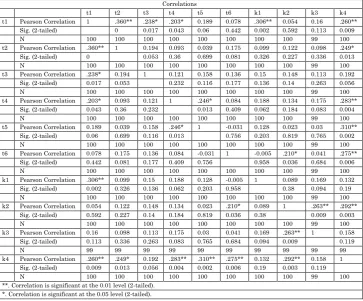
The relationship between the two variables, namely trust and Knowledge exploration, was verified and the result of both are reported in the correlation matrix. The two variables in the learning are found to be having high correlation between each other. Throughout the investigation trust will be donated by “t” and knowledge exploration will be donated by “K”.
Correlations
t1 t2 t3 t4 t5 t6 k1 k2 k3 k4
t1 Pearson Correlation 1 .360** .238* .203* 0.189 0.078 .306** 0.054 0.16 .260** Sig. (2-tailed) 0 0.017 0.043 0.06 0.442 0.002 0.592 0.113 0.009
N 100 100 100 100 100 100 100 100 99 100
t2 Pearson Correlation .360** 1 0.194 0.093 0.039 0.175 0.099 0.122 0.098 .249* Sig. (2-tailed) 0 0.053 0.36 0.699 0.081 0.326 0.227 0.336 0.013
N 100 100 100 100 100 100 100 100 99 100
t3 Pearson Correlation .238* 0.194 1 0.121 0.158 0.136 0.15 0.148 0.113 0.192 Sig. (2-tailed) 0.017 0.053 0.232 0.116 0.177 0.136 0.14 0.263 0.056
N 100 100 100 100 100 100 100 100 99 100
t4 Pearson Correlation .203* 0.093 0.121 1 .246* 0.084 0.188 0.134 0.175 .283** Sig. (2-tailed) 0.043 0.36 0.232 0.013 0.409 0.062 0.184 0.083 0.004
N 100 100 100 100 100 100 100 100 99 100
t5 Pearson Correlation 0.189 0.039 0.158 .246* 1 -0.031 0.128 0.023 0.03 .310** Sig. (2-tailed) 0.06 0.699 0.116 0.013 0.756 0.203 0.819 0.765 0.002
N 100 100 100 100 100 100 100 100 99 100
t6 Pearson Correlation 0.078 0.175 0.136 0.084 -0.031 1 -0.005 .210* 0.041 .275** Sig. (2-tailed) 0.442 0.081 0.177 0.409 0.756 0.958 0.036 0.684 0.006
N 100 100 100 100 100 100 100 100 99 100
k1 Pearson Correlation .306** 0.099 0.15 0.188 0.128 -0.005 1 0.089 0.169 0.132 Sig. (2-tailed) 0.002 0.326 0.136 0.062 0.203 0.958 0.38 0.094 0.19
N 100 100 100 100 100 100 100 100 99 100
k2 Pearson Correlation 0.054 0.122 0.148 0.134 0.023 .210* 0.089 1 .263** .292** Sig. (2-tailed) 0.592 0.227 0.14 0.184 0.819 0.036 0.38 0.009 0.003
N 100 100 100 100 100 100 100 100 99 100
k3 Pearson Correlation 0.16 0.098 0.113 0.175 0.03 0.041 0.169 .263** 1 0.158 Sig. (2-tailed) 0.113 0.336 0.263 0.083 0.765 0.684 0.094 0.009 0.119
N 99 99 99 99 99 99 99 99 99 99
k4 Pearson Correlation .260** .249* 0.192 .283** .310** .275** 0.132 .292** 0.158 1 Sig. (2-tailed) 0.009 0.013 0.056 0.004 0.002 0.006 0.19 0.003 0.119
N 100 100 100 100 100 100 100 100 99 100
**. Correlation is significant at the 0.01 level (2-tailed). *. Correlation is significant at the 0.05 level (2-tailed).
T K.
T 1 0.441**
K .441** 1
** correlation is significant at 0.01 level of significance. Table 3: Correlation Matrix Variable to variable
Table 3 shows the correlation matrix of variable to variable.
Regression Analysis:
For testing the assumption of the study, regression analysis was put into the third step. In order to look at the H1 of the study, regression was kept running, with trust as independent and knowledge exploration as dependent variable.
Variables Β t-stat Significance
T 0.481 4.834 0.00
R square = 19.4% Adjusted R square = 18.6% ** correlation is significant at 0.01 level of significance
Table 4: Regression Analysis
The top of table reveals that the coefficient of trust is 0.481 which is optimistic and highly significant at 0.01 level of significance. The t-stats of trust are 4.834 which also demonstrate that the product is very much significant. The general fit of the model is 19.4% (R square = 18.6%).
Recommendations and Particular Implications:
From the study and its results, the following are the recommendations drawn:
The colleagues do the best they can to help others and the teams to attain their goals.
Always involve the social group in assessments whenever they are affected or whenever there is a chance to attain from their knowledge.
We should be glad about ourselves for our daring and our courage to converse up uncomfortable issues.
Whenever a fault is done by our side then we should speak open about those faults and learn from that mistake.
We should be fully aware of ourselves and the strength of our team members.
We should have and use our abilities towards exploring new knowledge.
In the terms of knowledge we should be better than our team and fellows.
Limitations and Future Research:
There were several limitations faced while doing this study. The major limitation during the study was that the sample size was not large enough for the task. Upcoming research is directed to have a larger sample while studying such a relationship.
Due to the resource and time shortage the data was not collected from every field of life and different institutions. Future research is directed to gather the figures from different set of fields and organizations. This data was only collected from the students of a single university, the future research must contact more universities and educational organizations in order to increase its generalization to a much wider context.
BIBLIOGRAPHY:
Andarati, K. G. 2012. “Reviewing the relationship between Knowledge Management and Trust Levels in Organizations.” World Applied Sciences Journal 19(2): 257-264.
Argote, L. and Spektor, E. M. 2011. “Organization learning: from experience to knowledge.” Organization Science
22(5): 1123–1137.
Arora, A., Fosfuri, A., Gambardella, A., 2001a. “Markets for technology and their implications for corporate strategy.” Industrial and Corporate Change 10(2): 419 – 420.
Hildreth, P. and Kimble, C. 2000. "Communities of Practice in the distributed International environment." Journal of Knowledge Management 4(1): 27-38.
Huotari, M. L. and Iivonen M. 2004. “Managing Knowledge- Based Organization through Trust.” In Trust in Knowledge Management and Systems in Organizations,
edited by M. L. Huotari and M Iivonen, 1-29. IGI Global. doi:10.4018/978-1-59140-126-1
Levin, D. Z., Cross, R., and Abrams, L. C. 2002a. "The Strength of Weak Ties You Can Trust: The mediating role of trust in effective knowledge transfer." Rutgers University. Renzl, B., Matzler, K., and Mader, C. “Impact of trust in
colleagues and management on knowledge sharing
within and across work group.”
http://www2.warwick.ac.uk/fac/soc/wbs/conf/olkc/archive/ oklc6/papers/renzl_matzler__mader.pdf
Usoro, A., Sharratt, M. W., Tsui, E., and Shekhar, S. 2007. “Trust as an Antecedent of knowledge shares in virtual communities of practice.” Knowledge Management research & practice 5(3): 199–212.