EPiC: Efficient Privacy-Preserving Counting for
MapReduce
Abstract. In the face of an untrusted cloud infrastructure, outsourced data needs to be protected. We present EPiC, a practical protocol for the privacy-preserving evaluation of a fundamental operation on data sets: frequency counting. In an en-crypted outsourced data set, a cloud user can specify a pattern, and the cloud will count the number of occurrences of this pattern in an oblivious manner. A pattern is expressed as a Boolean formula on the fields of data records and can specify values counting, value comparison, range counting, and conjunc-tions/disjunctions of field values. We show how a general pattern, defined by a Boolean formula, is arithmetized into a multivariate polynomial and used in EPiC. To increase the performance of the system, we introduce a new privacy-preserving encoding with “somewhat homomorphic” properties. The encoding’s security is based on previous work on the Hidden Modular Group assumption, and it is highly efficient in our particular counting scenario. Besides a formal anal-ysis where we prove EPiC’s privacy, we also present implementation and evalua-tion results. We specifically target Google’s prominent MapReduce paradigm as offered by major cloud providers. Our evaluation performed both locally and in Amazon’s public cloud with up to 1 TByte data sets shows only a modest over-head of20%compared to non-private counting, attesting to EPiC’s efficiency.
1
Introduction
Cloud computing is a promising technology for large enterprises and even governmen-tal organizations. Major cloud computing providers such as Amazon and Google offer users to outsource their data and computation. The main advantage for users lies in the clouds’ flexible cost model: users are only charged by use, e.g., total amount of storage or CPU time used. In addition, clouds “elastic” services allow the users to efficiently scale resources to satisfy dynamic load. The appeal and success of outsourcing data and operating on outsourced data is exemplified by Google’s prominent MapReduce API [7]. MapReduce is offered by major public cloud providers today, such as Ama-zon, Google, IBM or Microsoft. MapReduce is typically used for analysis operations on huge amounts of (outsourced) data, e.g., scanning through data and finding patterns, counting occurrences of specific patterns, and other statistics [11].
solution running in a real-world cloud needs to be tailored to the specifics of the cloud computing paradigm, e.g., MapReduce.
This paper presents an efficient, practical, yet privacy-preserving protocol for a fun-damental data analysis primitive in MapReduce:counting occurrencesof patterns [11]. In an outsourced data set comprising a large number of encrypted data records, EPiC, “Efficient PrIvacy-preserving Counting for MapReduce”, allows the cloud user to spec-ify a pattern, and the cloud will count the number of occurrences of this pattern (and therefore histograms) in the stored ciphertexts without revealing the pattern and how often it occurs. A pattern is expressed as a Boolean formula on countable fields of data records and can specify a specific field value, a value comparison, a range of field val-ues, and more complex forms of conjunctions/disjunctions among sub-patterns. For ex-ample, in an outsourced data set of patient health records, a pattern could beage∈[50, 70]and(diabetes= 1or hypertension= 1). The main idea of EPiC is to transform the problem of privacy-preserving pattern counting into a summation of polynomial evaluations. Our work is inspired by Lauter et al. [13] to usesomewhat homomorphic encryption to address specific privacy-preserving operations. In EPiC, we extend a pre-vious work on cPIR protocols [18] to design a new “encoding” mechanisms that exhibits somewhat homomorphic properties. While we call our encoding encryption in the rest of this paper, we stress that our encryption does not provide traditional IND-CPA se-curity, but only weaker properties suited to the context we target in this paper, i.e., the summation of polynomial evaluations. In return, our “encryption” is particularly effi-cient in this context. We also show how a general pattern, defined by a Boolean formula, is arithmetized into a multivariate polynomial overGF(2), optimizing for efficiency. In conclusion, the contributions of this paper are:
– EPiC, a new protocol to enable privacy-preserving pattern counting in MapReduce clouds. EPiC reduces the problem of counting occurrences of a Boolean pattern to the summation of a multivariate polynomial evaluated on encrypted data.
– A new, practical “somewhat homomorphic” encoding/encryption scheme specifi-cally addressing secure counting in a highly efficient manner.
– An implementation of EPiC and its encryption mechanism together with an exten-sive evaluation in a realistic setting. The source code is available for download [2].
2
Problem Statement
Overview:We will use an example application to motivate our work. Along the lines of recent reports [17], imagine a hospital scenario where patient records are managed electronically. To reduce cost and grant access to, e.g., other hospitals and external doctors, the hospital refrains from investing into an own, local data center, but plans to outsource patient records to a public cloud. Regulatory matters require the privacy-protection of sensitive medical information, so outsourced data has to be encrypted. However, besides uploading, retrieving or editing patient records performed by multiple entities (hospitals, doctors etc.), one entity eventually wants to collect some statistics on the outsourced patient records without the necessity of downloading all of them.
2.1 Cloud Counting
frequency of occurrence of patternχ, e.g., how many patients haveR.disease = χ. Due to the large amount of data, downloading each patient record is prohibitive, and the counting should be performed by the cloud. While encryption of data, access control, and key management in a multi-user cloud environment are clearly important topics, we focus on the problem of a-posteriori extracting information out of the outsourced data in a privacy-preserving manner. The cloud must neither learn details about the stored data, nor any information about the counting, what is counted, the count itself, etc. Instead, the cloud processesU’s counting queries “obliviously”. We will now first specify the general setup of counting schemes for public clouds and then formally define privacy requirements. Note that throughout this paper, we will assume the countable fields to be non-negative integer fields. Besides, records may contain non-countable data, e.g., pictures or doctors’ notes, that can be IND-CPA (AES-CBC) encrypted – Therewith, it is of no importance for privacy defined below.
Definition 1 (Cloud Counting).LetRdenote a sequence of recordsR:={R1, . . . , Rn}. Besides some non-countable data, each recordRicontainsmdifferent countable
fields. Thek-th countable field of thei-th record, denoted asRi,j,1≤k≤m, can take
valuesRi,k ∈ Dk ={0,1, . . . ,|Dk| −1}, whereDk denotes the domain of thek-th
field with size1|Dk|. For the “multi-domain” ofmcountable fields we writeD=D
1× · · · × Dm. A privacy-preserving counting scheme comprises the following probabilistic polynomial time algorithms:
1. KEYGEN(κ): using a security parameterκ, outputs a secret keyS.
2. ENCRYPT(S,R): uses secret key S to encrypt the sequence of recordsR. The output is a sequence of encryptions of recordsE :={ER1, . . . , ERn}, whereERi
denotes the encryption of recordRi.
3. UPLOAD(E): uploads the sequence of encryptionsEto the cloud.
4. PREPAREQUERY(S, χ): this algorithms generates an encrypted query Qout of secretSand the multiple-field patternχ∈ D.
5. PROCESSQUERY(Q,E): uses an encrypted queryQ, the sequence of ciphertextsE, and outputs a resultEΣ. This algorithm performs the actual counting.
6. DECODE(S, EΣ): takes secretSand EΣto output a final result, the occurrences
Σ(the “count”) of the specified pattern inR.
According to this definition, cloud userU encrypts the sequence of records and uploads them into the cloud. IfUwants to know the number of occurrences ofχin the records, he prepares a queryQ, which is – as we will see later – simply a fixed-length sequence of encrypted values.Uthen sendsQto the cloud, and the cloud processesQ. Finally, the cloud sends a resultEΣback toUwho can decrypt this result and learn the
numberΣof occurrences of patternχ, i.e., the count.
2.2 Privacy
In the face of an untrusted cloud infrastructure, cloud userUwants to perform counting in a privacy-preserving manner. Intuitively, the data stored at the cloud as well as the counting operations must be protected against a curious cloud. Informally, we demand
1Domain size|D
1) storage privacy, where the cloud does not learn anything about stored data, and 2)counting privacy, where the cloud does not learn anything about queries and query results. The cloud, which we now call “adversary”A, should only learn “trivial” privacy properties like the total size of outsourced data, the total number of patient records or the number of counting operations performed forU. We formalize privacy for counting using a game-based setup. In the following,(κ)denotes a negligible function in the security parameterκ.
Definition 2 (Bit mapping).LetR={R1, . . . , Rn}be a set of records, andRi,k ∈ {0,1}∗thek-th field of recordR
i. Letχ, Σ∈ {0,1}∗be bit string representations of a
pattern and a count. ForX∈ {Ri,k, χ, Σ},bit(j, X)denotes thej-th bit ofX.
Definition 3 (Storage privacy).A challenger generates two same-size same-field-types sets of recordsR,R0and two patternsχ, χ0 ∈ D. The challenger then usesENCRYPT
andPREPAREQUERYto compute the encrypted sets of recordsE,E0and two encrypted counting queriesQ, Q0 corresponding to two patternsχ, χ0. UsingPROCESSQUERY, he evaluatesEwithQ, andE0withQ0to get encrypted resultsE
Σ, E0Σ. The challenger
sendsI :={E,E0, Q, Q0, E
Σ, EΣ0 }to adversaryA. For any patternsχ, χ0, anyX, X0
such that eitherX∈ {{Ri,k}}andX0 ∈ {{Ri,k}}orX =χandX0 =χ0orX =Σ andX0=Σ0, and for anyb= bit(j, X)andb0= bit(j0, X0), the adversaryAoutputs 1, if she guessesb =b0, and0otherwise. A protocol preserves storage privacy,ifffor any probabilistic polynomial time (PPT) algorithmA, the probability of correct output is not higher than a random guess. That is,Pr [A(I) = 1|b=b0]−12
≤ (κ)and
Pr [A(I) = 0|b6=b0]−12
≤(κ).
Definition 4 (Counting privacy).A challenger generates two same-size same-field-types sets of recordsR,R0, and two patternsχ, χ0, usesENCRYPT,PREPAREQUERY,
andPROCESSQUERY, and sends encryptedI :={E,E0, Q, Q0, E
Σ, EΣ0 }, toA. Now, Aoutputs 1, if χ = χ0, and0 otherwise. A protocol preserves counting privacy,iff for any PPT algorithmAthe probability of correct output is not better than a random guess:Pr [A(I) = 1|χ=χ0]−12
≤(κ)and
Pr [A(I) = 0|χ6=χ0]−12
≤(κ).
Similar to traditional indistinguishability,storage privacyandcounting privacy cap-tures the intuition that, by storing data and counting, the cloud should not learn anything about the content it stores. In addition, the cloud should not learn anything about the counting performed, such as which pattern is counted, whether a pattern is counted twice or what the resulting count is.
2.3 MapReduce
EPiC’s counting “job” runs in two phases. First, in the “mapping” phase,Mapper nodes scan data through InputSplits (data pieces split automatically by MapReduce framework) and evaluate the counting’smapfunction on the data. These operations are performed by all Mappers in parallel. The outputs of eachmapfunction are sent to one Reducernode, which, in the “reducing” phase, aggregates them and produces a final output that is sent back to the user. This setup takes advantage of the parallel nature of a cloud data center and allows for scalability and elasticity.
3
EPiC Protocol
To motivate the need for a more sophisticated protocol like EPiC, we briefly discuss why possible straightforward solutions do not work in our particular application scenario. Precomputed Counters:One could imagine that the cloud user, in the purpose of count-ing a valueχkin a single countable fieldDk, simply stores encrypted counters for each
possible value ofχkin domainDkin the cloud. Each time records are added, removed
or updated, the cloud user updates the encrypted counters. However, this approach does not scale very well in our scenario where multiple cloud users (different “doctors”) per-form updates and add or modify records. An expensive user side locking mechanism would be required to ensure consistency of the encrypted counters. Moreover, in the case of complex queries involving multiple fields, all possible combinations of counters need to be updated by users involving a lot of user side computation.
Per-Record Counters (“Voting”):Alternatively and similar to a naive voting scheme, each encrypted record stored in the cloud could be augmented with an encrypted “vot-ing” field containing |Dk| subsets, each oflog2nbits. If a record’s countable value
in fieldDk matches the value corresponding to a subset, then the according subset is set to 1. To find the count, the cloud sums the encrypted voting fields (using addi-tive homomorphic encryption) for all records. Again, such an approach requires heavy locking mechanism and recomputation of counters for each operation of adding, remov-ing, or modifying a record. In conclusion, these straightforward solutions require heavy user-side computation and do not provide efficient, practical, and flexible solutions for multi-user, multiple field data sets.
3.1 EPiC Overview
For ease of understanding, weinitiallyintroduce EPiC for the simpler case of count-ing on only a scount-ingle countable fieldDk in a multiple countable fields data set where values are in GF(q). Subsequently, we extend EPiC to support counting on Boolean combinations of multiple countable fieldsD1, . . . ,Dmover GF(q). Finally, for
perfor-mance improvement, we further optimize our mechanisms by considering conversion of (generic) finite fields GF(q) into binary finite fields GF(2).
EPiC’s main rationale is to perform the counting in the cloud by evaluating an in-dicator polynomial Pχ(·), as queryQ, specific to the patternχ the cloud userU is
interested in. Conceptually, the cloud evaluatesPχ(·)on the countable fields’ values of
each record. The outcome of all individual polynomial evaluations is a (large) set of values of either “1” or “0”. The cloud now adds these values and sends the sum back to
3.2 Counting on a single field
Without loss of generality, we assume a userU wishes to count occurrences of χin the first fieldD1in an oblivious manner. The idea is to prepare a univariate indicator
polynomialPχ(x)such thatPχ(x) =
1,ifx=χ
0,otherwise , and scan through the data set
R = {R1, . . . , Rn} of all records to compute the sumP n
i=1Pχ(Ri,1). The result is
the number of occurrences ofχin the first field in the data set. The idea for generating Pχ(x) is to construct the polynomial in the Lagrange interpolation form Pχ(x) := P|D1|−1
j=0 aj·xj := Qα∈D1,α6=χ
x−α
χ−α.The polynomial Pχ(x)is of degree|D1| −1,
and its coefficientsaj are uniquely determined.
Encrypted polynomial:In EPiC, each countable valueRi,kis encrypted toERi,k. The
above indicator polynomial based counting method for plaintext values can be applied in a similar manner. UserU prepares the indicator polynomial based on plaintextχ, but
U encrypts coefficientsaj toEaj before sending them to the cloud, which now
com-putes the encrypted sum EΣ := P n
i=1Pχ(ERi,1) =
Pn
i=1
P|D1|−1
j=0 Eaj·(ERi,1)
j.
Note that the polynomialcoefficientsare encrypted (and potentially large), but the poly-nomialdegreeremains|D1| −1. In order for the cloud to computeEΣ and userU to
decrypt it later, additively and multiplicatively homomorphic properties are required for the encryption, which we describe in Section 3.5. As a final step,Usimply receives backEΣ and only decrypts the countσ:=DEC(EΣ) =Pχ(x). This does not require
high computational costs at the user, suiting the cloud computing paradigm well.
Cloud computation cost:Our counting technique above requiresn· |D1|additions, n· |D1|multiplications, andn·(|D1| −1)exponentiations. We can improve efficiency
by rearranging the order of computations:
EΣ := n X
i=1
Pχ(ERi,1) =
n X
i=1
|D1|−1
X
j=0
Eaj ·(ERi,1)
j= |D1|−1
X
j=0 (Eaj ·
n X
i=1 (ERi,1)
j).
(1) Therewith, the number of multiplications is reduced to|D1|. We will apply this
tech-nique also to multiple field counting later, significantly improving performance. We also note that in the case of a binary domain (|D1|= 2), there are no exponentiations. This
observation motivates our optimization described later in Section 3.4.
Oblivious counting: Our indicator polynomial based counting method is oblivious: first, the query is submitted to the cloud as a sequence of encrypted coefficients of the indicator polynomial;second, no matter what query is made, exactly|D1|coefficients
(including 0-coefficients) are sent, thus preventing the cloud to infer query information based on the query size.
3.3 Counting patterns defined by a Boolean formula
to arithmetic operations, which is similar toarithmetization, cf. Babai and Fortnow [4] or Shamir [15].
Conjunctive counting:Assume cloud userU is interested in counting the number of records that have theirmcountable fields set to the patternχ = (χ1, . . . , χm). Here,
χk,1 ≤ k ≤ m, denotes the queried value in thek-th field. Let ϕ = (x1 = χ1∧ . . .∧xm = χm)be the conjunction amongmfields in the data set. UserU can now
constructPϕ(x) = Q m
k=1Pχk(xk),wherex = (x1, . . . , xm)denotes the variables in
the multivariate polynomialPϕ(x), andPχk(xk)is the univariate indicator polynomial
(as defined in Section 3.2) for countingχkin thek-th field. Therewith,Pϕ(x)yields1
only whenχis matched. Note that the size of the multi-domainDis|D|=Qm k=1|Dk|,
and the degree ofPϕ(x)isP m
k=1(|Dk| −1).
Disjunctive counting: Assume the data set has 2 countable fields, and U’s objec-tive is to count the number of records that have value χ1 inD1 or valueχ2 inD2.
The multivariate indicator polynomial for this disjunction isPχ1∨χ2(x) =Pχ1(x1) + Pχ2(x2)−Pχ1∧χ2(x),wherePχ1(x1), Pχ2(x2)are univariate indicator polynomials forD1,D2, respectively, andPχ1∧χ2(x)is a multivariate indicator polynomial for con-junctive counting betweenD1andD2. This method can be easily generalized to design
counting query for disjunctions ofmfields.
Complement counting: U can count records that do not satisfy a condition among fields by “flipping” the satisfying indicator polynomial:P¬ϕ(x) = 1−Pϕ(x).
Integer range counting:AssumeU wants to count records having a fieldDklying in an integer range[a, b], i.e.,ϕ = (xk = a∨xk = a+ 1∨. . .∨xk = b). Based on
disjunctive constructing method, we haveP[a,b](xk) = Pa(xk) +Pa+1(xk) +. . .+
Pb(xk)−Pa∧a+1−. . .; Since(xk =u)and(xk =v)are exclusive disjunctions for
anyu6=v∈[a, b],P[a,b](xk)reduces toP[a,b](xk) =P b
χk=aPχk(xk).
Integer comparison counting: Queries involving integer comparisons can be con-structed based on integer range counting, e.g.,Pχk≤a(xk) =P[0,a](xk), orPχk>a(xk) =
P[a+1,|Dk|−1](xk).
Privacy: Although the user-defined queries are different in construction, the en-crypted queriesQalways have exactly|D|=Qm
k=1|Dk|encrypted coefficients as we
include zero coefficients also. As mentioned in Section 3.2, this prevents the cloud to differentiate queries based on query sizes.
Efficiency:The user-side computation involving constructing the query’s coeffi-cients is carried on plain-text before encryption, hence it introduces much lower compu-tation cost compared to the compucompu-tation burden on the cloud. To improve the user-side performance, one could apply optimizing techniques for reducing complex expressions, but this is out of scope of our paper. To improve the cloud’s performance, we apply the method of rearranging order of computations as in equation (1) for the sequence E(Ri) = (ERi,1, . . . , ERi,m)of encrypted fields and coefficientsaj withj= (j1, . . . ,
jm)∈ Dcorresponding to multivariate monomialsxj11·x j2
2 · · ·xjmm:
EΣ= n X
i=1
Pχ(E(Ri)) = X
j∈D
(Eaj ·
n X
i=1 m Y
k=1 (ERi,k)
3.4 Optimization through arithmetization inGF(2)
EPiC’s efficiency relies on the computations performed by the cloud. As discussed in Section 3.2, there areno exponentiationsrequired for counting on a binary field. Con-sequently, we optimize EPiC by converting generic (non-binary) fields into multiple binary fields, thereby avoiding costly exponentiations. Note that as the conversion pre-serves Boolean expression output, results shown in Section 3.3 still hold, and protocol details discussed later in Section 3.6 remain unchanged.
Our idea is to store every generic fieldDkas separate binary fieldsDk,1,Dk,2,. . ., Dk,kDkk.2Therefore,mgeneric fieldsD1, . . . ,DmbecomeP
m
k=1kDkkbinary fields D1,1, . . . ,D1,kD1k, . . . ,Dm,1, . . . ,Dm,kDmk. The indicator polynomial for countingχk in fieldDkis now constructed asPχk,1∧...∧χk,kDkk(xk,1, . . . , x1,kDkk) =
QkDkk
l=1 Pχk,l(xk,l),
wherexk,l represents thel-th bit in the generic fieldDk, andχk,ldenotes the
corre-sponding queried bit value. Applying arithmetization to “transform” from Boolean to multivariate polynomials, Boolean expressions of mgeneric fields can be converted into equivalent multiple binary fields. For convenience in later sections, we call the conversion to binary fields “GF(2) arithmetized” (shortly “G”), while the original is “Basic” (shortly “B”). We note that although the number of coefficients of the GF(2) arithmetized multivariate indicator polynomial corresponding to each query remains the same as in the generic case, the (multivariate) degree of the GF(2) arithmetized polynomial is much lower at deg(P(G)) = Pm
k=1kDkk =
Pm
k=1dlog2|Dk|e
Pm
k=1(|Dk| −1) = deg(P
(B)). This implies a significant improvement for
compu-tational costs on the cloud. We refer to EPiC’s evaluation in Section 4 for details.
3.5 Encryption
Since EPiC’s indicator polynomial based counting technique involves additions and multiplications on ciphertexts, a homomorphic encryption scheme is needed as a build-ing block. While there already exist various schemes [6, 9, 13, 20], their computational complexities are high, rendering their use in current clouds impractical. Although EPiC can seamlessly integrate related work, we use a novel, specific encryption scheme. As we will see, this scheme does not enjoy the same security properties, i.e., IND-CPA, as related work, but only security with respect to definitions 3 and 4 as required in the spe-cific context of EPiC. Due to its weaker security properties, our scheme is especially practical in the settings we target. We design a somewhat homomorphic encryption scheme derived from the computational Private Information Retrieval (cPIR) technique of Trostle and Parrish [18]. Our new scheme is a secret key encryption scheme, where the cloud does not have the secret key to decrypt the data, but instead blindly performs operations on outsourced data.
Key generation– KEYGEN(s1, s2, n,D): Parameterss1, s2 ∈ Nare security
param-eters,n ∈ Nis the upper bound for the total number of records in the data set, and
D=D1×. . .× Dmis the multi-domain ofmcountable fields. KEYGENcomputes a
random primeqsuch thatq > n, a random primep, and a randomb∈Zp. The secret
key, the output of KEYGEN, is defined asK:={p, b}. The primepis generated based
2kXk=dlog
on the following condition (refer to Appendix A for details).
kpk ≥s1+knk+kqk+ m X
k=1
(s2+kqk)·(|Dk| −1). (3)
Encryption– ENC(P): Selects a random numberr,krk ≤s2, and encrypts the
plain-textPtoC=ENC(P) :=b·(r·q+P) modp.
Decryption– DEC(C): DecryptsCtoP=DEC(C) :=b−1· Cmodpmodq.
The security of our encryption scheme is based on the Hidden Modular Group Order hardness assumption and the cPIR protocol in [18]. The rationale is that, for appropri-ate security parameters, more than half of the bits ofpare still secret against any PPT adversary (Theorem 4.5 in Trostle and Parrish [18]); and if a PPT adversary can break the cPIR protocol, the Hidden Group Orderpis also revealed, violating the assumption. Based on the proof of the cPIR protocol, we will prove EPiC’s security properties in Section 3.7. The addition and multiplication operations on ciphertexts take place in the integers. There is no modulo reduction, as the cloud does not knowp. One can verify that this scheme provides additively and multiplicatively homomorphic properties (see Appendix A). Note that a multiplication of ciphertexts will increase the exponent ofb in the result. Therefore, in general, a decryption of a ciphertext after(j−1) multipli-cations has to bePj =DEC(Cj, j) :=b−j· Cjmodpmodq. So, contrary to related
work, decryption in our scheme requires the number of multiplications performed on the ciphertext. Also, EPiC’s encryption scheme does also not allow addition of two ci-phertexts that have different exponents of b, i.e., are results of a different number of multiplications. In the particular context of EPiC, we can accept these limitations, and we gain high computation efficiency in return. Finally, this scheme is only somewhat homomorphic: as the cloud cannot perform modulo operations, ciphertexts increase for every multiplication and addition (see Appendix A). This requires a careful selection of qandpin advance, such that decryption remains possible.
3.6 Detailed Protocol Description
With all ingredients ready, we now describe EPiC using the notation of Section 2.1.
KEYGEN(κ): Based on security parameterκ, cloud userUchoosess1, s2for the
some-what homomorphic encryption, determines an upper bound n for the total number of records that might be stored and the appropriate multi-domain D for the count-able fields.U generates a secret keyK from the somewhat homomorphic encryption KEYGEN(s1, s2, n,D)and a symmetric keyK0 for a block cipher such as AES used
for non-countable data. The secret keyS :={K, K0}is used throughout EPiC.
ENCRYPT(S,R): AssumeU wants to storenrecordsR={R1, . . . , Rn}. Each record
Ri is encrypted separating the countable valuesRi,k from the rest of the record.Ri,k
is encrypted using the somewhat homomorphic encryption mechanism, i.e.,ERi,k :=
ENC({p, b}, Ri,k). For the rest of the recordRi, a random initialization vectorIV is
chosen and the record is AESK−CBC encrypted. In conclusion, a recordRiencrypts
toERi := {ERi,1, . . . , ERi,m, IV,AESK −CBC(Ri,rest)}.The output of ENCRYPT
Algorithm 1: PROCESSQUERY
For each MapperM:
initsj:= 0,∀j∈ D
forallERiinInputSplit(M)do
read{ERi,1, . . . , ERi,m}
forallj= (j1, . . . , jk)∈ Ddo
sj:=sj+Qmk=1(ERi,k) jk
end end
emit{j, sj},∀j∈ D
ReducerR:
initEΣ:= 0,Sj:= 0,∀j∈ D
forall{j, sj}inMappersOutputdo Sj:=Sj+sj
end
foralljinDdo
EΣ:=EΣ+Eaj·Sj
end write{EΣ}
UPLOAD(E): Upload simply sends all records as one large file to the MapReduce cloud
where the file is automatically split intoInputSplits.
PREPAREQUERY(S, χ): To prepare a query forχ,U computes the|D|coefficientsaj,
j∈ D, of the indicator polynomialPχ(x)as described in Section 3.3. Coefficientsajare
encrypted and sent to the cloud. The cloud will be using these coefficients to perform the evaluation ofPχ(x). Consequently in EPiC, the outputQof PREPAREQUERYsent
to the cloud isQ:={Eaj,j∈ D}.
PROCESSQUERY(Q,E): Based on the data set size and the cloud configuration, the MapReduce framework selectsM Mapper nodes and1Reducer node.
Algorithm 1 depicts the specification of EPiC’smapandreducefunctions that will be executed by the cloud. In the mapping phase, for each input recordRiin their locally
stored InputSplits, the Mappers compute in parallel all monomialsQm
k=1(ERi,k) jkof
the countable fields and add the same-degree monomials together. After the Mappers finish scanning over all records, the sumssjof monomials are output as key-value pairs.
These pairs contain the multi-degreej as key, and the computed sumsj as value. In
MapReduce, output of the Mappers is then automatically sent (“emit”) to the Reducer. The sums sj emitted by each Mapper are taken over records in the InputSplit
corre-sponding to that Mapper only. The Reducer, therefore, based on the sums received from all Mappers, combines them together to obtain theglobalsumsSj, i.e., the sums over all
records in the data set. In a last step, the Reducer uses the coefficientsEaj received from
Uto evaluate the polynomial by computing the inner product with the global sums. The resultEΣis sent back toU and can be decrypted to obtain the count value.
DECODE(S, EΣ):U receivesEΣand computes the counting resultσ=DEC(EΣ).
3.7 Privacy Analysis
We now formally prove Storage and Counting privacy for EPiC and its underlying en-cryption. We stress that, below, we neither target nor prove that our novel “encryption” provides traditional IND-CPA security. Instead, we show that, in combination with other details of our protocol, it provides security according to definitions 3 and 4.
Proof. cPIR-security, e.g., by Trostle and Parrish [18], can be summarized as follows. With au×ubit database, a user wants to retrieve any-th row and sends an encrypted PIR request to the cloud:P ={Ev1, . . . , Evu}, whereEvk=ENC(vk), cf. Section 3.5,
andvk = 1, ifk = y, andvk = 0otherwise. This cPIR protocol is secureiff for all
PPT adversariesA∗, the probability of findingyis negligible more than guessing, i.e.,
Pr [A∗(P) =y]≤1/u+∗(κ).
We now prove our lemma by reduction from cPIR security. We show that, for se-curity parameterκ, any PPT(t(κ), (κ))-adversaryAbreaking EPiC’s storage privacy (Definition 3) int(κ)steps with non-negligible advantage(κ)can be used to construct a(t∗(κ), ∗(κ))-adversaryA∗as a subroutine breaking the cPIR protocol in [18]. We
constructA∗based on theparityofu.
1.uis odd.First,A∗receives as input the PIR requestP and splitsP into two halves E = {Ev1, . . . , Evbu/2c},E
0 = {E
vbu/2c+1, . . . , Eu−1}, i.e., treating the PIR request as two EPiC data sets of the same size (bu/2crecords). SinceEvk are either
encryp-tions of0 or1,E andE0 are now viewed as single-binary-field data sets, where each
record contains only 1 countable binary field.A∗randomly selectsl
1, l2, l10, l02∈[1, u]
and creates two EPiC counting queriesQ={Evl1, Evl2}, Q
0 ={E
vl0
1 , Evl0
2
}. These are two valid queries, because for single-binary-field data setsE,E0, any EPiC query
contains exactly 2 encrypted coefficients of0or1, cf. Section 3.3. ThenA∗runs P
RO
-CESSQUERYonEwithQ, andE0withQ0, thereby obtainingE
ΣandEΣ0 .A∗forwards
I={E,E0, Q, Q0, E
Σ, E0Σ}toA.A∗’s output depends onA’s output as follows.
IfAoutputs0,A∗outputsu. The intuition is that, sinceA“believes” the two halves EandE0are the same,A0concludes that the requested element must not belong to either EorE0, i.e.,v
u= 1.
If A outputs 1, A∗ randomly selects k ∈ [1, u−1] and outputs k. The
intu-ition is that “Aoutputs1” indicates the requested row index is between1andu−1, andA∗ simply makes a random guess for it. The probability forA∗ to output
cor-rectly isPr [A∗(P) =y] = Pr [A= 0|y=u]·Pr [y=u] + Pr [A= 1, k=y|y < u]·
Pr [y < u] = 12 +(κ) · 1
u + 1 2+(κ)
· 1
u−1· u−1
u =
1 u+
2(κ)
u .Therewith,A ∗
has a non-negligible advantage of∗(κ) = 2(κ)/uin findingy.
2.uis even.A∗ makes a new PIR requestP0 by removing the last elementv u from
P, that isP0 = {Ev1, . . . , Evu−1}. Then A
∗ uses the same approach as in the odd
case forP0, i.e., splittingP0 into 2 halves, feeding them toA. Now,A∗ outputsu−
1, ifA outputs 0, or outputs random k ∈ [1, u−2]otherwise. It can be observed that A∗can find ywith non-negligible probability, only ify 6= u, i.e., the requested
element is not the last element discarded from P. Otherwise,A∗ cannot find y (i.e.,
zero probability). More precisely, the probability of correct guess isPr [A∗(P) =y]
= Pr [A∗(P0) =y|y < u]· Pr [y < u] + Pr [A∗(P0) =y|y=u]· Pr [y=u]
=u−11+2u−(κ1)· u−1 u + 0·
1 u =
1 u+
2(κ)
u .Therefore,A
∗also has a non-negligible
advantage of2(κ)/uin findingy.
Consequently, in both cases,A∗has a non-negligible advantage∗(κ) = 2(κ)/u
of breaking the cPIR protocol int∗(κ) =t(κ)steps, rendering our reduction tight. ut
1e-05 0.0001 0.001 0.01 0.1 1 10
500 1000 1500 2000 2500 3000 3500 4000 4500
Operation time (ms)
Size of p (bits)
Encryption Decryption Addition
Multiplication Exponentiation
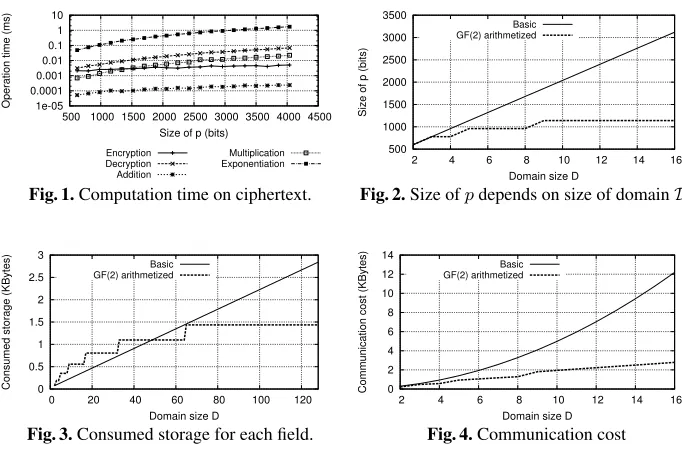
Fig. 1.Computation time on ciphertext.
500 1000 1500 2000 2500 3000 3500
2 4 6 8 10 12 14 16
Size of p (bits)
Domain size D Basic GF(2) arithmetized
Fig. 2.Size ofpdepends on size of domainD.
0 0.5 1 1.5 2 2.5 3
0 20 40 60 80 100 120
Consumed storage (KBytes)
Domain size D Basic GF(2) arithmetized
Fig. 3.Consumed storage for each field.
0 2 4 6 8 10 12 14
2 4 6 8 10 12 14 16
Communication cost (KBytes)
Domain size D Basic GF(2) arithmetized
Fig. 4.Communication cost Proof. We prove our lemma by reduction from cPIR security. Recall the cPIR-security definition as in Lemma 1’s proof. We assume the existence of a PPT(t(κ), (κ)) -EPiC-adversaryAbreaking EPiC’s counting privacy (Definition 4) int(κ)steps with non-negligible advantage (κ). In the following, we construct a new (t∗(κ), ∗(κ)) -PIR-adversaryA∗that breaks this cPIR security.
A∗ receives as input the PIR request P = {E
v1, . . . , Evu}, wherevy = 1and
vk = 0,∀k6=y. The goal ofA∗is to guessy. First,A∗setsE=E0=Pand randomly
picks 4 elementsEl1, El2, El01, El20 fromPto make two EPiC queriesQ={El1, El2}, Q0 ={El0
1, El02}. Note thatE,E
0can be viewed as EPiC’s two identical
single-binary-field data sets, andQ, Q0 are valid queries (corresponding to some patternsχ, χ0) for
E,E0. ThenA∗ runs PROCESSQUERYonE withQand on E0 withQ0 to obtainE Σ,
EΣ0 . Now,A∗forwardsI={E,E0, Q, Q0, E
Σ, EΣ0 }toAand observesA’s output.
LetU ={1, . . . , u}, L={l1, l2, l01, l02}. IfAreturns1,A∗concludes that the two
queriesQandQ0are identical, implying thatE
vy ∈/Q∪Q
0, i.e.,y /∈L. Therewith,A∗
makes a guess foryby selecting a randomk∈U\Land outputsk. Otherwise, ifA re-turns0,A∗concludes thatv
yis in eitherQorQ0, thusA∗outputs a randomk∈L. The
probability of the correct guess isPr [A∗(P) =y] = Pr [A(I) = 1, k=y|y∈U \L]·
Pr [y∈U \L] + Pr [A(I) = 0, k=y|y∈L]·Pr [y∈L] = 12+(κ) · 1
u−4· u−4
u +
1 2+(κ)
· 1 4 · 4 u = 1 u +
2(κ)
u . That isA
∗has a non-negligible advantage 0(κ) =
2(κ)/uof breaking the cPIR protocol int∗(κ) =t(κ)steps. ut
4
Evaluation
Java’s standard BigInteger data type. Still, exponentiation, e.g.Cj, withj = 15and |C| ≈ 4000takes< 2ms on a1.8GHz Intel Core i7 laptop, a single addition is not measurable with < 1µs. Figure 1 shows a benchmark of various operations on the ciphertexts using our encryption scheme. In our evaluation, we use security parame-ters s1 = 400 bits as suggested by Trostle and Parrish [18] for good security, and s2 = |r| = 160bits. We have implemented a data generator program to randomly
generate patient records withmcountable fields with size between 4 and 10 bits. We have evaluated the performance of EPiC by comparing our “Basic” and “GF(2) arithmetized” solutions with a “non-privacy-preserving” solution. Unless otherwise stated, the single/multi-domain size in both “Basic” and “GF(2) arithmetized” solutions is al-ways set to the same value|D|for comparison. For shorter presentation, we use “B” as index of the cost in Basic approach, and “G” in GF(2) arithmetized approach, e.g.,
kpBk,kpGkindicate the size in bits ofpin Basic, GF(2) arithmetized approach respec-tively. We also setu=s1+knk+kqk,v=s2+kqkand use them as fixed parameters
(with respect to|D|) when evaluating the cost.
Size of primep As discussed in Section 3.5, primeqdepends only on the number of recordsn, while primepalso depends on|D|. Derived from Equation (3), we show the benefit of the GF(2) arithmetized approach (m=kDk,|Dk|= 2) by demonstrating that
a conversion to multiple binary fields reduceskpksignificantly tokpGk=u+kDk ·v, while the Basic approach (m= 1,|D1|=|D|) requires thatkpBk=u+ (|D| −1)·v.
Figure 2 shows the logarithmic increase of size ofpwith GF(2) arithmetized approach and linear increase with Basic approach.
Storage cost The storage cost depends on the size of the data stored on the cloud. In the following, we only focus on the size of the countable fields, which is determined by the size of primep. In Basic approach, a generic field of domainDrequires a storage ofSB =kpBk=u+ (|D| −1)·vbits. In GF(2) arithmetized approach, the equivalent
generic field converted to binary fields requires a storage ofSG=kDk · kpGk=kDk ·
(u+kDk ·v)bits. Again, in Figure 3, we see a linear increase of storage in terms of the domain size|D|in Basic approach, while the GF(2) arithmetized approach consumption increase only logarithmically. This demonstrates a significant improvement on reducing the data size when “splitting” them into binary fields.
User computation cost Uprepares the query in plaintext, which incurs very low com-putation cost compared to the cloud comcom-putation performed on ciphertexts. The en-cryption of one coefficient takes roughly 1 ms (Figure 1), resulting in approximately
|D|ms for encrypting|D|coefficients in the query, regardless of using Basic or GF(2) arithmetized. The count is obtained by decrypting only one final sum, therefore the total user computation cost is negligible compared to the cloud cost (shown below).
User communication cost Due to oblivious counting, userUprepares and sends all|D|
coefficients corresponding toallmonomials to the cloud. The total size of the encrypted coefficients is|D|·kpk. In Basic approach, the query size isQB =|D|·kpBk=|D|·(u+
0 200 400 600 800 1000 1200 1400
0 200 400 600 800 1000 0 0.2 0.4 0.6 0.8 1 1.2
Counting time (s)
Ratio
Data set size (GB) Non-private GF(2) arithmetized Basic GF(2) arithmetized ratio Basic/non-private ratio
Fig. 5.Counting time vs. data set size.|D|= 16. 0 20 40 60 80 100 120
0 200 400 600 800 1000 0
0.2 0.4 0.6 0.8 1 1.2 1.4
Counting time (s)
Ratio
Record size (KBytes) GF(2) arithmetized
Non-private Ratio
Fig. 6.50GB, varying record size.|D|= 16.
0 500 1000 1500 2000 2500 3000 3500 4000 4500
10 x 1 bit 5 x 2 bits 3 bits + 3 bits + 4 bits
Counting time (s)
Different combinations of multiple fields Fig. 7.Effect of different field combinations.
500 510 520 530 540 550 560 570 580
Specific value MSB=0 LSB=0
Counting time (s)
Query types
Fig. 8.Different query types on the same data.
field of domain size|D|= 1024(i.e.,kDk= 10), the corresponding query size in each approach isQB = 22.5MBytes, andQG= 280KBytes, respectively.
The answer size (size in bits of the received ciphertext as final sum) depends on the maximum size of the multivariate monomial. The size of a monomial is determined by the ciphertext size (i.e.,kpk) and the number of performed multiplications, i.e., its multi-degree. Letddenote the maximum multi-degree of monomials, then,d = |D|
in the Basic approach, andd = kDkin the GF(2) arithmetized approach. We have AB =|D|·kpBk=|D|·(u+(|D|−1)·v)andAG=kDk·kpGk=kDk·(u+kDk·v).
For example of a data set containingn= 106records with a countable field of domain
size|D|= 1024, the answer size in each approach isAB = 22.5Mbytes, andAG =
2.7KBytes, respectively.
Total transfer cost:The total communication cost,C=Q+A, as shown in Figure 4, is much less in GF(2) arithmetized approach than in Basic approach:CB=QB+AB=
2· |D| ·(u+ (|D| −1)·v),CG=QG+AG= (|D|+kDk)·(u+kDk ·v).
Cloud computation We have evaluated the cloud computation cost for large-scale data sets on Amazon’s public cloud. As Amazon imposes an (initial) limit of 20 instances per job, we restrict ourselves to 20 Standard Large On-Demand instances [1]. Each instance comprises 4 2.27GHz Intel Xeon CPUs and a total of 7.5 GB RAM.
but as well the time a “non-privacy-preserving” counting would take, i.e., the countable field is not encrypted and directly counted. Moreover, we also show the overhead ra-tio between EPiC’s two approaches and non-private counting. The addira-tional overhead introduced by EPiC over non-private counting is less than 20%. We conjecture that only20%overhead/additional cost over non-privacy-preserving counting is acceptable in many real-world situations, rendering EPiC practical.
Variable record size:To also evaluate the effect of the size of the records on the general performance, we run the system with a fixed data set size of 50 GB. The record size is changed from 100 KB to 1 MB. Figure 6 shows that, while IO time remains unchanged, a higher number of records increases counting time in EPiC. However, the overhead of EPiC is still under20% even for small record sizes such as 100 KB compared to non-private counting. That is, EPiC is efficient even for small patient records.
Effect of multiple fields:To study the efficiency of transforming a single countable field
Dinto multiple fields of different size, we conduct an experiment on a data set size of 100GB. The total domain size is set to|D|= 1024(10 bits). We compare three cases: (a) transformDinto 10 single binary fields; (b) transformDinto 5 quaternary fields each of 2 bits; (c) transformDinto 3 fields of 3 bits, 3 bits, and 4 bits, respectively. In Figure 7, we can see that the GF(2) arithmetized approach yields the best performance.
Query types:Finally, to evaluate the effects of different query types on the performance, we run EPiC with a fixed data set of 100 GB. Total domain size is|D| = 1024. We make 3 different queries: (a) query for a specific value; (b) query for the MSB of the field equal to 0; (c) query for the LSB of the field equal to 0. Figure 8 demonstrates that there is no significant difference in counting time between different queries.
5
Related Work
Protecting privacy of outsourced data and delegated operations in a cloud computing environment is the perfect setting for fully homomorphic encryption. While there is cer-tainly a lot of ongoing research in fully homomorphic encryption (see Vaikuntanathan [19] for an overview), current implementations indicate high storage and computational overhead [10, 14], rendering fully homomorphic encryption impractical for the cloud.
Similar to EPiC, Lauter et al. [13] observe that often weaker “somewhat” homomor-phic encryption might be sufficient. Lauter et al. [13]’s scheme is based on a protocol for lattice-based cryptography by Brakerski and Vaikuntanathan [6]. However, for the specific application scenario considered in this paper, EPiC’s somewhat homomorphic encryption scheme allows for much faster exponentiation.
Superficially, our work bears similarity with the work of Kamara and Raykova [12] that protect polynomial evaluation by randomized reduction techniques. Withqbeing the degree of a polynomial, the user splits each data record into2·q+ 1shares, each of size2·q+ 1. Shares are then uploaded and evaluated in parallel, and results are aggregated. However, storage expansion, even for modest values ofq, the approach quickly becomes impractical. Also, for different polynomials, the user would need to upload the data multiple times.
to perform efficient counting in a highly parallel cloud computing, e.g., MapReduce environment. Also notice that, e.g., Boneh et al. [5] rely on the computation of very expensive bilinear pairings for each element of a data set, rendering this approach im-practical in a cloud setting.
Much research has been done to compute statistics in a privacy-preserving manner usingdifferential privacy, see the seminal paper by Dwork [8]. Contrary to the threat model considered in this paper, the adversary in differential privacy research is not the cloud infrastructure, but a curious user querying statistics to learn information about individual entries in a data set. EPiC addresses the opposite problem, where a user does not trust the cloud infrastructure.
6
Conclusion
In this paper, we present EPiC to address a fundamental problem of statistics com-putation on outsourced data: privacy-preserving pattern counting. EPiC’s main idea is to count occurrences of patterns in outsourced data through a privacy-preserving summation of the pattern’s indicator-polynomial evaluations over the encrypted dataset records. Using a “somewhat homomorphic” encryption mechanism, the cloud neither learns any information about outsourced data nor about the queries performed. Our im-plementation and evaluation results for MapReduce running on Amazon’s cloud with up to 1 TByte of data show only modest overhead compared to non-privacy-preserving counting. Contrary to related work, this makes EPiC practical in a real-world cloud computing setting today.
Bibliography
[1] Amazon. Elastic MapReduce, 2012. http://aws.amazon.com/
elasticmapreduce/.
[2] Anonymized for submission. EPiC Source Code, 2013. Download from
https://www.dropbox.com/s/abr7tuck1akv1ly/epic.zip.
[3] Apache. Hadoop, 2010.http://hadoop.apache.org/.
[4] L. Babai and L. Fortnow. Arithmetization: A New Method In Structural Complexity Theory. Computational Complexity, pages 41–66, 1991. ISSN 1016-3328.
[5] D. Boneh, G. DiCrescenzo, R. Ostrovsky, and G. Persiano. Public key encryption with keyword search. InProceedings of Eurocrypt, pages 506–522, Barcelona, Spain, 2004. [6] Z. Brakerski and V. Vaikuntanathan. Fully Homomorphic Encryption from Ring-LWE and
Security for Key Dependent Messages. InProceedings of Annual Cryptology Conference, pages 505–524, Santa Barbara, USA, 2011. ISBN 978-3-642-22791-2.
[7] J. Dean and S. Ghemawat. MapReduce: Simplified Data Processing on Large Clusters. In Proceedings of Symposium on Operating System Design and Implementation, pages 137– 150, San Francisco, USA, 2004.
[8] C. Dwork. Differential Privacy. InProceedings of Colloquium Automata, Languages and Programming, pages 1–12, Venice, Italy, 2006. ISBN 3-540-35907-9.
[9] C. Gentry. Fully homomorphic encryption using ideal lattices. InProceedings of ACM Symposium on Theory of Computing, pages 169–178, Bethesda, USA, 2009. ISBN 978-1-60558-506-2.
[11] Hadoop. Powered by Hadoop, list of applications using Hadoop MapReduce, 2011.http:
//wiki.apache.org/hadoop/PoweredBy.
[12] S. Kamara and M. Raykova. Parallel Homomorphic Encryption. Technical Report, ePrint Report 2011/596, 2011.http://eprint.iacr.org/2011/596.
[13] K. Lauter, N. Naehrig, and V. Vaikuntanathan. Can Homomorphic Encryption be Practical? In Proceedings of ACM Workshop on Cloud Computing Security, Chicago, USA, 2011. ISBN 978-1-4503-1004-8.
[14] H. Perl, M Brenner, and M. Smith. An Implementation of the Fully Homomorphic Smart-Vercauteren Crypto-System. InProceedings of Conference on Computer and Communica-tions Security, pages 837–840, Chicago, USA, 2011. ISBN 978-1-4503-0948-6.
[15] A. Shamir. IP = PSPACE.Journal of the ACM, 39(4):869–877, 1992. ISSN 0004-5411. [16] D.X. Song, D. Wagner, and A. Perrig. Practical techniques for searches on encrypted data.
InProceedings of Symposium on Security and Privacy, pages 44–55, Berkeley, USA, 2000. [17] The Telegraph. Patient records go online in data cloud, 2011.
http://www.telegraph.co.uk/health/healthnews/8600080/
Patient-records-go-online-in-data-cloud.html.
[18] J. Trostle and A. Parrish. Efficient computationally private information retrieval from anonymity or trapdoor groups. InProceedings of Conference on Information Security, pages 114–128, Boca Raton, USA, 2010.
[19] Vinod Vaikuntanathan. Computing blindfolded: New developments in fully homomorphic encryption. InProceedings of the 2011 IEEE 52nd Annual Symposium on Foundations of Computer Science, FOCS ’11, pages 5–16, 2011.
[20] M. van Dijk, C. Gentry, S. Halevi, and V. Vaikuntanathan. Fully homomorphic encryption over the integers. InProceedings of International Conference on Theory and Applications of Cryptographic Techniques, pages 24–43, Monaco, 2010. ISBN 3-642-13189-1.
A
Properties of EPiC’s somewhat homomorphic encryption
Along with EPiC’s encryption scheme specified in Section 3.5, for ease of presentation, we introducee(P)as a shorthand forr·q+x. Therewith, an encryption of a plaintext
P can be rewritten asC=ENC(P) =b·e(P) modp.
Somewhat homomorphismWith the appropriate selection of primep, cf. Equation (3), EPiC’s encryption scheme supports up to nadditions and|D| multiplications on en-crypted data. The homomorphism of the encryption scheme is shown below.
Additively homomorphic:DEC(C1j+C2j, j)
=b−j·[(b·e(P1) modp)j+ (b·e(P2) modp)j] modpmodq
= [b−j·(b·e(P1) modp)j modpmodq] + [b−j·(b·e(P2) modp)j modpmodq]
=DEC(C1j, j) +DEC(C2j, j)
Multiplicatively homomorphic:DEC(C1j· C2k, j+k)
=b−(j+k)·[(b·e(P1) modp)j·(b·e(P2) modp)k] modpmodq
= [b−j·(b·e(P1) modp)j modpmodq]·[b−k·(b·e(P2) modp)kmodpmodq]
=DEC(C1j, j)·DEC(Ck 2, k)
– Addition:kC1+C2k=
kC1k+ 1, ifkC1k=kC2k.
max(kC1k,kC2k),otherwise.
.
– Multiplication:kC1· C2k=kC1k+kC2k −1. – Scalar multiplication:kn· Ck=knk+kCk −1.
– Exponentiation:kCjk=j· kCk −(j−1).
Encrypting data and queryWe employ this encryption scheme to encrypt both count-able fields and query. Using the secret keyK = {p, b}returned from KEYGEN, the user encrypts each countable field Ri,k toERi,k = ENC(Ri,k)before uploading his
encrypted data to the cloud. The encryption of a counting queryQ, as a sequence of encrypted coefficientsEaj, however, is more difficult. A simple method of encrypting
ajtoEaj =ENC(aj)does not allow the decryption of the final sumEΣ of Equation 2
due to different exponents ofbin the multivariate monomials, explained below. Consider the cloud computation in Equation (2). For everyj= (j1, . . . , jm)∈ D,
jk ∈ Dk, the corresponding multivariate monomialQ m
k=1(ERi,k)
jkhas a multi-degree
dependent on j. More precisely, let d1(j) = degQ m
k=1(ERi,k)
jk denote the
multi-degree of the multivariate monomialQm
k=1(ERi,k)
jk, thend
1(j) =P m
k=1jk. Ifajwas
simply encrypted similarly to the encryption of countable fields, i.e.,Eaj = ENC(aj),
each productEaj ·
Pn
i=1
Qm
k=1(ERi,k)
jk would containbof different degree equal to
1 +d1(j). This would prohibit additions among them to obtain thedecryptablefinal
sumEΣ, as our encryption scheme only allows adding ciphertexts containing the same
exponents ofb. Our approach is to “augment” the exponents ofbin the coefficients. Specifically, we encryptajtoEaj :=ENC(aj)·(ENC(1))
d2(j)=bd2(j)+1·e(a
j) modp,
whered2(j) = P m
k=1(|Dk| −jk −1). Therewith,EΣ will containb of degreed =
1 +d1(j) +d2(j) = 1 +P m
k=1(|Dk| −1), which is independent ofj. All multivariate
monomials now have the same exponents ofb, allowing successful decryption ofEΣ.
Selection of q andp Consider a ciphertextC = ENC(P) = b·e(P) modpand
its decryption procedure: DEC(C) =b−1· Cmodpmodq=e(P) modpmodq(=a)
e(P) modq(=b)P. For the equalities (a) and (b) to hold, the plaintextPneeds to satisfy: 1)P ∈GF(q)for (b) to hold; 2)e(P)∈GF(p)for (a) to hold.
In EPiC, userUreceives the encrypted final sumEΣfrom the cloud. In this context, P =σ=DEC(EΣ)is the plaintext count to be decrypted fromEΣ. The first condition
requires thatσ∈GF(q). Sinceσis the count value, it is at most the number of records in the data set, i.e.,σ≤n. This impliesq > n.
Since e(σ) = P
j∈D(e(aj)· Pni=1Qmk=1(e(Ri,k))jk)and the second condition
requirese(σ)∈GF(p). Therewith, we establish the lower bound on the size ofpas
kpk ≥ knk+kqk+
m X
k=1
(s2+kqk)·(|Dk| −1).