Publicly Verifiable Ciphertexts
∗Juan Manuel Gonz´alez Nieto1, Mark Manulis2, Bertram Poettering3, Jothi Rangasamy1, and Douglas Stebila1
1
Queensland University of Technology, Brisbane, Australia {j.gonzaleznieto | j.rangasamy | stebila}@qut.edu.au
2 University of Surrey, Guildford, United Kingdom [email protected]
3 Royal Holloway, University of London, United Kingdom [email protected]
Abstract. In many applications, where encrypted traffic flows from an open (public) domain to a protected (private) domain, there exists a gate-way that bridges the two domains and faithfully forwards the incoming traffic to the receiver. We observe that indistinguishability against (adap-tive) chosen-ciphertext attacks (IND-CCA), which is a mandatory goal in face of active attacks in a public domain, can be essentially relaxed to indistinguishability against chosen-plaintext attacks (IND-CPA) for ciphertexts once they pass the gateway that acts as an IND-CCA/CPA filter by first checking the validity of an incoming IND-CCA ciphertext, then transforming it (if valid) into an IND-CPA ciphertext, and for-warding the latter to the recipient in the private domain. “Non-trivial filtering” can result in reduced decryption costs on the receivers’ side. We identify a class of encryption schemes withpublicly verifiable cipher-texts that admit generic constructions of (non-trivial) IND-CCA/CPA filters. These schemes are characterized by existence of public algorithms that can distinguish between valid and invalid ciphertexts. To this end, we formally define (non-trivial) public verifiability of ciphertexts for general encryption schemes, key encapsulation mechanisms, and hybrid encryption schemes, encompassing public-key, identity-based, and tag-based encryption flavours. We further analyze the security impact of public verifiability and discuss generic transformations and concrete con-structions that enjoy this property.
1
Introduction
Transmission of sensitive information over public networks necessitates the use of cryptographic protection. Modern cryptography offers various techniques, in-cluding public key encryption (PKE) and identity-based encryption (IBE), by which the sender can use public information to encrypt a message only the in-tended receiver can decrypt. These two encryption flavours can be combined into a common syntax, called general encryption (GE) [1], and for longer messages,
∗
hybrid encryption schemes based on key and data encapsulation techniques, i.e. the KEM/DEM approach [10], are often more efficient.
The most standard security notion for encryption schemes is indistinguisha-bility (IND) — a ciphertext may not leak any information about the encrypted message (except possibly its length) — whose definitions consider different types of attacks. The strongest is anadaptive chosen-ciphertext attack(CCA), in which an attacker can ask for decryption of ciphertexts of her own choice (other than the target ciphertext).IND-CCA-security hence protects encrypted messages of honest senders despite the threat that receivers may also have to decrypt ci-phertexts constructed by the adversary. More generally, such threat exists if the network is susceptible to active attacks. In contrast, if senders are trustworthy and their messages are delivered over a network that protects authenticity, then security againstchosen-plaintext attacks (CPA) would already provide sufficient confidentiality guarantees, possibly resulting in better performance.
IND-CCA/CPA Filtering and Its Applications. Consider an intermediate party, called agateway, and assume that encrypted sender’s messages are trans-mitted over a public network until they reach the gateway and are then forwarded by the gateway over a private network to the receiver, with the gateway being trusted by the receiver to forward faithfully.
By the above reasoning, IND-CCA security would be required for the en-crypted traffic from (possibly malicious) senders towards the gateway. But for messages on the internal network — including from the gateway to the receiver — IND-CPA security would be sufficient in practice to preserve confidentiality. If the gateway just forwards all (IND-CCA) ciphertexts from the outside world without modification, all security goals remain satisfied, but perhaps we can im-prove efficiency for the receiver by having the gateway do some processing on ciphertexts before forwarding them.
An often observed difference betweenIND-CPAandIND-CCAschemes is that
IND-CPAschemes successfully decrypt every given ciphertext, whereas the ma-jority of IND-CCA schemes typically check ciphertexts for consistency and de-crypt only those that are “well-formed” [8,10,16,17,18]. For such schemes the gateway could act as a filter that would sort out inconsistent IND-CCA cipher-texts. There exist fewIND-CCAschemes [4,24,25], that decrypt every ciphertext to a possibly meaningless (random) message. Such schemes are not well-suited to filtering since the gateway would need to know the receiver’s private key to de-cide whether the message is meaningful, which would in general be unacceptable since it requires trusting gateways for confidentiality, not just integrity.
Many real applications could benefit from this “sender-gateway-receiver” sce-nario: for example, sensor networks often consist of many low-powered nodes that communicate with each other locally and which use a single more pow-erful gateway device to communicate with the Internet. To protect their local communications, nodes may have shared keys with the sink which they use in highly efficient symmetric key algorithms, only needing to resort to more expen-sive asymmetric algorithms when communicating with the outside world. In our paradigm, the gateway could take IND-CCA-secure traffic from senders in the outside world, check it for validity, and convert it to a simpler (IND-CPA-secure) format to reduce the processing costs for receiving sensor nodes. As a second ex-ample, mail servers (MTAs) generally receive emails over unprotected networks, whereas email recipients typically contact these servers to access their emails after having established an end-to-end authenticated (and possibly encrypted) channel with them. Hence, for encrypted emails or attachments, the mail server could perform a “sanity check” and filter out inconsistent ciphertexts, saving the client from their local processing.
Ciphertext Consistency Checks. IND-CCA-secure schemes where
incon-sistent ciphertexts can be filtered out based on consistency checks seem very suitable for our purposes. Consistency checks can be either private or public: the check is private if it requires at least partial knowledge of the private key (e.g. in [10]), while public checks do not require any secrets (e.g. in [8,16]).
We will focus onIND-CCA-secure cryptosystems with publicly verifiable ci-phertexts. Interestingly, public verifiability has been treated so-far in a rather folklore manner, e.g. as a property of concrete schemes, e.g. [8,16,18,17]. To make use of this property in general, for example to enable “black-box” con-structions of higher-level security protocols from publicly verifiable encryption schemes, a more formal and thorough characterization of public verifiability is merited. We also note that public verifiability has been extensively addressed in a different context, namely with regard tothreshold encryption, where as ob-served initially in [19] and then provably realized in [31,8,7,21], this property is useful to make the threshold decryption process of anIND-CCA-secure threshold encryption scheme non-interactive and robust.
consistencywithout losingIND-CPAsecurity. However, this approach would of-fer somewhat weaker guarantees in contrast to publicly verifiable schemes: if the delegated trapdoor keys are ever leaked, then IND-CCAsecurity can never be recovered. This contrasts with our approach, in which the receiver always has the potential to obtain IND-CCAsecurity at any particular time simply by performing more operations.
Contributions. We formalize the property ofpublicly verifiable ciphertextsfor general encryption, general KEMs, and general KEM/DEM hybrid schemes. Our definitions emphasize the role of public ciphertext consistency checks within the decryption procedure. In our approach, decryption algorithms of publicly veri-fiable schemes follow a strictly modular design where the consistency check can be performed independently of the remaining “lightweight” decryption proce-dure. Success or failure of the entire decryption procedure is indicated by the consistency check, which can be performed by any third party without access to any secret information. The only exception is the KEM/DEM approach, where we relax these conditions to account for decryption failures in the DEM part. Our definitions employ the syntax of generalized encryption by Abdallaet al.[1] which we extend to also capture tag-based encryption (TBE) [3,16] and to ad-dress KEMs and the KEM/DEM framework.
With these definitions, we first prove the very general statement that any
IND-CCA-secure scheme with publicly verifiable ciphertexts remains at least
IND-CPA-secure if the underlying consistency check is outsourced from the de-cryption procedure. In some sense, this gives us the trivial and well-known result that any IND-CCA-secure ciphertext can be publicly converted into a cipher-text that still guarantees basicIND-CPAprotection (since everyIND-CCA-secure scheme is also IND-CPA-secure). However, the notion of public verifiability is particular interesting in the case where the verification algorithm isstrictly non-trivial — the public consistency check fails exactly when theIND-CCA-secure scheme’s decryption algorithm fails — as such publicly verifiable schemes can readily be used to build the aforementionedIND-CCA/CPAfilters.
hybrid scheme — namely, we define a somewhat non-trivial public verification for hybrid encryption schemes by linking a failure in the hybrid decryption pro-cess to a verification failure in either the KEM or the DEM, and show that by outsourcing KEM consistency check the hybrid construction remains at least
IND-CPA-secure.
2
Publicly Verifiable Ciphertexts in General Encryption
2.1 Definition: General Encryption
A general encryption (GE) scheme GE = (PG,KG,Enc,Dec) consists of four algorithms:
PG(1k): The parameter generation algorithm PGtakes input a security
param-eter 1k, k ≥0, and returns public parameterspar and a master secret key msk. Public parameters include a description of the identity spaceIDSp, the message spaceMsgSp, and the tag spaceTagSp.
KG(par,msk,id): On inputpar,msk, andid∈IDSp, the key generation algorithm
KGproduces an encryption keyekand decryption key dk.
Enc(par,ek, M, t): On inputpar,ek, a messageM ∈MsgSp, and a tagt∈TagSp, the encryption algorithmEncoutputs a ciphertextC.
Dec(par,ek,dk, C, t): On input par, ek, dk, C, and a tag t, the deterministic decryption algorithm Dec returns either a plaintext message M or ⊥ to indicate that it rejects.
This GE formalism encompasses public-key, identity-based, and tag-based en-cryption schemes:
PKE: Setmsk=and assume thatIDSpandTagSpcontain a single fixed element that can be omitted as implicit input to the algorithms.
IBE: Consider KG that on input id outputs ek = id and assume that TagSp
contains again a single fixed element that can be omitted as implicit input to the algorithms.
TBE: Set msk= and assume that IDSpcontains again a single fixed element that can be omitted as implicit input to the algorithms.
Correctness. A general encryption schemeGE= (PG,KG,Enc,Dec) iscorrect
if, for all (par,msk)∈[PG], all plaintextsM ∈MsgSp, all identitiesid∈IDSp, all (ek,dk)∈[KG(par,msk,id)], and all tagst∈TagSp, we haveDec(par,ek,dk,Enc(
par,ek, M, t), t) = M with probability one, where the probability is taken over the coins ofEnc.
Indistinguishability. TheIND-CCA/CPAsecurity games between a challenger
and an adversary A are defined by the experiments in Figure 1 (left column). The advantage ofAin those games is defined as
AdvINDA,GE-xxx(k) =
Pr
where xxx ∈ {CPA,CCA}. A GE scheme is IND-xxx-secure if the advantage of any PPT adversary A in the corresponding game is negligible in the security parameterk.
ExpINDA,GE-xxx,b(k) :
1. (par,msk)←$ PG(1k) 2. U, V, KList, DList← ∅
3. (st, M0, M1,id∗, t∗) $
← AOEK,ODK[,ODec]
1 (par)
IfAqueriesOEK(id): (a) Ifid∈U then return⊥
(b) U←U∪ {id}
(c) (ek[id],dk[id])←$ KG(par,msk,id) (d) Append (id,ek[id],dk[id]) toKList
(e) AnswerAwithek[id] IfAqueriesODK(id) : (a) Ifid∈/U then return⊥
(b) V ←V ∪ {id}
(c) AnswerAwithdk[id] fromKList
IfAqueriesODec(C,id, t) (ifxxx=CCA): (a) Ifid∈/U then return⊥
(b) M←Dec(par,ek[id],dk[id], C, t) (c) Append (C,id, t) toDList
(d) AnswerAwithM
4. IfM0=M1or|M0| 6=|M1|then return⊥
5. Ifid∗∈/U then return⊥
6. C∗←$ Enc(par,ek[id∗], Mb, t∗)
7. b0← A$ OEK,ODK[,ODec]
2 (st, C∗)
Answer queries as above 8. Ifid∗∈V then return⊥
9. If (C∗,id∗, t∗)∈DListthen return⊥
10. Return 1 ifb0=b, else return 0.
ExpINDA,GKEM-xxx,b(k) :
1. (par,msk)←$ PG(1k) 2. U, V, KList, DList← ∅
3. (st,id∗, t∗)← A$ OEK,ODK[,ODec]
1 (par)
IfAqueriesOEK(id): (a) Ifid∈U then return⊥
(b) U←U∪ {id}
(c) (ek[id],dk[id])←$ KG(par,msk,id) (d) Append (id,ek[id],dk[id]) toKList
(e) AnswerAwithek[id] IfAqueriesODK(id) : (a) Ifid∈/U then return⊥
(b) V ←V ∪ {id}
(c) AnswerAwithdk[id] fromKList
IfAqueriesODec(C,id, t) (ifxxx=CCA): (a) Ifid∈/U then return⊥
(b) K←Decap(par,ek[id],dk[id], C, t) (c) Append (C,id, t) toDList
(d) AnswerAwithK
4. Ifid∗∈/U then return⊥
5. (C∗, K0∗) $
←Encap(par,ek[id∗], t∗)
6. K1∗ $
←KeySp(k)
7. b0 $
← AOEK,ODK[,ODec]
2 (st, C∗, Kb∗) Answer queries as above. 8. Ifid∗∈V then return⊥
9. If (C∗,id∗, t∗)∈DListthen return⊥
10. Return 1 ifb0=b, else return 0.
Fig. 1.IND-CCA/CPAsecurity experiments for General Encryption (left) and General Key Encapsulation (right)
2.2 General Encryption with Publicly Verifiable Ciphertexts
In our definition of general encryption with publicly verifiable ciphertexts we require existence of a separate algorithm for ciphertext validation and that the scheme’s original decryption procedure can be logically divided into this public validation check followed by a lightweight decryption algorithm.
1. C0 ←Ver(par,ek, C, t) 2. IfC0=⊥, then return⊥ 3. M ←Dec0(par,ek,dk, C0, t) 4. Return M
whereVer andDec0 satisfy the following:
Ver(par,ek, C, t): Given public parameters par, the encryption key ek, a cipher-textC, and a tagt, this algorithm outputs either⊥if the ciphertext fails the validation or a (transformed) ciphertextC0. Note that Verdoes not take any secrets as input.
Dec0(par,ek,dk, C0, t): This deterministic algorithm takes input public parame-terspar, encryption and decryption keys(ek,dk), a ciphertext C0, and a tag t, and outputs a message M or⊥.
Hereafter, when we sayDec=Dec0◦Verwe mean that Deccan be decomposed into two algorithmsVerandDec0 according to the above construction. Note that all IND-CCA-secure general encryption schemes trivially achieve public verifi-ability with respect to Ver(par,ek, C, t) := C and Dec0 := Dec. We are often interested in the case where something non-trivial is occurring inVer, i.e. where the consistency check is essential for successful decryption. Note that this sepa-ration does not formally ensure thatDec0 is more efficient thanDec, though in practice we are of course interested primarily in such schemes.
Definition 2 (Strictly Non-Trivial Public Verification). Let GE = (PG,
KG,Enc,Dec) be a general encryption scheme that is publicly verifiable with respect to auxiliary algorithms Ver and Dec0. Let (par,msk) ← PG(1k). Ver is said to be strictly non-trivial if, for all id ∈ IDSp, all t ∈ TagSp, and (ek,dk)←KG(par,msk,id),
1. Ver(par,ek, C, t) =⊥ ⇔Dec(par,ek,dk, C, t) =⊥for allC, and 2. there exists a ciphertext C for whichDec(par,ek,dk, C, t) =⊥.
Condition 1 requires that successful public verification is both necessary and sufficient for the decryption algorithm not to fail. Condition 2 formally excludes
IND-CCA-secure schemes whereDecnever outputs⊥(e.g. [24,25,4] where modi-fied (challenge) ciphertexts decrypt to random messages) to capture the intuition that in order to determine whetherCcarries some meaningful message one must have at least partial knowledge of the private key (which contradicts the goals of strictly non-trivial public verification).
Theorem 1. Let GE = (PG,KG,Enc,Dec) be an IND-CCA-secure general en-cryption scheme that is publicly verifiable with respect to Ver and Dec0. Let Enc0 := Ver◦ Enc (where ◦ denotes the obvious composition) and let GE0 := (PG,KG,Enc0,Dec0). For every IND-CPA adversary A against GE0 there exists an IND-CCA adversaryBagainst GEsuch that, for all k≥0,AdvINDA,GE-CPA0 (k)≤
AdvINDB,GE-CCA(k), whereB has (asymptotically) the same running time asA.
2.3 Publicly Verifiable Ciphertexts through CHK Transformation
Canetti, Halevi, and Katz [9] described an method for constructing anIND-CCA -secure public key encryption scheme PKE from any IND-CPA-secure identity-based encryption scheme IBE with identity-space {0,1}`s(k) and any strongly
unforgeable one-time signature scheme OTS = (KG,Sign,Vrfy) with the verifi-cation key space {0,1}`s(k) (see [9] for the syntax of OTS and the details of
the original CHK transform; note that one-time signature schemes can be con-structed from any one-way function [27]). Later, Kiltz [16] showed that CHK transform works also if theIND-CPA-secure IBE scheme is replaced by a weakly
IND-CCA-secure tag-based encryption schemeTBE with tag-space{0,1}`s(k).
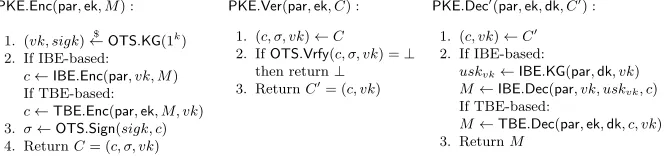
Figure 2 (which uses GE notation) shows that in both cases, the resulting
PKE is public verification with respect to PKE.Ver and PKE.Dec0, but impor-tantly the public verification is not strictly non-trivial: the IBE or TBE de-cryption operation may still fail. In the IBE-based case ek = remains empty while dk =mskand par are output by IBE.PG. In the TBE-based caseek and
dk are output byTBE.KGusing pargenerated by TBE.PG. Original IBE-based transform from [9] and its TBE-based version from [16] are obtained using
PKE.Dec=PKE.Dec0◦PKE.Ver.
PKE.Enc(par,ek, M) :
1. (vk, sigk)←$ OTS.KG(1k
) 2. If IBE-based:
c←IBE.Enc(par, vk, M) If TBE-based:
c←TBE.Enc(par,ek, M, vk) 3.σ←OTS.Sign(sigk, c) 4. ReturnC= (c, σ, vk)
PKE.Ver(par,ek, C) :
1. (c, σ, vk)←C
2. IfOTS.Vrfy(c, σ, vk) =⊥
then return⊥
3. ReturnC0= (c, vk)
PKE.Dec0(par,ek,dk, C0) :
1. (c, vk)←C0
2. If IBE-based:
uskvk←IBE.KG(par,dk, vk)
M←IBE.Dec(par, vk, uskvk, c)
If TBE-based:
M←TBE.Dec(par,ek,dk, c, vk) 3. ReturnM
Fig. 2.PKE with Publicly Verifiable Ciphertexts from CHK Transformation
2.4 Publicly Verifiable Ciphertexts using NIZKs
PKE is given by (dk,ek) = ((dk1,dk2),(ek1,ek2, ρ)) where (dki,eki),i ∈ {1,2},
are obtained from two independent runs ofPKE0.KGandρis the common refer-ence string of the NIZK proof system for languages of the form (c1, c2,ek1,ek2) satisfying c1 = PKE0.Enc(par,ek1, M)∧c2 = PKE0.Enc(par,ek2, M) where M (and implicitly random coins used in the encryption process) play the role of the witness. As demonstrated in Figure 3,IND-CCAschemes output by this transfor-mation offer public verifiability, though not strictly non-trivial public verifiability as the PKE0.Dec operation inPKE.Dec0 may output⊥. This reasoning also ap-plies to the NIZK-based constructions from [12] and to the firstIND-CCA-secure PKE scheme by Dolev, Dwork, and Naor [11] that uses NIZK-proofs in a slightly different way. Although NIZK-based schemes are regarded as not efficient, we notice that their lightweight decryption procedureDec0 (if the scheme is viewed from the public verifiability perspective) is as efficient as that of CHK-based schemes in Figure 2.
PKE.Enc(par,ek, M) :
1. (ek1,ek2, ρ)←ek
2.c1←PKE0.Enc(par,ek1, M)
3.c2←PKE0.Enc(par,ek2, M)
4.π←P(M,(c1, c2,ek1,ek2), ρ)
5. ReturnC= (c1, c2, π)
PKE.Ver(par,ek, C) :
1. (ek1,ek2, ρ)←ek
2. (c1, c2, π)←C
3. IfV(ρ,(c1, c2,ek1,ek2), π) =⊥
then return⊥
4. ReturnC0=c
1
PKE.Dec0(par,ek,dk, C0) :
1. (dk1,dk2)←dk
2. c1←C0
3. M←PKE0.Dec(par,ek
1,dk1,
c1)
4. ReturnM
Fig. 3.PKE with Publicly Verifiable Ciphertexts from NIZK-based Transformation
2.5 Our PKE Scheme with Strictly Non-Trivial Publicly Verifiable Ciphertexts
In this section, we propose a practical IND-CCA-secure PKE scheme, whose public verification is strictly non-trivial and is well-suited for IND-CCA/CPA
filters described in the introduction due to an especially light algorithm Dec0. Our construction is inspired by the IND-CCA public-key KEM of Kiltz [17], which when plugged into a KEM/DEM framework would yield an IND-CCA -secure PKE scheme (but loose strictly non-trivial public verification as discussed in Section 4). In contrast, we obtain strictly non-trivial publicly verifiable PKE in a more direct way, by using the encapsulated key in [17] as a one-time pad for the message and by linking the resulting ciphertext components together with a one-time signature, whose verification key is in turn bound to the KEM ciphertext part through a tweak on the original scheme from [17]. Our scheme provides strictly non-trivial public verifiability, unlike the schemes presented in Sections 2.3 and 2.4 based on the CHK and NIZK transformations.
The scheme. OurPGalgorithm is similar to [17] except that it uses gap groups: PG(1k) outputs public parameters par = (
G, p, g,DDH,H) where G = hgi is a
algorithm such that DDH(ga, gb, gc) = 1⇔c=ab(p), andH:
G→ {0,1}`1(k)
is a cryptographic hash function such that `1(k) is a polynomial in k. We also use a strong one-time signature schemeOTS= (KG,Sign,Vrfy) with verification key space {0,1}`2(k) such that `2(k) is a polynomial in k and a target
colli-sion resistant hash function TCR: G× {0,1}`2(k) →
Zp. The message space is MsgSp={0,1}`1(k). The scheme works as shown in Figure 4.
PKE.KG(par) :
1. x←$ Z∗p
2. u←gx,v←$ G 3. ek←(u, v),dk←x
4. Return (ek,dk)
PKE.Enc(par,ek, M) :
1. (u, v)←ek
2. (vk, sigk)←$ OTS.KG(1k)
3. r←$ Z∗p,c1←gr
4. t←TCR(c1, vk),π←(utv)r
5. K←H(ur),c
2←M⊕K
6. c←(c1, c2, π)
7. σ←OTS.Sign(sigk, c) 8. ReturnC= (c, σ, vk)
PKE.Ver(par,ek, C) :
1. (u, v)←ek 2. (c, σ, vk)←C
3. (c1, c2, π)←c
4. t←TCR(c1, vk)
5. IfDDH(c1, utv, π)6= 1 or
OTS.Vrfy(c, σ, vk) =⊥
return⊥
6. ReturnC0= (c1, c2)
PKE.Dec0(par,ek,dk, C0) :
1. (c1, c2)←C0
2. x←dk 3. K←H(cx
1),M←c2⊕K
4. ReturnM
Fig. 4.Our PKE with Strictly Non-Trivial Publicly Verifiable Ciphertexts
Security Analysis. First we give intuition why our scheme isIND-CCA-secure.
Let (c∗, σ∗, vk∗) be the challenge ciphertext. As we discussed above, without the CHK transform, the proposed PKE can be seen as a KEM/DEM combination which is at leastIND-CPA-secure due to Herranzet al.[14]. As for the KEM, the Hashed Diffie-Hellman (HDH) assumption [2] can be used to prove theIND-CPA
security of the resulting PKE. Note that the message does not depend on vk∗, andσ∗ is just the signature onc∗. Thereforec∗being an output of theIND-CPA -secure scheme hides the value of the chosenb from the adversary.
We now claim that theIND-CCA adversaryAmay access decryption oracle but gains no help in guessing the value of b. Suppose the adversary submits a ciphertext (c0, σ0, vk0) 6= (c∗, σ∗, vk∗) to the decryption oracle. Now there are two cases: (a)vk0 = vk∗ or (b)vk0 =6 vk∗. When vk0 = vk∗, the decryption
oracle will output ⊥ as the adversary fails to break the underlying strongly unforgeable one-time signature scheme with respect to vk0. When vk0 6= vk∗, the attackerBagainst the HDH problem can set the public keys as seen in the
Theorem 2. Assume thatTCRis a target collision resistant hash function and OTS is a strongly unforgeable one-time signature scheme. Under the Hashed Diffie-Hellman assumption for G and H, the PKE scheme (PKE.KG,PKE.Enc,
PKE.Dec=PKE.Dec0◦PKE.Ver)based on Figure 4 is IND-CCA-secure.
Efficiency. Our PKE scheme in Figure 4 is more efficient than previous
schemes with public consistency checks. In our scheme, public keys consist of 2 group elements, the ciphertext overhead is 2 group elements, a one-time signature and a one-time verification key, encryption requires 3.5 group exponentiations (using simultaneous exponentiation) and 1 one-time signature, verification re-quires 1 group exponentiation, 2 pairings, and 1 one-time signature verification, and lightweight decryption requires only one exponentiation.
Amongst existing PKE constructions with public consistency checks, only two seem to offer the same efficiency for lightweight decryption: Kiltz [17] describes a (direct) PKE construction (in addition to KEM) that is publicly verifiable with the same lightweight decryption cost of 1 group exponentiation, but at the cost of requiring public keys with the number of group elements being linear in the security parameter, as opposed to only 2 group elements in the public key of our scheme. Hanaoka and Kurosawa [13] describe a publicly verifiable KEM that, when combined with a DEM, would yield a (somewhat non-trivial, cf. Section 4) publicly verifiable PKE. Its lightweight decryption would require 1 group exponentiation (plus any costs from the DEM) but its public keys would contain 3 group elements, compared to 2 group elements in our scheme.
3
Publicly Verifiable Ciphertexts in General KEMs
3.1 Definition: General KEM
A general key encapsulation mechanism (GKEM) is a tuple GKEM= (PG,KG,
Encap,Decap) of four algorithms such that PGand KG have the same syntax as in case of general encryption (cf. Section 2.1) except that message space is replaced with the key space KeySp, whereas the syntax of Encap and Decap
matches that of Enc andDec, respectively, with the only difference that Encap
outputs a ciphertextCand a session keyK∈KeySp, whileDecapoutputs either K or⊥.
GKEM correctness and adversarial advantage AdvINDA,GKEM-xxx (k), xxx∈ {CPA,
CCA} in indistinguishability experiments from Figure 1 are also defined analo-gously to the case of general encryption.
3.2 General KEMs with Public Verifiable Ciphertexts
Ver(par,ek, C, t): Given public parameters par, the encryption key ek, a cipher-textC, and a tagt, this algorithm outputs either⊥if the ciphertext fails the validation, or a (transformed) ciphertextC0. Note thatVerdoes not take any secrets as input.
Decap0(par,ek,dk, C0, t): This deterministic algorithm takes input public param-eterspar, encryption and decryption keys(ek,dk), a ciphertextC0, and a tag t, and outputs a keyK.
Since allIND-CCA-secure general GKEMs trivially achieve public verifiabil-ity with respect to Ver(par,ek, C, t) := C and Decap0 := Decap we can reuse Definition 2 for GKEMs to define their strictly non-trivial public verification.
Theorem 3 (whose proof is identical to that of Theorem 1 and is omitted here) shows that any publicly verifiable IND-CCA-secure GKEM scheme will remain at least IND-CPA-secure if the verification algorithm Ver is run by an honest-but-curious gateway. To account for a non-trivial verification process that may modify the ciphertext, we again apply post-processing to the output of the encapsulation algorithm (cf. Section 2.2).
Theorem 3. Let GKEM = (PG,KG,Encap,Decap) be an IND-CCA-secure gen-eral KEM and publicly verifiable with respect to Ver andDecap0. Let Encap0 :=
Ver◦Encapand let GKEM0:= (PG,KG,Encap0,Decap0). For every IND-CPA ad-versary AagainstGKEM0, there exists anIND-CCA adversaryBagainst GKEM such that, for allk≥0,AdvINDA,GKEM-CPA0(k)≤AdvINDB,GKEM-CCA(k), whereBhas
(asymp-totically) the same running time as A.
3.3 Constructions of Strictly Non-Trivial Publicly Verifiable KEMs
We now present some examples for KEMs with publicly verifiable ciphertexts. First, we discuss the publicly verifiable construction of an identity-based KEM that we obtain immediately from theIND-CCA-secure IB-KEM proposed by Kiltz and Galindo [18]. Parameters par0 = (G1,GT, p, g, e,H) chosen by parameter
generation algorithm PG(1k), k ∈
Z≥0, are such that G1 is a multiplicative cyclic group of prime order p: 22k < p,
GT is a multiplicative cyclic group of
the same order, g is a random generator of G1, e : G1×G1 → GT is a
non-degenerate bilinear map, andH:{0,1}`(k)→
G1is a random hash function such that `(k) is a polynomial ink. We also use a target collision resistant function
TCR:G1→Zp. Figure 5 details the scheme.
KEM.PG(1k) :
1. Generate
par0= (G1,GT, p, g, e,H) 2. α←$ G1,msk←α 3. u, v←$ G1,z←e(g, α) 4. pk←(u, v, z) 5. par←(par0,pk) 6. Return (par,msk)
KEM.Encap(par,id) :
1. (par0,pk)←par
2. Parsepar0andpk
3. r←$ Z∗p,c
1←gr 4. t←TCR(c1) 5. c2←H(id)r 6. c3←(utv)r 7. K←zr∈GT 8. C←(c1, c2, c3)∈G31 9. Return (C, K)
KEM.KG(par,msk,id) :
1. Parse (par0,pk)←parandpar0
2. s←$ Zp,dk[id]←(α·H(id)s, gs) 3. Returndk[id]
KEM.Ver(par,pk,id, C) :
1. (par0,pk)←par
2. Parsepar0andpk
3. (c1, c2, c3)←C,t←TCR(c1) 4. Ife(g, c3)6=e(c1, utv) or
e(g, c2)6=e(c1,H(id)), then return⊥ 5. ReturnC0= (c1, c2)
KEM.Decap0(par,id,dk[id], C0) :
1. (par0,pk)←par
2. Parsepar0
3. (c1, c2)←C0, (d1, d2)←dk[id] 4. K←e(c1, d1)/e(c2, d2) 5. ReturnK
Fig. 5.Kiltz-Galindo IB-KEM with Publicly Verifiable Ciphertexts
4
Publicly Verifiable Ciphertexts in Hybrid Encryption
Since its invention, the KEM/DEM approach [10,29], being very simple and flex-ible, has become popular and part of several encryption standards [15,23,30]. It has been shown that if both the KEM and the DEM are secure against chosen-ciphertext attacks, then so is the resulting hybrid encryption scheme [10]. Her-ranz et al. [14] studied necessary and sufficient security conditions for KEMs and DEMs in relation with the security of the hybrid construction. They showed that for theIND-CCA-security of the hybrid scheme, the KEM must beIND-CCA -secure while the security requirement on the DEM can be relaxed fromIND-CCA
4.1 Definition: Hybrid General Encryption
Let GKEM = (PG,KG,Encap,Decap) be a general KEM scheme (as defined in Section 3.1) and letDEM= (Enc,Dec) be a one-time symmetric key encryption scheme [14]. The two schemes are assumed to be compatible, i.e. session keys output byKEMare appropriate for DEM.
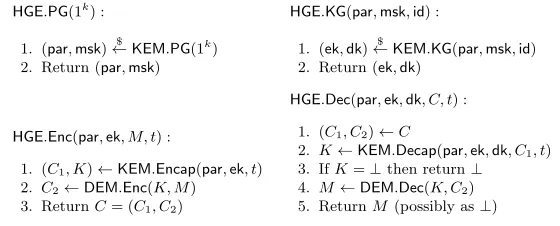
A hybrid general encryption (HGE) scheme is a tuple HGE = (PG,KG,
Enc,Dec) of four algorithms as defined in Figure 6.
HGE.PG(1k) :
1. (par,msk)←$ KEM.PG(1k) 2. Return (par,msk)
HGE.Enc(par,ek, M, t) :
1. (C1, K)←KEM.Encap(par,ek, t) 2. C2←DEM.Enc(K, M) 3. ReturnC= (C1, C2)
HGE.KG(par,msk,id) :
1. (ek,dk)←$ KEM.KG(par,msk,id) 2. Return (ek,dk)
HGE.Dec(par,ek,dk, C, t) :
1. (C1, C2)←C
2. K←KEM.Decap(par,ek,dk, C1, t) 3. IfK=⊥then return⊥
4. M←DEM.Dec(K, C2) 5. ReturnM(possibly as⊥)
Fig. 6.Hybrid General Encryption SchemeHGE
Correctness. A hybrid general encryption scheme HGE= (PG,KG,Enc,Dec) is correct if, for all (par,msk) ∈ [HGE.PG], all plaintexts M, all identities id ∈ IDSp, all (ek,dk) ∈ [HGE.KG(par,msk,id)], and all tags t ∈ TagSp, we have
HGE.Dec(par,ek,dk,HGE.Enc(par,ek, M, t), t) =M with probability one, where the probability is taken over the coins ofHGE.Enc.
4.2 Hybrid General Encryption with Publicly Verifiable Ciphertexts
When defining public verifiability of HGE = (PG,KG,Enc,Dec) schemes with respect to Ver and Dec0, we can essentially reuse Definition 1 for general en-cryption. Note that messageM output by the lightweight decryption algorithm
Dec0 could also be an error symbol⊥. As previously mentioned, in generalHGE
cannot satisfy Definition 2 of strictly non-trivial public verification since failure of the original decryption procedureHGE.Decmay not necessarily imply failure of the verification algorithmVer0. For this reason we define the following relaxed notion:
Definition 4 (Somewhat Non-Trivial Public Verification). Let HGE = (PG,KG,Enc,Dec)be a hybrid general encryption scheme from Figure 6 that is publicly verifiable with respect to auxiliary algorithmsVerandDec0. Let(par,msk) ← PG(1k). Ver is said to be somewhat non-trivial if, for all id ∈ IDSp, all
t∈TagSp, and(ek,dk)←KG(par,msk,id),
2. there exists a ciphertext C for whichDec(par,ek,dk, C, t) =⊥.
Condition 1 requires that successful public verification is necessary but not suf-ficient for the decryption algorithm to successfully decrypt. In particular, if
Ver succeeds then the only reason why HGE.Dec fails is because of a failure in DEM.Dec. Condition 2 remains as in Definition 2.
Theorem 4 (proven in Appendix C) shows that if the underlying general KEM is publicly verifiable with strictly non-trivial verification then the hybrid general encryption scheme is publicly verifiable in the somewhat non-trivial way and that by outsourcing verification of the KEM part the hybrid scheme remains at leastIND-CPA-secure.
Theorem 4. Let GKEM = (PG,KG,Encap,Decap) be an IND-CCA-secure gen-eral key encapsulation mechanism that is publicly verifiable with respect toGKEM.
Ver and GKEM.Decap0, DEM = (Enc,Dec) be an IND-OTCCA-secure data en-capsulation mechanism, and HGE = (PG,KG,Enc,Dec) be the resulting hybrid general encryption scheme.
1. If GKEM.Ver is strictly non-trivial then HGE is publicly verifiable with re-spect to a somewhat non-trivialHGE.Verand an algorithm HGE.Dec0.
2. Let HGE0 := (PG,KG,Enc0,Dec0)with HGE0.Enc0 =HGE.Ver◦HGE.Enc and HGE0.Dec0 =HGE.Dec0. For any IND-CPA adversaryAagainst HGE0, there exists anIND-CPAadversaryB1 againstGKEM0 and anIND-OTCCA adver-saryB2 against DEMsuch that
AdvINDA,HGE-CPA0 (k)≤AdvINDB -CCA
1,GKEM0(k) +Adv
IND-OTCCA
B2,DEM (k) ∀k≥0
andB1 andB2 have (asymptotically) the same running time as A.
4.3 Constructions of Hybrid Encryption with Publicly Verifiable Ciphertexts
Herranz et al. [14] showed that if someIND-CCA-secure KEM is combined with anIND-OTCCA-secure DEM then the resulting hybrid encryption scheme is also
IND-CCA-secure. As shown by Cramer and Shoup [10], one can easily construct an IND-OTCCA-secure DEM by adding a one-time MAC to a one-time-secure DEM such as one-time pad. Moreover, Theorem 4 states that if the underly-ing KEM is publicly verifiable then the resultunderly-ing hybrid encryption scheme is publicly verifiable as well. We can thus immediately obtain a range of publicly verifiable constructions of hybrid encryption schemes with somewhat non-trivial verification from these two building blocks; for instance, we can apply publicly verifiable KEM constructions from Section 3.3.
In the case of tag-based KEM/DEM approach, Abe et al. [3] showed that
IND-CCA-secure public-key KEMs and one-time MACs. Our publicly verifiable public-key-based KEM constructions from Section 3.3 can be used to instantiate their tag-based KEMs, resulting in further publicly verifiable hybrid encryption schemes.
5
Conclusion
In this work we formalized the notion of public verifiability for encryption schemes, KEMs, and hybrid KEM/DEM constructions. By adopting and extend-ing the generalized syntax from [1] our definitions of publicly verifiable schemes and corresponding security results hold for public-key based, identity-based, and tag-based settings. We defined conditions under which public verifiability can be seen as a non-trivial requirement for IND-CCA security and have proven that by outsourcing verification those schemes remain at least IND-CPAsecure. We showcased that well-known CHK and NIZK-based transforms offer strictly non-trivial public verification, proposed a new PKE scheme that makes most use of this property, and discussed different flavours of efficient strictly non-trivial pub-licly verifiable KEMs. With regard to hybrid schemes we showed that although strictly non-trivial verification is not achievable, a relaxed notion of somewhat non-trivial public verifiability can be obtained, which still offers sufficient per-formance gains in IND-CCA/CPA filters that are useful for applications where outsourcing of ciphertext verification to an honest-but-curios gateway without losing confidentiality is sufficient for practical purposes.
Acknowledgements
This research was supported by the Australian Technology Network (ATN) and German Academic Exchange Service (DAAD) Joint Research Co-operation Scheme. Juan Manuel Gonz´alez Nieto and Douglas Stebila were further sup-ported by the Australia–India Strategic Research Fund project TA020002. Mark Manulis acknowledges support through German Research Foundation (DFG) via grant MA 4957. This work was also supported by CASED and EC-SPRIDE.
References
1. M. Abdalla, M. Bellare, and G. Neven. Robust Encryption. In D. Micciancio, editor,TCC 2010,LNCS, vol. 5978, pp. 480–497, Springer, 2010.
2. M. Abdalla, M. Bellare, and P. Rogaway. The Oracle Diffie-Hellman Assumptions and an Analysis of DHIES. In CT-RSA 2001, LNCS, vol. 2020, pp. 143–158, Springer, 2001.
3. M. Abe, R. Gennaro, and K. Kurosawa. Tag-KEM/DEM: A New Framework for Hybrid Encryption. Journal of Cryptology, 21(1):97–130, 2008.
5. K. Bentahar, P. Farshim, J. Malone-Lee, and N. P. Smart. Generic Constructions of Identity-Based and Certificateless KEMs. J. Cryptology, 21(2):178–199, 2008. 6. D. Boneh and J. Katz. Improved efficiency for CCA-secure cryptosystems built
using identity-based encryption. InCT-RSA 2005,LNCS, vol. 3376, pp. 87–103, Springer, 2005.
7. D. Boneh, X. Boyen, and S. Halevi. Chosen Ciphertext Secure Public Key Thresh-old Encryption Without Random Oracles. InCT-RSA 2006,LNCS, vol. 3860, pp. 226–243, Springer, 2006.
8. X. Boyen, Q. Mei, and B. Waters. Direct chosen ciphertext security from identity-based techniques. In V. Atluri, C. Meadows, A. Juels, editors, ACM CCS 2005, pp. 320–329, ACM, 2005.
9. R. Canetti, S. Halevi and J. Katz. Chosen-ciphertext security from identity-based encryption. In C. Cachin and J. Camenisch, editors,EUROCRYPT 2004,LNCS, vol. 3027, pp. 207–222, Springer, 2004.
10. R. Cramer and V. Shoup. Design and analysis of practical public-key encryption schemes secure against adaptive chosen ciphertext attack. SIAM J. Computing, 33(1):167–226, 2003.
11. D. Dolev, C. Dwork, and M. Naor Non-Malleable Cryptography (Extended Ab-stract). ACM STOC 1991, pp. 542-552, ACM, 1991.
12. E. Elkind and A. Sahai. A unified methodology for constructing public-key encryp-tion schemes secure against adaptive chosen-ciphertext attack. Cryptology ePrint Archive, Report 2002/042, 2002.http://eprint.iacr.org/
13. G. Hanaoka and K. Kurosawa. Efficient Chosen Ciphertext Secure Public Key Encryption under the Computational Diffie-Hellman Assumption. InASIACRYPT 2009,LNCS, vol. 5350, pp. 308–325, Springer, 2009.
14. J. Herranz, D. Hofheinz, and E. Kiltz. KEM/DEM: Necessary and sufficient con-ditions for secure hybrid encryption. Cryptology ePrint Archive, Report 2006/256, 2006.http://eprint.iacr.org/
15. H. Imai and A. Yamagishi. CRYPTREC Project — Cryptographic Evaluation Project for the Japanese Electronic Government. In ASIACRYPT 2000,LNCS, vol. 1976, pp. 399–400, Springer, 2000.
16. E. Kiltz. Chosen-Ciphertext Security from Tag-Based Encryption. InTCC 2006, LNCS, vol. 3876, pp. 581–600, Springer, 2006.
17. E. Kiltz. Chosen-Ciphertext Secure Key-Encapsulation Based on Gap Hashed Diffie-Hellman. InPKC 2007,LNCS, vol. 4450, pp. 282–297, Springer, 2007. 18. E. Kiltz and D. Galindo. Direct Chosen-Ciphertext Secure Identity-Based Key
Encapsulation Without Random Oracles. InACISP 2006,LNCS, vol. 4058, pp. 336–347. Springer, 2006.
19. C. H. Lim and P. J. Lee. Another Method for Attaining Security against Adaptively Chosen Ciphertext Attacks. In CRYPTO 1993, LNCS, vol. 773, pp. 420–434, Springer, 1993.
20. J. K. Liu, C-K. Chu and J. Zhou. Identity-Based Server-Aided Decryption. In ACISP 2011,LNCS, vol. 6812, pp. 337–352, Springer, 2011
21. B. Libert and M. Yung. Adaptively Secure Non-interactive Threshold Cryptosys-tems. InICALP 2011, Part II,LNCS, vol. 6756, pp. 588–600. Springer, 2011. 22. M. Naor and M. Yung. Public-key Cryptosystems Provably Secure against Chosen
Ciphertext Attacks. ACM STOC 1990, pp. 427-437. ACM, 1990.
24. D. H. Phan and D. Pointcheval. Chosen-Ciphertext Security without Redundancy. InASIACRYPT 2003,LNCS, vol. 2894, pp. 1–18, Springer, 2003.
25. D. H. Phan and D. Pointcheval. OAEP 3-round: A Generic and Secure Asymmetric Encryption Padding. InASIACRYPT 2004,LNCS, vol. 3329, pp. 63–78, Springer, 2004.
26. P. Persiano. About the Existence of Trapdoors in Cryptosystems. Manuscript. Available athttp://libeccio.dia.unisa.it/Papers/Trapdoor/Trapdoor.pdf 27. J. Rompel. One-Way Functions are Necessary and Sufficient for Secure Signatures.
InSTOC 1990, pp. 387–394, ACM, 1990.
28. A. Sahai. Non-malleable non-interactive zero-knowledge and adaptive chosen-ciphertext security. FOCS 1999, pp. 543-553, IEEE, 1999.
29. V. Shoup. A proposal for an ISO standard for public key encryption (version 2.1). Manuscript, 2001. http://shoup.net/papers.
30. V. Shoup. ISO 18033-2: An emerging standard for public-key encryption, Final Committee Draft, December 2004. http://shoup.net/iso/std6.pdf.
31. V. Shoup and R. Gennaro. Securing Threshold Cryptosystems against Chosen Ciphertext Attack. In EUROCRYPT 1998,LNCS, vol. 1403, pp. 1-16, Springer, 1998.
A
Proof of Theorem 1
Proof. LetAbe an adversary that breaks theIND-CPAsecurity ofGE0 and runs in time tA. We build an algorithm B running in time tB that, using A as a
sub-routine, breaks theIND-CCAsecurity of GE. Let CGE denote the challenger
in the associatedIND-CCAsecurity game forGE.
AlgorithmBinteracts withCGEandA. WithA,Bacts as a challenger playing
the IND-CPA security game for GE0. In detail, B does the following: On input
public par, B forwards them on to A. At some point A outputs the challenge consisting of two messages M0 andM1, a target identityid∗, and a target tag t∗. B forwardsM0 and M1 along with id∗ and t∗ to GE challenger CGE, which
in turn responds with a ciphertext C∗ onMb∗ for a random bitb (unknown to B). Since C∗ is publicly verifiable, Bhands ¯C∗←Ver(par,ek[id∗], C∗, t∗) as the challenge ciphertext over to A. Eventually,A outputs a bitb0, whichB uses as it own output.
Queries ofAto the oraclesOEK andODK are answered byBas follows:
• OEK(id):BqueriesOEK(id) toCGEand responds toAwith whatever it receives
fromCGE. Note thatAis allowed to queryOEK onid∗.
• ODK(id): B queries ODK(id) toCGE and responds toA with whatever it
re-ceives fromCGE. Note thatAis not allowed to queryODKonid∗.
The total running time ofBistB≤tA+tVer withtAbeing the running time
ofAandtVerbeing the execution time ofVer.
Given the above perfect simulation of oracles,Bclearly breaks theIND-CCA
B
Proof of Theorem 2
Proof. Let A be any PPT adversary that breaks the IND-CCA security of the PKE scheme with non-negligible advantage, makes at mostqdecryption queries and runs in timetA. Now we build an algorithmBrunning in timetBthat using Aas a sub-routine breaks the HDH assumption with non-negligible advantage. Before describing the algorithm B, we define the event Forge and find an upper bound for the probability that it occurs. Let (c∗, σ∗, vk∗) be the challenge ciphertext given byBtoA. LetForgebe the event thatAsubmits to the decryp-tion oracle a ciphertext (c, σ, vk)6= (c∗, σ∗, vk∗) such that (c, σ)6= (c∗, σ∗) but OTS.Vrfy(c, σ, vk∗) = 1. This event also includes the case that such a query is submitted by A before it receives the challenge ciphertext and therefore (c, σ, vk) 6= (c∗, σ∗, vk∗) is not needed in this case. This implies that A can be used to forge the underlying one-time signature schemeOTSwith probability PrA[Forge]. The scheme OTS being a strongly unforgeable one-time signature
scheme implies that PrA[Forge] must be negligible in the security parameterk.
We now describe howB proceeds. Attacker B’s input is a random instance of the HDH problem (u=ga, gb, W). The goal ofB is to decide whetherW = H(gab) orW is a random bit string of appropriate length. WithA,B acts as a
challenger playing the IND-CCA security game for PKE. In detail, B does the following:
Key Generation & Challenge. First B runs the key generation algorithm
of OTS to generate (vk∗, sigk∗). Then B selects d ←$
Z∗p, computes part of
the challenge ciphertext for A to be (c∗1, π∗) ← (gb,(gb)d). Now B computes
t∗←TCR(c∗1, vk∗) andv←u−t∗·gdand sets the public key as (u, v). We say a
ci-phertext (c= (c1, π, c2), σ, vk) is consistent ifπ= (utv)rfort←TCR(c1, vk) and r= loggc1. Note that for a consistent ciphertext, the setup of the public keys im-plies thatπ= (utv)r= (utu−t∗gd)r= (ur)t−t∗cd
1andH(ur) =H((π/cd1)(t−t
∗)−1
). NowBrunsAon input the public key (u, v).
Decryption Queries. Adversary A may query decryption oracle with a
ci-phertext (c, σ, vk) for which Bproceeds as follows: • IfOTS.Vrfy(c, σ, vk)6= 1, then Breturns⊥.
• IfOTS.Vrfy(c, σ, vk) = 1 and vk=vk∗, then the event Forgehappens, so B halts and outputs a random bit.
• IfOTS.Vrfy(c, σ, vk) = 1 andvk6=vk∗, then forC= (c1, π, c2),Bcomputes t ← TCR(c1, vk) and utv and verifies the consistency of the ciphertext by
checking π = (u? tv)r, i.e. B aborts if DDH(c
1, utv, π) 6= 1. Otherwise there are three cases based ont←TCR(c1, vk):
Case 2: t = t∗ and c1 6= c1∗: In this case B finds a collision c1 6= c∗1 but
TCR(c1, vk) =TCR(c∗1, vk∗). So,Boutputs the collision and aborts.
Case 3: t 6=t∗: In this caseB decrypts the message successfully as m ← H((π/cd
1)(t−t
∗)−1
)⊕c2 and returns the messagemtoA.
Guess. At some point, A outputs two different messages M0 and M1 of the
same length whereAwishes to be challenged. Using already computed challenge ciphertext part (c∗1, π∗)←(gb,(gb)d) and (vk∗, sigk∗),Bcomputesc∗
2←W⊕Mδ
for a random bit δ and sets the challenge ciphertext for A to be (c∗, σ∗, vk∗), where c∗ ← (c∗1, π∗, c∗2) and σ∗ ← OTS.Sign(sigk∗, c∗). Now A may continue its queries to the decryption oracle except for the challenge ciphertext and B answers them as before. Finally A outputs a guess bit δ0. If δ = δ0, then B outputs γ = 1 which means that B’s guess is W = H(gab). If δ 6=δ0, then B outputsγ= 0 which means thatB’s guess is thatW is a random string.
From the above we see that unlessB receivesc∗
1 fromA(Case 1) or finds a collision inTCR,BsimulatesA’s view perfectly as in the original PKE security experiment.
B’s success probability and running time. If A wins, then B also wins. Therefore we have,∀k≥0,
AdvHDHB (k)≥AdvINDA,PKE-CCA(k)−Adv
Hash-colli
TCR,H (k)−PrA[Forge]−q/p. B’s total running time istB≤tA+O(tG) wheretA is the running time ofA andtGis the time to perform a basic operation inG. ut
C
Proof of Theorem 4
Proof. Statement 1. The first statement of the theorem is proven as follows: if
GKEMthat is used in theHGEconstruction is publicly verifiable (in the sense of Definition 3) then there exist two algorithmsGKEM.VerandGKEM.Decap0 such that GKEM.Decap=GKEM.Decap0◦GKEM.Ver.
We construct now two algorithmsHGE.Verand HGE.Dec0 as follows:
HGE.Ver(par,ek, C, t): Given public parameters par, the encryption key ek, a ciphertext C and a tag t, this algorithm first parses C into C1 and C2 and runsGKEM.Ver(par,ek, C1, t). IfGKEM.Ver(·) outputs⊥the algorithm
HGE.Veralso outputsC0=⊥. Otherwise the output ofGKEM.Ver(·) is a new (transformed) ciphertextC10 and in this case the algorithmHGE.Veroutputs a ciphertextC0= (C10, C2).
HGE.Dec0(par,ek,dk, C0, t): The algorithm parses C0 as (C10, C2) and obtains K ← GKEM.Decap0(par,ek,dk, C10, t). If K = ⊥ then it outputs ⊥. Oth-erwise, it runsDEM.Dec(K, C2) and outputs its result (which could also be ⊥).
1. (C1, C2)←C
2. C0 ←HGE.Ver(par,ek, C, t) 3. IfC0 =⊥then return⊥ 4. M ←HGE.Dec0(par,ek,dk, C0, t) 5. ReturnM (possibly as⊥)
This construction ofHGE.Decimplies thatHGEis publicly verifiable with respect toHGE.VerandHGE.Dec0. Now observe that if eitherHGE.VerorHGE.Dec0 fails then so doesHGE.Dec. By construction,DEM.Dec(K, C2) =⊥leads to the failure ofHGE.Dec0. Hence, we get
HGE.Ver(par,ek, C, t) =⊥ ∨DEM.Dec(K, C2) =⊥ ⇒ (1)
HGE.Dec(par,ek,dk, C, t) =⊥. As for the opposite implication observe that ifHGE.Dec outputs⊥then either
HGE.Ver(par,ek, C, t) =⊥or HGE.Dec0(par,ek,dk, C0, t) =⊥. Note that by con-struction, HGE.Dec0 fails ifGKEM.Decap0(par,ek,dk, C10, t) =⊥orDEM.Dec(K, C2) = ⊥. Since GKEM.Decap = GKEM.Decap0 ◦GKEM.Ver and GKEM.Ver is strictly non-trivial we have GKEM.Decap0(par,ek,dk, C10, t) = ⊥ if and only if C0=⊥. SinceC0=⊥is equivalent to the failure ofHGE.Ver we have
HGE.Dec(par,ek,dk, C , t) =⊥ ⇒ (2)
HGE.Ver(par,ek, C, t) =⊥ ∨DEM.Dec(K, C2) =⊥. (1) and (2) mean thatHGE.Veris somewhat non-trivial according to Definition 4. Statement 2.To prove the second statement, we first need to show that the hybrid general encryption schemeHGE0 := (PG,KG,Enc0,Dec0) isIND-CPA-secure. Note thatHGE0 is a general encryption scheme that is obtained through a hybrid con-struction of GKEM0 := (PG,KG,Encap0,Decap0) and DEM= (Enc,Dec), where