Public Key Cryptosystems Constructed Based on Reed-Solomon Codes,
K(XV)SE(2)PKC, Realizing Coding Rate of Exactly 1.0
Masao KASAHARA
Faculty of Informatics, Osaka Gakuin University, Suita-shi, 564-8511 Japan.
[email protected]
Abstract
In this paper, we present a new class of public-key cryptosys-tems, K(XV)SE(2)PKC realizing the coding rate of exactly 1.0, based on Reed-Solomon codes(RS codes). We show that K(XV)SE(2)PKC is secure against the various attacks in-cluding the attacks based on the Gr¨obner basis calculation (Gr¨obner basis attack, GB attack) and a linear transforma-tion attack.
Keyword
Public key cryptosystem, PQC, Reed-Solomon code, Code based PKC, Multivariate PKC, Gr¨obner basis.
1
Introduction
Most of the multivariate PKC are constructed by the simul-taneous equations of degree larger than or equal to 2 [1]∼[14]. All these proposed schemes are very interesting and im-portant. However unfortunately, some of these schemes have been proved not necessarily secure against the conventional attacks such as Patarin’s attack[3], the attack based on the Gr¨obner basis calculation (GB Attack)[11-13] and Braeken-Wolf-Preneel(BWP) attack[14].
The author recently proposed several classes of multi-variate PKC’s that are constructed by many sets of linear equations[15-20]. It should be noted that McEliece PKC[21] presented in 1978 can be regarded as a member of the class of linear multivariate PKC.
In 2011 the author presented a multivariate PKC, K(XIV)RSE(g)PKC, based on message-dependent transfor-mation[22]. The K(XIV)RSE(g)PKC would be secure against the various conventional attacks[11-13], as the transformation is performed depending on the given message sequence.
In this paper we present a new class of public key cryp-tosystem, K(XV)SE(2)PKC based on error-correcting codes, realizing the coding rate of exactly 1.0. K(XV)SE(2)PKC is constructed on the basis of K(X)SE(1)PKC[23] which is not secure against a linear transformation attack[24]. We show
that K(XV)SE(2)PKC is secure against the attacks based on a linear transformation attack and the GB Attack[11-13].
Throughout this paper, when the variable vi takes on
a value ˜vi, we shall denote the corresponding vector v =
(v1, v2,· · ·, vn) as
˜
v= (˜v1,v˜2,· · ·,vn).˜ (1)
The vector v = (v1, v2,· · · , vn) will be represented by the
polynomial as
v(x) =v1+v2x+· · ·+vnxn−1. (2)
The ˜u, ˜u(x) et al. will be similarly defined.
2
k(XV)SE(1)PKC
In this section we present a simple version of K(XV)SE(2)PKC
referred to as k(XV)SE(2)PKC. Generalization of
k(XV)SE(2)PKC to K(XV)SE(2)PKC is straightforward.
2.1
Preliminaries
Let us define several symbols:
gi(x) : Generator polynomial of RS code of degree 2 overF2m;i= 1,2.
Li : Location,Li≥2,i= 1,2,L1̸=L2.
xLi : Single error whose error value is 1 that
occurred at the locationLi;i= 1,2.
mi : Message symbol overF2m;i= 1,2,3,4.
PC[bgi(x)] : Probability thatgi(x) is estimated correctly,i= 1,2.
Figure 1: Schematic diagram of principle of k(XV)SE(2)PKC
PC[bgi(x)∩Li]b : Probability that bothgi(x) andLi(x) are estimated correctly,i= 1,2.
Hi : Random matrix whose component
takes on 0 or 1 equally likely,i= 1,2.
gF(x) : Random primitive polynomial of
degree 2mwhose coefficients except
those ofx0andx2mtake on 0 or 1 equally likely.
Gi(x) : Generator polynomial of RS code of
degreeg overF2m ;i= 1,2,· · · , E.
2.2
Construction
Let the message vectorAoverF2 be represented by
A= (A1, A2,· · · , AN). (3)
Throughout this paper we assume that the messages A1, A2,· · · , AN are mutually independent and equally likely.
LetAbe transformed into
A·H1=a
= (a1, a2,· · ·, aN),
(4)
whereH1 is anN×N non-singular random matrix overF2.
Letabe partitioned into
a= (m1, m2, m3, m4), (5)
wheremi’s arem-tuples overF2.
Let us regardmi as an element ofF2m. Letm1 andm2 be represented by
m1= (a11,· · · , a1m) (6)
and
m2= (a21,· · · , a2m). (7)
respectively.
Letr1(x) be obtained by
m2xL1≡r1(x) =m2r2x+m2r1modg1(x), (8)
yielding a code word,F1(x) :
F1(x) =m2xL1+m2r2x+m2r1≡0 modg1(x). (9)
Letm3andm4 be represented by
m3= (a31,· · ·, a3m) (10)
and
m4= (a41,· · ·, a4m) (11)
respectively.
Letr2(x) be given by
m4xL2≡r2(x) =m4r4x+m4r3modg2(x), (12)
yielding a code word,F2(x) :
F2(x) =m4xL2+m4r4x+m4r3≡0 modg2(x). (13)
Regarding (m2r2, m4r4) as a 2m-tuple over F2, it is
trans-formed into
(m2r2, m4r4)H2=s
= (s1, s2,· · · , s2m),
(14)
whereH2 is a 2m×2mnon-singular random matrix overF2.
Regarding (m2r1, m4r3) as a 2m-tuple overF2, it is
trans-formed into
(m2r1, m4r3)P1=t
= (t1, t2,· · ·, t2m),
(15)
whereP1 is a 2m×2mrandom permutation matrix.
Lettingt(x) be represented by t1+t2x+· · ·+t2mx2m−1, it is transformed into
{t(x)}3≡γ(x)
≡γ1+γ2x+· · ·+γ2mx2m−1modgF(x), (16)
where gF(x) is a random primitive polynomial of degree 2m
overF2.
Letγ= (γ1, γ2,· · ·, γ2m) be transformed into
γH3=δ
= (δ1, δ2,· · · , δ2m),
(17)
whereH3is a 2m×2mmatrix overF2which is not necessarily
non-singular.
Letδbe represented by
δ= (δλ,δµ), (18)
whereδλ andδµ overF2 are defined by
δλ= (δ1, δ2,· · ·, δm) (19)
and
δµ= (δm+1, δm+2,· · · , δ2m) (20)
respectively.
It should be noted that the component ofδi; i= 1,2,· · ·, 2m, is a quadratic equation in the variables A1, A2,· · · , AN
overF2.
Letδ′λ andδ′µ be defined by
δP1−1= (δ′λ,δ′µ). (21) Regarding (m1, m3) over F2m as an element of F22m, (m1, m3) is transformed into
(m1, m3)θ=ω
= (ω1, ω2,· · · , ω2m)∈F22m,
(22)
whereθ is given by
θ= 20+ 21+· · ·+ 2η<22m−1. (23) Letωλ andωµ, be defined by
ωλ= (ω1, ω2,· · ·, ωm) (24) and
ωµ= (ωm+1, ωm+2,· · · , ω2m). (25)
Letω′λ andω′µ be defined by
ωP1−1= (ω′λ,ω′µ). (26)
At the sending end, after calculatingωby Eq.(22),t+δ+ω
is obtained. The ciphertextCis given by
C= (s,t+δ+ω). (27)
We have the following set of keys.
Public key : m1,m3,{si},{ti+δi},θ,F2m,F22m. Secret key : H1,H2,H3,P1,L1,L2,
r1,r2,r3,r4,g1(x),g2(x),gF(x)
2.3
Encryption and decryption
Encryption:
Step1 :The ˜sis calculated from the public keys whose com-ponent is represented by the variables A1, A2, · · ·,
AN.
Step2 :The ˜t+ ˜δ is calculated from the public key t+δ
whose component is represented by the variables A1, A2,· · ·, AN.
Step3 :The ˜ωis calculated from ˜m1 and ˜m3 by Eq.(22).
Step4 :The ciphertext ˜C is given by
e
C= (˜s,˜t+ ˜δ+ ˜ω). (28)
Decryption:
Step1 :The ( ˜m2r2,m˜4r4) is decoded by (˜s1,˜s2,· · · ,˜s2m)H2−1.
Step2 :The ( ˜m2r1+ ˜δ′λ+ ˜ω′λ,m˜4r3+ ˜δ′µ+ ˜ω′µ) is decoded by (˜t+ ˜δ+ ˜ω)P1−1.
Step3 :From ( ˜m2r2,m˜2r1+ ˜δ′λ+ ˜ω′λ) and ( ˜m4r4,m˜4r3+ ˜δ′µ+ ˜
ω′µ), the sets of double erasure errors, ( ˜m2xL1,δ˜′λ+ ˜
ω′λ) and ( ˜m4xL2,˜δ′µ+ ˜ω′µ) are decoded, for example, by Euclidean decoding[25], yielding ( ˜m2,˜δ′λ+ ˜ω′λ) and ( ˜m4,δ˜′µ+ ˜ω′µ).
Step4 :From ˜m2and ˜m4, the (˜δ′λ,˜δ′µ) is decoded by Eqs.(15)
∼(21), yielding ˜ω′λ and ˜ω′µ. Step5 :The ˜ωis decoded by ( ˜ω′λ,ω˜′µ)P1.
Step6 :The ( ˜m1,m˜3), an element ofF22m, is decoded by ˜ω1/θ.
Step7 :The original message A˜ is decoded by
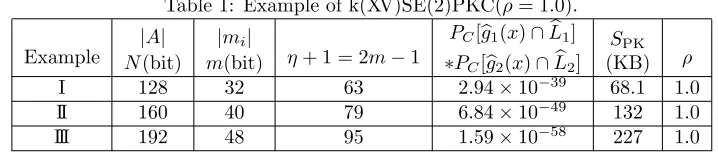
Table 1: Example of k(XV)SE(2)PKC(ρ= 1.0).
Example |
A| N(bit)
|mi|
m(bit) η+ 1 = 2m−1
PC[bg1(x)∩Lb1]
∗PC[gb2(x)∩Lb2]
SPK
(KB) ρ
I 128 32 63 2.94×10−39 68.1 1.0
II 160 40 79 6.84×10−49 132 1.0
III 192 48 95 1.59×10−58 227 1.0
2.4
Parameters
Let us define several symbols:
NV : Total number of message variables,N = 4m.
NESl : Total number of 2mlinear equations
repre-senting the components ofs, s1, s2,· · · , s2m.
NESq : Total number of 2mquadratic equations
representing the components oft+δ.
SE(s) : Set of linear equations related tosin the
variablesA1,A2,· · ·,AN.
SE(t+δ) : Set of quadratic equations related tot+δ
in the variablesA1,A2,· · ·,AN.
SE(mi) : Set of linear equations related tom1 orm3
in the variablesA1,A2,· · ·,AN.
The sizes of SE(s),SE(t+δ), SE(m1) and SE(m3) are given
by
|SE(s)|=NV ∗NESl, (29)
|SE(t+δ)|=NVH2·NESq, (30) and
|SE(m1)|=|SE(m3)|=NV ∗m, (31)
respectively.
The size of the public key for m1, m3, {s} and {t+δ},
SP K is given by
SP K =NVH2·2m+ 4NV ∗m. (32)
The coding rateρis given by
ρ= |M|
|C|
= |m1|+|m2|+|m3|+|m4|
|m2r2|+|m4r4|+|m2r1+ωλ+δλ|+|m4r3+ωµ+δµ| = 1.0.
(33)
We see that the coding rate is given by exactly 1.0. The probability that the location is estimated correctly, PC
h ˆ Li
i
, is given by
PC h
ˆ Li
i
= (2m−3)−1∼= 2−m;i= 1,2. (34)
The probability thatgi(x) is estimated correctly,PC[ˆgi(x)], is given by
PC[ˆgi(x)] = n
2m(g−2)∗(2m−1) o−1
∼= 2−m(g−1);i= 1,2.(35)
2.5
Examples
In Table 1, we show three examples of k(XV)SE(2)PKC.
2.6
Security consideration
Attack 1 : Attack on Li and gi(x) ; i = 1,2.
The probability that gi(x)’s and Li’s are estimated cor-rectly is given by
n
Pc[bgi(x)∩Li]b o2
= n
[PC[bgi(x)]·PC[Li]b o2
;i= 1,2, (36)
sufficiently small value for m >∼20. We conclude that
k(XV)SE(2)PKC is secure against Attack 1. 2
Attack 2 : GB Attack on ciphertext
The components ofωoverF22m can be represented by the set of equations overF2of very high degree. Sets of the
com-ponents of (s,t+δ+ω) yield a set of 2mequations of degree η+ 1 in the variablesA1, A2,· · ·, AN and a set of 2m linear equations in the variablesA1, A2,· · · , AN. The degrees take on a very high value of at least 63 as we see in the exam-ples in Table 1. We thus conclude that our proposed scheme, k(XV)SE(2)PKC, can be secure against GB Attack, the
at-tack based on Gr¨obner basis calculation. 2
Attack 3 : Exhaustive attack on ( ˜m1,m˜3).
We see that when ( ˜m1,m˜3) is estimated correctly by an
exhaustive manner, the ciphertext can be disclosed by the GB attack on the set of 2mquadratic equations and 2mlinear equations. It is easy to see that the average number of times required for estimating ( ˜m1,m˜3) in an exhaustive manner is
given by 22m−1.
In order to be secure against this attack, 2m, the size of ( ˜m1,m˜3) is recommended to be sufficiently large(m >∼30). 2
Attack 4 : Attack on (m2r1, m4r3)from s.
It is apparent that (m2r1, m4r3) can be disclosed from
However in k(XV)SE(2)PKC, (m2r1, m4r3) is transformed
into a set of quadratic equations through a series of transfor-mations given by Eqs.(15),(16) and (17).
We conclude that (m2r1, m4r3) cannot be disclosed from s
by a linear transformation.
3
K(XV)SE(2)PKC
In this section we present a generalized version of
k(XV)SE(2)PKC, referred to as K(XV)SE(2)PKC. As
K(XV)SE(2)PKC is a straightforward generalization of k(XV)SE(2), we shall only present an outline of the construc-tion of K(XV)SE(2)PKC.
3.1
Construction
Letmi be
mi= (mi1,· · · , mim) ;i= 1,2,· · · , E. (37)
In the followings let us regardmi’s as the elements ofF2m. Let
m1xL1≡r1(x)
=m1r11+m1r12x+· · ·+m1r1gxg−1modG1(X),
m2xL2≡r2(x)
=m2r21+m2r22x+· · ·+m2r2gxg−1modG2(X),
..
. (38)
mExLE≡rE(x)
=mErE1+mErE2x+· · ·
· · ·+mErEgxg−1modGE(X),
where all the locations Li’s are distinct and satisfy
g≤Li≤2m−2 ;i= 1,2,· · ·, E. (39)
We also assume that the degree ofGi(x);i= 1,2,· · ·, E, is given byg.
Let the remainderri(x) =miri1+miri2x+· · ·+mirigxg−1
given by Eq.(38) be partitioned into
ri(x) =riE(x) +riH(x), ;i= 1,2,· · ·, E, (40)
whereriE(x) andriH(x) are given by
riE(x) =miri,H+1xH+miri,H+2xH+1+· · ·
· · ·+mirigxg−1 (41)
and
riH(x) =miri,1+miri,2x+· · ·+miriHxH−1
(42)
Let the positive integersE andH satisfy
E+H =g. (43)
respectively.
Givenm1, m2,· · ·, mE, we construct E
X
i=1
mixLi= E X
i=1
miriH+1 +
E X
i=1
miriH+2x+
· · · + E X
i=1
mirgxg−1.
(44)
The vectorVE=³PEi=1miri,H+1,· · ·,
PE i=1mirig
´ is tra-nsformed into
VE·H4=s
= (VH+1, VH+2,· · · , Vg),
(45)
whereH4 is a randomE×E non-singular matrix over F2m.
The vectorVH = (
PE
i=1miri1,· · · ,
PE
i=1miriH) is
trans-formed into
VH·P2=T
= (V1, V2,· · · , VH),
(46)
whereP2is a H×H random permutation matrix overF2m. TheT is transformed into
T3=Γ (47)
in a similar manner as Eq.(16).
MessagesmE+1, mE+2,· · · , mN, are publicized as
VP = (mE+1, mE+2,· · ·, mN), (48)
In a simlar manner as Eq.(22),Ωis given by
VΘP =Ω. (49)
The correspondence among the parameters for
k(XV)SE(2)PKC and K(XV)SE(2)PKC is shown below:
k(XV)SE(2)PKC K(XV)SE(2)PKC
(m2r2, m4r4) VE
(m2r1, m4r3) VH
(m1, m3)
θ
=ω VΘP =Ω
(m2r2, m4r4)H2=s VEH4=S
(m2r1, m4r3)P1=t VHP2=T
t3=γ T3=Γ
γH3=δ ΓH5=∆
4
Conclusion
In this paper we have presented k(XV)SE(2)PKC. We have briefly described K(XV)SE(2)PKC because it can
be constructed by a straightforward generalization of
k(XV)SE(2)PKC.
We have shown that k(XV)SE(2)PKC would be secure against the various attacks including GB Attack, the attack based on Gr¨obner basis calculation.
References
[1] T.Mastumoto and H.Imai: “Public Quadratic
Polynomial-Tuples for Efficient Signature - Verification
and Message-Encryption”, Advances in Cryptology,
Eurocrypt’88, Springer-Verlag, pp.419-453, (1988).
[2] S.Tsujii, A.Fujioka and Y. Hirayama: “Generalization of the public-key cryptosystem based on the difficulty of solving a system of non-linear equations”, IEICE Trans. Vol.1 J-72-A, 2, pp.390-397, (1989-02).
[3] J. Patarin: “Hidden fields equations(HFE) and isomor-phisms of polynomials(IP): two new families of asymmet-ric algorithm”, Proc.EUROCRYPT’96, Lecture Notes in Computer Science, Vol.1070, pp.33-48, Springer, (1996-05).
[4] M.Kasahara and R.Sakai: “A Construction of Public Key Cryptosystem for Realizing Ciphertext of size 100 bit and Digital Signature Scheme”, IEICE Trans. Vol. E87-A, 1, pp.102-109, (2004-01).
[5] S. Tsujii, R. Fujita and K. Tadaki: “Proposal of
MOCHIGOMA(piece in hand) concept for multivariate type public key cryptosystem”, Technical Report of IE-ICE, ISEC 2004-74, (2004-09).
[6] J. Ding: “A New Variant of the Matsumoto-Imai Cryp-tosystem through Perturbation”, PKC 2004, LNCS 2947, pp.305-318, 2004.
[7] M.Kasahara and R.Sakai: “A Construction of Public Key Cryptosystem Based on Singular Simultaneous Equa-tions”, IEICE Trans. Vol. E88-A, 1, pp.74-79, (2005-01).
[8] J. Ding, D. Schmidt and J. Gower: “Multivariate Public key Cryptography”, Springer-Verlag(2006).
[9] M.Kasahara: “New Classes of Public Key
Cryp-tosystem Constructed on the Basis of Multivariate Polynomials and Random Coding - Generalization of K(III)RSE(g)PKC -”, Technical Report of IEICE, ISEC 2007-118, pp.41-47, (2007-12).
[10] M. Kasahara: “Public Key Cryptosystems Constructed Based on Cyclic Codes, Realizing Coding Rate of Exactly 1.0, K(XI)SE(g)PKC and K(XII)SE(g)PKC”, Technical Report of IEICE, ISEC 2011-23(2011-07).
[11] A. Kipnis and A. Shamir: “Cryptoanalysis of the
HFE Public Key Cryptosystem by Relinearization”, Ad-vances in Cryptography-Crypto’99, LNCS 1666, pp.19-30, (1999).
[12] M. Bardet, J. C. Faug´ere and B. Salvy: “Complexity of Gr¨obner basis computation for semi-regular overdeter-mined sequence overF2 with solutions inF2”, Technical
Report RR-5049, INRIA, (2003-12).
[13] J-C Faug´ere: “Algebraic cryptanalysis of HFE using
Gr¨obner basis”, INRIA (2003).
[14] C. Wolf: “Multivariate Quadratic Polynomials in Public Key Cryptography”, Dr. Thesis, Katholieke Universiteit Leuven, (2005-11).
[15] M.Kasahara: “Construction of New class of Linear Mul-tivariate Public Key Cryptosystem - Along With a Note on the Number 9999990 and its Application”, Technical Report of IEICE, ISEC 2009-44 (2009-09).
[16] M.Kasahara: “Linear Multivariate Cryptosystem Con-structed on the Basis of Probabilistic Structure”, 2009 JSIAM Annual Meesing, Osaka, (2009-09).
[17] M. Kasahara: “New Classes of Public Key Cryptosys-tems Constructed Based on Error-Correcting Codes and Probabilistic Structure”, Technical Report of IEICE , ISEC 2009-134 (2010-03).
[18] M. Kasahara: “A New Class of Public Key Cryptosystem Constructed Based on Error-Correcting Codes Realizing Coding Rate of Exactly 1.0”, Cryptology ePrint Archive, 2010/139 (2010).
[19] M. Kasahara: “A New Class of Public Key Cryptosys-tems Constructed Based on Error-Correcting Codes,
Using K(III) Scheme”, Cryptology ePrint Archive,
2010/341 (2010).
[20] M. Kasahara: “Public Key Cryptosystems
Con-structed Based on Random Pseudo Cyclic Codes, K(IX)SE(1)PKC, Realizing Coding Rate of Exactly 1.0”, Cryptology ePrint Archive 2011 / 545(2011).
[21] R. J. McEliece: “A public key cryptosystem based on algebraic coding theory”, DSN Prog. Re., pp.114-116, (1978).
[22] M. Kasahara: “A New Class of Multivariate Public
[23] M. Kasahara: “Public Key Cryptosystems Constructed Based on Reed-Solomon Codes and Pseudo Cyclic Codes, K(IX)SE(1)PKC and K(X)SE(1)PKC, Realizing Coding Rate of Exactly 1.0”, Technical Report of IEICE, ISEC 2011-31, (2011-9).
[24] M. Kasahara: “K(X)SE(1)PKC is not secure”, Memo-random for File at Kasahara Lab., Osaka Gakuin Uni-versity, (2011-11).
[25] Y. Sugiyama, M. Kasahara, S. Hirasawa and T.