© 2017, IRJET | Impact Factor value: 6.171 | ISO 9001:2008 Certified Journal
| Page 182
A STUDY ON WORKABILITY AND SPLIT TENSILE STRENGTH OF MULTI
BLEND CONCRETE OF M20
GRADE
MALEPATI NAGARJUNA
1, M PRAVEEN KUMAR
21
Postgraduate Scholar, Dept. of Civil Engineering, Visvodaya Engineering college,
Kavali, Nellore(District), Andhra Pradesh, INDIA.
2
Assistant Professor, Dept. of Civil Engineering, Visvodaya Engineering college,
Kavali, Nellore(District), Andhra Pradesh, INDIA.
---***---Abstract -
The production of cement results in productionof greenhouse gases in atmosphere, which will leads for global warning. Hence, the researchers are currently focusing on use of waste materials which are having cementing properties, which can be replaced in concrete as partially for cement, without comprising on its strength and durability, which will result in decrease of cement production thus reduction in emission of greenhouse gases, in addition to sustainable management of the waste. The properties of concrete mainly depend on the constituents used in concrete. The waste product like fly ash, Ground Granulated Blast Furnace slag (GGBS), silica fume, metakaolin etc. which has cementitious properties was used as partial replacement material for cement. This paper presents a study on mechanical properties of concrete made with multi component cement i.e., cement is blended with optimum.% of fly ash, Ground Granulated Blast Furnace slag (GGBS), silica fume & metakaolin. Study includes concepts of multi blended cement exploits the Compressive strength of multi blend concrete.
Key Words: Fly ash, GGBS, silica fume, metakaolin, multi
blend concrete etc.,
1. INTRODUCTION
Fly ash, Ground Granulated Blast furnace Slag, Silica fume, Metakaolin and many others, are some of pozzolanic substances which can be used as partially alternatives for cement in concrete. In present study i.e., Multi Blended Concrete is concrete in which binding multiple numbers of components. At gift look at, cement is blended with four components, namely Fly ash, GGBS, Silica Fume & Metakaolin. The fly ash, GGBS & silica fume materials are through products life, manufacture of metallic & silicon alloys respectively, whereas metakaolin is dehydroxilated form of clay mineral kaolinite. In present investigation studied about compressive strength of MULTI BLEND CONCRETE.
2. Materials and Their properties
2.1. Cement
In the present investigation, commercially available 53 Grade ordinary Portland cement supplied by Zuari Cement, having Sp. Gravity 3.15, fineness modulus is 290 m2/kg,
Normal consistency is 30%, initial setting time 45mins, final
setting time is 6hr. 40min. and compressive strength of mortar is 54.2 MPa.
2.2. Fly ash
Fly ash conforming to the requirements of IS 3812 and IS 1727 (1967) and produced from RTPP muddanur (class F i.e., low calcium fly ash) with Specific gravity of 2.2 and specific surface area of fly ash 280 m2/ kg was used as supplementary cementitious material in concrete mixtures. 85% of particles are passed through 45µm sieve.
2.3. Ground Granulated Blast Furnace Slag
(GGBS
)
In this present investigation, commercially available GGBS particle size less than 20 micro meters was supplied by ASTRRA chemicals pvt. Limited, Chennai with specific gravity 2.85 was used for all concrete mixtures. Specific surface area of GGBS used in present investigation is 390 m2/ kg.
2.4. Silica fume
Silica fume used in present investigation is densified silica fume for good results. Silica fume is bought from AASTRRA Chemicals Pvt. Ltd. from Chennai. The specific gravity of used silica fume is 2.2. Specific surface of Silica fume 15,000 to 30,000 m2/ kg.
2.5. Metakaolin
Metakaolin is a dehydroxylated form of the clay mineral Kaolin or china clay. Stone which are rich in Kaolin are called China clay or Kaolin, traditionally used inside the manufacture of porcelain. The particle length of Metakaolin is smaller than cement debris, but not as first-rate as silica fume. Metakaolin used on this present experimental have a look at is acquired from ASTRRA chemical substances, Chennai. The specific gravity of Metakaolin is 2.2 with spherical shape of particles.
2.6. Aggregates
© 2017, IRJET | Impact Factor value: 6.171 | ISO 9001:2008 Certified Journal
| Page 183
(I) Fine aggregate(II) Coarse aggregate
Properties of sand are fine aggregates i.e., sand are specific gravity with 2.65, fineness modulus with 2.83(zone-II) and water absorption with 1%.
Properties of 20mm coarse aggregate are specific gravity with 2.76 and water absorption 0.5%
3. MIX DESIGN
For required, designed according to IS10262-2009. For a target mean strength of 26.6 N/mm2, the water/binder ratio
with medium workability condition equal to 0.5 (for moderate exposure) was considered from IS 10262-2009. The mix proportion is as follows
Water : Cement : Fine aggregates : Coarse aggregate
176 : 352 : 717.69 : 1220.085
0.5 : 1 : 2.03 : 3.46
4. OBJECTIVES
The main objective of the study is to use waste materials produced from industries and to reduce environmental pollution.
To find the optimum content of the fly ash, GGBS, silica fume & metakaolin used in different proportions for increasing the compressive strength.
5. EXPERIMENTAL PROGRAM
The Concrete combos have been produced at a constant water/Cement ratio of 0.5 and one conventional concrete mix and 14 different combinations with exceptional percentages of fly ash, GGBS, silica fume and metakaolin are organized as mixture also. Initially for control mixture workability is found, and then 3 cylinders were casted, tested for 7 days, 14 days and 28 days. Same is done for other concrete mixtures in which cement is partially replaced with fly ash, GGBS, silica fume and metakaolin. Cement is partially replaced with materials for optimum dosages of fly ash, GGBS, silica fume and metakaolin
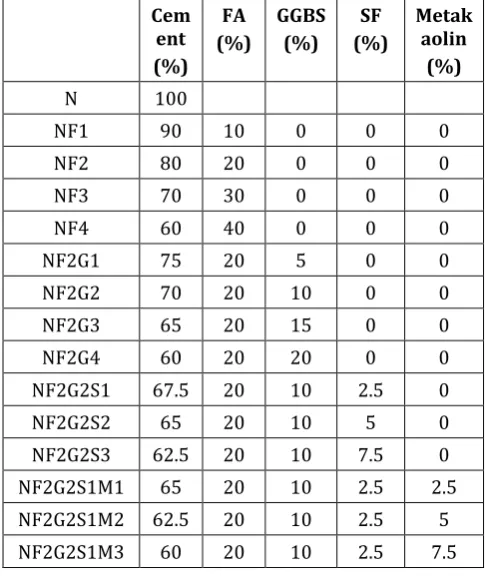
[image:2.595.312.555.107.399.2]Initially cement is replaced with fly ash, and then to the optimum replacement of FA, GGBS will be added in varying proportions. To the optimum replacements of FA and GGBS, SF is added in varying proportions as partial replacement, and from this we will get optimum replacement of SF. Finally Metakaolin is replaced partially in cement along with optimum replacements of FA, GGBS, and SF. Summary of % of replaced binding material is given in table1
Table – 1:
Summary of % of replaced binding material
Cem ent (%)
FA (%)
GGBS (%)
SF (%)
Metak aolin (%)
N 100
NF1 90 10 0 0 0
NF2 80 20 0 0 0
NF3 70 30 0 0 0
NF4 60 40 0 0 0
NF2G1 75 20 5 0 0
NF2G2 70 20 10 0 0
NF2G3 65 20 15 0 0
NF2G4 60 20 20 0 0
NF2G2S1 67.5 20 10 2.5 0
NF2G2S2 65 20 10 5 0
NF2G2S3 62.5 20 10 7.5 0
NF2G2S1M1 65 20 10 2.5 2.5
NF2G2S1M2 62.5 20 10 2.5 5
NF2G2S1M3 60 20 10 2.5 7.5
FA : Fly Ash
GGBS : Ground Granulated Blast-furnace Slag
SF : Silica Fume
N : Normal concrete
NF1 : Normal concrete with 10% Fly ash
NF2 : Normal concrete with 20% Fly ash
NF3 : Normal concrete with 30% Fly ash
NF4 : Normal concrete with 40% Fly ash
NF2G1 : Normal concrete with 20% Fly ash
and 5% GGBS
NF2G2 : Normal concrete with 20% Fly ash
and 10% GGBS
NF2G3 : Normal concrete with 20% Fly ash
and 15% GGBS
NF2G4 : Normal concrete with 20% Fly ash
and 20% GGBS
NF2G2S1 : Normal concrete with 20% Fly ash,
© 2017, IRJET | Impact Factor value: 6.171 | ISO 9001:2008 Certified Journal
| Page 184
NF2G2S2 : Normal concrete with 20% Fly ash,10% GGBS and 5% Silica fume.
NF2G2S3 : Normal concrete with 20% Fly ash,
10% GGBS and 7.5% Silica fume.
NF2G2S1M1: Normal concrete with 20% Fly ash,
10% GGBS, 2.5% Silica fume and
2.5% Metakaolin.
NF2G2S1M2: Normal concrete with 20% Fly ash,
10% GGBS, 2.5% Silica fume and 5%
Metakaolin.
NF2G2S1M3: Normal concrete with 20% Fly ash,
10% GGBS, 2.5% Silica fume and
5% Metakaolin.
6. EXPERIMENTAL RESULTS
6.1 Workability
[image:3.595.252.534.461.745.2]In this paper we have compared the workability of normal concrete and to the replacements of fly ash, GGBS, metakaolin and SF. slump of normal and multi blended concrete are shown in table 2. Graph shown in chart 1 is the variation in slump to optimum replacements of blended materials i.e., to NF2, NF2G2, NF2G2S1, & nF2G2S1M1.
Table – 2: SLUMP OF CONCRETE
Type of
concrete Slump in mm
N 40
NF1 42
NF2 44
NF3 45
NF4 42
NF2G1 45
NF2G2 45
NF2G3 43
NF2G4 43
NF2G2S1 48
NF2G2S2 45
NF2G2S3 43
NF2G2S1M1 50 NF2G2S1M2 48 NF2G2S1M3 47
Chart- 1: Comparison of Slump of Normal concrete With the optimum dosages of Multi blended
Materials
6.2. Split Tensile Strength
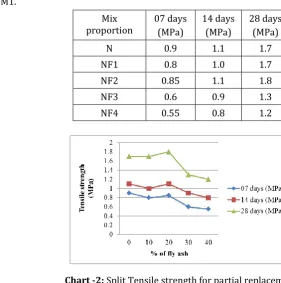
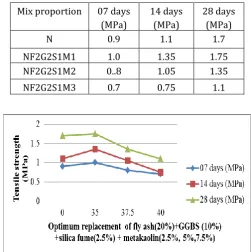
The Split Tensile strength of concrete is found in laboratory by compressive testing machine at age of 7days, 14days and 28days curing by casting cylinders of size150mm×300mm. The results are tabulated which are given below. The results in table 7 in are shown for optimum replacement of blended materials. The remaining proportions of blended materials which are shown in table 1 are less in strength when compared to the normal concrete. Variation of graph for optimum % replacement of blended materials is shown in chart-6. Split Tensile strength of remaining proportions is shown in tabular columns from 3 to 6 along with graphs shown from chart 2 to 5.
Table – 3: Split Tensile strength of concrete with fly ash replacement (10%, 20%, 30%, & 40%)
Mix
proportion 07 days (MPa) 14 days (MPa) 28 days (MPa)
N 0.9 1.1 1.7
NF1 0.8 1.0 1.7
NF2 0.85 1.1 1.8
NF3 0.6 0.9 1.3
NF4 0.55 0.8 1.2
© 2017, IRJET | Impact Factor value: 6.171 | ISO 9001:2008 Certified Journal
| Page 185
Table -4: Split Tensile strength of concrete withOptimum FA (20%) + varying proportions of GGBS (5%, 10%, 15% & 20%)
Mix
proportion 07 days (MPa) 14 days (MPa) 28 days (MPa)
N 0.9 1.1 1.7
NF2G1 0.65 0.75 1.3
NF2G2 0.9 1.1 1.7
NF2G3 0.75 0.95 1.4
NF2G4 0.7 0.75 0.9
Chart-3: Split Tensile strength of concrete with optimum fly ash (20%) + varying % of GGBS (5%, 10%,
15% & 20%)
Table – 5: Split Tensile strength of optimum fly ash (20%) + GGBS (10%) + varying silica fume (2.5%, 5% &
7.5%)
[image:4.595.306.558.127.380.2]Chart – 4: Split Tensile strength Vs optimum fly ash (20%) + GGBS (10%) + silica fume (2.5%, 5% & 7.5%)
Table – 6: Split Tensile strength of optimum fly ash (20%) + GGBS (10%) + silica fume (2.5%) + varying proportion of
metakaolin (2.5%, 5% & 7.5%)
Chart – 5: Split Tensile strength Vs optimum fly ash (20%) + GGBS (10%) + silica fume (2.5%) + varying proportion of
[image:4.595.46.565.457.726.2]metakaolin (2.5%, 5% & 7.5%)
Table – 7: Split Tensile strengths for optimum replacements of materials used
Chart – 6: Variation of Split Tensile strengths for optimum replacements of materials used Mix
proportion 07 days (MPa) 14 days (MPa) 28 days (MPa)
N 0.9 1.1 1.7
NF2G2S1 1.0 1.35 1.85
NF2G2S2 0..8 1.1 1.55
NF2G2S3 0.7 0.85 1.15
Mix proportion 07 days (MPa)
14 days (MPa)
28 days (MPa)
N 0.9 1.1 1.7
NF2G2S1M1 1.0 1.35 1.75
NF2G2S1M2 0..8 1.05 1.35
NF2G2S1M3 0.7 0.75 1.1
Mix
proportion 7 Days (MPa) 14 Days (Mpa) 28 Days (MPa)
N 0.9 1.1 1.7
NF2 0.85 1.1 1.8
NF2G2 0.9 1.1 1.7
NF2G2S1 1.0 1.35 1.85
© 2017, IRJET | Impact Factor value: 6.171 | ISO 9001:2008 Certified Journal
| Page 186
7. DISCUSSIONS
7.1. Workability
The slump value in mm of normal concrete is improved by way of 10% at 20% replacement fly ash in cement content.
The slump value in mm of normal concrete is improved b12.5% at 20% replacement of fly ash and 10% replacement of GGBS in cement content.
The slump value in mm of normal concrete is improved by 20% at 20% replacement of fly ash and 10% replacement of GGBS, 2.5% of SF in cement content.
The slump value in mm of normal concrete is improved by 20% at 20% replacement of fly ash and 10% replacement of GGBS, 2.5% of SF and 2.5% of metakaolin in cement content.
7.2. Split Tensile Strength
The split tensile strength of concrete is increased upto a maximum of 5.8% at 20% replacement fly ash in cement content for 28 days of curing. By further addition of flyash, the split tensile strength reduced. The Split Tesile strength in early days have reduced when compared to normal concrete.
The split tensile strength of concrete is same at 20% replacement fly ash and 10% replacement of GGBS in cement content at 7days, 14days and 28 days of curing respectively. By further addition of GGBS to the 20% fly ash replaced cement, the split tensile strength has been reduced.
The split tensile strength of concrete is increased upto a maximum of 11.11% 22.7% and 8.82% at 20% replacement fly ash, 10% replacement of GGBS and 2.5% of silica fume in cement content at 07days, 14days and 28 days of curing respectively. By further addition of silica fume to the 20% fly ash and 10% GGBS replaced cement, the split tensile strength has been reduced.
The split tensile strength of concrete is increased upto a maximum of 11.11%, 22.7% and 2.9% at 20% replacement fly ash, 10% replacement of GGBS, 2.5% of silica fume and 2.5% of metakaolin in cement content at 07days, 14days and 28 days of curing respectively. By further addition of metakaolin to the 20% fly ash and 10% GGBS and 2.5% silica fume replaced cement, the split tensile strength has been reduced.
8. REFERENCES
[1] Dr. D. V. Prasada Rao, N.Lakshmi Narayana, 2017 “Properties of multi component composite cement concrete” IJERGS, Volume 5, Issue 1, January-February, 2017, ISS 2091-2730, pg no. 54-61
[2] Balakrishna.Y, V.Lavanya, Naresh. A ,S.vijaya Bhaskar Reddy 2016 “Study the combined effect of Micro silica and GGBS on compressive, split tensile and flexural strength in concrete by partial replacement of cement” IRJET, Vol. 3. [3] S. Vijaya Bhaskar Reddy, Dr. P. Srinivasa Rao 2016, “Influence of micro silica and GGBS on compressive strength of blended with two supplementary cementing materials in concrete” IJERT, Vol. 5, Issue 03, March-2016