
© 2017, IRJET | Impact Factor value: 5.181 | ISO 9001:2008 Certified Journal | Page 2376
A REVIEW ON IMPROVING SEISMIC PERFORMANCE OF STRUCTURES BY
USING ISOLATION SYSTEM
Anand Kumar Tiwari
1, Abhishek Kumar
2,
Mohd. Afaque Khan
31
Post Graduate Student, Structural Engineering, Babu Banarasi Das University, Lucknow, Uttar Pradesh, India.
2 Head of Dept, Dept. of Civil Engg.BBDNIIT , Lucknow, Uttar Pradesh,India.3
Assistant Professor, Dept. of Civil Engg. Babu Banarasi Das University, Lucknow, Uttar Pradesh, India.
---***---Abstract -
The seismic activity in some parts of the world requires that the performance of structures under this type of excitation, is carefully evaluated. In regions where seismicity is insignificant or less, the conventional design approach aims at the design of structural members in such a way that all static and dynamic loads (such as wind load, seismic load) are withstand elastically by structure. However, in cases where seismic excitation has to be taken into account, this approach may lead to uneconomic solutions of design.Therefore, two alternative design concepts are often employed. In the first design phenomenon, plastic deformation is allowed in special parts of the structures. The second concept consists of the implementation of mechanical devices(such as bearings , Magnetorheological fluid dampers) into the structure. In some of these cases, the mechanical devices are placed underneath the superstructure. This is often referred to as seismic base isolation system. In seismic base isolation systems, frequently, nonlinear behavior of structures is encountered. In many cases, though, these systems are modeled linearly. This may lead to an unrealistic representation of the dynamic response of the isolated structure. In this article, the influence of the dynamic characteristics of the super structure and the nonlinear modeling of base isolation systems on the total structure's dynamic response, is considered. Furthermore, the dynamic performance of a baseisolated structure is evaluated, based on additional insight in its nonlinear behavior , obtained using dynamic analyses of model.Progress in material science and manufacturing technology have resulted in the discovery of
new construction materials characterized by light weight, higher strength, long life and better performance, e.g., high performance concrete(HPC), high strength structural steel (Fe500)and composites(fiber reinforced concrete). These new construction material integrated with better quality control norms in the manufacturing process and also during construction process have led to the emergence of complex and slender structures such as high-rise buildings, long span bridges, deep water construction offshore platforms of structures,
Key Words: Isolation system, Magnetorheological Fluid, Elastomeric Bearing, Seismic Protection System, Hybrid Isolation System, Smart Base Isolation System seismic structures.
1.INTRODUCTION
A large portion of the population in the world lives in seismic hazard regions and they are at risk from earthquakes of varying severity of event and frequency of occurrence. Every year earthquakes cause significant loss of life and damage to properties of peoples. Traditionally, progress in design of structures and assessment methods of civil structures comes after occurrence of major earthquakes, whenever the need of improving the safety level of engineering structures became important. The importance of continuous and extensive research is recognized as the most important factor to provide new methods to reduce the most severe earthquake effects on structures.In this context, seismic isolation is a technology which mitigates the earthquake effects on buildings and on their potentially vulnerable contents. The theory of protecting a structure from the damaging effects of an earthquake by introducing a support for isolating the building from the shaking ground is quite older, but research continues for seeking economical ,more effective, and reliable seismic isolation systems. In the last years, major developments have occurred on advance material properties. The term advanced in the civil structural context refers to a capability to increase the structural performance, safety, comfort conditions building design life time, and serviceability with respect to traditional materials. A key aspect to move towards the improved structural technology is the development of advanced materials for design and its use in innovative structural systems.
© 2017, IRJET | Impact Factor value: 5.181 | ISO 9001:2008 Certified Journal | Page 2377 the superstructure. Since the displacement demand of the
superstructure is small, we can assure its elastic response. Moreover, if nonlinear isolation system devices are used, the maximum base shear transmitted to the superstructure is limited and capacity design can be performed. In this way all the nonlinear and dissipating phenomena will occur at the isolation level, and brittle failure mode of structure will be avoided.
Period Shift - A change in global structure stiffness shifts the fundamental period of vibration. Since the isolation layer is more flexible than the superstructure, the fundamental period of the isolated structure is increased with respect to the one in the non isolated condition, inferring to either the displacement or the acceleration demand. Thus, the isolation system affects strongly the properties of the 1st mode of vibration of structure. In an isolated structure the fundamental mode is very different from all the other modes of structure and it is even more important than in the not isolated case. The vertical profile of the horizontal displacements is rectangular, with equal motions for all the masses apply. Further, fundamental mode is characterized by a large participating mass, approx equal to the total mass. Therefore the isolation system determines the first period and damping of an isolated structure, and control the structural seismic response and makes structure safe from seismic events.
[image:2.595.38.269.428.591.2].
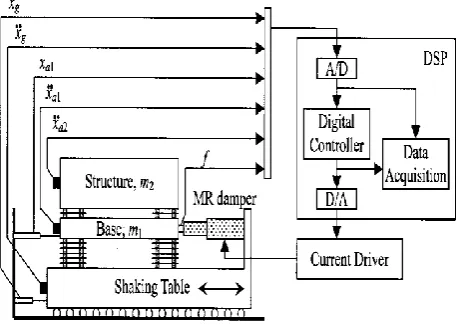
Fig. 1. Experimental setup of smart base isolation system
3. LITERATURE REVIEW
Shirley J. Dyke: Inthis paper focuses on the development of a semiactive control system for the nonlinear twenty-story building. The damping force provided by the Magnetorheological fluid device is a nonlinear function of magnetic flux across the coil in the system. Therefore predicting the amount of voltage required to be supplied to the device to obtaining a required damping force is a challenging task. This process involves the development of nonlinear control algorithms to monitor voltage supply to the Magnetorheological fluid damper to obtain a desired
damping action. Both parametric and non-parametric modeling of Magnetorheological fluid damper hysteretic character has been reported in the previous studies. Most widely accepted is the Bouc - Wen hysteretic model proposed. Recent studies on large scale Magnetorheological fluid damper (maximum capacity is twenty tones) have reported the dependence of the Bouc-wen hysteretic parameters on amplitude and frequency of the input excitation. Bouc-Wen model is a simple model and does not incorporate the amplitude and frequency dependence of its parameters and operations. Hence, investigation of amplitude and frequency dependence in the Bouc-Wen parameters used to describe the Magnetorheological fluid damper hysteretic character forms one of the goals in this study. This can be further explored to provide a modified Bouc-Wen model that can alleviate some of the drawbacks described in the system. The number of plastic connections formed during each earthquake was also reduced significantly in the controlled cases by it.
J.C. Ramallo In this paper a smart base isolation system, comprised of low-damping elastomeric bearings, and smart controllable semi-active damper, was shown to have super performance compared to several passive base isolation designs using lead-rubber bearings. A major component of their research is the investigation of the cyclic behavior of a new class of multi-stage friction bearings. These isolation devices are characterized by parameters that can be selected such that the bearing exhibits cyclic performance that evolves with the amplitude of displacement demand of structure. Characterization of the behavior of these bearings and validation of the derived model though extensive experiments provides a basis for further parametric analytical studies and performance assessment of the system.
© 2017, IRJET | Impact Factor value: 5.181 | ISO 9001:2008 Certified Journal | Page 2378
Toshiyuki SUEOKA , Shingo : In this paper represent the characteristic of the high-rise building with middle-story isolation interface. The total height of this building is 120 meters (total number of story is 25). The construction of this building has been continued from 1st March , 2002. And it will be finished in July 2004. First, The outline and design concept of the above building is represented. The building comprises office space at the upper floors (number of floor is 14) and the hotel space at lower floors. And especially, the large glass atrium is supplied at the lower floors (the ration of open space area is about 50% of total area). On the principal feature of structural design, the following structural system is represented in this paper.
Shirley J. Dyke and J. David Carlson: Inthis paper they documents the results of an experimental study conducted to demonstrate the capabilities of multiple magnetorheological (MR) devices for seismic control of civil engineering structures. Passive control strategies, such as base isolation systems, passive energy dissipation systems, and tuned mass dampers, etc., have been widely accepted by the engineering community for mitigating structural responses and seismic effects. Passive control systems do not require any external energy supply to operate. These systems either use potential energy generated by the response of the structure (fluid column dampers) to supply the control force or dissipate the energy of the excitation through friction or viscoelastic deformation of them(friction dampers and viscoelastic dampers). However, passive devices cannot be tuned to adjust themselves to a varied range of frequency content that may be present in the external loading. Hence, the efficiency of these systems cannot be assured if the actual excitations created at time of seismic events (amplitude an d frequency content) are different from the one considered
in tuning and design of these devices. Active control systems operate using an external energy supply to apply control forces on structures. Active control systems use sensors to measure the response of the system and/or excitation produced by vibrations, computes the control command from the sensor output using a control algorithm (coded in a hardware) and apply the control command to the structure by means of actuators to use them.
Active mass dampers, active mass drivers, active tendon system, etc., are some of the active control devices developed and tested for actual structural design applications during the last two decades . Active control systems are dependent on external power supply and for Civil Engineering structures the power requirement is quite high(because they are very big). This makes such systems vulnerable to power failure during extreme events like earthquake. Moreover, due to high power requirement, it is difficult to provide an active control system with its own dedicated power supply to operate these system. On the other hand, semi-active systems have a significant practical implementation potential because they have more reliability of passive systems and the versatility and adaptability of active control
systems, by using moderate power sources, that can be supplied by some batteries.
E.A. Pavlou, and E.C. Pisiara : In this paper the dynamic response of base-isolated block-like slender objects, such as statues, subjected to horizontal ground motion is investigated. However, analyses were carried out with reported numerical instabilities that likely affect high-frequency acceleration response in the isolated structure. In addition, the effect of property modification factors for long-term changes in isolator properties were accounted for, as was the presence of vertical acceleration. These last two effects were concluded to be of minor consideration in the estimation of secondary system response.
Hirokazu IEMURA :
In this paper theyadopted the high-damping rubber bearing (HDR) in the process of the construction of a large scale pedestrian bridge. This system serves for making the structure itself more flexible, greatly reducing the power of earthquakes accelerations, and consequently enhancing resistance against the earthquake shock. A broad category of seismic isolation devices is elastomeric bearings. Such bearings rely on the flexible properties of natural and synthetic elastomeric compounds of them to achieve the desired characteristics of an isolation. Elastomeric bearings can be divided into three sub-categories: lead rubber (L.R.), high-damping rubber (H.D.R.) and natural rubber (N.R.). Any elastomeric isolation bearing is constructed of alternating layers of rubber pads and steel shims, bonded together with a robust, non-degrading or less degrading adhesive. The steel shims prevent the rubber pads from excessive bulging at their perimeter, and hence enhance the vertical stiffness of the bearing. The layers of rubber pads in natural rubber bearings are compounded with an unfilled rubber that exhibits very little inherent damping. In contrast, the rubber layers in high-damping rubber bearings are specially compounded with a blend of synthetic elastomers and filler materials, such as carbon black and polymers, which enhances the internal energy dissipation capability of the rubber matrix. Lead rubber bearings generally consist of natural rubber bearings with a lead core press and fit into the central mandrel hole. This mandrel hole is required of any elastomeric bearing type since the vulcanization process requires heating from both the center and the exterior surface of the bearings. A detailed treatment of the mechanical characteristics of elastomeric isolation bearings is provided by Kelly .© 2017, IRJET | Impact Factor value: 5.181 | ISO 9001:2008 Certified Journal | Page 2379 applies not only to the structure but also to the life safety of
their occupants and the equipments housed inside the building. Therefore, the protection of a building structure, the equipment housed within and safety of human occupants, against damage induced by large environmental loads, e.g., earthquake, strong wind etc. without doubt, a worldwide priority for the Structural Engineers community. Significant research efforts have been made recently on protecting Civil structures from strong earthquake accelerations and wind loads. The objectives of these research studies range from developing protective schemes for occupant comfort and reliable operation of the structures to human safety and structural survivability during earthquake. Traditional design strategies provide increased structural strengths to resist dynamic loadings and rely on the inelastic deformation of structural components to dissipate input (seismic/wind) energy. The idea is to develop plastic hinges within the structure during hazardous environmental loads at time of earthquake without resulting in a complete collapse of the structure, thus protecting the occupants within the structure. Inelastic deformation (yielding) is permitted as means of dissipating a portion of the energy transfered to the structure by these environmental loads. However, plastic deformation due to the yielding results in permanent damage. Thus conventional structural design is often based on providing sufficient strength and stiffness to the structure such as to limit the inelastic deformation to an acceptable limit. However, structures cannot be designed to withstand all possible external load conditions. Some extraordinary loading episodes do occur, leading to damage or even failure of the structure. Higher flexibility and low damping characteristic of slender high rise structure have given rise to higher material distress during large environmental loads resulting in the unacceptable levels of vibrations and/or failure of the structural element.
4. CONCLUSIONS
The performance of a smart isolation system for the base-isolated two-degree-of-freedom structural model employing Magnetorheological fluid dampers has been investigated. The efficiency of this smart base isolation system in reducing the structural responses for a wide range of loading conditions has been demonstrated in a series of experiments conducted at the Structural Dynamics and Control Earthquake Engineering Laboratory . An analytical model of theMagnetorheological damper employing the BoucWen hysteresis has been presented. By applying a threshold to the control voltage for theMagnetorheological damper, the controller becomes robust for ambient vibration produced. The dynamic behaviour of the system is also shown to be predictable well. Results for the smart isolation system were compared to those where the Magnetorheological damper was operated in a passive mode. current being sent to the Magnetorheological fluid damper. In the passive mode, the Magnetorheological fluid damper behaves as a yielding device and approximates the behaviour of lead rubber bearings. An optimization was performed experimentally to obtain the optimal passive damper configuration. As compared to this optimal hysteretic passive system, the
smart isolation system achieved significant acceleration reductions over the entire range of earthquake intensities . These results indicate that the smart damping isolation system can be very effective over a wide range of ground motion intensities and characteristics. Base isolation greatly benefits the dynamic behaviour of the superstructure. Performance indicators, such as the interstory drift ratio ,displacements, deflection and floor accelerations, have been shown to be reduced, such that damage to non-structural components is prevented. Furthermore, modelling effects, such as the influence of varying normal force in the determination of the friction force and superstructure flexibility vertical excitation, have been considered. It is shown that an approximation of the isolator displacement can be determined by disregarding the vertical excitation and accelerations and the varying normal force for the establishing of the frictional forces. In addition, these effects can be disregarded in earthquake simulations, if the dynamics of the superstructure are considered. Finally, superstructure flexibility(ductility) should always be taken into account in numerical time simulations.
5.ACKNOWLEDGEMENT
First of all, I would like to express my sincere gratitude to my supervisor Mr. Abhishek Kumar for enlightening me for this research work. His valuable guidance, support, consistent encouragement and immense knowledge in the subjects helped me a lot throughout this research. Besides my advisor, I would like to thank Mr. Mohd. Afaque Khan (Assistant professor), for his timely co-operations and guidance for this project work. He has always been the co-guide for me. I also extend my sincere thanks to Mr. Anupam Mehrotra (Head of the department), Civil Engineering for his valuable suggestions. I am also very thankful to my colleagues for being with me throughout the year and encouraging me to move ahead. I am grateful to the Management of Central Building Research Institute (IIT Roorkee), Indian Institute of Technology Madras, Indian Institute of Technology Kanpur, Department of earthquake engineering IIT Roorkee, Central Power Research Institute and Motilal National Institute of Technology, Allahabad, India for permitting and supporting the above study.
6.REFERENCES
1. Osamu Yoshida and Shirley J. Dyke, Seismic Control of a Nonlinear Benchmark Building Using Smart Dampers. 2. J. C. Ramallo and B. F. Spencer Jr., M.ASCE, ‘‘Smart’’ Base Isolation Systems.
© 2017, IRJET | Impact Factor value: 5.181 | ISO 9001:2008 Certified Journal | Page 2380 4.Toshiyuki sueoka , Shingo torii and Yasuhiro tsuneki,The
application of response control design using middle-story isolation system to high-rise building.
5.Fu Yi, ,Juan M. Caicedo,and J. David Carlson,Experimental verification OF multiinput seismic control strategies for smart dampers.
6. P.C. Roussis , and E.C. Pisiara, Base-isolation technology for earthquake protection of art objects .
7.Shuji iwata , hirokazu iemura , atsushi honda, katuhira sakai, toru fukushima, Hybrid earthquake loading test of bidirectional base isolation bearing for a large pedestrian bridge.
8. S.J.Patil, G.R.Reddy ,State of Art Review -Base Isolation Systems For Structures.
9. EN 1998-1-3:2003 “Design provisions for Earthquake Resistant Structures. Part 1: General Rules, Seismic Actions and Rules for Building”.
10. ACI 318-02 “Building Code Requirements for Structural Concrete (ACI 318M-02) and Commentary (ACI 318RM-02)”, American Concrete Institsute, ACI Committee 318, Farmington Hills.
11. BIS (2000), IS 456, “Indian Standard Plain and reinforced concrete-code of practice” (Fourth revision), Bureau of Indian Standards, New Delhi.
12. NZS 3101: Part 1:1995 “Concrete Structures Standard, Part 1: The Design of Concrete Structures”, New Zealand Standard, New Zealand.
13. NZS 3101: Part 2:1995 “Concrete Structures Standard, Part 2: The Design of Concrete Structures”, New Zealand Standard, New Zealand.
14. IS:13920 -1993, “Ductile Detailing of Reinforced Concrete Structures subjected to Seismic forces- Code of practice”, Bureau of Indian Standards, New Delhi.
BIOGRAPHIES
Mr. Anand Kumar Tiwari was born in 1993 in Lucknow, Uttar Pradesh. He received his Bachelor of Technology degree in Civil Engineering from Uttar Pradesh Technical University(presently known as Dr. A.P.J. Abdul Kalam Technical University ), lucknow, in 2014. He is right now pursuing his Master of Technology in Structural Engineering from Babu Banarasi Das University, Lucknow.
Mr. Abhishek Kumar was born in 1986 in Patna city. Then received his Bachelor of Technology degree in Civil Engineering from school of Engineering (Cochin University of Science and Technology) ,Konchi, Kerala in 2009“. In 2011 he received his Master’s degree in Structural Engineering from MNNIT, Allahabad. He joined Babu Banarasi Das University, Lucknow in 2011 as a faculty where he works as Assistant Professor in Civil Engineering department with a total of 6 years of experience . Presently he is working as Head of Department of Civil Engineering at BBDNIIT Lucknow from july 2017.
Mr. Mohd. Afaque Khan was born in 1982 in Gonda city. He received his Bachelor of Technology degree in Civil Engineering from ZHCET, AMU, Aligarh in 2009. In 2012 he received his Master’s degree in Structural Engineering from ZHCET, AMU, Aligarh. He joined Babu Banarasi Das University, Lucknow in 2012 as a faculty. He worked as a Head of Department in Babu Banarsi Das Engineering College and he is now Assistant Professor in Civil Engineering department with a total of 6 years of experience.
![(E) 1 (4 Chlorophenyl) 3 [4 (2,3,4,6 tetra O acetyl β D allopyranosyloxy)phenyl]prop 2 en 1 one](data:image/gif;base64,R0lGODlhAQABAIAAAP///wAAACH5BAEAAAAALAAAAAABAAEAAAICRAEAOw==)