© 2017, IRJET | Impact Factor value: 5.181 | ISO 9001:2008 Certified Journal | Page 3160
Comparitive analysis for Pre-Processing of Images and videos using
Histogram Equalization methodology and Gamma correction method
Pratiksha M. Patel
1, Dr. Sanjay M. Shah
21
Research Scholar
,KSV, Gandhinagar, India
2
Guide, Director of Computer Science Department, SKPIMCS, Gandhinagar, India
---***---Abstract -
Pre-processing is an action performed on poor quality of images, degraded video files and also to find finer details of an image and video. Brightness and contrast enhancement are two major factors which play important role in improving visual artifacts and patterns of an image. Conservative HE results in unnecessary contrast enchantment which in turn gives processed image and aberrant look and also creates visual artifacts. In this paper diverse essences of deprived quality of images and videos with law lightning conditions and foggy or videos with noisy environment are taken. In this paper HE based algorithm, Advanced HE algorithm CLAHE and CLAHE-RGB are applied on various images and videos and they have been analyzed using both subjective and objective fidelity criteria. The research work is also spotlight on applying gamma correction method on the mentioned images and video file. This paper compares and analyzes performance of gamma correction and CLAHE technique based on PSNR value as a measuring parameter. The proposed work of comparative analysis tried to find out which histogram equalization method accomplishes higher accuracy, and which method is effective.Key Words: Contrast Limited Adaptive Histogram Equalization, Image Enhancement, Gamma Correction, PSNR, GHE
1.
INTRODUCTION
In day to day digital life, ratio of smart devices and
transaction with smart device are increase. In terms of
banking, credit card, billing, government organization,
medical science, forensic science, or in crime
investigation department there is a need to improve the
quality of images for further analysis, or to improve the
quality of some law lightning illumination condition
videos, or to enhance the degradation of video file
capture from CCTV camera, or video taken from any
external sources. Sometimes, during the capturing of
video there may be heavy rain, or environment
becomes cloudy, or foggy, there is snowfall then the
result of captured video file is also degrade. To solve
such crisis of image and video file, different image
enhancement techniques are implemented. Image
enhancement is only the method which performed on
an image to improve its quality or visual appearance
[1]. Video file also require enhancement techniques to
improve its quality, this can be achieved via contrast
procedure. From the observation it is clear that contrast
is determined by the difference in the color and
brightness of an object with other objects [2]. Contrast
enhancement of any image is measured with contrast
index factor. The higher CI value signifies better
contrast improvement in the output image [3].
Brightness of an image depends on type of image,
whether it is a monochrome image or color. Three
pillars of histogram equalizations such as Bi, Multi, and
Clipping Histogram are applied and to measure the
quality PSNR, AMBE, Entropy, MSE, SNR are used [1]. It
has been observed that images and video system are
sometimes homogenous, heterogeneous, in such a
situation to achieve superior feature consequence
CLAHE is used which basically work on shape of Hist.,
and it used the concept of distribution constraint [4].
Image contrast is directly evaluated by contrast ratio
equation then it refers as enhancement done directly
[5]. Vikram Mutneja el al proposed PSNR value for
achieving measurement, and extracting information for
video sequence [5]. Gamma correction is also used to
enhance the contrast of multiple frames in the video
sequence [5]. The subsequent themes express detail
view of methodology.
1.1
Contrast Enhancement Using Histogram
Equalization
Proposed work applied with poor quality of image as well as foggy, blurry video sequence. This section discuss the method of basic HE for contrast enhancement. Process of HE are mentioned below. Acquisition of an image or video file
Key Frame Extraction in case of video file Conversion of RGB to Grey
Histogram Generation
© 2017, IRJET | Impact Factor value: 5.181 | ISO 9001:2008 Certified Journal | Page 3161
1.2 Contrast Enhancement using CLAHE
The CLAHE (Contrast Limited Adaptive HE) is better-quality edition of algorithm which has adaptive characteristics [8]. Local histogram enhancement enhances the local details of an image, which apply on local neighborhood of the pixel. The main problem with local enhancement is that it is a tedious task to do the manipulation, more computations are compulsory. To solve the above problem the system used adaptive contrast enhancement. Adaptive filter worked globally on entire image of un-even contrast with an effective manner. It is worked on local characteristics of mean and variance. Workflow of CLAHE is shown in subsequent figure1.
1.3
Implementation of Gamma Correction
Method
Various researchers discussed varied flavors of image enhancement techniques [1][2][3]for an image and some of them are discussed varied techniques on enhancement of poor quality video for instance fog degradation, poor lightning conditions[4][5][6]. But the gaps suggest that to improve contrast enhancement in an image or video, use some basic Grey Level Transformations techniques before enhancement applied, grey level transformation functions are simple and easy to implement for enhancement. Algorithmic steps are as follows.
The extracted histogram of images and poor quality of video files are compared with HE, CLAHE, and gamma correction with HE. The comparative study proves that which technique is best for image as well as different type’s video file based on PSNR value. The practical implementation and experimental results are discussed in following section, which include comparative tables and graphs.
2.
Experimental Results
Contrast enhancement of poor quality video file or image using HE, CLAHE, and gamma correction methods which was tested using emgucv-windows-universal 3.0.0.2157 with c# as a software tool. This system is tested with 10 different types of images and 10 varied types of videos; out of them a few are display below. The targeted images formed by mentioned methods are statistically shows with PSNR (Peak Signal to Noise Ratio) .The PSNR values for output images and videos are stored in tabular form and Shown in subsequent Tables and the graphical illustration of PSNR are shown by Figure respectively.
Table 1 shows different PSNR value for normal pre-processing including RGB to grey conversion, Histogram equalization of an image, CLAHE, and finally conversion from CLAHE grey to RGB to achieve quality of original image again. It also displays value for 10 different images with different dimensions and having different format. The value written in red color indicates higher PSNR value of mentioned technique. Table 2 shows PSNR value for 10 different images using HE, CLAHE, gamma correction methods. The value written in red color indicates higher PSNR value and it is up to the mark.
Video is a process of continuous frame running at a single shot or single glance, it is specified that the frame of video size is selected as 640 X 360 and 960 X 540. Video used for practical implementation use different criteria. Among 10 video 5 videos frame rate is 29 frames/ second, 3 videos frame rate is 25 frames/ second, 1 video frame rate is 23 frames/ second, and remaining video also having frame rate of 30 frames/ second. Implementation result of video is
Start
Read Image Read Video
Extract Frames Convert RGB to grey scale
Calculate Intensity Chanel for each frame
Set the block size and Clip limit
Repeat until last frame
Interpolate each the frame and convert into image
Convert back targeted image into RGB
Generate histogram of final frame/ or image
Stop Estimate PSNR
© 2017, IRJET | Impact Factor value: 5.181 | ISO 9001:2008 Certified Journal | Page 3162 tested with histogram equalization method and CLAHE and
[image:3.595.32.566.171.476.2]Gamma correction method shown in Table 3.
Table 1: PSNR values for static images using HE, CLAHE, CLAHE_RGB
Image Grey Conversion HE CLAHE CLAHE_RGB
Tire 74.823135 18.035897 18.617591 22.967649
Cameraman 361.20199 19.072920 19.300983 12.573542
Face 17.127225 12.647498 13.986621 10.774499
Lena 17.868341 12.974201 13.938925 15.336492
Hurricane Andrew
30.314857 19.521672 14.932527 13.414176
Random matches
35.269357 6.0011012 12.040845 22.282529
Cygnus loop 28.282844 6.8734821 10.278123 18.970536
Crab pulsar radio
21.003479 8.1118209 14.413110 18.696397
Bottom_Left (beans)
361.20199 7.533428 13.442106 22.655151
Rice 361.20199 12.481749 33.730153 23.524081
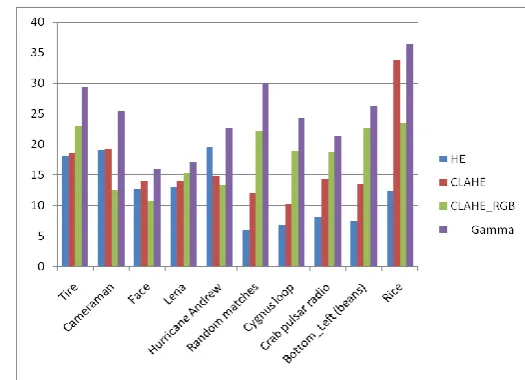
Chart 1 proved that CLAHE_RGB is the essential method for different dimensions and different types of images.
Chart -1: Comparative chart of varied images with HE techniques
The proposed Table 2 displays PSNR of targeted image after applying gamma correction method. From experimental result it is confirmed that for better grey level enhancement it is a very efficient method for pre-processing on an image.
Table 2 Comparison table for static images using HE, CLAHE-RGB, Gamma
Image HE CLAHE CLAHE_RGB Gamma
Tire 18.035897 18.617591 22.967649 29.39581
Cameraman 19.072920 19.300983 12.573542 25.393626
Face 12.647498 13.986621 10.774499 15.992922
Lena 12.974201 13.938925 15.336492 17.071886
Hurricane Andrew
19.521672 14.932527 13.414176 22.719994
Random matches
6.0011012 12.040845 22.282529 30.102464
Cygnus loop 6.8734821 10.278123 18.970536 24.289442
Crab pulsar radio
8.1118209 14.413110 18.696397 21.450496
Bottom_Left (beans)
7.533428 13.442106 22.655151 26.244559
Rice 12.481749 33.730153 23.524081 36.303978
Chart 2 proved that Gamma correction is up to the mark pre-processing methods for different flavors of images.
[image:3.595.301.564.526.716.2]© 2017, IRJET | Impact Factor value: 5.181 | ISO 9001:2008 Certified Journal | Page 3163 Table 3 shows comparison of varied pre-processing
[image:4.595.33.293.165.671.2]techniques for effective last frame of video-quality.
Table 3 : PSNR value for video file using different pre-processing techniques
Video HE CLAHE CLAHE_RGB Gamma
Simple 9.371095 16.23958 9.5401253 24.48523
Lake_1 11.98895 15.72640 18.66261 26.06742
Lake_2 13.33258 19.05307 17.95406 28.52813
Mist 19.95238 14.69283 13.40044 25.40510
Ocean 13.38362 18.39174 10.81132 21.86923
Rush_hour 19.85590 16.04474 11.90557 21.48534
Snow 24.981487 16.809983 12.83182 23.82112
Snowfall 10.19004 14.617166 8.3044725 27.16425
Street 18.534571 15.30914 9.80656 26.12038
Tree 14.47888 13.35891 9.787354 15.41554
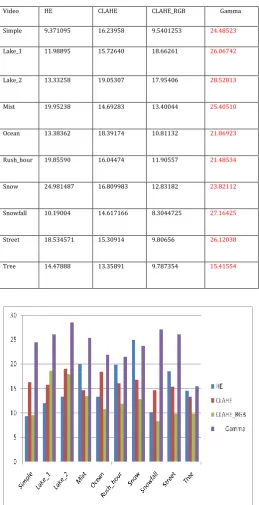
Chart -3: Comparative chart of varied video of last frame with HE techniques, gamma correction
From Highlighted Red color marked PSNR and from chart 3, it is observed that for real life video file or video with poor lightning conditions, mist, fog, street traffic, snowfall etc. , one must apply pre-processing of gamma correction, and
then apply contrast stretching techniques of CLAHE to improve as well enhance brightness and contrast in video file of each key frame to achieve betterment of video file.
3. CONCLUSIONS
To accomplish contrast effect on an image or video file here the histogram equalization methods are applied and comparative analysis are done based on parameter of image file and video file. Out of 10 images, 6 images which are either grey scale or color achieve higher quality of image after contrast enhancement by using CLAHE RGB that is contrast limited adaptive histogram equalization; 3 images achieved high PSNR value using CLAHE, and remaining image achieved high contrast enhancement using simple HE. The paper shows various PSNR value for different frame of different videos. It use total 10 video files, out of which 5 video’s frame and its PSNR is shown with two techniques HE and CLAHE. It is proved that for video file of simple, lake-2, ocean, and snowfall improved efficient quality in a key frame of video sequences only by applying CLAHE of histogram equalization method. From all results it is proved that CLAHE pre-processing is up to the mark for varied static images and Gamma correction is suitable for foggy, blurry video files. In future use combination of varied HE techniques to improve contrast enhancement and brightness ratio of an image and video file.
ACKNOWLEDGEMENT
I would like to thank Dr. Sanjay M. Shah, Director, S.K. Patel Institute of Computer Studies, for his support and sparing valuable time and implant extra ordinary knowledge in completing my research work. Finally I would like to thank one and all who directly or indirectly support me and guide me.
REFERENCES
[1] Saritha K R., “A Study on Image Enhancement
Techniques and Performance Measuring Metrics.” International Journal of Innovative Research in Computer and Communication Engineering 4.4 ,2016
[2] Enhancement and Lacuna Texture Synthesis,” Computer
Journal of IEEE Transactions Image Processing,
[3] Raju, A., "A comparative analysis of histogram
equalization based techniques for contrast enhancement and brightness preserving.",2013.
[4] Yadav, Garima, Saurabh Maheshwari, and Anjali
[image:4.595.30.293.167.677.2]© 2017, IRJET | Impact Factor value: 5.181 | ISO 9001:2008 Certified Journal | Page 3164
[5] Mutneja, Vikram, and Deepak Kumar Behera. "Contrast
enhancement analysis of video sequence in the temporal-based (TB) method."
[6] Ramya, C., and Dr S. Subha Rani. "Contrast Enhancement
for Fog Degraded Video Sequences Using
BPDFHE." International Journal of computer sciences & informationtechniques vol3 (2) ,2012.
[7] Y. T. Kim, “Contrast Enhancement Using Brightness
Preserving Bi -Histogram Equation”, IEEE Transactions on Consumer Electronics, vol. 43,1997 .February , pp. 1-8 .
[8] Das, Sourav, Tarun Gulati, and Vikas Mittal. "Histogram
equalization techniques for contrast enhancement: a review."International Journal of Computer Applications114.10 ,2015.
[9] Bhagya H.K, Keshaveni N. “Review on video
enhancement techniques.” International Journal of Engineering Science Invention Research & Development.3.2 ,2016.
[10] Sahu, Niraj Kumar, and Sampada Satav. "A Study paper
on Development of Robust Video Contrast Enhancement Technique using intra-frame Techniques."
[11] S. Srinivasan, N. Balram, “Adaptive Contrast
Enhancement Using Local Region Stretching.” 8.12 oct
[12] Wang, Dongsheng, Xin Niu, and Yong Dou. "A
piecewise-based contrast enhancement framework for low lighting video." Security, Pattern Analysis, and Cybernetics (SPAC), 2014 International Conference on. IEEE, 2014.
[13] Pratiksha M. Patel, “Contrast Enhancement of Images