5
IX
September 2017
Parametric Optimization of GTAW Welding Using
Taguchi and ANOVA
Anurag singh jadon1, Nishant singh kushwah2, Pavan agrawal3, Promise mittal4
1, 2, 3, 4
Department of Mechanical Engineering, VITM, Gwalior
Abstract:Welding process is widely used by manufacturing engineers and production personnel to quickly and effectively set up of manufacturing processes to obtain desired products. In this research work, bead on plate welds were carried out on AISI 409 & Mild Steel plates using Gas tungsten arc welding (GTAW) process. The input process variables considered here as welding current, welding voltage & gas pressure. A total no of 27 experiment runs were conducted as suggested by Taguchi method. The analysis for signal-to-noise ratio was done using MINITAB-17 software for higher-the-better criteria. The significance of each parameter was studied by using the ANOVA (Analysis of variance).Finally the confirmation tests were performed. Thus, with the proposed optimal parameters it is possible to increase the efficiency of welding joint by which tensile strength of joint can be increased with suitable set of parameter.the experimental values confirm its effectiveness in the analysis of tensile strength of the joint.
Keywords: Tensile strength, Stainless steel AISI 409, Mild steel, Taguchi method, orthogonal array(L27),ANOVA,GTAW
I. INTRODUCTION
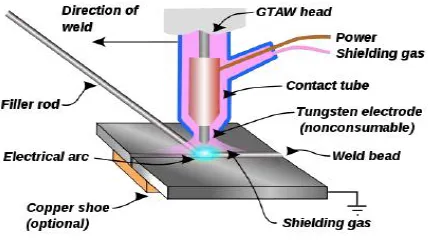
[image:2.612.201.415.433.553.2]Welding is a manufacturing process of creating a permanent joint obtained by the fusion of the surface of the parts to be joined together, with or without the application of pressure and a filler material.[7] Tungsten Inert Gas welding is also known as Gas tungsten arc welding (GTAW), is an arc welding process that uses a non-consumable tungsten electrode to produce arc. The welded area is protected from atmospheric contamination by an inert shielding gas (argon or helium), and a filler is normally used to weld thick plate. The electrode is no consumable since its melting point is about 34000C.The schematic diagram of GTAW or TIG welding process is shown in Figure.[10]
Fig.1-Schematic diagram of TIG Welding
Both the direct current (DC) and alternating current (AC) may be used for TIG welding. When the work is connected to the positive terminal of DC welding machine and the negative terminal to an electrode the welding set up is said to have straight polarity. When work is connected to negative and electrode to positive terminal then the welding set up is said to have reversed polarity.
A. Principle of GTAW machine
power source to produce energy and conducted across the arc through a column of highly ionized gas and metal vapours. The electric arc produce high temperature and heat can be focused to malt and join two different parts of work piece
B. Advantages of TIG welding process
1) Concentrated arc produced for control heat input to the workpiece. It resulting in a narrow heat-affected zone.
2) This process is done without use of flux, therefore no slag formation during welding process.
3) No Sparks or Spatter because of no transfer of metal across the arc during TIG welding.
4) Compared to other arc welding processes like flux cored welding, fewer amounts of fumes or smokes are produced.
5) Welding of thin material is possible.
6) Welding dissimilar type material is possible.
7) Welding of different types of metal and metal alloys are possible by proper control
C. Autogenous TIG welding
A weld joint produced by melting the contact edge surfaces and subsequently solidifying it at room temperature (without addition of any filler metal) is called “autogenous weld”. Thus, the composition of the autogenous weld metal corresponds to the base metal only. However, autogenous weld is crack sensitive when solidification temperature range of the base metal to be welded is significantly high. TIG welding process performed without application of filler material is known as autogenous TIG welding process. Autogenous TIG welding is preferred especially for less than 5 mm thick plate. The advantages of this process are that, it is economical process as compare to heterogeneous or homogenous welding process as no edge preparation and filler material are required.
II. TAGUCHI METHOD
Traditional experimental design procedures are too complex and not easy to use. A large number of experimental works have to be carried out when the number of the process parameters increases with their levels. To solve this problem, the Taguchi method uses a special design of orthogonal arrays to study the entire parameter space with only a small number of experiments. The greatest advantage of this method is to save the effort in performing Experiments: to save the experimental time, to reduce the cost, and to find out significant factors fast. Taguchi robust design method is a most powerful tool for the design of a high-quality system. He considered three steps in a process’s and product’s development: system design, parameter design, and tolerance design. In system design, the engineer uses scientific and engineering principles to determine the fundamental configuration. In the parameter design step, the specific values for system parameters are determined. Tolerance design is used to determine the best tolerances for the parameters.
A. The standard S/N ratios generally used are as follows
1) Smaller-The-Better n: - 10 Log10 [means of sum of square of measured data]
2) Larger-The-Better n: - 10 Log10 [means of sum square of inverse of measured data]
3) Nominal-The-Best n: - 10 Log10 (squares of mean/ variance)
Chart 1. Steps to apply Taguchi method [5]
Determining of Quality Characteristics which required for optimization
Identify the noise factor and test condition
Identify the control factors and their different levels
Develop the design matrix (OA)
Conduction of experiments
Analyze the data and determining the optimum levels of the control factors
III. ANOVA
Purpose of the ANOVA is to investigate which process parameters significantly affect the performance characteristics. The ANOVA procedure performs analysis of variance (ANOVA) for balanced and unbalanced data from a wide variety of experimental designs. In analysis of variance, a continuous response variable, known as a dependent variable, is measured under experimental conditions identified by classification variables, known as independent variables. The variation in the response is assumed to be due to effects in the classification, with random error accounting for the remaining variation. In short the basic idea behind analysis of variance (ANOVA) is to breakdown total variability of the experimental results into components of variance, and then assesses their significance. The significance of the variation components associated with factor effects is assessed by comparison with the residual. The optimum level of these significant parameters was found by examining the level averages of the factors. The F-test was utilized for comparing variances for this purpose.
IV. EXPERIMENT DETAIL
A number of experiment were conducted to study the effect of various machining parameter on welding process. These studies have been undertaken to investigate the effects of current, voltage, pressure on tensile strength of dissimilar welded joints.
Table 1 -Welding parameter and their levels
Levels Pressure Current Voltage
1 12 150 15
2 15 170 20
[image:4.612.42.574.447.721.2]3 18 190 25
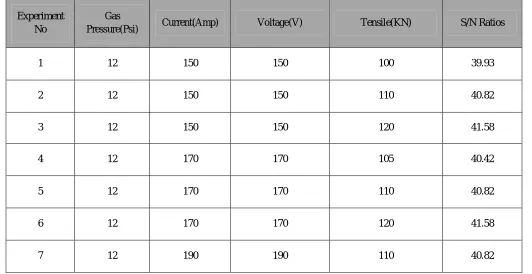
Table 2 -Experiment result of Tensile strength and S/N ratio
Experiment No
Gas
Pressure(Psi) Current(Amp) Voltage(V) Tensile(KN) S/N Ratios
1 12 150 150 100 39.93
2 12 150 150 110 40.82
3 12 150 150 120 41.58
4 12 170 170 105 40.42
5 12 170 170 110 40.82
6 12 170 170 120 41.58
8 12 190 190 115 41.21
9 12 190 190 125 41.93
10 15 150 170 100 39.93
11 15 150 170 105 40.42
12 15 150 170 115 41.21
13 15 170 190 105 40.42
14 15 170 190 115 41.21
15 15 170 190 125 41.93
16 15 190 150 105 40.42
17 15 190 150 120 41.58
18 15 190 150 125 41.93
19 18 150 190 100 39.93
20 18 150 190 110 40.82
21 18 150 190 120 41.58
22 18 170 150 110 40.82
23 18 170 150 115 41.21
24 18 170 150 125 41.93
25 18 190 170 110 40.82
26 18 190 170 120 41.58
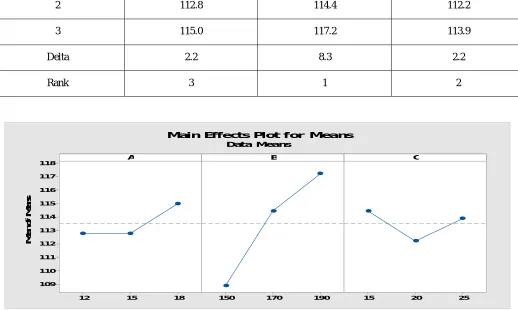
Table 3 -Mean response table for UltimateTensile Strength(UTS)
Level A B C
1 112.8 108.9 114.4
2 112.8 114.4 112.2
3 115.0 117.2 113.9
Delta 2.2 8.3 2.2
Rank 3 1 2
18 15 12 118 117 116 115 114 113 112 111 110 109 190 170
150 15 20 25
A M e a n o f M e a n s B C
Main Effects Plot for Means
Data Means
Fig 2 - Means of responce
The ANOVA analysis for ultimate tensile strength verses gas presser, current and voltage by using Minitab 17 software are shown in Table
Table 4 -ANOVA Table
Source DF Seq SS Adj SS Adj MS F P
GP 2 29.63 29.63 14.81 2.91 0.078
CUR. 2 324.07 324.07 162.04 31.82 0.000
VOLT. 2 1335.19 1335.19 667.59 131.09 0.000
ERROR 20 101.85 101.85 5.09
TOTAL 26 1790.74
R-Sq = 94.31% R-Sq(adj) = 92.61%
V. RESULTS OF ANOVA
[image:6.612.66.548.521.689.2]Percentage contribution of input parameter on Tensile strength Input parameter Percentage contribution (%)
Gas pressure 1.65
Current 18.10
Voltage 74.56
Error
5.69
VI. CONCLUSION
TIG welding is one of the best welding technique by which we can join two similar and dissimilar materials. Analysis of variance (ANOVA) helps to find out the significance level of the each parameter. The optimum value was determined using MINITAB-17 software.
Based on the investigations following conclusions can be made
TIG welding process is very successful to join stainless steel (AISI-409) and Mild steel.
Based on S/N ratio analysis and ANOVA, the process parameters which significantly affects the ultimate tensile strength was voltage and welding current.
The effect of parameters on the ultimate tensile strength can be ranked in decreasing order as follows: voltage > current>pressure
REFERENCE
[1] K. Kishore, P.V. Gopal Krishna, K. Veladari and Syed Qasim Ali, “Analysis of Defects In Gas Shielded Arc Welding Of AISI1040 Steel Using Taguchi method,” APRN Journal Of Engg & Applied Science, Vol 5, pp 37-41, January.
[2] Arc Welding Processes: TIG, Plasma Arc, MIG Ulrich Kruger, Schweibtechnische Lehrund Versuchsanstalt Berlin.Abdul wahab H. Khuder and Esam J. Ebraheam, “Study
[3] The factors effecting on welding joint of dissimilar metals”, Al-Khwarizmi engineering journal, April (2011), Vol 7, No. 1, pp.-76-81.
[4] M. Aghakhani, E. Mehrdad, and E. Hayati, “Parametric optimization of gas metal arc welding process by Taguchi method on weld dilution”, International Journal of Modeling and Optimization, August (2011), Vol. 1, No. 3, pp.- 216-220
[5] Pawan Kumar, Dr. B. K. Roy and Nishant, “Parametres optimization for gas tungsten arc welding of austenitic stainless steel (AISI 304) & low carbon steel using Taguchi’s technique”, International journal of engineering and management research, August (2013), pp.-18-22.
[6] Jyoti Prakash, S.P.Tewari, Bipin Kumar Srivastava, ―Shielding Gas for Welding of Aluminium Alloys by TIG/MIG Welding-A Review‖ Vol.1, Issue.2, pp.
690-699, 2003
[7] Imran A. Shaikh and M.Veerabhadra Rao, “Optimizing Process Parameters for TIG Welding using Taguchi Method & Grey Relational Analysis,” International Journal of Science and Research, vol 4, No 6, pp. 2449- 2452, June 2015
[8] Mukesh, Sanjeev Sharma, “Study of Mechanical Properties in Austenitic Stainless Steel Using Gas Tungsten Arc Welding (GTAW)”,IJERA, Vol.3, Issue 6, pp. 547-553, Nov-Dec 2013
[9] Dheeraj Singh, Vedansh Chaturvedi, Jyoti Vimal, “Parametric Optimization on of TIG Process Using Taguchi and Grey Taguchi analysis”, IJETED, Vol.4, Issue 4,June-July 2013
[10] A.S. Shahi and Subodh Kumar, “Effect of heat input on the microstructure and mechanical properties of gas tungsten arc welded AISI 304 stainless steel joints,” journal of materials and design, vol 32, pp 3617-3623
[11] prof. s. d. ambekar, sunil r.wadhokar, “ parametric optimization of gas metal arc welding process by using taguchi method on stainless steel aisi 410”, international journal of research in modern engineering and emerging technology, vol. 3, no.1,january 2015
[12] Abhishek Prakash, Raj Kumar Bag, Siva Sankar Raju ,” Parametric Optimization of Tungsten Inert Gas (TIG) Welding by using Taguchi Approach”, International Journal of Scientific & Engineering Research, Volume 8, Issue 2, February-2017 ISSN 2229-5518 58 IJSER © 2017 http://www.ijser.org IJSER International Journal of Innovative Research in Science, Engineering and Technology, Vol. 5, Issue 3, March 2016