Preparation and Characterization of
Graphene-grafted Chitosan/ polypyrrole Composite for
Thermal, Mechanical and Electrical Properties
Suchismita Mohanty1, Subrata Sarangi2,Gouri Sankar Roy3 1,2
Department of Physics, Centurion University of Technology and Management, Odisha, 3
PG Department of Physics, College of Engineering and Technology, Bhubaneswar. Odisha,
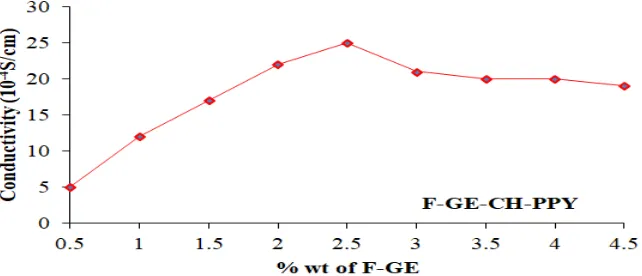
Abstract: Nowadays graphene based composites were developed due to their unique structure and excellent properties. Present study involves the preparation of graphene grafted chitosan (CS) and polypyrrole (PPY) (F-GE-CS-PPY) composite through solution casting method for electrical conductivity. The prepared composite was characterised by FTIR, TGA, XRD and Conductivity analysis. The formation of F-GE-CS composite was confirmed by FTIR and XRD studies through the shifting of peak values from Chitosan to F-GE-CS composite due to strong interaction between the compounds. Thermal stability of the sample was analysed by TGA curves. The electrical conductivities of F-GE-CS-PPY increased with the increase of F-GE content.
Keywords: Graphene, Chitosan, PPY, F-GE-CH-PPY Composite,
I. INTRODUCTION
Graphene, the starting material for all the carbon nanostructures has attracted strong scientific and technological interest in recent years. It has shown great promise in many applications, such as electronics, energy storage and conversion (super capacitors, batteries, fuel cells, solar cells, and bioscience/biotechnologies). Graphene is a zero-gap semiconductor material, which is electro active and transparent [1-4].
The functionalized graphene acts as efficient nano filler in polymer composites to improve its engineering properties and a small quantity of polymer functionalized graphene improve the mechanical, electronic, optical, thermal and magnetic properties significantly .The living radical polymerizations on graphene surface can also produce diverse polymeric architecture promoting graphene from a laboratory to important nanotechnological applications. The conjugated polymer functionalized graphene exhibits typical bistable electrical switching and a nonvolatile rewritable memory effect, with a turn-on voltage of about -1 V and an ON/OFF-state current ratio of more than 103because of strong π-π interaction . Some conjugated polymer functionalized graphene like polythiophenes or its derivative composites are widely used in photovoltaic devices and lightemitting diodes etc. Conducting polymers like polyaniline, polypyrrole functionalized graphene composites have a potential application in super capacitors in various field [5-8].Polymer functionalized graphene reinforced into the matrix polymer with molecular level dispersion and fine interfacial interaction enhances the strength, stiffness, toughness of the composite. These types of composites materials may have potential applications in aerospace and naval engineering. Till now, the applications of polymer functionalized graphene composites are not very abrupt and thus it is extremely required of this type of novel materials for stepping forward together with computational studies . We believe that the exploration of polymer functionalized graphene research will bring us much surprise in the future.
Polypyrrole, is typical electrode materials among many kinds of conducting polymers for supercapacitors. The as-prepared graphene/PPy nanocomposites have been successfully characterized in terms of composition, morphology, and electrochemical properties. It was found that the chemically modified graphene nanosheets and in-situ polymerized PPy layers formed uniform nanocomposites with homogeneous PPy layers intercalated between the graphene substrates[9].Therefore, recent research on conducting polymers is directed towards hybrid supercapacitor systems following doping with metal oxides or other carbon materials for enhanced electrochemical performances .
Furthermore, chitosan possesses bioadhesive properties which make it of interest in bioadhesive sustained release formulation required [10].
In the present communication, we have described the synthesis and characterization of PPY with F-GE grafted with chitosan fabricated by in situ polymerization. The nanocomposites were characterized by a number of techniques including Fourier transform infrared spectroscopy (FTIR), X-ray diffraction (XRD), thermal gravity analysis and electrical conductivity.
II. EXPERIMENTAL
A. Materials
polypyrrole were purchased from Aldrich. graphene used in this study was purchased from Cheap Tubes (USA, 10– 20 nm diameter). Other reagents like ammonium persulfate (APS), hydrochloric, sulfuric, and nitric acid (Sigma Chemicals) were of analytical grade.
B. Oxidation of GE
0·5 g of GE was dispersed in 40 ml of concentrated H2SO4 and HNO3 with a volume ratio of 3:1 using an ultrasonicator for 10 min.
The mixture was stirred at 600C for 24 h and then washed several times with deionized water until the pH reached 7. The resulting acid-functionalized GE was filtered with 0·2 μm PTFE membrane filter and dried in a vacuum at 700C for 24 h. This treatment produced carboxylic acid groups (–COOH) on the surfaces of GE at their defects and shortened the length of the tubes.
C. Preparation of PPY/F-GE nanocomposites
Each of 2 and 5 wt% F-GE (based on the weight of PPY) was dispersed in the solution of 0·015 mol PPY in 100 ml of 0·1 M HCl by ultrasonication for 10–15 min. Then, the solution of 0·015 mol APS in 50 ml of 0·1 M HCl was added drop by drop into the previous solution which was stirred constantly in an ice bath in a period of 30 min to initiate the polymerization. The reaction was kept for 24 h. Acetone was then poured into the reaction mixture to stop polymerization and to precipitate the PPY/F-GE nanocomposite [9]. The purification and drying procedures were the same as those for the synthesis of the bare polymer.
D. Synthesis of F-GE-chitosan Derivative
F-GE-COCl (400 mg) was reacted with CS (2 g) in 100 mL 2% acetic acid at 75 °C for 24 hours while stirring. After the reaction was stopped, the product was washed three times with 2% acetic acid to remove unreacted chitosan.
E. Synthesis of F-GE-chitosan-PPY Derivative
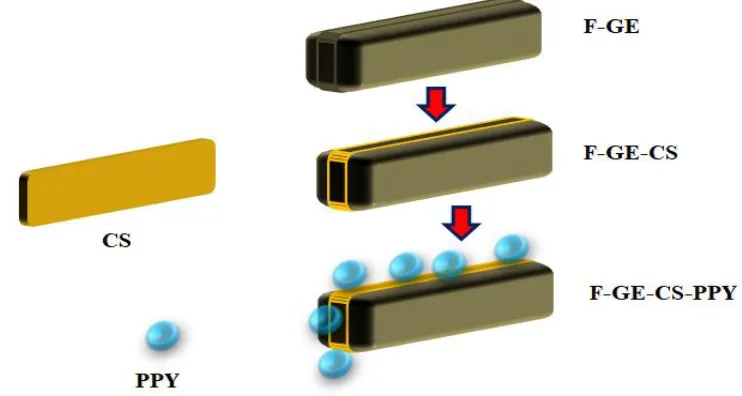
Synthesis of F-GE-CS Grafted Derivative—GE-CS (0.1 g) was reacted with K2S2O8 (0.02 g) PPY in 2% acetic acid solution at 75
[image:3.612.115.486.518.716.2]°C for 2 hours. Product was centrifuged at 20,000 rpm and washed twice with water before drying at 90 °C. Hereafter, the product will be referred to as GE-CS- PPY , schematically presented in figure.1 [12].
III. MEASUREMENT
A. IR spectra
IR spectra The Fourier transform infrared (FT-IR) spectra were recorded on a Nicolet 8700 spectrometer, in the range 400–4,000 cm-1.
B. XRD
X-ray diffraction (Rigaku, D/Max, 2,500 V, Cu-αa radiation: 1.54056 A ° ) experiments were carried out on both the plain PoPD and the composite samples. Wide-angle X-ray diffractograms were recorded at temperature of 300C after isothermal crystallization at this temperature for 1 h .
C. TGA
TGA was performed on a thermal analyser (TA Instruments, SDT Q600) from 40–8000C at a heating rate of 100C/min under
nitrogen atmosphere.
D. Mechanical properties evaluation:
Tensile strength of the samples was measured according to the ASTM D638 standard. Samples were prepared with 0.01-0.02 mm width for F-GE-chitosan tensile strength was determined with a mechanical testing machine (zwick-1446) at a crosshead speed of 5 mm/min.
E. Electrical conductivities
The electrical conductivities of all nanocomposite samples were measured by four-point probe methods [8] . The four-point probe method, a four-point resistivity probing fixture (Signatone probe S-302-4 with a SP4 probe head) was used. The relative humidity in the moisturizing chamber was controlled by a humidity controller with an accuracy of ±5%RH.
IV. RESULT AND DISCUSSION
A. FT-IR Spectrometry
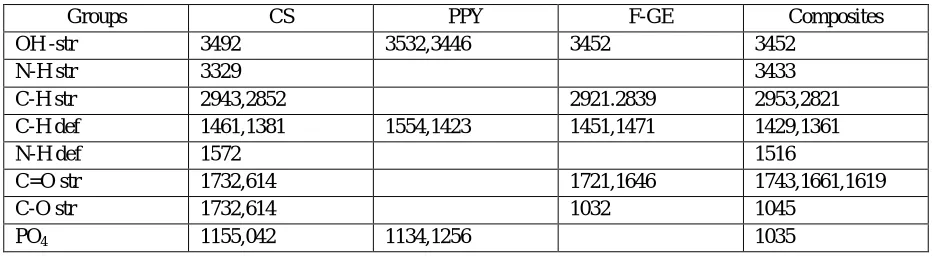
FTIR spectrum of pure compound CS, F-GE, F-GE/CS and F-GE/CS-PPY composite was shown in Figure 2 and table 1. The C=O stretching of NHCO (amide I) and N-H bending of NH2 (amide II) for pure CS was observed at 1661 cm-1 and 1572cm-1, the
similar value was observed at 1682 cm-1 and 1521 cm-1 for F-GE-CS composite. The shifting of bands to lower values indicates the strong interaction between CS and F-GE during grafting and also with PPY during composite formation [13-15].
[image:4.612.135.490.520.720.2]The C-O stretching vibrational bands of CS and F-GE was overlapped with PPY [16-18]. CS and F-GE showed its C-H, C=C and C-C stretching vibrations at 2821 cm-1, 2953 cm-1, 1429 cm-1, 1361 cm-1 respectively as shown in table. Figure shows a small peak of OH stretching vibration of PPY and CS at 3600 cm-1. This less intense peak indicates that the OH group of both the compound was involved in weaker Hydrogen bonding.
Table.1 FTIR values for pure chitosan, OPD, grapheme and F-GE/CH/OPD
Groups CS PPY F-GE Composites
OH -str 3492 3532,3446 3452 3452
N-H str 3329 3433
C-H str 2943,2852 2921.2839 2953,2821
C-H def 1461,1381 1554,1423 1451,1471 1429,1361
N-H def 1572 1516
C=O str 1732,614 1721,1646 1743,1661,1619
C-O str 1732,614 1032 1045
PO4 1155,042 1134,1256 1035
[image:5.612.121.497.323.452.2]B. XRD
Figure 3 shows the XRD patterns of pure CS, F-GE, PPY and the prepared F-GE/CS composite. Pure CS was shown at 16.50, F-GE
at 16.20 and F-GE/CS at 9.250 and 16.630. In F-GE/CS/PPY was found broadened peak at around 9.65o which are the diffractions of (211), (300), (202) at an angle of 9.3o, 15.2o, 31° respectively [19, 20]. The broadness of a peak indicates the partial demineralization of PPY and low crystalinity of the F-GE/CS composite [21-22]. The pure CS shows characteristic peaks at 16o (Crystalline structure) . The broadness of the first peak was decreased and the second peak was shifted and overlapped with F-GE (10o) peak due to the strong interaction of CS with OPD and F-GE [23, 24].
Figure 3. XRD spectrum of CS,F-GE,PPY,F-GE-CS, F-GE-CS-PPY nanocomposite
[image:5.612.112.498.563.725.2]C. Tensile strength
Figure 4. Tensile strength of CS,F-GE,PPY, F-GE-CS-PPY nanocomposite
D. Thermal Analysis
[image:6.612.136.478.446.623.2]The prepared F-GE/CS-PPY composite was subjected to TGA and DTG Analysis. TGA thermogram of prepared F-GE/CS-PPY composite (Figure 5) showed the various stages of decomposition. The weight loss occurred between 33-2250C showed two derivative peaks at 47.270C and 208.470C. The peak one indicates desorption of adsorbed water molecules and peak two indicates the release of crystalline water of PPY [24]. The weight loss occurred at this temperature is very less (9.12%) and it co-insides with FTIR spectra of the composite, confirming the existence of weaker hydrogen bonding. A major weight loss of 18.73% was observed between 2700C - 4250C, which corresponds to the degradation of the glucosamine in CS and it was indicated by a derivative peak of 3000C [25]. The weight loss between 4380C and 4250C attributed to the combustion of carbon present in F-GE and CS [26]. The decomposition of PPY was observed at 6820C shown by the DTG curve. The TGA analysis confirms the presence of all the three compounds and their decomposition temperatures. The thermal stability of the prepared composite was not increased as expected.
Figure 5. TGA and DTG of CS,F-GE,PPY, F-GE-CS-PPY nanocomposite
E. Conductivity of F-GE-CS-PPY
Figure 6. Conductivity of F-GE-CS-PPY nanocomposite by four probe method
V. CONCLUSION
F-GE grafted CS and PPY composite was successfully prepared by solution casting method. XRD and FTIR evidenced the strong interaction among the precursors. TGA studies of the prepared F-GE-CS composite confirm the grafting of F-GE through Hydrogen bonding with CS and PPY.
REFERENCE
[1] Altland. A., “Low-Energy Theory of Disordered Graphene” Phys. Rev. Lett.,2006, 97 , 236802.
[2] An S.J., Zhu Y., Lee S.H., Stoller M.D., Emilsson T., Park S. et al, “Thin film fabrication and simultaneous anodic reduction of deposited graphene oxide platelets by electrophoretic deposition” Journal of Physical Chemistry Letters, 2010, 1 ,1259–1263.
[3] Antonio Di Bartolomeo, “Graphene Schottky diodes: An experimental review of the rectifying graphene/semiconductor heterojunction” Physics Reports, 2016, 606, 1-58
[4] Berger C., Song Z., Li T., Li X., Ogbazghi A.Y., Feng R., Dai Z., Marchenkov A.N., Conrad E.H., First P.N., de Heer W.A., “Ultrathin Epitaxial Graphite: 2d Electron Gas Properties and a Route toward Graphene-Based Nanoelectronics” J. Phys. Chem. B, 2004,108 , 19912-19916.
[5] Biro. L., Nemes-Inczea Peter and Lambin Philippe , Graphene: nanoscale processing and recent applications, Nanoscale , 2012, 4, 1824
[6] C.N.R. Rao, A.K. Sood, K.S. Subrahmanyam, A. Govindaraj, “Graphene: the new two-dimensional nanomaterial” AngewandteChemie International Edition 2009, 48 , 7752–7777.
[7] Chen S., Zhu J., Wu X., Han Q., Wang X., “Graphene Oxide−MnO2 Nanocomposites for Supercapacitors” ACS Nano, 2010, 4 , 2822-2830. [8] Dato A., Radmilovic V., Lee Z., Phillips J., Frenklach M., “Substrate-Free Gas-Phase Synthesis of Graphene Sheets” Nano Lett., 2008, 8 , 2012-2016. [9] YunLiu., HuanhuanWang., JieZhou., LinyiBian., EnweiZhu., JiefengHai., JianTang., WeihuaTang., Graphene/polypyrrole intercalating nanocomposites as
supercapacitors electrode, Electrochimica Acta, 112, ,2013, 44-52
[10] Majeti N.VRavi Kumar, A review of chitin and chitosan applications, Reactive and Functional Polymers,46(1), 2000, 1-27
[11] Donglin Han Lifeng Yan Wu feng Chen Wan Li,Preparation of chitosan/graphene oxide composite film with enhanced mechanical strength in the wet state, Carbohydrate Polymers , 83(2), 2011, 653-658
[12] Manoj Kumar Pati, Puspalata Pattojoshi, and Gouri Sankar Roy, Synthesis of Graphene-Based Nanocomposite and Investigations of Its Thermal and Electrical Properties, Journal of Nanotechnology, 2016,1-9
[13] Huamin Q, Lulu F, Li X, Li L, Min S, Chuannan L Carbohydrate polymers 92(2013)394-399
[14] Alwarappan. S, Cisell. K, Dixit. S, Li CZ, Mohapatra. S Journal of Electroanalytical chemistry 686 (2012) 6972
[15] Huanting Hu, Xianbao Wang, Jingchao Wang, Fangming Liu, Min Zhang, Chunhui Xu, Applied surface science 257 (2011) 2637-2642 [16] G.N. Kousalya, Muniyappan Rajiv Gandhi, C. Sairam Sundaram, S. Meenakshi,Carbohydrate polymers 82 (2010) 594-599
[17] Andrea M. Costa, Gloria Dulce de Almeida Soares, Reinaldo Calixto, Antonella M. Rossi, Bioceramics 16 [18] Fei Chen, Zhou-Cheng Wang, Chang-Jian Lin, Materials letters 57(2002) 858-861.
[19] Quan-Li Li,Zhi-Qing Chen, Brain W. Darwell, Quan Zeng, Gang Li, Guo-Min Ou, Ming-Yue Wu, Materials letters 60 (2006) 3533-3536 [20] Qiaoling Hu, Baoqiang Li, Mang Wang, Jiacong Shen, Biomaterials 25 (2004) 779-785.
[21] Yanzhong Zhang, Jayarama Reddy Venugopal, Adel El-Turki, Seeram Ramakrishna, Bo Su , Chwee Teck Lim, Biomaterials 29 (2008)4314-4322 [22] Prabakaran. E, Parani. S, Alexander. M, Paulraj. P, Pandiyan. K, J. Nanosci. Letters, 2013,3:18
[23] Ana Jankovic, Sanja Erakovic, Miodrag Mitric, Ivana Z. Matc, Zorica D. Juranic, Gary C.P. Tsui, Vesna Miskovic-Stankovic, Kyong Yop Rhee , Soo Jin Park, Journal of alloys and compounds 624 (2015) 148-157
[24] Richard Justin, Biqiong Chen, Material science and engineering C 34 (2014) 50-53
[25] Adebola Oyefusi, Opeyemi Olanipekun, Gururaj M. Neelgund, Deforest Peterson, Julia M. Stone, Ebonee Williams, Laura Carson, Gloria Regisford, Aderemi Ok Spectrachimica Acta Part A: Molecular and Biomolecular Spectroscopy 132 (2014) 410-416