Compiler Optimization for SIMD type Vector
Processor
Mohammad Suaib1, Mohd. Akbar2,
Department of Computer Science & Engg., Integral University Lucknow, India
Abstract—Performance of the processor can be enhanced by parallelization of instructions in terms of execution. Here we are applying compiler optimization techniques like loop unrolling, loop peeling for SIMD type Vector Processor. SIMD type vector processor is a high performance computational model which exploits the computational capabilities of both SIMD and vector architecture. SIMD type vector processor works on short vector instructions of vector length four and has four processing units which enables execution of four vector operands simultaneously [1]. To have the model which speeds up the computation in this paper we have created a CDFG (Control Data Flow graph) which gives the direct translation to the hardware. To create a CDFG we have used the tool SUIF2 and MACHSUIF which is a research project provided by Stanford University and Harvard university. To create a CDFG from the C source file first we have to do profiling on it to get the area of source file which have higher run time. We have unrolled the loops to get maximum ILP (Instruction level Parallelism) [7]. To limit the hardware we have unrolled only up to a maximum size of 4 [1]. Then a CFG (Control Flow Graph) is created for the source C file. Then the data flow analysis has been done on each basic block of the CFG by using the bvd class provided with MachSUIF. Then all the DFG (Data Flow graph) of every basic block are combined to get a full CDFG. In this paper We have designed the new hardware i.e. the SIMD type Vector processor based on HPL-PD VLIW architecture ISA which is supported by trimaran by default to accelerate the work.
Keywords—SIMD-Vector Architecture, Loop unrolling, ILP, Suif, Machsuif, Loop peeling
I. INTRODUCTION
A compiler is a computer program that transforms source code written in a programming language i.e. the source language into another computer language i.e. the target language, often having a binary form known as object code [2,3]. If the compiled program can run on a computer whose CPU or operating system is different from the one on which the compiler runs, the compiler is known as a cross-compiler. A program that translates from a low level language to a higher level one is a decompiler. A program that translates between high-level languages is called a language translator, source to source translator, or language converter. A language rewriter is a program that translates the form of expressions without a change of language .document is a template.
The output of some compilers may target hardware at a very low level, for example a Field Programmable Gate Array (FPGA) or structured Application-specific integrated circuit (ASIC) [8]. Such compilers are known as hardware compilers or synthesis tools because the source code they compile
effectively control the final configuration of the hardware and how it operates; the output of the compilation are not instructions that are executed in sequence - only an interconnection of transistors or lookup tables. For example, XST is the Xilinx Synthesis Tool used for configuring FPGAs [8]. Similar tools are available from Altera, Synplicity, Synopsys and other vendors.
A. Compiler optimizations
resources. Some code optimization problems are NP-complete, or even undecidable. In practice, factors such as the programmer's willingness to wait for the compiler to complete its task place upper limits on the optimizations that a compiler implementer might provide. Optimization is generally a very CPU- and memory-intensive process.
B. Instruction-level parallelism (ILP)
Instruction-level parallelism (ILP) is a measure of how many of the operations in a computer program can be performed simultaneously [5,6]. A goal of compiler and processor designers is to identify and take advantage of as much ILP as possible. Ordinary programs are typically written under a sequential execution model where instructions execute one after the other and in the order specified by the programmer. ILP allows the compiler and the processor to overlap the execution of multiple instructions or even to change the order in which instructions are executed [7].
C. Loop Unrolling
Loop unrolling is effective in uncovering ILP by exposing more parallelism to the compiler or underlying hardware [5]. It is, in essence, a technique that transforms loop level parallelism into instruction level parallelism.
for (i=0; i<8; i++) {
a[i] = b[i] + c[i];
}
Before loop unrolling.
for (i=0; i<8; i+=4) {
a[i+0] = b[i+0] + c[i+0];
a[i+1] = b[i+1] + c[i+1];
a[i+2] = b[i+2] + c[i+2];
a[i+3] = b[i+3] + c[i+3];
}
After loop unrolling.
D. CFG (Control Flow graph)
A control flow graph is a representation of a program where contiguous regions of code without branches, known as basic blocks, are represented as nodes in a graph and edges between nodes indicate the possible flow of the program [9,4]. In a control flow graph each node in the graph represents a basic block, i.e. a straight-line piece of code without any jumps or jump targets; jump targets start a block, and jumps end a block. Directed edges are used to represent jumps in the control flow.
E. DFG (data Flow graph)
The purpose of data-flow analysis is to provide global information about how a procedure or a larger segment of a program manipulates its data [4,10]. Constant-propagation analysis seeks to determine whether all assignments to a particular variable that may provide the value of that variable at some particular point necessarily give it the same constant value.
II. PROPOSED HARDWARE MODELINGFOR COMPILATION
This section describes the proposed model for creating a CDFG from the basic C based applications. Here the basic tools are SUIF2 and the MACHSUIF is also described in detail to help in understanding of the creation of CDFG. The CFG pass ant the CDFG pass used in the implementation is described along with its psuedocode which is written in MACHSUIF.
A. SUIF Overview
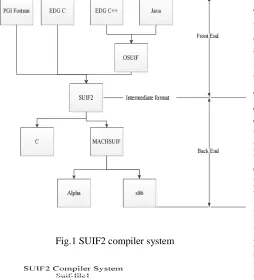
sequential program can be made easily. The SUIF2 compiler system is built of many modules and a common driver called suifdriver. Fig.2 shows the SUIF2 compiler pass which is formed with importing modules dynamically via the suifdriver. The SUIF2 compiler system allows user to develop new modules or compiler passes according to their specific requirements. Furthermore, programming languages that SUIF2 compiler system supports in current are as follows, Fortran, C, C++ and Java.
Fig.1 SUIF2 compiler system
Fig. 2 SUIF2 compiler pass
B. MachSUIF
Machine SUIF is a flexible, extensible, and easily-understood infrastructure for constructing compiler back ends. Machine SUIF is both a working compiler and a collection of analyses/optimizations that can be quickly and easily inserted into a new compilation environment. Machine-SUIF distribution contains a working compiler based on the Stanford SUIF compiler infrastructure (version 2.1). This compiler is capable of producing optimized code for machines based on the Alpha or x86 architectures.
C. CDFG PASS
To have the data flow graph the class bvd of the MachSUIF is used. The bit-vector data flow (BVD) library of Machine SUIF is a framework for iterative, bit-vector-based data-flow analyzers. It uses Machine SUIF's control-flow graph (CFG) library to parse the program being analyzed into basic blocks, and it associates data-flow results with the CFG nodes.
The BVD library contains two concrete solvers, one that computes liveness information and another that does reaching-definitions analysis. The data-flow analyzers do two things: they identify an interesting class of syntactic or semantic program elements, and for each such element, they identify the points in the program to which the element, or some aspect of the element i.e. flows. For an available-expressions problem, the elements are syntactic expressions evaluated by the program, and an expression e flows to point p in the program if e is computed (generated) on every path to p without being invalidated (killed) by an assignment to some variable in e before p is reached. For the reaching-definitions problem, the universe of interesting elements consists of the statements that assign to, or otherwise side-affect storage locations, and these definitions flow to all the program points reached by paths that don't contain an overriding assignment. For a liveness problem, the universe consists of storage cells, such as variables and registers. The liveness of a variable is generated by a use of the variable, and it flows backward along control paths until killed by a definition of i.e. an assignment the variable.
D. CDFG Generation
effectiveness. The loop unrolling and peeling is done by SUIF2 passes. To implement the proposed work we have used
MachSUIF. In MachSUIF, the IR(Intermediate
Representation) uses a SUIFvm (SUIF virtual machine architecture) which assumes that the underlying architecture is a generic RISC which is not biased towards any existing architecture.
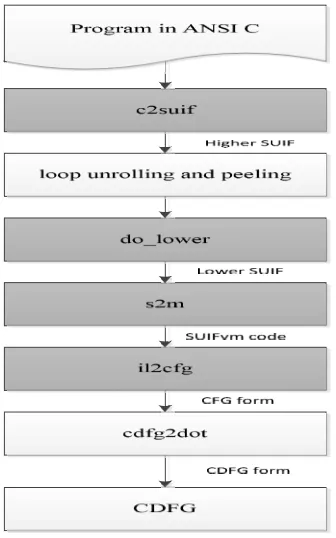
[image:5.612.319.487.105.374.2]The program code is decomposed into its IR consisting of operations with minimal complexity i.e. in primitive or atomic instructions. Then this IR description of the program code is organized into control data flow graph with primitive instructions as its nodes and edges denoting control and data dependencies [11]. Before the CDFG is created loop unrolling and peeling is done. The flow graph of the CDFG generation is shown in fig.1. The shaded blocks on the figure shows the available passes of the MachSUIF infrastructure. The c2suif pass converts the input ANSI C code to the SUIF frontend i.e. the code is preprocessed and its SUIF representation is emitted. After c2suif loop unrolling and peeling is done by a custom made pass which does it according to our architecture. In this pass at first the SUIF file is converted to the ANSI C code and then the loop unrolling and peeling is done on this C code. The peeling is done in such a manner that the number of iterations would become a multiple of 4 and unrolling is done for a size of 4. After the unrolling and peeling the pass again converts the C code to SUIF IR. The 3rdstep is do_lower pass or an equivalent pass with all necessary transformations which is provided with SUIF. In this step several machine independent transformations is done like dismantling of loop and conditional statements to low-level operations. By doing the do_lower we translate the higher SUIF representation to lower SUIF representation. To convert lower SUIF representation to SUIFvm representation an s2m compiler pass is used which is available in MachSUIF. After s2m, architecture independent optimizations are done on IR and a CFG (Control Flow Graph) is created by pass il2cfg. A CFG form is got in which the cdfg2dot pass parses on each node of the CFG and constructs a corresponding CDFG. By this we get a CDFG of each node.
Fig. 3 Flow graph for CDFG generation
IV. COMOILER FLOW FOR THESIMDVECTOR PROCESSOR ARCHITECTURE
To execute software code on the new architecture i.e. a VLIW processor with a tightly coupled coprocessor which is a SIMD type Vector model, a compilation flow was developed. The input to the flow is C code. The code is read into the compiler and scheduled into instructions that can be performed in parallel. The final result which is a elcor IR which can be executed on the new hardware and is simulated in the simulator SIMU provided with the Trimaran to collect the binaries or executables of the C based application.
Trimaran has a back-end vectorizer that can identify and exploit data level parallelism for efficient execution on architectures with SIMD (single-instruction multiple-data) support. The technique implemented in Trimaran is called selective vectorization [14]. It creates highly efficient instruction schedules by distributing computation between scalar and vector functional units to improve resource utilization. For processor models that contain an abundance of scalar and vector processing units, selective vectorization creates loops with a balance of both vector and scalar instructions. Since vector and scalar occupy the same loop body, scalar operations are unrolled by a factor of the vector length. As such, the technique is most applicable to the
short-vector instruction sets commonly found in today’s multimedia
extensions. The Elcor parameter do_vectorize in $ELCOR HOME/DRIVER DEFAULTS enables the vectorization of loops during compilation. The vectorizer is most effective, and in many cases only applicable, when it has precise memory dependence information. 4 options are found in $ELCOR HOME/VECTORIZER DEFAULTS to provide control in applying the vectorizer:Presently the Trimaran supports 4 vectorize model. The vectorizer will apply different techniques and heuristics according to the model selected. There are four current models implemented. They are:
–Unroll the loop by a factor of vector length.
–Vectorize all vectorizable operations.
– Perform full vectorization or no vectorization. Select the
option with the highest predicted performance after modulo
scheduling.
– Perform selective vectorization.
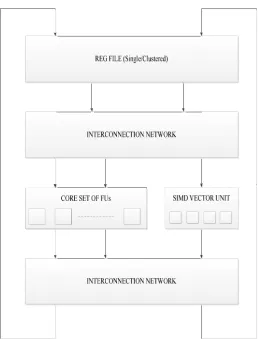
[image:6.612.323.581.103.442.2]The SIMD Vector model back-end is closely coupled to code from the ELCOR back-end. This is done by having a new .hmdes2 file which specifies our architecture also. The architecture to be defined is shown in figure 5.3. In this .hmdes2 file we have added the functionality vectorization also by enabling the vectorization in the Trimaran. The proposed architecture is a SIMD VLIW architecture which is a SIMD Vector model as a tightly coupled co-processor of a VLIW machine. The VLIW is chosen in the work as it is already present with Trimaran and thus speeds up the architecture modelling process.
Fig. 4 The enhanced architecture.
vector processor which is able to operate on 4 instructions at a time. Only changes that were required for the SIMD Vector machine were made. The back-end is responsible for instruction scheduling, register allocation, and code generation.Further the vector instructions are defined along with its latencies and other properties in the machine description provided with Elcor in Trimaran. By running the elcor we will be provided with an elcor IR which is run in simu to produce the binaries or executables.
V. CONCLUSION
In this paper we have shown how the binaries are generated from the benchmark or the C based applications using the tool Trimaran. The elcor backend was modified to incorporate the custom hardware which has been generated from the CDFG which was described in the previous section. Here the custom hardware is used as a tightly coupled co-processor as a SIMD type vector processor with the basic hardware which is a single cluster VLIW machine.
VI. REFERENCES
[1] Mohammad Suaib, Abel Palaty, and Kumar Sambhav
Pandey,”Architecture of SIMD Type Vector Processor”,
Digital Library URI:
http://www.ijcaonline.org/archives/- volume20/number-4 /2418-3233, ISBN: 978-93-80749-15-7, 2011.
[2] Alfred V. Aho, Ravi Sethi, and Jeffrey D. Ullman, Compilers Principles, Techniques, and Tools, Addison-Wesley, 1986.
[3] Randy Allen and Ken Kennedy, Optimizing Compilers for Modern Architectures: A Dependence-based Approach, Morgan Kaufmann, San Francisco, California, 2001.
[4] Steven S. Muchnick, ADVANCED COMPILER
DESIGN AND IMPLEMENTATION, Morgan
Kaufmann, 1997.
[5] Davidson, J. W. and Jinturkar S.,“Improving Instruction level Parallelism by Loop Unrolling and Dynamic
memory Disambiguation,” Technical Report CS-95-13, Department of Computer Science, University of Virginia, Charlottesville, February 1995.
[6] Bacon, D. F., Graham, S. L., and Sharp O. J.,“Compiler Transformations for High-Performance Computing,”
ACM Computing Surveys, 26(4), Dec. 1994, pp. 345-420.
[7] Abel Palaty, Mohammad Suaib, and Kumar Sambhav
Pandey ,”Exploiting ILP in a SIMD type Vector Processor,” ACC-2011, will Communications in Computer and Information Science Series(CCIS), ISSN: 1865:0929.
[8] Takahisa Wada, Shunichi Ishiwata, Katsuyuki Kimura, Keiri Nakanishi, Masato Sumiyoshi,Takashi Miyamori,
Member, IEEE, “A VLIW Vector Media Coprocessor With Cascaded SIMD ALUs” IEEE TRANSACTIONS ON VERY LARGE SCALE INTEGRATION (VLSI) SYSTEMS, VOL. 17, NO. 9, SEPTEMBER 2009
[9] Robert Morgan, Building an Optimizing Compiler. Digital Press, 1998.
[10] Glenn H. Holloway and Michael D. Smith, The Machine-SUIF Control Flow Graph Library, The Machine SUIF documentation set, Harvard University, 1998.
[11] Nikolaos Kavvadias and Spiridon
Nikolaidis,”Application Analysis with Integrated
Identification of Complex Instructions for Configurable
Processors,”Proc. of the 14th Intl. Workshop on Power
and Timing Modeling, Optimization and Simulation, Santorini, Greece, pp. 633-642, September 15-17(2004).
[12] L. N. Chakrapani, W. F. Wong, and K. V.
Palem,“Enhancing the Trimaran compiler infrastructure to support strongarm code generation,”CREST, Georgia
Institute of Technology, Atlanta, GA, Tech. Rep. CREST-TR-01-01, 2001.
[13] Y. Chobe, B. Narahari, R. Simha, and
W.Wong,“Tritanium: Augmenting the Trimaran
compiler infrastructure to support ia64 code
generation,”The George Washington University, Washington DC.
[14] X. Tang, T. Jiang, A. Jones, and P. Banerjee,“Compiler optimizations in the pact hdl behavioral synthesis tool
for asics and fpgas,” IEEE International SoC Conference