A Survey on Routing Protocols in Wireless Sensor
Nodes
Nimisha1, Faseeh Ahmad2, Dr. K. K. Sharma3 1M.Tech Scholar GITM Lucknow, 2Assistant Professor GITM Lucknow
Abstract: In current scenarios the demand for WSN had rapidly increased in various applications like weather monitoring, petroleum and military due to low power, small size, light weight, and wireless sensors. However, these inexpensive sensors are equipped with limited battery power and thus constrained in energy. One of the major issues with WSN is that one need to increase the lifetime of network. Generally, lifetime of network is defined as the time whenever the first node fails to send its information to base station. This issue can be resolved by implementing data aggregation technique as it decreases data traffic and further saves energy by merging multiple incoming packets into a single packet whenever the sensed information are highly correlated. Numerous researches have been carried out to further extent network lifetime.
Keywords: Network lifetime, Wireless Sensor Networks, Routing protocol
I. INTRODUCTION
A wireless sensor network is typically composed of a large number of sensor nodes, which may be densely deployed either inside the phenomenon or very close to it, depending on the field of their usage. The position of sensor nodes need not be engineered or pre-determined. This envisages random deployment in inaccessible terrains or disaster relief operations. On the other hand, this also indicates that sensor network protocols and algorithms need to possess self-organizing capabilities. Another unique feature of sensor networks is the cooperative effort of sensor nodes. Instead of sending the raw data to the nodes responsible for the fusion, sensor nodes use their processing abilities to locally carry out simple computations and transmit only the required and partially processed data. Realization of these and other sensor network applications require wireless ad hoc networking techniques. Although there have been a number of protocols and algorithms proposed for traditional wireless ad hoc networks, they are not well suited for the unique features and application requirements of wireless sensor networks. The differences between sensor networks and ad hoc networks are outlined below:
The number of sensor nodes in a sensor network is higher than the nodes in an ad hoc network. Sensor nodes are densely deployed as compared to ad-hoc nodes.
Sensor nodes are more prone to failures.
The topology of a sensor network changes very frequently.
Sensor nodes mainly use broadcast or multi-hop communication paradigm whereas most ad hoc networks are based on point-to-point communications.
Sensor nodes have limitations of power, computational capacities, and memory.
Sensor nodes may not have global identification (ID) because of the large amount of overhead and large number of sensors.
Designing suitable routing algorithms for different applications, fulfilling the different performance demands has been considered as an important issue in wireless sensor networks. In these context many routing algorithms have been proposed to improve the performance demands of various applications through the network layer of the wireless sensor networks protocol stack [3, 4], but most of them are based on single-path routing. In single-path routing approach basically source selects a single path which satisfies the performance demands of the application for transmitting the load towards the sink. Though the single path between the source and sink can be developed with minimum computation complexity and resource utilization, the other factors such as the limited capacity of single path reduces the available throughput [5]. Secondly, considering the unreliable wireless links single path routing is not flexible to link failures, degrading the network performance. Finding an alternate path after the primary path has disrupted to continue the data transmission will cause an extra overhead and increase delay in data delivery. Due to these factors single path routing cannot be considered effective technique to meet the performance demands of various applications.
II. LITERATURE REVIEW
multi-in WSNs, energy consumption, lifetime of the network and scalability can be improved [8]. Clustermulti-ing has important applications multi-in high-density sensor networks, because it is much easier to manage a set of cluster representatives i.e. CH from each cluster than to manage whole sensor nodes. Cluster formation is generally based on the energy reserve of sensors and sensors proximity to the CHs. In WSNs the sensor nodes are resource constrained which means they have limited energy, low transmit power, less memory, and have very little computational capabilities. Energy consumed by the sensor nodes for communicating data from the nodes to the BS is the crucial cause of energy depletion in sensor nodes.
Clustering is an efficient approach that has been implemented in many communication protocols for WSN. In a clustering based network nodes are grouped into several clusters. Each cluster consists of one cluster-head and a number of member nodes. Member nodes or normal nodes send their data to CH in addition to sending it to the desired recipient. In this section, we discuss various energy efficient routing protocols of WSN which are proposed in past few years. Cluster-head may perform data processing like data fusing before forwarding the data to sink.
The LEACH uses randomized, self-configuring cluster formation technique to achieve energy efficiency In set up phase clusters are formed and in the steady state phase transfer of data takes place. LEACH uses a TDMA or a CDMA MAC to reduce collisions between two neighbors‟ nodes. LEACH [16], [17] clustering protocol is a kind of adaptive and low-energy consumed routing algorithm. It improves the energy consumption in the WSNs. In LEACH algorithm, energy efficiency is achieved by construction of clusters and then distributes the total network energy evenly to individual node. Thus energy consumption is lowered and system life is improved consequently.
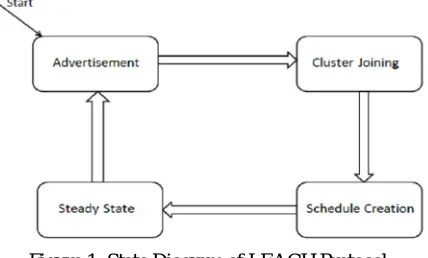
[image:3.612.202.416.365.494.2]The LEACH protocol has many rounds and each round has two phases, a setup phase and a steady state phase. The operation of LEACH can be divided into rounds. Each round begins with a set-up phase when the clusters are organized, followed by a steady state phase where several frames of data are routed from the nodes to BS via CHs. During the setup phase, each sensor node tries to select itself as a CH according to probability model.
Figure 1: State Diagram of LEACH Protocol
The LEACH operation is broken into rounds, having a set-up phase and a steady-state phase. In the beginning of the set-up phase, each node probabilistically decides whether or not to be a cluster head. To become a cluster-head, each node n chooses a random number between 0 and 1. If the number is less than the threshold T(n), the node becomes the cluster-head for the current round. The threshold is set at:
(1)
where, P is the cluster-head probability, r the number of the current round and G the set of nodes that have not been cluster-heads in the last 1/P rounds.
a way out to the shortcoming in the earlier protocol. LEACH offers no assurance about the placement of the cluster-head nodes in the cluster. Thus unlike LEACH, where nodes self-configure themselves into clusters, LEACH-C utilizes the BS for cluster formation. During the setup phase of LEACH-C, the BS receives information regarding the location and energy level of each node in the network. Using this information, the BS finds optimal number of CHs using simulated annealing technique and configures the network into clusters. The steady-state operations of LEACH-C are identical to those of LEACH. Other nodes in that cluster may expend more energy transmitting through the selected node located far from the cluster centroid.
We study the impact of heterogeneity of nodes, in terms of their energy, in wireless sensor networks that are hierarchically clustered. In these networks some of the nodes become cluster heads, aggregate the data of their cluster members and transmit it to the sink. We assume that a percentage of the population of sensor nodes is equipped with additional energy resources—this is a source of heterogeneity which may result from the initial setting or as the operation of the network evolves. SEP, a heterogeneous-aware protocol to prolong the time interval before the death of the first node (we refer to as stability period), which is crucial for many applications where the feedback from the sensor network must be reliable. SEP is based on weighted election probabilities of each node to become cluster head according to the remaining energy in each node.
SEP, improves the stable region of the clustering hierarchy process using the characteristic parameters of heterogeneity, namely the
fraction of advanced nodes (m) and the additional energy factor between advanced and normal nodes (α). In order to prolong the
stable region, SEP attempts to maintain the constraint of well balanced energy consumption. Intuitively, advanced nodes have to become cluster heads more often than the normal nodes, which is equivalent to a fairness constraint on energy consumption. Intuitively, advanced nodes have to become cluster heads more often than the normal nodes, which is equivalent to a fairness constraint on energy consumption. Note that the new heterogeneous setting (with advanced and normal nodes) has no effect on the spatial density of the network so the a priori setting of popt, from Equation (2), does not change. On the other hand, the total energy of the system changes. Suppose that Eo is the initial energy of each normal sensor.
The energy of each advanced node will be Eo · (1 + α). The total energy of the new heterogeneous setting is equal to:
n × (1 − m)Eo + n × m × Eo (1 + α) = n × Eo (1 + α × m) (2)
So, the total energy of the system is increased by 1+α ·m times. The first improvement to the existing LEACH is to increase the
epoch of the sensor network in proportion to the energy increment. In order to optimize the stable region of the system, the new
epoch must become equal to 1/ popt · (1 + α · m) because the system has α · m times more energy and virtually α · m more nodes
(with the same energy as the normal nodes). CHs election in SEP is done randomly on the basis of probability of each type of node as in LEACH. Nodes sense data and transmit it to associated CH which convey it to BS.
SEP is a two level heterogeneous protocol. SEP assigns different probability (to become cluster head) for nodes on the basis of their energy level. However, SEP does not use extra energy of higher level nodes efficiently. In SEP normal nodes and advance nodes are deployed randomly. If majority of normal nodes are deployed far away from base station, it consumes more energy while transmitting data which results in the shortening of stability period and decrease in throughput. Hence efficiency of SEP decreases. To remove these flaws network field is divided into regions. As corners are most distant areas in the field, where nodes need more energy to transmit data to base station. So normal nodes are placed near the base station and they transmit their data directly to base station. However advance nodes are deployed far away from base station as they hay more energy. If advance nodes transmit data directly to base station more energy consumes, so to save energy of advance nodes clustering technique is used for advance nodes only.
An extension of SEP, considers three types of nodes, normal nodes, intermediate nodes and advance nodes. Where, advance nodes are in a fraction of total nodes with an additional energy as in SEP and a fraction of nodes with some extra energy greater than normal nodes and less than advance nodes, called intermediate nodes, while rest of the nodes are normal nodes. As in SEP, in ESEP CHs are selected depending on probability of each type of node. However, energy dissipation is controlled to some extent due to three levels of heterogeneity.
III. FUZZY LOGIC TECHNIQUES
The Fuzzy logic is based on the idea that all things admit of the degrees. It attempts to model our sense of the words, our decision making and our common sense. In 1965 Lotfi Zadeh, extended the work on possibility theory into a formal system of mathematical logic with the application of natural language terms to create ‘Fuzzy Logic’.
The increase in the growth of wireless application demands for the wireless network to have the capability to trace the locations of mobile users. Location updating scheme using fuzzy logic controls have been proposed in [20] that adaptively adjusts size of the location area for each user. There are varied applications of intelligent techniques in wireless networks [19]. Halgamuge et al. presents an energy efficient cluster formation for WSNs using subtractive and fuzzy C-mean clustering approach [21].
Different approaches in improving the reliability and accuracy of measurement information from the sensor networks have been described in [22]. It offers a way of integrating sensor measurement results with association information, available or a priori, derived at aggregating nodes by using some optimization algorithm. They have considered both neuro-fuzzy and probabilistic models for sensor results and association information. The models carry out classification of the information sources, available in sensor systems.
IV. CONCLUSION
The Wireless Sensor Networks are increasingly used nowadays in various applications. In this research paper, we have discussed the various terminologies related to Wireless Sensor Networks. The use of Fuzzy Logic Techniques in the area of Wireless Sensor Networks has also been exemplified. The use of Fuzzy Logic Techniques to implement an energy efficient protocol is to be done in future.
REFERENCES
[1] Abbasi A.A., Younis M. “A survey on clustering algorithms for wireless sensor networks”. Elsevier 2007. [2] M. Negnevitsky, Artificial intelligence: A guide to intelligent systems, Addison-Wesley, Reading, MA, 2001. [3] \Xuxun Liu 2012. A survey on clustering routing protocols in wireless sensor networks.
[4] Heinzelman W.B., Chandrakasan A.P. An application specific protocol architecture for wireless microsensor networks. IEEE, 2002.
[5] Kour H., Sharma A.K. Hybrid energy efficientdistributed protocol for heterogeneous wireless sensor network. International Journal of Computer Applications, 2010.
[6] Yun Li, Nan Yu, Weiyi Zhang, Weiliang Zhao, Xiaohu You, Daneshmand M. Enhancing the performance of LEACH protocol in wireless sensor networks. IEEE, 2011.
[7] A. Safiotti, “Fuzzy logic in autonomous robotics: behavior coordination,” in proc. Sixth IEEE International Conference on Fuzzy Systems, Jul. 1997, pp. 573 – 578
[8] Demirbas M., Arora A., Mittal V. FLOC: A fast local clustering service for wireless sensor networks.
[9] J. Agre, L. Clare, “An integrated architecture for cooperative sensing networks,” IEEE Computer Magazine (May 2000) 106–108. [10] Mamalis B., Gavalas D., Konstantopoulos C., Pantziou G. Clustering in wireless sensor networks
[11] C. Chee-Yee and S.P. Kumar, “Sensor networks: evolution, opportunities, and challenges,” in Proc of the IEEE, Aug. 2003, pp.1247 – 1256 [12] M. Negnevitsky, Artificial intelligence: A guide to intelligent systems, Addison-Wesley, Reading, MA, 2001
[13] InboSim, Koung Jin Choi, Koung Jin Kwon and Jaiyong Lee,―Energy Efficient Cluster header Selection Algorithm in WSNǁ, International Conference on Complex, Intelligent and Software Intensive Systems , IEEE, 2009.
[14] W. Heinzelman, A. Chandrakasan and H. Balakrishnan, “An application-specific protocol architecture for wireless microsensor networks,” in IEEE Transactions onWireless Communications, Oct. 2002, pp. 660 – 670
[15] Dilip Kumar, Trilok C. Aseri, R.B. Patel, ―EEHC: Energy efficient heterogeneous clustered scheme for WSNsǁ, ELSEVIER, Computer Communications, 32 (2009) 662–667
[16] Jones, S Agrawal, J Cheng Chen, “ A Seurvey of Energy Efficient Network Protocols for Wireless Networks”, Wireless Networks 7, 343-358, 2001
[17] E.M. Petriu, N.D. Georganas, D.C. Petriu, D. Makrakis, and V.Z. Groza, “Sensor-based information appliances,” IEEE Instrumentation and Measurement Magazine (December 2000) 31–35.
[18] G.D. Abowd, J.P.G. Sterbenz, “Final report on the interagency workshop on research issues for smart environments,” IEEE Personal Communications (October 2000) 36–40
[19] S. Hammadi and C. Tahon, “Special issue on intelligent techniques in flexible manufacturing systems,” in IEEE Transactions on Systems, Man and Cybernetics, May 2003, pp. 157 – 158
[20] L.Chou, L. Gen-Chung, “Location management using fuzzy logic control for wireless networks,” in International Conferences on Info-tech and Info-net, Oct. 2001, pp. 339 – 344
[21] M.N. Halgamuge, S.M. Guru, A. Jennings, “Energy efficient cluster formation in wireless sensor networks,” in 10th International Conference on Telecommunications, Mar. 2003, pp. 1571 – 1576
[22] L. Reznik, V. Kreinovich, “Fuzzy and probabilistic models of association information in sensor networks,” in proc. IEEE International Conference on Fuzzy Systems, Jul. 2004, pp. 185 – 189
[23] The Net’s Original Fuzzy Logic Archieve Since 1994,” [Online]. Available: www.austinlinks.com/Fuzzy/.
[24] Demirbas M., Arora A., Mittal V., Kulathumani V. Design and analysis of a fast local clustering service for wireless sensor networks. IEEE
[25] J. Wan, D. Yuan, and X. Xu. A Review of Cluster Formation Mechanism for Clustering Routing Protocols, 11th IEEE International Conference on Communication Technology(ICCT),pp. 611-616, 2008.
BIOGRAPHY
During her M.Tech she has also taken various teaching assignments.
Mr. Faseeh Ahmad, is currently working as an Assistant professor, in Electronics and Communication Engineering Department, GITM Luknow. He has done M.Tech and B.Tech from AKTU Lucknow. He has done PG Diploma in Embedded Systems form CDAC Pune. He has industry experience in Wireless Telecommunication Engineering and 8 years of teaching experience.