Application of Analytic Hierarchical Process Method for
Video Game Genre Selection
Elaachak Lotfi
Computer science, systems and telecommunication
Laboratory (LiST) Faculty of Sciences and
Technologies
Abdelmalek Essaadi University Tangier, Morocco
Belahbib Amine
Computer science, systems and telecommunication
Laboratory (LiST) Faculty of Sciences and
Technologies
Abdelmalek Essaadi University Tangier, Morocco
Bouhorma Mohammed
Computer science, systems and telecommunication
Laboratory (LiST) Faculty of Sciences and
Technologies
Abdelmalek Essaadi University Tangier, Morocco
ABSTRACT
The game genre is an important feature for organizing, accessing and developing video games; however the choice of the genre during the process of video games making requires expertise and thorough study which can sometimes lead to unexpected issues due to the bad choice that can affect the final result. In this paper, we will present the application of analytic hierarchical process method “AHP” to resolve the problem of game genre selection, then, we will discuss the results to see if the chosen method gives the right decision that will help game developers to choose easily the correct game genre.
General Terms
Video Game Genre Selection
Keywords
AHP, Multi-criteria Decision Making, Game genre
1.
INTRODUCTION
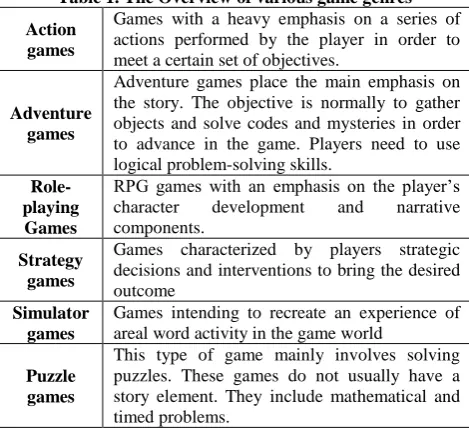
[image:1.595.49.284.556.773.2]Video games are often classified into genres, which purport to define games in terms of having a common style or set of properties or characteristics, like defined in terms of perspective, gameplay, interaction, objectives. The typical genres include: Strategy, Action, FPS, Role-Playing (RPG), Fighting, Racing, Sports, Simulation, Family, Child, and Adventure [1, 2].Table 1 shows a simplified overview of the six best known game genres.
Table 1. The Overview of various game genres
Action games
Games with a heavy emphasis on a series of actions performed by the player in order to meet a certain set of objectives.
Adventure games
Adventure games place the main emphasis on the story. The objective is normally to gather objects and solve codes and mysteries in order to advance in the game. Players need to use logical problem-solving skills.
Role-playing
Games
RPG games with an emphasis on the player’s character development and narrative components.
Strategy games
Games characterized by players strategic decisions and interventions to bring the desired outcome
Simulator games
Games intending to recreate an experience of areal word activity in the game world
Puzzle
This type of game mainly involves solving puzzles. These games do not usually have a
However, current descriptors of video game genres are none standardized, undefined and embedded with multiple information [3]. Therefore, these problems can influence the outcome of the video games development process, and cause difficulties in choosing the right game genre that will meet the need envisaged by video game creators.
In this paper we will present the application of analytic hierarchical process “AHP” for video game genre selection via a web application, the selection will be done dynamically according to the parameters passed by the users, and AHP method will be fed by the values of statistical study about serious games done by our research team. An evaluation of how the chosen method proved successful along with an outlook on future research concludes this paper.
2.
LITERATURE RIVIEW
3.
STATISTICAL STUDY OF VIDEO
GAME GENRES
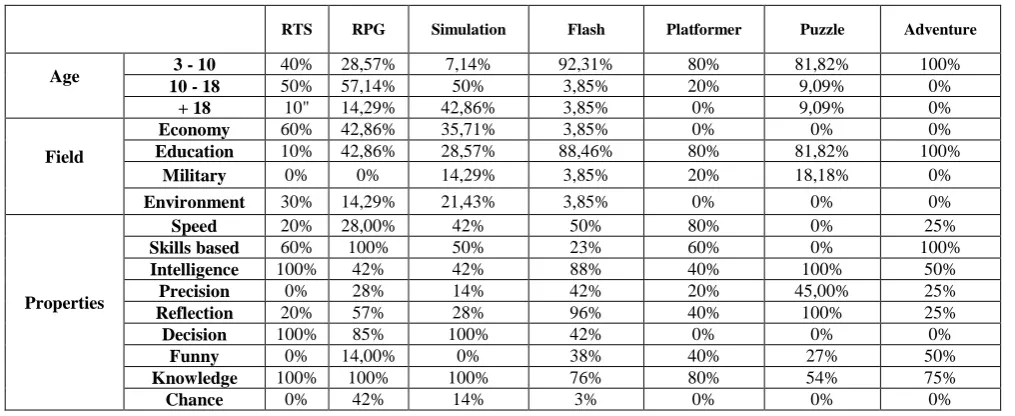
In order to feed the system of multi-criteria decision making based on AHP method, we have decided to do a statistical study [14] concerning different online serious games since their genre, we have filtered the results according to three main criteria "age, field and properties" and for each main criterion there are sub criteria, for the age there are three intervals "3-10, 10 -18 and + 18", for the field there are also four sub criterion "education, economy, health care and environment," and for the properties there are nine sub criteria which refer to properties related to video games "Speed, Skills based, Intelligence, Precision, Reflection, Decision, Funny, Knowledge and Chance", Table 2 contains all percentages according to the genre and criteria mentioned above. These percentages will be used by the AHP method, to make decisions in order to select the game genre according to the parameters given by the users. The decision will help both game designers and game developers to select the best choice that meets the result that responds to the need.
4.
APPLICATION OF AHP FOR GAME
GENRE SELECTION
Problem of game genre selection has been dealt with using a statistical study detailed above; the study has concerned several online serious games to extract criteria that will be used by the AHP method to classify game genres according to the parameters chosen by the users.
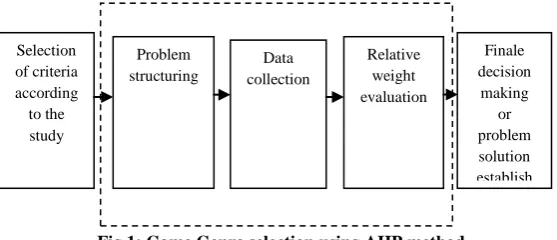
[image:2.595.315.549.162.377.2]In this work, the AHP method is used to select the most suitable video game genre according to the parameters given by the users. In general, the AHP method consists of four main phases, including problem structuring, data collection, relative weight evaluation and problem solution establishment. The Fig 1 below explains the process flowed to do the game genre selection by using the AHP method.
Fig 1: Game Genre selection using AHP method
4.1
Problem
structuring
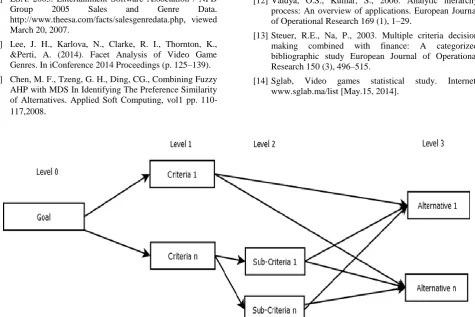
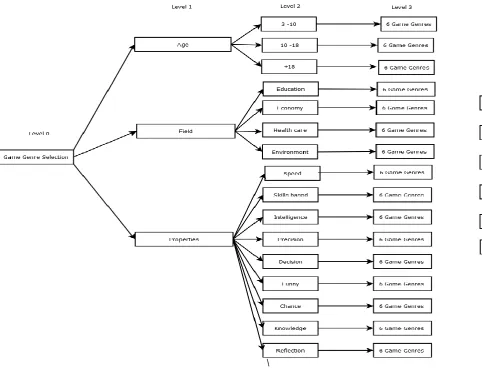
The problem structuring consists of decomposing a certain complex problem of decision making into a series of hierarchies where each level represents a smaller number of managed attributes. Among the rules to construct a good hierarchical structure for decision making, there are the clear definition of the decision problem and the determination of the main goal, the structure of the hierarchy from the top through the intermediate levels to the lowest levels. In Fig 2 the goal of the problem is located at level 0. Level 1 houses the major criteria and the level2 contains all the sub-criteria. Finally, the alternatives are located at the last level of the hierarchy. The game genre selection criteria and the alternatives detail in Fig 2.
4.2
Data collection
The second phase in AHP process consists of collecting data and its calculation. The decision maker assigns relative weight to pairs of attributes of a single hierarchy level, for all levels of the hierarchy, by using the most common scale of nine levels Table 3.
Table 3. The fundamental scale for pair-wise comparison
Intensity of importance
Definition Explanation
1 Equal
importance
Two elements contribute equal to the objective
3 Moderate
importance
Experience and judgment moderately favor one element over another
5 Strong
importance
Experience and judgment strongly favor one element over another 7 Very Strong
importance
One element is favored very strongly over another its dominance is demonstrated in practice
9 Extreme
importance
The evidence favoring one element over another of the highest possible order of affirmation Intensities of 2, 4, 6 and 8 can be used to express
intermediate values.
The set of criteria is, composed of n elements C= {C1, ., Cn }. The result of the evaluation matrix in which every element ai,j
(I,j = 1,2…..,n) is the quotient of the weights of the criteria.
A=
=a11 = 1, aij = 1/aji , aij ≠ 0. (1)
4.3
Relative weight evaluation
In this phase of AHP method the pair-wise matrix, by pairs, transfers into problems of own value determination in order to get the normalized and a single eigenvector, as well as the weight of all attribute on each hierarchy level.
4.3.1
Problem resolution
The problem resolution is the final phase of the AHP method and it involves the establishment of the so-called composite normalized vector. The determination of alternatives importance in the model comes next, within each criterion. The final step consists of synthesizing the total problem by carried out in the following way: the weight of each criterion is multiplied by the weight of the reviewed criterion, and these values are the summarized for each alternative separately. The result is the weight of the reviewed alternative within the model. The weight of the rest of the alternatives is calculated in the same way; finally, the final ranking of alternatives is determined.
4.3.2
Consistency verification
Saaty [1] recommended that the maximum eigenvalue, max
can be determined as:
max =
[image:2.595.26.305.461.581.2]Where max is the maximum eigenvalue of positive real values
in judgment matrix, wj is the weight of the jth factor, and wi is
the weight of ith factor.
Eigenvector X can be determined as: (3)
Saaty [1] recommended using consistency index (CI) and consistency ratio (CR) to check for the consistency associated with the comparison matrix.
Saaty [1] demonstrated that for a consistent reciprocal matrix, the largest eigenvalue is equal to the number of comparisons, or λmax = n. Then he gave a measure of consistency, called the
consistency Index as a deviation or a degree of consistency using the following formula by using (3):
(4)
Knowing the Consistency Index, we can calculate the consistency ratio (CR) by using (3):
(5)
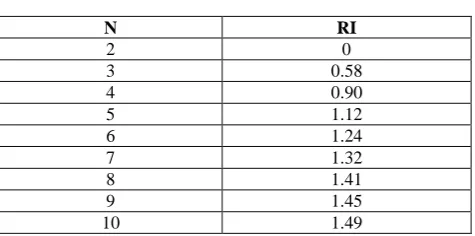
[image:3.595.310.548.172.218.2]Where RI represents average consistency index over a number of random entries of some order reciprocal matrices presented in Table 4.
Table 4.The Reference Values of RI Different Numbers
N RI
2 0
3 0.58
4 0.90
5 1.12
6 1.24
7 1.32
8 1.41
9 1.45
10 1.49
The ratio of coherence can be interpreted as the probability that random matrix is full. The overall coherence of appreciation is assessed using the consistency ratio (RC). According to Saaty[1], if the value of Consistency Ratio is smaller or equal to 10%, the inconsistency is acceptable. Alternatively, if the Consistency Ratio is greater than 10%, the subjective judgment should be revised.
4.4
Application
According to the theoretical part of this section we have implemented the hierarchical structure dedicated to game genre selection it’s composed of four levels; Level contains the main goal or objective “selection of game genre”. Level 1 there are three criteria “age, filed and properties”, level 2 there are three sets of sub-criteria related for each criterion of level 1, in our case there are three sub-criteria related to age criterion, four sub-criteria related to field criterion and nine sub-criteria “Speed, Skills based, Intelligence, Precision, Reflection, Decision, Funny, Knowledge and Chance” related to properties, for the alternatives there are seven elements “RPG, RTS, Simulation,
structure Fig 3. After implementation of hierarchical structure we can calculate the pair-wise comparison matrix for all levels existing in hierarchical structure.
4.4.1
Pair-wise comparison of level 1
The Matrix of Pair-wise comparison of level 1 that concerns the three criteria “Age, Field, and Properties” is detailed in Table 5.
Table 5.First level attributes comparison
Goal Age Field Properties Weight
Age 1 3 1/4 0.23
Field 1/3 1 1/5 0.10
Properties 4 5 1 0.66
As can be seen from the table, we have given preference value to each criterion. The preference values (1/3) of field criterion to age criterion means that the age criterion is moderately important then field criterion. Correspondingly the Properties criterion is strongly important than field and the properties criterion is also moderately important then the age criterion.
λmax =3.08 ; CI= 0.04 ; CR = 0.04< 0.1
4.4.2
Pair-wise comparison of sub level related to
Age
[image:3.595.49.287.385.503.2]For the sub criteria related to age there are three ranges of age "3- 10, 10 – 18, +18 ", we decided to give all the elements the same value of priority "Equal importance", the pair-wise comparison matrix of sub level related to age is detailed in Table 6. For the calculation of global priorities it depends on the range of age given by the user.
Table 6: Sub level age attributes comparison
C1 C2 C3 weight
3 – 10(C1) 1 1 1 0.33
10 -18(C2) 1 1 1 0.33
+ 18 (C3) 1 1 1 0.33
λmax = 3.0; CI = 0.0; CR = 0.0 < 0.1
4.4.3
Pair-wise comparison of sub level related to
Filed
[image:3.595.309.548.444.511.2]For the sub criteria related to field there are four fields "Education, Health care, Economy and Environment" we decided to give all the elements the same value of priority "Equal importance", the pair-wise comparison matrix of sub level related to the field is detailed in Table 7. For the calculation of global priorities its depend to the field chosen by the user.
Table 7: Sub level field attributes comparison
C1 C2 C3 Weight
Education(C1) 1 1 1 0.25
Health care (C2) 1 1 1 0.25
Economy (C3) 1 1 1 0.25
Environment (C4) 1 1 1 0.25
[image:3.595.310.549.643.704.2]4.4.4
Pair-wise comparison of sub level related to
Priorities
[image:4.595.308.538.101.332.2]For the sub criteria related to properties there are nine properties "Speed, Skills based, Intelligence, Precision, Reflection, Decision, Funny, Knowledge and Chance", we decided to give all the elements the same value of priority "Equal importance", the pair-wise comparison matrix of sub level related to properties is detailed in Table 8. For the calculation of global priorities it depends to the number of proprieties chosen by the user.
Table 8: A Sub level property attributes comparison
Local weight
Speed 0.111
Skills based 0.111
Intelligence 0.111
Precision 0.111
Reflection 0.111
Decision 0.111
Funny 0.111
Knowledge 0.111
Chance 0.111
λmax = 9.0; CI = 0.0; CR = 0.0 < 0.1
4.4.5
Pair-wise comparison of alternatives
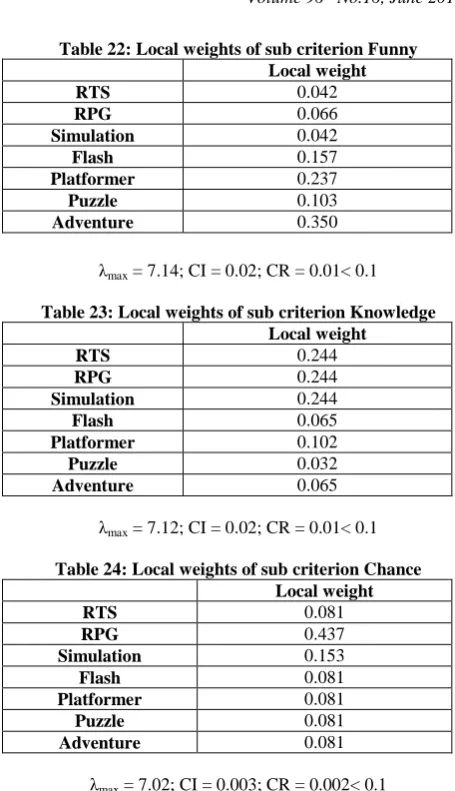
[image:4.595.49.289.208.328.2]For the proposed hierarchical structure there are seven genres "RPG, RTS, Simulation, Platformer, Adventure, Puzzle and Flash", the Pair-wise comparison has to be calculated by the local and global weight for each sub criterion connected to each game genre the tables from 9 to 24.
Table 9: Local weights of sub criterion [3 – 10] years Local weight
RTS 0.054
RPG 0.030
Simulation 0.019
Flash 0.257
Platformer 0.214
Puzzle 0.214
Adventure 0.209
[image:4.595.48.280.420.772.2]λmax = 7.86; CI = 0.14; CR = 0.1<= 0.1
Table 10: Local weights of sub criterion [10 – 18] years Local weight
RTS 0.261
RPG 0.261
Simulation 0.261
Flash 0.040
Platformer 0.092
Puzzle 0.040
Adventure 0.040
λmax = 7.11; CI = 0.01; CR = 0.01< 0.1
Table 11: Local weights of sub criterion [+18] years Local weight
RTS 0.139
RPG 0.139
Simulation 0.424
Flash 0.074
Platformer 0.074
Puzzle 0.074
Adventure 0.074
λmax = 7.03;CI = 0.006; CR = 0.004< 0.1
Table 12: Local weights of sub criterion Education Local weight
RTS 0.022
RPG 0.054
Simulation 0.029
Flash 0.174
Platformer 0.174
Puzzle 0.174
Adventure 0.371
λmax = 7.31; CI = 0.05; CR = 0.03< 0.1
Table 13: Local weights of sub criterion Health care Local weight
RTS 0.088
RPG 0.100
Simulation 0.170
Flash 0.088
Platformer 0.290
Puzzle 0.170
Adventure 0.088
λmax = 7.14; CI = 0.02; CR = 0.01< 0.1
Table 14: Local weights of sub criterion Economy Local weight
RTS 0.419
RPG 0.227
Simulation 0.162
Flash 0.047
Platformer 0.047
Puzzle 0.047
Adventure 0.047
λmax = 7.11; CI = 0.01; CR = 0.01< 0.1
Table 15: Local weights of sub criterion Environment Local weight
RTS 0.339
RPG 0.137
Simulation 0.222
Flash 0.075
Platformer 0.075
Puzzle 0.075
Adventure 0.339
λmax = 7.02; CI = 0.004; CR = 0.003< 0.1
Table 16: Local weights of sub criterion Speed Local weight
RTS 0.060
RPG 0.060
Simulation 0.140
Flash 0.191
Platformer 0.457
Puzzle 0.027
Adventure 0.062
[image:4.595.49.282.427.532.2]Table 17: Local weights of sub criterion properties Skills based
Local weight
RTS 0.104
RPG 0.328
Simulation 0.074
Flash 0.033
Platformer 0.104
Puzzle 0.020
Adventure 0.332
[image:5.595.309.537.53.449.2]λmax = 7.52; CI = 0.08; CR = 0.06< 0.1
Table 18: Local weights of sub criterion Intelligence Local weight
RTS 0.293
RPG 0.043
Simulation 0.043
Flash 0.177
Platformer 0.043
Puzzle 0.332
Adventure 0.067
[image:5.595.46.280.74.184.2]λmax = 7.21; CI = 0.03; CR = 0.02< 0.1
Table 19: Local weights of sub criterion Reflection Local weight
RTS 0.042
RPG 0.108
Simulation 0.064
Flash 0.283
Platformer 0.108
Puzzle 0.283
Adventure 0.108
λmax = 7.06; CI = 0.01; CR = 0.007< 0.1
Table 20: Local weights of sub criterion Precision Local weight
RTS 0.033
RPG 0.110
Simulation 0.034
Flash 0.302
Platformer 0.077
Puzzle 0.409
Adventure 0.032
[image:5.595.50.275.76.337.2]λmax = 7.25; CI = 0.04; CR = 0.02< 0.1
Table 21: Local weights of sub criterion Decision Local weight
RTS 0.317
RPG 0.197
Simulation 0.317
Flash 0.086
Platformer 0.026
Puzzle 0.026
Adventure 0.026
λmax = 7.47; CI = 0.07; CR = 0.05< 0.1
Table 22: Local weights of sub criterion Funny Local weight
RTS 0.042
RPG 0.066
Simulation 0.042
Flash 0.157
Platformer 0.237
Puzzle 0.103
Adventure 0.350
λmax = 7.14; CI = 0.02; CR = 0.01< 0.1
Table 23: Local weights of sub criterion Knowledge Local weight
RTS 0.244
RPG 0.244
Simulation 0.244
Flash 0.065
Platformer 0.102
Puzzle 0.032
Adventure 0.065
λmax = 7.12; CI = 0.02; CR = 0.01< 0.1
Table 24: Local weights of sub criterion Chance Local weight
RTS 0.081
RPG 0.437
Simulation 0.153
Flash 0.081
Platformer 0.081
Puzzle 0.081
Adventure 0.081
λmax = 7.02; CI = 0.003; CR = 0.002< 0.1
For the global weights related to each alternative are calculated dynamically according to the parameters given by the users via the web application.
5.
RESULTS
As said before the users will use a web application that implements the AHP algorithm, and according to the parameters given by them the application will rank the game genres by summing the global weight of each criterion. For example if the user chooses these parameters “age = 15 that belong to the interval (10 – 18), filed = Education and the properties checked is knowledge, Decision and Intelligence” see Fig 4.
Table 24: Total weighted score of games genres
C1 C2 C3 C4 C5 C6 C7
[10 -18] 0.060 0.060 0.060 0.009 0.021 0.09 0.09
Education 0.002 0.006 0.003 0.018 0.018 0.018 0.038
knowledge 0.162 0.162 0.162 0.043 0.068 0.021 0.043
Decision 0.211 0.131 0.211 0.057 0.017 0.017 0.017
Intelligence 0.195 0.029 0.028 0.118 0.029 0.221 0.045
Total score 0.63 0.39 0.47 0.25 0.15 0.29 0.15
[image:5.595.311.536.80.263.2]pair-wise comparison were made via informed judgments and were consistent, and mathematical calculations were completed and validated thought the algorithm implemented on the web application.
6.
CONCLUSION AND PERSPECTIVES
This paper identifies the application of the AHP approach that helps game designers, game developers and other users to rank the game genres according to the parameters given by them. The role of game genre selection has become more than ever imperative for game designers to create their own video games. Among the perspectives considered there is the development of a game generator that will be oriented by the web application based on AHP approach, the game generator will be dedicated to the non-experts “Instructors and Trainers” that allows the generation of different serious games without the interaction of game programmers or artistic team.
7.
ACKNOWLEDGMENTS
We gratefully acknowledge the support of the students and all other participants.
8.
REFERENCES
[1] Fullerton, T., Swain, C., and Hoffman, S. 2004. Game Design Workshop: Designing, Prototyping, and Play testing Games. CMP Boocks, February.
[2] ESA. 2005. Entertainment Software Association / NPD Group 2005 Sales and Genre Data. http://www.theesa.com/facts/salesgenredata.php, viewed March 20, 2007.
[3] Lee, J. H., Karlova, N., Clarke, R. I., Thornton, K., &Perti, A. (2014). Facet Analysis of Video Game Genres. In iConference 2014 Proceedings (p. 125–139). [4] Chen, M. F., Tzeng, G. H., Ding, CG., Combining Fuzzy
AHP with MDS In Identifying The Preference Similarity of Alternatives. Applied Soft Computing, vol1 pp. 110-117,2008.
[5] Nijkamp, P., Rietveld, P., Voogd, H., 1990. Multi-criteria Evaluation in Physical Planning. North-Holland, Amsterdam.
[6] Howard, A.F., 1991. A critical look at multiple criteria decision-making techniques with reference to forestry applications. Canadian Journal of Forest Research 21, 1649–1659.
[7] Keeney, R.L., 1992. Value-Focused Thinking: A Path to Creative Decision Analysis. Harvard University Press, Cambridge.
[8] Hajkowicz, S.A., Prato, T., 1998. Multiple objective decision analysis of farming systems in Goodwater Creek Watershed, Missouri. Research Report No. 24, Centre for Agriculture, Resources and Environmental Systems, Columbia, Missouri.
[9] Massam, B.H., 1988. Multi-criteria decision-making techniques in planning. Progress in Planning 30, 1–84. [10] Saaty, T.L. The Analytic Hierarchy Process. New York,
New York: McGraw-Hill International, 1980.
[11] Schmoldt, Daniel L., et al. The Analytic Heirarchy Process in Natural Resource and Environmental Decision Making. Dordrecht, the Netherlands: Kluwer Academic Publishers, p 15, 2001.
[12] Vaidya, O.S., Kumar, S., 2006. Analytic hierarchy process: An overview of applications. European Journal of Operational Research 169 (1), 1–29.
[13] Steuer, R.E., Na, P., 2003. Multiple criteria decision making combined with finance: A categorized bibliographic study European Journal of Operational Research 150 (3), 496–515.
[image:6.595.62.538.349.666.2][14] Sglab, Video games statistical study. Internet: www.sglab.ma/list [May.15, 2014].
\
[image:7.595.51.557.468.731.2]Fig 3: The AHP hierarchy for game genre selection
Table 2. Statistical study on serious games according to the genre
RTS RPG Simulation Flash Platformer Puzzle Adventure
Age 3 - 10 40% 28,57% 7,14% 92,31% 80% 81,82% 100%
10 - 18 50% 57,14% 50% 3,85% 20% 9,09% 0%
+ 18 10" 14,29% 42,86% 3,85% 0% 9,09% 0%
Field
Economy 60% 42,86% 35,71% 3,85% 0% 0% 0%
Education 10% 42,86% 28,57% 88,46% 80% 81,82% 100%
Military 0% 0% 14,29% 3,85% 20% 18,18% 0%
Environment 30% 14,29% 21,43% 3,85% 0% 0% 0%
Properties
Speed 20% 28,00% 42% 50% 80% 0% 25%
Skills based 60% 100% 50% 23% 60% 0% 100%
Intelligence 100% 42% 42% 88% 40% 100% 50%
Precision 0% 28% 14% 42% 20% 45,00% 25%
Reflection 20% 57% 28% 96% 40% 100% 25%
Decision 100% 85% 100% 42% 0% 0% 0%
Funny 0% 14,00% 0% 38% 40% 27% 50%
Knowledge 100% 100% 100% 76% 80% 54% 75%